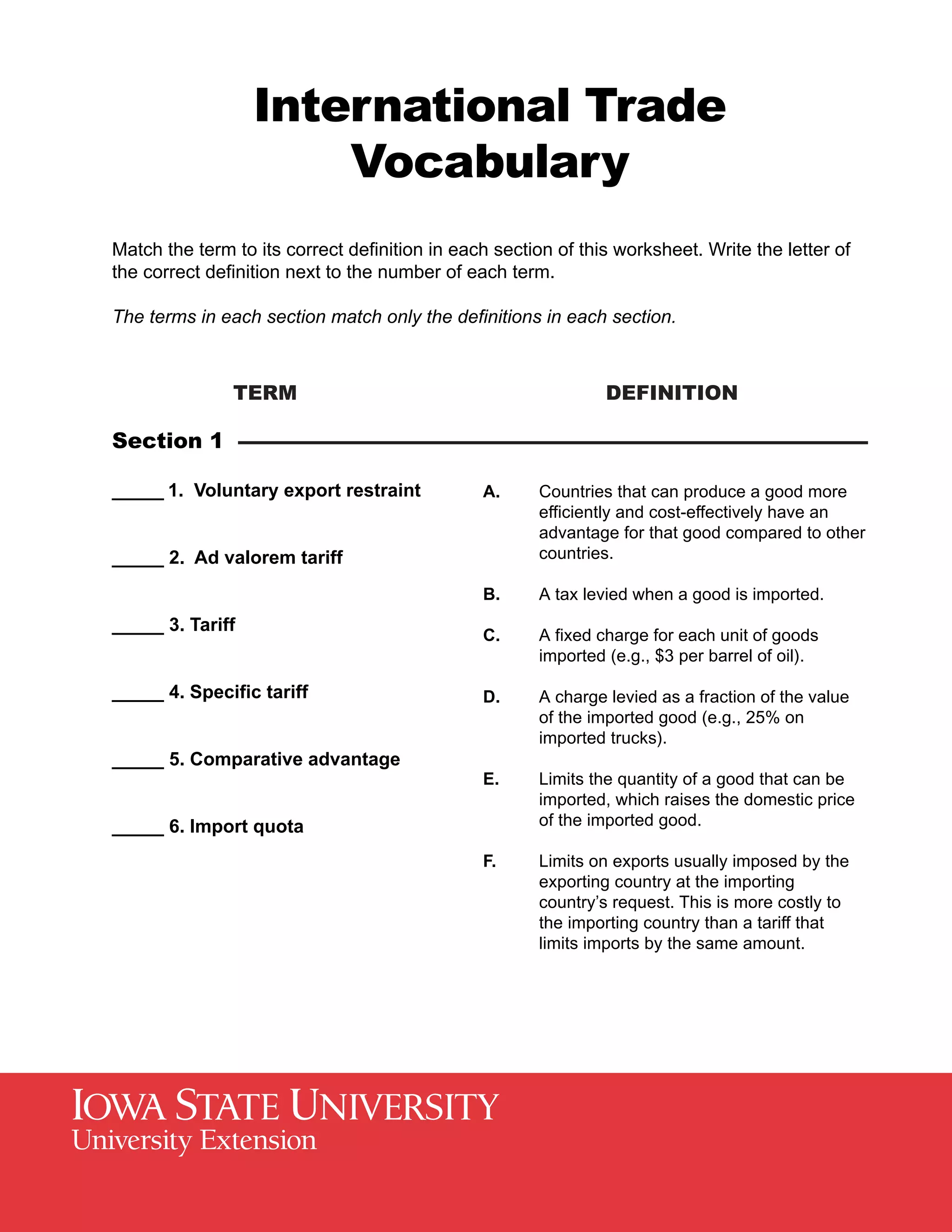
International Trade
Vocabulary
Match the term to its correct definition in each section of this worksheet. Write the letter of
the correct definition next to the number of each term.
The terms in each section match only the definitions in each section.
_____ 1. Voluntary export restraint
_____ 2. Ad valorem tariff
_____ 3. Tariff
_____ 4. Specific tariff
_____ 5. Comparative advantage
_____ 6. Import quota
A. Countries that can produce a good more
efficiently and cost-effectively have an
advantage for that good compared to other
countries.
B. A tax levied when a good is imported.
C. A fixed charge for each unit of goods
imported (e.g., $3 per barrel of oil).
D. A charge levied as a fraction of the value
of the imported good (e.g., 25% on
imported trucks).
E. Limits the quantity of a good that can be
imported, which raises the domestic price
of the imported good.
F. Limits on exports usually imposed by the
exporting country at the importing
country’s request. This is more costly to
the importing country than a tariff that
limits imports by the same amount.
TERM DEFINITION
Section 1
_____ 14. World Trade
Organization (WTO)
_____ 15. General Agreement
on Tariffs and Trade
(GATT)
_____ 16. European Union (EU)
_____ 17. North American Free
Trade Agreement
(NAFTA)
Section 3
N. An agreement established in 1947, and last ratified
in 1994, between 23 countries on a set of rules for
trade between them.
O. An organization established in 1995 to promote
fair trade among its members. It uses a system of
trading rules to resolve trading disputes. When a
country has been found to be in violation, most
often the offending country changes its trade policy
to come into conformance.
P. An agreement established in 1993 between
Canada, the United States, and Mexico on a set of
rules for trade between them.
Q. An organization of 15 European countries that
have agreed to remove all tariffs with respect to
each other and form one export subsidy program
known as the Common Agricultural Policy.
Section 2
_____ 7. National procurement
_____ 8. Export subsidy
_____ 9. Currency appreciation
_____ 10. Currency depreciation
_____ 11. Exchange rate
_____ 12. Export credit subsidy
_____ 13. Red-tape barriers
G. Payment to a firm or individual that ships a
goodabroad.Thissubsidycaneitherbefixedorad
valorem.
H. Similar to an export subsidy except that it takes
the form of a subsidized loan to the buyer.
I. Purchases by the government, or strongly
regulated firms, directed toward domestically
produced goods even when these goods are more
expensive than imports.
J. Restricting imports through normal health, safety,
and custom procedures so as to place substantial
obstacles in the way of trade.
K. The price of one currency in the terms of another.
L. Happens when a lower amount of another
currency is able to exchange for one unit of a
domestic currency. A drop of exchange rates of
0.8 pounds per dollar to 0.6 pounds per dollar is a
drop in the value of the dollar.
M. When a higher amount of another currency is able
to exchange for another unit of domestic currency.
An increase in exchange rates of 0.6 pound per
dollar to 0.8 pounds per dollar is an increase in the
value of the dollar.
(7/8/03)

International trade vocabulary matching

  • 1.
    International Trade Vocabulary Match theterm to its correct definition in each section of this worksheet. Write the letter of the correct definition next to the number of each term. The terms in each section match only the definitions in each section. _____ 1. Voluntary export restraint _____ 2. Ad valorem tariff _____ 3. Tariff _____ 4. Specific tariff _____ 5. Comparative advantage _____ 6. Import quota A. Countries that can produce a good more efficiently and cost-effectively have an advantage for that good compared to other countries. B. A tax levied when a good is imported. C. A fixed charge for each unit of goods imported (e.g., $3 per barrel of oil). D. A charge levied as a fraction of the value of the imported good (e.g., 25% on imported trucks). E. Limits the quantity of a good that can be imported, which raises the domestic price of the imported good. F. Limits on exports usually imposed by the exporting country at the importing country’s request. This is more costly to the importing country than a tariff that limits imports by the same amount. TERM DEFINITION Section 1
  • 2.
    _____ 14. WorldTrade Organization (WTO) _____ 15. General Agreement on Tariffs and Trade (GATT) _____ 16. European Union (EU) _____ 17. North American Free Trade Agreement (NAFTA) Section 3 N. An agreement established in 1947, and last ratified in 1994, between 23 countries on a set of rules for trade between them. O. An organization established in 1995 to promote fair trade among its members. It uses a system of trading rules to resolve trading disputes. When a country has been found to be in violation, most often the offending country changes its trade policy to come into conformance. P. An agreement established in 1993 between Canada, the United States, and Mexico on a set of rules for trade between them. Q. An organization of 15 European countries that have agreed to remove all tariffs with respect to each other and form one export subsidy program known as the Common Agricultural Policy. Section 2 _____ 7. National procurement _____ 8. Export subsidy _____ 9. Currency appreciation _____ 10. Currency depreciation _____ 11. Exchange rate _____ 12. Export credit subsidy _____ 13. Red-tape barriers G. Payment to a firm or individual that ships a goodabroad.Thissubsidycaneitherbefixedorad valorem. H. Similar to an export subsidy except that it takes the form of a subsidized loan to the buyer. I. Purchases by the government, or strongly regulated firms, directed toward domestically produced goods even when these goods are more expensive than imports. J. Restricting imports through normal health, safety, and custom procedures so as to place substantial obstacles in the way of trade. K. The price of one currency in the terms of another. L. Happens when a lower amount of another currency is able to exchange for one unit of a domestic currency. A drop of exchange rates of 0.8 pounds per dollar to 0.6 pounds per dollar is a drop in the value of the dollar. M. When a higher amount of another currency is able to exchange for another unit of domestic currency. An increase in exchange rates of 0.6 pound per dollar to 0.8 pounds per dollar is an increase in the value of the dollar. (7/8/03)