WTO Agreement on Subsidies and
Countervailing Measures
(Subsidy Rules and WTO Jurisprudence)
Shailja Singh
Assistant Professor
Centre for WTO Studies
IIFT
1
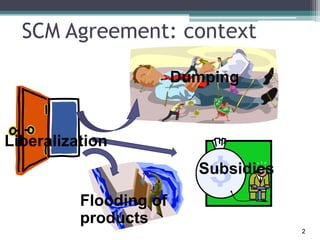
SCM Agreement: context
Liberalization
Dumping
Subsidies
Flooding of
products
2
Subsides…
• Very sensitive matter in international trade relations
▫ On one hand, subsidies evidently used by governments
to pursue legitimate objective of economic and social
policy.
▫ On the other hand, subsidies may have adverse effects
on the interests of trading partners, whose industries
may suffer from unfair competition
• Subsidies: can distort trade flows if they give an artificial
competitive advantage to exporters or import competing
industries.
• Example of subsidies: aid to the poor, aid for
technological development, special aids for education,
aid to disadvantaged groups and regions etc.
3
4
COVERAGE OF THE SCM AGREEMENT
The SCM Agreement regulates:
▫ Subsidisation by WTO Members
▫ Use of countervailing measures
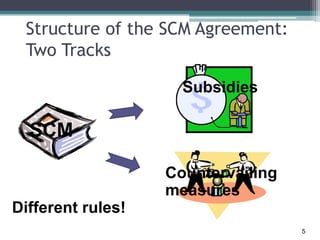
Structure of the SCM Agreement:
Two Tracks
Subsidies
SCM
Countervailing
measures
Different rules!
5
SCM Agreement: Subsidies
• Traffic light approach
• Subsidies are put into various
baskets/categories:
i. Red (“prohibited”)
ii. Yellow or amber (“actionable”)
iii. Green (“non-actionable”)
6
Broad Scheme of SCM Agreement
• Uruguay Round Subsidies Text is extensive and
detailed
▫ Part I – General Provisions (definition and
specificity)
▫ Part II – Prohibited subsidies (red light)
▫ Part III – Actionable subsidies (yellow or amber
light)
▫ Part IV – Non-Actionable subsidies (green light)
▫ Part V – Countervailing duty measures
7
Subsidy Defined
• Three key elements when examining
whether a programme, scheme, etc.
constitutes a subsidy are:
i. Financial contribution / income or price
support
ii. By a Government or any public body
iii. Which confers benefit
• If any of the three elements is missing, then
the programme, scheme, etc. is NOT a
subsidy under SCM Agreement.
8
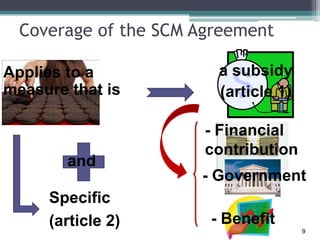
Coverage of the SCM Agreement
Applies to a
measure that is
Specific
(article 2)
a subsidy
(article 1)
and
- Financial
contribution
- Government
- Benefit
9
10
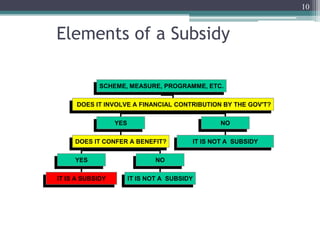
Elements of a Subsidy
SCHEME, MEASURE, PROGRAMME, ETC.
DOES IT INVOLVE A FINANCIAL CONTRIBUTION BY THE GOV'T?
YES NO
DOES IT CONFER A BENEFIT?
YES NO
IT IS A SUBSIDY IT IS NOT A SUBSIDY
IT IS NOT A SUBSIDY
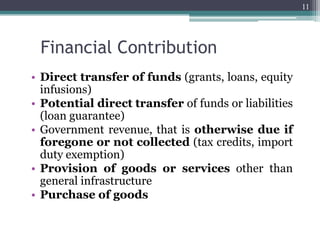
Financial Contribution
• Direct transfer of funds (grants, loans, equity
infusions)
• Potential direct transfer of funds or liabilities
(loan guarantee)
• Government revenue, that is otherwise due if
foregone or not collected (tax credits, import
duty exemption)
• Provision of goods or services other than
general infrastructure
• Purchase of goods
11
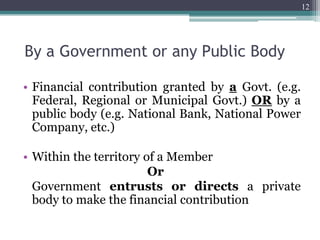
By a Government or any Public Body
• Financial contribution granted by a Govt. (e.g.
Federal, Regional or Municipal Govt.) OR by a
public body (e.g. National Bank, National Power
Company, etc.)
• Within the territory of a Member
Or
Government entrusts or directs a private
body to make the financial contribution
12
Concept of Benefit
• Benefit = advantage (to recipient), not cost
to Govt:
▫ “Whether the financial contribution places the
recipient in a more advantageous position than
would have been the case, but for the financial
contribution”
• Basis for comparison = Market place:
▫ Is the financial contribution “provided on
terms which are more advantageous than those
that would have been available to the recipient
on the market”
13
Concept of Benefit (Contd.)
• Govt. equity infusions do not confer a benefit
unless: “the investment decision can be regarded
as inconsistent with the usual investment
practice (including …risk capital) of private
investors in the territory of that Member”
• Govt. loans do not confer a benefit unless:
“there is a difference between the amount that
the firm receiving the loan pays on the Govt. loan
and the amount the firm would pay on a
comparable commercial loan which the firm
could actually obtain on the market.”
14
Concept of Benefit (Contd.)
• Govt. loan guarantees do not confer a benefit
unless: “there is a difference between the
amount the firm receiving the guarantee pays on
a loan guaranteed by the Govt. and the amount
the firm would pay on comparable commercial
loan absent the Govt. guarantee.
• Govt. provision of goods or services does
not confer a benefit unless for less than adequate
remuneration based on prevailing market
conditions
15
Concept of Benefit (Contd.)
• Govt. purchase of goods does not confer a
benefit unless: for more than adequate
remuneration based on prevailing market
conditions.
16
Footnote 1 – Important Exemption
• Exemption of an exported product
• From duties or taxes borne by a like product
destined for domestic consumption
• Not deemed a subsidy
17
Types of Specificity
• Enterprise specific
• Industry specific
• Group of enterprises or industries
• Region specific
• Prohibited subsidies are deemed to be
specific
• Setting or change of generally applicable tax
rates by all levels of govts. entitled to do so
are not specific subsidy
18
Types of Specificity (Contd.)
• Specificity will not exist where granting
authority or legislation concerned establishes
objective criteria or conditions for extending
the subsidy- these criteria should be neutral,
economic in nature and horizontal in
application
• Two broad categories:
i. De-jure specific subsidies
ii. De-facto specific subsidies
19
Specific Subsidies – de-jure
• A subsidy is de-jure specific if
Access to the subsidy explicitly limited to certain
enterprises. If access is limited based on objective
criteria then it would not be a specific subsidy
• To be determined with reference to the
jurisdiction of the granting authority
20
De-facto Specificity (Art. 2.1(c))
• Notwithstanding any appearance of non-
specificity, the subsidy may in fact be
specific. Following factors may be
considered:
Use by a limited number of enterprises
Predominant use by certain enterprises
Granting of disproportionately large amounts to
certain enterprises
Manner in which discretion has been exercised
21
Specificity : Implications
• For Members as providers of subsidies:
▫ Specific subsidies are subject to the rules/disciplines under Article
4 and 7 of the SCM Agreement, in case of prohibited and
actionable subsidies, respectively (under the MULTILATERAL
TRACK); and can be countervailed (Part V) (under the
NATIONAL TRACK)
▫ Must notify specific subsidies to the SCM Committee
• For Members affected by others’ subsidies:
▫ Can challenge (MULTILATERAL TRACK) or countervail
(NATIONAL TRACK) other Members’ specific subsidies
22
Subsidies – Categorization: Recap
i. Prohibited Subsidy
ii. Actionable Subsidy
iii. Non-actionable Subsidy
23
Subsidy Types: Prohibited Subsidy
• Certain subsidies are regarded as outright trade
distortive – hence prohibited
• These are:
i. Export subsidies – subsidies that are
contingent on export performance , except as
provided in the Agreement on Agriculture
ii. Import substitution subsidies – contingent
on use of domestic over imported goods
24
Export Subsidy
• Subsidies contingent, in law or in fact, whether wholly or
as one of several other conditions, upon export
performance are called export subsidies
• Examples (set out in Annex-I):
▫ provision of goods or services for use in the production of
exported goods in terms more favorable than those for the
production of goods for domestic consumption;
▫ export related exemption, remission or deferral of direct
taxes; excess exemption, remission, or deferral of indirect
taxes or import duties;
▫ provision of export credit guarantee or insurance
programmes at premium rates which are inadequate to cover
the operating costs and losses of the programmes
25
Export Subsidy: Permissible Duty
Exemptions
• Exemption or remission of indirect taxes on export products-
Footnote 1
• Remission, Exemption & Deferral (RED) of prior stage cumulative
indirect taxes on inputs used in production of the exported product
provided this does not exceed corresponding RED on inputs used in
the production of domestically sold like products – item (h), Annex I
• RED on prior stage cumulative indirect taxes on inputs consumed in
production of the exported product. To be interpreted in accordance
with guidelines in Annex II – item (h), Annex I
• Remission or drawback of import charges on imported inputs
consumed in the production of the exported product. Substitution
drawback schemes are permitted in accordance with guidelines in
Annex III – item (h), Annex I
26
Conditions for RED of Cumulative
Indirect Taxes
• Inputs must have been consumed in the
production process
Physically incorporated inputs
Energy, fuel, oil and catalysts
• There must be a reasonable and effective
verification system in place to confirm which
inputs are consumed and in what amounts.
27
Remedy against Prohibited Subsidy
• Remedy through DSU
• It can be challenged in WTO on the basis of
special accelerated procedures
• Complaining Member not obliged to show trade
effects as these are regarded as trade distorting
subsidies
• Defaulting member required to withdraw the
subsidy without delay or face counter -
measures
28
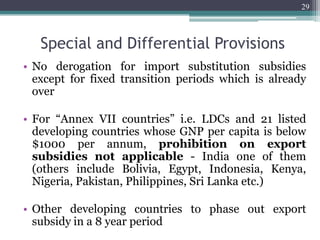
Special and Differential Provisions
• No derogation for import substitution subsidies
except for fixed transition periods which is already
over
• For “Annex VII countries” i.e. LDCs and 21 listed
developing countries whose GNP per capita is below
$1000 per annum, prohibition on export
subsidies not applicable - India one of them
(others include Bolivia, Egypt, Indonesia, Kenya,
Nigeria, Pakistan, Philippines, Sri Lanka etc.)
• Other developing countries to phase out export
subsidy in a 8 year period
29
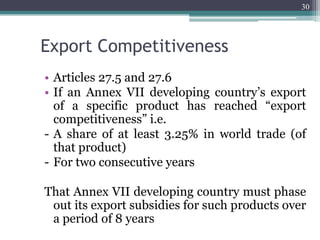
Export Competitiveness
• Articles 27.5 and 27.6
• If an Annex VII developing country’s export
of a specific product has reached “export
competitiveness” i.e.
- A share of at least 3.25% in world trade (of
that product)
- For two consecutive years
That Annex VII developing country must phase
out its export subsidies for such products over
a period of 8 years
30
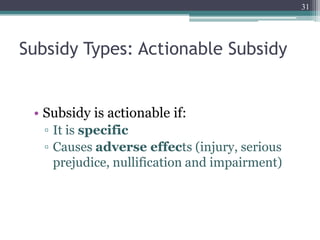
Subsidy Types: Actionable Subsidy
• Subsidy is actionable if:
▫ It is specific
▫ Causes adverse effects (injury, serious
prejudice, nullification and impairment)
31
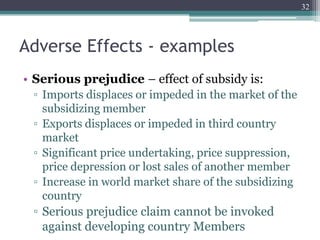
Adverse Effects - examples
• Serious prejudice – effect of subsidy is:
▫ Imports displaces or impeded in the market of the
subsidizing member
▫ Exports displaces or impeded in third country
market
▫ Significant price undertaking, price suppression,
price depression or lost sales of another member
▫ Increase in world market share of the subsidizing
country
▫ Serious prejudice claim cannot be invoked
against developing country Members
32
Serious Prejudice
Serious Prejudice deemed to exist (Art 6.1) where:
i. Total ad valorem subsidization of a product exceeds
5%;
ii. Subsidies cover operating losses sustained by an
industry;
iii. Subsidies to cover operating losses sustained by an
enterprise – exception: one-time measures which
are non-recurrent and given to develop long term
solutions and to avoid acute social problem;
iv. Direct forgivenenss of debt
These provisions lapsed in 1999
33
Nullification or Impairment
• This arises where the improved access to a
market that is presumed to flow from a bound
tariff reduction is undercut by subsidization in
that market
• This can serve as a basis for a complaint related
to harm to a Member’s exporting interests in an
importing country market
34
Types of Injury
• There are three types of injury:
i. Current material injury;
ii. Threat of material injury;
iii. Material retardation of the establishment of a
domestic industry
35
Current Material Injury
• Its determination is to be based on positive
evidence
• There should be objective examination of both
the volume of subsidized imports and the effect
of these imports on prices in the domestic
market for like product
• Consequent impact of such imports on the
domestic producers of such products
36
Threat of Material Injury
• It must be based on facts and not merely on
possibility
• Factors to be considered are :
▫ Nature of subsidy and trade effects likely to arise
therefrom;
▫ Significant increase of subsidized imports;
▫ Sufficient freely disposable capacity or
▫ An imminent substantial increase in capacity of the
exporter, indicating likelihood of substantially
increased subsidized exports
37
Material Retardation of the Establishment
of a Domestic Industry
• The agreement is silent regarding criteria for
evaluation of material retardation of the
establishment of a domestic industry
38
Actionable Subsidy - Remedy
• Action and DSU panel process in all cases and
through countervailing duty investigation for
imports:
• Serious prejudice and nullification or impairment
can be challenged at the multilateral level only
• Remedy:
▫ Removal of adverse effects of the subsidy or
▫ Withdrawal of subsidy or
▫ Imposition of countervailing duty on imports
39
Subsidy Type: Non-actionable Subsidy
• No action can be taken against subsidies that are non-
specific – determined on the basis of:
Criteria are neutral, economic in nature and horizontal in
application
No predominant use by certain enterprises
Eligibility based on objective criteria or conditions
Eligibility automatic, criteria strictly adhered to
• Up to 1999 a specific subsidy given for R&D assistance,
to disadvantaged regions and for environmental
purposes were non-actionable. Now lapsed
40
Remedies
• Subsidy that causes injury can be challenged at
two levels:
i. Unilateral level through countervailing action;
ii. Multilateral level through the WTO’s Dispute
Settlement Mechanism
• Countervailing action can be taken only where
there is injury
• Serious prejudice and nullification or impairment
can be challenged at the multilateral level only
41
Countervailing Measures
• SCM Agreement contains detailed rules regarding
initiation and conduct of investigations, imposition of
preliminary and final measures and the duration of
measures
• These rules are meant to ensure that investigations
are conducted in a transparent manner, all parties
have full opportunity to defend their interests, and
investigating authorities explain the basis of their
determination
• Most of procedural rules are similar to those applied
for Anti-Dumping Agreement
42
Special & Differential Treatment
• De minimis - if overall subsidy level by a DC
does not exceed 2% of the value of the
product, countervailing investigation to be
terminated immediately
• De minimis of 3% for Annex VII Members
and DCs which have eliminated their export
subsidies before the end of the 8-year
transition period
• For other Members, De mimimis level is 1%
43
Special & Differential Treatment
(contd.)
• If volume of subsidized imports from a DC is
less than 4% of the total imports of the like
product in the importing Member,
countervailing investigation has to be
terminated
• The cut-off percentage is 9% where collective
imports from more than one DC is under
investigation and share of each DC is less
than 4%
44
45

WTO Agreement on Subsidies and Countervailing Measures

  • 1.
    WTO Agreement onSubsidies and Countervailing Measures (Subsidy Rules and WTO Jurisprudence) Shailja Singh Assistant Professor Centre for WTO Studies IIFT 1
  • 2.
  • 3.
    Subsides… • Very sensitivematter in international trade relations ▫ On one hand, subsidies evidently used by governments to pursue legitimate objective of economic and social policy. ▫ On the other hand, subsidies may have adverse effects on the interests of trading partners, whose industries may suffer from unfair competition • Subsidies: can distort trade flows if they give an artificial competitive advantage to exporters or import competing industries. • Example of subsidies: aid to the poor, aid for technological development, special aids for education, aid to disadvantaged groups and regions etc. 3
  • 4.
    4 COVERAGE OF THESCM AGREEMENT The SCM Agreement regulates: ▫ Subsidisation by WTO Members ▫ Use of countervailing measures
  • 5.
    Structure of theSCM Agreement: Two Tracks Subsidies SCM Countervailing measures Different rules! 5
  • 6.
    SCM Agreement: Subsidies •Traffic light approach • Subsidies are put into various baskets/categories: i. Red (“prohibited”) ii. Yellow or amber (“actionable”) iii. Green (“non-actionable”) 6
  • 7.
    Broad Scheme ofSCM Agreement • Uruguay Round Subsidies Text is extensive and detailed ▫ Part I – General Provisions (definition and specificity) ▫ Part II – Prohibited subsidies (red light) ▫ Part III – Actionable subsidies (yellow or amber light) ▫ Part IV – Non-Actionable subsidies (green light) ▫ Part V – Countervailing duty measures 7
  • 8.
    Subsidy Defined • Threekey elements when examining whether a programme, scheme, etc. constitutes a subsidy are: i. Financial contribution / income or price support ii. By a Government or any public body iii. Which confers benefit • If any of the three elements is missing, then the programme, scheme, etc. is NOT a subsidy under SCM Agreement. 8
  • 9.
    Coverage of theSCM Agreement Applies to a measure that is Specific (article 2) a subsidy (article 1) and - Financial contribution - Government - Benefit 9
  • 10.
    10 Elements of aSubsidy SCHEME, MEASURE, PROGRAMME, ETC. DOES IT INVOLVE A FINANCIAL CONTRIBUTION BY THE GOV'T? YES NO DOES IT CONFER A BENEFIT? YES NO IT IS A SUBSIDY IT IS NOT A SUBSIDY IT IS NOT A SUBSIDY
  • 11.
    Financial Contribution • Directtransfer of funds (grants, loans, equity infusions) • Potential direct transfer of funds or liabilities (loan guarantee) • Government revenue, that is otherwise due if foregone or not collected (tax credits, import duty exemption) • Provision of goods or services other than general infrastructure • Purchase of goods 11
  • 12.
    By a Governmentor any Public Body • Financial contribution granted by a Govt. (e.g. Federal, Regional or Municipal Govt.) OR by a public body (e.g. National Bank, National Power Company, etc.) • Within the territory of a Member Or Government entrusts or directs a private body to make the financial contribution 12
  • 13.
    Concept of Benefit •Benefit = advantage (to recipient), not cost to Govt: ▫ “Whether the financial contribution places the recipient in a more advantageous position than would have been the case, but for the financial contribution” • Basis for comparison = Market place: ▫ Is the financial contribution “provided on terms which are more advantageous than those that would have been available to the recipient on the market” 13
  • 14.
    Concept of Benefit(Contd.) • Govt. equity infusions do not confer a benefit unless: “the investment decision can be regarded as inconsistent with the usual investment practice (including …risk capital) of private investors in the territory of that Member” • Govt. loans do not confer a benefit unless: “there is a difference between the amount that the firm receiving the loan pays on the Govt. loan and the amount the firm would pay on a comparable commercial loan which the firm could actually obtain on the market.” 14
  • 15.
    Concept of Benefit(Contd.) • Govt. loan guarantees do not confer a benefit unless: “there is a difference between the amount the firm receiving the guarantee pays on a loan guaranteed by the Govt. and the amount the firm would pay on comparable commercial loan absent the Govt. guarantee. • Govt. provision of goods or services does not confer a benefit unless for less than adequate remuneration based on prevailing market conditions 15
  • 16.
    Concept of Benefit(Contd.) • Govt. purchase of goods does not confer a benefit unless: for more than adequate remuneration based on prevailing market conditions. 16
  • 17.
    Footnote 1 –Important Exemption • Exemption of an exported product • From duties or taxes borne by a like product destined for domestic consumption • Not deemed a subsidy 17
  • 18.
    Types of Specificity •Enterprise specific • Industry specific • Group of enterprises or industries • Region specific • Prohibited subsidies are deemed to be specific • Setting or change of generally applicable tax rates by all levels of govts. entitled to do so are not specific subsidy 18
  • 19.
    Types of Specificity(Contd.) • Specificity will not exist where granting authority or legislation concerned establishes objective criteria or conditions for extending the subsidy- these criteria should be neutral, economic in nature and horizontal in application • Two broad categories: i. De-jure specific subsidies ii. De-facto specific subsidies 19
  • 20.
    Specific Subsidies –de-jure • A subsidy is de-jure specific if Access to the subsidy explicitly limited to certain enterprises. If access is limited based on objective criteria then it would not be a specific subsidy • To be determined with reference to the jurisdiction of the granting authority 20
  • 21.
    De-facto Specificity (Art.2.1(c)) • Notwithstanding any appearance of non- specificity, the subsidy may in fact be specific. Following factors may be considered: Use by a limited number of enterprises Predominant use by certain enterprises Granting of disproportionately large amounts to certain enterprises Manner in which discretion has been exercised 21
  • 22.
    Specificity : Implications •For Members as providers of subsidies: ▫ Specific subsidies are subject to the rules/disciplines under Article 4 and 7 of the SCM Agreement, in case of prohibited and actionable subsidies, respectively (under the MULTILATERAL TRACK); and can be countervailed (Part V) (under the NATIONAL TRACK) ▫ Must notify specific subsidies to the SCM Committee • For Members affected by others’ subsidies: ▫ Can challenge (MULTILATERAL TRACK) or countervail (NATIONAL TRACK) other Members’ specific subsidies 22
  • 23.
    Subsidies – Categorization:Recap i. Prohibited Subsidy ii. Actionable Subsidy iii. Non-actionable Subsidy 23
  • 24.
    Subsidy Types: ProhibitedSubsidy • Certain subsidies are regarded as outright trade distortive – hence prohibited • These are: i. Export subsidies – subsidies that are contingent on export performance , except as provided in the Agreement on Agriculture ii. Import substitution subsidies – contingent on use of domestic over imported goods 24
  • 25.
    Export Subsidy • Subsidiescontingent, in law or in fact, whether wholly or as one of several other conditions, upon export performance are called export subsidies • Examples (set out in Annex-I): ▫ provision of goods or services for use in the production of exported goods in terms more favorable than those for the production of goods for domestic consumption; ▫ export related exemption, remission or deferral of direct taxes; excess exemption, remission, or deferral of indirect taxes or import duties; ▫ provision of export credit guarantee or insurance programmes at premium rates which are inadequate to cover the operating costs and losses of the programmes 25
  • 26.
    Export Subsidy: PermissibleDuty Exemptions • Exemption or remission of indirect taxes on export products- Footnote 1 • Remission, Exemption & Deferral (RED) of prior stage cumulative indirect taxes on inputs used in production of the exported product provided this does not exceed corresponding RED on inputs used in the production of domestically sold like products – item (h), Annex I • RED on prior stage cumulative indirect taxes on inputs consumed in production of the exported product. To be interpreted in accordance with guidelines in Annex II – item (h), Annex I • Remission or drawback of import charges on imported inputs consumed in the production of the exported product. Substitution drawback schemes are permitted in accordance with guidelines in Annex III – item (h), Annex I 26
  • 27.
    Conditions for REDof Cumulative Indirect Taxes • Inputs must have been consumed in the production process Physically incorporated inputs Energy, fuel, oil and catalysts • There must be a reasonable and effective verification system in place to confirm which inputs are consumed and in what amounts. 27
  • 28.
    Remedy against ProhibitedSubsidy • Remedy through DSU • It can be challenged in WTO on the basis of special accelerated procedures • Complaining Member not obliged to show trade effects as these are regarded as trade distorting subsidies • Defaulting member required to withdraw the subsidy without delay or face counter - measures 28
  • 29.
    Special and DifferentialProvisions • No derogation for import substitution subsidies except for fixed transition periods which is already over • For “Annex VII countries” i.e. LDCs and 21 listed developing countries whose GNP per capita is below $1000 per annum, prohibition on export subsidies not applicable - India one of them (others include Bolivia, Egypt, Indonesia, Kenya, Nigeria, Pakistan, Philippines, Sri Lanka etc.) • Other developing countries to phase out export subsidy in a 8 year period 29
  • 30.
    Export Competitiveness • Articles27.5 and 27.6 • If an Annex VII developing country’s export of a specific product has reached “export competitiveness” i.e. - A share of at least 3.25% in world trade (of that product) - For two consecutive years That Annex VII developing country must phase out its export subsidies for such products over a period of 8 years 30
  • 31.
    Subsidy Types: ActionableSubsidy • Subsidy is actionable if: ▫ It is specific ▫ Causes adverse effects (injury, serious prejudice, nullification and impairment) 31
  • 32.
    Adverse Effects -examples • Serious prejudice – effect of subsidy is: ▫ Imports displaces or impeded in the market of the subsidizing member ▫ Exports displaces or impeded in third country market ▫ Significant price undertaking, price suppression, price depression or lost sales of another member ▫ Increase in world market share of the subsidizing country ▫ Serious prejudice claim cannot be invoked against developing country Members 32
  • 33.
    Serious Prejudice Serious Prejudicedeemed to exist (Art 6.1) where: i. Total ad valorem subsidization of a product exceeds 5%; ii. Subsidies cover operating losses sustained by an industry; iii. Subsidies to cover operating losses sustained by an enterprise – exception: one-time measures which are non-recurrent and given to develop long term solutions and to avoid acute social problem; iv. Direct forgivenenss of debt These provisions lapsed in 1999 33
  • 34.
    Nullification or Impairment •This arises where the improved access to a market that is presumed to flow from a bound tariff reduction is undercut by subsidization in that market • This can serve as a basis for a complaint related to harm to a Member’s exporting interests in an importing country market 34
  • 35.
    Types of Injury •There are three types of injury: i. Current material injury; ii. Threat of material injury; iii. Material retardation of the establishment of a domestic industry 35
  • 36.
    Current Material Injury •Its determination is to be based on positive evidence • There should be objective examination of both the volume of subsidized imports and the effect of these imports on prices in the domestic market for like product • Consequent impact of such imports on the domestic producers of such products 36
  • 37.
    Threat of MaterialInjury • It must be based on facts and not merely on possibility • Factors to be considered are : ▫ Nature of subsidy and trade effects likely to arise therefrom; ▫ Significant increase of subsidized imports; ▫ Sufficient freely disposable capacity or ▫ An imminent substantial increase in capacity of the exporter, indicating likelihood of substantially increased subsidized exports 37
  • 38.
    Material Retardation ofthe Establishment of a Domestic Industry • The agreement is silent regarding criteria for evaluation of material retardation of the establishment of a domestic industry 38
  • 39.
    Actionable Subsidy -Remedy • Action and DSU panel process in all cases and through countervailing duty investigation for imports: • Serious prejudice and nullification or impairment can be challenged at the multilateral level only • Remedy: ▫ Removal of adverse effects of the subsidy or ▫ Withdrawal of subsidy or ▫ Imposition of countervailing duty on imports 39
  • 40.
    Subsidy Type: Non-actionableSubsidy • No action can be taken against subsidies that are non- specific – determined on the basis of: Criteria are neutral, economic in nature and horizontal in application No predominant use by certain enterprises Eligibility based on objective criteria or conditions Eligibility automatic, criteria strictly adhered to • Up to 1999 a specific subsidy given for R&D assistance, to disadvantaged regions and for environmental purposes were non-actionable. Now lapsed 40
  • 41.
    Remedies • Subsidy thatcauses injury can be challenged at two levels: i. Unilateral level through countervailing action; ii. Multilateral level through the WTO’s Dispute Settlement Mechanism • Countervailing action can be taken only where there is injury • Serious prejudice and nullification or impairment can be challenged at the multilateral level only 41
  • 42.
    Countervailing Measures • SCMAgreement contains detailed rules regarding initiation and conduct of investigations, imposition of preliminary and final measures and the duration of measures • These rules are meant to ensure that investigations are conducted in a transparent manner, all parties have full opportunity to defend their interests, and investigating authorities explain the basis of their determination • Most of procedural rules are similar to those applied for Anti-Dumping Agreement 42
  • 43.
    Special & DifferentialTreatment • De minimis - if overall subsidy level by a DC does not exceed 2% of the value of the product, countervailing investigation to be terminated immediately • De minimis of 3% for Annex VII Members and DCs which have eliminated their export subsidies before the end of the 8-year transition period • For other Members, De mimimis level is 1% 43
  • 44.
    Special & DifferentialTreatment (contd.) • If volume of subsidized imports from a DC is less than 4% of the total imports of the like product in the importing Member, countervailing investigation has to be terminated • The cut-off percentage is 9% where collective imports from more than one DC is under investigation and share of each DC is less than 4% 44
  • 45.