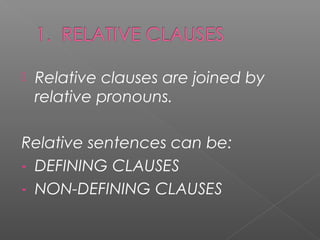
 Relative clauses are joined by
relative pronouns.
Relative sentences can be:
- DEFINING CLAUSES
- NON-DEFINING CLAUSES
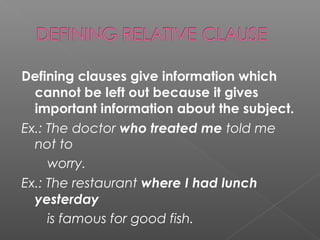
Defining clauses give information which
cannot be left out because it gives
important information about the subject.
Ex.: The doctor who treated me told me
not to
worry.
Ex.: The restaurant where I had lunch
yesterday
is famous for good fish.
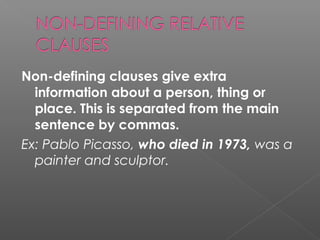
Non-defining clauses give extra
information about a person, thing or
place. This is separated from the main
sentence by commas.
Ex: Pablo Picasso, who died in 1973, was a
painter and sculptor.
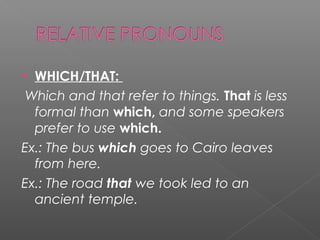
• WHICH/THAT:
Which and that refer to things. That is less
formal than which, and some speakers
prefer to use which.
Ex.: The bus which goes to Cairo leaves
from here.
Ex.: The road that we took led to an
ancient temple.
That is also used to refer to people in
speech and informal writing in defining
clauses.
Ex.: The woman that we spoke to gave us
some information about the incident.
In Non-defining clauses that can not be
used. You should use which to talk about
things and who to talk about people.
Ex.: John, who is Peter’s brother, is an actor.
(who refers to a person)
Ex.: The film, which was also shown in the
USA, is extremely funny.
(which refers to a thing)
- WHO AND WHOM:
Who and whom refer to people. We use
whom in formal speech and writing to
introduce an object clause
Ex.: The doctor that/who/whom I spoke to
told me not to worry.
In informal language people use who
instead of whom.
Some more examples:
• It was the same boy whom I met
yesterday (formal)
• No one knows by whom the victim was
shot (formal)
• No one knows who the victim was shot
by.
• (informal)
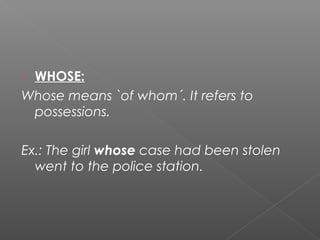
- WHOSE:
Whose means `of whom´. It refers to
possessions.
Ex.: The girl whose case had been stolen
went to the police station.
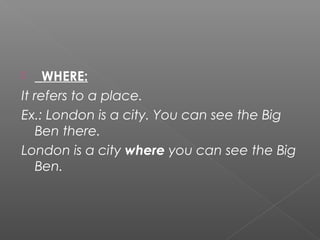
 _WHERE:
It refers to a place.
Ex.: London is a city. You can see the Big
Ben there.
London is a city where you can see the Big
Ben.
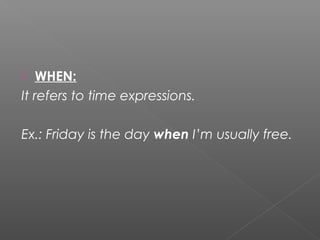
 WHEN:
It refers to time expressions.
Ex.: Friday is the day when I’m usually free.
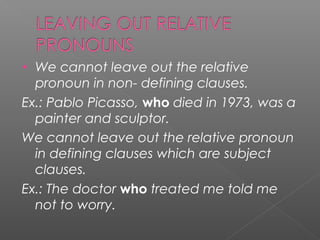
• We cannot leave out the relative
pronoun in non- defining clauses.
Ex.: Pablo Picasso, who died in 1973, was a
painter and sculptor.
We cannot leave out the relative pronoun
in defining clauses which are subject
clauses.
Ex.: The doctor who treated me told me
not to worry.
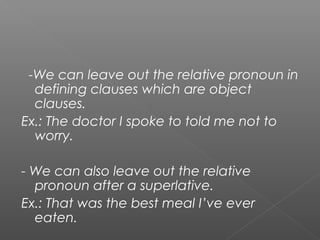
-We can leave out the relative pronoun in
defining clauses which are object
clauses.
Ex.: The doctor I spoke to told me not to
worry.
- We can also leave out the relative
pronoun after a superlative.
Ex.: That was the best meal I’ve ever
eaten.
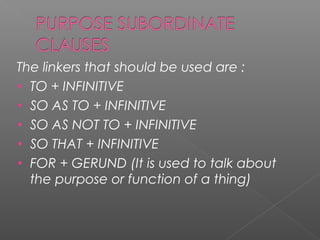
The linkers that should be used are :
• TO + INFINITIVE
• SO AS TO + INFINITIVE
• SO AS NOT TO + INFINITIVE
• SO THAT + INFINITIVE
• FOR + GERUND (It is used to talk about
the purpose or function of a thing)
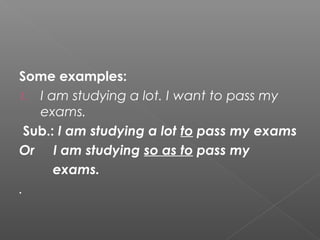
Some examples:
1. I am studying a lot. I want to pass my
exams.
Sub.: I am studying a lot to pass my exams
Or I am studying so as to pass my
exams.
.
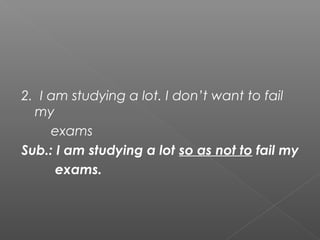
2. I am studying a lot. I don’t want to fail
my
exams
Sub.: I am studying a lot so as not to fail my
exams.
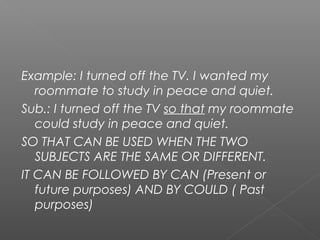
Example: I turned off the TV. I wanted my
roommate to study in peace and quiet.
Sub.: I turned off the TV so that my roommate
could study in peace and quiet.
SO THAT CAN BE USED WHEN THE TWO
SUBJECTS ARE THE SAME OR DIFFERENT.
IT CAN BE FOLLOWED BY CAN (Present or
future purposes) AND BY COULD ( Past
purposes)
Example with for:
We use the knife for cutting bread.
With these clauses we have to use the
following linkers:
• BECAUSE
• SINCE
• AS
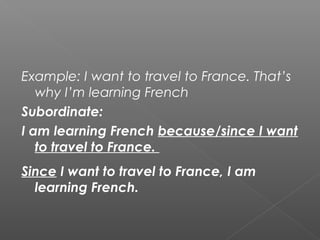
Example: I want to travel to France. That’s
why I’m learning French
Subordinate:
I am learning French because/since I want
to travel to France.
Since I want to travel to France, I am
learning French.
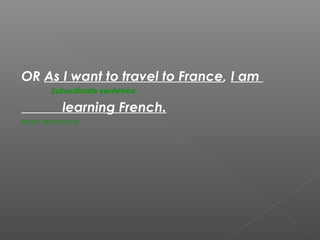
OR As I want to travel to France, I am
Subordinate sentence
learning French.
Main sentence
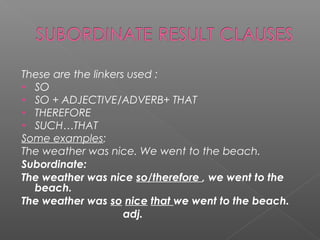
These are the linkers used :
• SO
• SO + ADJECTIVE/ADVERB+ THAT
• THEREFORE
• SUCH…THAT
Some examples:
The weather was nice. We went to the beach.
Subordinate:
The weather was nice so/therefore , we went to the
beach.
The weather was so nice that we went to the beach.
adj.
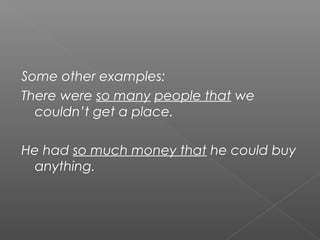
Some other examples:
There were so many people that we
couldn’t get a place.
He had so much money that he could buy
anything.
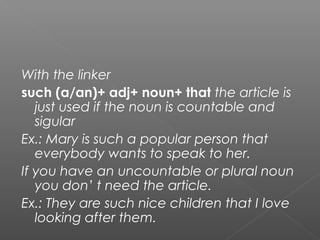
With the linker
such (a/an)+ adj+ noun+ that the article is
just used if the noun is countable and
sigular
Ex.: Mary is such a popular person that
everybody wants to speak to her.
If you have an uncountable or plural noun
you don’ t need the article.
Ex.: They are such nice children that I love
looking after them.
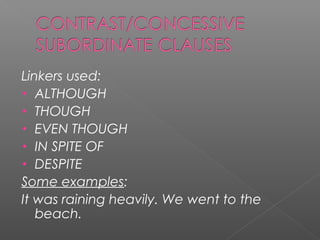
Linkers used:
• ALTHOUGH
• THOUGH
• EVEN THOUGH
• IN SPITE OF
• DESPITE
Some examples:
It was raining heavily. We went to the
beach.
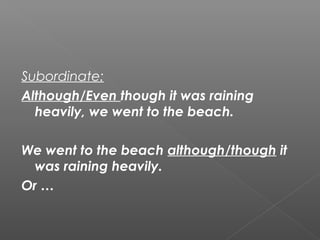
Subordinate:
Although/Even though it was raining
heavily, we went to the beach.
We went to the beach although/though it
was raining heavily.
Or …
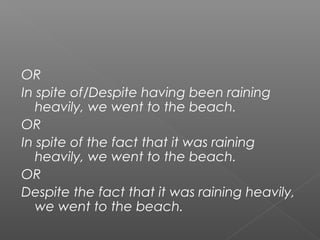
OR
In spite of/Despite having been raining
heavily, we went to the beach.
OR
In spite of the fact that it was raining
heavily, we went to the beach.
OR
Despite the fact that it was raining heavily,
we went to the beach.
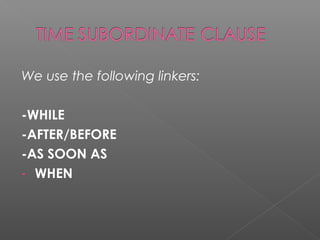
We use the following linkers:
-WHILE
-AFTER/BEFORE
-AS SOON AS
- WHEN
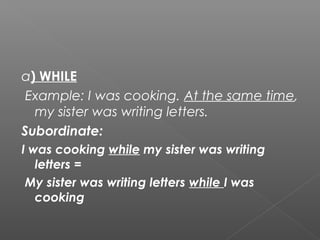
a) WHILE
Example: I was cooking. At the same time,
my sister was writing letters.
Subordinate:
I was cooking while my sister was writing
letters =
My sister was writing letters while I was
cooking
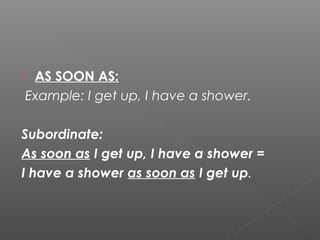
• AS SOON AS:
Example: I get up, I have a shower.
Subordinate:
As soon as I get up, I have a shower =
I have a shower as soon as I get up.
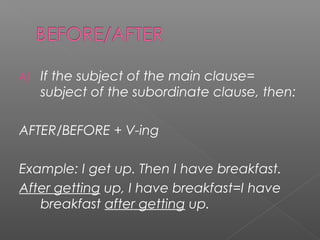
A) If the subject of the main clause=
subject of the subordinate clause, then:
AFTER/BEFORE + V-ing
Example: I get up. Then I have breakfast.
After getting up, I have breakfast=I have
breakfast after getting up.
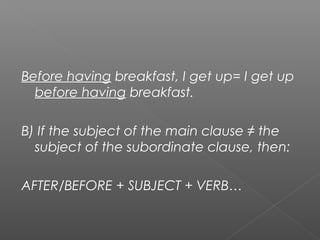
Before having breakfast, I get up= I get up
before having breakfast.
B) If the subject of the main clause ≠ the
subject of the subordinate clause, then:
AFTER/BEFORE + SUBJECT + VERB…
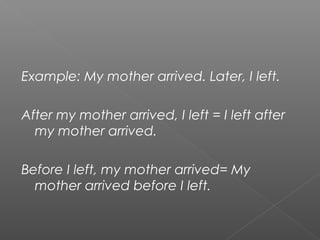
Example: My mother arrived. Later, I left.
After my mother arrived, I left = I left after
my mother arrived.
Before I left, my mother arrived= My
mother arrived before I left.
 WHEN
When is used when two short events
happen at
the same time.
 Example:I heard you when you opened
the door.

Subordinate sentences

  • 2.
     Relative clausesare joined by relative pronouns. Relative sentences can be: - DEFINING CLAUSES - NON-DEFINING CLAUSES
  • 3.
    Defining clauses giveinformation which cannot be left out because it gives important information about the subject. Ex.: The doctor who treated me told me not to worry. Ex.: The restaurant where I had lunch yesterday is famous for good fish.
  • 4.
    Non-defining clauses giveextra information about a person, thing or place. This is separated from the main sentence by commas. Ex: Pablo Picasso, who died in 1973, was a painter and sculptor.
  • 5.
    • WHICH/THAT: Which andthat refer to things. That is less formal than which, and some speakers prefer to use which. Ex.: The bus which goes to Cairo leaves from here. Ex.: The road that we took led to an ancient temple.
  • 6.
    That is alsoused to refer to people in speech and informal writing in defining clauses. Ex.: The woman that we spoke to gave us some information about the incident.
  • 7.
    In Non-defining clausesthat can not be used. You should use which to talk about things and who to talk about people. Ex.: John, who is Peter’s brother, is an actor. (who refers to a person) Ex.: The film, which was also shown in the USA, is extremely funny. (which refers to a thing)
  • 8.
    - WHO ANDWHOM: Who and whom refer to people. We use whom in formal speech and writing to introduce an object clause Ex.: The doctor that/who/whom I spoke to told me not to worry. In informal language people use who instead of whom.
  • 9.
    Some more examples: •It was the same boy whom I met yesterday (formal) • No one knows by whom the victim was shot (formal) • No one knows who the victim was shot by. • (informal)
  • 10.
    - WHOSE: Whose means`of whom´. It refers to possessions. Ex.: The girl whose case had been stolen went to the police station.
  • 11.
     _WHERE: It refersto a place. Ex.: London is a city. You can see the Big Ben there. London is a city where you can see the Big Ben.
  • 12.
     WHEN: It refersto time expressions. Ex.: Friday is the day when I’m usually free.
  • 13.
    • We cannotleave out the relative pronoun in non- defining clauses. Ex.: Pablo Picasso, who died in 1973, was a painter and sculptor. We cannot leave out the relative pronoun in defining clauses which are subject clauses. Ex.: The doctor who treated me told me not to worry.
  • 14.
    -We can leaveout the relative pronoun in defining clauses which are object clauses. Ex.: The doctor I spoke to told me not to worry. - We can also leave out the relative pronoun after a superlative. Ex.: That was the best meal I’ve ever eaten.
  • 15.
    The linkers thatshould be used are : • TO + INFINITIVE • SO AS TO + INFINITIVE • SO AS NOT TO + INFINITIVE • SO THAT + INFINITIVE • FOR + GERUND (It is used to talk about the purpose or function of a thing)
  • 16.
    Some examples: 1. Iam studying a lot. I want to pass my exams. Sub.: I am studying a lot to pass my exams Or I am studying so as to pass my exams. .
  • 17.
    2. I amstudying a lot. I don’t want to fail my exams Sub.: I am studying a lot so as not to fail my exams.
  • 18.
    Example: I turnedoff the TV. I wanted my roommate to study in peace and quiet. Sub.: I turned off the TV so that my roommate could study in peace and quiet. SO THAT CAN BE USED WHEN THE TWO SUBJECTS ARE THE SAME OR DIFFERENT. IT CAN BE FOLLOWED BY CAN (Present or future purposes) AND BY COULD ( Past purposes)
  • 19.
    Example with for: Weuse the knife for cutting bread.
  • 20.
    With these clauseswe have to use the following linkers: • BECAUSE • SINCE • AS
  • 21.
    Example: I wantto travel to France. That’s why I’m learning French Subordinate: I am learning French because/since I want to travel to France. Since I want to travel to France, I am learning French.
  • 22.
    OR As Iwant to travel to France, I am Subordinate sentence learning French. Main sentence
  • 23.
    These are thelinkers used : • SO • SO + ADJECTIVE/ADVERB+ THAT • THEREFORE • SUCH…THAT Some examples: The weather was nice. We went to the beach. Subordinate: The weather was nice so/therefore , we went to the beach. The weather was so nice that we went to the beach. adj.
  • 24.
    Some other examples: Therewere so many people that we couldn’t get a place. He had so much money that he could buy anything.
  • 25.
    With the linker such(a/an)+ adj+ noun+ that the article is just used if the noun is countable and sigular Ex.: Mary is such a popular person that everybody wants to speak to her. If you have an uncountable or plural noun you don’ t need the article. Ex.: They are such nice children that I love looking after them.
  • 26.
    Linkers used: • ALTHOUGH •THOUGH • EVEN THOUGH • IN SPITE OF • DESPITE Some examples: It was raining heavily. We went to the beach.
  • 27.
    Subordinate: Although/Even though itwas raining heavily, we went to the beach. We went to the beach although/though it was raining heavily. Or …
  • 28.
    OR In spite of/Despitehaving been raining heavily, we went to the beach. OR In spite of the fact that it was raining heavily, we went to the beach. OR Despite the fact that it was raining heavily, we went to the beach.
  • 29.
    We use thefollowing linkers: -WHILE -AFTER/BEFORE -AS SOON AS - WHEN
  • 30.
    a) WHILE Example: Iwas cooking. At the same time, my sister was writing letters. Subordinate: I was cooking while my sister was writing letters = My sister was writing letters while I was cooking
  • 31.
    • AS SOONAS: Example: I get up, I have a shower. Subordinate: As soon as I get up, I have a shower = I have a shower as soon as I get up.
  • 32.
    A) If thesubject of the main clause= subject of the subordinate clause, then: AFTER/BEFORE + V-ing Example: I get up. Then I have breakfast. After getting up, I have breakfast=I have breakfast after getting up.
  • 33.
    Before having breakfast,I get up= I get up before having breakfast. B) If the subject of the main clause ≠ the subject of the subordinate clause, then: AFTER/BEFORE + SUBJECT + VERB…
  • 34.
    Example: My motherarrived. Later, I left. After my mother arrived, I left = I left after my mother arrived. Before I left, my mother arrived= My mother arrived before I left.
  • 35.
     WHEN When isused when two short events happen at the same time.  Example:I heard you when you opened the door.