RELATIVE CLAUSES 1º BACHILLERATO
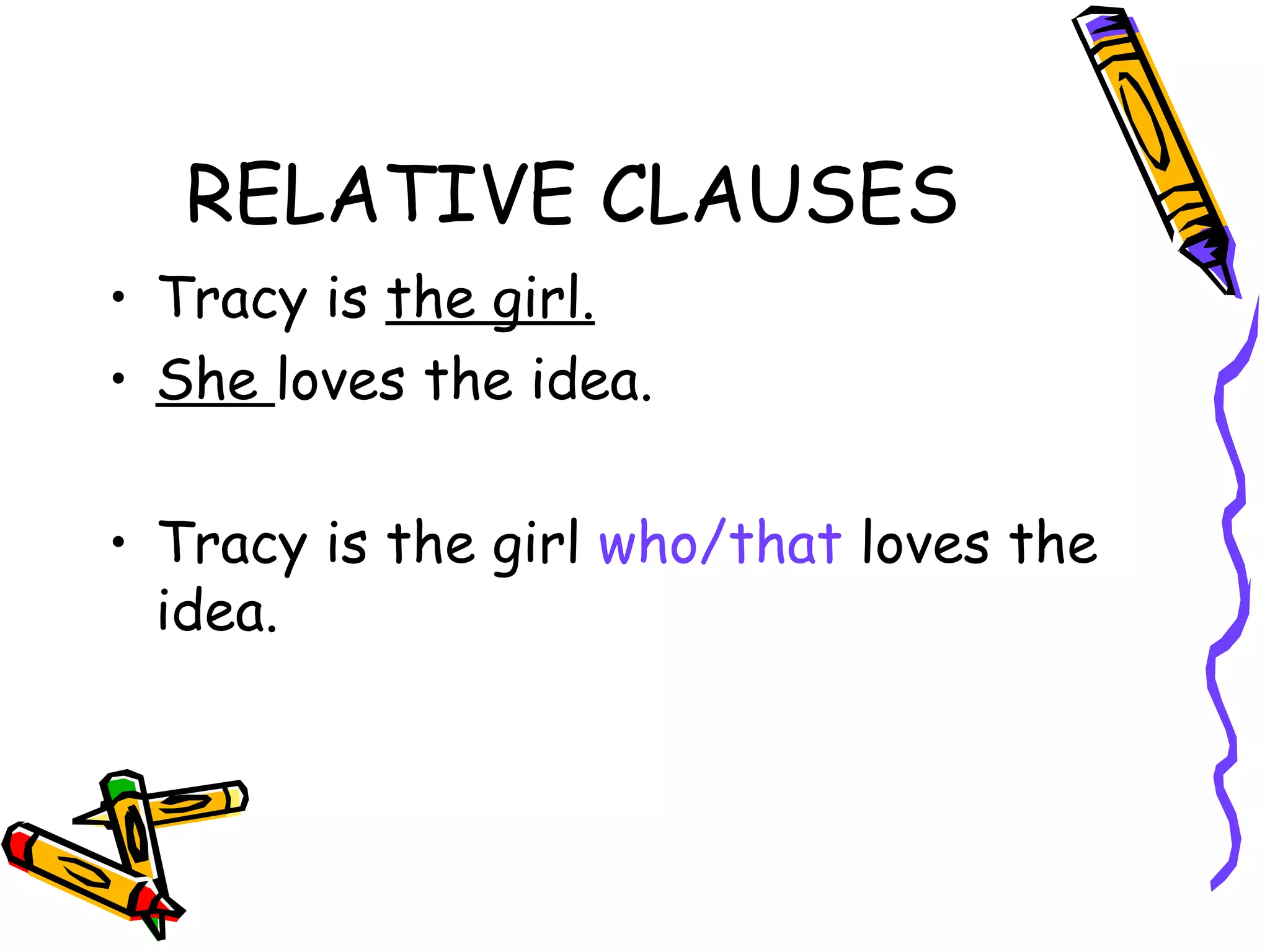
RELATIVE CLAUSES Tracy is  the girl.   She  loves the idea. Tracy is the girl  who/that  loves the idea.
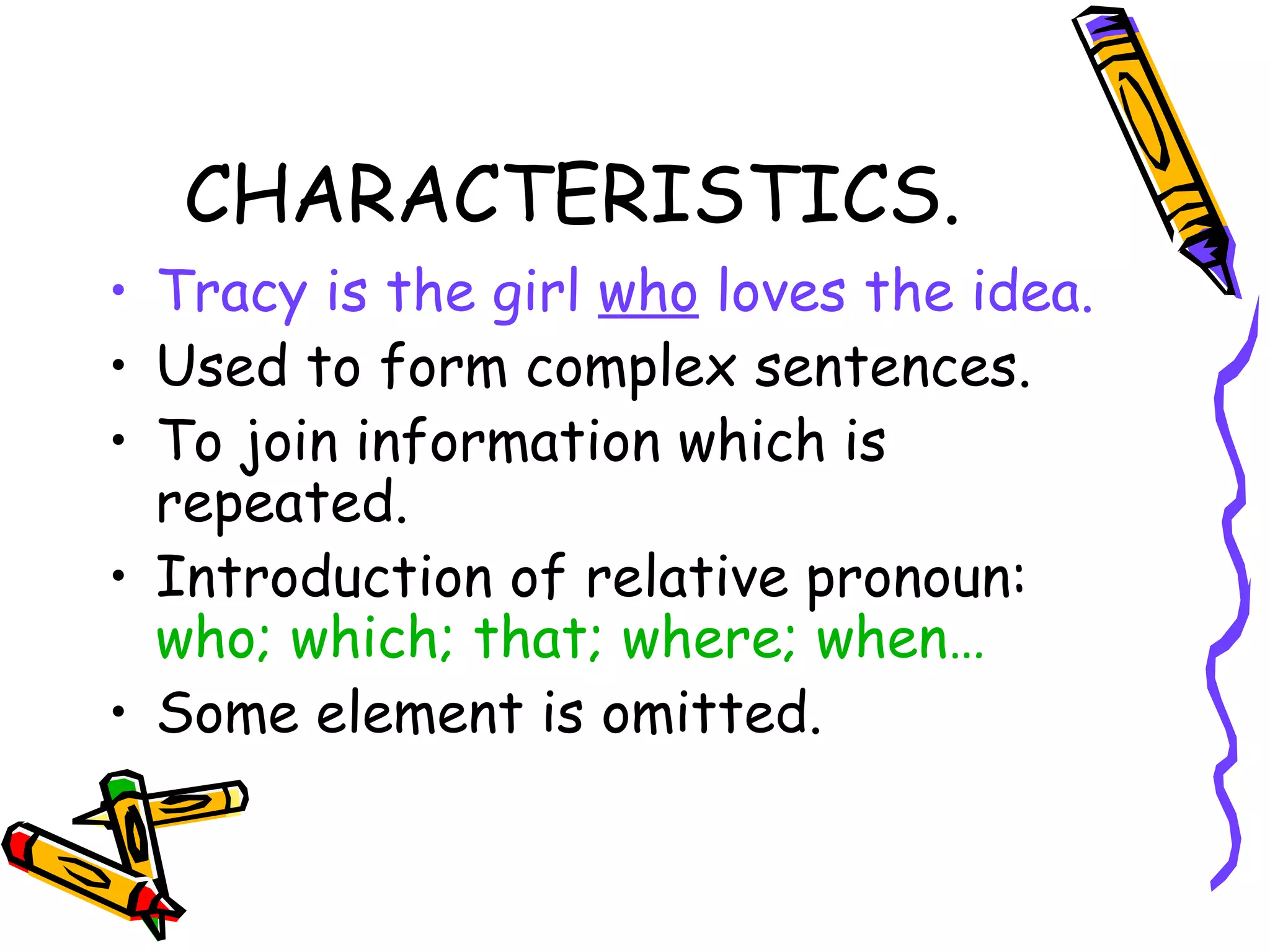
CHARACTERISTICS. Tracy is the girl  who  loves the idea. Used to form complex sentences. To join information which is repeated.  Introduction of relative pronoun:  who; which; that; where; when… Some element is omitted.
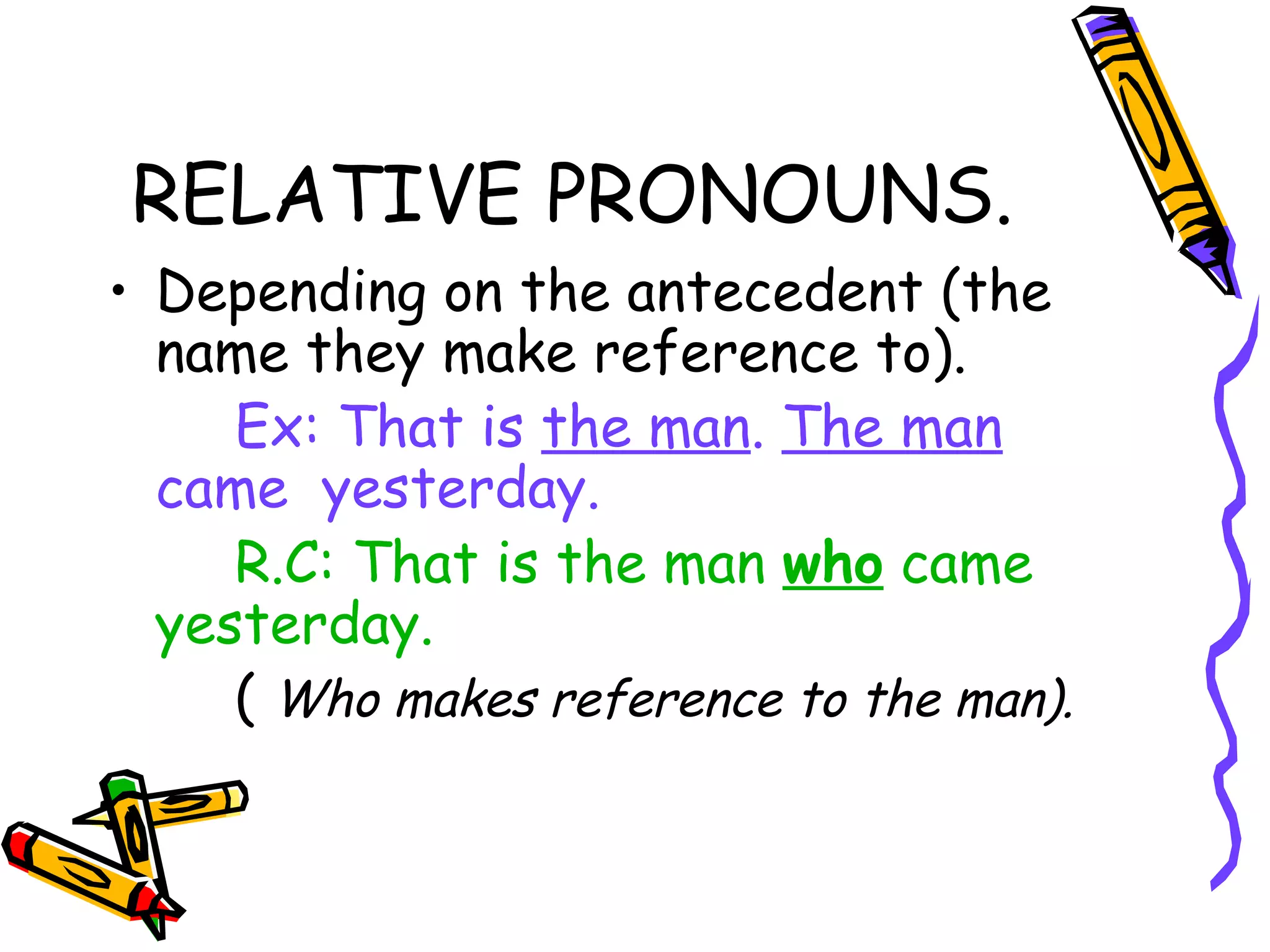
RELATIVE PRONOUNS. Depending on the antecedent (the name they make reference to). Ex: That is  the man .  The man  came  yesterday. R.C: That is the man  who  came yesterday. (  Who makes reference to the man).
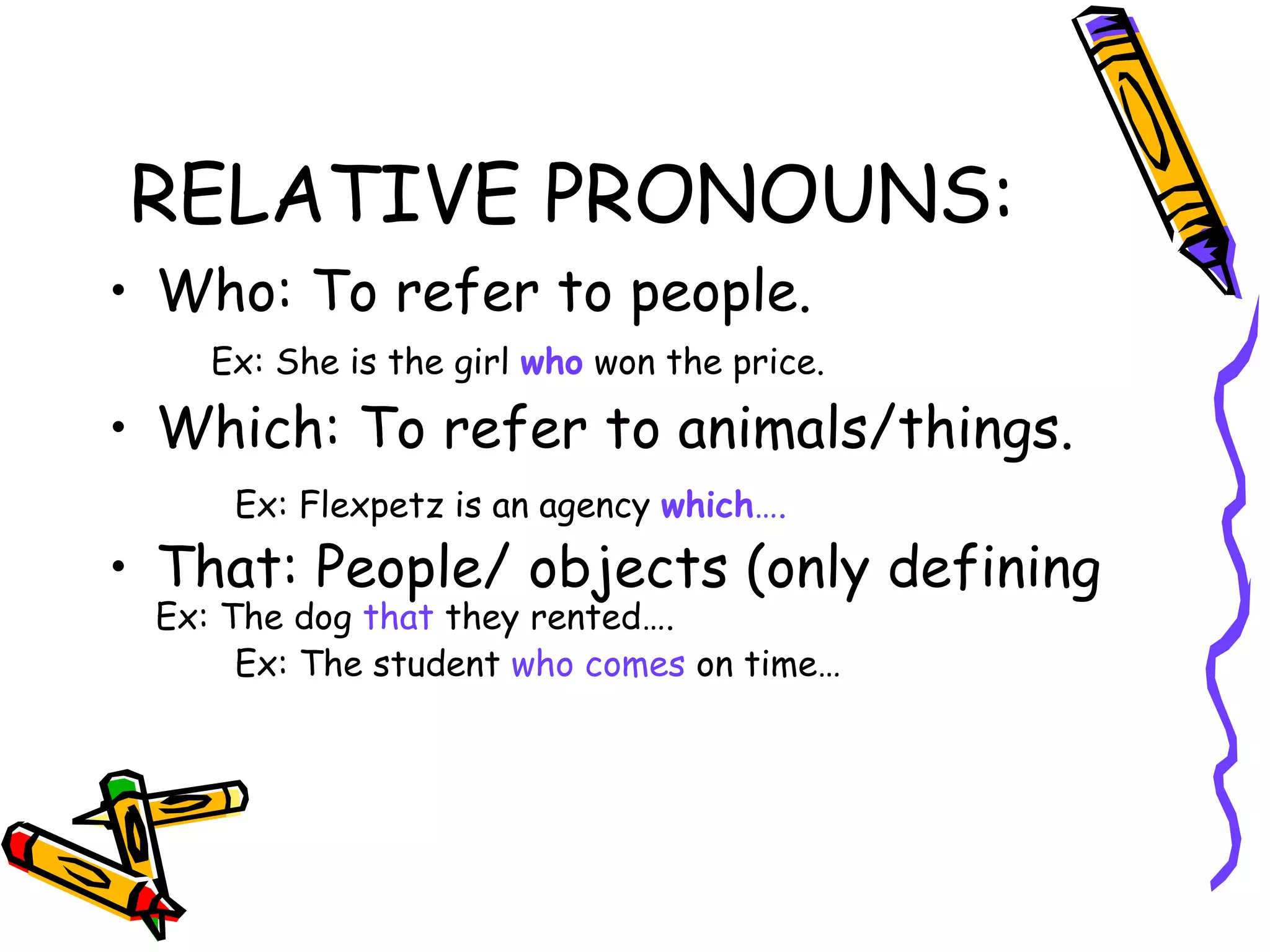
RELATIVE PRONOUNS: Who: To refer to people. Ex: She is the girl   who   won the price. Which: To refer to animals/things. Ex: Flexpetz is an agency   which …. That: People/ objects (only defining  Ex: The dog  that  they rented…. Ex: The student  who comes  on time…
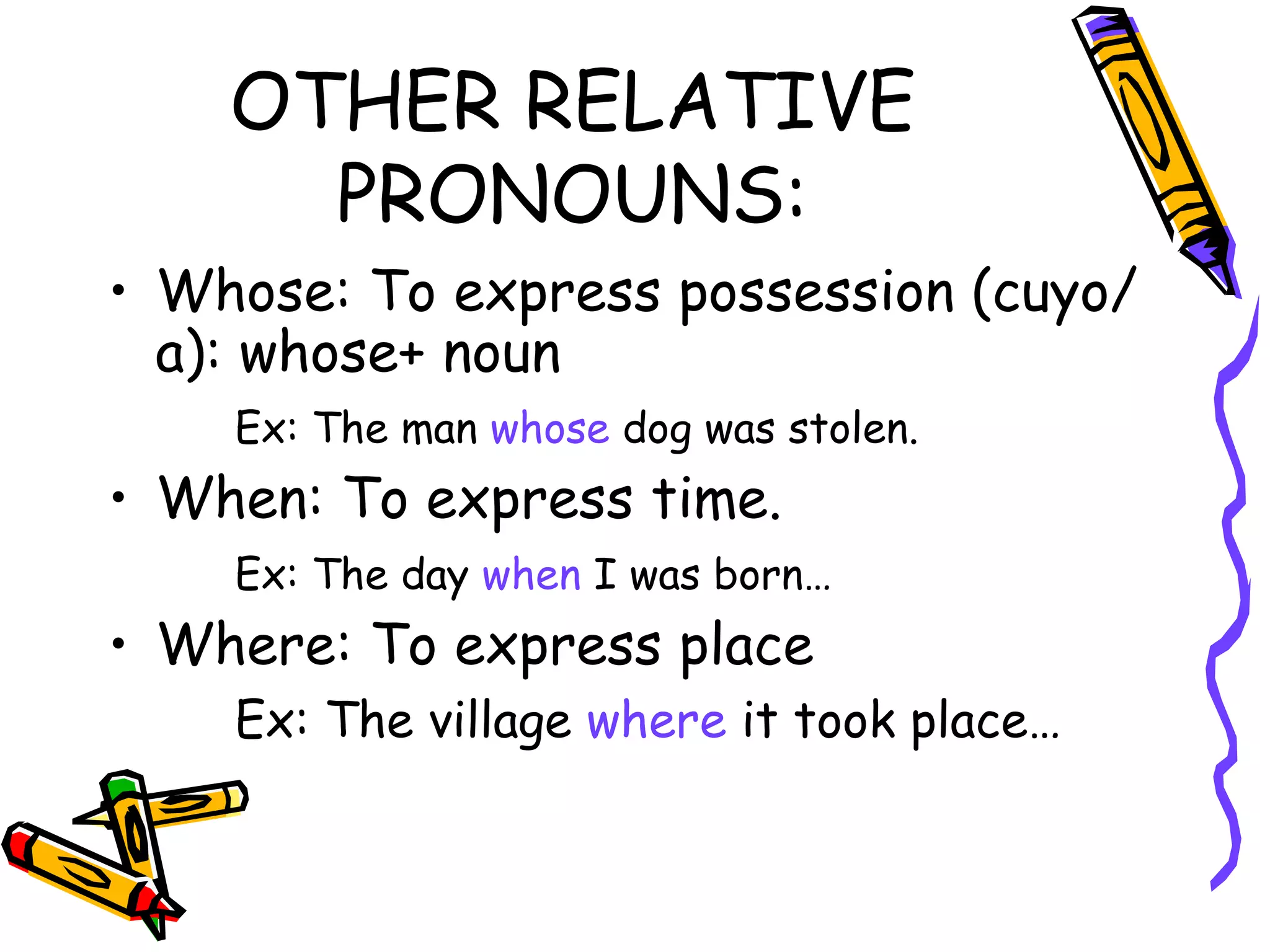
OTHER RELATIVE PRONOUNS: Whose: To express possession (cuyo/a): whose+ noun Ex: The man  whose  dog was stolen. When: To express time. Ex: The day  when  I was born… Where: To express place Ex: The village  where  it took place…
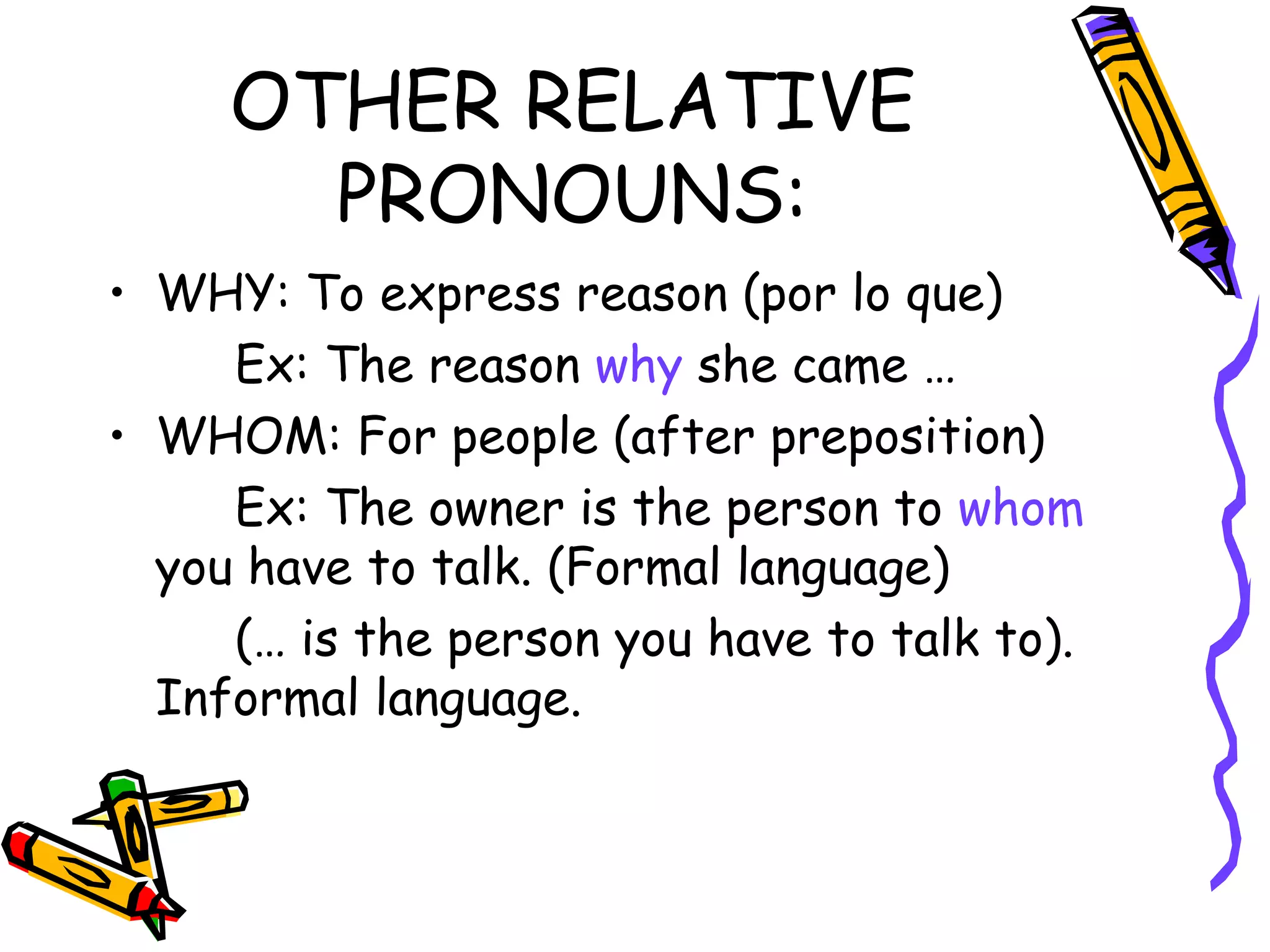
OTHER RELATIVE PRONOUNS: WHY: To express reason (por lo que) Ex: The reason  why  she came … WHOM: For people (after preposition) Ex: The owner is the person to  whom  you have to talk. (Formal language) (… is the person you have to talk to). Informal language.
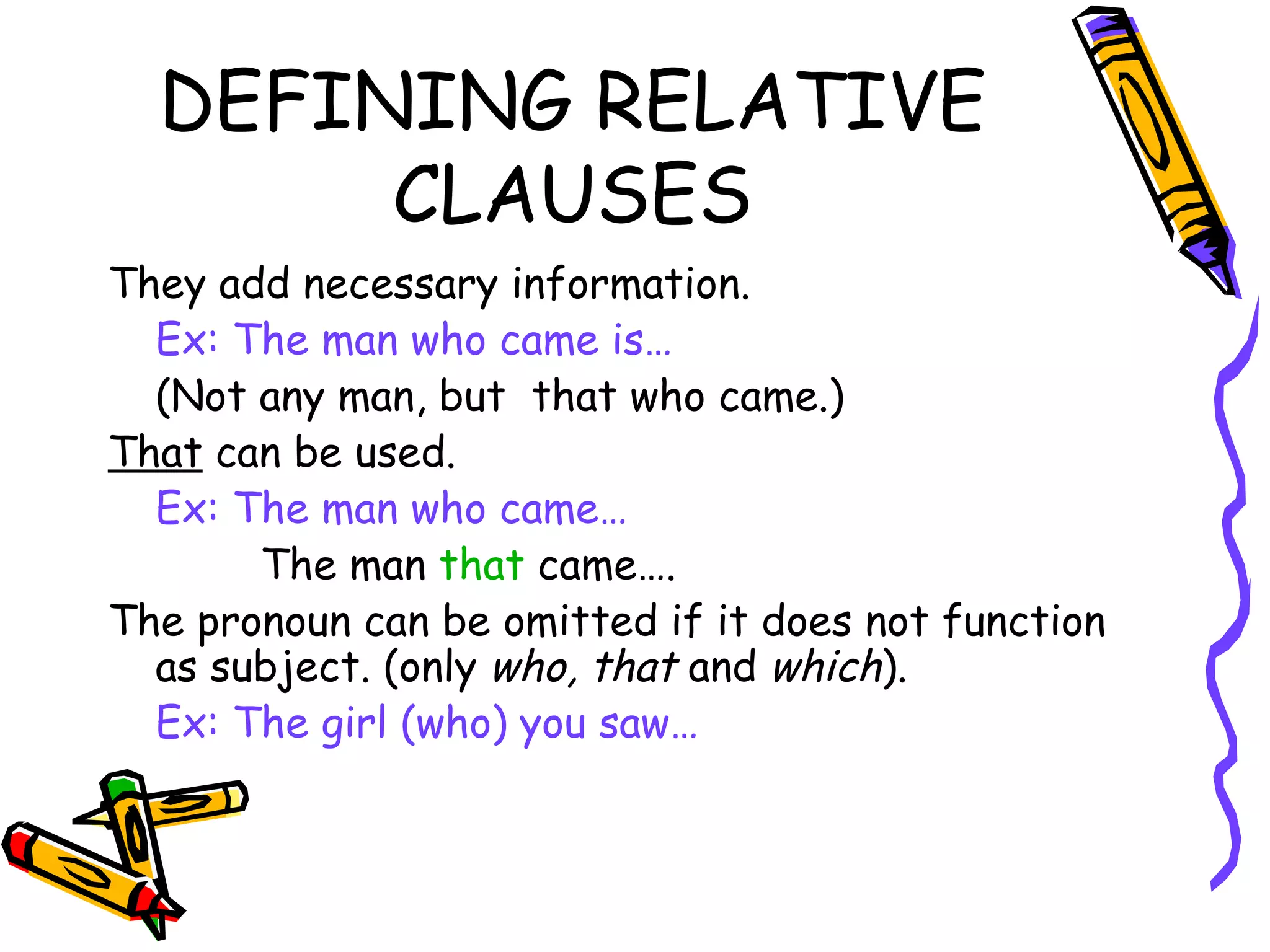
DEFINING RELATIVE CLAUSES They add necessary information. Ex: The man who came is… (Not any man, but  that who came.) That  can be used. Ex: The man who came…   The man  that  came….  The pronoun can be omitted if it does not function as subject. (only  who, that  and  which ). Ex: The girl (who) you saw…
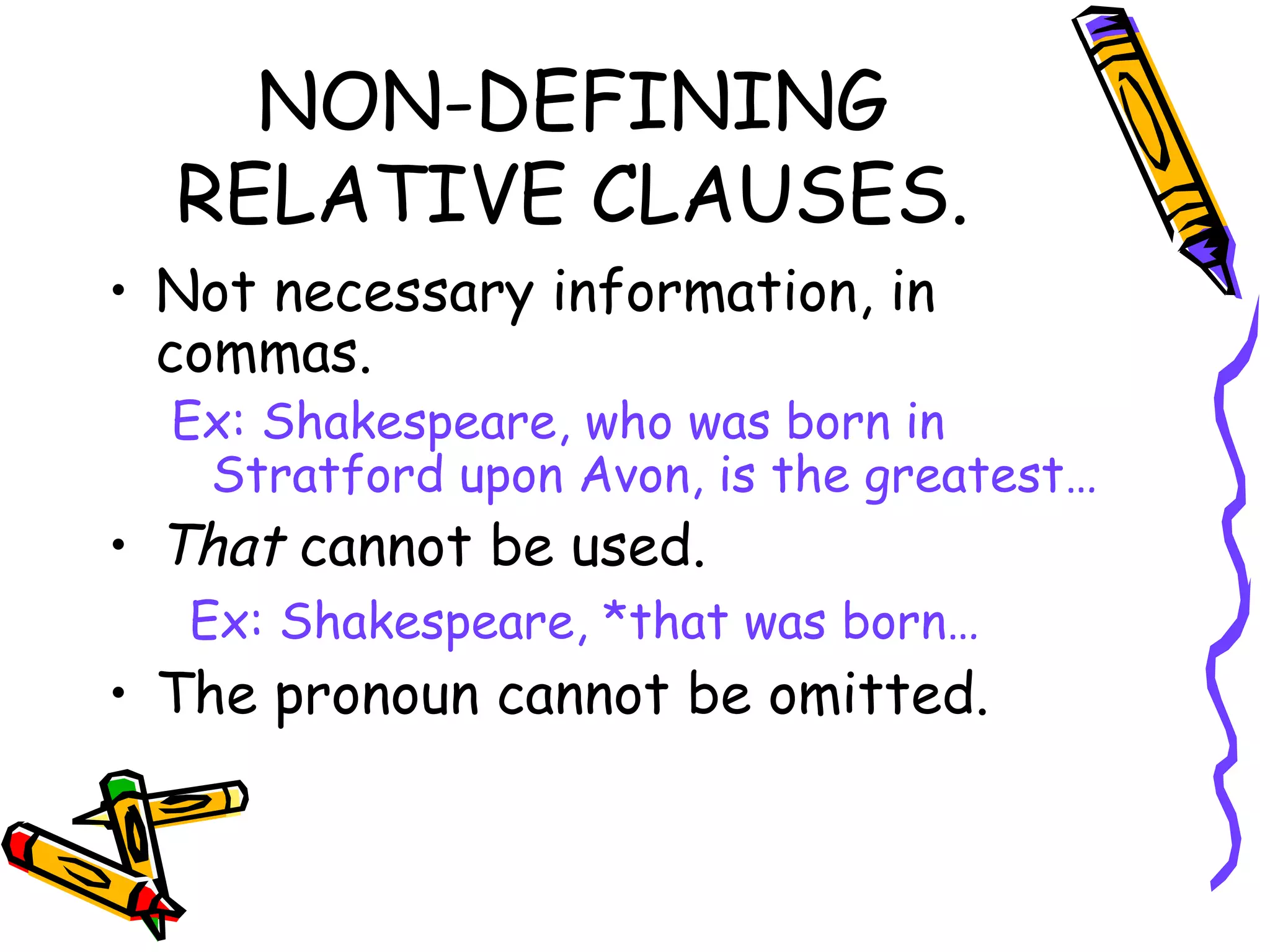
NON-DEFINING RELATIVE CLAUSES. Not necessary information, in commas. Ex: Shakespeare, who was born in Stratford upon Avon, is the greatest… That  cannot be used.   Ex: Shakespeare, *that was born… The pronoun cannot be omitted.
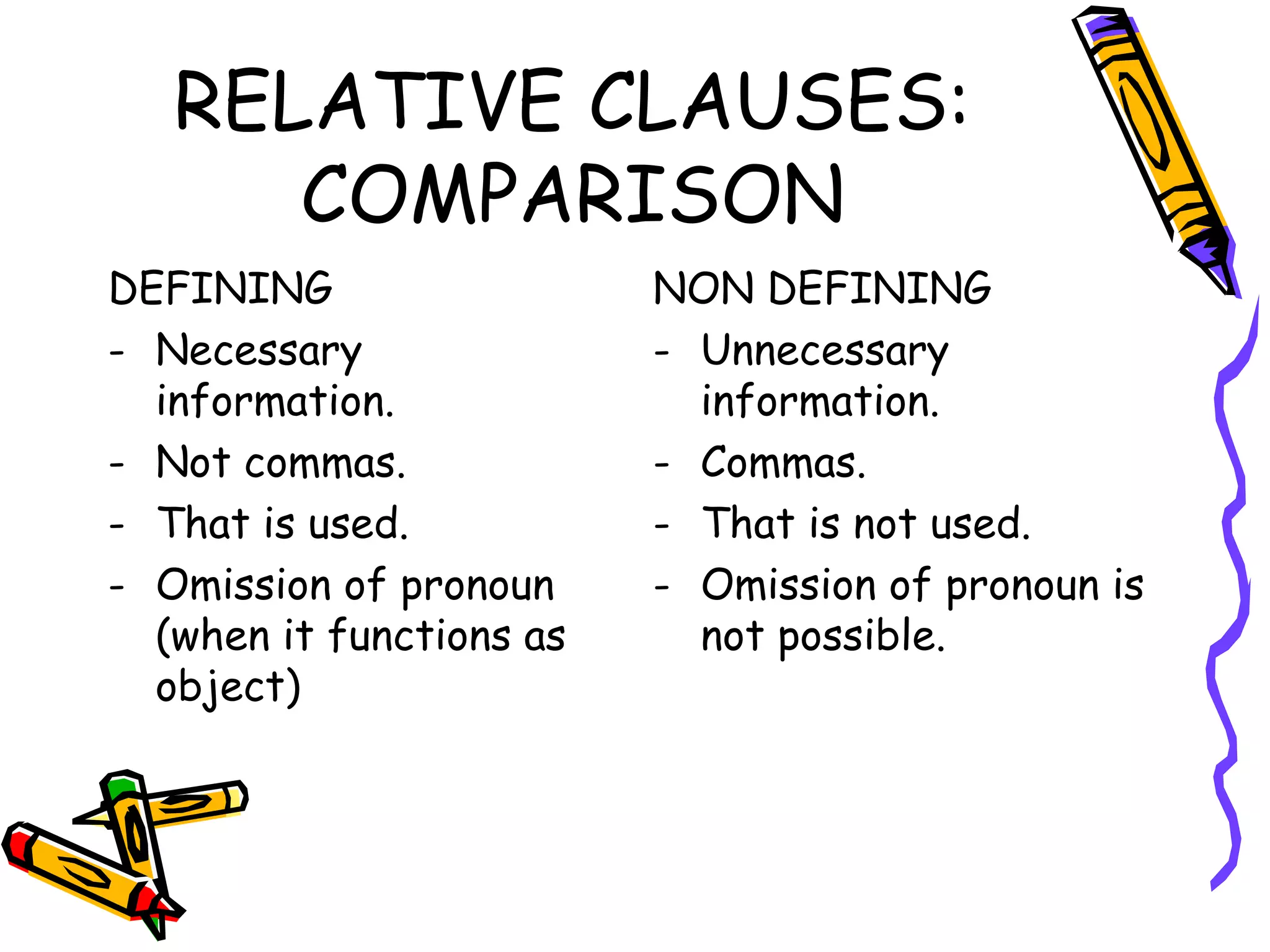
RELATIVE CLAUSES: COMPARISON DEFINING Necessary information. Not commas. That is used. Omission of pronoun (when it functions as object) NON DEFINING Unnecessary information. Commas. That is not used. Omission of pronoun is not possible.
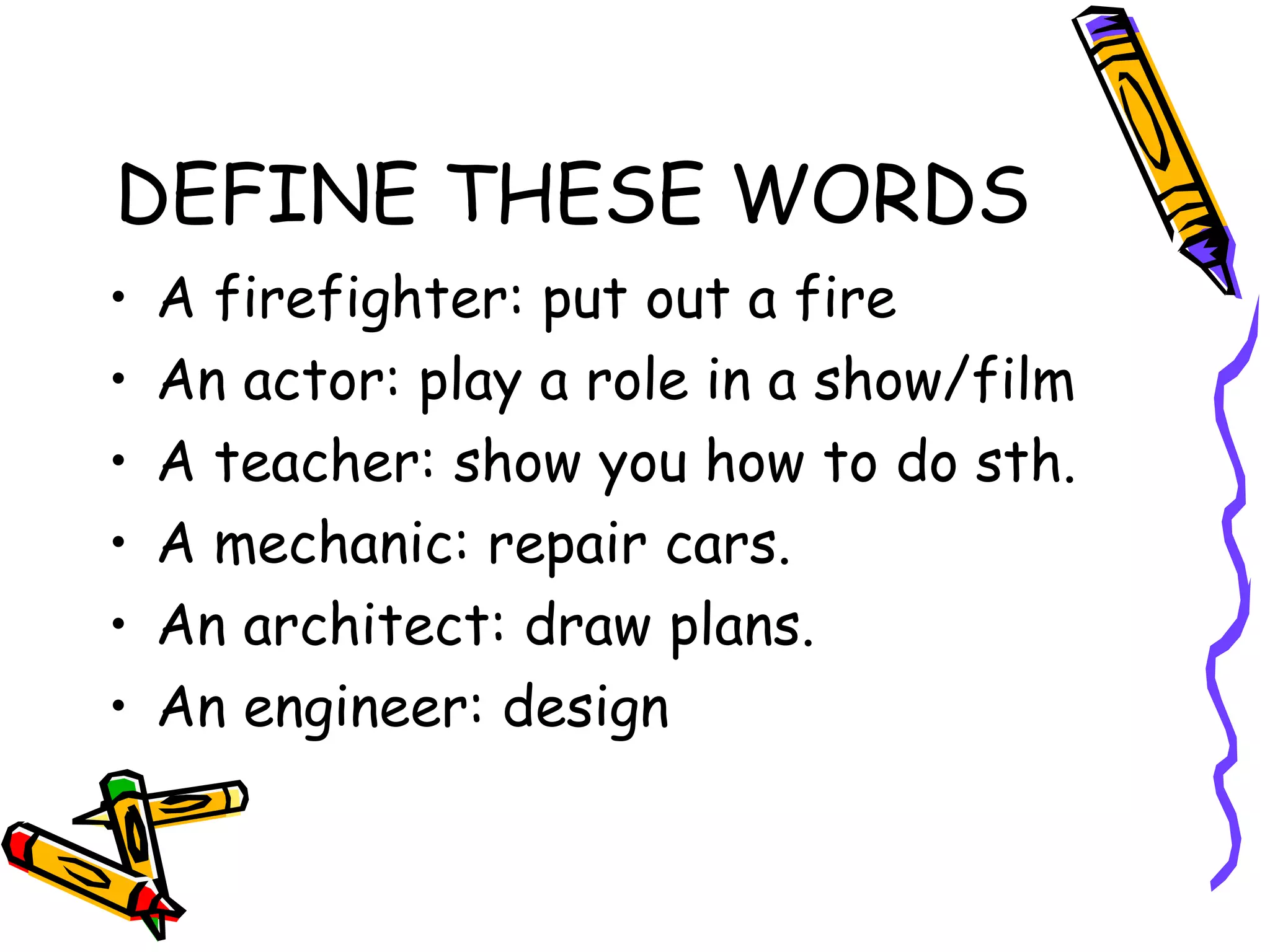
DEFINE THESE WORDS A firefighter: put out a fire An actor: play a role in a show/film A teacher: show you how to do sth. A mechanic: repair cars. An architect: draw plans. An engineer: design
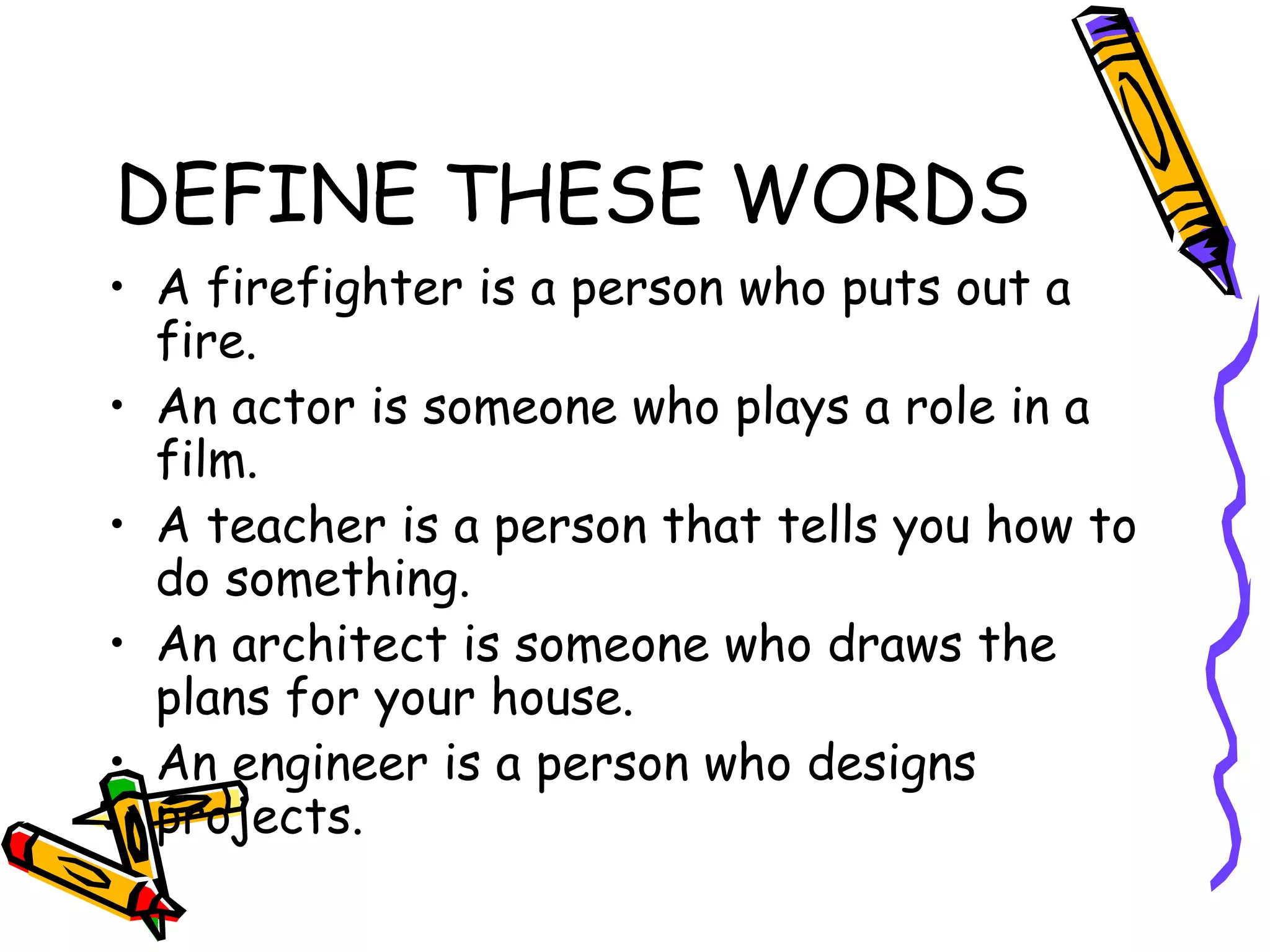
DEFINE THESE WORDS A firefighter is a person who puts out a fire. An actor is someone who plays a role in a film. A teacher is a person that tells you how to do something. An architect is someone who draws the plans for your house. An engineer is a person who designs projects.
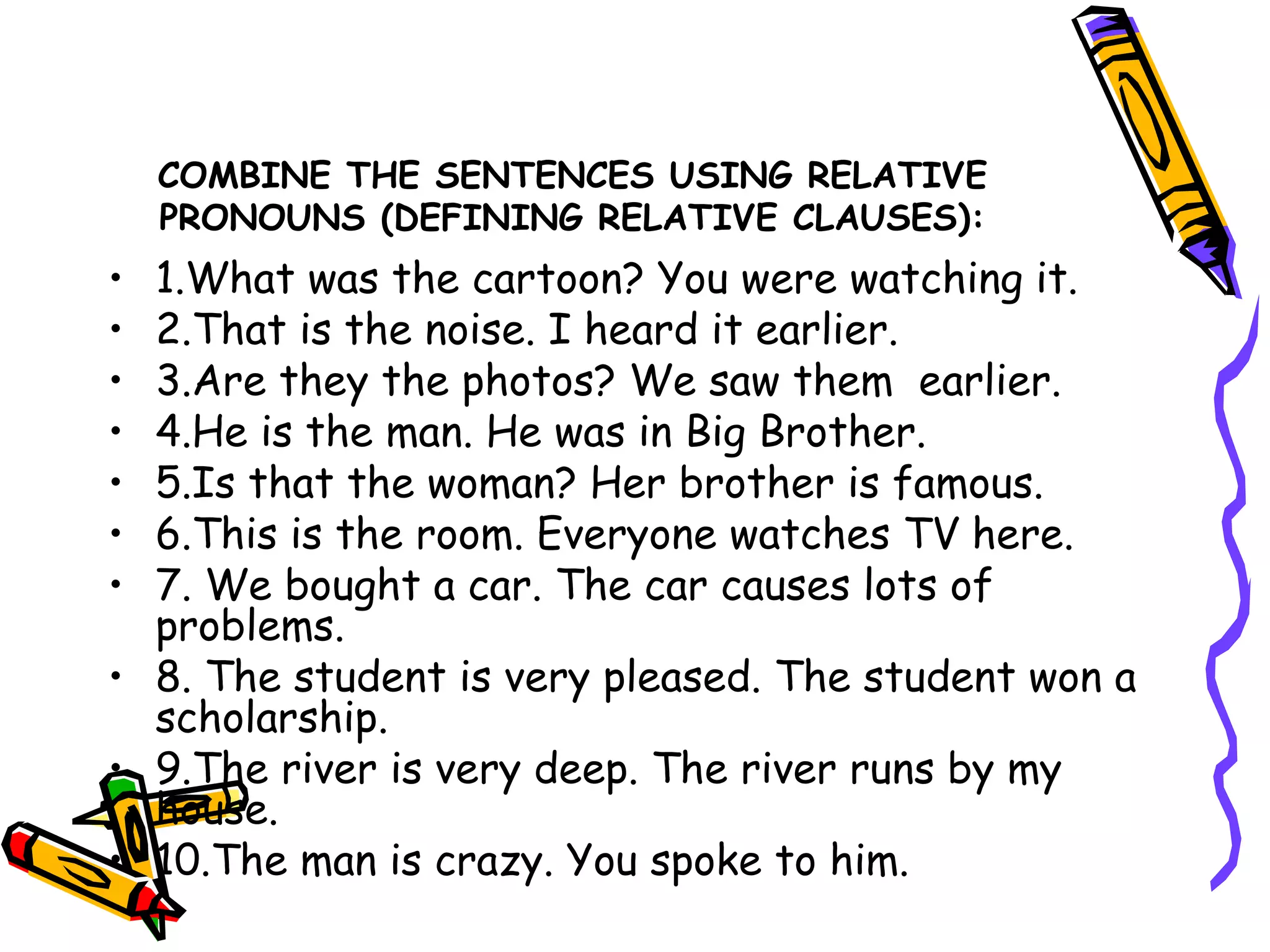
COMBINE THE SENTENCES USING RELATIVE PRONOUNS (DEFINING RELATIVE CLAUSES): 1.What was the cartoon? You were watching it. 2.That is the noise. I heard it earlier. 3.Are they the photos? We saw them  earlier. 4.He is the man. He was in Big Brother. 5.Is that the woman? Her brother is famous. 6.This is the room. Everyone watches TV here. 7. We bought a car. The car causes lots of problems. 8. The student is very pleased. The student won a scholarship. 9.The river is very deep. The river runs by my house. 10.The man is crazy. You spoke to him.
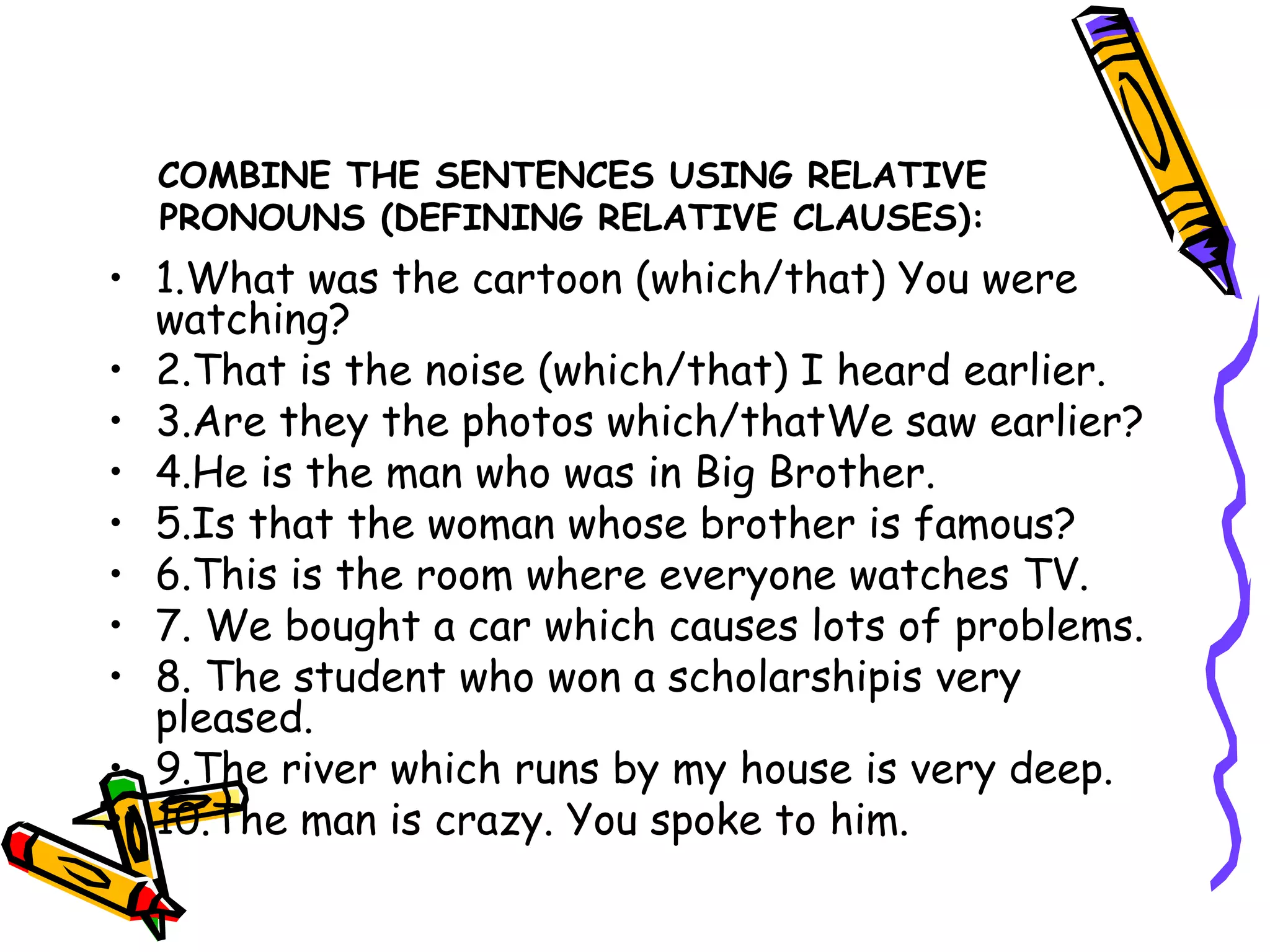
COMBINE THE SENTENCES USING RELATIVE PRONOUNS (DEFINING RELATIVE CLAUSES): 1.What was the cartoon (which/that) You were watching? 2.That is the noise (which/that) I heard earlier. 3.Are they the photos which/thatWe saw earlier? 4.He is the man who was in Big Brother. 5.Is that the woman whose brother is famous? 6.This is the room where everyone watches TV. 7. We bought a car which causes lots of problems. 8. The student who won a scholarshipis very pleased.  9.The river which runs by my house is very deep. 10.The man is crazy. You spoke to him.
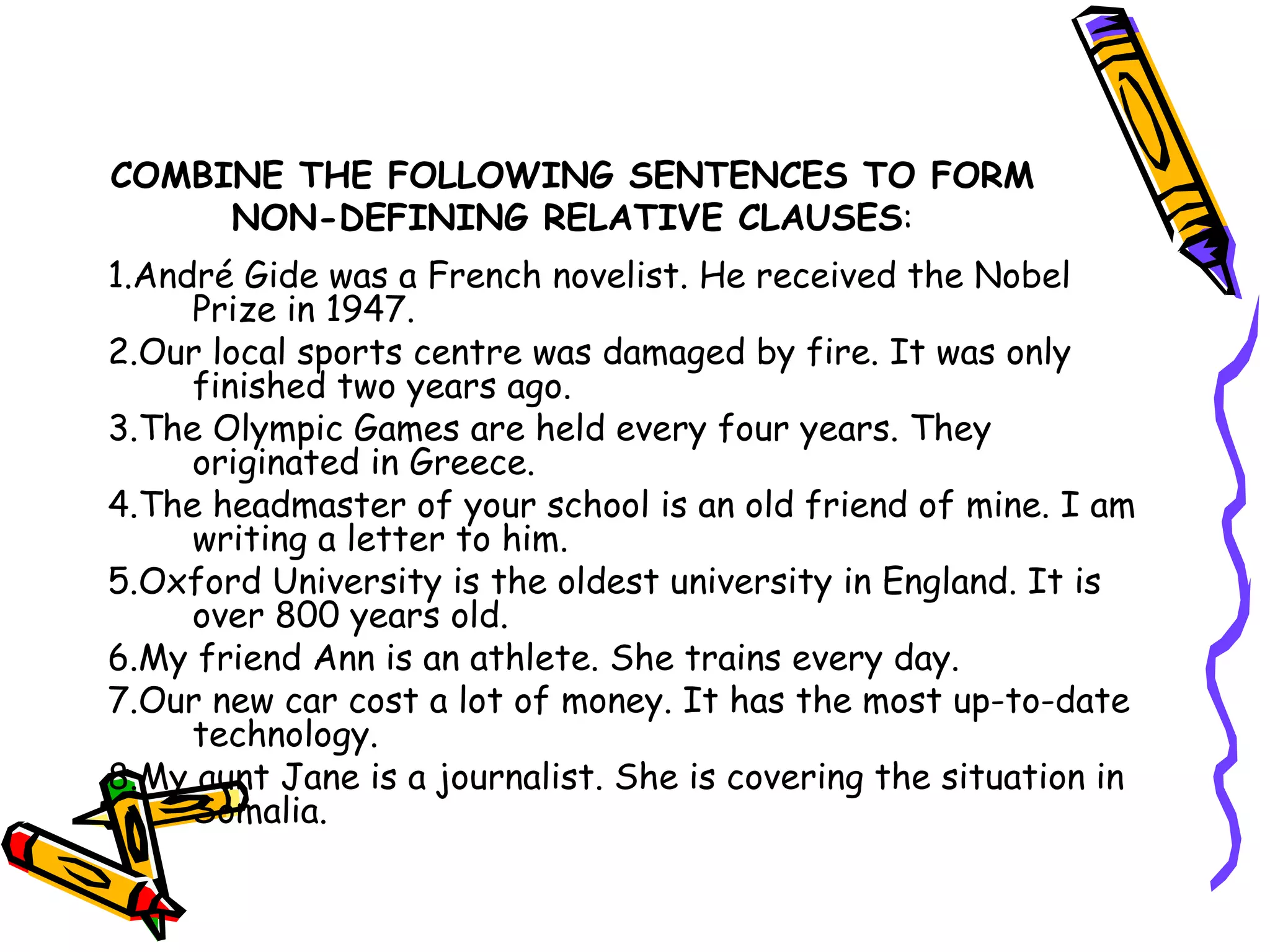
COMBINE THE FOLLOWING SENTENCES TO FORM NON-DEFINING RELATIVE CLAUSES : 1.André Gide was a French novelist. He received the Nobel Prize in 1947. 2.Our local sports centre was damaged by fire. It was only finished two years ago. 3.The Olympic Games are held every four years. They originated in Greece. 4.The headmaster of your school is an old friend of mine. I am writing a letter to him. 5.Oxford University is the oldest university in England. It is over 800 years old. 6.My friend Ann is an athlete. She trains every day. 7.Our new car cost a lot of money. It has the most up-to-date technology. 8.My aunt Jane is a journalist. She is covering the situation in Somalia.
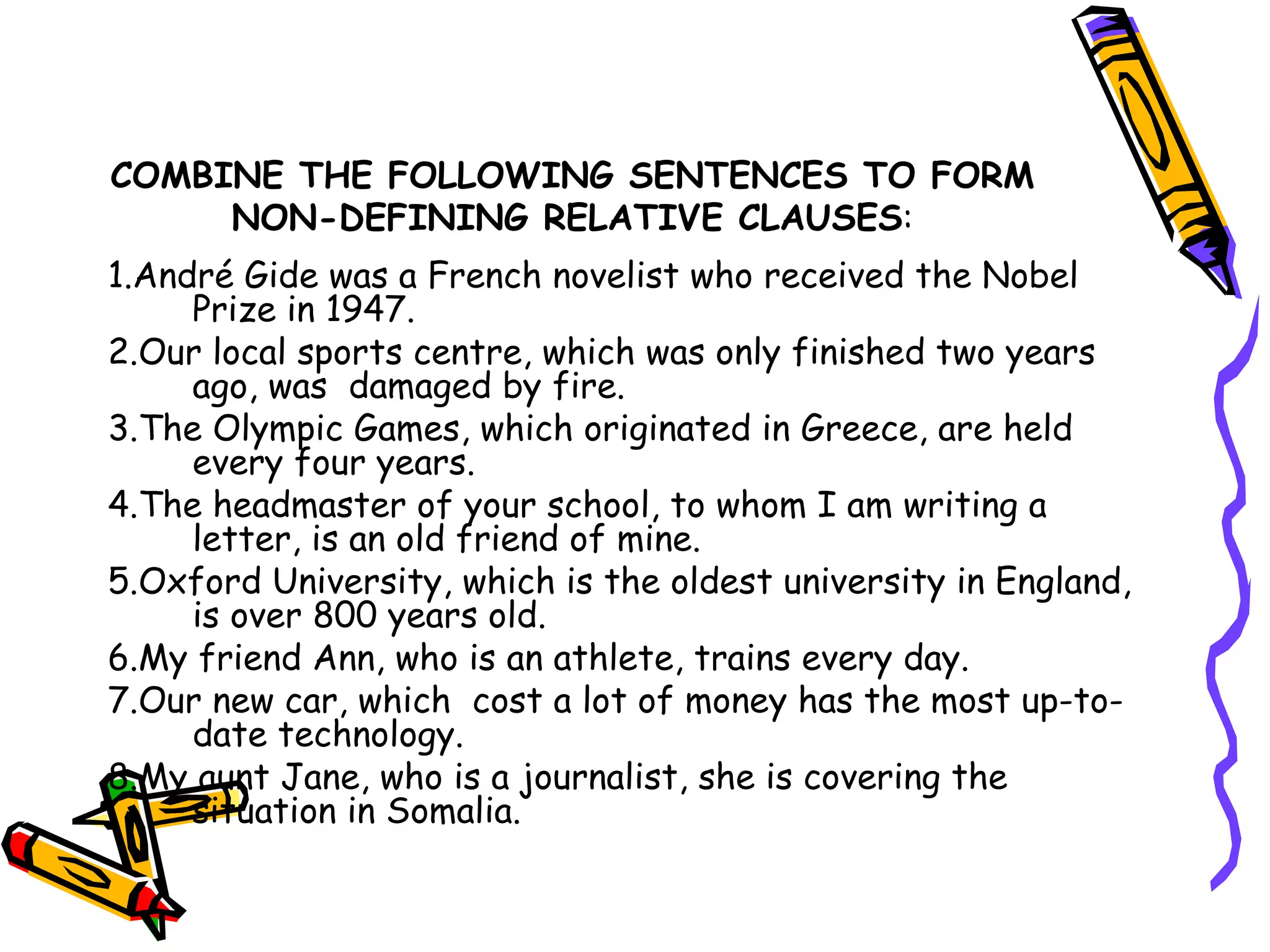
COMBINE THE FOLLOWING SENTENCES TO FORM NON-DEFINING RELATIVE CLAUSES : 1.André Gide was a French novelist who received the Nobel Prize in 1947. 2.Our local sports centre, which was only finished two years ago, was  damaged by fire.  3.The Olympic Games, which originated in Greece, are held every four years.  4.The headmaster of your school, to whom I am writing a letter, is an old friend of mine.  5.Oxford University, which is the oldest university in England,  is over 800 years old. 6.My friend Ann, who is an athlete, trains every day. 7.Our new car, which  cost a lot of money has the most up-to-date technology. 8.My aunt Jane, who is a journalist, she is covering the situation in Somalia.

/Media/usbdisk/relative clauses

  • 1.
  • 2.
    RELATIVE CLAUSES Tracyis the girl. She loves the idea. Tracy is the girl who/that loves the idea.
  • 3.
    CHARACTERISTICS. Tracy isthe girl who loves the idea. Used to form complex sentences. To join information which is repeated. Introduction of relative pronoun: who; which; that; where; when… Some element is omitted.
  • 4.
    RELATIVE PRONOUNS. Dependingon the antecedent (the name they make reference to). Ex: That is the man . The man came yesterday. R.C: That is the man who came yesterday. ( Who makes reference to the man).
  • 5.
    RELATIVE PRONOUNS: Who:To refer to people. Ex: She is the girl who won the price. Which: To refer to animals/things. Ex: Flexpetz is an agency which …. That: People/ objects (only defining Ex: The dog that they rented…. Ex: The student who comes on time…
  • 6.
    OTHER RELATIVE PRONOUNS:Whose: To express possession (cuyo/a): whose+ noun Ex: The man whose dog was stolen. When: To express time. Ex: The day when I was born… Where: To express place Ex: The village where it took place…
  • 7.
    OTHER RELATIVE PRONOUNS:WHY: To express reason (por lo que) Ex: The reason why she came … WHOM: For people (after preposition) Ex: The owner is the person to whom you have to talk. (Formal language) (… is the person you have to talk to). Informal language.
  • 8.
    DEFINING RELATIVE CLAUSESThey add necessary information. Ex: The man who came is… (Not any man, but that who came.) That can be used. Ex: The man who came… The man that came…. The pronoun can be omitted if it does not function as subject. (only who, that and which ). Ex: The girl (who) you saw…
  • 9.
    NON-DEFINING RELATIVE CLAUSES.Not necessary information, in commas. Ex: Shakespeare, who was born in Stratford upon Avon, is the greatest… That cannot be used. Ex: Shakespeare, *that was born… The pronoun cannot be omitted.
  • 10.
    RELATIVE CLAUSES: COMPARISONDEFINING Necessary information. Not commas. That is used. Omission of pronoun (when it functions as object) NON DEFINING Unnecessary information. Commas. That is not used. Omission of pronoun is not possible.
  • 11.
    DEFINE THESE WORDSA firefighter: put out a fire An actor: play a role in a show/film A teacher: show you how to do sth. A mechanic: repair cars. An architect: draw plans. An engineer: design
  • 12.
    DEFINE THESE WORDSA firefighter is a person who puts out a fire. An actor is someone who plays a role in a film. A teacher is a person that tells you how to do something. An architect is someone who draws the plans for your house. An engineer is a person who designs projects.
  • 13.
    COMBINE THE SENTENCESUSING RELATIVE PRONOUNS (DEFINING RELATIVE CLAUSES): 1.What was the cartoon? You were watching it. 2.That is the noise. I heard it earlier. 3.Are they the photos? We saw them earlier. 4.He is the man. He was in Big Brother. 5.Is that the woman? Her brother is famous. 6.This is the room. Everyone watches TV here. 7. We bought a car. The car causes lots of problems. 8. The student is very pleased. The student won a scholarship. 9.The river is very deep. The river runs by my house. 10.The man is crazy. You spoke to him.
  • 14.
    COMBINE THE SENTENCESUSING RELATIVE PRONOUNS (DEFINING RELATIVE CLAUSES): 1.What was the cartoon (which/that) You were watching? 2.That is the noise (which/that) I heard earlier. 3.Are they the photos which/thatWe saw earlier? 4.He is the man who was in Big Brother. 5.Is that the woman whose brother is famous? 6.This is the room where everyone watches TV. 7. We bought a car which causes lots of problems. 8. The student who won a scholarshipis very pleased. 9.The river which runs by my house is very deep. 10.The man is crazy. You spoke to him.
  • 15.
    COMBINE THE FOLLOWINGSENTENCES TO FORM NON-DEFINING RELATIVE CLAUSES : 1.André Gide was a French novelist. He received the Nobel Prize in 1947. 2.Our local sports centre was damaged by fire. It was only finished two years ago. 3.The Olympic Games are held every four years. They originated in Greece. 4.The headmaster of your school is an old friend of mine. I am writing a letter to him. 5.Oxford University is the oldest university in England. It is over 800 years old. 6.My friend Ann is an athlete. She trains every day. 7.Our new car cost a lot of money. It has the most up-to-date technology. 8.My aunt Jane is a journalist. She is covering the situation in Somalia.
  • 16.
    COMBINE THE FOLLOWINGSENTENCES TO FORM NON-DEFINING RELATIVE CLAUSES : 1.André Gide was a French novelist who received the Nobel Prize in 1947. 2.Our local sports centre, which was only finished two years ago, was damaged by fire. 3.The Olympic Games, which originated in Greece, are held every four years. 4.The headmaster of your school, to whom I am writing a letter, is an old friend of mine. 5.Oxford University, which is the oldest university in England, is over 800 years old. 6.My friend Ann, who is an athlete, trains every day. 7.Our new car, which cost a lot of money has the most up-to-date technology. 8.My aunt Jane, who is a journalist, she is covering the situation in Somalia.