UPPER INTERMEDIATE
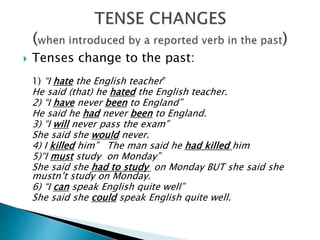
 Tenses change to the past:
1) “I hate the English teacher”
He said (that) he hated the English teacher.
2) “I have never been to England”
He said he had never been to England.
3) “I will never pass the exam”
She said she would never.
4) I killed him” The man said he had killed him
5)“I must study on Monday”
She said she had to study on Monday BUT she said she
mustn’t study on Monday.
6) “I can speak English quite well”
She said she could speak English quite well.
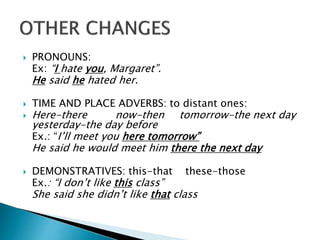
 PRONOUNS:
Ex: “I hate you, Margaret”.
He said he hated her.
 TIME AND PLACE ADVERBS: to distant ones:
 Here-there now-then tomorrow-the next day
yesterday-the day before
Ex.: “I’ll meet you here tomorrow”
He said he would meet him there the next day
 DEMONSTRATIVES: this-that these-those
Ex.: “I don’t like this class”
She said she didn’t like that class
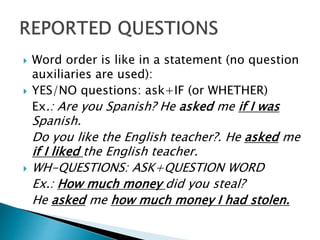
 Word order is like in a statement (no question
auxiliaries are used):
 YES/NO questions: ask+IF (or WHETHER)
Ex.: Are you Spanish? He asked me if I was
Spanish.
Do you like the English teacher?. He asked me
if I liked the English teacher.
 WH-QUESTIONS: ASK+QUESTION WORD
Ex.: How much money did you steal?
He asked me how much money I had stolen.
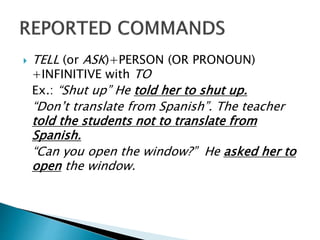
 TELL (or ASK)+PERSON (OR PRONOUN)
+INFINITIVE with TO
Ex.: “Shut up” He told her to shut up.
“Don’t translate from Spanish”. The teacher
told the students not to translate from
Spanish.
“Can you open the window?” He asked her to
open the window.
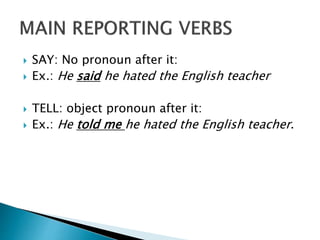
 SAY: No pronoun after it:
 Ex.: He said he hated the English teacher
 TELL: object pronoun after it:
 Ex.: He told me he hated the English teacher.
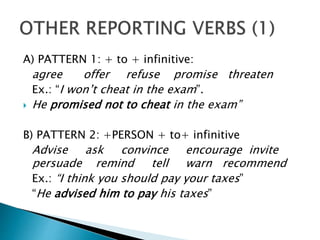
A) PATTERN 1: + to + infinitive:
agree offer refuse promise threaten
Ex.: “I won’t cheat in the exam”.
 He promised not to cheat in the exam”
B) PATTERN 2: +PERSON + to+ infinitive
Advise ask convince encourage invite
persuade remind tell warn recommend
Ex.: “I think you should pay your taxes”
“He advised him to pay his taxes”
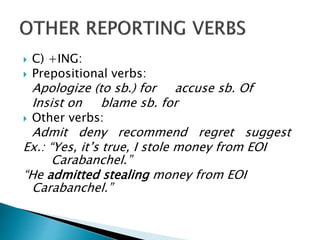
 C) +ING:
 Prepositional verbs:
Apologize (to sb.) for accuse sb. Of
Insist on blame sb. for
 Other verbs:
Admit deny recommend regret suggest
Ex.: “Yes, it’s true, I stole money from EOI
Carabanchel.”
“He admitted stealing money from EOI
Carabanchel.”

Reportedspeechandreportingverbsupperintermediate

  • 1.
  • 2.
     Tenses changeto the past: 1) “I hate the English teacher” He said (that) he hated the English teacher. 2) “I have never been to England” He said he had never been to England. 3) “I will never pass the exam” She said she would never. 4) I killed him” The man said he had killed him 5)“I must study on Monday” She said she had to study on Monday BUT she said she mustn’t study on Monday. 6) “I can speak English quite well” She said she could speak English quite well.
  • 3.
     PRONOUNS: Ex: “Ihate you, Margaret”. He said he hated her.  TIME AND PLACE ADVERBS: to distant ones:  Here-there now-then tomorrow-the next day yesterday-the day before Ex.: “I’ll meet you here tomorrow” He said he would meet him there the next day  DEMONSTRATIVES: this-that these-those Ex.: “I don’t like this class” She said she didn’t like that class
  • 4.
     Word orderis like in a statement (no question auxiliaries are used):  YES/NO questions: ask+IF (or WHETHER) Ex.: Are you Spanish? He asked me if I was Spanish. Do you like the English teacher?. He asked me if I liked the English teacher.  WH-QUESTIONS: ASK+QUESTION WORD Ex.: How much money did you steal? He asked me how much money I had stolen.
  • 5.
     TELL (orASK)+PERSON (OR PRONOUN) +INFINITIVE with TO Ex.: “Shut up” He told her to shut up. “Don’t translate from Spanish”. The teacher told the students not to translate from Spanish. “Can you open the window?” He asked her to open the window.
  • 6.
     SAY: Nopronoun after it:  Ex.: He said he hated the English teacher  TELL: object pronoun after it:  Ex.: He told me he hated the English teacher.
  • 7.
    A) PATTERN 1:+ to + infinitive: agree offer refuse promise threaten Ex.: “I won’t cheat in the exam”.  He promised not to cheat in the exam” B) PATTERN 2: +PERSON + to+ infinitive Advise ask convince encourage invite persuade remind tell warn recommend Ex.: “I think you should pay your taxes” “He advised him to pay his taxes”
  • 8.
     C) +ING: Prepositional verbs: Apologize (to sb.) for accuse sb. Of Insist on blame sb. for  Other verbs: Admit deny recommend regret suggest Ex.: “Yes, it’s true, I stole money from EOI Carabanchel.” “He admitted stealing money from EOI Carabanchel.”