The Use of Articles

       HENRY
     LEONARDO
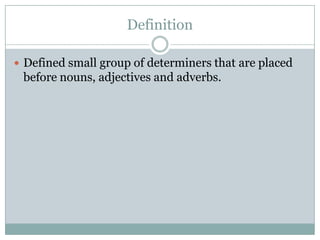
Definition

 Defined small group of determiners that are placed
 before nouns, adjectives and adverbs.
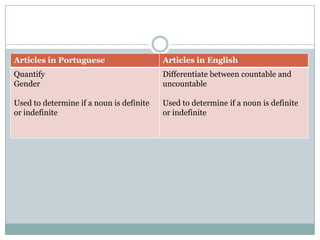
Articles in Portuguese                    Articles in English
Quantify                                  Differentiate between countable and
Gender                                    uncountable

Used to determine if a noun is definite   Used to determine if a noun is definite
or indefinite                             or indefinite
Indefinite Articles

 A and An
   A and an are used before singular countable nouns that are
    not specific and are being mentioned for the first time.
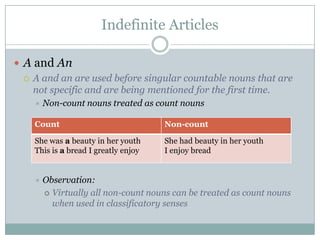
       Non-count nouns treated as count nouns

    Count                             Non-count

    She was a beauty in her youth     She had beauty in her youth
    This is a bread I greatly enjoy   I enjoy bread


       Observation:
         Virtually all non-count nouns can be treated as count nouns
          when used in classificatory senses
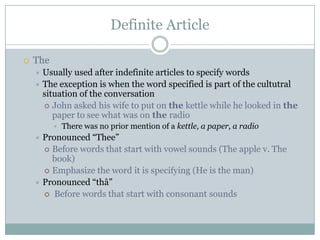
Definite Article

   The
     Usually used after indefinite articles to specify words
     The exception is when the word specified is part of the cultutral
      situation of the conversation
       John asked his wife to put on the kettle while he looked in the
         paper to see what was on the radio
          • There was no prior mention of a kettle, a paper, a radio
     Pronounced “Thee”
       Before words that start with vowel sounds (The apple v. The
        book)
       Emphasize the word it is specifying (He is the man)
     Pronounced “thâ”
       Before words that start with consonant sounds
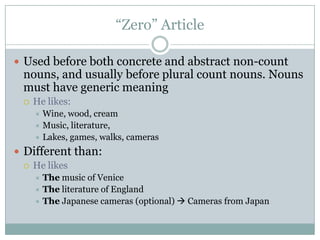
“Zero” Article

 Used before both concrete and abstract non-count
 nouns, and usually before plural count nouns. Nouns
 must have generic meaning
    He likes:
      Wine, wood, cream
      Music, literature,
      Lakes, games, walks, cameras

 Different than:
   He likes
      The music of Venice
      The literature of England
      The Japanese cameras (optional)  Cameras from Japan
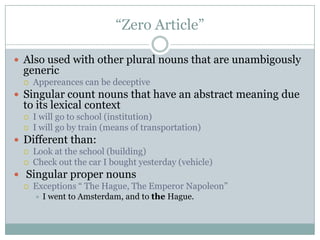
“Zero Article”

 Also used with other plural nouns that are unambigously
 generic
    Appereances can be deceptive
 Singular count nouns that have an abstract meaning due
 to its lexical context
    I will go to school (institution)
    I will go by train (means of transportation)
 Different than:
    Look at the school (building)
    Check out the car I bought yesterday (vehicle)
 Singular proper nouns
    Exceptions “ The Hague, The Emperor Napoleon”
        I went to Amsterdam, and to the Hague.
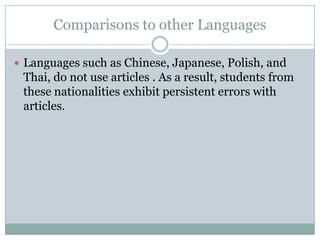
Comparisons to other Languages

 Languages such as Chinese, Japanese, Polish, and
 Thai, do not use articles . As a result, students from
 these nationalities exhibit persistent errors with
 articles.
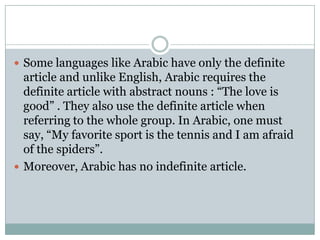
 Some languages like Arabic have only the definite
  article and unlike English, Arabic requires the
  definite article with abstract nouns : “The love is
  good” . They also use the definite article when
  referring to the whole group. In Arabic, one must
  say, “My favorite sport is the tennis and I am afraid
  of the spiders”.
 Moreover, Arabic has no indefinite article.
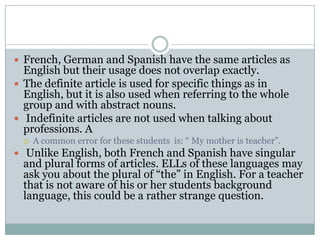
 French, German and Spanish have the same articles as
  English but their usage does not overlap exactly.
 The definite article is used for specific things as in
  English, but it is also used when referring to the whole
  group and with abstract nouns.
 Indefinite articles are not used when talking about
  professions. A
     A common error for these students is: “ My mother is teacher”.
 Unlike English, both French and Spanish have singular
  and plural forms of articles. ELLs of these languages may
  ask you about the plural of “the” in English. For a teacher
  that is not aware of his or her students background
  language, this could be a rather strange question.
Works Cited

 Quirk, Randolph, and Sidney Greenbaum. "4.17 -
 4.21." A University Grammar of English. [Harlow]:
 Longman, 1973. 69-74. Print.

Henry e leonardo

  • 1.
    The Use ofArticles HENRY LEONARDO
  • 2.
    Definition  Defined smallgroup of determiners that are placed before nouns, adjectives and adverbs.
  • 3.
    Articles in Portuguese Articles in English Quantify Differentiate between countable and Gender uncountable Used to determine if a noun is definite Used to determine if a noun is definite or indefinite or indefinite
  • 4.
    Indefinite Articles  Aand An  A and an are used before singular countable nouns that are not specific and are being mentioned for the first time.  Non-count nouns treated as count nouns Count Non-count She was a beauty in her youth She had beauty in her youth This is a bread I greatly enjoy I enjoy bread  Observation:  Virtually all non-count nouns can be treated as count nouns when used in classificatory senses
  • 5.
    Definite Article  The  Usually used after indefinite articles to specify words  The exception is when the word specified is part of the cultutral situation of the conversation  John asked his wife to put on the kettle while he looked in the paper to see what was on the radio • There was no prior mention of a kettle, a paper, a radio  Pronounced “Thee”  Before words that start with vowel sounds (The apple v. The book)  Emphasize the word it is specifying (He is the man)  Pronounced “thâ”  Before words that start with consonant sounds
  • 6.
    “Zero” Article  Usedbefore both concrete and abstract non-count nouns, and usually before plural count nouns. Nouns must have generic meaning  He likes:  Wine, wood, cream  Music, literature,  Lakes, games, walks, cameras  Different than:  He likes  The music of Venice  The literature of England  The Japanese cameras (optional)  Cameras from Japan
  • 7.
    “Zero Article”  Alsoused with other plural nouns that are unambigously generic  Appereances can be deceptive  Singular count nouns that have an abstract meaning due to its lexical context  I will go to school (institution)  I will go by train (means of transportation)  Different than:  Look at the school (building)  Check out the car I bought yesterday (vehicle)  Singular proper nouns  Exceptions “ The Hague, The Emperor Napoleon”  I went to Amsterdam, and to the Hague.
  • 8.
    Comparisons to otherLanguages  Languages such as Chinese, Japanese, Polish, and Thai, do not use articles . As a result, students from these nationalities exhibit persistent errors with articles.
  • 9.
     Some languageslike Arabic have only the definite article and unlike English, Arabic requires the definite article with abstract nouns : “The love is good” . They also use the definite article when referring to the whole group. In Arabic, one must say, “My favorite sport is the tennis and I am afraid of the spiders”.  Moreover, Arabic has no indefinite article.
  • 10.
     French, Germanand Spanish have the same articles as English but their usage does not overlap exactly.  The definite article is used for specific things as in English, but it is also used when referring to the whole group and with abstract nouns.  Indefinite articles are not used when talking about professions. A  A common error for these students is: “ My mother is teacher”.  Unlike English, both French and Spanish have singular and plural forms of articles. ELLs of these languages may ask you about the plural of “the” in English. For a teacher that is not aware of his or her students background language, this could be a rather strange question.
  • 11.
    Works Cited  Quirk,Randolph, and Sidney Greenbaum. "4.17 - 4.21." A University Grammar of English. [Harlow]: Longman, 1973. 69-74. Print.