Expressions with prepositions
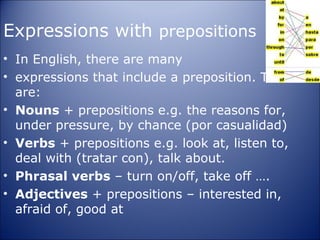
• In English, there are many
• expressions that include a preposition. There
  are:
• Nouns + prepositions e.g. the reasons for,
  under pressure, by chance (por casualidad)
• Verbs + prepositions e.g. look at, listen to,
  deal with (tratar con), talk about.
• Phrasal verbs – turn on/off, take off ….
• Adjectives + prepositions – interested in,
  afraid of, good at
Nouns + prepositions
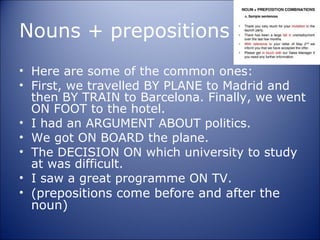
• Here are some of the common ones:
• First, we travelled BY PLANE to Madrid and
  then BY TRAIN to Barcelona. Finally, we went
  ON FOOT to the hotel.
• I had an ARGUMENT ABOUT politics.
• We got ON BOARD the plane.
• The DECISION ON which university to study
  at was difficult.
• I saw a great programme ON TV.
• (prepositions come before and after the
  noun)
Verbs + prepositions
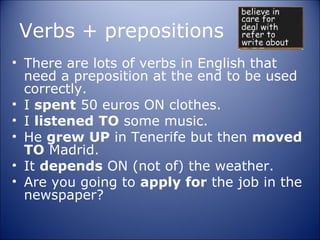
• There are lots of verbs in English that
  need a preposition at the end to be used
  correctly.
• I spent 50 euros ON clothes.
• I listened TO some music.
• He grew UP in Tenerife but then moved
  TO Madrid.
• It depends ON (not of) the weather.
• Are you going to apply for the job in the
  newspaper?
Phrasal verbs
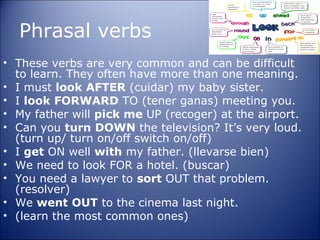
• These verbs are very common and can be difficult
  to learn. They often have more than one meaning.
• I must look AFTER (cuidar) my baby sister.
• I look FORWARD TO (tener ganas) meeting you.
• My father will pick me UP (recoger) at the airport.
• Can you turn DOWN the television? It’s very loud.
  (turn up/ turn on/off switch on/off)
• I get ON well with my father. (llevarse bien)
• We need to look FOR a hotel. (buscar)
• You need a lawyer to sort OUT that problem.
  (resolver)
• We went OUT to the cinema last night.
• (learn the most common ones)
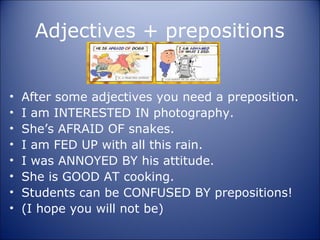
Adjectives + prepositions


•   After some adjectives you need a preposition.
•   I am INTERESTED IN photography.
•   She’s AFRAID OF snakes.
•   I am FED UP with all this rain.
•   I was ANNOYED BY his attitude.
•   She is GOOD AT cooking.
•   Students can be CONFUSED BY prepositions!
•   (I hope you will not be)
How to learn these expressions
• Remember to learn new words in at
  least groups of three i.e. learn the
  new word, the word before it, and
  the word after it.
• Case = In + case + of an emergency
• Look = Have a + look + at this menu
• Care = take + care + of yourself
• Regards = send my + regards+ to
  John

Prepositional Phrases

  • 1.
    Expressions with prepositions •In English, there are many • expressions that include a preposition. There are: • Nouns + prepositions e.g. the reasons for, under pressure, by chance (por casualidad) • Verbs + prepositions e.g. look at, listen to, deal with (tratar con), talk about. • Phrasal verbs – turn on/off, take off …. • Adjectives + prepositions – interested in, afraid of, good at
  • 2.
    Nouns + prepositions •Here are some of the common ones: • First, we travelled BY PLANE to Madrid and then BY TRAIN to Barcelona. Finally, we went ON FOOT to the hotel. • I had an ARGUMENT ABOUT politics. • We got ON BOARD the plane. • The DECISION ON which university to study at was difficult. • I saw a great programme ON TV. • (prepositions come before and after the noun)
  • 3.
    Verbs + prepositions •There are lots of verbs in English that need a preposition at the end to be used correctly. • I spent 50 euros ON clothes. • I listened TO some music. • He grew UP in Tenerife but then moved TO Madrid. • It depends ON (not of) the weather. • Are you going to apply for the job in the newspaper?
  • 4.
    Phrasal verbs • Theseverbs are very common and can be difficult to learn. They often have more than one meaning. • I must look AFTER (cuidar) my baby sister. • I look FORWARD TO (tener ganas) meeting you. • My father will pick me UP (recoger) at the airport. • Can you turn DOWN the television? It’s very loud. (turn up/ turn on/off switch on/off) • I get ON well with my father. (llevarse bien) • We need to look FOR a hotel. (buscar) • You need a lawyer to sort OUT that problem. (resolver) • We went OUT to the cinema last night. • (learn the most common ones)
  • 5.
    Adjectives + prepositions • After some adjectives you need a preposition. • I am INTERESTED IN photography. • She’s AFRAID OF snakes. • I am FED UP with all this rain. • I was ANNOYED BY his attitude. • She is GOOD AT cooking. • Students can be CONFUSED BY prepositions! • (I hope you will not be)
  • 6.
    How to learnthese expressions • Remember to learn new words in at least groups of three i.e. learn the new word, the word before it, and the word after it. • Case = In + case + of an emergency • Look = Have a + look + at this menu • Care = take + care + of yourself • Regards = send my + regards+ to John