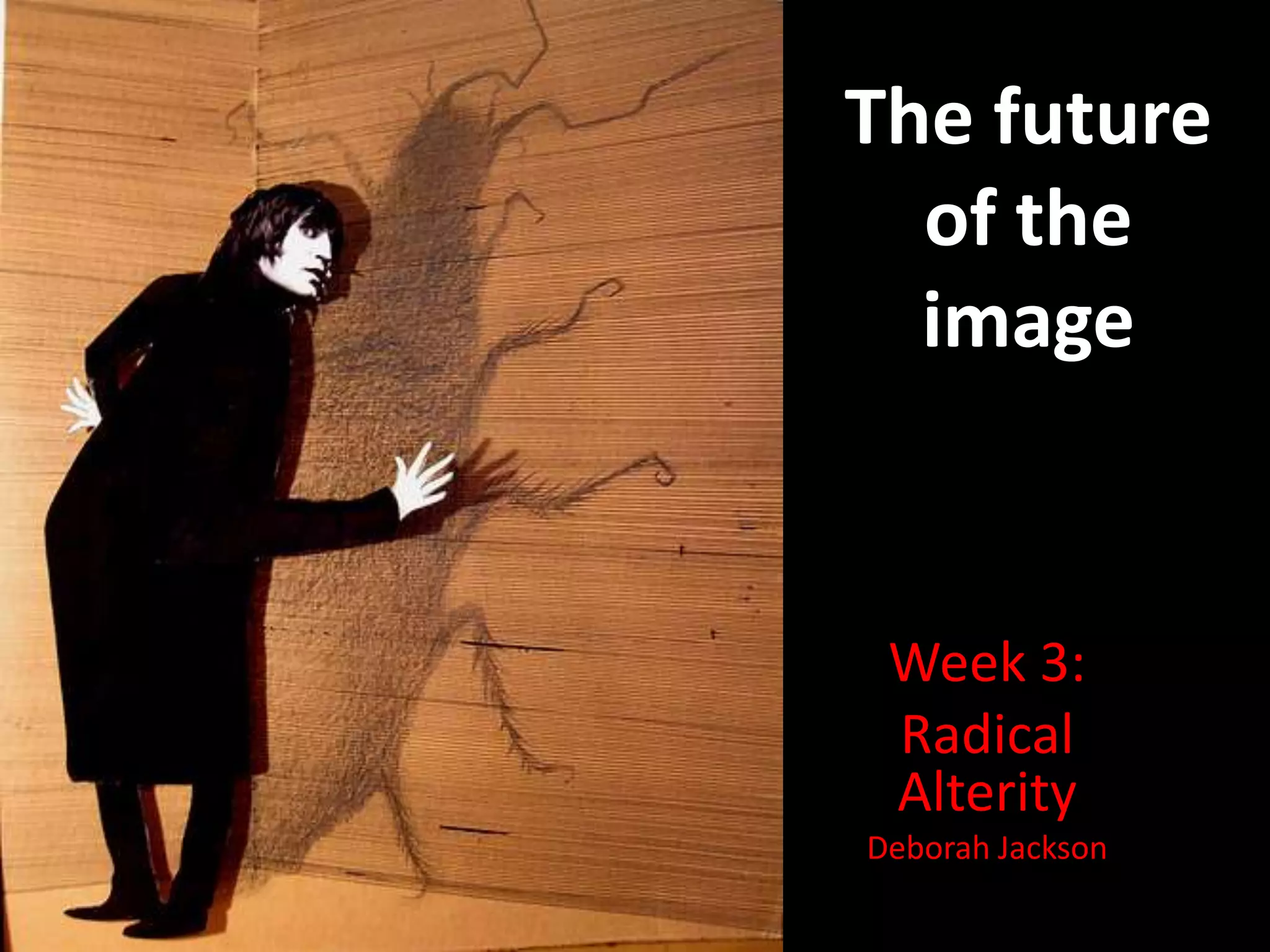
The future
  of the
  image


 Week 3:
 Radical
 Alterity
Deborah Jackson
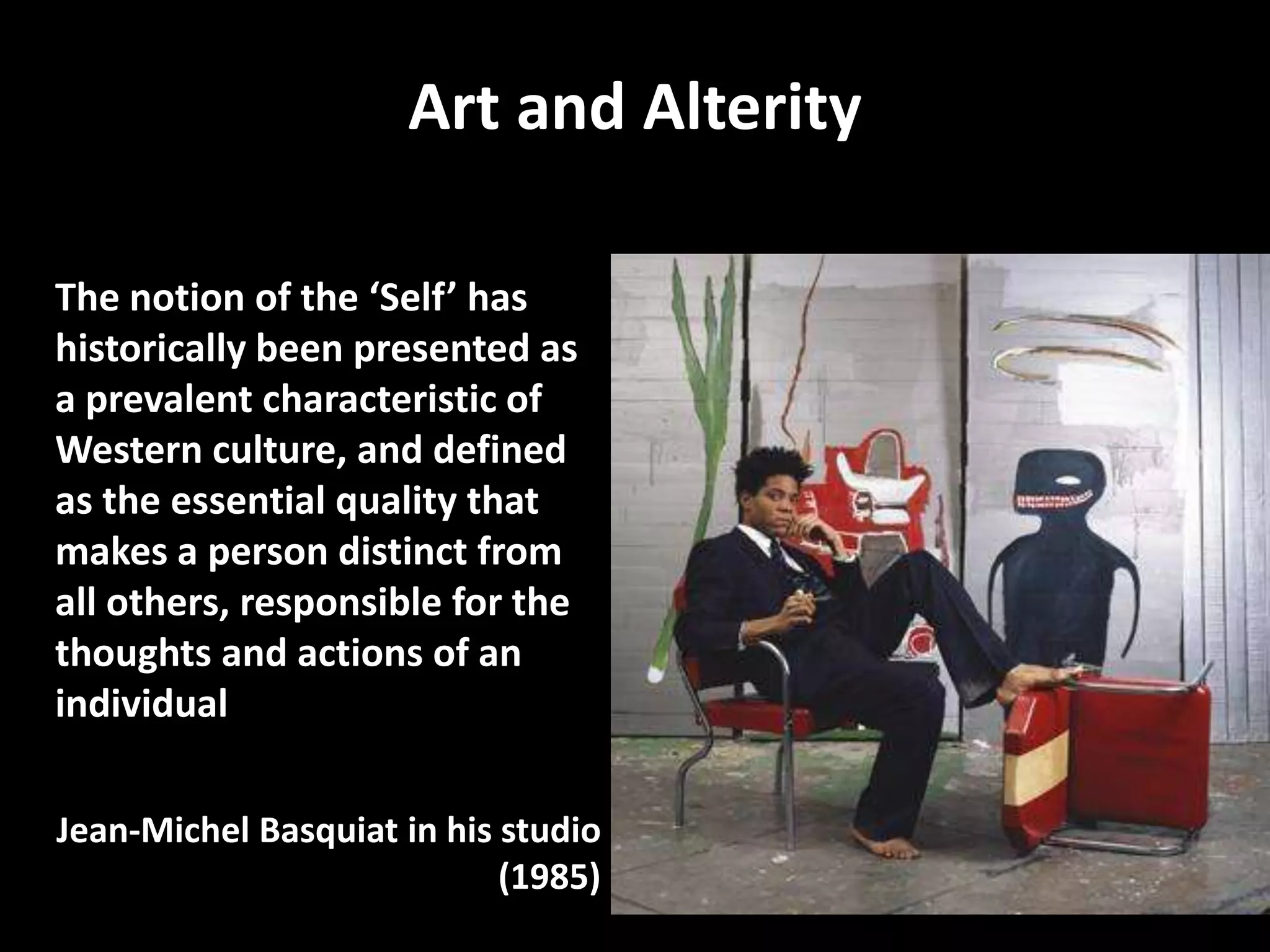
Art and Alterity

The notion of the ‘Self’ has
historically been presented as
a prevalent characteristic of
Western culture, and defined
as the essential quality that
makes a person distinct from
all others, responsible for the
thoughts and actions of an
individual

Jean-Michel Basquiat in his studio
                            (1985)
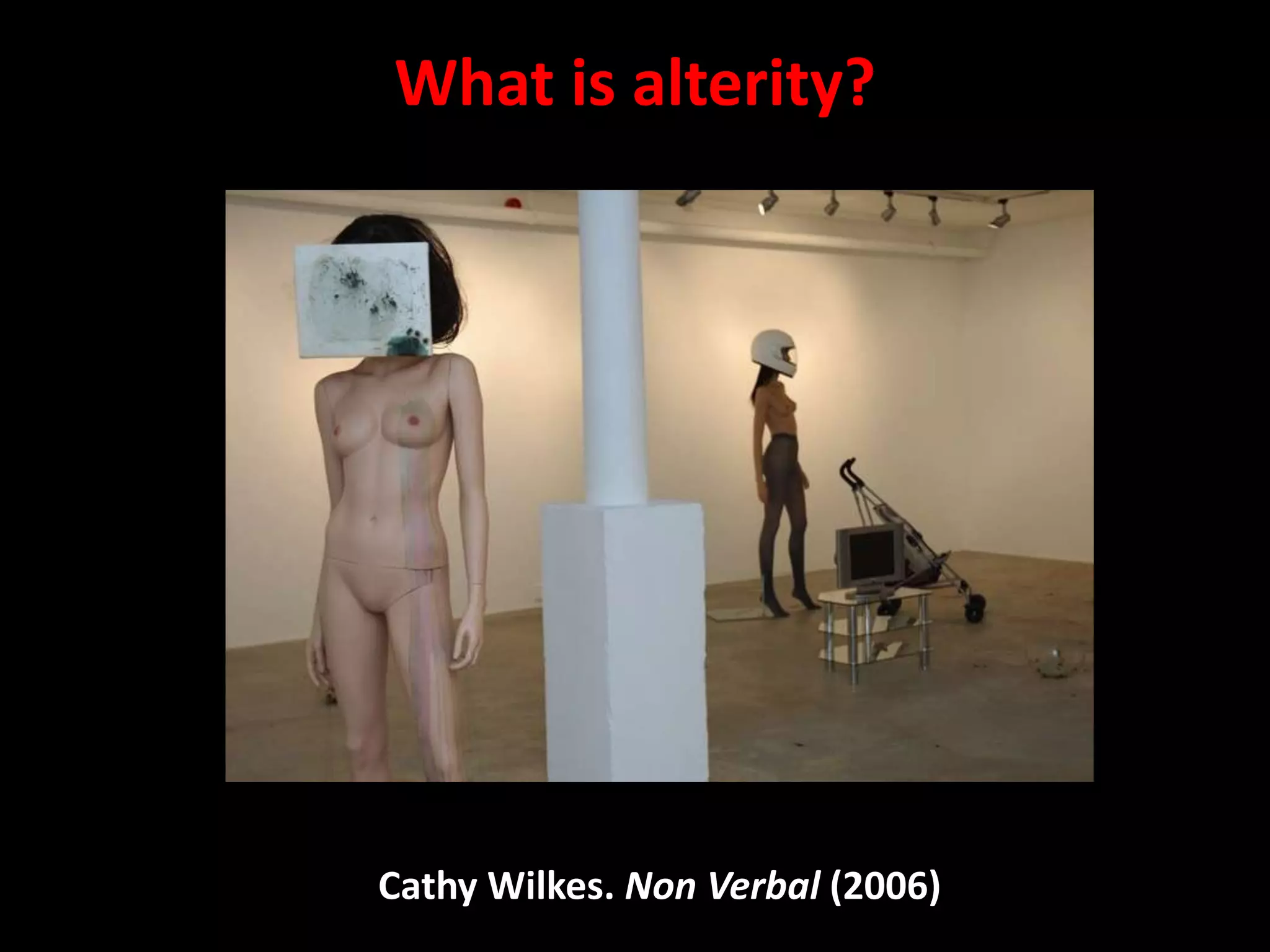
What is alterity?


Cathy Wilkes. Non Verbal (2006)
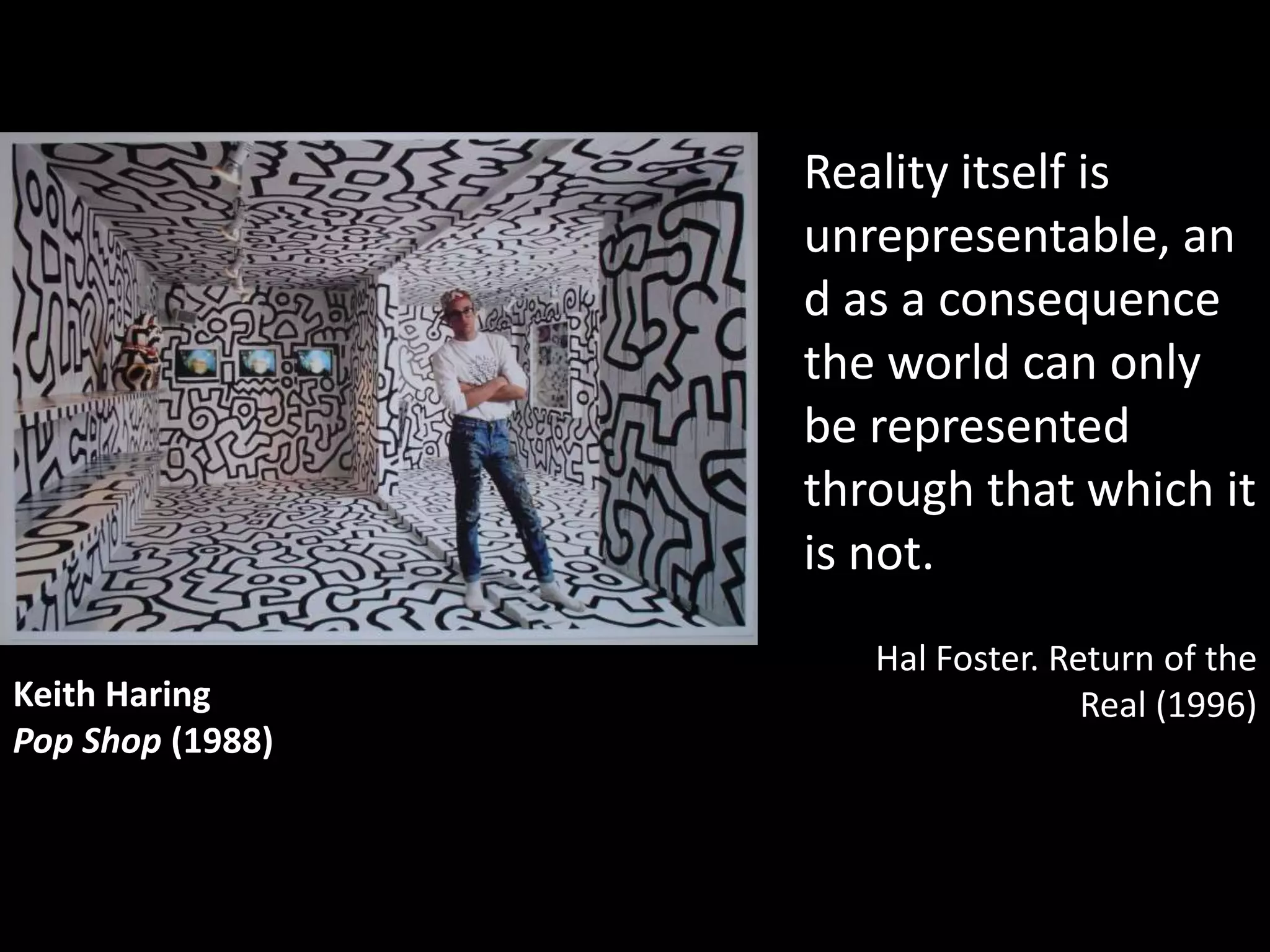
Reality itself is
                  unrepresentable, an
                  d as a consequence
                  the world can only
                  be represented
                  through that which it
                  is not.
                     Hal Foster. Return of the
Keith Haring                       Real (1996)
Pop Shop (1988)
REPRESENTATION IS
   NOT NEUTRAL;
  IT IS AN ACT OF
       POWER
 IN OUR CULTURE.
            Craig Owens (1992)
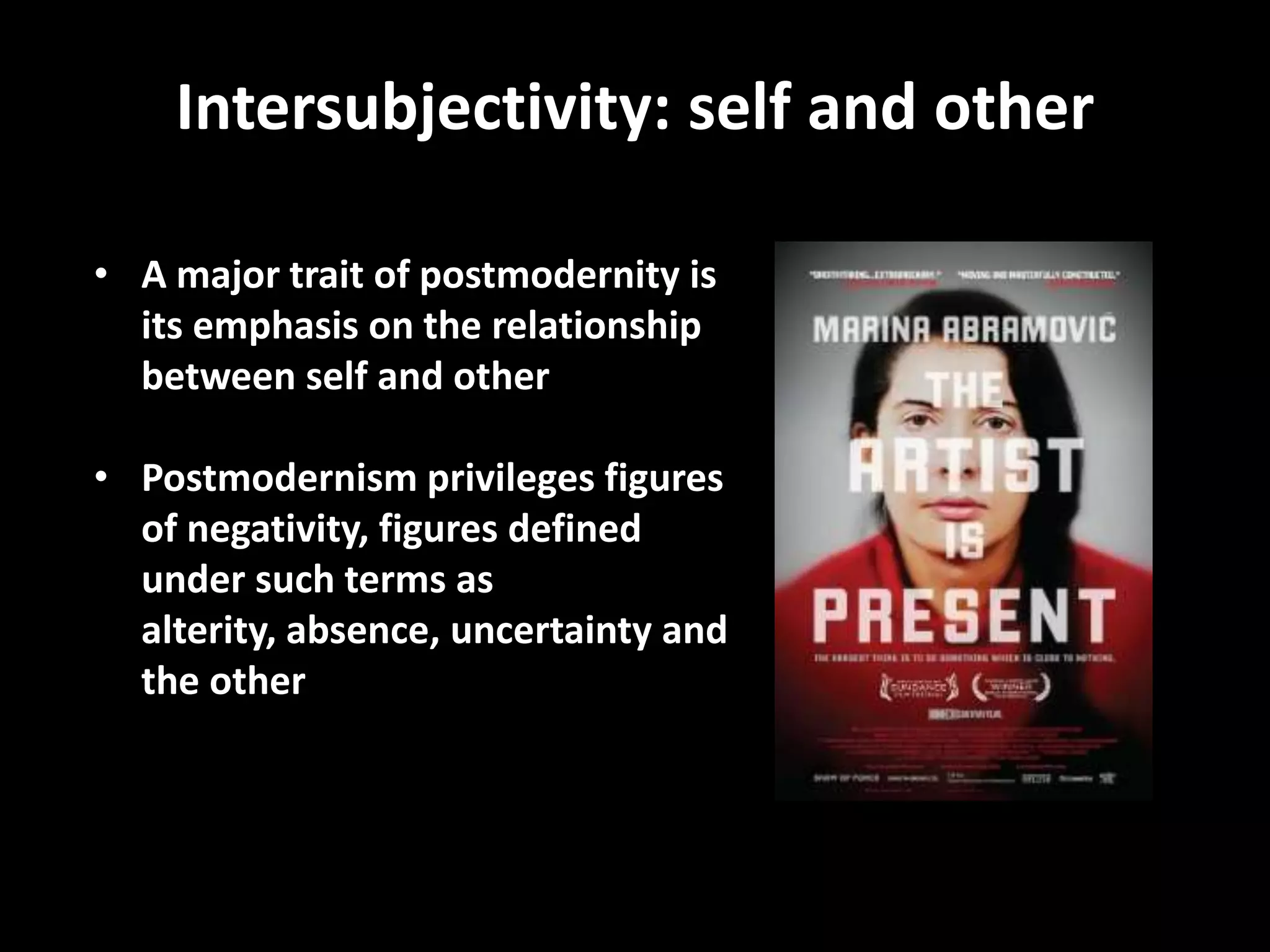
Intersubjectivity: self and other

• A major trait of postmodernity is
  its emphasis on the relationship
  between self and other

• Postmodernism privileges figures
  of negativity, figures defined
  under such terms as
  alterity, absence, uncertainty and
  the other
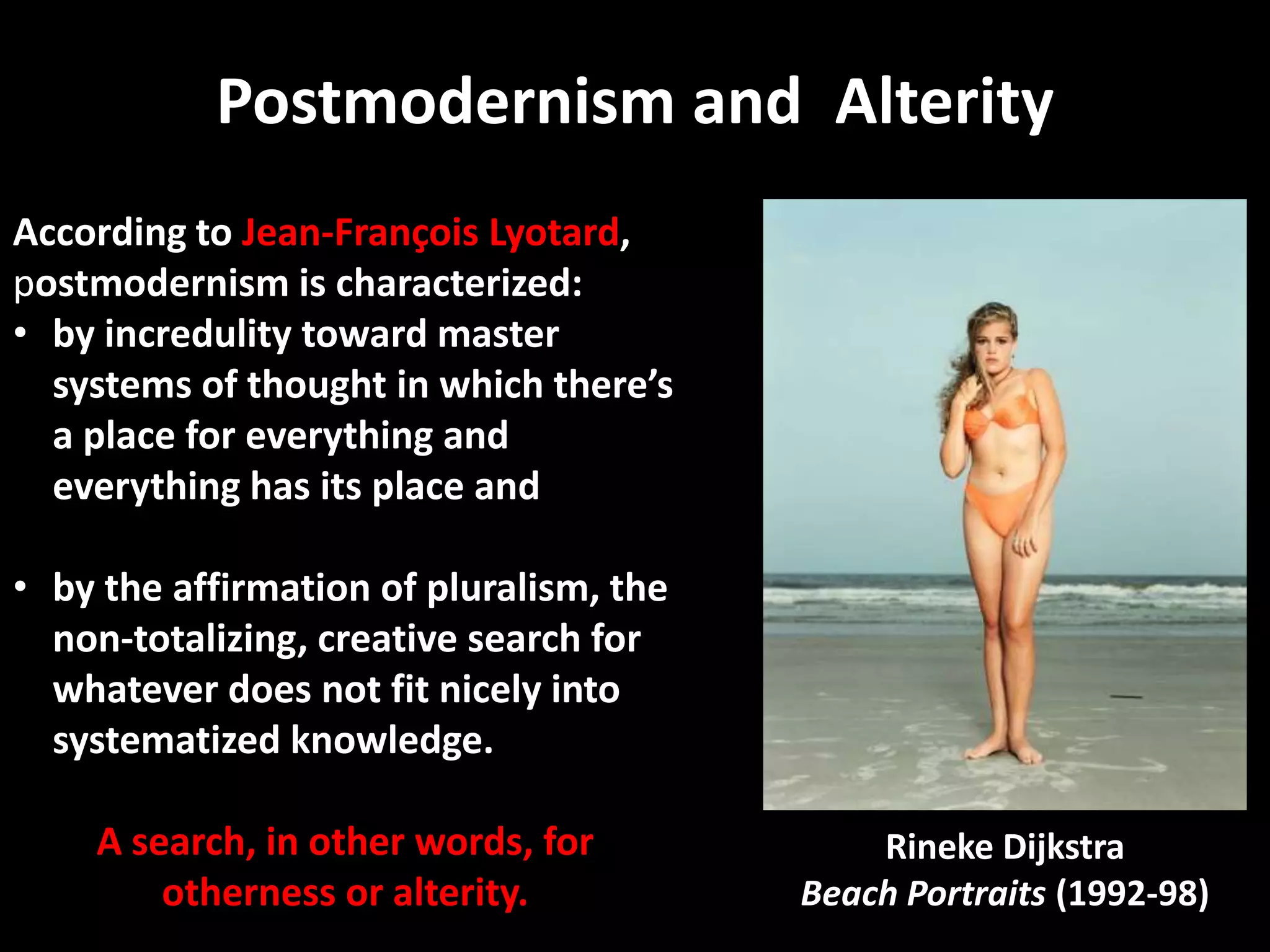
Postmodernism and Alterity
According to Jean-François Lyotard,
postmodernism is characterized:
• by incredulity toward master
  systems of thought in which there’s
  a place for everything and
  everything has its place and

• by the affirmation of pluralism, the
  non-totalizing, creative search for
  whatever does not fit nicely into
  systematized knowledge.

    A search, in other words, for            Rineke Dijkstra
        otherness or alterity.           Beach Portraits (1992-98)
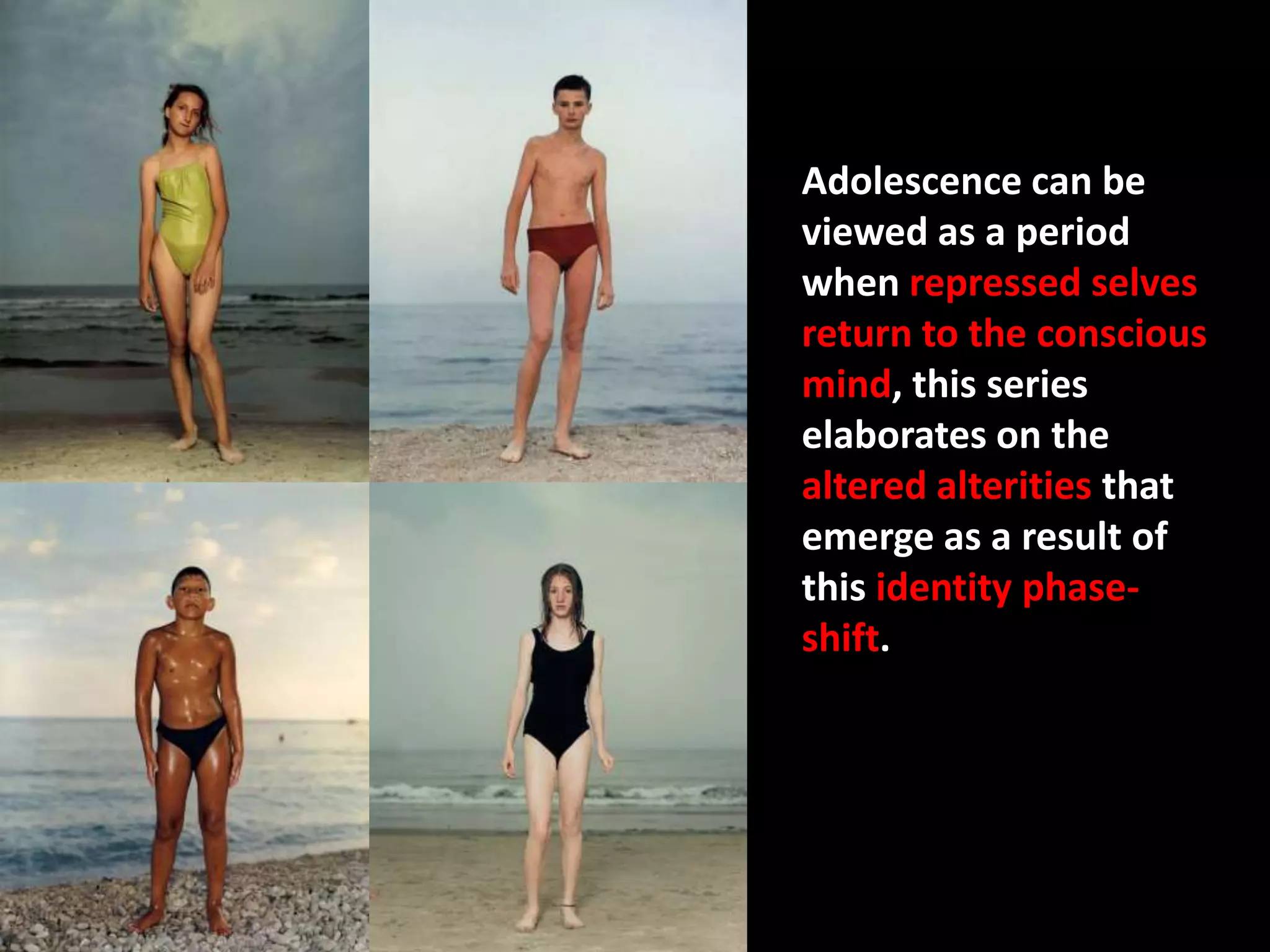
Adolescence can be
viewed as a period
when repressed selves
return to the conscious
mind, this series
elaborates on the
altered alterities that
emerge as a result of
this identity phase-
shift.
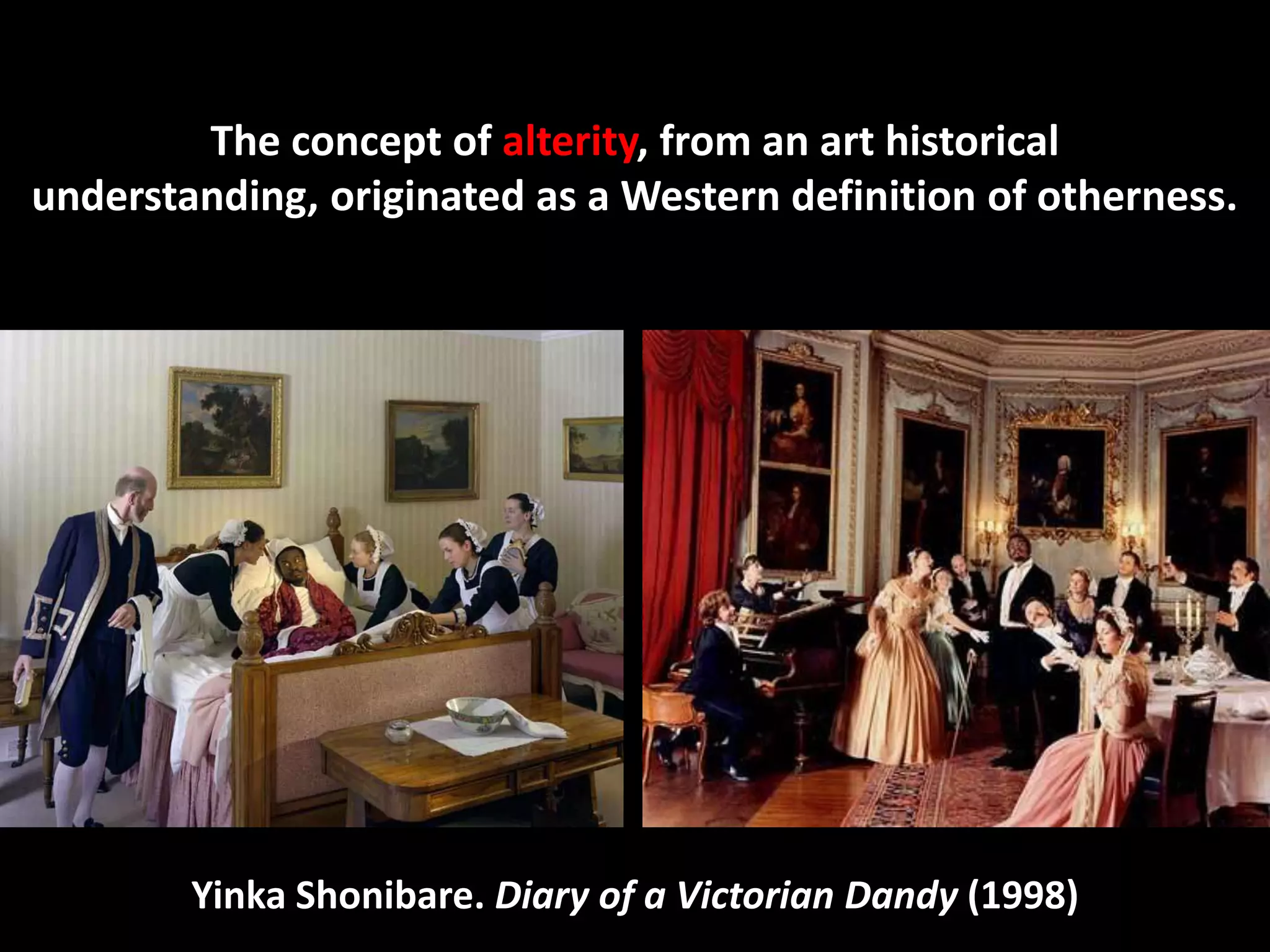
The concept of alterity, from an art historical
understanding, originated as a Western definition of otherness.


        Yinka Shonibare. Diary of a Victorian Dandy (1998)
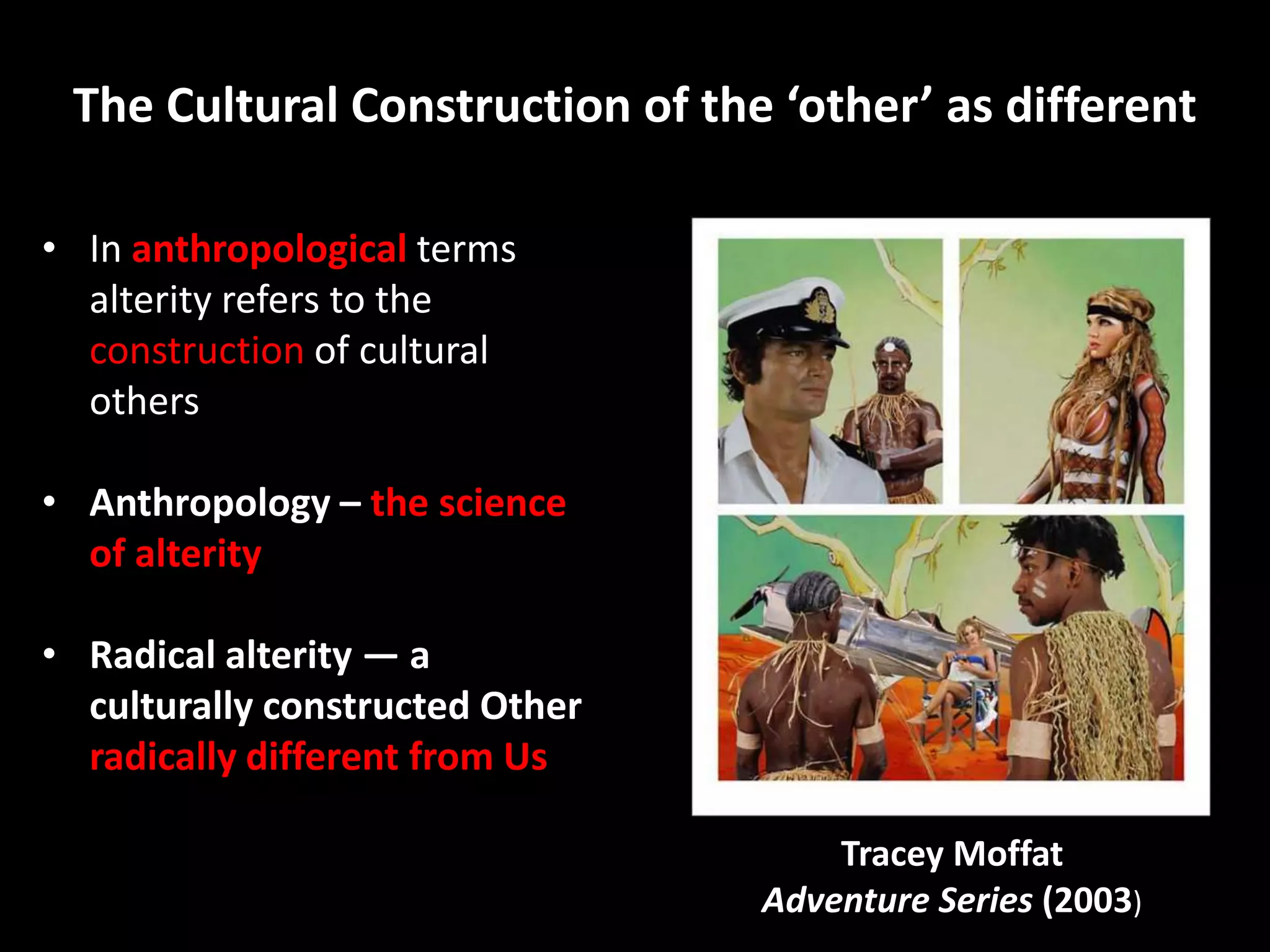
The Cultural Construction of the ‘other’ as different

• In anthropological terms
  alterity refers to the
  construction of cultural
  others

• Anthropology – the science
  of alterity

• Radical alterity — a
  culturally constructed Other
  radically different from Us

                                     Tracey Moffat
                                 Adventure Series (2003)
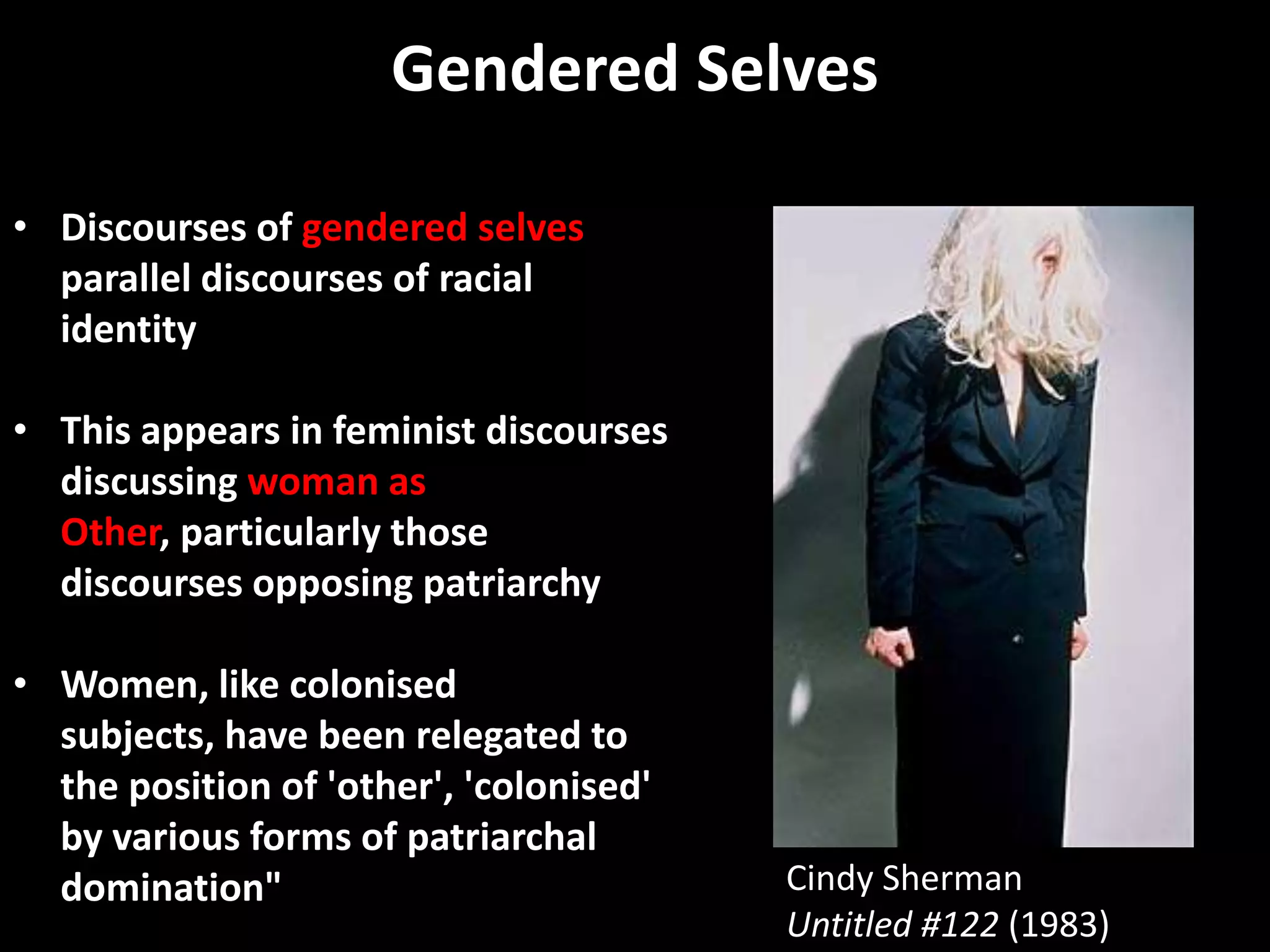
Gendered Selves

• Discourses of gendered selves
  parallel discourses of racial
  identity

• This appears in feminist discourses
  discussing woman as
  Other, particularly those
  discourses opposing patriarchy

• Women, like colonised
  subjects, have been relegated to
  the position of 'other', 'colonised'
  by various forms of patriarchal
  domination"                            Cindy Sherman
                                         Untitled #122 (1983)
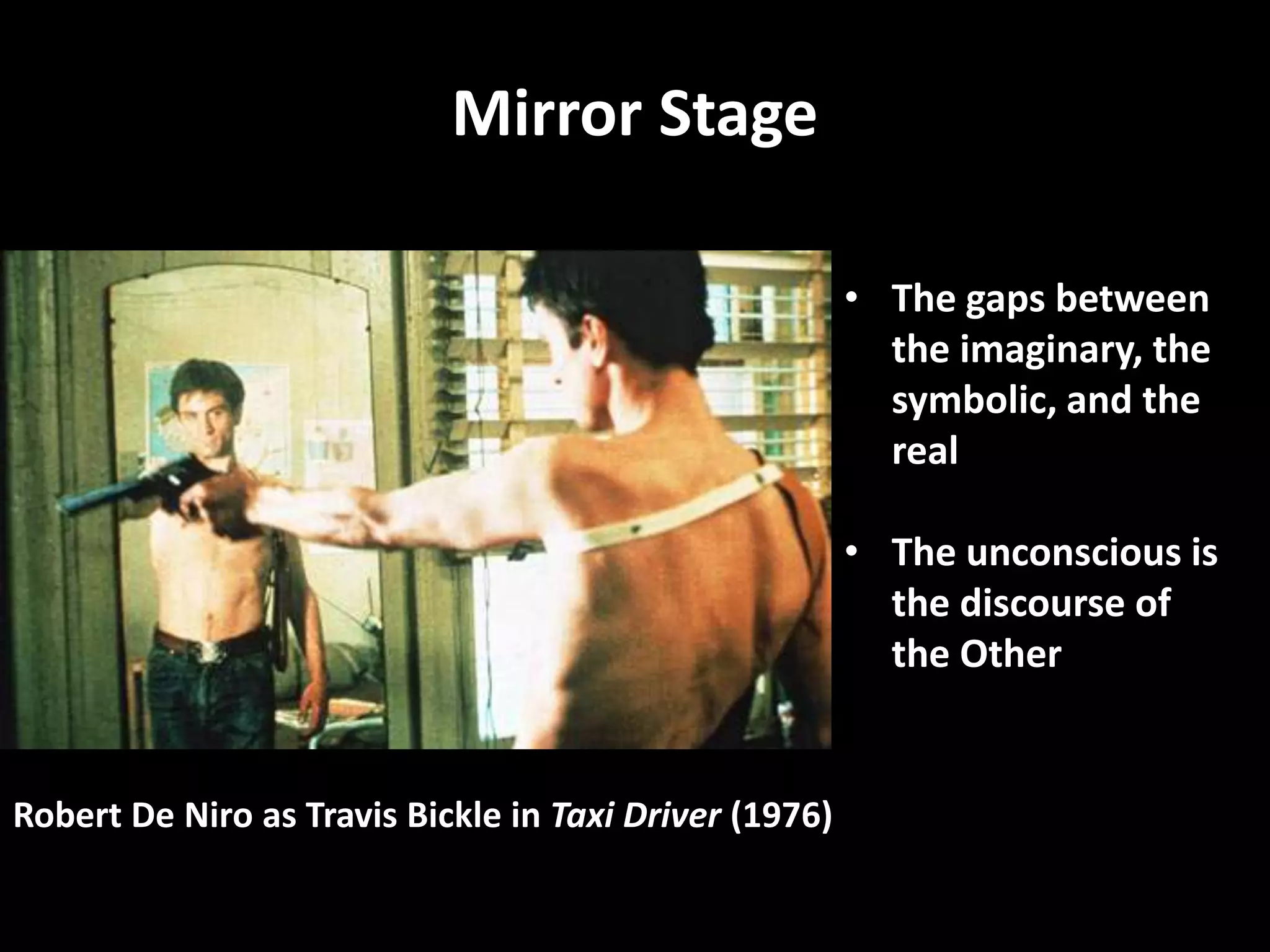
Mirror Stage

                                                        • The gaps between
                                                          the imaginary, the
                                                          symbolic, and the
                                                          real

                                                        • The unconscious is
                                                          the discourse of
                                                          the Other


Robert De Niro as Travis Bickle in Taxi Driver (1976)
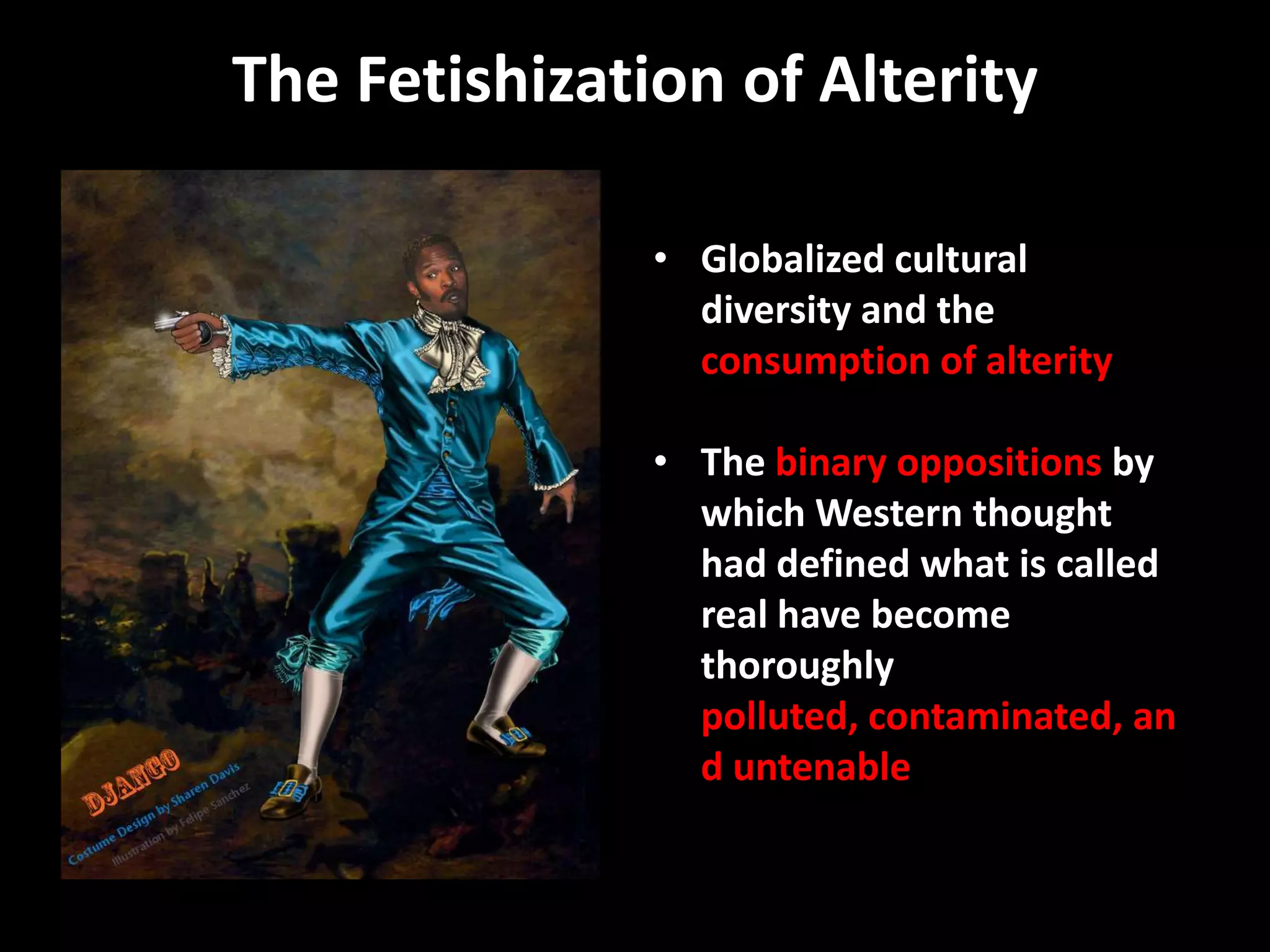
The Fetishization of Alterity

               • Globalized cultural
                 diversity and the
                 consumption of alterity

               • The binary oppositions by
                 which Western thought
                 had defined what is called
                 real have become
                 thoroughly
                 polluted, contaminated, an
                 d untenable
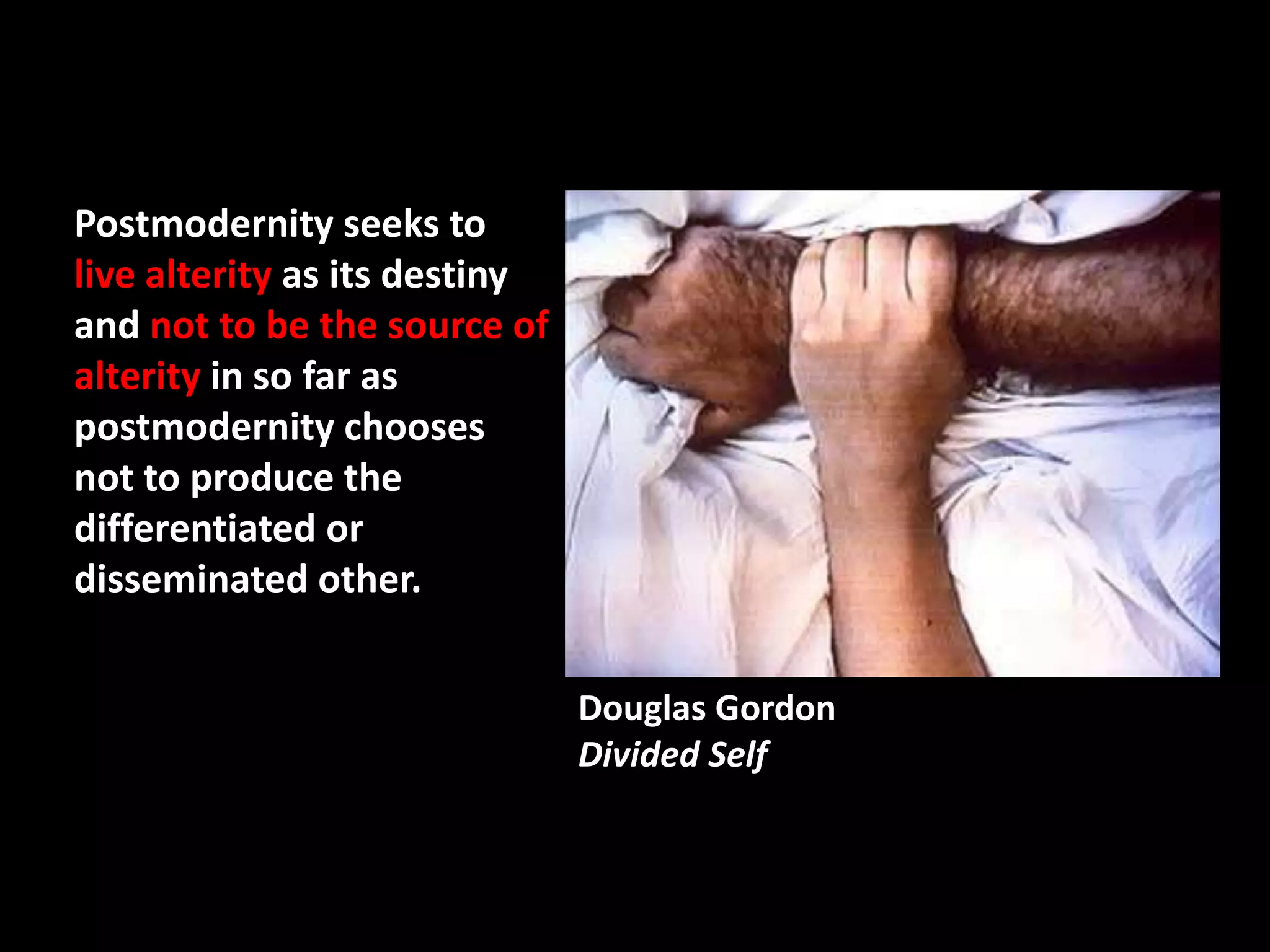
Postmodernity seeks to
live alterity as its destiny
and not to be the source of
alterity in so far as
postmodernity chooses
not to produce the
differentiated or
disseminated other.


                               Douglas Gordon
                               Divided Self
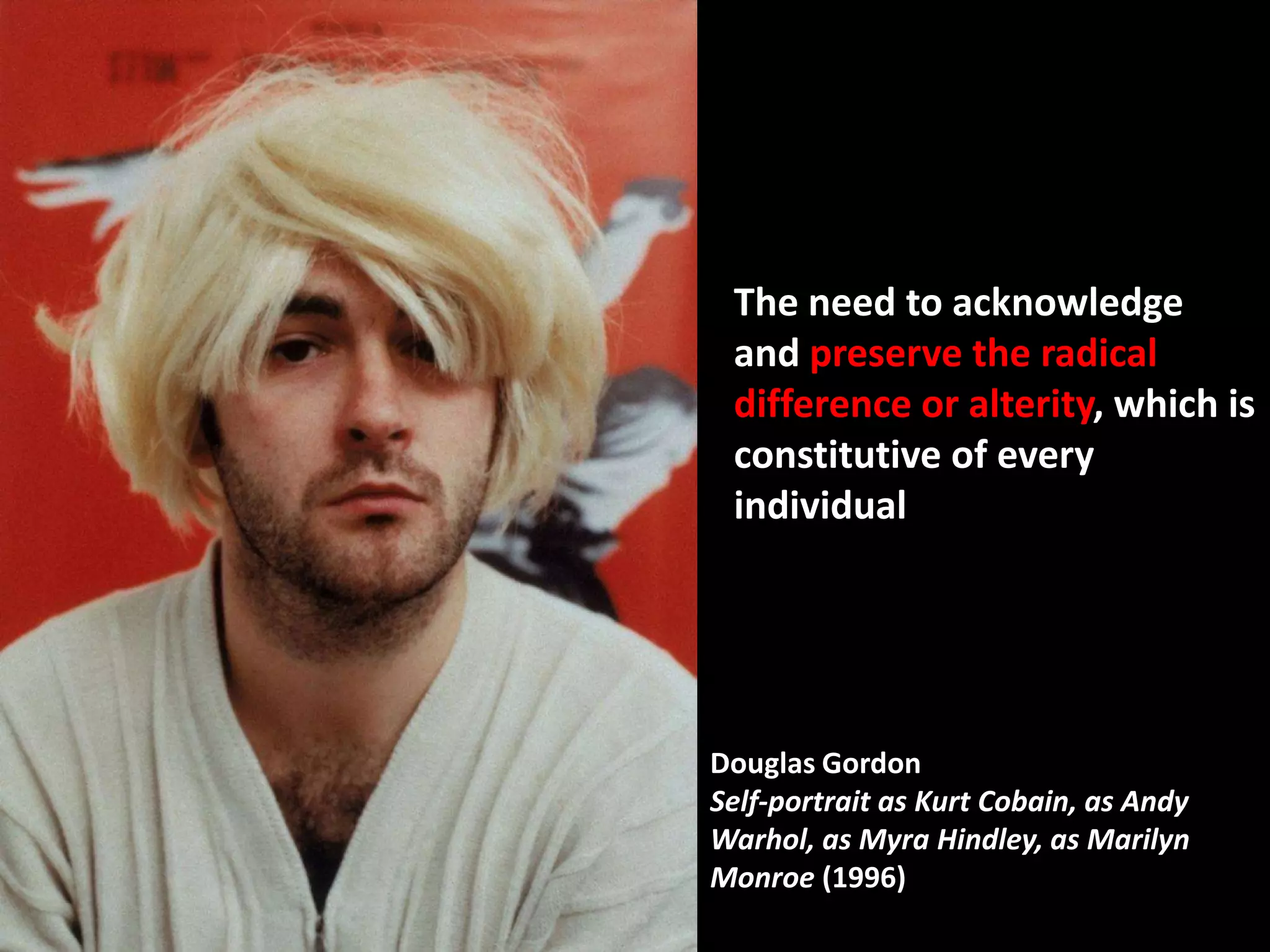
The need to acknowledge
 and preserve the radical
 difference or alterity, which is
 constitutive of every
 individual


Douglas Gordon
Self-portrait as Kurt Cobain, as Andy
Warhol, as Myra Hindley, as Marilyn
Monroe (1996)
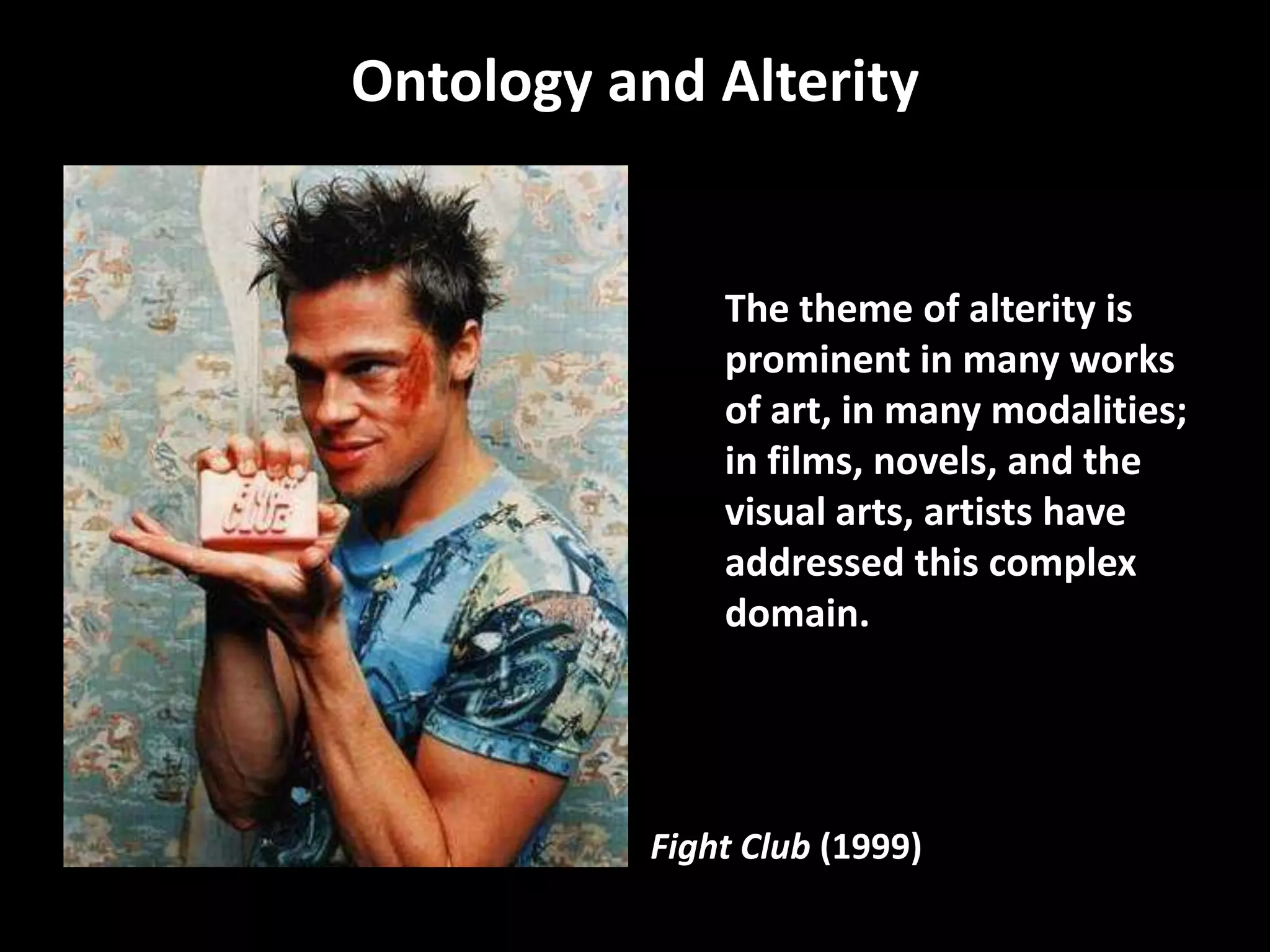
Ontology and Alterity


               The theme of alterity is
               prominent in many works
               of art, in many modalities;
               in films, novels, and the
               visual arts, artists have
               addressed this complex
               domain.


           Fight Club (1999)
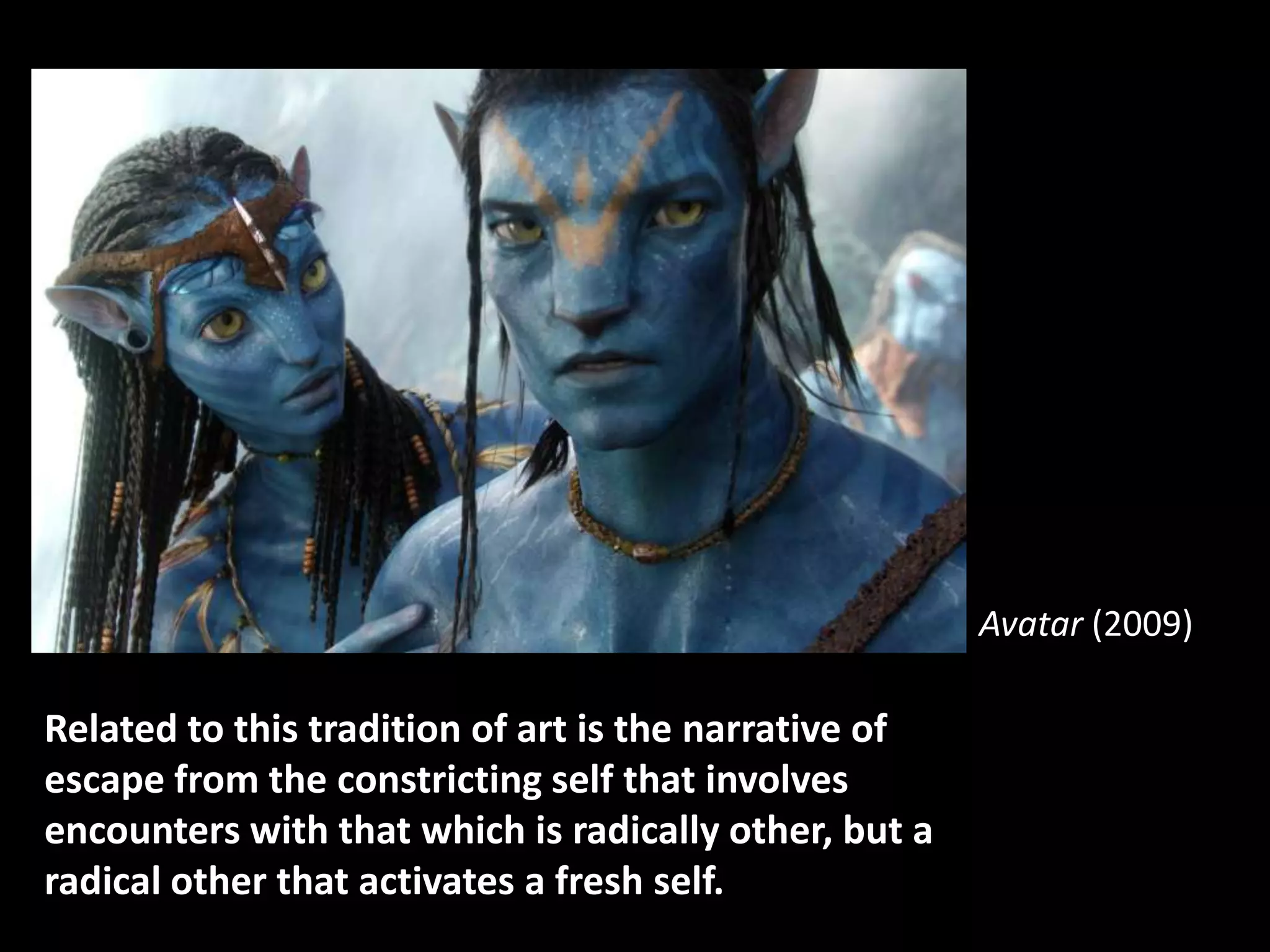
Avatar (2009)

Related to this tradition of art is the narrative of
escape from the constricting self that involves
encounters with that which is radically other, but a
radical other that activates a fresh self.
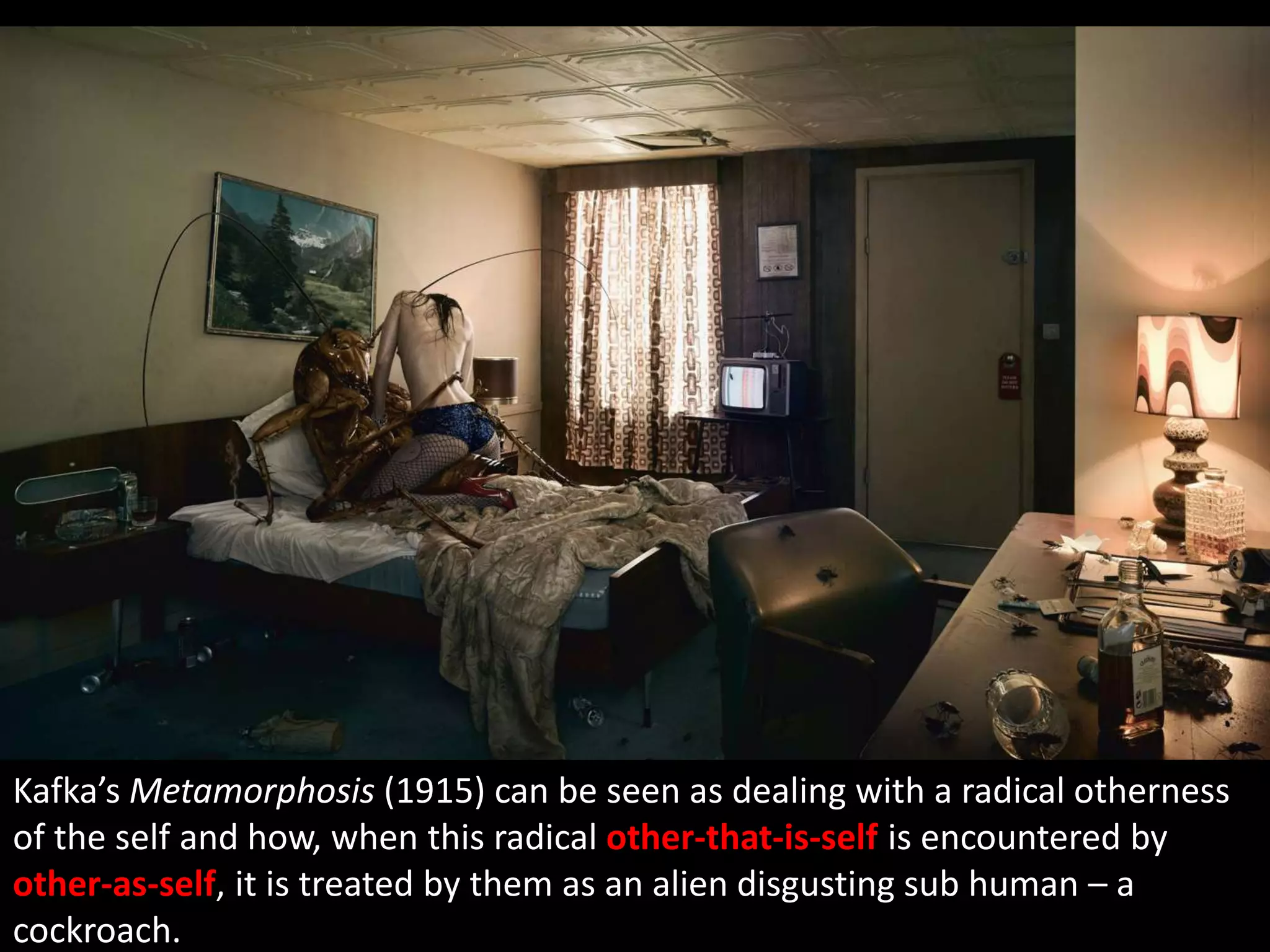
Kafka’s Metamorphosis (1915) can be seen as dealing with a radical otherness
of the self and how, when this radical other-that-is-self is encountered by
other-as-self, it is treated by them as an alien disgusting sub human – a
cockroach.
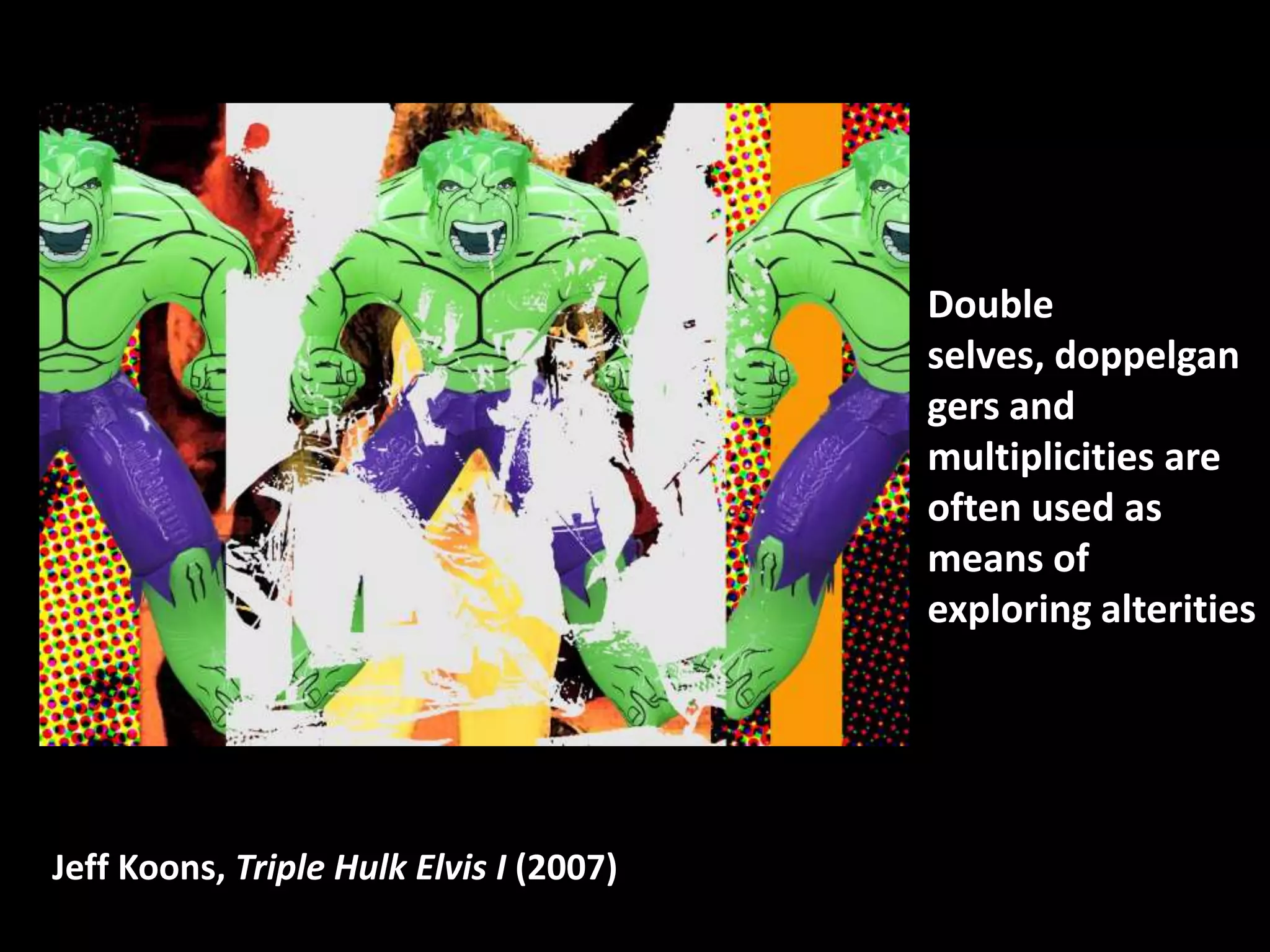
Double
                                         selves, doppelgan
                                         gers and
                                         multiplicities are
                                         often used as
                                         means of
                                         exploring alterities


Jeff Koons, Triple Hulk Elvis I (2007)
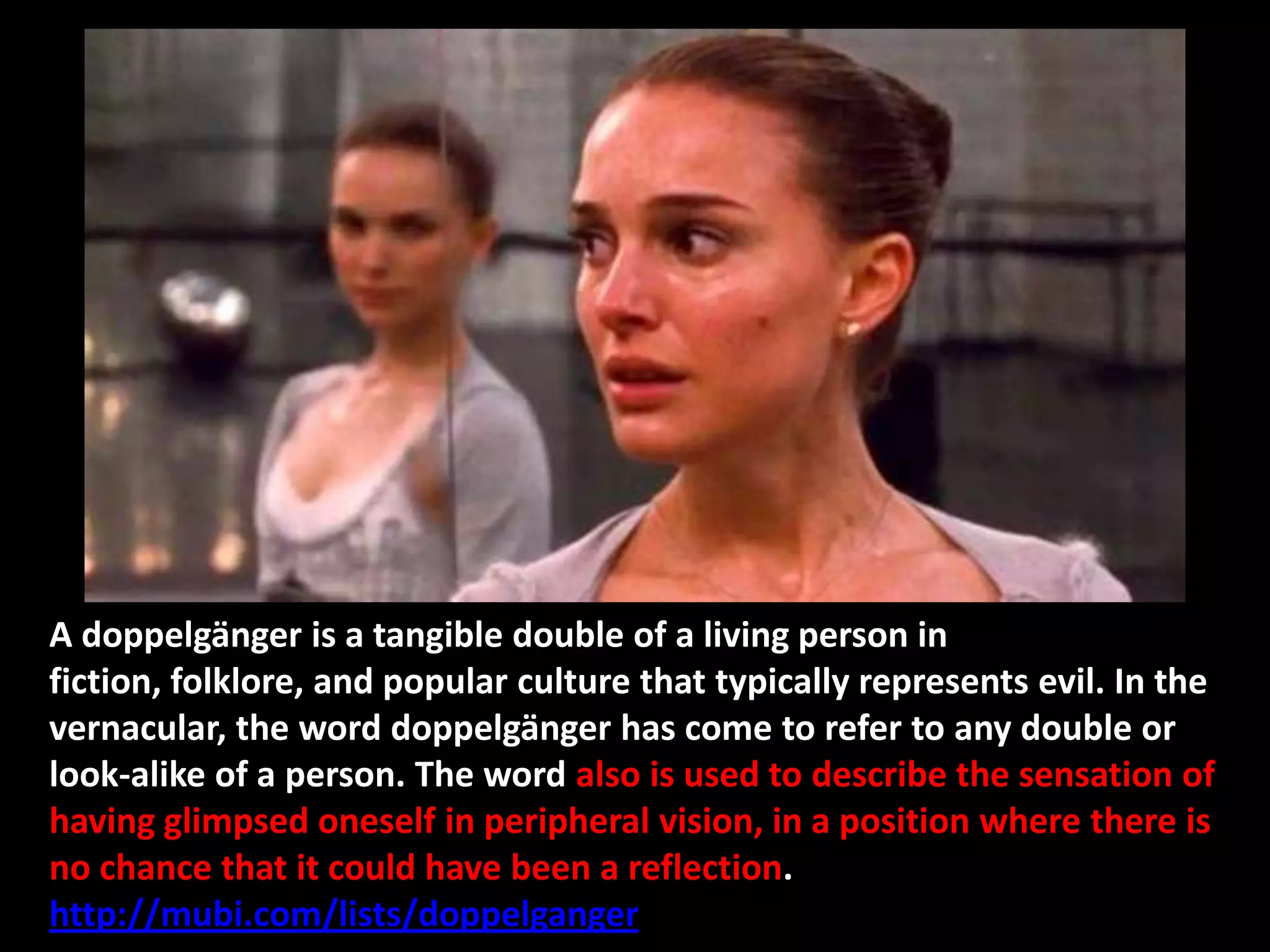
A doppelgänger is a tangible double of a living person in
fiction, folklore, and popular culture that typically represents evil. In the
vernacular, the word doppelgänger has come to refer to any double or
look-alike of a person. The word also is used to describe the sensation of
having glimpsed oneself in peripheral vision, in a position where there is
no chance that it could have been a reflection.
http://mubi.com/lists/doppelganger
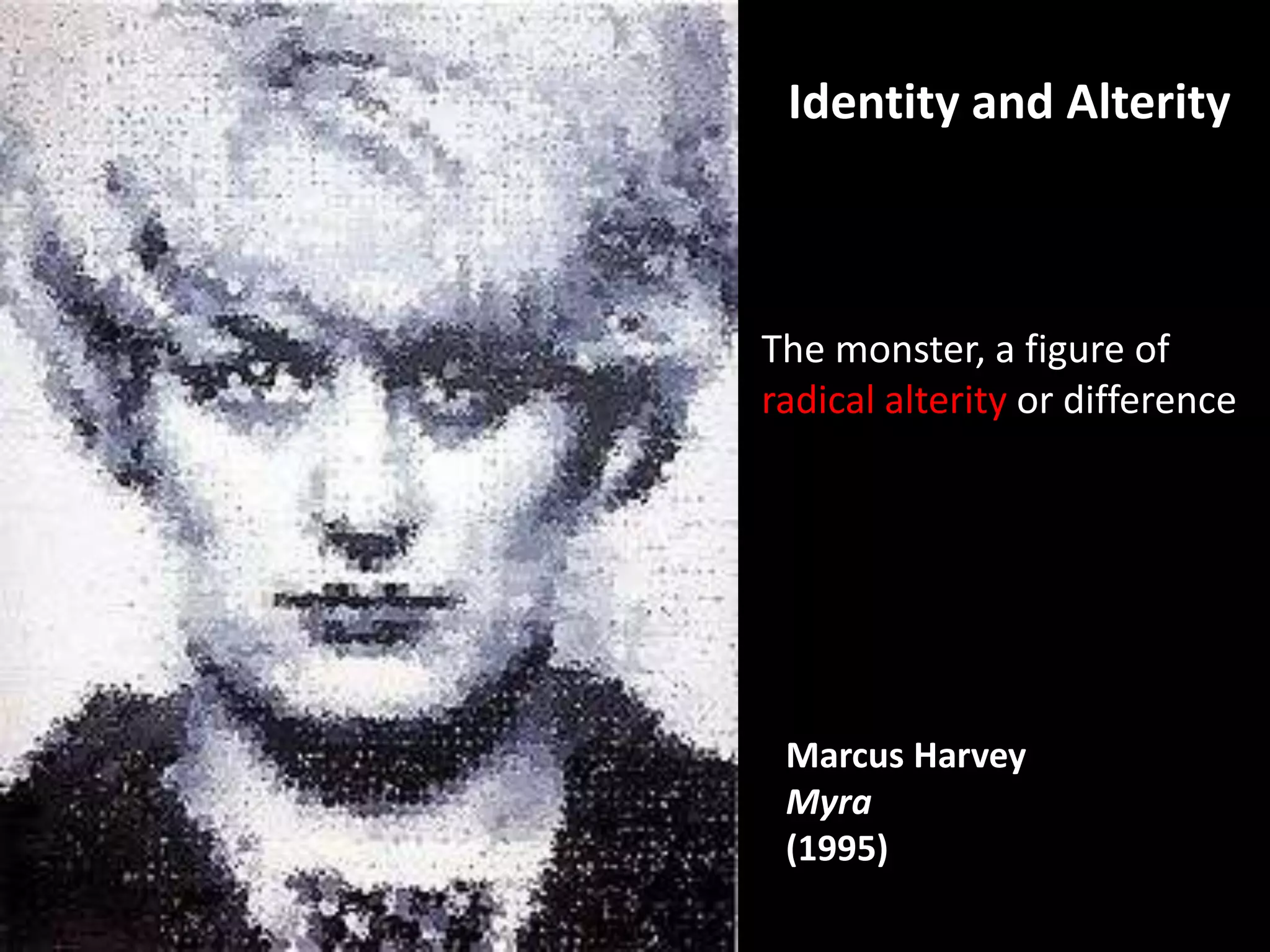
Identity and Alterity


The monster, a figure of
radical alterity or difference


 Marcus Harvey
 Myra
 (1995)
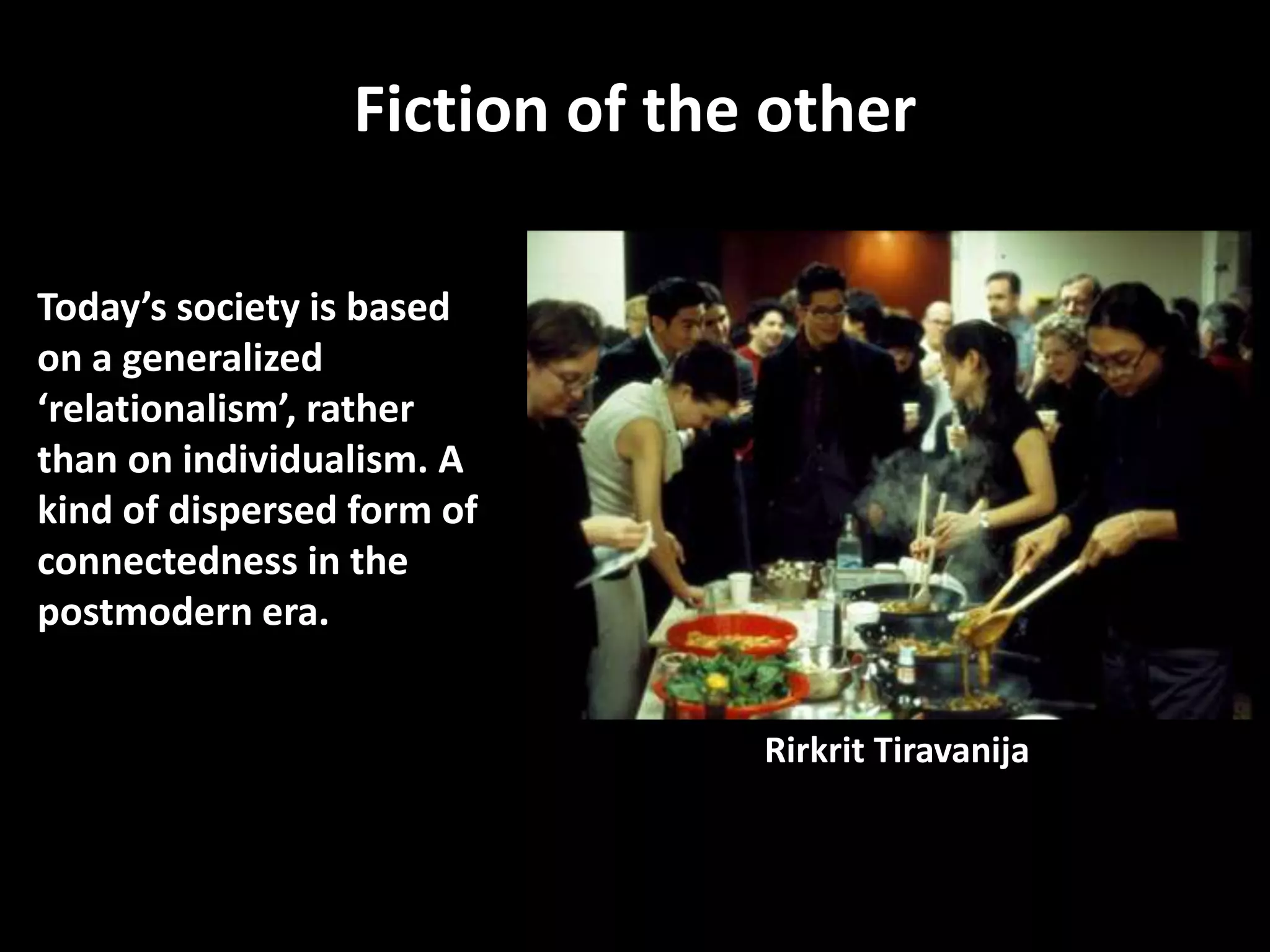
Fiction of the other

Today’s society is based
on a generalized
‘relationalism’, rather
than on individualism. A
kind of dispersed form of
connectedness in the
postmodern era.


                               Rirkrit Tiravanija
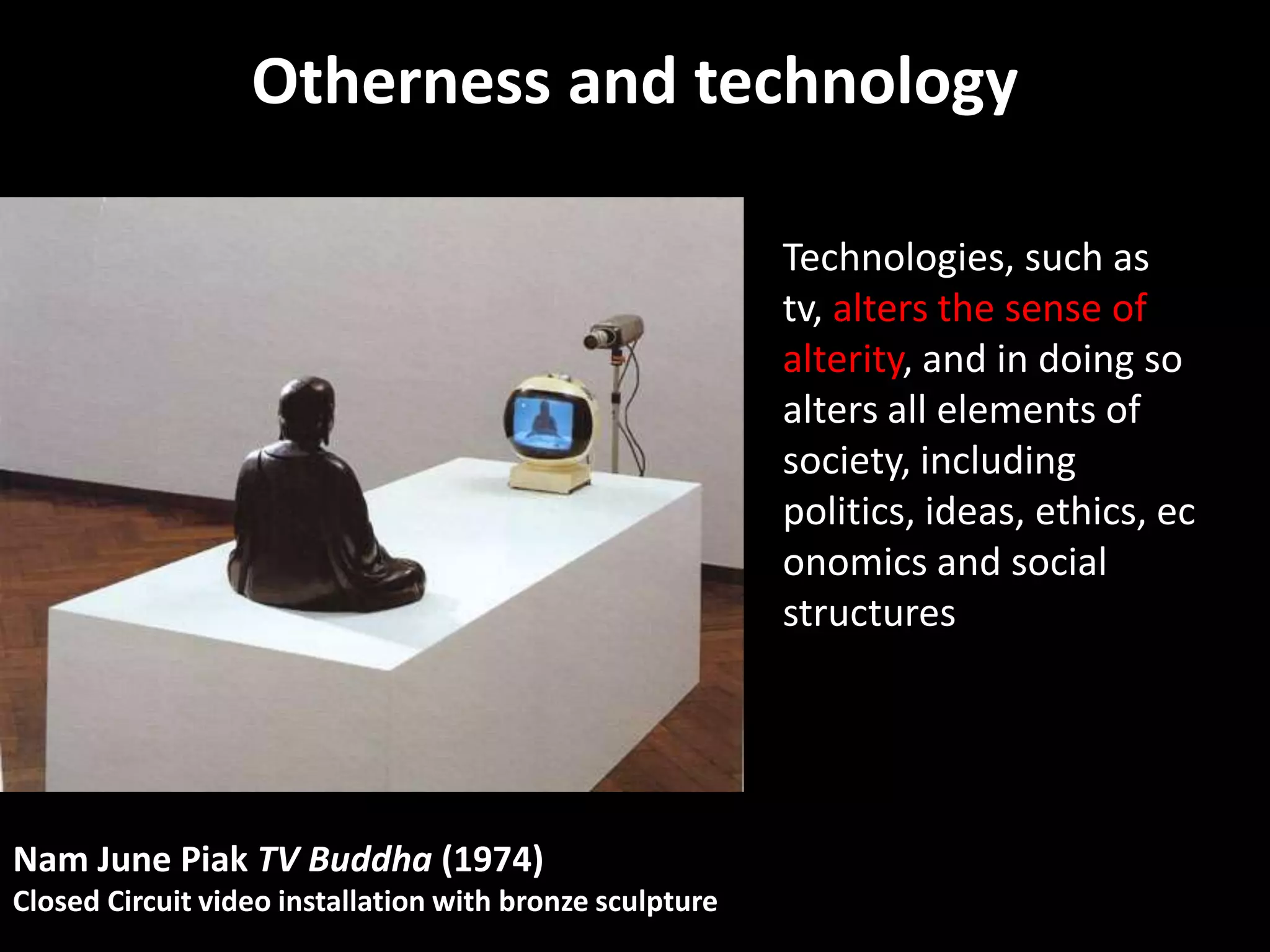
Otherness and technology

                                                          Technologies, such as
                                                          tv, alters the sense of
                                                          alterity, and in doing so
                                                          alters all elements of
                                                          society, including
                                                          politics, ideas, ethics, ec
                                                          onomics and social
                                                          structures


Nam June Piak TV Buddha (1974)
Closed Circuit video installation with bronze sculpture
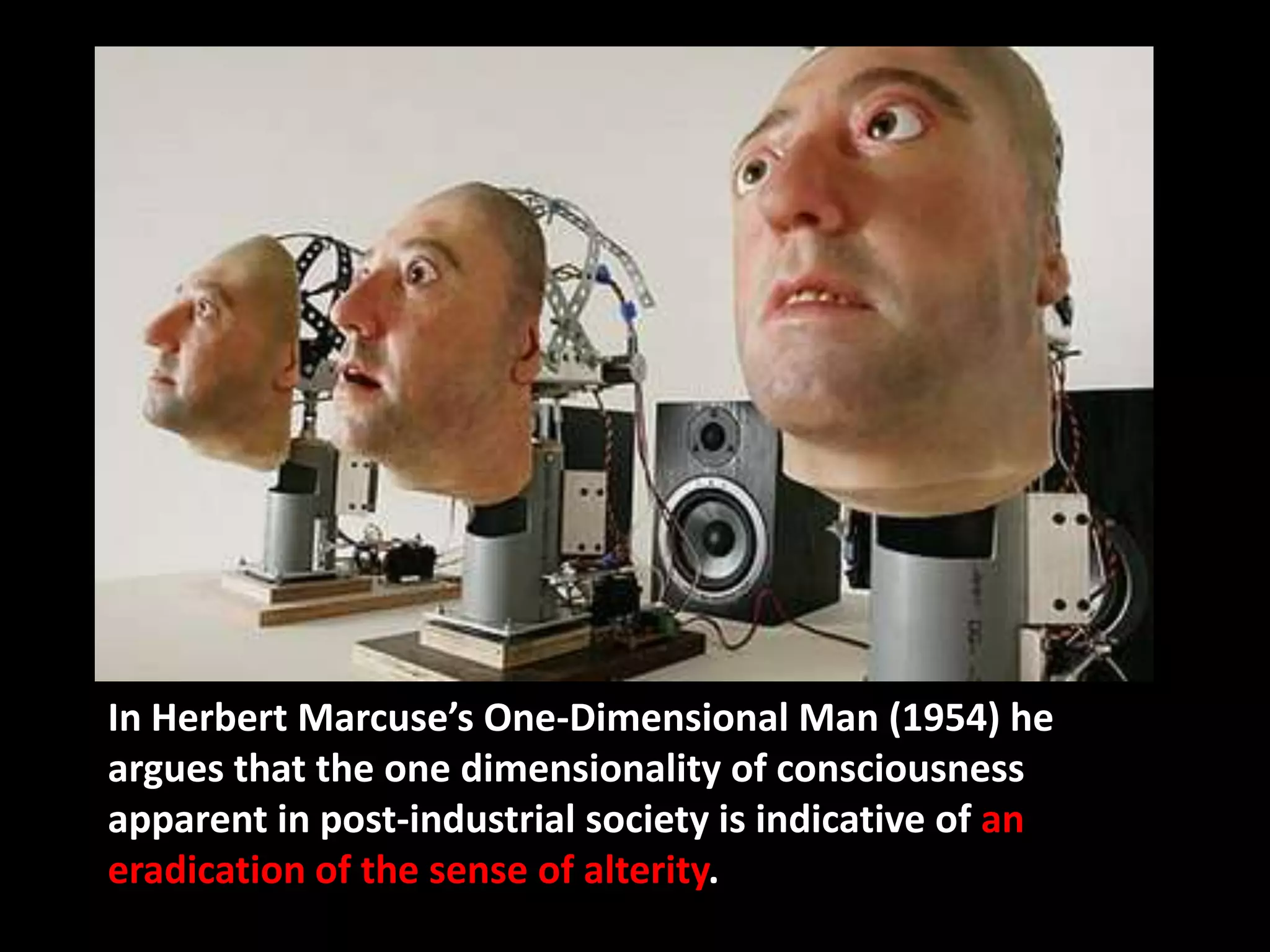
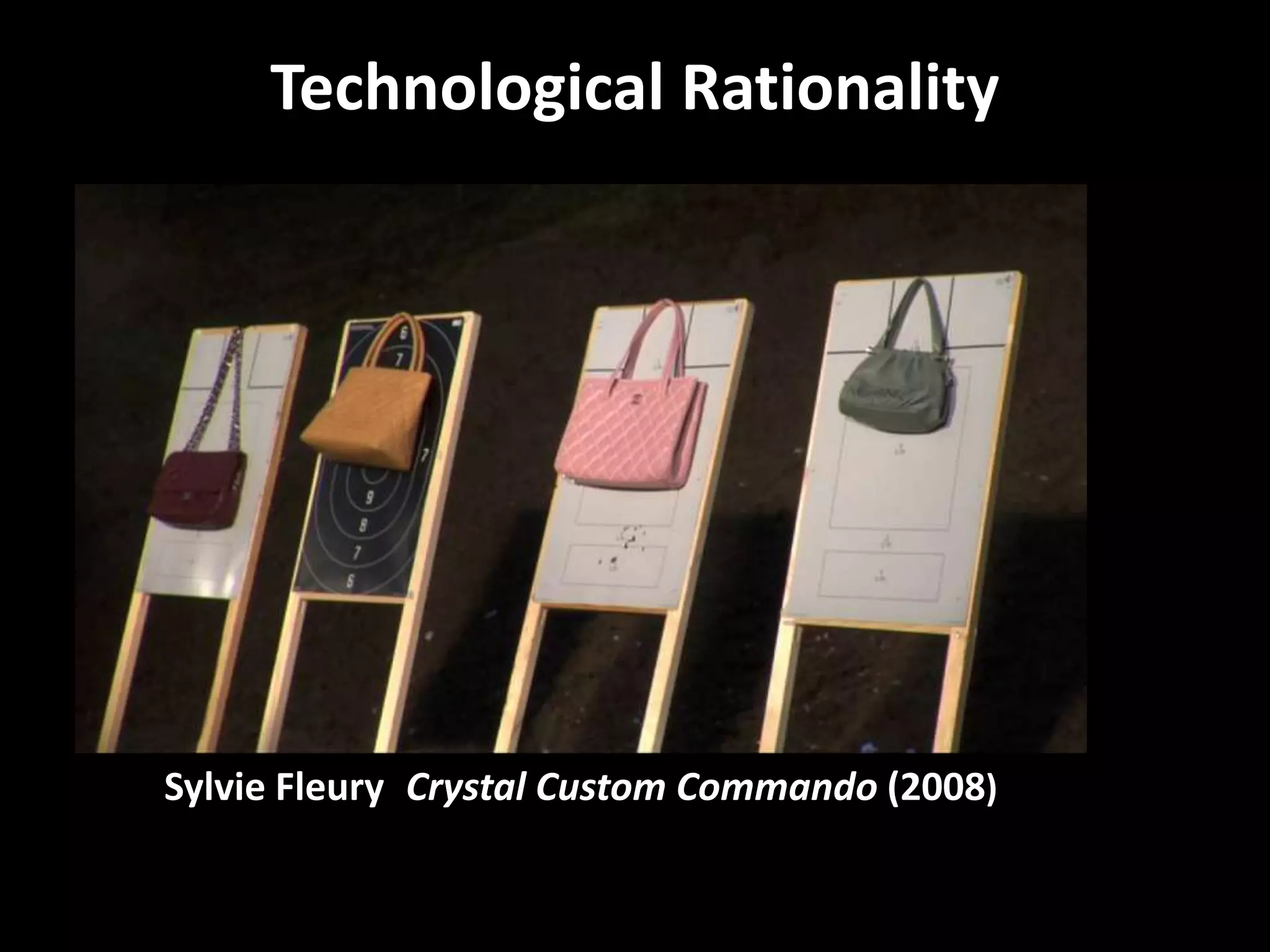
In Herbert Marcuse’s One-Dimensional Man (1954) he
argues that the one dimensionality of consciousness
apparent in post-industrial society is indicative of an
eradication of the sense of alterity.
Technological Rationality


Sylvie Fleury
Crystal Custom Commando (2008)
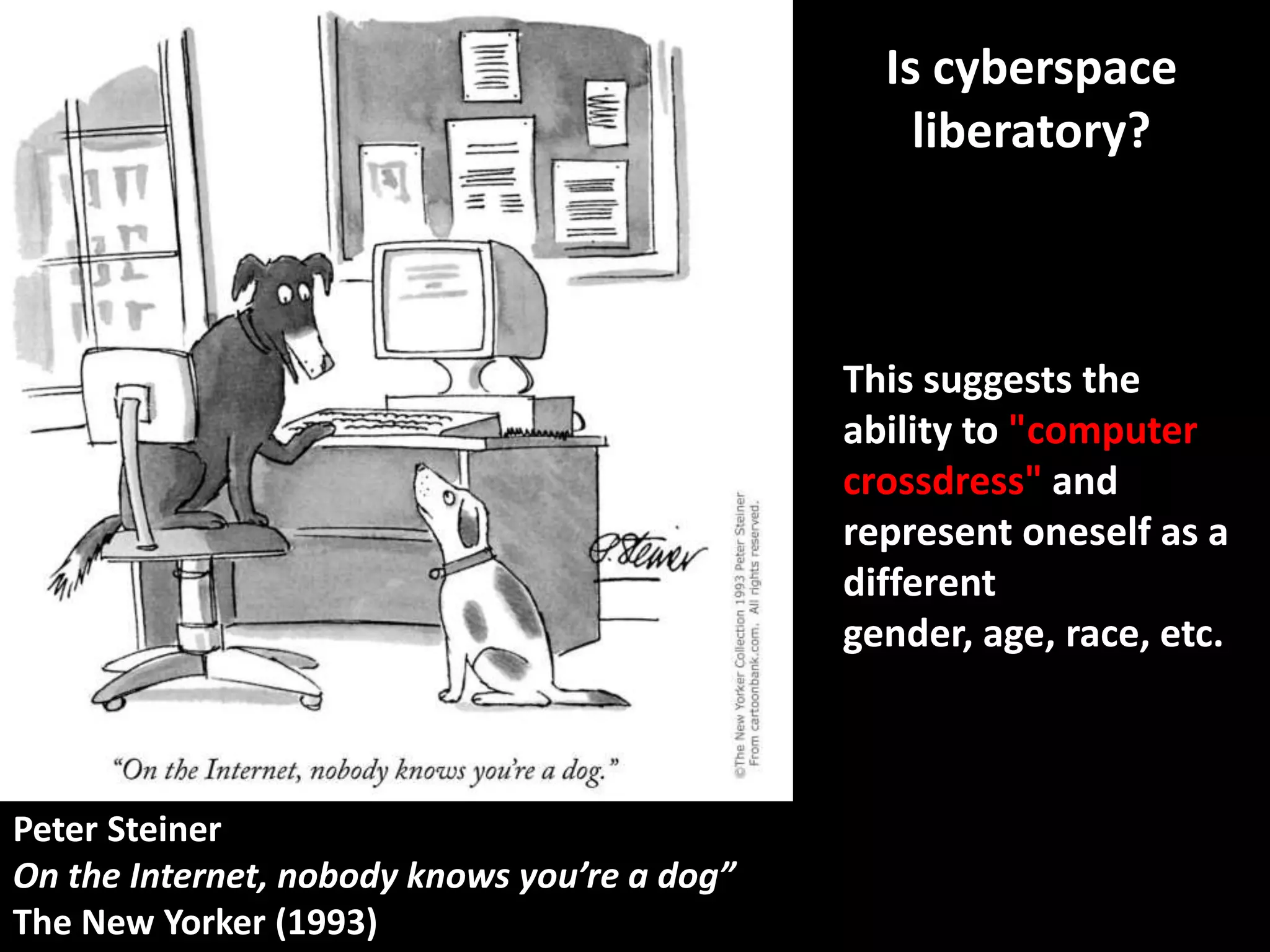
Is cyberspace
                                                  liberatory?


                                              This suggests the
                                              ability to "computer
                                              crossdress" and
                                              represent oneself as a
                                              different
                                              gender, age, race, etc.


Peter Steiner
On the Internet, nobody knows you’re a dog”
The New Yorker (1993)
Virtual Reality works by deceiving the senses of the user into
 thinking that what they are experiencing is something real.


  “The question is not: is it true? But: does it work? What does it
  enable? What new thought does it make possible to think? What
  new emotions does it make it possible to feel?”

                                                      Brian Massumi
        (Introduction to Deleuze and Guattarri’s A Thousand Plateus)
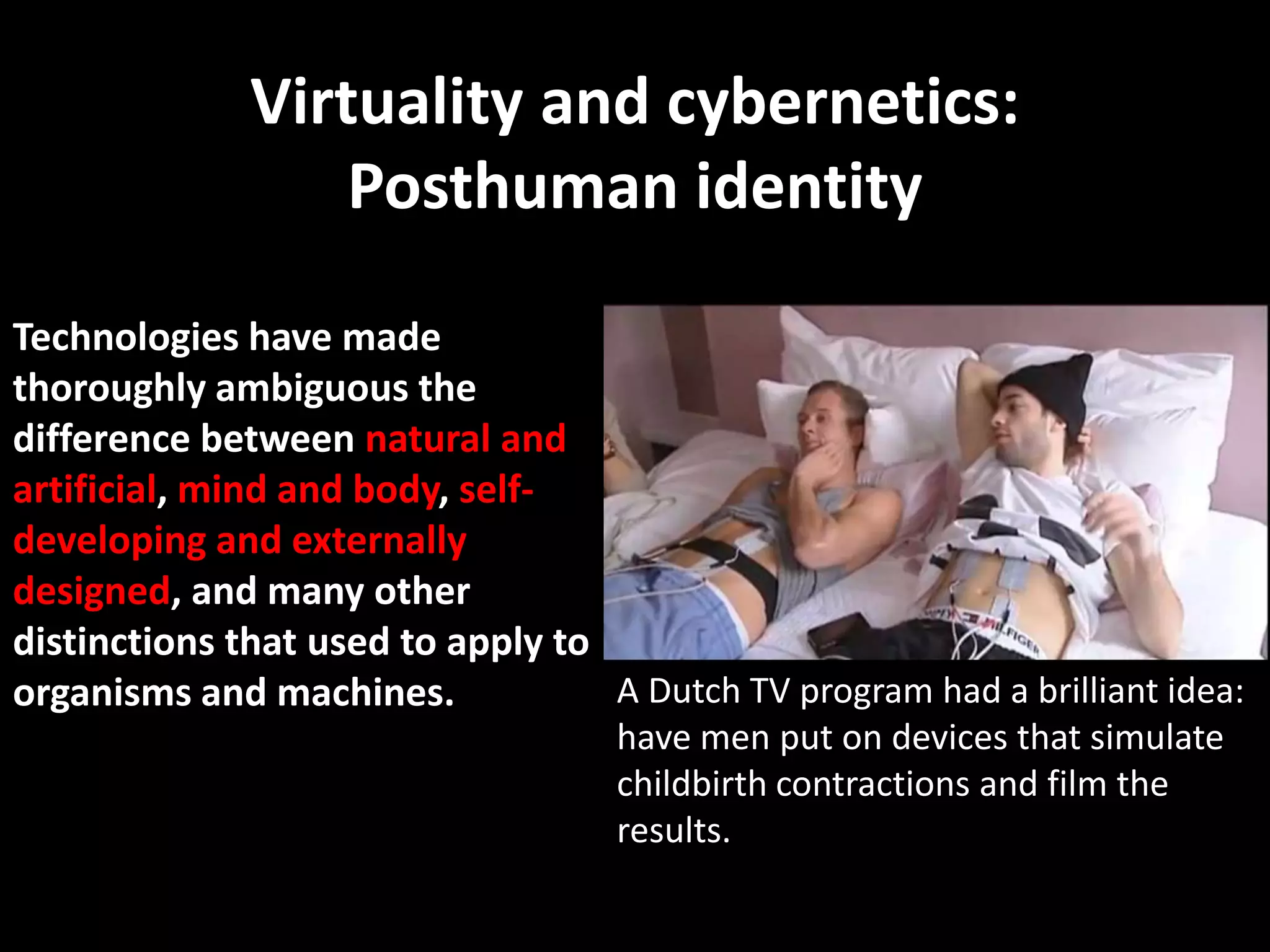
Virtuality and cybernetics:
                  Posthuman identity

Technologies have made
thoroughly ambiguous the
difference between natural and
artificial, mind and body, self-
developing and externally
designed, and many other
distinctions that used to apply to
organisms and machines.            A Dutch TV program had a brilliant idea:
                                    have men put on devices that simulate
                                    childbirth contractions and film the
                                    results.
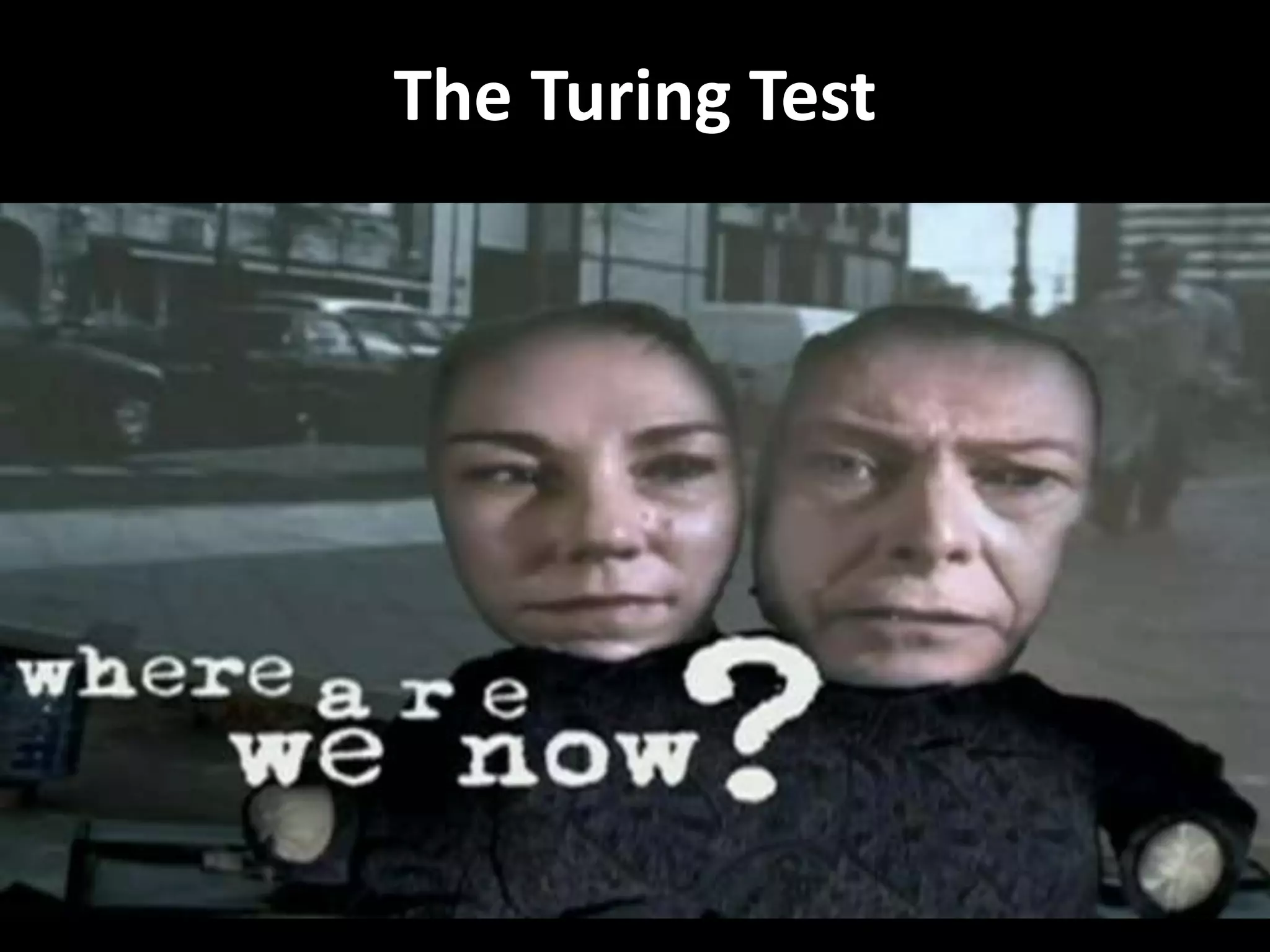
The Turing Test
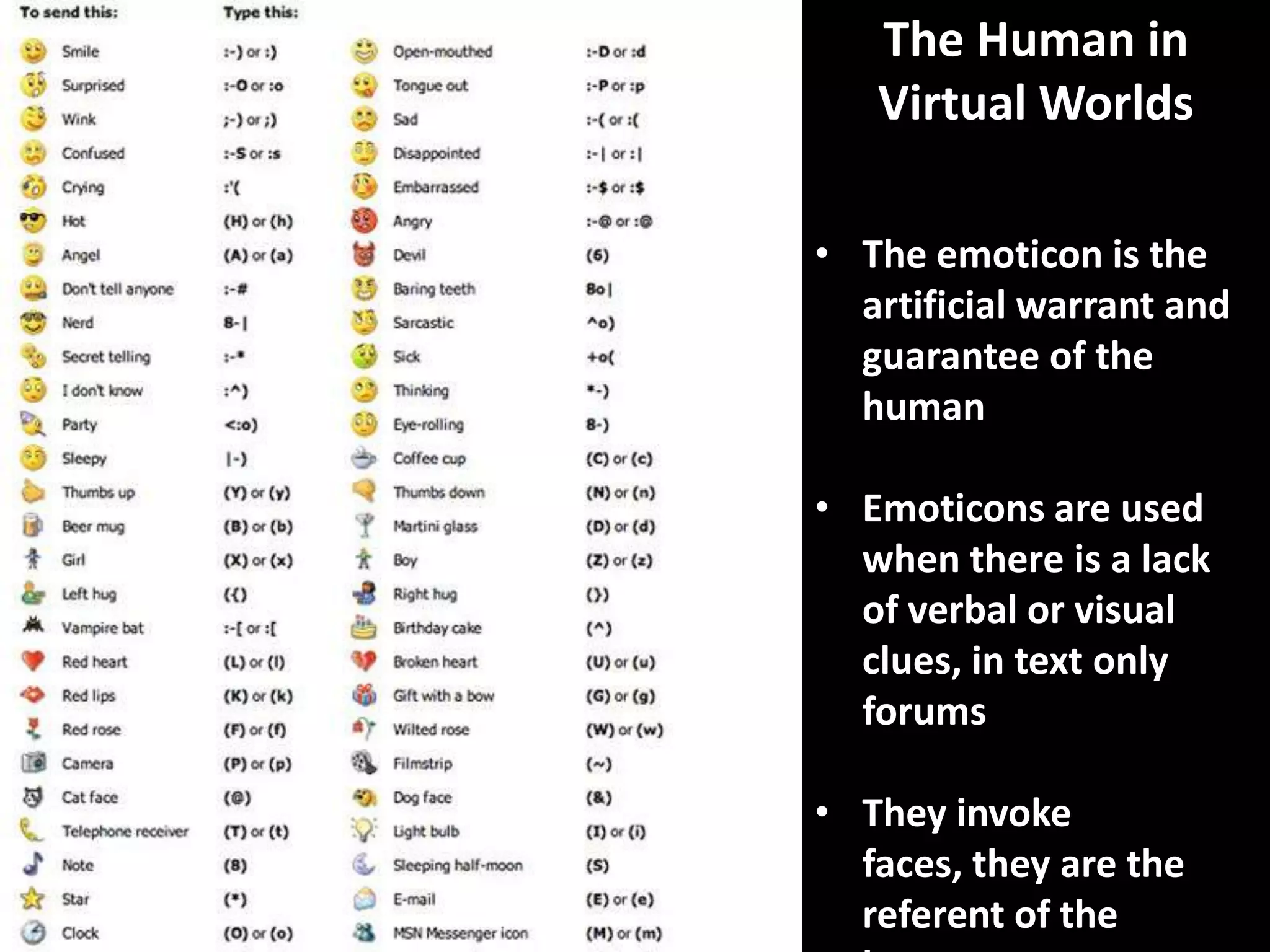
The Human in
   Virtual Worlds

• The emoticon is the
  artificial warrant and
  guarantee of the
  human

• Emoticons are used
  when there is a lack
  of verbal or visual
  clues, in text only
  forums

• They invoke
  faces, they are the
  referent of the
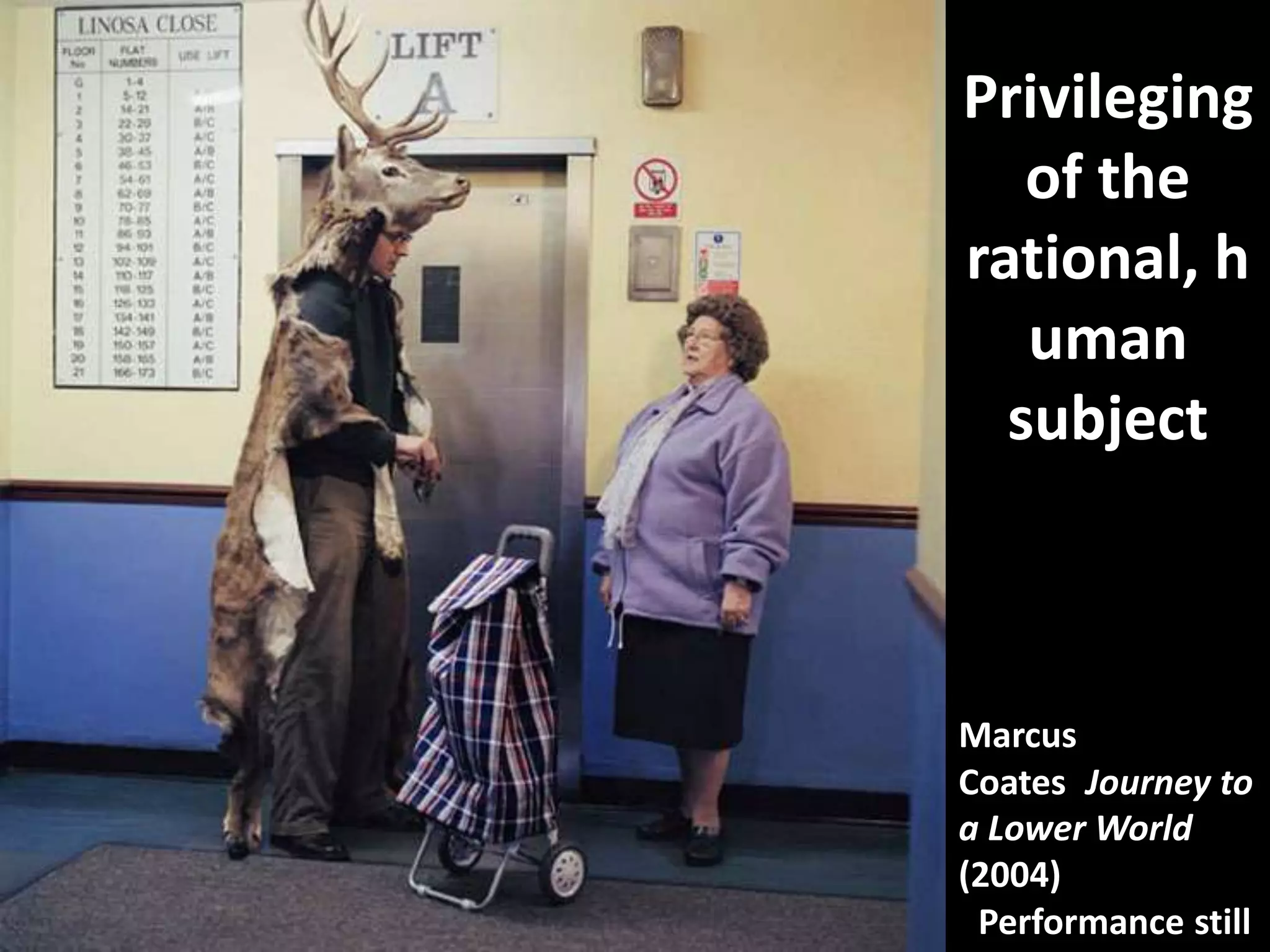
Privileging
   of the
rational, h
   uman
  subject


Marcus
Coates
Journey to
a Lower World
(2004)

Performance still
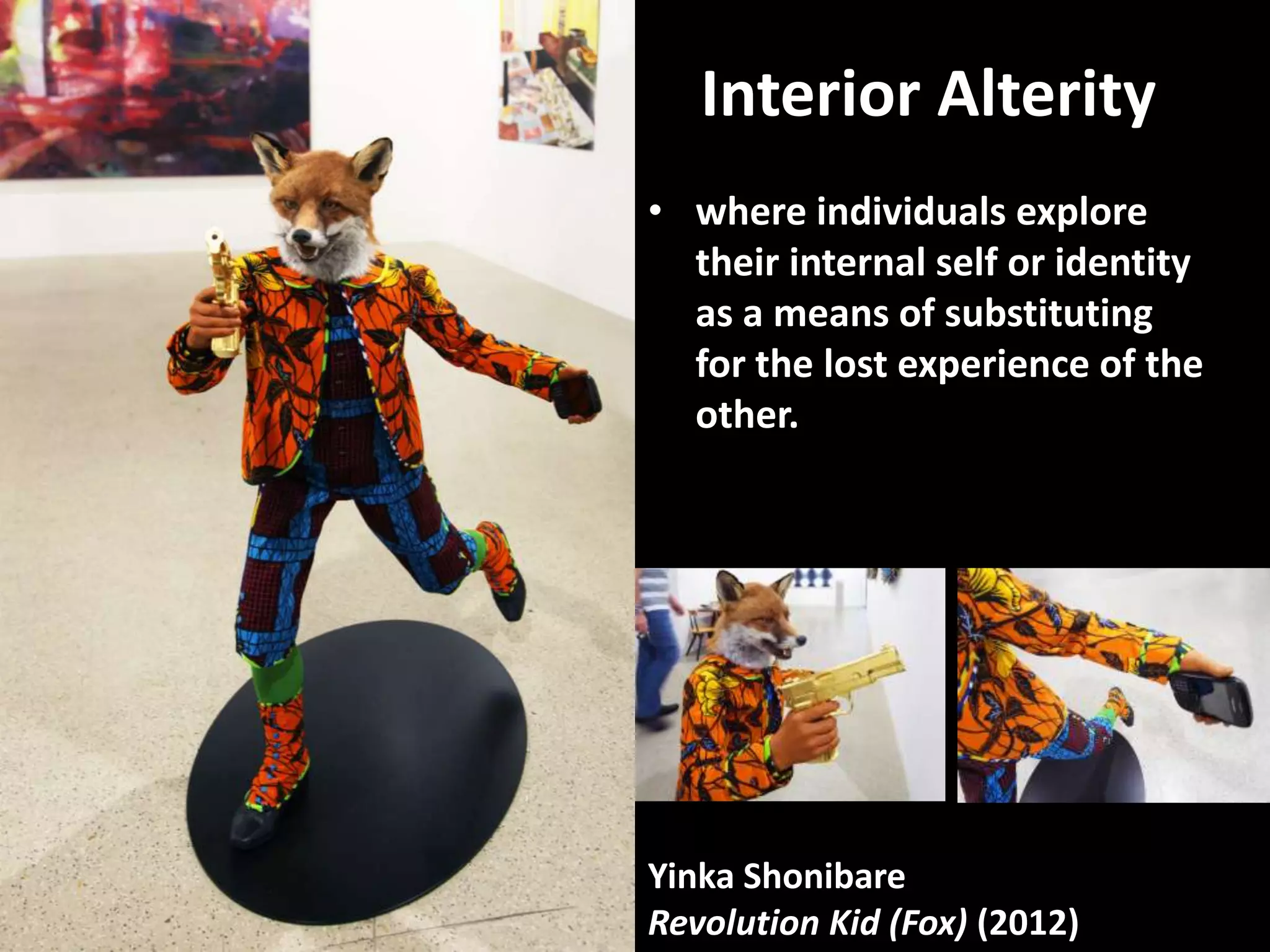
Interior Alterity
• where individuals explore
  their internal self or identity
  as a means of substituting
  for the lost experience of the
  other.


Yinka Shonibare
Revolution Kid (Fox) (2012)
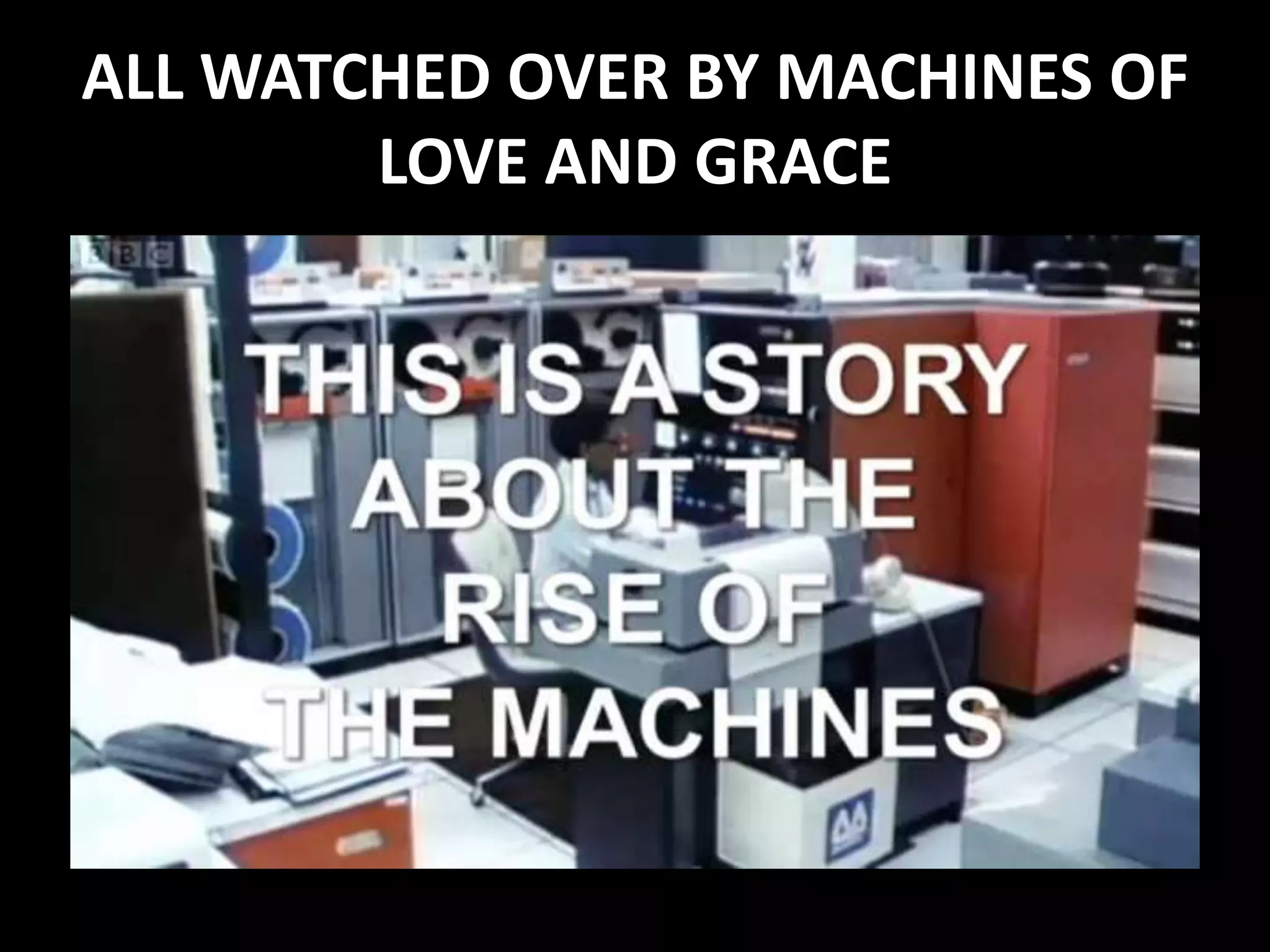
ALL WATCHED OVER BY MACHINES OF
        LOVE AND GRACE

The Future of the Image week 3: Radical Alterity

  • 1.
    The future of the image Week 3: Radical Alterity Deborah Jackson
  • 2.
    Art and Alterity Thenotion of the ‘Self’ has historically been presented as a prevalent characteristic of Western culture, and defined as the essential quality that makes a person distinct from all others, responsible for the thoughts and actions of an individual Jean-Michel Basquiat in his studio (1985)
  • 3.
    What is alterity? CathyWilkes. Non Verbal (2006)
  • 4.
    Reality itself is unrepresentable, an d as a consequence the world can only be represented through that which it is not. Hal Foster. Return of the Keith Haring Real (1996) Pop Shop (1988)
  • 5.
    REPRESENTATION IS NOT NEUTRAL; IT IS AN ACT OF POWER IN OUR CULTURE. Craig Owens (1992)
  • 6.
    Intersubjectivity: self andother • A major trait of postmodernity is its emphasis on the relationship between self and other • Postmodernism privileges figures of negativity, figures defined under such terms as alterity, absence, uncertainty and the other
  • 7.
    Postmodernism and Alterity Accordingto Jean-François Lyotard, postmodernism is characterized: • by incredulity toward master systems of thought in which there’s a place for everything and everything has its place and • by the affirmation of pluralism, the non-totalizing, creative search for whatever does not fit nicely into systematized knowledge. A search, in other words, for Rineke Dijkstra otherness or alterity. Beach Portraits (1992-98)
  • 8.
    Adolescence can be viewedas a period when repressed selves return to the conscious mind, this series elaborates on the altered alterities that emerge as a result of this identity phase- shift.
  • 9.
    The concept ofalterity, from an art historical understanding, originated as a Western definition of otherness. Yinka Shonibare. Diary of a Victorian Dandy (1998)
  • 10.
    The Cultural Constructionof the ‘other’ as different • In anthropological terms alterity refers to the construction of cultural others • Anthropology – the science of alterity • Radical alterity — a culturally constructed Other radically different from Us Tracey Moffat Adventure Series (2003)
  • 11.
    Gendered Selves • Discoursesof gendered selves parallel discourses of racial identity • This appears in feminist discourses discussing woman as Other, particularly those discourses opposing patriarchy • Women, like colonised subjects, have been relegated to the position of 'other', 'colonised' by various forms of patriarchal domination" Cindy Sherman Untitled #122 (1983)
  • 12.
    Mirror Stage • The gaps between the imaginary, the symbolic, and the real • The unconscious is the discourse of the Other Robert De Niro as Travis Bickle in Taxi Driver (1976)
  • 13.
    The Fetishization ofAlterity • Globalized cultural diversity and the consumption of alterity • The binary oppositions by which Western thought had defined what is called real have become thoroughly polluted, contaminated, an d untenable
  • 14.
    Postmodernity seeks to livealterity as its destiny and not to be the source of alterity in so far as postmodernity chooses not to produce the differentiated or disseminated other. Douglas Gordon Divided Self
  • 15.
    The need toacknowledge and preserve the radical difference or alterity, which is constitutive of every individual Douglas Gordon Self-portrait as Kurt Cobain, as Andy Warhol, as Myra Hindley, as Marilyn Monroe (1996)
  • 16.
    Ontology and Alterity The theme of alterity is prominent in many works of art, in many modalities; in films, novels, and the visual arts, artists have addressed this complex domain. Fight Club (1999)
  • 17.
    Avatar (2009) Related tothis tradition of art is the narrative of escape from the constricting self that involves encounters with that which is radically other, but a radical other that activates a fresh self.
  • 18.
    Kafka’s Metamorphosis (1915)can be seen as dealing with a radical otherness of the self and how, when this radical other-that-is-self is encountered by other-as-self, it is treated by them as an alien disgusting sub human – a cockroach.
  • 19.
    Double selves, doppelgan gers and multiplicities are often used as means of exploring alterities Jeff Koons, Triple Hulk Elvis I (2007)
  • 20.
    A doppelgänger isa tangible double of a living person in fiction, folklore, and popular culture that typically represents evil. In the vernacular, the word doppelgänger has come to refer to any double or look-alike of a person. The word also is used to describe the sensation of having glimpsed oneself in peripheral vision, in a position where there is no chance that it could have been a reflection. http://mubi.com/lists/doppelganger
  • 21.
    Identity and Alterity Themonster, a figure of radical alterity or difference Marcus Harvey Myra (1995)
  • 22.
    Fiction of theother Today’s society is based on a generalized ‘relationalism’, rather than on individualism. A kind of dispersed form of connectedness in the postmodern era. Rirkrit Tiravanija
  • 23.
    Otherness and technology Technologies, such as tv, alters the sense of alterity, and in doing so alters all elements of society, including politics, ideas, ethics, ec onomics and social structures Nam June Piak TV Buddha (1974) Closed Circuit video installation with bronze sculpture
  • 24.
    In Herbert Marcuse’sOne-Dimensional Man (1954) he argues that the one dimensionality of consciousness apparent in post-industrial society is indicative of an eradication of the sense of alterity.
  • 25.
  • 26.
    Is cyberspace liberatory? This suggests the ability to "computer crossdress" and represent oneself as a different gender, age, race, etc. Peter Steiner On the Internet, nobody knows you’re a dog” The New Yorker (1993)
  • 27.
    Virtual Reality worksby deceiving the senses of the user into thinking that what they are experiencing is something real. “The question is not: is it true? But: does it work? What does it enable? What new thought does it make possible to think? What new emotions does it make it possible to feel?” Brian Massumi (Introduction to Deleuze and Guattarri’s A Thousand Plateus)
  • 28.
    Virtuality and cybernetics: Posthuman identity Technologies have made thoroughly ambiguous the difference between natural and artificial, mind and body, self- developing and externally designed, and many other distinctions that used to apply to organisms and machines. A Dutch TV program had a brilliant idea: have men put on devices that simulate childbirth contractions and film the results.
  • 29.
  • 30.
    The Human in Virtual Worlds • The emoticon is the artificial warrant and guarantee of the human • Emoticons are used when there is a lack of verbal or visual clues, in text only forums • They invoke faces, they are the referent of the
  • 31.
    Privileging of the rational, h uman subject Marcus Coates
Journey to a Lower World (2004) 
Performance still
  • 32.
    Interior Alterity • whereindividuals explore their internal self or identity as a means of substituting for the lost experience of the other. Yinka Shonibare Revolution Kid (Fox) (2012)
  • 33.
    ALL WATCHED OVERBY MACHINES OF LOVE AND GRACE

Editor's Notes

  • #2 AlterityAbjectIdentityPortraitEthicsVirtuality of Alterity
  • #3 Historically the term artist has been applied to a person who displays a creative or innovative ability to expresses themselves through a variety of mediums, a person whom displays complete autonomy. The notion of the ‘Self’ has historically been presented as a prevalent characteristic of Western culture, and defined as the essential quality that makes a person distinct from all others, responsible for the thoughts and actions of an individual. Arguably the very notion of the ‘Self’ has been deemed as necessary for the mechanisms of advanced capitalism to function, employed as a technology that allows humans to create a false sense of self, which is ultimately harmful in that it has the potential to create racial, sexual and national divides. An alternative position is that the ‘Self’ is just a person and that a person is a physical system.
  • #4 AlterityAs half of a signifying binary, the "Other" is a term with a rich and lengthy philosophical history dating at least from Plato’s Sophist, in which the Stranger participates in a dialogue on the ontological problems of being and non-being, of the One and the Other. Many contemporary theories of identity use the Other as half of a Self/Other dichotomy distinguishing one person from another. For instance, pointing out an oppositional racial distinction. The creation of binary opposition structures the way we view others. One of the oppositional terms is always privileged, controlling and dominating the other.
  • #5 Reality itself is unrepresentable, and as a consequence the world can only be represented through that which it is not.Hal Foster. Return of the Real (1996)
  • #7 A major trait of postmodernity is its emphasis on the relationship between self and otherPostmodernism privileges figures of negativity, figures defined under such terms as alterity, absence, uncertainty and the Other.Problem/Challenges us…How can we entice ourselves to widen our horizons to take into account the experiences of others, which challenge the fragile ideological structures of explanation we have built to cope with the world?
  • #8 Postmodernism is characterized:by incredulity toward master systems of thought in which there’s a place for everything and everything has its place and by the affirmation of pluralism, the non-totalizing, creative search for whatever does not fit nicely into systematized knowledge. A search, in otherwords, for otherness or alterity
  • #9 Adolescence can be viewed as a period when repressed selves return to the conscious mind, this series elaborates on the altered alterities that emerge as a result of this identity phase-shift.
  • #10 The concept of alterity, from an art historical understanding, originated as a Western definition of otherness.COLONIALISM
  • #11 THE CULTURAL CONSTRUCTION OF THE "OTHER" AS DIFFERENTIn anthropological terms alterity refers to the construction of cultural others. Anthropology – the science of alterityRadical alterity — a culturally constructed Other radically different from Us
  • #12 Discourses of gendered selves parallel discourses of racialidentity in the tendency to humanize the Other.This appears in feminist discourses discussing woman as Other, particularly those discourses opposing patriarchyIn many different societies, women, like colonised subjects, have been relegated to the position of 'other', 'colonised' by various forms of patriarchal domination"
  • #13 Jacques Lacan’s Mirror Stage, important here is the gaps between the imaginary, the symbolic, and the realThe unconscious is the discourse of the Other
  • #14 Globalized cultural diversity and the consumption of alterityIn Postmodernism the binary oppositions by which Western thought had defined what is called real have become thoroughly polluted, contaminated, and untenable. 
  • #15 Postmodernity seeks to live alterity as its destiny and not to be the source of alterity in so far as postmodernity chooses not to produce the differentiated or disseminated other.
  • #16 Postmodern philosophers like Jean Baudrillard and Jean-Francois Lyotard have dismissed the possibility of a foundational "grand narrative" that would permit a universal discourse.  What is maintained, however, is the need to acknowledge and preserve the radical difference or alterity, which is constitutive of every individual. The question of the relation between unity and plurality, self and other, has occupied a preeminent place not only within the world of philosophy, but also within the world of politics, economics, and law. How do we meaningfully incorporate the individuality or radicality, which is self and other into the larger community of selves and others?
  • #17 The theme of alterity is prominent in many works of art, in many modalities; in films, novels, and the visual arts, artists have addressed this complex domain.
  • #18 Related to this tradition of art is the narrative of escape from the constricting self that involves encounters with that which is radically other, but a radical other that activates a fresh self.
  • #19 Kafka’s Metamorphosis (1915) can be seen as dealing with a radical otherness of the self and how, when this radical other-that-is-self is encountered by other-as-self, it is treated by them as an alien disgusting sub human – a cockroach.
  • #20 Double selves, doppelgangers and multiplicities are often used as means of exploring alterities.
  • #21 A doppelgänger is a tangible double of a living person in fiction, folklore, and popular culture that typically represents evil. In the vernacular, the word doppelgänger has come to refer to any double or look-alike of a person. The word also is used to describe the sensation of having glimpsed oneself in peripheral vision, in a position where there is no chance that it could have been a reflection.
  • #23 Today’s society is based on a generalized ‘relationalism’, rather than on individualism. A kind of dispersed form of connectedness in the postmodern era. This highlights the idea that we may lose both connectedness and alterity, in other words, that the world is becoming homogenized, is a familiar one in our globalised era.
  • #24 Marshall McLuhan’s works offer interesting connections between the experience of otherness and technology, especially technologies of communication. The medium of the television, he argues, is an intensely overwhelming participatory one. It breaks down barriers of space and time and recreates the sense of oneness one could imagine existing around a campfire tens of thousands of years ago. TV alters the whole sensorium of the viewer. So radical is this alteration that he argues that what is on the tv is not as important as the deep change that takes place in the sensorium of the viewer. It is a face-to-face encounter, where much information is taken in simultaneously and participation in and with the other is maximized. So technologies, such as tv, alters the sense of alterity, and in doing so alters all elements of society, including politics, ideas, ethics, economics and social structures.
  • #25 In Herbert Marcuse’s One-Dimensional Man (1954) he argues that the one dimensionality of consciousness apparent in post-industrial society is indicative of an eradication of the sense of alterity.Alterity is undermined by the “advances” engendered by the development of modern industry and technological rationality.Whilst humans have freedom in their inner consciousness, Marcuse argues that we have become alienated from our individuality. His point is that the greater the mass culture, the less individuality is available. We don’t have the freedom to be critical of this system because we are so immersed in itValues, aspiration, ideals that don’t fit are repressed Robs humans of their individuality in order to make production more efficientWe think we are free, but only within the parameters imposed by technological rationality; for instance:We have economic choice in the marketplacebut we can’t not engage in economic competitionWe have political choice in electionsbut only between preordained optionsWe have freedom of thoughtbut only within the parameters of the mass culture in which we are indoctrinated
  • #26 For Marcuse, commodities and consumption play a far greater role in contemporary capitalist society than that envisaged by MarxPerpetuate toil, aggression, misery, injustice by ensuring we are all concerned with relaxing, having fun, behaving, and, above all, consuming in accordance with mass ideals.Needs are created for usNot the needs of earlier generations (food, shelter, etc.)While we are not starving, we are not necessarily freeWhen you have more, you simply have more (false) needs
  • #27 The cartoon marks a notable moment in the history of the Internet. Once the exclusive domain of government engineers and academics, the Internet was now a subject of discussion in general interest magazines like The New Yorker.The ability to self-represent from behind the computer screen may be part of the compulsion to go online. The phrase can be taken "to mean that cyberspace will be liberatory because gender, race, age, looks, or even 'dogness' are potentially absent or alternatively fabricated or exaggerated with unchecked creative license for a multitude of purposes both legal and illegal”. The phrase also suggests the ability to "computer crossdress" and represent oneself as a different gender, age, race, etc.On another level, "the freedom which the dog chooses to avail itself of, is the freedom to 'pass' as part of a privileged group; i.e. human computer users with access to the Internet."
  • #28 Virtual Reality works by deceiving the senses of the user into thinking that what they are experiencing is something real.
  • #29 Technologies have made thoroughly ambiguous the difference between natural and artificial, mind and body, self-developing and externally designed, and many other distinctions that used to apply to organisms and machines. As a result we are no longer, and perhaps never really were able to distinguish the human from its others.Virtuality and cybernetics: posthuman identity formed from an erosion of the boundaries that have characterised the human.Posthuman, like any other post (postmodernism, poststructuralism), is not a simple rejection of the human, but something like an outgrowth.
  • #30 In 1950 he devised the now famous ‘Turing Test’ for machine intelligence, posing the question ‘Can machines think?’ The question was discussed in the format of a game played by a man (A), a woman (B) and an interrogator (C) who puts questions to them in order to determine which is the man and which is the woman.Turing asked what would happen when a machine took the part of A. He suggested that if the responses from the computer are indistinguishable from those of a human, then the computer can be said to be thinking.
  • #31 The Human in virtual worldsThe emoticon much more that a cute graphical addition to low-bandwidth communication. In cyberspace it is theartificial warrant and guarantee of the humanEmoticons are used when there is a lack of verbal or visual clues in text only forums.Emoticons invoke faces, all be it sideways, they are the referent of the human.The emoticon signifies the human face, but like all signifiers it betrays the fact that its referent is already absent from the scene.
  • #32 Humans are defined in opposition to others, against the ‘non-human’ (the animal and the machine). The line that divides ‘us’ from ‘them’ and delimits the inside from the outside, keeps shifting. Traditionally, in Western thought, it has been ‘reason’ that delineates where one draws the line between human and animal and human and machine. It is because animal and machine share this negative position that they have been allied under one form of alterity. This is a privileging of the rational, human subject.
  • #33 YinkaShoinbareexplores the conflicts of race and class by toying with taxidermy and fabricsIn social sciences alterity is linked to ideas of trauma, colonialism, deviance and social differenceInterior Alterity: where individuals explore their internal self or identity as a means of substituting for the lost experience of the other.
  • #34 In addition to the readings that are posted for each week, before the next seminar in week 5 I want you to watch:All Watched Over by Machines of Loving Grace. It is a 2011 BBC documentary series by filmmaker Adam Curtis. A three part series argues that computers have failed to liberate humanity and instead have "distorted and simplified our view of the world around us” 1.1 Love and Power 1.2 The Use and Abuse of Vegetational Concepts 1.3 The Monkey In The Machine and the Machine in the Monkey