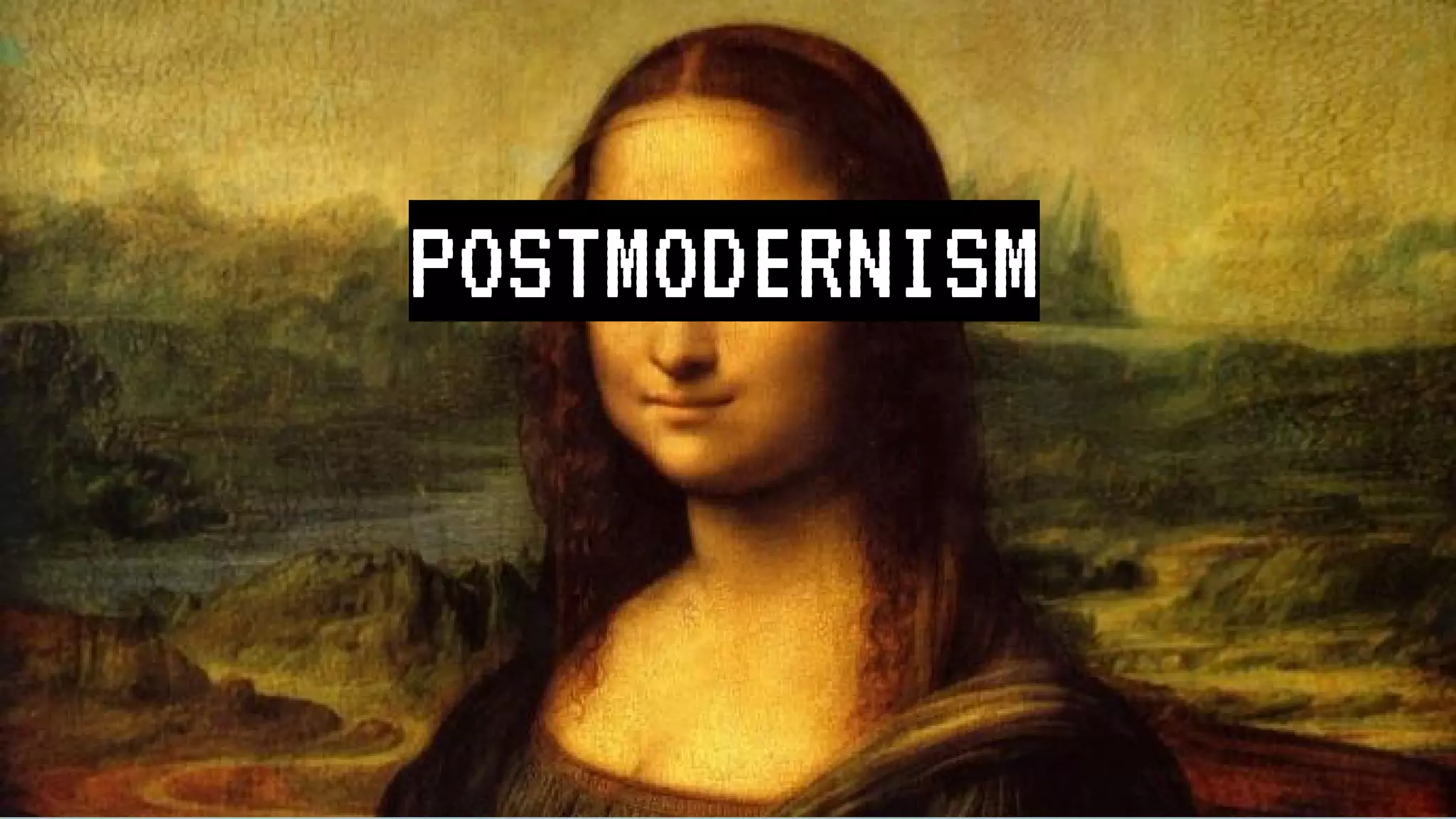
POSTMODERNISM
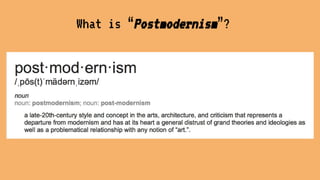
What is “Postmodernism”?
A BRIEF HISTORY BEHIND POSTMODERNISM
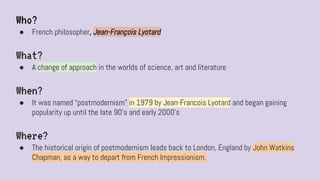
Who?
● French philosopher, Jean-François Lyotard
What?
● A change of approach in the worlds of science, art and literature
When?
● It was named “postmodernism” in 1979 by Jean-Francois Lyotard and began gaining
popularity up until the late 90’s and early 2000’s
Where?
● The historical origin of postmodernism leads back to London, England by John Watkins
Chapman, as a way to depart from French Impressionism.
Postmodernism isn’t a term that’s easily defined,
and its roots aren’t easily traced. We find it is
used to describe architecture, art, technology
and literature among other areas; either
stemming from modernism or opposed to it.
10 Facts on Postmodernism
1. Everything is Art.
● Postmodern art is a body of art movements that sought to contradict some aspects of
modernism or some aspects that emerged or developed in its aftermath.
● Postmodernism describes movements which both arise from, and react against or reject,
trends in modernism.
2. Belief in internationalism
● Postmodernists reject the idea of nationalism because it drives nations into conflict with
one another, deterring healthy human progress. Internationalism ensures that we’re
looking out for the greater good, uniting as opposed to dividing.
3. Equality
● Postmodernists hold many socially liberal views, believing in equality for all in spite of
race, sexual preference, class or creed. Of course, they believe no one should impose their
views of right and wrong on others, so there isn’t one right way to live.
4. Am I better than you? Who cares?
Postmodernism says that since people’s opinions change and since one person's
opinion cannot be more right than another, it means nothing to say, (for example) “one
work of art is better than any other.”
Postmodernism says that art, music, and literature, for example, can be anything that
its maker says that it is.
5. Pioneering Postmodernism
● Andy Warhol was at the forefront of the postmodern movement away from the control of
the modernist art world in the 1960’s.
● Postmodernism began to bloom in society. (rigid characteristics of modern art)
● Campbell soup cans to the Marilyn Monroe paintings to the Brillo boxes
Warhol’s goal of becoming famous became a reality, and along the way he helped changed the
face of the art world FOREVER.
6. Political Correctness
● If truth does not exist, all knowledge is mere opinion; all teaching becomes political in the
sense that it tries to win others over to the instructor's viewpoint.
● “If I ask about the world,” wrote Goodman, a Harvard philosopher, “you can offer to tell me
how it is under one or more frames of reference; but if I insist that you tell me how it is
apart from all frames, what can you say? We are confined to ways of describing whatever
is described. Our universe, so to speak, consists of these ways rather than of a world.”
7. Each religion is legitimate
● There isn’t a moral system that’s right for everybody. Traditional beliefs that have been
accepted for centuries fall by the wayside when people accept that truth is relative. This
is where many Christians clash with postmodern thinkers.
● Because there’s no objective truth, postmodernists believe there isn’t one religion that’s
"right." Instead, all of them are legitimate. If you subscribe to a faith based on personal
experiences and it’s compatible to you, then it’s accepted by postmodernists.
8. Truth is relative
● There are no objective truths. They have been defined by people and groups who use them
to attain power. One person’s perception of reality doesn’t always match another
person’s perception of reality. For example, although you may view a person of the
opposite sex as in a relationship based on their seemingly conventional practices that
indicate they’re taken, they may not see themselves as in a relationship.
9. Rationalization
● Opinions are what matter in postmodern thinking; after all, facts are ignored. As long as
the opinion is rationalized, it can be accepted as the best explanation. This means that
science is rejected because there is no objectivity.
10. Facts & Criticisms
● According to postmodernists, facts can change from day-to-day or they may be outright
lies. This comes with believing that truth is subjective and it’s something that shouldn’t
be widely acknowledged.
● Criticisms of postmodernism are intellectually diverse, including the assertions that
postmodernism is meaningless and promotes obscurantism.
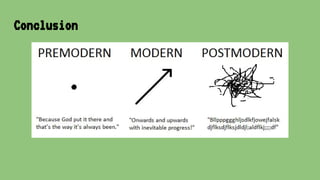
Conclusion
Thank you
I’m dying inside
Bibliography
- "10 Core Components Of Postmodernism - Web Design Schools Guide". Web Design
Schools Guide. N.p., 2017. Web. 28 Mar. 2017.
- "Postmodernism". En.wikipedia.org. N.p., 2017. Web. 28 Mar. 2017.
- "Postmodernism Facts For Kids | Kidzsearch.Com". Wiki.kidzsearch.com. N.p., 2017. Web.
29 Mar. 2017.
- "Postmodern Art". Postmodern-art.tumblr.com. N.p., 2017. Web. 29 Mar. 2017.
- Decorte, Laura. Art And Society. 1st ed. 2011. Web. 29 Mar. 2017.

10 Facts on Postmodernism

  • 1.
  • 2.
  • 3.
    A BRIEF HISTORYBEHIND POSTMODERNISM
  • 4.
    Who? ● French philosopher,Jean-François Lyotard What? ● A change of approach in the worlds of science, art and literature When? ● It was named “postmodernism” in 1979 by Jean-Francois Lyotard and began gaining popularity up until the late 90’s and early 2000’s Where? ● The historical origin of postmodernism leads back to London, England by John Watkins Chapman, as a way to depart from French Impressionism.
  • 5.
    Postmodernism isn’t aterm that’s easily defined, and its roots aren’t easily traced. We find it is used to describe architecture, art, technology and literature among other areas; either stemming from modernism or opposed to it.
  • 6.
    10 Facts onPostmodernism
  • 7.
    1. Everything isArt. ● Postmodern art is a body of art movements that sought to contradict some aspects of modernism or some aspects that emerged or developed in its aftermath. ● Postmodernism describes movements which both arise from, and react against or reject, trends in modernism.
  • 9.
    2. Belief ininternationalism ● Postmodernists reject the idea of nationalism because it drives nations into conflict with one another, deterring healthy human progress. Internationalism ensures that we’re looking out for the greater good, uniting as opposed to dividing.
  • 10.
    3. Equality ● Postmodernistshold many socially liberal views, believing in equality for all in spite of race, sexual preference, class or creed. Of course, they believe no one should impose their views of right and wrong on others, so there isn’t one right way to live.
  • 11.
    4. Am Ibetter than you? Who cares? Postmodernism says that since people’s opinions change and since one person's opinion cannot be more right than another, it means nothing to say, (for example) “one work of art is better than any other.” Postmodernism says that art, music, and literature, for example, can be anything that its maker says that it is.
  • 12.
    5. Pioneering Postmodernism ●Andy Warhol was at the forefront of the postmodern movement away from the control of the modernist art world in the 1960’s. ● Postmodernism began to bloom in society. (rigid characteristics of modern art) ● Campbell soup cans to the Marilyn Monroe paintings to the Brillo boxes Warhol’s goal of becoming famous became a reality, and along the way he helped changed the face of the art world FOREVER.
  • 13.
    6. Political Correctness ●If truth does not exist, all knowledge is mere opinion; all teaching becomes political in the sense that it tries to win others over to the instructor's viewpoint. ● “If I ask about the world,” wrote Goodman, a Harvard philosopher, “you can offer to tell me how it is under one or more frames of reference; but if I insist that you tell me how it is apart from all frames, what can you say? We are confined to ways of describing whatever is described. Our universe, so to speak, consists of these ways rather than of a world.”
  • 14.
    7. Each religionis legitimate ● There isn’t a moral system that’s right for everybody. Traditional beliefs that have been accepted for centuries fall by the wayside when people accept that truth is relative. This is where many Christians clash with postmodern thinkers. ● Because there’s no objective truth, postmodernists believe there isn’t one religion that’s "right." Instead, all of them are legitimate. If you subscribe to a faith based on personal experiences and it’s compatible to you, then it’s accepted by postmodernists.
  • 15.
    8. Truth isrelative ● There are no objective truths. They have been defined by people and groups who use them to attain power. One person’s perception of reality doesn’t always match another person’s perception of reality. For example, although you may view a person of the opposite sex as in a relationship based on their seemingly conventional practices that indicate they’re taken, they may not see themselves as in a relationship.
  • 16.
    9. Rationalization ● Opinionsare what matter in postmodern thinking; after all, facts are ignored. As long as the opinion is rationalized, it can be accepted as the best explanation. This means that science is rejected because there is no objectivity.
  • 17.
    10. Facts &Criticisms ● According to postmodernists, facts can change from day-to-day or they may be outright lies. This comes with believing that truth is subjective and it’s something that shouldn’t be widely acknowledged. ● Criticisms of postmodernism are intellectually diverse, including the assertions that postmodernism is meaningless and promotes obscurantism.
  • 18.
  • 19.
  • 20.
    Bibliography - "10 CoreComponents Of Postmodernism - Web Design Schools Guide". Web Design Schools Guide. N.p., 2017. Web. 28 Mar. 2017. - "Postmodernism". En.wikipedia.org. N.p., 2017. Web. 28 Mar. 2017. - "Postmodernism Facts For Kids | Kidzsearch.Com". Wiki.kidzsearch.com. N.p., 2017. Web. 29 Mar. 2017. - "Postmodern Art". Postmodern-art.tumblr.com. N.p., 2017. Web. 29 Mar. 2017. - Decorte, Laura. Art And Society. 1st ed. 2011. Web. 29 Mar. 2017.