English Subject Knowledge Audit
Initial Subject Knowledge Audit
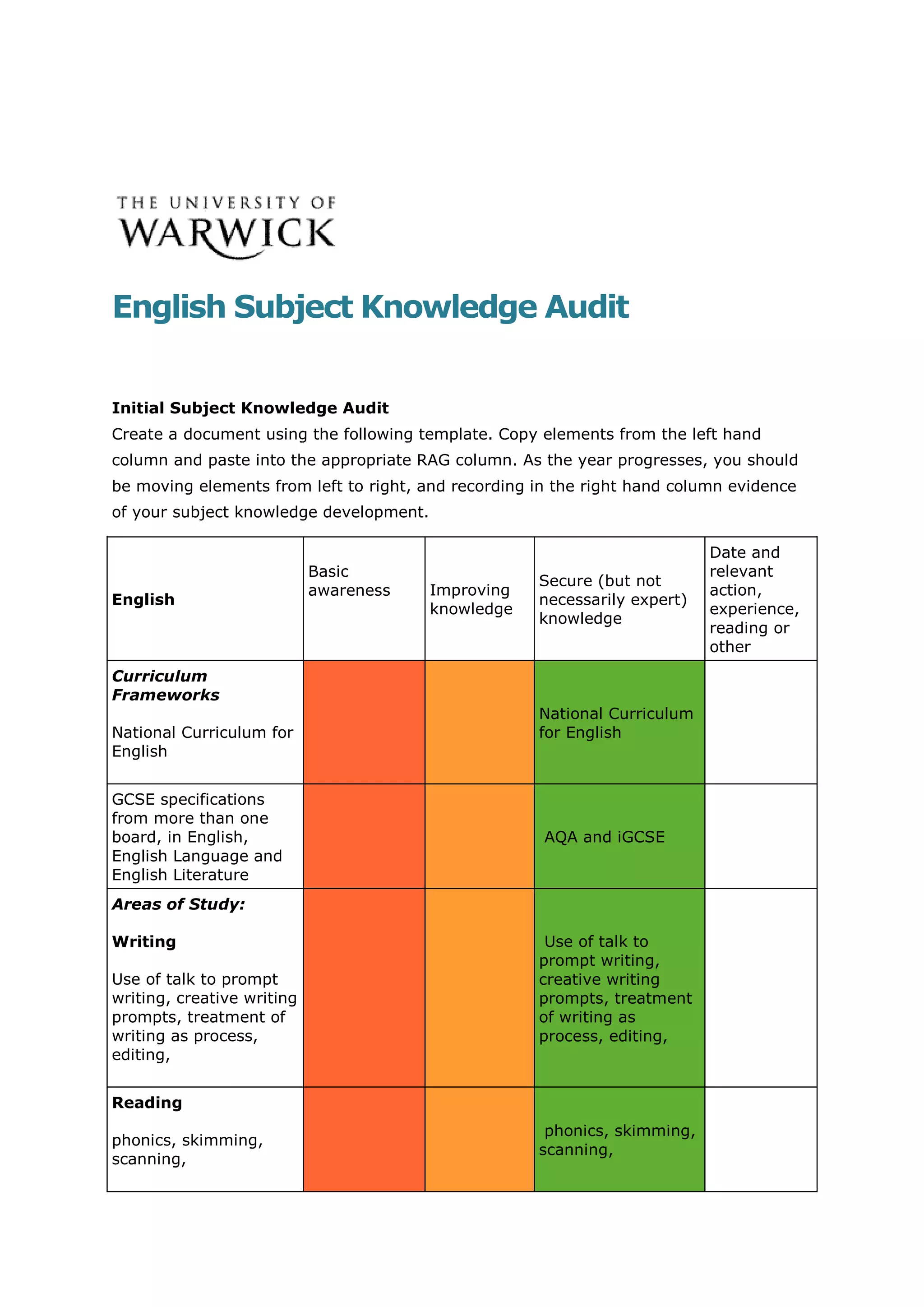
Create a document using the following template. Copy elements from the left hand
column and paste into the appropriate RAG column. As the year progresses, you should
be moving elements from left to right, and recording in the right hand column evidence
of your subject knowledge development.
English
Basic
awareness Improving
knowledge
Secure (but not
necessarily expert)
knowledge
Date and
relevant
action,
experience,
reading or
other
Curriculum
Frameworks
National Curriculum for
English
National Curriculum
for English
GCSE specifications
from more than one
board, in English,
English Language and
English Literature
AQA and iGCSE
Areas of Study:
Writing
Use of talk to prompt
writing, creative writing
prompts, treatment of
writing as process,
editing,
Use of talk to
prompt writing,
creative writing
prompts, treatment
of writing as
process, editing,
Reading
phonics, skimming,
scanning,
phonics, skimming,
scanning,
Speaking and
Listening
Group work (different
structures), roleplay,
presentation, public
speaking,
Group work
(different
structures),
roleplay,
presentation, public
speaking,
Linguistic/ literary
devices
metaphor, simile,
rhetorical questions,
alliteration, assonance,
onomatopoeia,
juxtaposition,
oxymoron, etc
metaphor, simile,
rhetorical questions,
alliteration,
assonance,
onomatopoeia,
juxtaposition,
oxymoron, etc
English literary
heritage (pre-
twentieth century)
Shakespeare e.g.
Macbeth etc including
contextual knowledge
about his time and
society, and
Elizabethan theatre
performance.
Shakespeare e.g.
Othello, Romeo &
Juliet, A
Midsummer’s Night
Dream including
contextual
knowledge about his
time and society,
and Elizabethan
theatre
performance.
e.g.
Other Renaissance
playwrights;
Romantics; Gothic;
Restoration Comedy;
Chaucer; Austen;
Hardy; Eliot; Dickens;
Brontës; etc.
Other Renaissance
playwrights;
Romantics; Gothic;
Restoration
Comedy; Chaucer;
Austen; Hardy;
Eliot; Dickens;
Brontës; etc.
English literary
heritage (twentieth
century) e.g. First
World War Poetry;
Golding; Steinbeck;
Plath; Pinter etc
First World War
Poetry; Owen,
Golding; Steinbeck;
Priestley; Lee,
Sassoon, Brooke
Contemporary
Writers e.g. Morpurgo,
Duffy, Armitage,
Heaney, Syal, etc
Morpurgo,
Duffy,
Armitage,
Heaney
Writers representing Behn, Zephaniah,
cultures and
traditions other than
White British e.g.
Agard, Zephaniah,
Syal, Toni Morrison,
Maya Angelou, Chinua
Achebe, Peter Carey,
etc etc!
Collins, Voltaire,
Flaubert, Zola
KS3 novelists e.g.
Morpurgo, Pullman,
Sachar, Gleitzman,
Blackman etc.
Morpurgo, Collins,
Almond,
KS3 plays e.g.
versions of Dracula,
Our Day Out etc.
Dracula
Language
 Word classes
Word classes
 Sentence Types Sentence Types
 Sentence parsing
(syntax)
Sentence
parsing
(syntax)
 Clauses Clauses
 Tenses Tenses
Punctuation Punctuation
Other topics used to
teach English
e.g. Greek myths
Greek
Mythology,
Ballads
Spoken Language
Study (GCSE)
• variations of usage in
both spoken and
written language.
• variations
of usage in
both spoken
and written
language.
• how geographical,
social, personal and
historical variation
shape and change
forms and meanings in
language.
• how
geographical, social,
personal and
historical variation
shape and change
forms and meanings
in language.
• frameworks for the
study of language, e.g.
pragmatics, face
• frameworks
for the study
of language,
theory, semantics. e.g.
pragmatics,
face theory,
semantics.
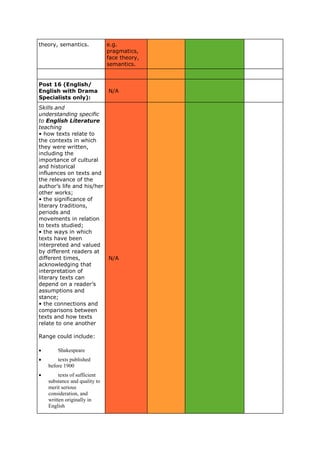
Post 16 (English/
English with Drama
Specialists only):
N/A
Skills and
understanding specific
to English Literature
teaching
• how texts relate to
the contexts in which
they were written,
including the
importance of cultural
and historical
influences on texts and
the relevance of the
author’s life and his/her
other works;
• the significance of
literary traditions,
periods and
movements in relation
to texts studied;
• the ways in which
texts have been
interpreted and valued
by different readers at
different times,
acknowledging that
interpretation of
literary texts can
depend on a reader’s
assumptions and
stance;
• the connections and
comparisons between
texts and how texts
relate to one another
Range could include:
 Shakespeare
 texts published
before 1900
 texts of sufficient
substance and quality to
merit serious
consideration, and
written originally in
English
N/A
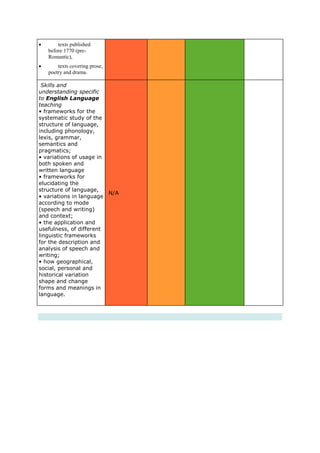
 texts published
before 1770 (pre-
Romantic),
 texts covering prose,
poetry and drama.
Skills and
understanding specific
to English Language
teaching
• frameworks for the
systematic study of the
structure of language,
including phonology,
lexis, grammar,
semantics and
pragmatics;
• variations of usage in
both spoken and
written language
• frameworks for
elucidating the
structure of language,
• variations in language
according to mode
(speech and writing)
and context;
• the application and
usefulness, of different
linguistic frameworks
for the description and
analysis of speech and
writing;
• how geographical,
social, personal and
historical variation
shape and change
forms and meanings in
language.
N/A

Subject knowledge audit 3

  • 1.
    English Subject KnowledgeAudit Initial Subject Knowledge Audit Create a document using the following template. Copy elements from the left hand column and paste into the appropriate RAG column. As the year progresses, you should be moving elements from left to right, and recording in the right hand column evidence of your subject knowledge development. English Basic awareness Improving knowledge Secure (but not necessarily expert) knowledge Date and relevant action, experience, reading or other Curriculum Frameworks National Curriculum for English National Curriculum for English GCSE specifications from more than one board, in English, English Language and English Literature AQA and iGCSE Areas of Study: Writing Use of talk to prompt writing, creative writing prompts, treatment of writing as process, editing, Use of talk to prompt writing, creative writing prompts, treatment of writing as process, editing, Reading phonics, skimming, scanning, phonics, skimming, scanning,
  • 2.
    Speaking and Listening Group work(different structures), roleplay, presentation, public speaking, Group work (different structures), roleplay, presentation, public speaking, Linguistic/ literary devices metaphor, simile, rhetorical questions, alliteration, assonance, onomatopoeia, juxtaposition, oxymoron, etc metaphor, simile, rhetorical questions, alliteration, assonance, onomatopoeia, juxtaposition, oxymoron, etc English literary heritage (pre- twentieth century) Shakespeare e.g. Macbeth etc including contextual knowledge about his time and society, and Elizabethan theatre performance. Shakespeare e.g. Othello, Romeo & Juliet, A Midsummer’s Night Dream including contextual knowledge about his time and society, and Elizabethan theatre performance. e.g. Other Renaissance playwrights; Romantics; Gothic; Restoration Comedy; Chaucer; Austen; Hardy; Eliot; Dickens; Brontës; etc. Other Renaissance playwrights; Romantics; Gothic; Restoration Comedy; Chaucer; Austen; Hardy; Eliot; Dickens; Brontës; etc. English literary heritage (twentieth century) e.g. First World War Poetry; Golding; Steinbeck; Plath; Pinter etc First World War Poetry; Owen, Golding; Steinbeck; Priestley; Lee, Sassoon, Brooke Contemporary Writers e.g. Morpurgo, Duffy, Armitage, Heaney, Syal, etc Morpurgo, Duffy, Armitage, Heaney Writers representing Behn, Zephaniah,
  • 3.
    cultures and traditions otherthan White British e.g. Agard, Zephaniah, Syal, Toni Morrison, Maya Angelou, Chinua Achebe, Peter Carey, etc etc! Collins, Voltaire, Flaubert, Zola KS3 novelists e.g. Morpurgo, Pullman, Sachar, Gleitzman, Blackman etc. Morpurgo, Collins, Almond, KS3 plays e.g. versions of Dracula, Our Day Out etc. Dracula Language  Word classes Word classes  Sentence Types Sentence Types  Sentence parsing (syntax) Sentence parsing (syntax)  Clauses Clauses  Tenses Tenses Punctuation Punctuation Other topics used to teach English e.g. Greek myths Greek Mythology, Ballads Spoken Language Study (GCSE) • variations of usage in both spoken and written language. • variations of usage in both spoken and written language. • how geographical, social, personal and historical variation shape and change forms and meanings in language. • how geographical, social, personal and historical variation shape and change forms and meanings in language. • frameworks for the study of language, e.g. pragmatics, face • frameworks for the study of language,
  • 4.
    theory, semantics. e.g. pragmatics, facetheory, semantics. Post 16 (English/ English with Drama Specialists only): N/A Skills and understanding specific to English Literature teaching • how texts relate to the contexts in which they were written, including the importance of cultural and historical influences on texts and the relevance of the author’s life and his/her other works; • the significance of literary traditions, periods and movements in relation to texts studied; • the ways in which texts have been interpreted and valued by different readers at different times, acknowledging that interpretation of literary texts can depend on a reader’s assumptions and stance; • the connections and comparisons between texts and how texts relate to one another Range could include:  Shakespeare  texts published before 1900  texts of sufficient substance and quality to merit serious consideration, and written originally in English N/A
  • 5.
     texts published before1770 (pre- Romantic),  texts covering prose, poetry and drama. Skills and understanding specific to English Language teaching • frameworks for the systematic study of the structure of language, including phonology, lexis, grammar, semantics and pragmatics; • variations of usage in both spoken and written language • frameworks for elucidating the structure of language, • variations in language according to mode (speech and writing) and context; • the application and usefulness, of different linguistic frameworks for the description and analysis of speech and writing; • how geographical, social, personal and historical variation shape and change forms and meanings in language. N/A