RP3
John Henry Newman Catholic College (JHNCC)
Individual Provision Plan (IPP)
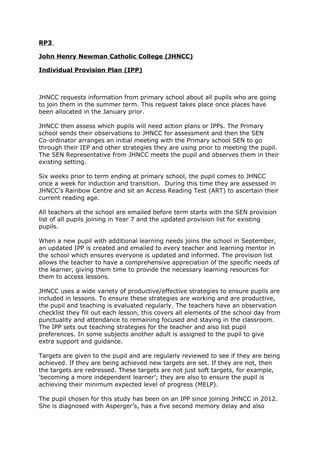
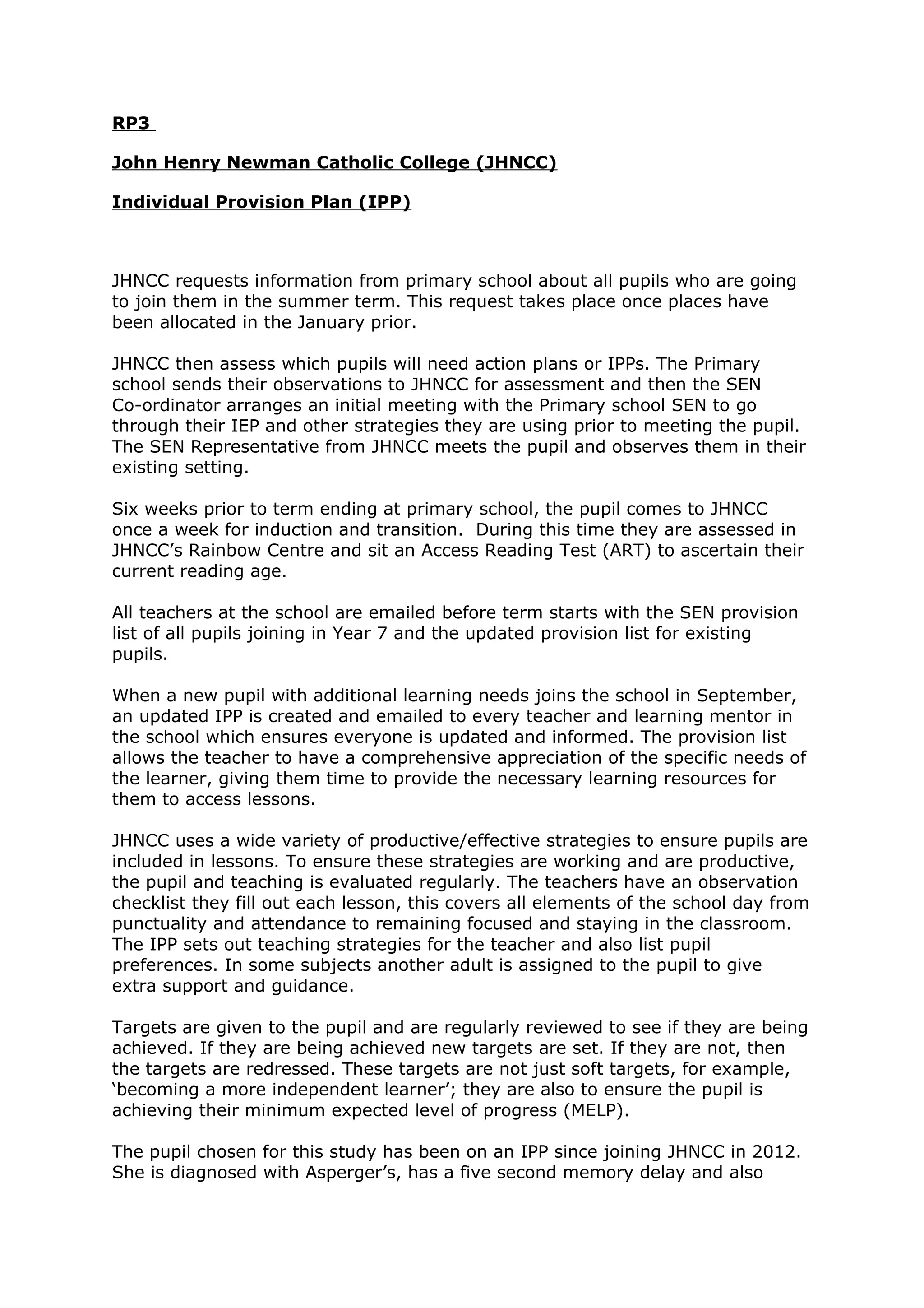
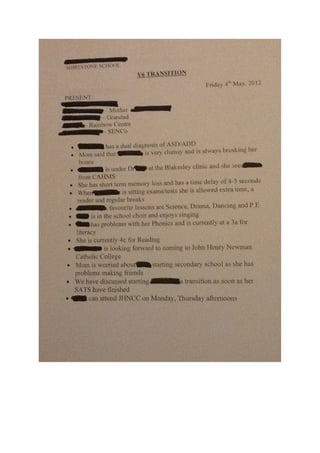
JHNCC requests information from primary school about all pupils who are going
to join them in the summer term. This request takes place once places have
been allocated in the January prior.
JHNCC then assess which pupils will need action plans or IPPs. The Primary
school sends their observations to JHNCC for assessment and then the SEN
Co-ordinator arranges an initial meeting with the Primary school SEN to go
through their IEP and other strategies they are using prior to meeting the pupil.
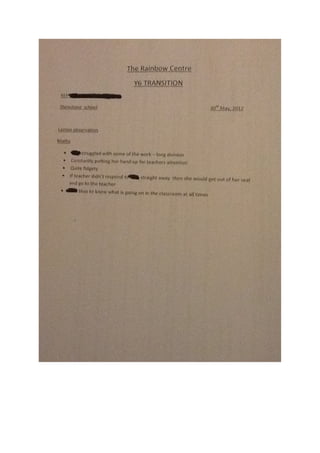
The SEN Representative from JHNCC meets the pupil and observes them in their
existing setting.
Six weeks prior to term ending at primary school, the pupil comes to JHNCC
once a week for induction and transition. During this time they are assessed in
JHNCC’s Rainbow Centre and sit an Access Reading Test (ART) to ascertain their
current reading age.
All teachers at the school are emailed before term starts with the SEN provision
list of all pupils joining in Year 7 and the updated provision list for existing
pupils.
When a new pupil with additional learning needs joins the school in September,
an updated IPP is created and emailed to every teacher and learning mentor in
the school which ensures everyone is updated and informed. The provision list
allows the teacher to have a comprehensive appreciation of the specific needs of
the learner, giving them time to provide the necessary learning resources for
them to access lessons.
JHNCC uses a wide variety of productive/effective strategies to ensure pupils are
included in lessons. To ensure these strategies are working and are productive,
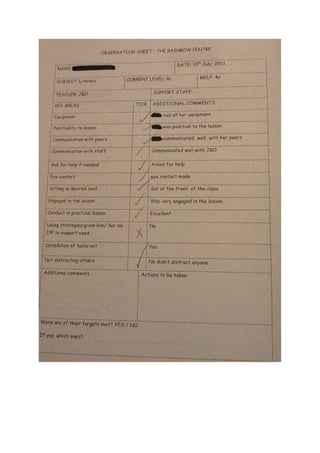
the pupil and teaching is evaluated regularly. The teachers have an observation
checklist they fill out each lesson, this covers all elements of the school day from
punctuality and attendance to remaining focused and staying in the classroom.
The IPP sets out teaching strategies for the teacher and also list pupil
preferences. In some subjects another adult is assigned to the pupil to give
extra support and guidance.
Targets are given to the pupil and are regularly reviewed to see if they are being
achieved. If they are being achieved new targets are set. If they are not, then
the targets are redressed. These targets are not just soft targets, for example,
‘becoming a more independent learner’; they are also to ensure the pupil is
achieving their minimum expected level of progress (MELP).
The pupil chosen for this study has been on an IPP since joining JHNCC in 2012.
She is diagnosed with Asperger’s, has a five second memory delay and also
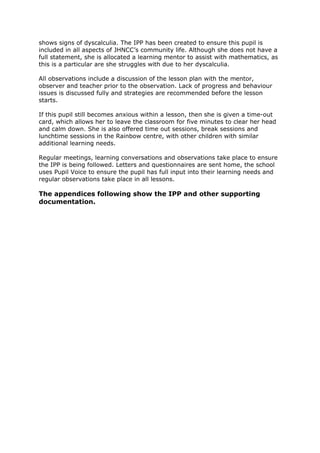
shows signs of dyscalculia. The IPP has been created to ensure this pupil is
included in all aspects of JHNCC’s community life. Although she does not have a
full statement, she is allocated a learning mentor to assist with mathematics, as
this is a particular are she struggles with due to her dyscalculia.
All observations include a discussion of the lesson plan with the mentor,
observer and teacher prior to the observation. Lack of progress and behaviour
issues is discussed fully and strategies are recommended before the lesson
starts.
If this pupil still becomes anxious within a lesson, then she is given a time-out
card, which allows her to leave the classroom for five minutes to clear her head
and calm down. She is also offered time out sessions, break sessions and
lunchtime sessions in the Rainbow centre, with other children with similar
additional learning needs.
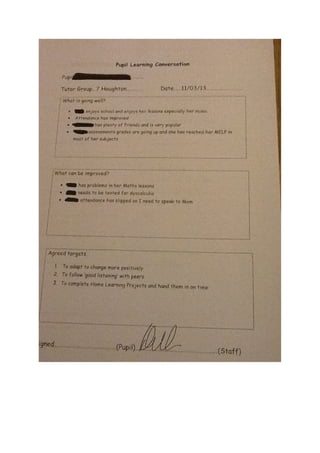
Regular meetings, learning conversations and observations take place to ensure
the IPP is being followed. Letters and questionnaires are sent home, the school
uses Pupil Voice to ensure the pupil has full input into their learning needs and
regular observations take place in all lessons.
The appendices following show the IPP and other supporting
documentation.
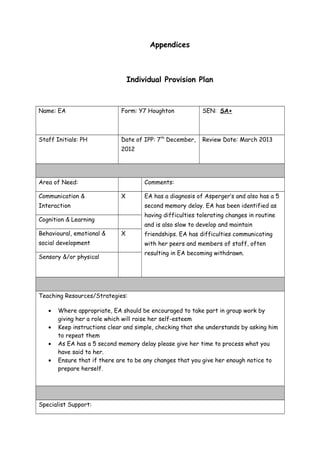
Appendices
Individual Provision Plan
Name: EA Form: Y7 Houghton SEN: SA+
Staff Initials: PH Date of IPP: 7th
December,
2012
Review Date: March 2013
Area of Need: Comments:
Communication &
Interaction
X EA has a diagnosis of Asperger’s and also has a 5
second memory delay. EA has been identified as
having difficulties tolerating changes in routine
and is also slow to develop and maintain
friendships. EA has difficulties communicating
with her peers and members of staff, often
resulting in EA becoming withdrawn.
Cognition & Learning
Behavioural, emotional &
social development
X
Sensory &/or physical
Teaching Resources/Strategies:
• Where appropriate, EA should be encouraged to take part in group work by
giving her a role which will raise her self-esteem
• Keep instructions clear and simple, checking that she understands by asking him
to repeat them
• As EA has a 5 second memory delay please give her time to process what you
have said to her.
• Ensure that if there are to be any changes that you give her enough notice to
prepare herself.
Specialist Support:
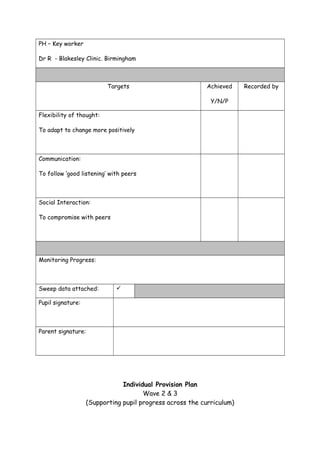
PH – Key worker
Dr R - Blakesley Clinic. Birmingham
Targets Achieved
Y/N/P
Recorded by
Flexibility of thought:
To adapt to change more positively
Communication:
To follow ‘good listening’ with peers
Social Interaction:
To compromise with peers
Monitoring Progress:
Sweep data attached: 
Pupil signature:
Parent signature:
Individual Provision Plan
Wave 2 & 3
(Supporting pupil progress across the curriculum)
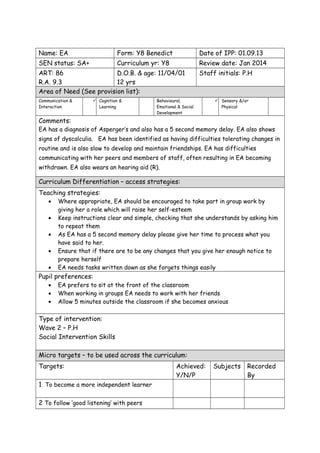
Name: EA Form: Y8 Benedict Date of IPP: 01.09.13
SEN status: SA+ Curriculum yr: Y8 Review date: Jan 2014
ART: 86
R.A. 9.3
D.O.B. & age: 11/04/01
12 yrs
Staff initials: P.H
Area of Need (See provision list):
Communication &
Interaction
 Cognition &
Learning
Behavioural,
Emotional & Social
Development
 Sensory &/or
Physical
Comments:
EA has a diagnosis of Asperger’s and also has a 5 second memory delay. EA also shows
signs of dyscalculia. EA has been identified as having difficulties tolerating changes in
routine and is also slow to develop and maintain friendships. EA has difficulties
communicating with her peers and members of staff, often resulting in EA becoming
withdrawn. EA also wears an hearing aid (R).
Curriculum Differentiation – access strategies:
Teaching strategies:
• Where appropriate, EA should be encouraged to take part in group work by
giving her a role which will raise her self-esteem
• Keep instructions clear and simple, checking that she understands by asking him
to repeat them
• As EA has a 5 second memory delay please give her time to process what you
have said to her.
• Ensure that if there are to be any changes that you give her enough notice to
prepare herself
• EA needs tasks written down as she forgets things easily
Pupil preferences:
• EA prefers to sit at the front of the classroom
• When working in groups EA needs to work with her friends
• Allow 5 minutes outside the classroom if she becomes anxious
Type of intervention:
Wave 2 – P.H
Social Intervention Skills
Micro targets – to be used across the curriculum:
Targets: Achieved:
Y/N/P
Subjects Recorded
By
1 To become a more independent learner
2 To follow ‘good listening’ with peers
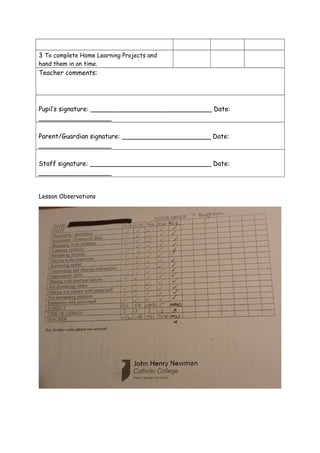
3 To complete Home Learning Projects and
hand them in on time.
Teacher comments:
Pupil’s signature: ______________________________ Date:
__________________
Parent/Guardian signature: ______________________ Date:
__________________
Staff signature: ______________________________ Date:
__________________
Lesson Observations
Reflective Practice 3

Reflective Practice 3

  • 1.
    RP3 John Henry NewmanCatholic College (JHNCC) Individual Provision Plan (IPP) JHNCC requests information from primary school about all pupils who are going to join them in the summer term. This request takes place once places have been allocated in the January prior. JHNCC then assess which pupils will need action plans or IPPs. The Primary school sends their observations to JHNCC for assessment and then the SEN Co-ordinator arranges an initial meeting with the Primary school SEN to go through their IEP and other strategies they are using prior to meeting the pupil. The SEN Representative from JHNCC meets the pupil and observes them in their existing setting. Six weeks prior to term ending at primary school, the pupil comes to JHNCC once a week for induction and transition. During this time they are assessed in JHNCC’s Rainbow Centre and sit an Access Reading Test (ART) to ascertain their current reading age. All teachers at the school are emailed before term starts with the SEN provision list of all pupils joining in Year 7 and the updated provision list for existing pupils. When a new pupil with additional learning needs joins the school in September, an updated IPP is created and emailed to every teacher and learning mentor in the school which ensures everyone is updated and informed. The provision list allows the teacher to have a comprehensive appreciation of the specific needs of the learner, giving them time to provide the necessary learning resources for them to access lessons. JHNCC uses a wide variety of productive/effective strategies to ensure pupils are included in lessons. To ensure these strategies are working and are productive, the pupil and teaching is evaluated regularly. The teachers have an observation checklist they fill out each lesson, this covers all elements of the school day from punctuality and attendance to remaining focused and staying in the classroom. The IPP sets out teaching strategies for the teacher and also list pupil preferences. In some subjects another adult is assigned to the pupil to give extra support and guidance. Targets are given to the pupil and are regularly reviewed to see if they are being achieved. If they are being achieved new targets are set. If they are not, then the targets are redressed. These targets are not just soft targets, for example, ‘becoming a more independent learner’; they are also to ensure the pupil is achieving their minimum expected level of progress (MELP). The pupil chosen for this study has been on an IPP since joining JHNCC in 2012. She is diagnosed with Asperger’s, has a five second memory delay and also
  • 2.
    shows signs ofdyscalculia. The IPP has been created to ensure this pupil is included in all aspects of JHNCC’s community life. Although she does not have a full statement, she is allocated a learning mentor to assist with mathematics, as this is a particular are she struggles with due to her dyscalculia. All observations include a discussion of the lesson plan with the mentor, observer and teacher prior to the observation. Lack of progress and behaviour issues is discussed fully and strategies are recommended before the lesson starts. If this pupil still becomes anxious within a lesson, then she is given a time-out card, which allows her to leave the classroom for five minutes to clear her head and calm down. She is also offered time out sessions, break sessions and lunchtime sessions in the Rainbow centre, with other children with similar additional learning needs. Regular meetings, learning conversations and observations take place to ensure the IPP is being followed. Letters and questionnaires are sent home, the school uses Pupil Voice to ensure the pupil has full input into their learning needs and regular observations take place in all lessons. The appendices following show the IPP and other supporting documentation.
  • 3.
    Appendices Individual Provision Plan Name:EA Form: Y7 Houghton SEN: SA+ Staff Initials: PH Date of IPP: 7th December, 2012 Review Date: March 2013 Area of Need: Comments: Communication & Interaction X EA has a diagnosis of Asperger’s and also has a 5 second memory delay. EA has been identified as having difficulties tolerating changes in routine and is also slow to develop and maintain friendships. EA has difficulties communicating with her peers and members of staff, often resulting in EA becoming withdrawn. Cognition & Learning Behavioural, emotional & social development X Sensory &/or physical Teaching Resources/Strategies: • Where appropriate, EA should be encouraged to take part in group work by giving her a role which will raise her self-esteem • Keep instructions clear and simple, checking that she understands by asking him to repeat them • As EA has a 5 second memory delay please give her time to process what you have said to her. • Ensure that if there are to be any changes that you give her enough notice to prepare herself. Specialist Support:
  • 4.
    PH – Keyworker Dr R - Blakesley Clinic. Birmingham Targets Achieved Y/N/P Recorded by Flexibility of thought: To adapt to change more positively Communication: To follow ‘good listening’ with peers Social Interaction: To compromise with peers Monitoring Progress: Sweep data attached:  Pupil signature: Parent signature: Individual Provision Plan Wave 2 & 3 (Supporting pupil progress across the curriculum)
  • 5.
    Name: EA Form:Y8 Benedict Date of IPP: 01.09.13 SEN status: SA+ Curriculum yr: Y8 Review date: Jan 2014 ART: 86 R.A. 9.3 D.O.B. & age: 11/04/01 12 yrs Staff initials: P.H Area of Need (See provision list): Communication & Interaction  Cognition & Learning Behavioural, Emotional & Social Development  Sensory &/or Physical Comments: EA has a diagnosis of Asperger’s and also has a 5 second memory delay. EA also shows signs of dyscalculia. EA has been identified as having difficulties tolerating changes in routine and is also slow to develop and maintain friendships. EA has difficulties communicating with her peers and members of staff, often resulting in EA becoming withdrawn. EA also wears an hearing aid (R). Curriculum Differentiation – access strategies: Teaching strategies: • Where appropriate, EA should be encouraged to take part in group work by giving her a role which will raise her self-esteem • Keep instructions clear and simple, checking that she understands by asking him to repeat them • As EA has a 5 second memory delay please give her time to process what you have said to her. • Ensure that if there are to be any changes that you give her enough notice to prepare herself • EA needs tasks written down as she forgets things easily Pupil preferences: • EA prefers to sit at the front of the classroom • When working in groups EA needs to work with her friends • Allow 5 minutes outside the classroom if she becomes anxious Type of intervention: Wave 2 – P.H Social Intervention Skills Micro targets – to be used across the curriculum: Targets: Achieved: Y/N/P Subjects Recorded By 1 To become a more independent learner 2 To follow ‘good listening’ with peers
  • 6.
    3 To completeHome Learning Projects and hand them in on time. Teacher comments: Pupil’s signature: ______________________________ Date: __________________ Parent/Guardian signature: ______________________ Date: __________________ Staff signature: ______________________________ Date: __________________ Lesson Observations