GENRE, TEXT, GRAMMAR
HOW DO WE LEARN TO USE LANGUAGE?
● Language is both natural and cultural, individual and
social.
● A language operates in time and space.
● The shape and structure of the language is socially
determined.
WHAT IS A GENRE, TEXT AND GRAMMAR
MODEL OF LANGUAGE?
● Primarily concerned with what is going on in writing.
● The aim of genre, text and grammar is to provide
students with the ability to use the codes of writing
efficiently and effectively.
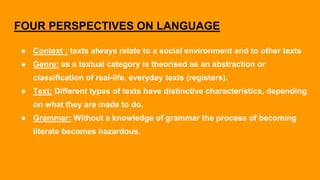
FOUR PERSPECTIVES ON LANGUAGE
● Context : texts always relate to a social environment and to other texts
● Genre: as a textual category is theorised as an abstraction or
classification of real-life, everyday texts (registers).
● Text: Different types of texts have distinctive characteristics, depending
on what they are made to do.
● Grammar: Without a knowledge of grammar the process of becoming
literate becomes hazardous.
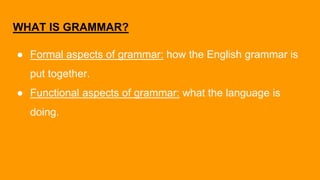
WHAT IS GRAMMAR?
● Formal aspects of grammar: how the English grammar is
put together.
● Functional aspects of grammar: what the language is
doing.
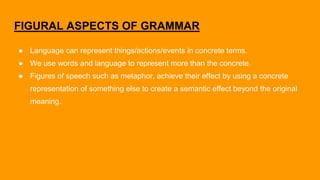
FIGURAL ASPECTS OF GRAMMAR
● Language can represent things/actions/events in concrete terms.
● We use words and language to represent more than the concrete.
● Figures of speech such as metaphor, achieve their effect by using a concrete
representation of something else to create a semantic effect beyond the original
meaning.
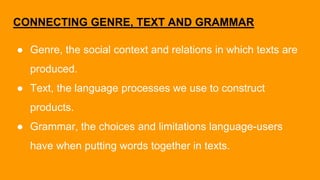
CONNECTING GENRE, TEXT AND GRAMMAR
● Genre, the social context and relations in which texts are
produced.
● Text, the language processes we use to construct
products.
● Grammar, the choices and limitations language-users
have when putting words together in texts.
BIBLIOGRAPHY
Knapp, P & Watkins, M. (2005) Genre, Grammar, Text:
Technologies for Teaching and Assessing Writing. Australia:
UNSW Press.
THANKS FOR WATCHING!
EDUARDO GARCÍA MALDONADO
MARTÍN ALEJANDRO GRAFF
PROFESORADO DE INGLÉS
4TH YEAR
PRÁCTICAS DISCURSIVAS DE LA COMUNICACIÓN ESCRITA 4.
ISFD 41.

Genre, text, grammar

  • 1.
  • 2.
    HOW DO WELEARN TO USE LANGUAGE? ● Language is both natural and cultural, individual and social. ● A language operates in time and space. ● The shape and structure of the language is socially determined.
  • 3.
    WHAT IS AGENRE, TEXT AND GRAMMAR MODEL OF LANGUAGE? ● Primarily concerned with what is going on in writing. ● The aim of genre, text and grammar is to provide students with the ability to use the codes of writing efficiently and effectively.
  • 4.
    FOUR PERSPECTIVES ONLANGUAGE ● Context : texts always relate to a social environment and to other texts ● Genre: as a textual category is theorised as an abstraction or classification of real-life, everyday texts (registers). ● Text: Different types of texts have distinctive characteristics, depending on what they are made to do. ● Grammar: Without a knowledge of grammar the process of becoming literate becomes hazardous.
  • 5.
    WHAT IS GRAMMAR? ●Formal aspects of grammar: how the English grammar is put together. ● Functional aspects of grammar: what the language is doing.
  • 6.
    FIGURAL ASPECTS OFGRAMMAR ● Language can represent things/actions/events in concrete terms. ● We use words and language to represent more than the concrete. ● Figures of speech such as metaphor, achieve their effect by using a concrete representation of something else to create a semantic effect beyond the original meaning.
  • 7.
    CONNECTING GENRE, TEXTAND GRAMMAR ● Genre, the social context and relations in which texts are produced. ● Text, the language processes we use to construct products. ● Grammar, the choices and limitations language-users have when putting words together in texts.
  • 8.
    BIBLIOGRAPHY Knapp, P &Watkins, M. (2005) Genre, Grammar, Text: Technologies for Teaching and Assessing Writing. Australia: UNSW Press.
  • 9.
    THANKS FOR WATCHING! EDUARDOGARCÍA MALDONADO MARTÍN ALEJANDRO GRAFF PROFESORADO DE INGLÉS 4TH YEAR PRÁCTICAS DISCURSIVAS DE LA COMUNICACIÓN ESCRITA 4. ISFD 41.