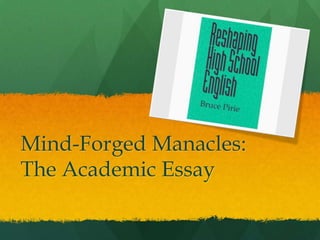
Those Things We Sometimes Fear to TeachThe Academic Essay and Grammar
Centre of GravityHow do we deal with the long-held cultural assumptions and folk psychologies about teaching English to engage our students in the potential for learning that writing essays and understanding grammar can offer?
Speaking My Mind“Persistence of the Five-Paragraph Essay”English Journal, 99 (3), 2010.
Mind-Forged Manacles: The Academic Essay
Mind-Forged Manacles: The Academic EssayA. What are the dangers of the academic essay? (Use Pirie’s article as a source of possibility as well as your own experience and knowledge.)B. What are the learning advantages of the academic essay? (Again, use Pirie and your own experience and reading.)What are alternatives you have seen?
Lamppost BlogIdeas from an Ontario Teacher
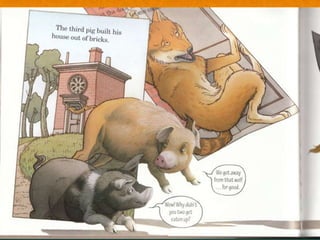
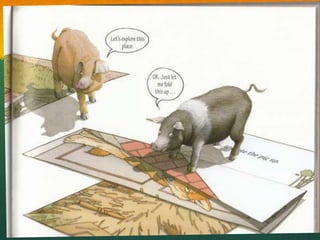
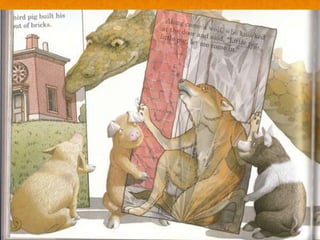
The Three PigsDavid Wiesner
R.A.F.T.S. WritingR—Role (who is speaking, telling?)A—Audience (who is being addressed?)F—Form (what genre?)T—Topic (what is the piece about?)S—Strong Voice/Verb (what tone?)
Use R.A.F.T.S. as an enabling constrainti.e., set the text for response but let the students choose the RAFTS; or let the students choose aspects of the RAFTS
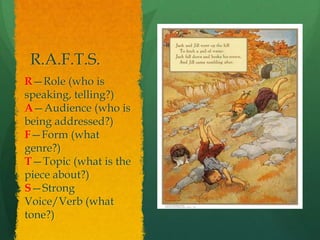
R.A.F.T.S.	R—Role (who is speaking, telling?)A—Audience (who is being addressed?)F—Form (what genre?)T—Topic (what is the piece about?)S—Strong Voice/Verb (what tone?)
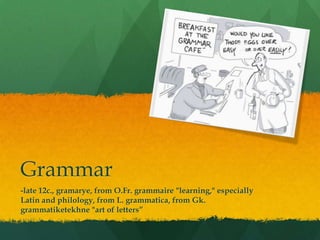
Grammar-late 12c., gramarye, from O.Fr. grammaire "learning," especially Latin and philology, from L. grammatica, from Gk. grammatiketekhne "art of letters”
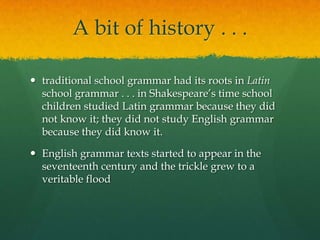
A bit of history . . . traditional school grammar had its roots in Latin school grammar . . . in Shakespeare’s time school children studied Latin grammar because they did not know it; they did not study English grammar because they did know it.English grammar texts started to appear in the seventeenth century and the trickle grew to a veritable flood
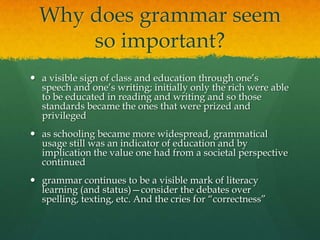
Why does grammar seem so important?a visible sign of class and education through one’s speech and one’s writing; initially only the rich were able to be educated in reading and writing and so those standards became the ones that were prized and privilegedas schooling became more widespread, grammatical usage still was an indicator of education and by implication the value one had from a societal perspective continuedgrammar continues to be a visible mark of literacy learning (and status)—consider the debates over spelling, texting, etc. And the cries for “correctness”
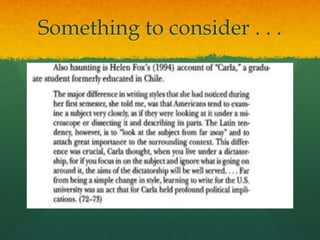
Something to consider . . .
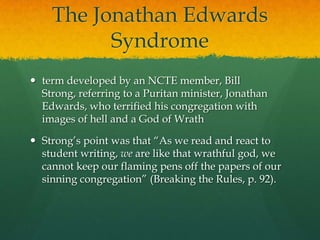
The Jonathan Edwards Syndrometerm developed by an NCTE member, Bill Strong, referring to a Puritan minister, Jonathan Edwards, who terrified his congregation with images of hell and a God of WrathStrong’s point was that “As we read and react to student writing, we are like that wrathful god, we cannot keep our flaming pens off the papers of our sinning congregation” (Breaking the Rules, p. 92).
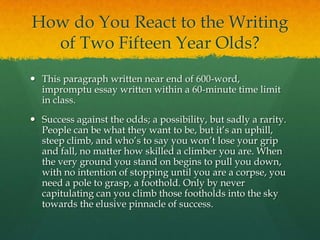
How do You React to the Writing of Two Fifteen Year Olds?This paragraph written near end of 600-word, impromptu essay written within a 60-minute time limit in class.Success against the odds; a possibility, but sadly a rarity. People can be what they want to be, but it’s an uphill, steep climb, and who’s to say you won’t lose your grip and fall, no matter how skilled a climber you are. When the very ground you stand on begins to pull you down, with no intention of stopping until you are a corpse, you need a pole to grasp, a foothold. Only by never capitulating can you climb those footholds into the sky towards the elusive pinnacle of success.
How do You React to the Writing of Two Fifteen Year Olds?This paragraph is extracted from a brief discussion of King Henry VIII, written by a fifteen year old at home in her own time.It is however but Justice and my Duty to declare that this amiable woman [Anne Boleyn] was entirely innocent of the crimes with which she was accused, of which her beauty, her elegance and her sprightliness were sufficient proofs, not to mention her solemn protestations of innocence and the King’s character; all of which add some confirmation, though perhaps but slight ones when in comparison with those before alleged in her favor.
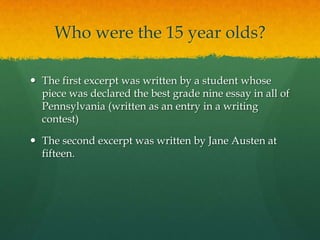
Who were the 15 year olds?The first excerpt was written by a student whose piece was declared the best grade nine essay in all of Pennsylvania (written as an entry in a writing contest)The second excerpt was written by Jane Austen at fifteen.
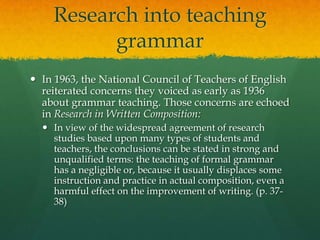
Research into teaching grammarIn 1963, the National Council of Teachers of English reiterated concerns they voiced as early as 1936 about grammar teaching. Those concerns are echoed in Research in Written Composition: In view of the widespread agreement of research studies based upon many types of students and teachers, the conclusions can be stated in strong and unqualified terms: the teaching of formal grammar has a negligible or, because it usually displaces some instruction and practice in actual composition, even a harmful effect on the improvement of writing. (p. 37-38)
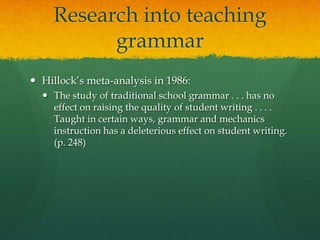
Research into teaching grammarHillock’s meta-analysis in 1986:The study of traditional school grammar . . . has no effect on raising the quality of student writing . . . . Taught in certain ways, grammar and mechanics instruction has a deleterious effect on student writing. (p. 248)
Why teach grammar at all?to expose ideas about languageto play with languageto broaden registers of language that one can useto support the learning of other languagesto broaden the tools for writing (but not necessarily improving writing ability)
H. Noden, English Journal, 95 (5), 2006I teach grammar because it is the doorway to the human soul. Its intricacies trigger our laughter, our tears, our dreams. Grammar is the secret muse of all expression, the portrait painter of life’s emotions . . . . Nothing in life is more essential, more sensitive, more intrinsic to the human soul . . . . How could we not teach grammar? (p. 19)Grammar teaches the power and control of our language. (Dean, p. 13)
NCTE and IRA 1996 StandardsStandard 4: Students adjust their use of spoken, written, and visual language (e.g. conventions, style, vocabulary) to communicate effectively with a variety of audiences and for different purposes.Standard 6: Students apply knowledge of language structure, language conventions (e.g. spelling and punctuation), media techniques, figurative language, and genre to create, critique, and discuss print and non-print texts.
NCTE and IRA 1996 StandardsStandard 9: Students develop an understanding of and respect for diversity in language use, patterns, and dialects across cultures, ethnic groups, geographic regions, and social roles.Standard 12: Students use spoken, written, and visual language to accomplish their own purposes (e.g., for learning, enjoyment, persuasion, and the exchange of information).
When it comes to teaching . . .It is anxiety producing when we don’t think we know enough . . .
Grammar Girl2010
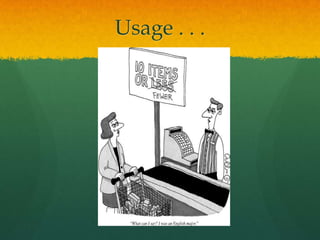
Four Dimensions of Teaching GrammarParts of speech and the vocabulary of grammarSyntaxPunctuationUsage
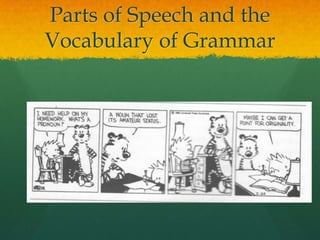
Parts of Speech and the Vocabulary of Grammar
Mad LibsUsing story as context.
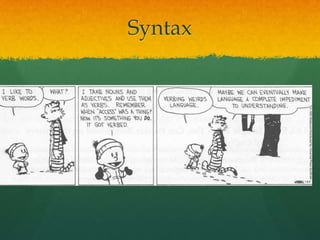
Syntax
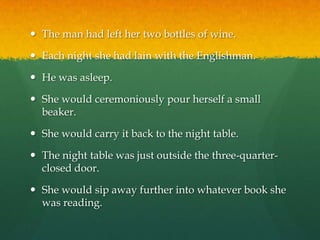
The man had left her two bottles of wine.Each night she had lain with the Englishman.He was asleep.She would ceremoniously pour herself a small beaker.She would carry it back to the night table.The night table was just outside the three-quarter-closed door.She would sip away further into whatever book she was reading.
The English PatientThe man had left her two bottles of wine, and each night after she had lain with the Englishman and he was asleep, she would ceremoniously pour herself a small beaker and carry it back to the night table just outside the three-quarter-closed door and sip away further into whatever book she was reading.
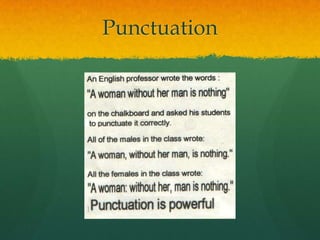
Punctuation
COMMA,DASH –SEMI-COLON;PARENTHESES ()PERIOD
Round Trip—P.K. PageThe passenger boards the waiting train—he is whiteand poised as the sculptured gull in flight;his matching bags might be packed with air—they are neat and flat.Now he removes his hat,smooths back his hair,arranges his long pressed legs away from the aisle.(The girl inside, meanwhile,afraid of adventure,trembles against his wrought-iron ribs like paper.)He waves through the window a last farewell,his pale sigh of a hand caressing the delicate paneblots out the faces one by one as thoughhe were snuffing candle flames.
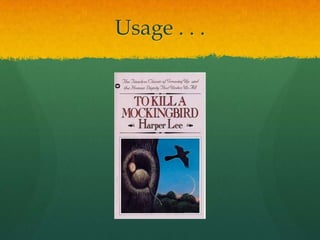
Usage . . .
Usage . . .
Good Luck!

Essays And Grammar

  • 1.
    Those Things WeSometimes Fear to TeachThe Academic Essay and Grammar
  • 2.
    Centre of GravityHowdo we deal with the long-held cultural assumptions and folk psychologies about teaching English to engage our students in the potential for learning that writing essays and understanding grammar can offer?
  • 3.
    Speaking My Mind“Persistenceof the Five-Paragraph Essay”English Journal, 99 (3), 2010.
  • 4.
  • 5.
    Mind-Forged Manacles: TheAcademic EssayA. What are the dangers of the academic essay? (Use Pirie’s article as a source of possibility as well as your own experience and knowledge.)B. What are the learning advantages of the academic essay? (Again, use Pirie and your own experience and reading.)What are alternatives you have seen?
  • 6.
    Lamppost BlogIdeas froman Ontario Teacher
  • 7.
  • 14.
    R.A.F.T.S. WritingR—Role (whois speaking, telling?)A—Audience (who is being addressed?)F—Form (what genre?)T—Topic (what is the piece about?)S—Strong Voice/Verb (what tone?)
  • 15.
    Use R.A.F.T.S. asan enabling constrainti.e., set the text for response but let the students choose the RAFTS; or let the students choose aspects of the RAFTS
  • 16.
    R.A.F.T.S. R—Role (who isspeaking, telling?)A—Audience (who is being addressed?)F—Form (what genre?)T—Topic (what is the piece about?)S—Strong Voice/Verb (what tone?)
  • 17.
    Grammar-late 12c., gramarye,from O.Fr. grammaire "learning," especially Latin and philology, from L. grammatica, from Gk. grammatiketekhne "art of letters”
  • 18.
    A bit ofhistory . . . traditional school grammar had its roots in Latin school grammar . . . in Shakespeare’s time school children studied Latin grammar because they did not know it; they did not study English grammar because they did know it.English grammar texts started to appear in the seventeenth century and the trickle grew to a veritable flood
  • 19.
    Why does grammarseem so important?a visible sign of class and education through one’s speech and one’s writing; initially only the rich were able to be educated in reading and writing and so those standards became the ones that were prized and privilegedas schooling became more widespread, grammatical usage still was an indicator of education and by implication the value one had from a societal perspective continuedgrammar continues to be a visible mark of literacy learning (and status)—consider the debates over spelling, texting, etc. And the cries for “correctness”
  • 20.
  • 21.
    The Jonathan EdwardsSyndrometerm developed by an NCTE member, Bill Strong, referring to a Puritan minister, Jonathan Edwards, who terrified his congregation with images of hell and a God of WrathStrong’s point was that “As we read and react to student writing, we are like that wrathful god, we cannot keep our flaming pens off the papers of our sinning congregation” (Breaking the Rules, p. 92).
  • 22.
    How do YouReact to the Writing of Two Fifteen Year Olds?This paragraph written near end of 600-word, impromptu essay written within a 60-minute time limit in class.Success against the odds; a possibility, but sadly a rarity. People can be what they want to be, but it’s an uphill, steep climb, and who’s to say you won’t lose your grip and fall, no matter how skilled a climber you are. When the very ground you stand on begins to pull you down, with no intention of stopping until you are a corpse, you need a pole to grasp, a foothold. Only by never capitulating can you climb those footholds into the sky towards the elusive pinnacle of success.
  • 23.
    How do YouReact to the Writing of Two Fifteen Year Olds?This paragraph is extracted from a brief discussion of King Henry VIII, written by a fifteen year old at home in her own time.It is however but Justice and my Duty to declare that this amiable woman [Anne Boleyn] was entirely innocent of the crimes with which she was accused, of which her beauty, her elegance and her sprightliness were sufficient proofs, not to mention her solemn protestations of innocence and the King’s character; all of which add some confirmation, though perhaps but slight ones when in comparison with those before alleged in her favor.
  • 24.
    Who were the15 year olds?The first excerpt was written by a student whose piece was declared the best grade nine essay in all of Pennsylvania (written as an entry in a writing contest)The second excerpt was written by Jane Austen at fifteen.
  • 25.
    Research into teachinggrammarIn 1963, the National Council of Teachers of English reiterated concerns they voiced as early as 1936 about grammar teaching. Those concerns are echoed in Research in Written Composition: In view of the widespread agreement of research studies based upon many types of students and teachers, the conclusions can be stated in strong and unqualified terms: the teaching of formal grammar has a negligible or, because it usually displaces some instruction and practice in actual composition, even a harmful effect on the improvement of writing. (p. 37-38)
  • 26.
    Research into teachinggrammarHillock’s meta-analysis in 1986:The study of traditional school grammar . . . has no effect on raising the quality of student writing . . . . Taught in certain ways, grammar and mechanics instruction has a deleterious effect on student writing. (p. 248)
  • 27.
    Why teach grammarat all?to expose ideas about languageto play with languageto broaden registers of language that one can useto support the learning of other languagesto broaden the tools for writing (but not necessarily improving writing ability)
  • 28.
    H. Noden, EnglishJournal, 95 (5), 2006I teach grammar because it is the doorway to the human soul. Its intricacies trigger our laughter, our tears, our dreams. Grammar is the secret muse of all expression, the portrait painter of life’s emotions . . . . Nothing in life is more essential, more sensitive, more intrinsic to the human soul . . . . How could we not teach grammar? (p. 19)Grammar teaches the power and control of our language. (Dean, p. 13)
  • 29.
    NCTE and IRA1996 StandardsStandard 4: Students adjust their use of spoken, written, and visual language (e.g. conventions, style, vocabulary) to communicate effectively with a variety of audiences and for different purposes.Standard 6: Students apply knowledge of language structure, language conventions (e.g. spelling and punctuation), media techniques, figurative language, and genre to create, critique, and discuss print and non-print texts.
  • 30.
    NCTE and IRA1996 StandardsStandard 9: Students develop an understanding of and respect for diversity in language use, patterns, and dialects across cultures, ethnic groups, geographic regions, and social roles.Standard 12: Students use spoken, written, and visual language to accomplish their own purposes (e.g., for learning, enjoyment, persuasion, and the exchange of information).
  • 31.
    When it comesto teaching . . .It is anxiety producing when we don’t think we know enough . . .
  • 32.
  • 33.
    Four Dimensions ofTeaching GrammarParts of speech and the vocabulary of grammarSyntaxPunctuationUsage
  • 34.
    Parts of Speechand the Vocabulary of Grammar
  • 35.
  • 36.
  • 37.
    The man hadleft her two bottles of wine.Each night she had lain with the Englishman.He was asleep.She would ceremoniously pour herself a small beaker.She would carry it back to the night table.The night table was just outside the three-quarter-closed door.She would sip away further into whatever book she was reading.
  • 38.
    The English PatientTheman had left her two bottles of wine, and each night after she had lain with the Englishman and he was asleep, she would ceremoniously pour herself a small beaker and carry it back to the night table just outside the three-quarter-closed door and sip away further into whatever book she was reading.
  • 39.
  • 40.
  • 41.
    Round Trip—P.K. PageThepassenger boards the waiting train—he is whiteand poised as the sculptured gull in flight;his matching bags might be packed with air—they are neat and flat.Now he removes his hat,smooths back his hair,arranges his long pressed legs away from the aisle.(The girl inside, meanwhile,afraid of adventure,trembles against his wrought-iron ribs like paper.)He waves through the window a last farewell,his pale sigh of a hand caressing the delicate paneblots out the faces one by one as thoughhe were snuffing candle flames.
  • 42.
  • 43.
  • 44.

Editor's Notes

  • #2 REALLY THIS IS THE CENTRE OF GRAVITY
  • #3 ASSIGNMENT NEXT COUPLE OF DAYS . . . BY THE WAY POSTED HUMAMENT
  • #4 WRITE YOUR THOUGHTS ABOUT 5-PARAGRAPH ESSAY
  • #5 BRUCE PIRIE TEACHER IN MISSASAUGA
  • #6 CHOOSE A GROUP OF 5 OT 6; I’LL GIVE YOU A TOPICS. 10 MINUTES . . . CLASS DISCUSSION . . . MICHAEL WRITES ON BOARD . . . WHAT HAVE YOU SEEN?
  • #7 ALTERNATIVES
  • #8 HAVE YOU TRY ANOTHER ALTERNATIVE—THEORY BEHIND THIS IS ILLUSTRATED MOST EASILY IN THIS CONTEXT BY ANOTHER PICTURE BOOK--
  • #14 INDICATIVE OF THE KIND OF THINKING THAT IS POSSIBLE WITH STORIES AND TOERH TEXTS. WHEN I TAUGHT HIGH SCHOOL ENGLISH AND ALEX WHITE . . . WHAT WAS HAPPENING?
  • #17 Alternatives. See what you can come up with in your group. LET’S HEAR ABOUT SOME OF THE ALTERNATIVES.
  • #18 PHILOLOGY: THE STUDY OF THE HISTORY, STRUCTURE, DEVELOPMENT OF LANGUAGES
  • #19 STUDENTS WHO LEARN THE GRAMMAR OF A FOREIGN LANGUAGE OFTEN HAVE AN EASIER TIME WITH GRAMMAR IN ENGLISH
  • #25 DOES YOUR OPINION CHANGE WHEN YOU HAVE MORE DETAILS ABOUT THE CONTEXT?
  • #29 GRAMMAR CAN BE ABOUT DEEP AND SPECIFIC COMMUNICATION.
  • #30 HERE’S WHERE GRAMMAR CAN INFLUENCE WRITING—WHEN WE THINK ABOUT HOW IT HELPS US COMMUNICATE . . . HOW IT HELPS US UNDERSTAND WHAT WE READ
  • #31 A RESPECT FOR DIVERSITY—REGISTERS ARGUMENT AND FOR THE PLEASURE OF BEING ABLE TO INFLUENCE THEIR EXPRESSION
  • #32 NEED TO GET COMFORTABLE WITH YOUR OWN KNOWLEDGE
  • #34 THERE ARE FOUR THINGS WE FREQUENTLYMEAN WHEN WE TALK ABOUT TEACHING GRAMMAR
  • #35 WHAT’S A NOUN, WHAT’S A CLAUSE, ETC.
  • #38 WORKING WITH SOMEONE NEXT TO YOU, TURN THIS INTO ONE SENTENCE—YOU CAN OMIT WORDS THAT ARE REPEATED AND DON’T ADD TO THE MEANING, E.G. “SHE.” WHEN YOU HAVE A SENTENCE, PLEASE COME UP AND WRITE IT ON THE BOARD. USE CONJUNCTIONS ETC.
  • #43 LESS MONEY BUT FEWER DOLLARS