NABH BASE
NURSING CARE PROCEDURE
SUBCUTANEOUS INJECTION
DR.ANJALTCHI MUTHUKUMARAN
Vice principal cum Nursing Supt
ELMCH, era university
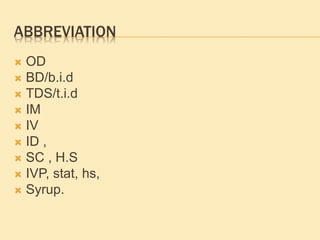
ABBREVIATION
 OD
 BD/b.i.d
 TDS/t.i.d
 IM
 IV
 ID ,
 SC , H.S
 IVP, stat, hs,
 Syrup.
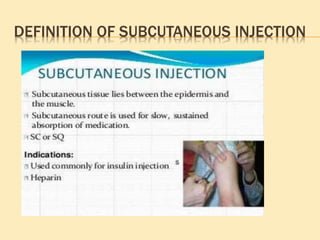
DEFINITION OF SUBCUTANEOUS INJECTION
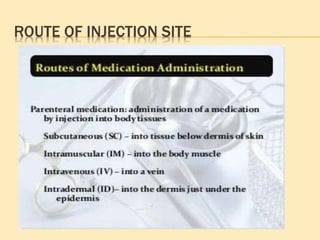
ROUTE OF INJECTION SITE
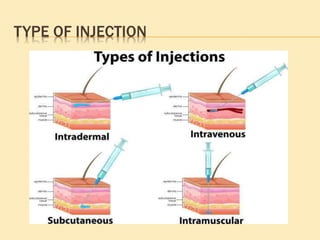
TYPE OF INJECTION
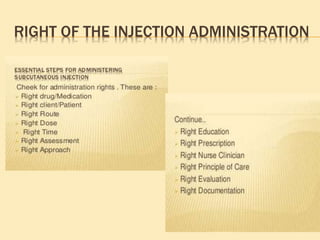
RIGHT OF THE INJECTION ADMINISTRATION
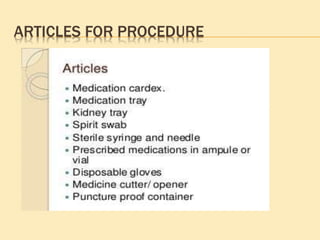
ARTICLES FOR PROCEDURE
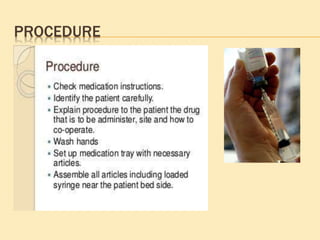
PROCEDURE
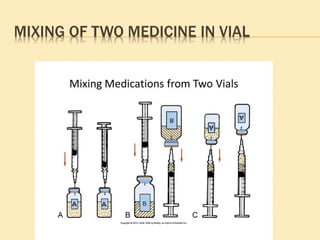
MIXING OF TWO MEDICINE IN VIAL
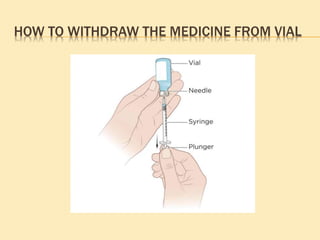
HOW TO WITHDRAW THE MEDICINE FROM VIAL
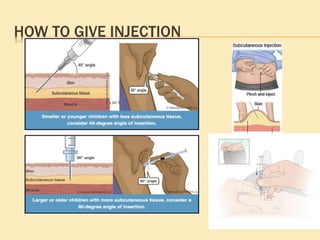
HOW TO GIVE INJECTION
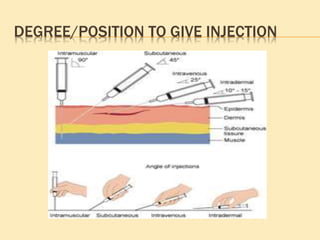
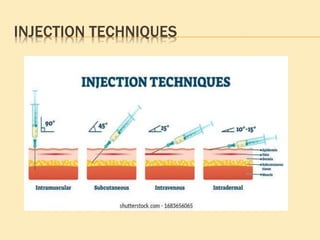
DEGREE/POSITION TO GIVE INJECTION
INJECTION TECHNIQUES
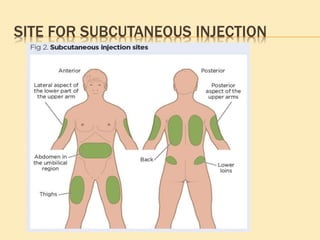
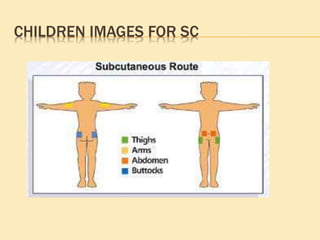
SITE FOR SUBCUTANEOUS INJECTION
CHILDREN IMAGES FOR SC
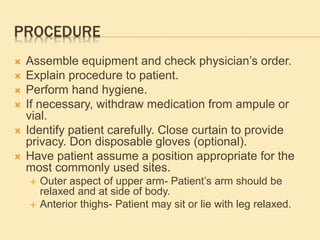
PROCEDURE
 Assemble equipment and check physician’s order.
 Explain procedure to patient.
 Perform hand hygiene.
 If necessary, withdraw medication from ampule or
vial.
 Identify patient carefully. Close curtain to provide
privacy. Don disposable gloves (optional).
 Have patient assume a position appropriate for the
most commonly used sites.
 Outer aspect of upper arm- Patient’s arm should be
relaxed and at side of body.
 Anterior thighs- Patient may sit or lie with leg relaxed.
CONTINUED
 Abdomen-Patient may lie in a semirecumbent position.
 Locate site of choice (outer aspect of upper arm,
abdomen, anterior aspect of thigh, upper back, upper
ventral or dorsogluteal area). Ensure that area is not
tender and is free of lumps or nodules.
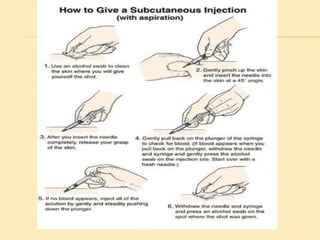
 Clean area around injection site with an alcohol swab.
Use a firm circular motion while moving outward from the
injection site. Allow antiseptic to dry. Leave alcohol swab
in a clean area for reuse when withdrawing the needle.
 Remove needle cap with nondominant hand, pulling it
straight off.
CONTINUED
 Grasp and bunch area surrounding injection site or
spread skin at site.
 Hold syringe in dominant hand between thumb and
forefinger. Inject needle quickly at an angle of 45 to
90 degrees, depending on amount and turgor of
tissue and length of needle.
 After needle is in place, release tissue. If you have a
large skin fold pinched up, ensure that the needle
stays in place as the skin is released. Immediately
move your nondominant hand to steady the lower
end of the syringe. Slide your dominant hand to the
tip of the barrel.
CONTINUED
 Aspirate, if recommended, by pulling back gently on
syringe plunger to determine whether needle is in the
blood vessel. If blood appears, the needle should be
withdrawn, the medication syringe and needle
discarded, and a new syringe with medication
prepared. Do not aspirate when giving insulin or
heparin.
 If no blood appears, inject solution slowly.
 Withdraw needle quickly at the same angle at which it
was inserted.
 Massage area gently with alcohol swab. (Do not
massage a subcutaneous heparin or insulin injection
site.) Apply a small bandage if needed.
CONTINUED
 Do not recap used needle. Discard needle and
syringe in appropriate receptacle.
 Assist patient to a position comfort.
 Remove gloves, if worm, and dispose of them
properly. Perform hand hygiene.
 Chart administration of medication, including the site
of administration. This charting can be done on
CMAR.
 Evaluate patient response to medication within an
appropriate time frame.
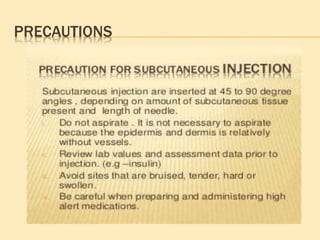
PRECAUTIONS
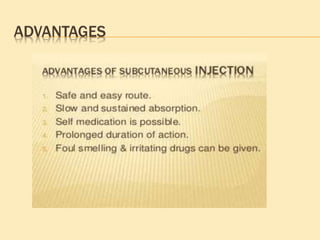
ADVANTAGES
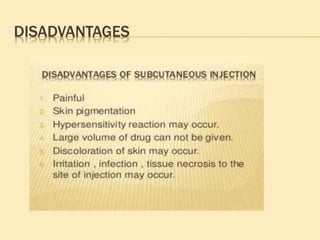
DISADVANTAGES
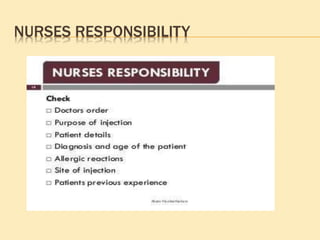
NURSES RESPONSIBILITY
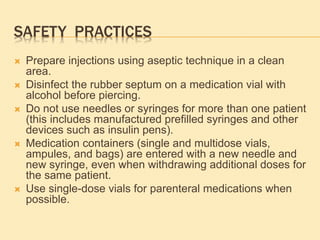
SAFETY PRACTICES
 Prepare injections using aseptic technique in a clean
area.
 Disinfect the rubber septum on a medication vial with
alcohol before piercing.
 Do not use needles or syringes for more than one patient
(this includes manufactured prefilled syringes and other
devices such as insulin pens).
 Medication containers (single and multidose vials,
ampules, and bags) are entered with a new needle and
new syringe, even when withdrawing additional doses for
the same patient.
 Use single-dose vials for parenteral medications when
possible.
SINGLE-USE (DISPOSABLE) DEVICES
 What is a single-use device?
 According to the Food and Drug Administration’s
(FDA’s) guidance entitled Labeling
Recommendations for Single-Use Devices
Reprocessed by Third Parties and Hospital sexternal
icon, “a single-use device, also referred to as a
disposable device, [is] intended for use on one
patient during a single procedure. It is not intended to
be reprocessed (cleaned, disinfected/sterilized) and
used on another patient.
 The labeling may or may not identify the device as
single-use or disposable and does not include
instructions for reprocessing.”
CONTINUED
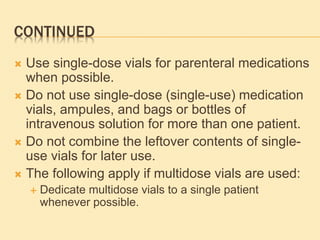
 Use single-dose vials for parenteral medications
when possible.
 Do not use single-dose (single-use) medication
vials, ampules, and bags or bottles of
intravenous solution for more than one patient.
 Do not combine the leftover contents of single-
use vials for later use.
 The following apply if multidose vials are used:
 Dedicate multidose vials to a single patient
whenever possible.
CONTINUED
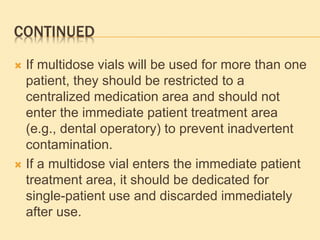
 If multidose vials will be used for more than one
patient, they should be restricted to a
centralized medication area and should not
enter the immediate patient treatment area
(e.g., dental operatory) to prevent inadvertent
contamination.
 If a multidose vial enters the immediate patient
treatment area, it should be dedicated for
single-patient use and discarded immediately
after use.
CONTINUED
 Date multidose vials when first opened and
discard within 28 days, unless the manufacturer
specifies a different date.
 Do not use fluid infusion or administration
sets (e.g., IV bags, tubings, connections) for
more than one patient.
REFERENCES
 CDC. Basic Expectations for Safe Care Training
Module 6 – Safe Injection Practices. Available
at: https://www.cdc.gov/oralhealth/infectioncontr
ol/safe-care-modules.htm. Accessed May 8,
2018.
 CDC. Summary of Infection Prevention
Practices in Dental Settings: Basic Expectations
for Safe Care. Available
at: https://www.cdc.gov/oralhealth/infectioncontr
ol/pdf/safe-care2.pdf pdf icon[PDF – 834 KB].
Accessed March 31, 2016.

SUBCUTANEOUS INJECTION AS PER NABH PPT.pptx

  • 1.
    NABH BASE NURSING CAREPROCEDURE SUBCUTANEOUS INJECTION DR.ANJALTCHI MUTHUKUMARAN Vice principal cum Nursing Supt ELMCH, era university
  • 2.
    ABBREVIATION  OD  BD/b.i.d TDS/t.i.d  IM  IV  ID ,  SC , H.S  IVP, stat, hs,  Syrup.
  • 3.
  • 4.
  • 5.
  • 6.
    RIGHT OF THEINJECTION ADMINISTRATION
  • 7.
  • 8.
  • 9.
    MIXING OF TWOMEDICINE IN VIAL
  • 10.
    HOW TO WITHDRAWTHE MEDICINE FROM VIAL
  • 11.
    HOW TO GIVEINJECTION
  • 12.
  • 13.
  • 14.
  • 15.
  • 16.
    PROCEDURE  Assemble equipmentand check physician’s order.  Explain procedure to patient.  Perform hand hygiene.  If necessary, withdraw medication from ampule or vial.  Identify patient carefully. Close curtain to provide privacy. Don disposable gloves (optional).  Have patient assume a position appropriate for the most commonly used sites.  Outer aspect of upper arm- Patient’s arm should be relaxed and at side of body.  Anterior thighs- Patient may sit or lie with leg relaxed.
  • 17.
    CONTINUED  Abdomen-Patient maylie in a semirecumbent position.  Locate site of choice (outer aspect of upper arm, abdomen, anterior aspect of thigh, upper back, upper ventral or dorsogluteal area). Ensure that area is not tender and is free of lumps or nodules.  Clean area around injection site with an alcohol swab. Use a firm circular motion while moving outward from the injection site. Allow antiseptic to dry. Leave alcohol swab in a clean area for reuse when withdrawing the needle.  Remove needle cap with nondominant hand, pulling it straight off.
  • 18.
    CONTINUED  Grasp andbunch area surrounding injection site or spread skin at site.  Hold syringe in dominant hand between thumb and forefinger. Inject needle quickly at an angle of 45 to 90 degrees, depending on amount and turgor of tissue and length of needle.  After needle is in place, release tissue. If you have a large skin fold pinched up, ensure that the needle stays in place as the skin is released. Immediately move your nondominant hand to steady the lower end of the syringe. Slide your dominant hand to the tip of the barrel.
  • 19.
    CONTINUED  Aspirate, ifrecommended, by pulling back gently on syringe plunger to determine whether needle is in the blood vessel. If blood appears, the needle should be withdrawn, the medication syringe and needle discarded, and a new syringe with medication prepared. Do not aspirate when giving insulin or heparin.  If no blood appears, inject solution slowly.  Withdraw needle quickly at the same angle at which it was inserted.  Massage area gently with alcohol swab. (Do not massage a subcutaneous heparin or insulin injection site.) Apply a small bandage if needed.
  • 20.
    CONTINUED  Do notrecap used needle. Discard needle and syringe in appropriate receptacle.  Assist patient to a position comfort.  Remove gloves, if worm, and dispose of them properly. Perform hand hygiene.  Chart administration of medication, including the site of administration. This charting can be done on CMAR.  Evaluate patient response to medication within an appropriate time frame.
  • 22.
  • 23.
  • 24.
  • 25.
  • 26.
    SAFETY PRACTICES  Prepareinjections using aseptic technique in a clean area.  Disinfect the rubber septum on a medication vial with alcohol before piercing.  Do not use needles or syringes for more than one patient (this includes manufactured prefilled syringes and other devices such as insulin pens).  Medication containers (single and multidose vials, ampules, and bags) are entered with a new needle and new syringe, even when withdrawing additional doses for the same patient.  Use single-dose vials for parenteral medications when possible.
  • 27.
    SINGLE-USE (DISPOSABLE) DEVICES What is a single-use device?  According to the Food and Drug Administration’s (FDA’s) guidance entitled Labeling Recommendations for Single-Use Devices Reprocessed by Third Parties and Hospital sexternal icon, “a single-use device, also referred to as a disposable device, [is] intended for use on one patient during a single procedure. It is not intended to be reprocessed (cleaned, disinfected/sterilized) and used on another patient.  The labeling may or may not identify the device as single-use or disposable and does not include instructions for reprocessing.”
  • 28.
    CONTINUED  Use single-dosevials for parenteral medications when possible.  Do not use single-dose (single-use) medication vials, ampules, and bags or bottles of intravenous solution for more than one patient.  Do not combine the leftover contents of single- use vials for later use.  The following apply if multidose vials are used:  Dedicate multidose vials to a single patient whenever possible.
  • 29.
    CONTINUED  If multidosevials will be used for more than one patient, they should be restricted to a centralized medication area and should not enter the immediate patient treatment area (e.g., dental operatory) to prevent inadvertent contamination.  If a multidose vial enters the immediate patient treatment area, it should be dedicated for single-patient use and discarded immediately after use.
  • 30.
    CONTINUED  Date multidosevials when first opened and discard within 28 days, unless the manufacturer specifies a different date.  Do not use fluid infusion or administration sets (e.g., IV bags, tubings, connections) for more than one patient.
  • 31.
    REFERENCES  CDC. BasicExpectations for Safe Care Training Module 6 – Safe Injection Practices. Available at: https://www.cdc.gov/oralhealth/infectioncontr ol/safe-care-modules.htm. Accessed May 8, 2018.  CDC. Summary of Infection Prevention Practices in Dental Settings: Basic Expectations for Safe Care. Available at: https://www.cdc.gov/oralhealth/infectioncontr ol/pdf/safe-care2.pdf pdf icon[PDF – 834 KB]. Accessed March 31, 2016.