M S . V I M A L
M A D H A L E
M S N D E P A R M E N T
N E U R O S C I E N C E
S P E C I A L I T Y
ADMINISTRATION OF
PARENTRAL MEDICATION
DEFINITION
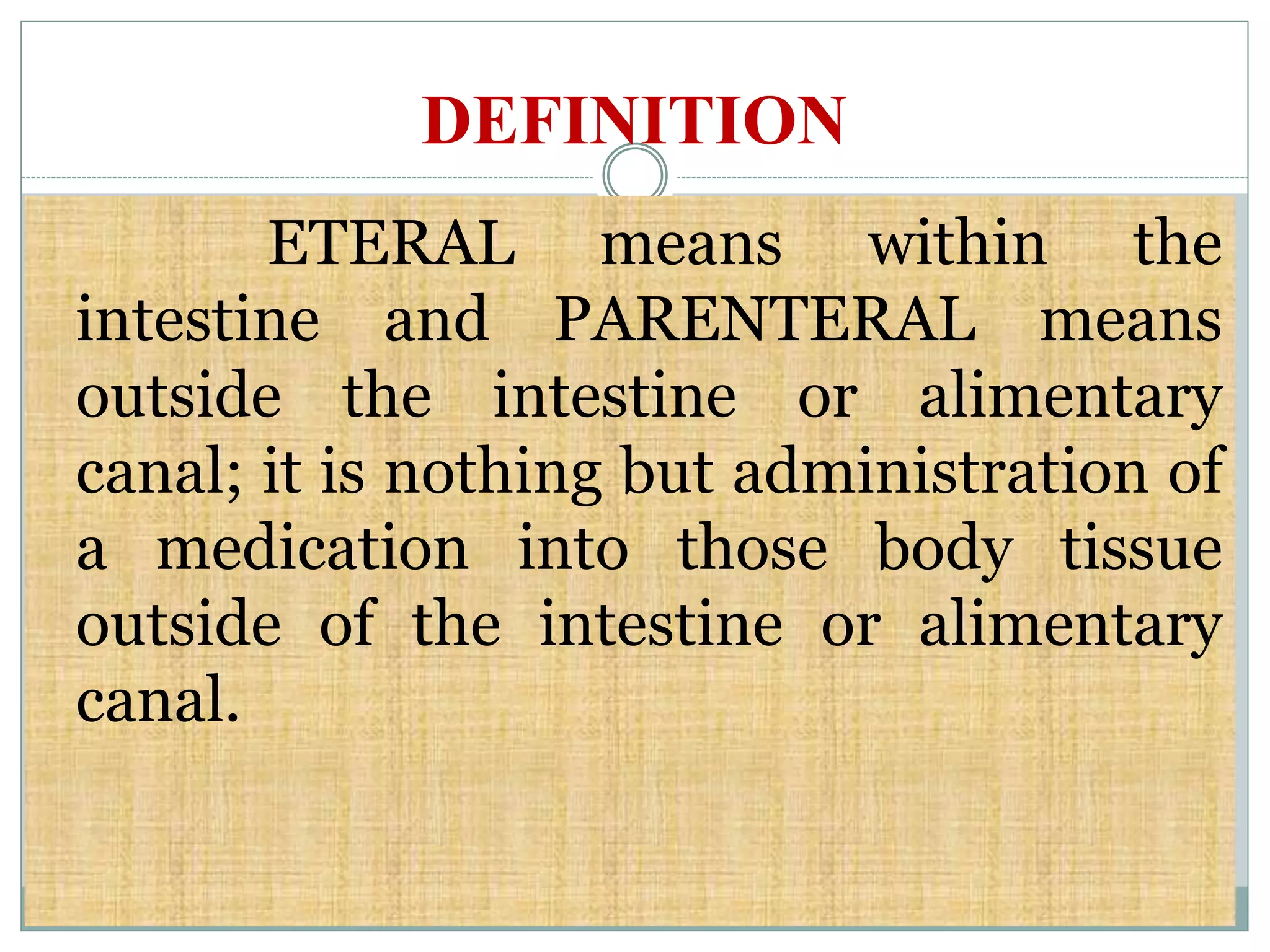
ETERAL means within the
intestine and PARENTERAL means
outside the intestine or alimentary
canal; it is nothing but administration of
a medication into those body tissue
outside of the intestine or alimentary
canal.
ADVANCED INJECTION
TECHNIQUE
NEEDLES AND SYRINGES
 NEEDLES ARE AVAILABLE IN VARIOUS
LENGTH AND GAUGES.
 LINGTH VARY FROM (0.8CM TO
5.1CM).
 NO:18 TO NO:30
 SYRINGES ARE SUPPLIED IN VARIOUS
SIZES:
 PLASTIC AND DISPOSABLE.
EQUIPMENT NEEDED FOR AN
INJECTION IS DEPENDS ON
ROUTE OF
ADMINISTRATION
VISCOSITY OF THE
SOLUTION
QUANTITY TO BE
ADMINISTERED
BODY SIZE
TYPE OF
MEDICATION
PARTS OF NEEDLES AND SYRINGE
PREPARATION OF MEDICATIONFOR
ADMINISTRATION BY INJECTIONS
MIXING MEDICATION IN
ONE SYRINGE
REMOVING MEDICATION FROM
AN AMPULE
EQUIPMENT
1.
Sterile syringe and filter needle
2.
Alcohol swab and quaze pad
3.
Ampule of medication.
4.
Medication kardex or computer
generated MAR
5.
Needle
REMOVING MEDICATION FROM AN
AMPULE
Sl. no.
ACTION
1. Gather equipment. Check the medication order
against the original physician ‘s order according to
agency policy.
2. Perform hand hygiene.
3. Tap the stem of the ampule or twist your wrist quickly
while holding the ampule vertically.
4. Wrap a small gauze pad or dry alcohol swab around
the neck of the ampule.
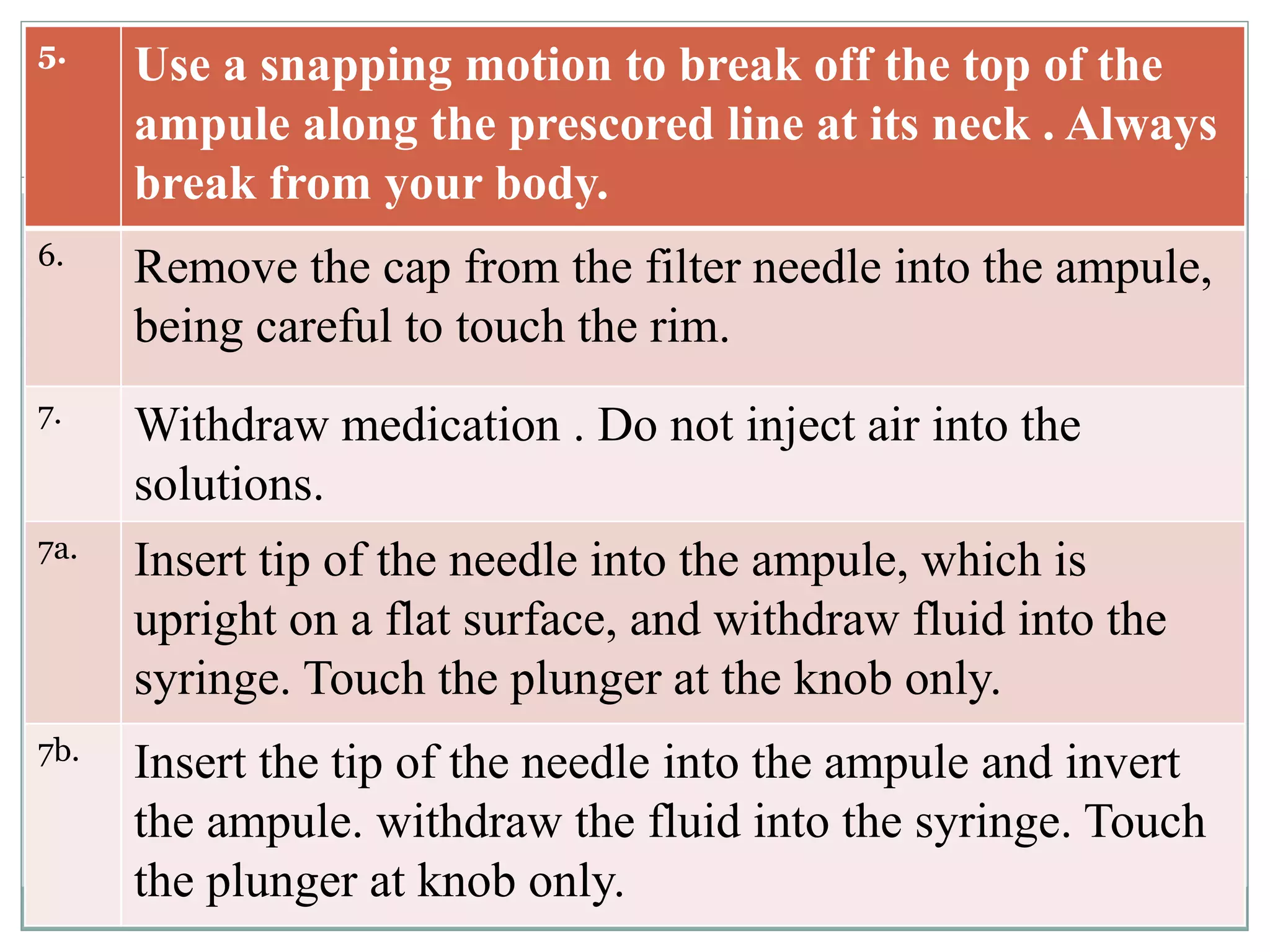
5.
Use a snapping motion to break off the top of the
ampule along the prescored line at its neck . Always
break from your body.
6.
Remove the cap from the filter needle into the ampule,
being careful to touch the rim.
7.
Withdraw medication . Do not inject air into the
solutions.
7a.
Insert tip of the needle into the ampule, which is
upright on a flat surface, and withdraw fluid into the
syringe. Touch the plunger at the knob only.
7b.
Insert the tip of the needle into the ampule and invert
the ampule. withdraw the fluid into the syringe. Touch
the plunger at knob only.
ACTION NO: 3 AND 5
8.
Do not expel any air bubble that may form in
the solution.
9.
Discard the ampule in a suitable container after
comparing with the medication kardex.
10.
Discard the filtered needle in a suitable
container. If the medication is to be given IM or
if agency policy require the use of a needle to
administer medication, attach the selected needle
to the syringe.
11.
Perform hand hygiene.
ACTION NO: 7a & 7b
REMOVING MEDICATION
FROM VIAL
EQUIPMENT
1.
STERILE SYRINGE AND NEEDLE
2.
VIAL OF MEDICATION
3.
MEDICATION KARDEX
4.
ALCOHOL SWAB
5.
FILTERED NEEDLE, SECOND NEEDLE.
ACTION
1.
Gather equipment
2.
Perform hand hygiene.
3.
Remove the metal or plastic cap on the vial that
protect the rubber stopper.
4.
Swab the rubber top with the alcohol swab.
5.
Remove the cap from the needle by pulling it
straight off. Draw back an amount of air into
syringes that is equal to the specific dose of
medication to be withdrawn.
6.
Pierce the rubber stopper in the center with needle
tip and inject the measured air into the space above
the solution. The vial may be positioned upright on a
flat surface or inverted.
7.
Invert the vial and withdraw the needle tip slightly so
that it is below the fluid level.
8.
Draw up the prescribed amount of medication while
holding the syringe at eye level and vertically. Be
careful to touch plunger at the knob only.
9.
If any air bubble accumulate in the syringe, tap the
barrel of the syringe sharply and move the needle pat the
fluid into the air space to reinject the air bubble into the
vial. Return the needle tip to the solution and continue
withdrawing the medication.
ACTION 6
ACTION NO : 7 AND 8
ACTION NO: 9
10 After the correct dose withdrawn, remove
needle from the vial and carefully replace the
cap over the needle. remove filter needle and
replace it with a new needle.
11
.
If a multidose vial is being used, label the vial
with date and time opened, and store the vial
containing the remaining medication according
to agency policy.
12
.
Perform hand hygiene.
ADMINISTERING MEDICATION
SUBCUTANEOUSLY
OUTER ASPECT OF THE
UPPER ARM
THE ABDOMEN
THE ANTERIOR ASPECT
OF THIGH
UPPER BACK
DORSOGLUTEAL
AREA
SUBCUTANEOUS
TISSUE LIES
BETWEEN THE
EPIDERMIS AND
THE MUSCLE
SITE OF INJECTION
CHARACTERISTICS
1.
EQUIPMENTS DEPENDS ON WHICH
INJECTION DEPENDS ON THE
MEDICATON TO BE GIVEN.
2.
A 5/16” to 1”, 25- to 30-gauge needle is used for
this route.
3.
No more than one ml solution administered
through this route.
4.
A 5/8” needle is inserted at a 45- degree angle, a
½” needle is inserted at a 90- degree angle
EQUIPMENT
1.
MEDICATION
2.
ALCOHOL SWAB
3.
DISPOSABLE GLOVES
4.
MEDICATION KARDEX OR COMPUTER
GENERATED MAR
5.
STERILE SYRINGE AND NEEDLES.
ACTION
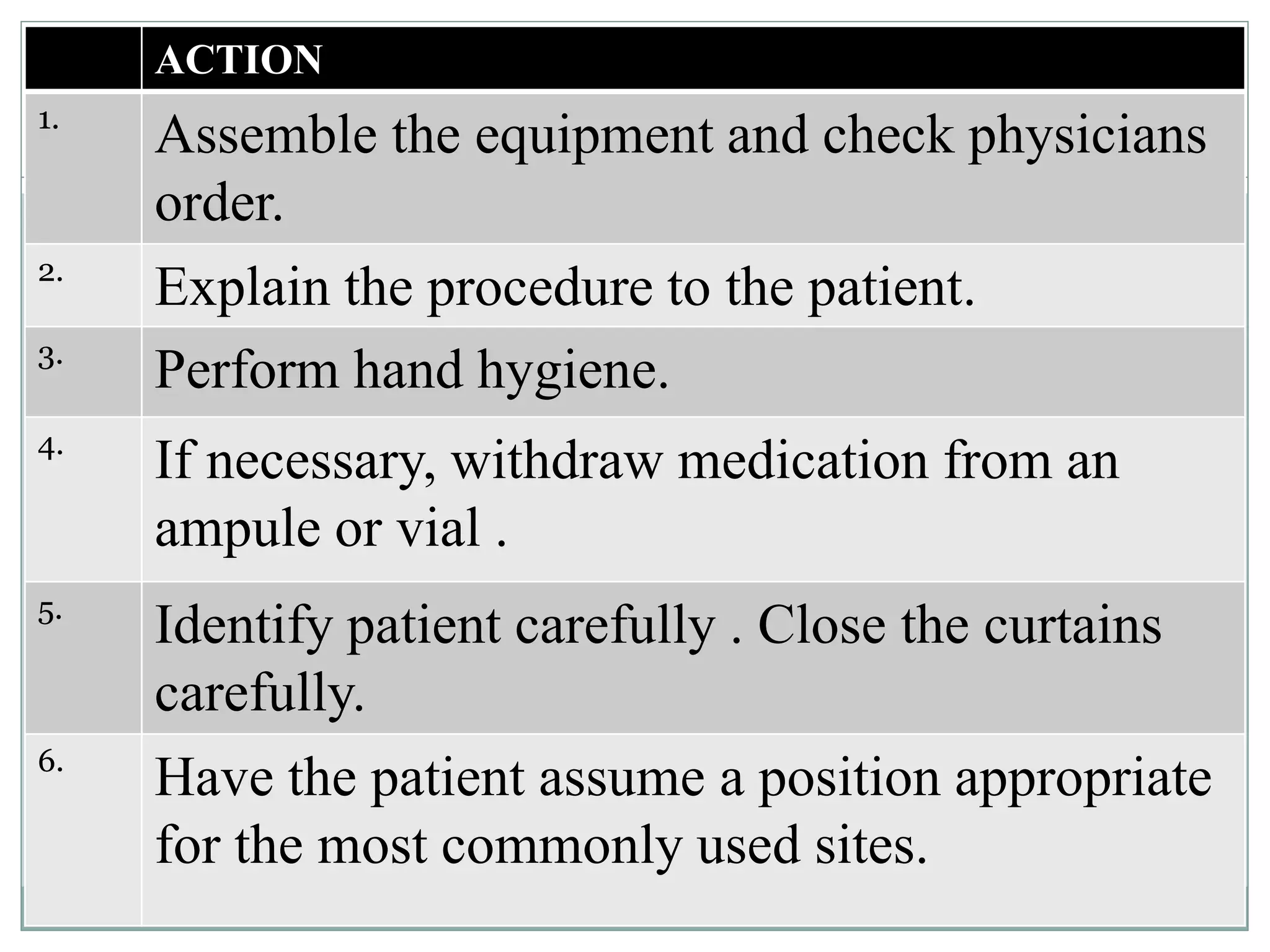
1.
Assemble the equipment and check physicians
order.
2.
Explain the procedure to the patient.
3.
Perform hand hygiene.
4.
If necessary, withdraw medication from an
ampule or vial .
5.
Identify patient carefully . Close the curtains
carefully.
6.
Have the patient assume a position appropriate
for the most commonly used sites.
6a . Outer aspect of the upper arm: the arm should be
relaxed and at the side of the body.
6b.
Anterior thigh : the patient may sit or lie with leg
relaxed.
6c.
Abdomen: the patient may lie in a semi
recumbent position.
7.
Locate the site of choice according to the direction
, ensure that the area is not tender and is free of
lumps or nodules.
8.
Clean the area around the injection site with an
alcohol swab. Use a firm circular motion while
moving outward from the injection site. Allow
antiseptic to dry . Leave the alcohol swab in a
clean area for reuse when withdrawing the needle.
ACTION
9.
Remove the needle cap with the nondominant . Pulling
it straight off .
10.
Grasp and bunch the area surrounding the injection site
or spread the skin at the site.
11.
Hold the syringe in non dominant hand between the
thumb and forefinger.
Inject the needle quickly at an angle at 45- degree to 90
degree, depending upon the amount and turger of the
tissue and length of the needle.
12.
After the needle in place, release the tissue .
Immediately remove your non dominant hand to steady
lower end of the syringe . Slide your dominant hand to
the tip of the barrel.
ACTION NO. 8
ACTION NO : 10
ACTION
13
ASPIRATE, if recommended , by pulling back
gently on the plunger of the syringes to determine
whether the needle is in blood vessel . Do not
aspirate when giving insulin or any form of
heparin.
14.
If no blood appear inject the solution slowly.
15.
Withdraw the needle quickly at the same angle at
which it was inserted.
16.
Massage the area gently with alcohol swab. Do not
massage a subcutaneous heparin or insulin
injection site . Apply a small bandage if necessary.
17.
Do not recap the used needle. Discard the needle
and syringes in receptacles.
ACTION NO : 11 AND 14
ACTION
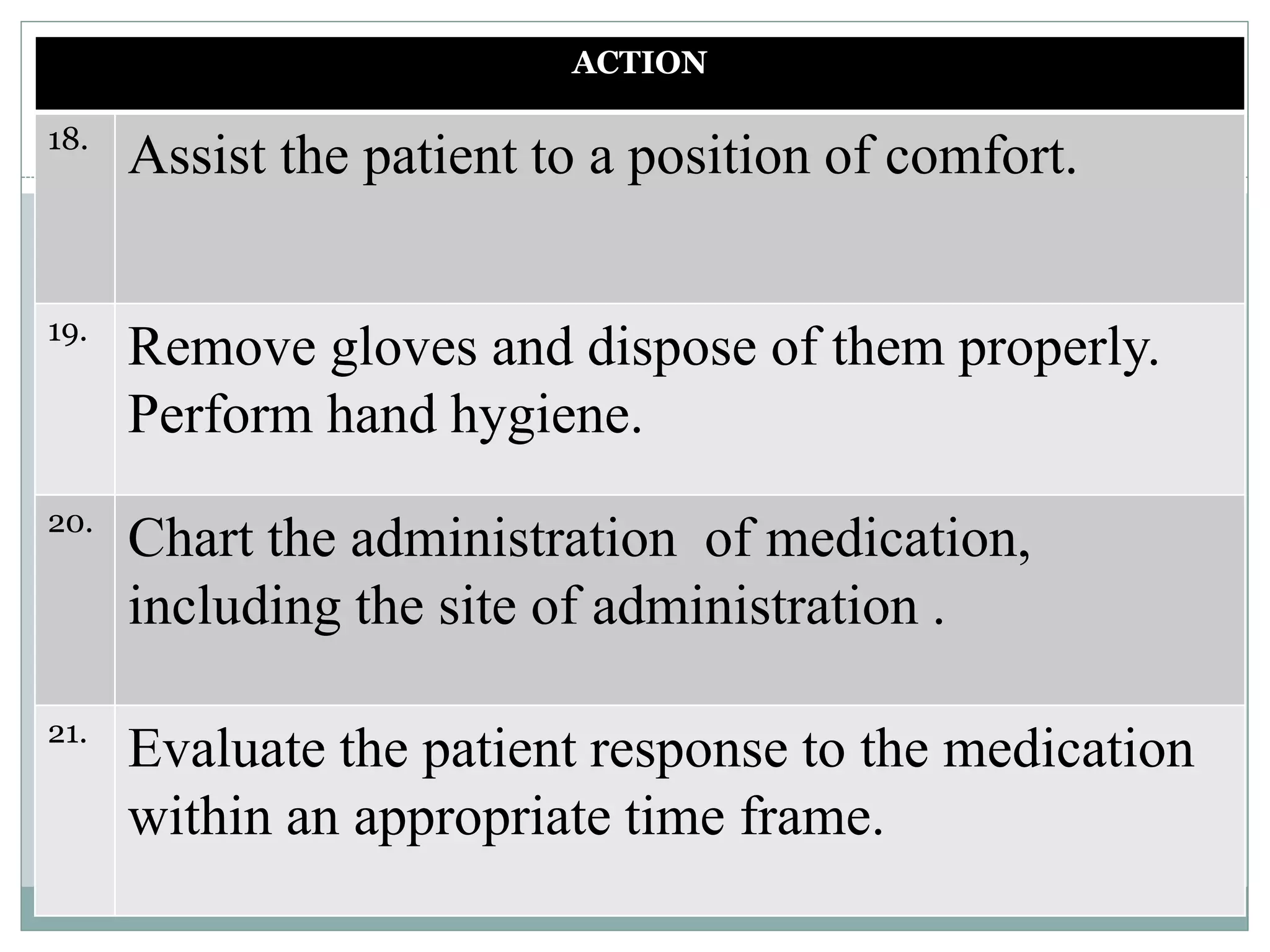
18.
Assist the patient to a position of comfort.
19.
Remove gloves and dispose of them properly.
Perform hand hygiene.
20.
Chart the administration of medication,
including the site of administration .
21.
Evaluate the patient response to the medication
within an appropriate time frame.
ADMINISTRATION OF
MEDICATION
INTRAMASCULARLY
INTRA MASCULAR ROUTE
The intra muscular route is often
used to administer drugs that are
irritating, because there are less nerve
endings in the deep muscle tissue.5ml is
considered maximum to be given at site
for an adult with well developed muscle.
Intramuscular injection
site
VASTUS
LATERALIS
DELTOID
MUSCLE
DORSOGLUTEAL
VASTUS LATERALIS
GENERAL CHARACTERISICS
1. NO MORE THAN 5ML SHOULD BE
INJECTED FOR ADULT WITH WELL
DEVELOPED MUSCLE AND FOR
CHILDRENS 1 TO 2 ML.
2. THE NEEDLE SHOULD ENTER THE SKIN
BEETWEEN 72 QND 90 DEGREES. THAT IS
1.5” (3.8CM), 21 TO 23 QUAGE NEEDLE,
NEEDLE SHUOLD 1” LONG.
EQUIPMENT
1.
MEDICATION
2.
ALCOHOL SWAB
3.
DRY SPONGE
4.
DISPOSABLE GLOVES
5.
MEDICATION KARDEX
6.
STERILE SYRINGE AND NEEDLE.
ACTION
1.
Assemble the equipment and check physicians
order.
2.
Explain the procedure to the patient.
3.
Perform hand hygiene.
4.
If necessary, withdraw medication from an
ampule or vial .
5.
Do not add air to the syringe.
6.
Identify the patient carefully.
6a.
Check the name of the patient’s identification
bracelet.
6b,c
Ask patient name his / her name, verify through
ACTION
7.
Provide for privacy. Have the patient assume a position
appropriate for the site selected.
7a
Ventrogluteal muscle: the patient may lie on the back or
side with the hip and knee flexed.
7b
Vastus lateralis: the patient may lie on the back or may
assume a sitting position.
7c
Deltoid : the patient may sit or lie with arm relaxed.
7d
Dorsogluteal : the patient may lie prone with toes
pointing inward or on the side with the upper leg flexed
and placed in front of the lower leg.
VENTROGLUTEAL SITE
VASTUS LATERALIS
DELTOID MUSCLE SITE FOR INJECTION
DORSOGLUTEAL REGION
ACTION
8.
LOCATE the site of choice.
9.
Clean area thoroughly with alcohol swab,
using friction. Allow alcohol to dry .
10.
Remove needle cap by pulling it straight
off.
11.
Displace the skin in a Z- track manner or
spread the skin at site using your non
dominant hand.
12.
Hold the syringe in your dominant hand
between the thumb & forefinger. Quickly dart
the needle into the tissue at a 72- degree to 90
degree angle.
13.
As soon as the needle is in place, use your non-
dominant hand to hold the lower end of the
syringe . Slide your dominant hand to the tip of
the barrel .
14.
Aspirate by slowly pulling back on the plunger
to determine whether the needle is in blood
vessel. If blood is aspirated , discard the needle ,
syringe and medication , prepare a new sterile
set up and inject at another site.
15.
If no blood is aspirated, inject the solution
slowly. (10 sec / ml medication).
16.
Remove the needle slowly and steadily . Release
the displaced tissue if the “Z” track technique
was used.
17.
Apply gentle pressure at the site with small, dry
sponge.
18.
Do not recap the used needle. Discard the needle
and syringes in receptacles.
19
Assist the patient to a position of
comfort.
20
Remove gloves and dispose of them
properly. Perform hand hygiene.
21
Chart the administration of medication,
including the site of administration .
22
Evaluate the patient response to the
medication within an appropriate time
frame.
REDUCING DISCOMFORT IN
SUBCUTANEOUS AND
INTRAMASCULAR STUDY.
1. Select a needle of the smallest qauge that is
appropriate for the site and solution to be
injected, and select the correct length of the
needle.
2. Be sure that the needle is free of medication
that may irritate superficial Tissue.
3. Use Z track method to prevent leakage of
medication into the needle track.
4. Inject the medication into relaxed muscles.
5. Do not inject areas that feel hard on palpation
or tender to patient.
ADMINISTRATION OF
INTRADERMAL INJECTION
 I D route has the longest absorption time of all
parenteral route
 Intradermal injection just placed below the
epidermis layer.
 Sites of epidermal layer are dorsal aspect of upper
arm, and the upper back.
 Syringe and needle with A ¼” to ½”(0.6cm to 1.3
cm)and 26 to 27 gauge needle is used.
 The dosage will be given small that is less than
0.5ml.
EQUIPMENT
1. MEDICATION
2. ALCOHOL SWAB
3. DISPOSABLE GLOVES
4. MEDICATION KARDEX
5. STERILE SYRINGE AND NEEDLE(25 TO 27
GAUGE)
6. ACETONE PAD.
SL.
NO
ACTION
1.
ASSEMBLES EQUIPMENT AND PHYSICIANS
ORDER.
2.
EXPLAIN THE PROCCEDURE TO THE
PATIENT.
3.
PERFORM HAND HYGEINE. DON
DISPOSABLE GLOVES.
4.
SELECT THE AREA AT INNER ASPECT OF THE
FORE ARM.
5.
CLEANSE THE SURFACE AREA WITH SWAB.
6. USE NON DOMINANT HAND SREAD THE SKIN
TAUT OVER THE INJECTION SITE.
7.
PLACE THE NEEDLE ALMOST FLAT
AGAINEST THE PATIENT SKIN AND ISERT
HALF OF THE NEEDLE INSIDE THE SKIN.
8.
SLOWLY INJECT THE MEDICATION SLOWLY
WHILE WATCHING FOR A SMALL WHEAL OR
BLISTER TO APPEAR.
9.
WITHDRAW THE NEEDLE WITH SAME
ANGLE.
10 .
DO NOT MASSAGE THE AREA AFTER
REMOVING THE NEEDLE.
CHART THE ADMINISTERED MEDICATION.

Administration of parentral medication

  • 1.
    M S .V I M A L M A D H A L E M S N D E P A R M E N T N E U R O S C I E N C E S P E C I A L I T Y ADMINISTRATION OF PARENTRAL MEDICATION
  • 3.
    DEFINITION ETERAL means withinthe intestine and PARENTERAL means outside the intestine or alimentary canal; it is nothing but administration of a medication into those body tissue outside of the intestine or alimentary canal.
  • 4.
  • 5.
  • 6.
     NEEDLES AREAVAILABLE IN VARIOUS LENGTH AND GAUGES.  LINGTH VARY FROM (0.8CM TO 5.1CM).  NO:18 TO NO:30  SYRINGES ARE SUPPLIED IN VARIOUS SIZES:  PLASTIC AND DISPOSABLE.
  • 7.
    EQUIPMENT NEEDED FORAN INJECTION IS DEPENDS ON ROUTE OF ADMINISTRATION VISCOSITY OF THE SOLUTION QUANTITY TO BE ADMINISTERED BODY SIZE TYPE OF MEDICATION
  • 8.
    PARTS OF NEEDLESAND SYRINGE
  • 9.
  • 10.
  • 11.
    REMOVING MEDICATION FROM ANAMPULE EQUIPMENT 1. Sterile syringe and filter needle 2. Alcohol swab and quaze pad 3. Ampule of medication. 4. Medication kardex or computer generated MAR 5. Needle
  • 12.
    REMOVING MEDICATION FROMAN AMPULE Sl. no. ACTION 1. Gather equipment. Check the medication order against the original physician ‘s order according to agency policy. 2. Perform hand hygiene. 3. Tap the stem of the ampule or twist your wrist quickly while holding the ampule vertically. 4. Wrap a small gauze pad or dry alcohol swab around the neck of the ampule.
  • 13.
    5. Use a snappingmotion to break off the top of the ampule along the prescored line at its neck . Always break from your body. 6. Remove the cap from the filter needle into the ampule, being careful to touch the rim. 7. Withdraw medication . Do not inject air into the solutions. 7a. Insert tip of the needle into the ampule, which is upright on a flat surface, and withdraw fluid into the syringe. Touch the plunger at the knob only. 7b. Insert the tip of the needle into the ampule and invert the ampule. withdraw the fluid into the syringe. Touch the plunger at knob only.
  • 14.
  • 15.
    8. Do not expelany air bubble that may form in the solution. 9. Discard the ampule in a suitable container after comparing with the medication kardex. 10. Discard the filtered needle in a suitable container. If the medication is to be given IM or if agency policy require the use of a needle to administer medication, attach the selected needle to the syringe. 11. Perform hand hygiene.
  • 16.
  • 17.
  • 18.
    EQUIPMENT 1. STERILE SYRINGE ANDNEEDLE 2. VIAL OF MEDICATION 3. MEDICATION KARDEX 4. ALCOHOL SWAB 5. FILTERED NEEDLE, SECOND NEEDLE.
  • 19.
    ACTION 1. Gather equipment 2. Perform handhygiene. 3. Remove the metal or plastic cap on the vial that protect the rubber stopper. 4. Swab the rubber top with the alcohol swab. 5. Remove the cap from the needle by pulling it straight off. Draw back an amount of air into syringes that is equal to the specific dose of medication to be withdrawn.
  • 20.
    6. Pierce the rubberstopper in the center with needle tip and inject the measured air into the space above the solution. The vial may be positioned upright on a flat surface or inverted. 7. Invert the vial and withdraw the needle tip slightly so that it is below the fluid level. 8. Draw up the prescribed amount of medication while holding the syringe at eye level and vertically. Be careful to touch plunger at the knob only. 9. If any air bubble accumulate in the syringe, tap the barrel of the syringe sharply and move the needle pat the fluid into the air space to reinject the air bubble into the vial. Return the needle tip to the solution and continue withdrawing the medication.
  • 21.
  • 22.
    ACTION NO :7 AND 8
  • 23.
  • 24.
    10 After thecorrect dose withdrawn, remove needle from the vial and carefully replace the cap over the needle. remove filter needle and replace it with a new needle. 11 . If a multidose vial is being used, label the vial with date and time opened, and store the vial containing the remaining medication according to agency policy. 12 . Perform hand hygiene.
  • 25.
  • 26.
    OUTER ASPECT OFTHE UPPER ARM THE ABDOMEN THE ANTERIOR ASPECT OF THIGH UPPER BACK DORSOGLUTEAL AREA SUBCUTANEOUS TISSUE LIES BETWEEN THE EPIDERMIS AND THE MUSCLE
  • 27.
  • 28.
    CHARACTERISTICS 1. EQUIPMENTS DEPENDS ONWHICH INJECTION DEPENDS ON THE MEDICATON TO BE GIVEN. 2. A 5/16” to 1”, 25- to 30-gauge needle is used for this route. 3. No more than one ml solution administered through this route. 4. A 5/8” needle is inserted at a 45- degree angle, a ½” needle is inserted at a 90- degree angle
  • 29.
    EQUIPMENT 1. MEDICATION 2. ALCOHOL SWAB 3. DISPOSABLE GLOVES 4. MEDICATIONKARDEX OR COMPUTER GENERATED MAR 5. STERILE SYRINGE AND NEEDLES.
  • 30.
    ACTION 1. Assemble the equipmentand check physicians order. 2. Explain the procedure to the patient. 3. Perform hand hygiene. 4. If necessary, withdraw medication from an ampule or vial . 5. Identify patient carefully . Close the curtains carefully. 6. Have the patient assume a position appropriate for the most commonly used sites.
  • 31.
    6a . Outeraspect of the upper arm: the arm should be relaxed and at the side of the body. 6b. Anterior thigh : the patient may sit or lie with leg relaxed. 6c. Abdomen: the patient may lie in a semi recumbent position. 7. Locate the site of choice according to the direction , ensure that the area is not tender and is free of lumps or nodules. 8. Clean the area around the injection site with an alcohol swab. Use a firm circular motion while moving outward from the injection site. Allow antiseptic to dry . Leave the alcohol swab in a clean area for reuse when withdrawing the needle.
  • 32.
    ACTION 9. Remove the needlecap with the nondominant . Pulling it straight off . 10. Grasp and bunch the area surrounding the injection site or spread the skin at the site. 11. Hold the syringe in non dominant hand between the thumb and forefinger. Inject the needle quickly at an angle at 45- degree to 90 degree, depending upon the amount and turger of the tissue and length of the needle. 12. After the needle in place, release the tissue . Immediately remove your non dominant hand to steady lower end of the syringe . Slide your dominant hand to the tip of the barrel.
  • 33.
  • 34.
  • 35.
    ACTION 13 ASPIRATE, if recommended, by pulling back gently on the plunger of the syringes to determine whether the needle is in blood vessel . Do not aspirate when giving insulin or any form of heparin. 14. If no blood appear inject the solution slowly. 15. Withdraw the needle quickly at the same angle at which it was inserted. 16. Massage the area gently with alcohol swab. Do not massage a subcutaneous heparin or insulin injection site . Apply a small bandage if necessary. 17. Do not recap the used needle. Discard the needle and syringes in receptacles.
  • 36.
    ACTION NO :11 AND 14
  • 37.
    ACTION 18. Assist the patientto a position of comfort. 19. Remove gloves and dispose of them properly. Perform hand hygiene. 20. Chart the administration of medication, including the site of administration . 21. Evaluate the patient response to the medication within an appropriate time frame.
  • 38.
  • 39.
    INTRA MASCULAR ROUTE Theintra muscular route is often used to administer drugs that are irritating, because there are less nerve endings in the deep muscle tissue.5ml is considered maximum to be given at site for an adult with well developed muscle.
  • 40.
  • 41.
  • 42.
  • 43.
    GENERAL CHARACTERISICS 1. NOMORE THAN 5ML SHOULD BE INJECTED FOR ADULT WITH WELL DEVELOPED MUSCLE AND FOR CHILDRENS 1 TO 2 ML. 2. THE NEEDLE SHOULD ENTER THE SKIN BEETWEEN 72 QND 90 DEGREES. THAT IS 1.5” (3.8CM), 21 TO 23 QUAGE NEEDLE, NEEDLE SHUOLD 1” LONG.
  • 44.
    EQUIPMENT 1. MEDICATION 2. ALCOHOL SWAB 3. DRY SPONGE 4. DISPOSABLEGLOVES 5. MEDICATION KARDEX 6. STERILE SYRINGE AND NEEDLE.
  • 45.
    ACTION 1. Assemble the equipmentand check physicians order. 2. Explain the procedure to the patient. 3. Perform hand hygiene. 4. If necessary, withdraw medication from an ampule or vial . 5. Do not add air to the syringe. 6. Identify the patient carefully. 6a. Check the name of the patient’s identification bracelet. 6b,c Ask patient name his / her name, verify through
  • 46.
    ACTION 7. Provide for privacy.Have the patient assume a position appropriate for the site selected. 7a Ventrogluteal muscle: the patient may lie on the back or side with the hip and knee flexed. 7b Vastus lateralis: the patient may lie on the back or may assume a sitting position. 7c Deltoid : the patient may sit or lie with arm relaxed. 7d Dorsogluteal : the patient may lie prone with toes pointing inward or on the side with the upper leg flexed and placed in front of the lower leg.
  • 47.
  • 48.
  • 49.
    DELTOID MUSCLE SITEFOR INJECTION
  • 50.
  • 51.
    ACTION 8. LOCATE the siteof choice. 9. Clean area thoroughly with alcohol swab, using friction. Allow alcohol to dry . 10. Remove needle cap by pulling it straight off. 11. Displace the skin in a Z- track manner or spread the skin at site using your non dominant hand.
  • 52.
    12. Hold the syringein your dominant hand between the thumb & forefinger. Quickly dart the needle into the tissue at a 72- degree to 90 degree angle. 13. As soon as the needle is in place, use your non- dominant hand to hold the lower end of the syringe . Slide your dominant hand to the tip of the barrel . 14. Aspirate by slowly pulling back on the plunger to determine whether the needle is in blood vessel. If blood is aspirated , discard the needle , syringe and medication , prepare a new sterile set up and inject at another site.
  • 53.
    15. If no bloodis aspirated, inject the solution slowly. (10 sec / ml medication). 16. Remove the needle slowly and steadily . Release the displaced tissue if the “Z” track technique was used. 17. Apply gentle pressure at the site with small, dry sponge. 18. Do not recap the used needle. Discard the needle and syringes in receptacles.
  • 55.
    19 Assist the patientto a position of comfort. 20 Remove gloves and dispose of them properly. Perform hand hygiene. 21 Chart the administration of medication, including the site of administration . 22 Evaluate the patient response to the medication within an appropriate time frame.
  • 56.
    REDUCING DISCOMFORT IN SUBCUTANEOUSAND INTRAMASCULAR STUDY.
  • 57.
    1. Select aneedle of the smallest qauge that is appropriate for the site and solution to be injected, and select the correct length of the needle. 2. Be sure that the needle is free of medication that may irritate superficial Tissue. 3. Use Z track method to prevent leakage of medication into the needle track. 4. Inject the medication into relaxed muscles. 5. Do not inject areas that feel hard on palpation or tender to patient.
  • 58.
  • 59.
    INTRADERMAL INJECTION  ID route has the longest absorption time of all parenteral route  Intradermal injection just placed below the epidermis layer.  Sites of epidermal layer are dorsal aspect of upper arm, and the upper back.  Syringe and needle with A ¼” to ½”(0.6cm to 1.3 cm)and 26 to 27 gauge needle is used.  The dosage will be given small that is less than 0.5ml.
  • 60.
    EQUIPMENT 1. MEDICATION 2. ALCOHOLSWAB 3. DISPOSABLE GLOVES 4. MEDICATION KARDEX 5. STERILE SYRINGE AND NEEDLE(25 TO 27 GAUGE) 6. ACETONE PAD.
  • 61.
    SL. NO ACTION 1. ASSEMBLES EQUIPMENT ANDPHYSICIANS ORDER. 2. EXPLAIN THE PROCCEDURE TO THE PATIENT. 3. PERFORM HAND HYGEINE. DON DISPOSABLE GLOVES. 4. SELECT THE AREA AT INNER ASPECT OF THE FORE ARM. 5. CLEANSE THE SURFACE AREA WITH SWAB.
  • 62.
    6. USE NONDOMINANT HAND SREAD THE SKIN TAUT OVER THE INJECTION SITE. 7. PLACE THE NEEDLE ALMOST FLAT AGAINEST THE PATIENT SKIN AND ISERT HALF OF THE NEEDLE INSIDE THE SKIN. 8. SLOWLY INJECT THE MEDICATION SLOWLY WHILE WATCHING FOR A SMALL WHEAL OR BLISTER TO APPEAR. 9. WITHDRAW THE NEEDLE WITH SAME ANGLE. 10 . DO NOT MASSAGE THE AREA AFTER REMOVING THE NEEDLE. CHART THE ADMINISTERED MEDICATION.