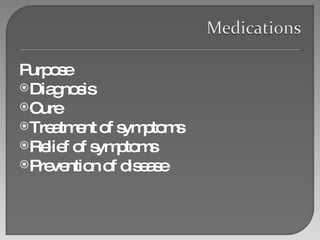
Purpose Diagnosis Cure Treatment of symptoms Relief of symptoms Prevention of disease
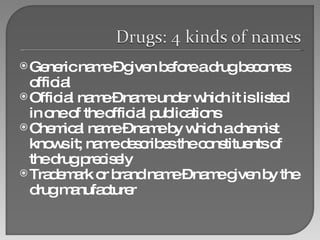
Generic name – given before a drug becomes official Official name – name under which it is listed in one of the official publications Chemical name – name by which a chemist knows it; name describes the constituents of the drug precisely Trademark or brand name – name given by the drug manufacturer
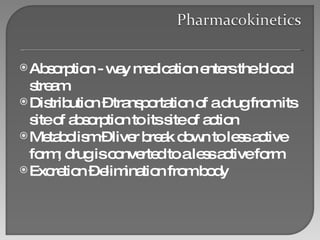
Absorption - way medication enters the blood stream Distribution – transportation of a drug from its site of absorption to its site of action Metabolism – liver break down to less active form; drug is converted to a less active form Excretion – elimination from body
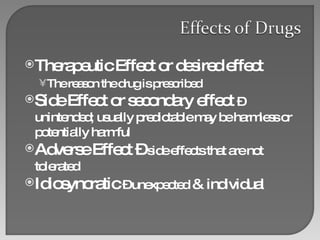
Therapeutic Effect or desired effect The reason the drug is prescribed Side Effect or secondary effect  – unintended; usually predictable may be harmless or potentially harmful Adverse Effect –  side effects that are not tolerated Idiosyncratic  – unexpected  & individual
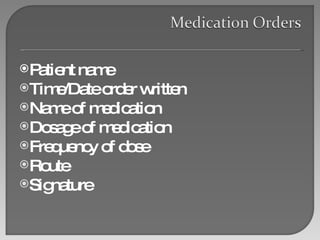
Patient name Time/Date order written Name of medication Dosage of medication Frequency of dose Route Signature
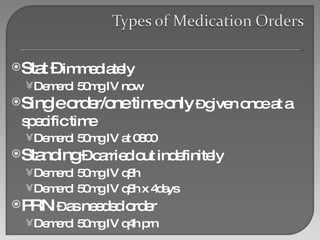
Stat –  immediately Demerol 50mg IV now Single order/one time only  –  given once at a specific time Demerol 50mg IV at 0800 Standing   – carried out indefinitely  Demerol 50mg IV q8h Demerol 50mg IV q8h x 4days PRN  –  as needed order   Demerol 50mg IV q4h prn
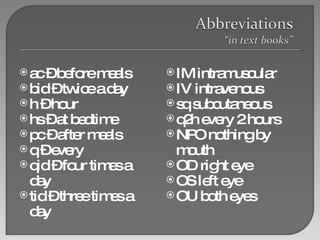
ac – before meals bid – twice a day h – hour hs – at bedtime pc – after meals q – every qid – four times a day tid – three times a day  IM intramuscular IV intravenous sq subcutaneous q2h every 2 hours NPO nothing by mouth OD right eye OS left eye OU both eyes
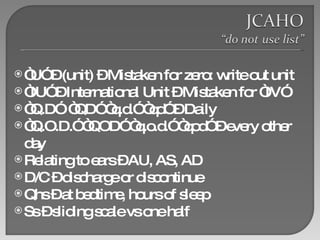
“ U” – (unit) – Mistaken for zero: write out unit “ IU” – International Unit – Mistaken for “IV”  “ Q.D”  “QD” “q.d.” “qd” – Daily “ Q.O.D.” “QOD” “q.o.d.” “qod” – every other day  Relating to ears – AU, AS, AD D/C – discharge or discontinue Qhs – at bedtime, hours of sleep Ss – sliding scale vs one half
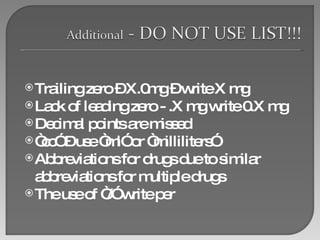
Trailing zero – X.0mg – write X mg Lack of leading zero - .X mg write 0.X mg Decimal points are missed “ cc” – use “ml” or “milliliters”  Abbreviations for drugs due to similar abbreviations for multiple drugs The use of “/” write per
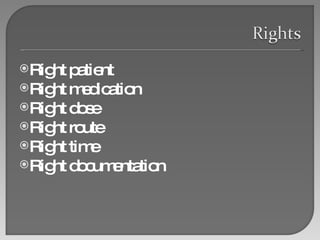
Right patient Right medication Right dose Right route Right time Right documentation
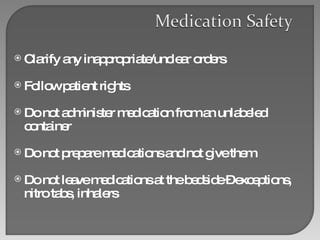
Clarify any inappropriate/unclear orders Follow patient rights Do not administer medication from an unlabeled container Do not prepare medications and not give them Do not leave medications at the bedside – exceptions, nitro tabs, inhalers
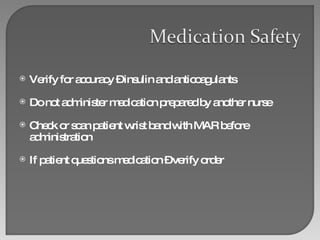
Verify for accuracy – insulin and anticoagulants Do not administer medication prepared by another nurse Check or scan patient wrist band with MAR before administration If patient questions medication – verify order
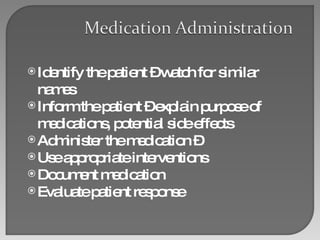
Identify the patient – watch for similar names Inform the patient – explain purpose of medications, potential side effects Administer the medication – Use appropriate interventions Document medication Evaluate patient response
Decreased vision/manual dexterity Decreased renal function Slower absorption in GI tract Decreased liver function Increased proportion of fat to lean body mass Increases the chances of cumulative effects and toxicity
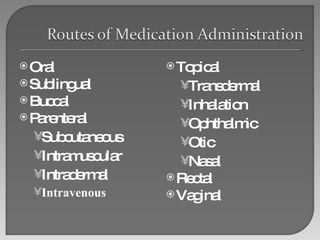
Oral Sublingual Buccal Parenteral Subcutaneous Intramuscular Intradermal Intravenous Topical Transdermal Inhalation Ophthalmic Otic Nasal Rectal  Vaginal
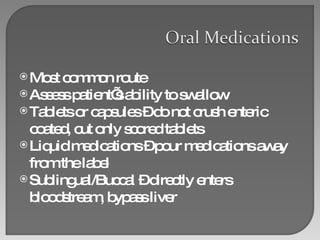
Most common route Assess patient’s ability to swallow Tablets or capsules – do not crush enteric coated, cut only scored tablets Liquid medications – pour medications away from the label Sublingual/Buccal – directly enters bloodstream, bypass liver
Assess patency of  NG tube, Dob-Hoff tubes are not used for medication administration. If to suction, turn suction off  Verify tube placement, aspiration or auscultation Flush tube with 15-30 ml of  water Dissolve medications in warm water Slowly administer medications through tube Flush tube –assuring administration Leave suction off for 30 minutes Record water used for flush/administration on Intake report
Tube placed through abdominal wall If to feeding, place on hold  Check residual by aspiration. Flush tube with 15-30 ml of  water Dissolve medications in warm water Slowly administer medications through tube Flush tube –assuring administration Resume feedings Record water used for flush/administration on Intake report
Provides local effect Dermatological- applied to skin Installations/Irrigations – urinary bladder, ears, eyes, nose, rectum, vagina Inhalations – into the respiratory system
Prolonged systemic affect Patches- nitroglycerine, estrogen, nicotine Apply to clean area of skin Each application to a different site May cause localized, redness, itching Wear gloves when applying to avoid receiving the medication
Administered by irrigation or installation Drops or ointment Clean eye from inner canthus to outer Medication is placed in the lower conjuctival sac
Installation or irrigation Softening of wax to ease with removal Reduce inflammation/infection Aseptic technique Sterile technique if eardrum is perforated
Drops or spray Shrink swollen membranes Loosen secretions to facilitate drainage Treat infections Chronic use of decongestants- rebound effect
Inhalation Nebulizers- delivered by a fine spray MDI- metered dose inhaler Rapid localized relief
Provides local therapeutic effect Treat infections & vaginal discomfort Foams, creams, suppositories Medical aseptic technique is used Application: Tubular applicator with a plunger (2in) Suppositories inserted with the index finger of a gloved hand (3-4in) Patient to remain supine for approx 5-10minutes
Suppositories Insert approx 4 inches Left lateral/supine for 5-10 minutes Retain for 30-40minutes Medication released at a slow steady rate
Intramuscular (IM) Ventrogluteal, vastus lateralis, dorsogluteal, deltoid  Gauge and needle size depend on amount of solution, muscle to be used, condition of patient
Ampule  – Glass, unit dose, draw up using filter needle then change to injection needle, do not inject air into ampule Vial –  Rubber seal, unit or multiple dose, clean top prior to withdrawing medication, inject air into vial equal to the amount to be withdrawn  Reconstitution  – adding of sterile water or sterile normal saline Mixing Medications  –  if compatible
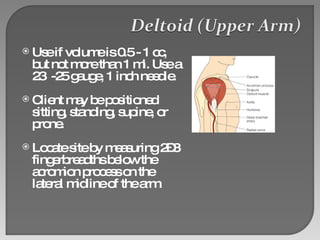
Use if volume is 0.5 - 1 cc, but not more than 1 ml. Use a 23  -25 gauge, 1 inch needle. Client may be positioned sitting, standing, supine, or prone. Locate site by measuring 2–3 fingerbreadths below the acromion process on the lateral midline of the arm.
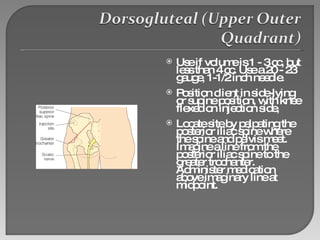
Use if volume is 1 - 3 cc, but less than 4 cc. Use a 20 - 23 gauge, 1-1/2 inch needle. Position client in side-lying or supine position, with knee flexed on injection side,  Locate site by palpating the posterior iliac spine where the spine and pelvis meet. Imagine a line from the posterior iliac spine to the greater trochanter. Administer medication above imaginary line at midpoint.
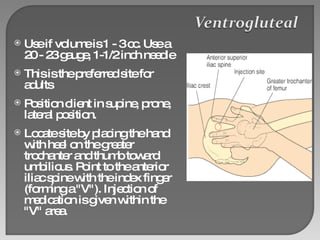
Use if volume is 1 - 3 cc. Use a 20 - 23 gauge, 1-1/2 inch needle This is the preferred site for adults  Position client in supine, prone, lateral position. Locate site by placing the hand with heel on the greater trochanter and thumb toward umbilicus. Point to the anterior iliac spine with the index finger (forming a "V"). Injection of medication is given within the "V" area.
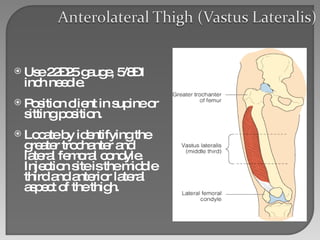
Use 22–25 gauge, 5/8–1 inch needle. Position client in supine or sitting position. Locate by identifying the greater trochanter and lateral femoral condyle. Injection site is the middle third and anterior lateral   aspect of the thigh.
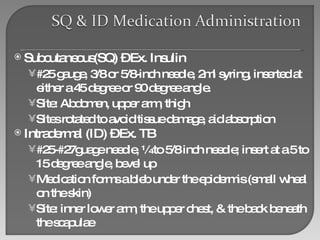
Subcutaneous(SQ) – Ex. Insulin #25 gauge, 3/8 or 5/8-inch needle, 2ml syring, inserted at either a 45 degree or 90 degree angle. Site: Abdomen, upper arm, thigh Sites rotated to avoid tissue damage, aid absorption Intradermal (ID) – Ex. TB #25-#27guage needle, ¼ to 5/8 inch needle; insert at a 5 to 15 degree angle, bevel up Medication forms a bleb under the epidermis (small wheal on the skin) Site: inner lower arm, the upper chest, & the back beneath the scapulae
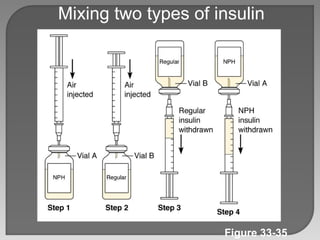
Figure 33-35 Mixing two types of insulin
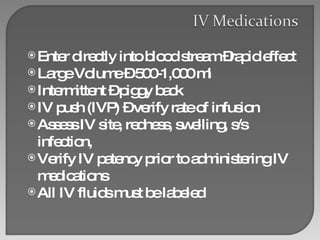
Enter directly into blood stream –rapid effect Large Volume – 500-1,000 ml Intermittent – piggy back  IV push (IVP) – verify rate of infusion Assess IV site, redness, swelling, s/s infection,  Verify IV patency prior to administering IV medications All IV fluids must be labeled
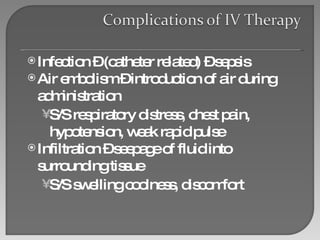
Infection – (catheter related) – sepsis Air embolism – introduction of air during administration S/S respiratory distress, chest pain, hypotension, weak rapid pulse Infiltration – seepage of fluid into surrounding tissue S/S swelling coolness, discomfort

Nursing Skills

  • 1.
  • 2.
    Purpose Diagnosis CureTreatment of symptoms Relief of symptoms Prevention of disease
  • 3.
    Generic name –given before a drug becomes official Official name – name under which it is listed in one of the official publications Chemical name – name by which a chemist knows it; name describes the constituents of the drug precisely Trademark or brand name – name given by the drug manufacturer
  • 4.
    Absorption - waymedication enters the blood stream Distribution – transportation of a drug from its site of absorption to its site of action Metabolism – liver break down to less active form; drug is converted to a less active form Excretion – elimination from body
  • 5.
    Therapeutic Effect ordesired effect The reason the drug is prescribed Side Effect or secondary effect – unintended; usually predictable may be harmless or potentially harmful Adverse Effect – side effects that are not tolerated Idiosyncratic – unexpected & individual
  • 6.
    Patient name Time/Dateorder written Name of medication Dosage of medication Frequency of dose Route Signature
  • 7.
    Stat – immediately Demerol 50mg IV now Single order/one time only – given once at a specific time Demerol 50mg IV at 0800 Standing – carried out indefinitely Demerol 50mg IV q8h Demerol 50mg IV q8h x 4days PRN – as needed order Demerol 50mg IV q4h prn
  • 8.
    ac – beforemeals bid – twice a day h – hour hs – at bedtime pc – after meals q – every qid – four times a day tid – three times a day IM intramuscular IV intravenous sq subcutaneous q2h every 2 hours NPO nothing by mouth OD right eye OS left eye OU both eyes
  • 9.
    “ U” –(unit) – Mistaken for zero: write out unit “ IU” – International Unit – Mistaken for “IV” “ Q.D” “QD” “q.d.” “qd” – Daily “ Q.O.D.” “QOD” “q.o.d.” “qod” – every other day Relating to ears – AU, AS, AD D/C – discharge or discontinue Qhs – at bedtime, hours of sleep Ss – sliding scale vs one half
  • 10.
    Trailing zero –X.0mg – write X mg Lack of leading zero - .X mg write 0.X mg Decimal points are missed “ cc” – use “ml” or “milliliters” Abbreviations for drugs due to similar abbreviations for multiple drugs The use of “/” write per
  • 11.
    Right patient Rightmedication Right dose Right route Right time Right documentation
  • 12.
    Clarify any inappropriate/unclearorders Follow patient rights Do not administer medication from an unlabeled container Do not prepare medications and not give them Do not leave medications at the bedside – exceptions, nitro tabs, inhalers
  • 13.
    Verify for accuracy– insulin and anticoagulants Do not administer medication prepared by another nurse Check or scan patient wrist band with MAR before administration If patient questions medication – verify order
  • 14.
    Identify the patient– watch for similar names Inform the patient – explain purpose of medications, potential side effects Administer the medication – Use appropriate interventions Document medication Evaluate patient response
  • 15.
    Decreased vision/manual dexterityDecreased renal function Slower absorption in GI tract Decreased liver function Increased proportion of fat to lean body mass Increases the chances of cumulative effects and toxicity
  • 16.
    Oral Sublingual BuccalParenteral Subcutaneous Intramuscular Intradermal Intravenous Topical Transdermal Inhalation Ophthalmic Otic Nasal Rectal Vaginal
  • 17.
    Most common routeAssess patient’s ability to swallow Tablets or capsules – do not crush enteric coated, cut only scored tablets Liquid medications – pour medications away from the label Sublingual/Buccal – directly enters bloodstream, bypass liver
  • 18.
    Assess patency of NG tube, Dob-Hoff tubes are not used for medication administration. If to suction, turn suction off Verify tube placement, aspiration or auscultation Flush tube with 15-30 ml of water Dissolve medications in warm water Slowly administer medications through tube Flush tube –assuring administration Leave suction off for 30 minutes Record water used for flush/administration on Intake report
  • 19.
    Tube placed throughabdominal wall If to feeding, place on hold Check residual by aspiration. Flush tube with 15-30 ml of water Dissolve medications in warm water Slowly administer medications through tube Flush tube –assuring administration Resume feedings Record water used for flush/administration on Intake report
  • 20.
    Provides local effectDermatological- applied to skin Installations/Irrigations – urinary bladder, ears, eyes, nose, rectum, vagina Inhalations – into the respiratory system
  • 21.
    Prolonged systemic affectPatches- nitroglycerine, estrogen, nicotine Apply to clean area of skin Each application to a different site May cause localized, redness, itching Wear gloves when applying to avoid receiving the medication
  • 22.
    Administered by irrigationor installation Drops or ointment Clean eye from inner canthus to outer Medication is placed in the lower conjuctival sac
  • 23.
    Installation or irrigationSoftening of wax to ease with removal Reduce inflammation/infection Aseptic technique Sterile technique if eardrum is perforated
  • 24.
    Drops or sprayShrink swollen membranes Loosen secretions to facilitate drainage Treat infections Chronic use of decongestants- rebound effect
  • 25.
    Inhalation Nebulizers- deliveredby a fine spray MDI- metered dose inhaler Rapid localized relief
  • 26.
    Provides local therapeuticeffect Treat infections & vaginal discomfort Foams, creams, suppositories Medical aseptic technique is used Application: Tubular applicator with a plunger (2in) Suppositories inserted with the index finger of a gloved hand (3-4in) Patient to remain supine for approx 5-10minutes
  • 27.
    Suppositories Insert approx4 inches Left lateral/supine for 5-10 minutes Retain for 30-40minutes Medication released at a slow steady rate
  • 28.
    Intramuscular (IM) Ventrogluteal,vastus lateralis, dorsogluteal, deltoid Gauge and needle size depend on amount of solution, muscle to be used, condition of patient
  • 29.
    Ampule –Glass, unit dose, draw up using filter needle then change to injection needle, do not inject air into ampule Vial – Rubber seal, unit or multiple dose, clean top prior to withdrawing medication, inject air into vial equal to the amount to be withdrawn Reconstitution – adding of sterile water or sterile normal saline Mixing Medications – if compatible
  • 30.
    Use if volumeis 0.5 - 1 cc, but not more than 1 ml. Use a 23 -25 gauge, 1 inch needle. Client may be positioned sitting, standing, supine, or prone. Locate site by measuring 2–3 fingerbreadths below the acromion process on the lateral midline of the arm.
  • 31.
    Use if volumeis 1 - 3 cc, but less than 4 cc. Use a 20 - 23 gauge, 1-1/2 inch needle. Position client in side-lying or supine position, with knee flexed on injection side, Locate site by palpating the posterior iliac spine where the spine and pelvis meet. Imagine a line from the posterior iliac spine to the greater trochanter. Administer medication above imaginary line at midpoint.
  • 32.
    Use if volumeis 1 - 3 cc. Use a 20 - 23 gauge, 1-1/2 inch needle This is the preferred site for adults Position client in supine, prone, lateral position. Locate site by placing the hand with heel on the greater trochanter and thumb toward umbilicus. Point to the anterior iliac spine with the index finger (forming a "V"). Injection of medication is given within the "V" area.
  • 33.
    Use 22–25 gauge,5/8–1 inch needle. Position client in supine or sitting position. Locate by identifying the greater trochanter and lateral femoral condyle. Injection site is the middle third and anterior lateral aspect of the thigh.
  • 34.
    Subcutaneous(SQ) – Ex.Insulin #25 gauge, 3/8 or 5/8-inch needle, 2ml syring, inserted at either a 45 degree or 90 degree angle. Site: Abdomen, upper arm, thigh Sites rotated to avoid tissue damage, aid absorption Intradermal (ID) – Ex. TB #25-#27guage needle, ¼ to 5/8 inch needle; insert at a 5 to 15 degree angle, bevel up Medication forms a bleb under the epidermis (small wheal on the skin) Site: inner lower arm, the upper chest, & the back beneath the scapulae
  • 35.
    Figure 33-35 Mixingtwo types of insulin
  • 36.
    Enter directly intoblood stream –rapid effect Large Volume – 500-1,000 ml Intermittent – piggy back IV push (IVP) – verify rate of infusion Assess IV site, redness, swelling, s/s infection, Verify IV patency prior to administering IV medications All IV fluids must be labeled
  • 37.
    Infection – (catheterrelated) – sepsis Air embolism – introduction of air during administration S/S respiratory distress, chest pain, hypotension, weak rapid pulse Infiltration – seepage of fluid into surrounding tissue S/S swelling coolness, discomfort

Editor's Notes

  • #26 Nurse role – instruct clients to use inhalers correctly. Refer to Teaching on page 850
  • #28 Advantages: avoids irritation of the upper GI tract in clients who encounter this problem It is advantageous when the medication has an objectionalbe taste or odor The drug is released at a slow but steady rate
  • #30 Mixing meds: two vials same as insulin; one vial & one ampule – 1 st prepare & withdraw from vial because ampules do not require the addition of air prior to withdrawal of the drug Reconstitution – antibiotics Mixing Meds – Demerol & phenergan
  • #33 Provides the greatest thickness of gluteal muscle Is sealed off by bone Contains consistently less fat than the buttock area, thus eliminating the need to determine the depth of subcutaneous fat. Side-lying position helps locate the ventrogluteal site more easily The right hand is used for the left hip, & the left hand for the right hip