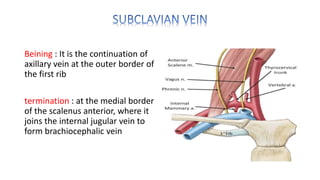
Beining : It is the continuation of
axillary vein at the outer border of
the first rib
termination : at the medial border
of the scalenus anterior, where it
joins the internal jugular vein to
form brachiocephalic vein
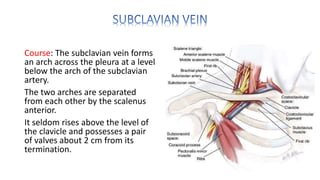
Course: The subclavian vein forms
an arch across the pleura at a level
below the arch of the subclavian
artery.
The two arches are separated
from each other by the scalenus
anterior.
It seldom rises above the level of
the clavicle and possesses a pair
of valves about 2 cm from its
termination.
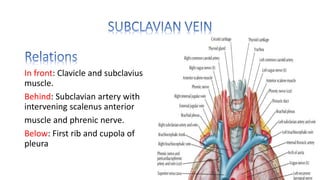
In front: Clavicle and subclavius
muscle.
Behind: Subclavian artery with
intervening scalenus anterior
muscle and phrenic nerve.
Below: First rib and cupola of
pleura
The following are the tributaries of the subclavian vein:
1. External jugular vein.
2. Dorsal scapular vein.
3. Thoracic duct on the left side and right lymphatic duct
on the right side
4. Anterior jugular vein.
5. Cephalic vein. Only sometimes
1- Subclavian vein catheterization
2- Subclavian vein thrombosis
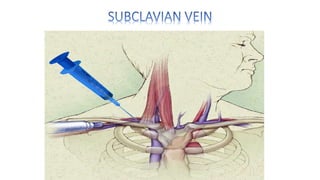
Subclavian vein catheterization:
The subclavian vein is located immediately posterior to the medial third of the
clavicle. It can be catheterized both from below (infra_x0002_clavicular
approach) and above (supraclavicular approach) the clavicle.
a) In infraclavicular approach, the needle is inserted just below the lower border
of the clavicle at the junction of its medial one-third and lateral two-third. The
needle is directed upwards and posteriorly towards the middle of the jugular
notch.
b) In supraclavicular approach, the needle is inserted at the junction of lateral
border of the clavicular head of sterno cleidomastoid and upper border of the
clavicle. The needle is directed downwards and medially towards the
mediastinum.
Subclavian vein thrombosis:
Clinically, it presents as edema of the upper limb especially
after exercise.
It can be spontaneous (primary) or secondary.
The primary thrombosis occasionally occurs due to
excessive and unaccustomed use of arm at the shoulder
joint.
The secondary thrombosis occurs as a complication of an
indwelling venous catheter.
subclavian vein.pptx

subclavian vein.pptx

  • 2.
    Beining : Itis the continuation of axillary vein at the outer border of the first rib termination : at the medial border of the scalenus anterior, where it joins the internal jugular vein to form brachiocephalic vein
  • 3.
    Course: The subclavianvein forms an arch across the pleura at a level below the arch of the subclavian artery. The two arches are separated from each other by the scalenus anterior. It seldom rises above the level of the clavicle and possesses a pair of valves about 2 cm from its termination.
  • 4.
    In front: Clavicleand subclavius muscle. Behind: Subclavian artery with intervening scalenus anterior muscle and phrenic nerve. Below: First rib and cupola of pleura
  • 5.
    The following arethe tributaries of the subclavian vein: 1. External jugular vein. 2. Dorsal scapular vein. 3. Thoracic duct on the left side and right lymphatic duct on the right side 4. Anterior jugular vein. 5. Cephalic vein. Only sometimes
  • 6.
    1- Subclavian veincatheterization 2- Subclavian vein thrombosis
  • 7.
    Subclavian vein catheterization: Thesubclavian vein is located immediately posterior to the medial third of the clavicle. It can be catheterized both from below (infra_x0002_clavicular approach) and above (supraclavicular approach) the clavicle. a) In infraclavicular approach, the needle is inserted just below the lower border of the clavicle at the junction of its medial one-third and lateral two-third. The needle is directed upwards and posteriorly towards the middle of the jugular notch. b) In supraclavicular approach, the needle is inserted at the junction of lateral border of the clavicular head of sterno cleidomastoid and upper border of the clavicle. The needle is directed downwards and medially towards the mediastinum.
  • 9.
    Subclavian vein thrombosis: Clinically,it presents as edema of the upper limb especially after exercise. It can be spontaneous (primary) or secondary. The primary thrombosis occasionally occurs due to excessive and unaccustomed use of arm at the shoulder joint. The secondary thrombosis occurs as a complication of an indwelling venous catheter.