14 style problems
Introduction to “The Associated
Press Stylebook and Briefing on
Media Law”
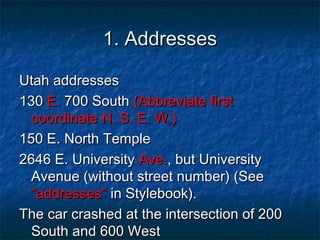
1. Addresses
Utah addresses
130 E. 700 South (Abbreviate first
coordinate N. S. E. W.)
150 E. North Temple
2646 E. University Ave., but University
Avenue (without street number) (See
“addresses” in Stylebook).
The car crashed at the intersection of 200
South and 600 West
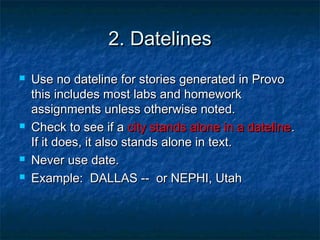
2. Datelines







Use no dateline for stories generated in Provo
this includes most labs and homework
assignments unless otherwise noted.
Check to see if a city stands alone in a dateline.
If it does, it also stands alone in text.
Never use date.
Example: DALLAS -- or NEPHI, Utah
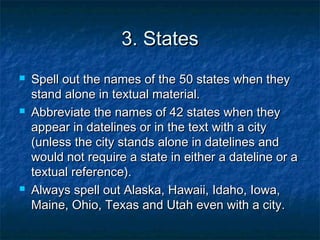
3. States






Spell out the names of the 50 states when they
stand alone in textual material.
Abbreviate the names of 42 states when they
appear in datelines or in the text with a city
(unless the city stands alone in datelines and
would not require a state in either a dateline or a
textual reference).
Always spell out Alaska, Hawaii, Idaho, Iowa,
Maine, Ohio, Texas and Utah even with a city.
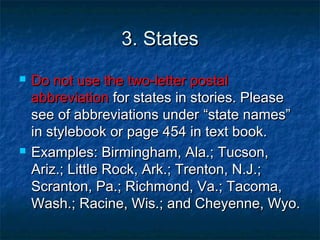
3. States




Do not use the two-letter postal
abbreviation for states in stories. Please
see of abbreviations under “state names”
in stylebook or page 454 in text book.
Examples: Birmingham, Ala.; Tucson,
Ariz.; Little Rock, Ark.; Trenton, N.J.;
Scranton, Pa.; Richmond, Va.; Tacoma,
Wash.; Racine, Wis.; and Cheyenne, Wyo.
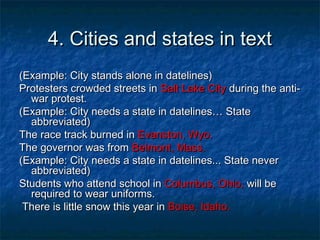
4. Cities and states in text
(Example: City stands alone in datelines)
Protesters crowded streets in Salt Lake City during the antiwar protest.
(Example: City needs a state in datelines… State
abbreviated)
The race track burned in Evanston, Wyo.
The governor was from Belmont, Mass.
(Example: City needs a state in datelines... State never
abbreviated)
Students who attend school in Columbus, Ohio, will be
required to wear uniforms.
There is little snow this year in Boise, Idaho.
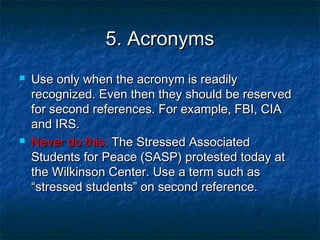
5. Acronyms




Use only when the acronym is readily
recognized. Even then they should be reserved
for second references. For example, FBI, CIA
and IRS.
Never do this: The Stressed Associated
Students for Peace (SASP) protested today at
the Wilkinson Center. Use a term such as
“stressed students” on second reference.
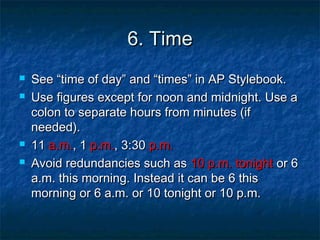
6. Time






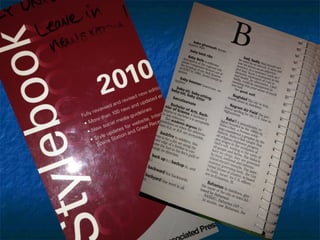
See “time of day” and “times” in AP Stylebook.
Use figures except for noon and midnight. Use a
colon to separate hours from minutes (if
needed).
11 a.m., 1 p.m., 3:30 p.m.
Avoid redundancies such as 10 p.m. tonight or 6
a.m. this morning. Instead it can be 6 this
morning or 6 a.m. or 10 tonight or 10 p.m.
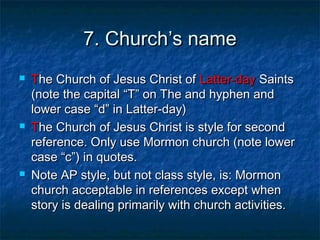
7. Church’s name






The Church of Jesus Christ of Latter-day Saints
(note the capital “T” on The and hyphen and
lower case “d” in Latter-day)
The Church of Jesus Christ is style for second
reference. Only use Mormon church (note lower
case “c”) in quotes.
Note AP style, but not class style, is: Mormon
church acceptable in references except when
story is dealing primarily with church activities.
8. BYU


BYU acceptable on all references for
class and student publications.
9. Composition titles




See AP stylebook “composition titles.” Do not
italicize names of newspapers or magazines.
Capitalize and put in quotes titles of books,
movies, television shows and musical works.
Example: “Grapes of Wrath,” “Lord of the Rings,”
“The Messiah,” “Friends,” and “Six Feet From
the Edge” and The Boston Globe.
10. Compound modifiers
(adjectives)








compound adjectives or compound
modifiers (See hyphen entry in
punctuation chapter)
Example:
30-year-old man
would-be dictator
No hyphen for adjectives ending in ly
locally owned newspaper
11. Identifying students
Identify students by name, age, class standing, hometown and major.
 Example:
 Bob Rogers, 20, a sophomore from Chicago majoring in English.
 Avoid placing the hometown after the major, because it often makes
it sound as if the discipline being studied exists only in the
hometown.
 Bad example:
 Bob Rogers, a sophomore majoring in psychology from Chicago.
 Note: most majors, except languages, are not capitalized.
 Example: Wendy Wilson, 19, a junior from Nampa, Idaho, majoring
in communications.
 Joan Price, 21, a junior from Washington D.C., majoring in
Japanese.
12. Months






See “months,” “dates” and “years” in AP
Stylebook. Remember abbreviations.
When a month is used with a specific
date, abbreviate only Jan., Feb., Aug.,
Sept., Oct., Nov. and Dec. Spell out when
using alone, or with a year alone.
Examples: January 2001, Jan. 18, Feb. 2
or August.
13. Money








$1
$1.50
$1.5 million (use million after $999,999)
5 cents
10 cents
Wrong: City officials spent one million dollars.
Correct: City officials spent $1 million.
14. Numbers





Spell out one through nine and first
through ninth. Spell out numbers when
they begin a sentence.
1,000, 14,000, 25,000
1 million

Style2013revision

  • 1.
    14 style problems Introductionto “The Associated Press Stylebook and Briefing on Media Law”
  • 4.
    1. Addresses Utah addresses 130E. 700 South (Abbreviate first coordinate N. S. E. W.) 150 E. North Temple 2646 E. University Ave., but University Avenue (without street number) (See “addresses” in Stylebook). The car crashed at the intersection of 200 South and 600 West
  • 5.
    2. Datelines     Use nodateline for stories generated in Provo this includes most labs and homework assignments unless otherwise noted. Check to see if a city stands alone in a dateline. If it does, it also stands alone in text. Never use date. Example: DALLAS -- or NEPHI, Utah
  • 6.
    3. States    Spell outthe names of the 50 states when they stand alone in textual material. Abbreviate the names of 42 states when they appear in datelines or in the text with a city (unless the city stands alone in datelines and would not require a state in either a dateline or a textual reference). Always spell out Alaska, Hawaii, Idaho, Iowa, Maine, Ohio, Texas and Utah even with a city.
  • 7.
    3. States   Do notuse the two-letter postal abbreviation for states in stories. Please see of abbreviations under “state names” in stylebook or page 454 in text book. Examples: Birmingham, Ala.; Tucson, Ariz.; Little Rock, Ark.; Trenton, N.J.; Scranton, Pa.; Richmond, Va.; Tacoma, Wash.; Racine, Wis.; and Cheyenne, Wyo.
  • 8.
    4. Cities andstates in text (Example: City stands alone in datelines) Protesters crowded streets in Salt Lake City during the antiwar protest. (Example: City needs a state in datelines… State abbreviated) The race track burned in Evanston, Wyo. The governor was from Belmont, Mass. (Example: City needs a state in datelines... State never abbreviated) Students who attend school in Columbus, Ohio, will be required to wear uniforms. There is little snow this year in Boise, Idaho.
  • 9.
    5. Acronyms   Use onlywhen the acronym is readily recognized. Even then they should be reserved for second references. For example, FBI, CIA and IRS. Never do this: The Stressed Associated Students for Peace (SASP) protested today at the Wilkinson Center. Use a term such as “stressed students” on second reference.
  • 10.
    6. Time     See “timeof day” and “times” in AP Stylebook. Use figures except for noon and midnight. Use a colon to separate hours from minutes (if needed). 11 a.m., 1 p.m., 3:30 p.m. Avoid redundancies such as 10 p.m. tonight or 6 a.m. this morning. Instead it can be 6 this morning or 6 a.m. or 10 tonight or 10 p.m.
  • 11.
    7. Church’s name    TheChurch of Jesus Christ of Latter-day Saints (note the capital “T” on The and hyphen and lower case “d” in Latter-day) The Church of Jesus Christ is style for second reference. Only use Mormon church (note lower case “c”) in quotes. Note AP style, but not class style, is: Mormon church acceptable in references except when story is dealing primarily with church activities.
  • 12.
    8. BYU  BYU acceptableon all references for class and student publications.
  • 13.
    9. Composition titles   SeeAP stylebook “composition titles.” Do not italicize names of newspapers or magazines. Capitalize and put in quotes titles of books, movies, television shows and musical works. Example: “Grapes of Wrath,” “Lord of the Rings,” “The Messiah,” “Friends,” and “Six Feet From the Edge” and The Boston Globe.
  • 14.
    10. Compound modifiers (adjectives)       compoundadjectives or compound modifiers (See hyphen entry in punctuation chapter) Example: 30-year-old man would-be dictator No hyphen for adjectives ending in ly locally owned newspaper
  • 15.
    11. Identifying students Identifystudents by name, age, class standing, hometown and major.  Example:  Bob Rogers, 20, a sophomore from Chicago majoring in English.  Avoid placing the hometown after the major, because it often makes it sound as if the discipline being studied exists only in the hometown.  Bad example:  Bob Rogers, a sophomore majoring in psychology from Chicago.  Note: most majors, except languages, are not capitalized.  Example: Wendy Wilson, 19, a junior from Nampa, Idaho, majoring in communications.  Joan Price, 21, a junior from Washington D.C., majoring in Japanese.
  • 16.
    12. Months    See “months,”“dates” and “years” in AP Stylebook. Remember abbreviations. When a month is used with a specific date, abbreviate only Jan., Feb., Aug., Sept., Oct., Nov. and Dec. Spell out when using alone, or with a year alone. Examples: January 2001, Jan. 18, Feb. 2 or August.
  • 17.
    13. Money        $1 $1.50 $1.5 million(use million after $999,999) 5 cents 10 cents Wrong: City officials spent one million dollars. Correct: City officials spent $1 million.
  • 18.
    14. Numbers    Spell outone through nine and first through ninth. Spell out numbers when they begin a sentence. 1,000, 14,000, 25,000 1 million