Capitalization
                    We left off college terms
Check “academic degrees” and “academic titles” in the AP Stylebook
Capital and Capitol
   Lowercase “capital” refers to the city where a seat of government is
    located, or property, equipment or money in terms of financial uses

   The word Capitol refers to the building in Washington, D.C. where Congress
    meets

   See capital and Capital in the AP Stylebook
Ethnic designations and color
   Capitalize race names, but do not capitalize color descriptions

   Caucasians and Negros live in South Africa.

   People who live in Tibet are Asians.

   We are all part of the human race – whether black, brown, red, yellow.


       See nationalities and race and colored in the AP Stylebook.
Geographic regions and directions
   Capitalize regions but not directions
       We toured the West on vacation.
       We had a flat tire west of Orlando.
       He speaks with a Southern accent and will always be a Southerner.
       The farmer told me to go south on U.S. 301 and turn east on I-4.

   Capitalize regions with a state’s name only if that state is famous. When in
    doubt, don’t.
       East and West Germany are now united.
       She grows oranges in Southern California.
       There is a popular ski resort in north Georgia.
         See directions and regions in the AP Stylebook
Government terms
   Somewhat inconsistent – always capitalize a specific government department.
         The New Orleans Police Department issued a curfew. The Police Department was
          quite serious about it.
         San Diego County fires raged even though the Fire Department worked around the
          clock.
         The Department of Agriculture encourages organic production.

       Specific government bodies are always capitalized: Congress, Senate and House
           The British Parliament is home to many a furious debate.

         Never capitalize board of directors or board of trustees. Words such as federal,
          government and administration are also not capitalized, nor are titles of president
          and vice-president unless they precede a name.
           See governmental bodies in the AP Stylebook.
Months, days of week and seasons
   Capitalize and spell out months and days of week. Do not capitalize seasons.
       My birthday is in July. I was born on Tuesday. The season that is hottest is summer.
       See months and days of week in the AP Stylebook
Political parties
   Always capitalize the name of the political party – including the word
    “party”

   Note that philosophies such as
    democratic, republication, communist, socialists and the like are not
    capitalized
       Uncle Joe would vote for the Democratic Party even if they were crazy.
       The Socialist Party enjoys strong support from Mary.
       It seems obvious that the communist ideal will never work.
       We in the United States favor a republican form of government.
         See government bodies, party affiliation and political parties and philosophies
           in the AP Stylebook.
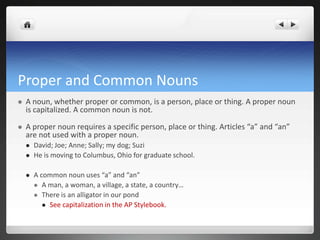
Proper and Common Nouns
   A noun, whether proper or common, is a person, place or thing. A proper noun
    is capitalized. A common noun is not.

   A proper noun requires a specific person, place or thing. Articles “a” and “an”
    are not used with a proper noun.
       David; Joe; Anne; Sally; my dog; Suzi
       He is moving to Columbus, Ohio for graduate school.

       A common noun uses “a” and “an”
         A man, a woman, a village, a state, a country…
         There is an alligator in our pond
            See capitalization in the AP Stylebook.
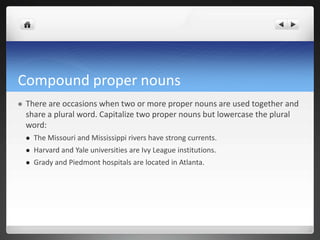
Compound proper nouns
   There are occasions when two or more proper nouns are used together and
    share a plural word. Capitalize two proper nouns but lowercase the plural
    word:
       The Missouri and Mississippi rivers have strong currents.
       Harvard and Yale universities are Ivy League institutions.
       Grady and Piedmont hospitals are located in Atlanta.
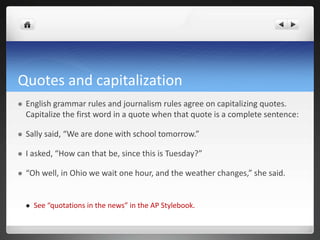
Quotes and capitalization
   English grammar rules and journalism rules agree on capitalizing quotes.
    Capitalize the first word in a quote when that quote is a complete sentence:

   Sally said, “We are done with school tomorrow.”

   I asked, “How can that be, since this is Tuesday?”

   “Oh well, in Ohio we wait one hour, and the weather changes,” she said.


       See “quotations in the news” in the AP Stylebook.
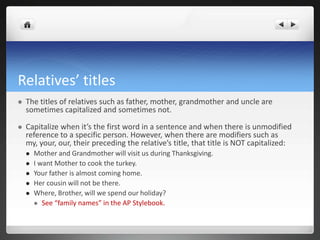
Relatives’ titles
   The titles of relatives such as father, mother, grandmother and uncle are
    sometimes capitalized and sometimes not.

   Capitalize when it’s the first word in a sentence and when there is unmodified
    reference to a specific person. However, when there are modifiers such as
    my, your, our, their preceding the relative’s title, that title is NOT capitalized:
       Mother and Grandmother will visit us during Thanksgiving.
       I want Mother to cook the turkey.
       Your father is almost coming home.
       Her cousin will not be there.
       Where, Brother, will we spend our holiday?
         See “family names” in the AP Stylebook.
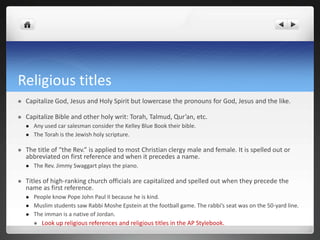
Religious titles
   Capitalize God, Jesus and Holy Spirit but lowercase the pronouns for God, Jesus and the like.

   Capitalize Bible and other holy writ: Torah, Talmud, Qur’an, etc.
       Any used car salesman consider the Kelley Blue Book their bible.
       The Torah is the Jewish holy scripture.

   The title of “the Rev.” is applied to most Christian clergy male and female. It is spelled out or
    abbreviated on first reference and when it precedes a name.
       The Rev. Jimmy Swaggart plays the piano.

   Titles of high-ranking church officials are capitalized and spelled out when they precede the
    name as first reference.
       People know Pope John Paul II because he is kind.
       Muslim students saw Rabbi Moshe Epstein at the football game. The rabbi’s seat was on the 50-yard line.
       The imman is a native of Jordan.
           Look up religious references and religious titles in the AP Stylebook.
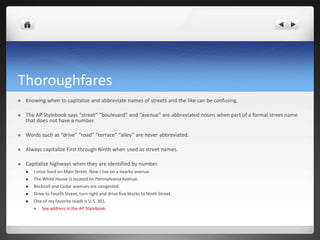
Thoroughfares
   Knowing when to capitalize and abbreviate names of streets and the like can be confusing.

   The AP Stylebook says “street” “boulevard” and “avenue” are abbreviated nouns when part of a formal street name
    that does not have a number.

   Words such as “drive” “road” “terrace” “alley” are never abbreviated.

   Always capitalize First through Ninth when used as street names.

   Capitalize highways when they are identified by number.
       I once lived on Main Street. Now I live on a nearby avenue.
       The White House is located on Pennsylvania Avenue.
       Becknell and Cedar avenues are congested.
       Drive to Fourth Street, turn right and drive five blocks to Ninth Street.
       One of my favorite roads is U.S. 301.
          See address in the AP Stylebook.
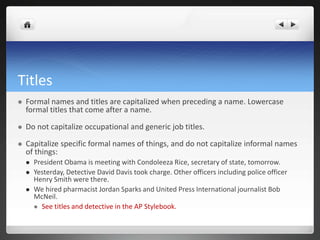
Titles
   Formal names and titles are capitalized when preceding a name. Lowercase
    formal titles that come after a name.

   Do not capitalize occupational and generic job titles.

   Capitalize specific formal names of things, and do not capitalize informal names
    of things:
       President Obama is meeting with Condoleeza Rice, secretary of state, tomorrow.
       Yesterday, Detective David Davis took charge. Other officers including police officer
        Henry Smith were there.
       We hired pharmacist Jordan Sparks and United Press International journalist Bob
        McNeil.
         See titles and detective in the AP Stylebook.
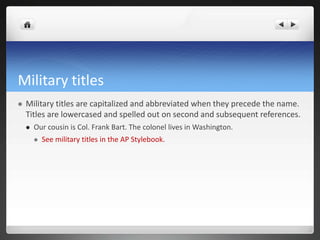
Military titles
   Military titles are capitalized and abbreviated when they precede the name.
    Titles are lowercased and spelled out on second and subsequent references.
       Our cousin is Col. Frank Bart. The colonel lives in Washington.
           See military titles in the AP Stylebook.
Trademarks
   The AP Stylebook defines a trademark as a brand, symbol or word used by a manufacturer
    or dealer and protected by law. Therefore, always capitalize a trademark because it is a
    proper noun.

   Trademark names have become part of our common language, so journalists must be
    careful. Use generic equivalents whenever possible to avoid legal action over trademark
    infringement.
       I’m going to McDonald’s to buy a Coca-Cola. (trademark version)
       I’m going to McDonald’s to buy a cola. (preferred)
         Her baby likes to eat Jell-O. (trademark)
         Her baby likes to eat gelatin. (preferred)
         A Land Rover will not get stuck in the mud.
         An all-terrain vehicle will not get stuck in the mud. (preferred)
            Look up trademarks, brand names and service mark in the AP Stylebook.

News editing capitalization2

  • 1.
    Capitalization We left off college terms Check “academic degrees” and “academic titles” in the AP Stylebook
  • 2.
    Capital and Capitol  Lowercase “capital” refers to the city where a seat of government is located, or property, equipment or money in terms of financial uses  The word Capitol refers to the building in Washington, D.C. where Congress meets  See capital and Capital in the AP Stylebook
  • 3.
    Ethnic designations andcolor  Capitalize race names, but do not capitalize color descriptions  Caucasians and Negros live in South Africa.  People who live in Tibet are Asians.  We are all part of the human race – whether black, brown, red, yellow.  See nationalities and race and colored in the AP Stylebook.
  • 4.
    Geographic regions anddirections  Capitalize regions but not directions  We toured the West on vacation.  We had a flat tire west of Orlando.  He speaks with a Southern accent and will always be a Southerner.  The farmer told me to go south on U.S. 301 and turn east on I-4.  Capitalize regions with a state’s name only if that state is famous. When in doubt, don’t.  East and West Germany are now united.  She grows oranges in Southern California.  There is a popular ski resort in north Georgia.  See directions and regions in the AP Stylebook
  • 5.
    Government terms  Somewhat inconsistent – always capitalize a specific government department.  The New Orleans Police Department issued a curfew. The Police Department was quite serious about it.  San Diego County fires raged even though the Fire Department worked around the clock.  The Department of Agriculture encourages organic production.  Specific government bodies are always capitalized: Congress, Senate and House  The British Parliament is home to many a furious debate.  Never capitalize board of directors or board of trustees. Words such as federal, government and administration are also not capitalized, nor are titles of president and vice-president unless they precede a name.  See governmental bodies in the AP Stylebook.
  • 6.
    Months, days ofweek and seasons  Capitalize and spell out months and days of week. Do not capitalize seasons.  My birthday is in July. I was born on Tuesday. The season that is hottest is summer.  See months and days of week in the AP Stylebook
  • 7.
    Political parties  Always capitalize the name of the political party – including the word “party”  Note that philosophies such as democratic, republication, communist, socialists and the like are not capitalized  Uncle Joe would vote for the Democratic Party even if they were crazy.  The Socialist Party enjoys strong support from Mary.  It seems obvious that the communist ideal will never work.  We in the United States favor a republican form of government.  See government bodies, party affiliation and political parties and philosophies in the AP Stylebook.
  • 8.
    Proper and CommonNouns  A noun, whether proper or common, is a person, place or thing. A proper noun is capitalized. A common noun is not.  A proper noun requires a specific person, place or thing. Articles “a” and “an” are not used with a proper noun.  David; Joe; Anne; Sally; my dog; Suzi  He is moving to Columbus, Ohio for graduate school.  A common noun uses “a” and “an”  A man, a woman, a village, a state, a country…  There is an alligator in our pond  See capitalization in the AP Stylebook.
  • 9.
    Compound proper nouns  There are occasions when two or more proper nouns are used together and share a plural word. Capitalize two proper nouns but lowercase the plural word:  The Missouri and Mississippi rivers have strong currents.  Harvard and Yale universities are Ivy League institutions.  Grady and Piedmont hospitals are located in Atlanta.
  • 10.
    Quotes and capitalization  English grammar rules and journalism rules agree on capitalizing quotes. Capitalize the first word in a quote when that quote is a complete sentence:  Sally said, “We are done with school tomorrow.”  I asked, “How can that be, since this is Tuesday?”  “Oh well, in Ohio we wait one hour, and the weather changes,” she said.  See “quotations in the news” in the AP Stylebook.
  • 11.
    Relatives’ titles  The titles of relatives such as father, mother, grandmother and uncle are sometimes capitalized and sometimes not.  Capitalize when it’s the first word in a sentence and when there is unmodified reference to a specific person. However, when there are modifiers such as my, your, our, their preceding the relative’s title, that title is NOT capitalized:  Mother and Grandmother will visit us during Thanksgiving.  I want Mother to cook the turkey.  Your father is almost coming home.  Her cousin will not be there.  Where, Brother, will we spend our holiday?  See “family names” in the AP Stylebook.
  • 12.
    Religious titles  Capitalize God, Jesus and Holy Spirit but lowercase the pronouns for God, Jesus and the like.  Capitalize Bible and other holy writ: Torah, Talmud, Qur’an, etc.  Any used car salesman consider the Kelley Blue Book their bible.  The Torah is the Jewish holy scripture.  The title of “the Rev.” is applied to most Christian clergy male and female. It is spelled out or abbreviated on first reference and when it precedes a name.  The Rev. Jimmy Swaggart plays the piano.  Titles of high-ranking church officials are capitalized and spelled out when they precede the name as first reference.  People know Pope John Paul II because he is kind.  Muslim students saw Rabbi Moshe Epstein at the football game. The rabbi’s seat was on the 50-yard line.  The imman is a native of Jordan.  Look up religious references and religious titles in the AP Stylebook.
  • 13.
    Thoroughfares  Knowing when to capitalize and abbreviate names of streets and the like can be confusing.  The AP Stylebook says “street” “boulevard” and “avenue” are abbreviated nouns when part of a formal street name that does not have a number.  Words such as “drive” “road” “terrace” “alley” are never abbreviated.  Always capitalize First through Ninth when used as street names.  Capitalize highways when they are identified by number.  I once lived on Main Street. Now I live on a nearby avenue.  The White House is located on Pennsylvania Avenue.  Becknell and Cedar avenues are congested.  Drive to Fourth Street, turn right and drive five blocks to Ninth Street.  One of my favorite roads is U.S. 301.  See address in the AP Stylebook.
  • 14.
    Titles  Formal names and titles are capitalized when preceding a name. Lowercase formal titles that come after a name.  Do not capitalize occupational and generic job titles.  Capitalize specific formal names of things, and do not capitalize informal names of things:  President Obama is meeting with Condoleeza Rice, secretary of state, tomorrow.  Yesterday, Detective David Davis took charge. Other officers including police officer Henry Smith were there.  We hired pharmacist Jordan Sparks and United Press International journalist Bob McNeil.  See titles and detective in the AP Stylebook.
  • 15.
    Military titles  Military titles are capitalized and abbreviated when they precede the name. Titles are lowercased and spelled out on second and subsequent references.  Our cousin is Col. Frank Bart. The colonel lives in Washington.  See military titles in the AP Stylebook.
  • 16.
    Trademarks  The AP Stylebook defines a trademark as a brand, symbol or word used by a manufacturer or dealer and protected by law. Therefore, always capitalize a trademark because it is a proper noun.  Trademark names have become part of our common language, so journalists must be careful. Use generic equivalents whenever possible to avoid legal action over trademark infringement.  I’m going to McDonald’s to buy a Coca-Cola. (trademark version)  I’m going to McDonald’s to buy a cola. (preferred)  Her baby likes to eat Jell-O. (trademark)  Her baby likes to eat gelatin. (preferred)  A Land Rover will not get stuck in the mud.  An all-terrain vehicle will not get stuck in the mud. (preferred)  Look up trademarks, brand names and service mark in the AP Stylebook.