Case Study : Stuxnet By Amr Thabet
Stuxnet Overview Most sophisticated malware ever seen in public  Uses up to 6 Vulnerabilities (5 in Win and 1 in Siemens) Its code is ~ 1.5 MB (very large) Has 3 Rootkits (User-Mode, Kernel-Mode & PLC Rootkit) Spreads via USB Flash Memory and Network Shares It updates itself via Internet by connecting (HTTP) to two Websites (encrypted connection) Infects SCADA Systems  The First Malware that has a physical payload
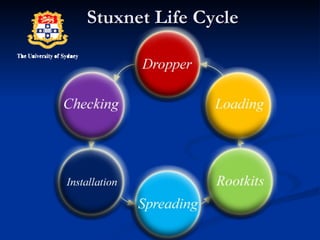
Stuxnet Life Cycle
Stuxnet’s Main Dropper The Dropper is a program  that contains the real malware and carries it from PC to another (like a ship) It loads the Main DLL with a special way It uses LoadLibraryA and Hooks the File Management APIs that’s used by LoadLibraryA to get the File from memory not from a file on the disk
Process Injection Stuxnet injects itself into a process (usually lsass.exe) It copies itself into the Memory of lsass and then forces lsass to execute it by modifying its code In Stuxnet case it unloads (remove) the original process (lsass) from its memory (when the process suspended) and then loads another PE File inside the memory has the same entrypoint
Escalation of Privileges Escalation of Privileges means do something you are not allowed to do. In stuxnet it takes the administrator privileges to install itself It uses 2 vulnerabilities in win OS CVE-2010-2743(MS-10-073) –Win32K.sys Keyboard Layout Vulnerability CVE-xxxx-xxxx(MS-xx-xxx) –Windows Task Scheduler Vulnerability These Vulnerabilities allow stuxnet to execute as a system application (runs like a system process)
Installation Mechanism It installs these files % SystemRoot%\inf\oem7A.PNF %SystemRoot%\inf\mdmeric3.PNF %SystemRoot%\inf\mdmcpq3.PNF %SystemRoot%\inf\oem6C.PNF  %SystemRoot%\Drivers\mrxnet.sys %SystemRoot%\Drivers\mrxcls.sys Then it adds MrxNet & MrxCls to registry to be sure they will be executed on every boot
Disabling Windows Defender It modifies some registry entries related to Window Defender: SOFTWARE\Microsoft\Windows Defender\Real-Time Protection EnableUnknownPrompts EnableKnownGoodPrompts ServicesAndDriversAgent   These modifications allows stuxnet to work normally without blocking
Spreading Mechanism USB Infection Stuxnet uses a vulnerability in Win OS: CVE-2010-2568(MS-10-046) -Windows Shell LNK Vulnerability This vulnerability is found in the shortcut of the CPL files In these shortcuts the Explorer loads the icon dynamically This loading makes Explorer load the CPL File and calls to its Entrypoint  Stuxnet uses this trick to make Explorer calls to the Entrypoint of its Executable
Spreading Mechanism Network Stuxnet Spreads via Network by using 2 Vulnerabilities: CVE-2010-2729(MS-10-061) –Windows Print Spooler Service Vulnerability CVE-2008-4250(MS-08-067) –Windows Server Service NetPathCanonicalize()  The 1 st   Vulnerability: allows Stuxnet to infect PCs that share their  printers The 2 nd   is used before in  Conflicker  and it allows Stuxnet to spreads via Network Shares
Updating Mechanism Stuxnet updates itself via 2 Websites  www.mypremierfutbol.com www.todaysfutbol.com Stuxnet updates itself via a P2P connection (on the isolated machines) They communicate via RPC connection  Control the ICS machines  without  a direct communication To the Internet
Rootkits Rootkit  is a program (or tool) is used by malwares to hide its presence  In Stuxnet, they hide stuxnet files in the USB Infected Flash Memory Stuxnet has 2 rootkits : User-Mode and Kernel-Mode rootkit
User-Mode Rootkit loaded by the  LNK  Vulnerability Used only once before Infecting a machine It modifies the pointer to the File Management APIs  Change the input or the output of these APIs Hide the Stuxnet Flash Memory Files
Kernel-Mode Rootkit It’s a device driver It’s installed in the installation progress of Stuxnet It’s a simple file system filter it modifies the outputs and the inputs of the File Management functions inside the Kernel
Loading Mechanism There’s two ways for stuxnet to load  1. WTR4141.TMP : Loaded by LNK Vulnerability  loads the Main Dropper of Stuxnet  2. MrxCls :  It’s a device driver  Injects Stuxnet into services.exe every time the system boots
Thank You For any question don’t Forget to mail me at: [email_address] For more about me visit my Website http://www.amrthabet.co.cc Or My Blog http:// blog.amrthabet.co.cc
Thank You

Stuxnet - Case Study

  • 1.
    Case Study :Stuxnet By Amr Thabet
  • 2.
    Stuxnet Overview Mostsophisticated malware ever seen in public Uses up to 6 Vulnerabilities (5 in Win and 1 in Siemens) Its code is ~ 1.5 MB (very large) Has 3 Rootkits (User-Mode, Kernel-Mode & PLC Rootkit) Spreads via USB Flash Memory and Network Shares It updates itself via Internet by connecting (HTTP) to two Websites (encrypted connection) Infects SCADA Systems The First Malware that has a physical payload
  • 3.
  • 4.
    Stuxnet’s Main DropperThe Dropper is a program that contains the real malware and carries it from PC to another (like a ship) It loads the Main DLL with a special way It uses LoadLibraryA and Hooks the File Management APIs that’s used by LoadLibraryA to get the File from memory not from a file on the disk
  • 5.
    Process Injection Stuxnetinjects itself into a process (usually lsass.exe) It copies itself into the Memory of lsass and then forces lsass to execute it by modifying its code In Stuxnet case it unloads (remove) the original process (lsass) from its memory (when the process suspended) and then loads another PE File inside the memory has the same entrypoint
  • 6.
    Escalation of PrivilegesEscalation of Privileges means do something you are not allowed to do. In stuxnet it takes the administrator privileges to install itself It uses 2 vulnerabilities in win OS CVE-2010-2743(MS-10-073) –Win32K.sys Keyboard Layout Vulnerability CVE-xxxx-xxxx(MS-xx-xxx) –Windows Task Scheduler Vulnerability These Vulnerabilities allow stuxnet to execute as a system application (runs like a system process)
  • 7.
    Installation Mechanism Itinstalls these files % SystemRoot%\inf\oem7A.PNF %SystemRoot%\inf\mdmeric3.PNF %SystemRoot%\inf\mdmcpq3.PNF %SystemRoot%\inf\oem6C.PNF %SystemRoot%\Drivers\mrxnet.sys %SystemRoot%\Drivers\mrxcls.sys Then it adds MrxNet & MrxCls to registry to be sure they will be executed on every boot
  • 8.
    Disabling Windows DefenderIt modifies some registry entries related to Window Defender: SOFTWARE\Microsoft\Windows Defender\Real-Time Protection EnableUnknownPrompts EnableKnownGoodPrompts ServicesAndDriversAgent These modifications allows stuxnet to work normally without blocking
  • 9.
    Spreading Mechanism USBInfection Stuxnet uses a vulnerability in Win OS: CVE-2010-2568(MS-10-046) -Windows Shell LNK Vulnerability This vulnerability is found in the shortcut of the CPL files In these shortcuts the Explorer loads the icon dynamically This loading makes Explorer load the CPL File and calls to its Entrypoint Stuxnet uses this trick to make Explorer calls to the Entrypoint of its Executable
  • 10.
    Spreading Mechanism NetworkStuxnet Spreads via Network by using 2 Vulnerabilities: CVE-2010-2729(MS-10-061) –Windows Print Spooler Service Vulnerability CVE-2008-4250(MS-08-067) –Windows Server Service NetPathCanonicalize() The 1 st Vulnerability: allows Stuxnet to infect PCs that share their printers The 2 nd is used before in Conflicker and it allows Stuxnet to spreads via Network Shares
  • 11.
    Updating Mechanism Stuxnetupdates itself via 2 Websites www.mypremierfutbol.com www.todaysfutbol.com Stuxnet updates itself via a P2P connection (on the isolated machines) They communicate via RPC connection Control the ICS machines without a direct communication To the Internet
  • 12.
    Rootkits Rootkit is a program (or tool) is used by malwares to hide its presence In Stuxnet, they hide stuxnet files in the USB Infected Flash Memory Stuxnet has 2 rootkits : User-Mode and Kernel-Mode rootkit
  • 13.
    User-Mode Rootkit loadedby the LNK Vulnerability Used only once before Infecting a machine It modifies the pointer to the File Management APIs Change the input or the output of these APIs Hide the Stuxnet Flash Memory Files
  • 14.
    Kernel-Mode Rootkit It’sa device driver It’s installed in the installation progress of Stuxnet It’s a simple file system filter it modifies the outputs and the inputs of the File Management functions inside the Kernel
  • 15.
    Loading Mechanism There’stwo ways for stuxnet to load 1. WTR4141.TMP : Loaded by LNK Vulnerability loads the Main Dropper of Stuxnet 2. MrxCls : It’s a device driver Injects Stuxnet into services.exe every time the system boots
  • 16.
    Thank You Forany question don’t Forget to mail me at: [email_address] For more about me visit my Website http://www.amrthabet.co.cc Or My Blog http:// blog.amrthabet.co.cc
  • 17.