SOCIALISATION
Study unit 4
By C.Settley
Learning Outcomes
 • Define the concept socialisation
 • Describe the socialisation process
 • Explore the four functions of the socialisation process
 • Describe the phases of socialisation
 • Discuss the following agents of socialisation:
 The family
 The school
 The peer group
 The mass media
 The workplace
 ● Analyse Re socialisation and Anticipatory socialisation
SocialisationDefined.Page55
 The process of learning the beliefs, norms and values that
are socially expected from us as members of a society or
social group.
 Process of internalizing norms (internalization is the process
of acceptance of a set of norms established by people or
groups which are influential to the individual.The process
starts with learning what the norms are, and then the
individual goes through a process of understanding why they
are of value or why they make sense, until finally they accept
the norm as their own viewpoint)
 Social interaction occurs
4Functionsofthe socialisation
process
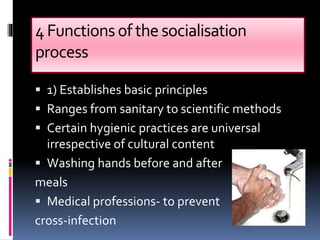
 1) Establishes basic principles
 Ranges from sanitary to scientific methods
 Certain hygienic practices are universal
irrespective of cultural content
 Washing hands before and after
meals
 Medical professions- to prevent
cross-infection
4Functionsofthe socialisation
process
 2) Identity
 In traditional communities, identity is
determined by factors such as gender, ethnic
group and family status
 In industrialised communities identity is
based on personal achievement and is
aquired later in life
 Socialisation in nursing starts with nursing
education and training
4Functionsofthe socialisation
process
 3)Teaches social roles
 Guides us on how to fulfill social roles and
teaches us the content, rights and obligations
associated with these roles
Rolesofa Nursein her/hisprofession
4Functionsofthe socialisation
process
 4)Teaches an individual skills
 Varies from communication skills to the
handling of technical machinery
 Conveyed from generation to generation
 Normally learned through daily imitation and
practice
NursingSkillsexamples
 Accurately gather information in a systematic manner in order to determine the
health-related needs
 •Assessed patient status (conditions) and notify physicians of clinical changes
 •Assigned to provide patient care for 10 patients in area 2
 •Assist patients in the rehabilitation process
 • Calculate and administer medications
 • Catheter, IV, and suctioning training
 • Comfort the dying and support the families of those who are ill
 • Educate patients/families on health care needs, conditions, options etc
 • Educated patients for home care and discharge planning
 •Teach procedures and health practices to patients and families
 • Implement patient care for up to 12 patients per section
 • Interact with departments regarding patient care
 • Maintained sterile fields and application of dressings
 • Medical terminology and medication administration skills
The phases of Socialisation. Page
64
PHASE 1:The commencement of
togetherness
The establishment phase The expectation phase
 Find home
 Secure an income
 Patterns of responsibility
 Mutually satisfactory sexual
relationship
 System of emotional/intellectual
communication
 Relationship with family members
 Patterns of interaction with
friends/community
 Develop a philosophy of life
 Reach consensus on planning of a
family
 From the wife falls
pregnant to the birth of
children
 New tasks: parenthood,
reorientation of
relationship
The phases of Socialisation
continued
PHASE 2
Child bearing families & couples
PHASE 3
Families & couples with pre school children
 CHILDREN:
 - birth till 30 months
 - dev sleeping patterns,
feeding, communication
 PARENTS:
 - new roles
 - attention
 - career
 CHILDREN:
 30 months- 6 yrs old
 habits, intellectual skills
 Motor skills
 Sleeping and eating patterns
established
 PARENTS:
 28-32 yrs
 New careers to increase
standards of living
 Mutual adjustment
The phases of Socialisation
continued
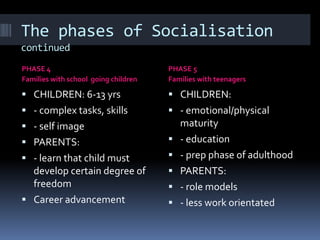
PHASE 4
Families with school going children
PHASE 5
Families with teenagers
 CHILDREN: 6-13 yrs
 - complex tasks, skills
 - self image
 PARENTS:
 - learn that child must
develop certain degree of
freedom
 Career advancement
 CHILDREN:
 - emotional/physical
maturity
 - education
 - prep phase of adulthood
 PARENTS:
 - role models
 - less work orientated
The phases of Socialisation
continued
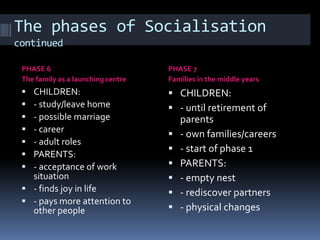
PHASE 6
The family as a launching centre
PHASE 7
Families in the middle years
 CHILDREN:
 - study/leave home
 - possible marriage
 - career
 - adult roles
 PARENTS:
 - acceptance of work
situation
 - finds joy in life
 - pays more attention to
other people
 CHILDREN:
 - until retirement of
parents
 - own families/careers
 - start of phase 1
 PARENTS:
 - empty nest
 - rediscover partners
 - physical changes
The phases of Socialisation
continued
PHASE 8
Ageing Families
 Until death
 Further physical changes
 Pension, savings, old age
homes
SocialisationAgents.Page67
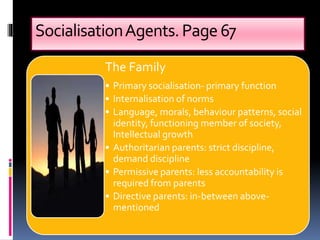
The Family
• Primary socialisation- primary function
• Internalisation of norms
• Language, morals, behaviour patterns, social
identity, functioning member of society,
Intellectual growth
• Authoritarian parents: strict discipline,
demand discipline
• Permissive parents: less accountability is
required from parents
• Directive parents: in-between above-
mentioned
SocialisationAgents.Page67
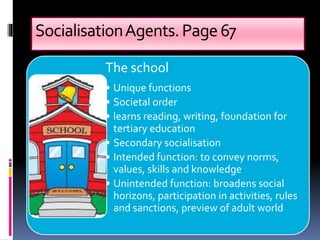
The school
• Unique functions
• Societal order
• learns reading, writing, foundation for
tertiary education
• Secondary socialisation
• Intended function: to convey norms,
values, skills and knowledge
• Unintended function: broadens social
horizons, participation in activities, rules
and sanctions, preview of adult world
SocialisationAgents.Page67
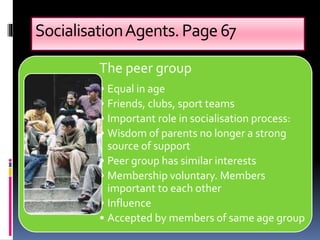
The peer group
• Equal in age
• Friends, clubs, sport teams
• Important role in socialisation process:
• Wisdom of parents no longer a strong
source of support
• Peer group has similar interests
• Membership voluntary. Members
important to each other
• Influence
• Accepted by members of same age group
SocialisationAgents.Page67
Mass media
•Radio, tv,
newspapers, books,
etc
•Conveys information
SocialisationAgents.Page67
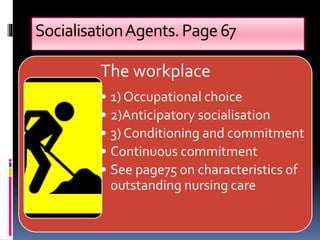
The workplace
• 1) Occupational choice
• 2)Anticipatory socialisation
• 3) Conditioning and commitment
• Continuous commitment
• See page75 on characteristics of
outstanding nursing care
ReSocialisation
 Takes place throughout the adult life
 When person enter a institution- new work,
prison, hospital, defence force etc
 Old age- illnesses
AnticipatorySocialisation
 Facilitated by social interactions
 Non-group-members learn to take on the values
and standards of groups that they aspire to join,
so as to ease their entry into the group and help
them interact competently once they have been
accepted by it
 It is the process of changing one's attitudes and
behaviours, in preparation for a shift in one's role
 Words commonly associated with anticipatory
socialization include grooming, play-acting,
training and rehearsing
 EXAMPLE: Nurse working night shift
Learning Activity!!
 DuToit, D.A. &Van Staden S.J. Page
References
 DuToit, D.A. &Van Staden S.J. (2014). Nursing
Sociology. 5th Edition. Pretoria:Van Schaik.
 http://en.wikipedia.org/wiki/Hygiene
 http://intranet.tdmu.edu.ua/data/kafedra/intern
al/i_nurse/classes_stud/BSN%20(4year)%20Prog
ram/Full%20time%20study/Third%20year/Foun
dations%20of%20Nursing%20Practicum/05.%20
Health%20Care%20Delivery%20System,%20Nu
rsing%20Research%20as%20the%20Basis%20of
%20Nursing.htm
 http://www.craven.k12.nc.us/bes/
TheEnd
ThankYou

Socialisation

  • 1.
  • 2.
    Learning Outcomes  •Define the concept socialisation  • Describe the socialisation process  • Explore the four functions of the socialisation process  • Describe the phases of socialisation  • Discuss the following agents of socialisation:  The family  The school  The peer group  The mass media  The workplace  ● Analyse Re socialisation and Anticipatory socialisation
  • 3.
    SocialisationDefined.Page55  The processof learning the beliefs, norms and values that are socially expected from us as members of a society or social group.  Process of internalizing norms (internalization is the process of acceptance of a set of norms established by people or groups which are influential to the individual.The process starts with learning what the norms are, and then the individual goes through a process of understanding why they are of value or why they make sense, until finally they accept the norm as their own viewpoint)  Social interaction occurs
  • 4.
    4Functionsofthe socialisation process  1)Establishes basic principles  Ranges from sanitary to scientific methods  Certain hygienic practices are universal irrespective of cultural content  Washing hands before and after meals  Medical professions- to prevent cross-infection
  • 5.
    4Functionsofthe socialisation process  2)Identity  In traditional communities, identity is determined by factors such as gender, ethnic group and family status  In industrialised communities identity is based on personal achievement and is aquired later in life  Socialisation in nursing starts with nursing education and training
  • 6.
    4Functionsofthe socialisation process  3)Teachessocial roles  Guides us on how to fulfill social roles and teaches us the content, rights and obligations associated with these roles
  • 7.
  • 8.
    4Functionsofthe socialisation process  4)Teachesan individual skills  Varies from communication skills to the handling of technical machinery  Conveyed from generation to generation  Normally learned through daily imitation and practice
  • 9.
    NursingSkillsexamples  Accurately gatherinformation in a systematic manner in order to determine the health-related needs  •Assessed patient status (conditions) and notify physicians of clinical changes  •Assigned to provide patient care for 10 patients in area 2  •Assist patients in the rehabilitation process  • Calculate and administer medications  • Catheter, IV, and suctioning training  • Comfort the dying and support the families of those who are ill  • Educate patients/families on health care needs, conditions, options etc  • Educated patients for home care and discharge planning  •Teach procedures and health practices to patients and families  • Implement patient care for up to 12 patients per section  • Interact with departments regarding patient care  • Maintained sterile fields and application of dressings  • Medical terminology and medication administration skills
  • 10.
    The phases ofSocialisation. Page 64 PHASE 1:The commencement of togetherness The establishment phase The expectation phase  Find home  Secure an income  Patterns of responsibility  Mutually satisfactory sexual relationship  System of emotional/intellectual communication  Relationship with family members  Patterns of interaction with friends/community  Develop a philosophy of life  Reach consensus on planning of a family  From the wife falls pregnant to the birth of children  New tasks: parenthood, reorientation of relationship
  • 11.
    The phases ofSocialisation continued PHASE 2 Child bearing families & couples PHASE 3 Families & couples with pre school children  CHILDREN:  - birth till 30 months  - dev sleeping patterns, feeding, communication  PARENTS:  - new roles  - attention  - career  CHILDREN:  30 months- 6 yrs old  habits, intellectual skills  Motor skills  Sleeping and eating patterns established  PARENTS:  28-32 yrs  New careers to increase standards of living  Mutual adjustment
  • 12.
    The phases ofSocialisation continued PHASE 4 Families with school going children PHASE 5 Families with teenagers  CHILDREN: 6-13 yrs  - complex tasks, skills  - self image  PARENTS:  - learn that child must develop certain degree of freedom  Career advancement  CHILDREN:  - emotional/physical maturity  - education  - prep phase of adulthood  PARENTS:  - role models  - less work orientated
  • 13.
    The phases ofSocialisation continued PHASE 6 The family as a launching centre PHASE 7 Families in the middle years  CHILDREN:  - study/leave home  - possible marriage  - career  - adult roles  PARENTS:  - acceptance of work situation  - finds joy in life  - pays more attention to other people  CHILDREN:  - until retirement of parents  - own families/careers  - start of phase 1  PARENTS:  - empty nest  - rediscover partners  - physical changes
  • 14.
    The phases ofSocialisation continued PHASE 8 Ageing Families  Until death  Further physical changes  Pension, savings, old age homes
  • 15.
    SocialisationAgents.Page67 The Family • Primarysocialisation- primary function • Internalisation of norms • Language, morals, behaviour patterns, social identity, functioning member of society, Intellectual growth • Authoritarian parents: strict discipline, demand discipline • Permissive parents: less accountability is required from parents • Directive parents: in-between above- mentioned
  • 16.
    SocialisationAgents.Page67 The school • Uniquefunctions • Societal order • learns reading, writing, foundation for tertiary education • Secondary socialisation • Intended function: to convey norms, values, skills and knowledge • Unintended function: broadens social horizons, participation in activities, rules and sanctions, preview of adult world
  • 17.
    SocialisationAgents.Page67 The peer group •Equal in age • Friends, clubs, sport teams • Important role in socialisation process: • Wisdom of parents no longer a strong source of support • Peer group has similar interests • Membership voluntary. Members important to each other • Influence • Accepted by members of same age group
  • 18.
  • 19.
    SocialisationAgents.Page67 The workplace • 1)Occupational choice • 2)Anticipatory socialisation • 3) Conditioning and commitment • Continuous commitment • See page75 on characteristics of outstanding nursing care
  • 20.
    ReSocialisation  Takes placethroughout the adult life  When person enter a institution- new work, prison, hospital, defence force etc  Old age- illnesses
  • 21.
    AnticipatorySocialisation  Facilitated bysocial interactions  Non-group-members learn to take on the values and standards of groups that they aspire to join, so as to ease their entry into the group and help them interact competently once they have been accepted by it  It is the process of changing one's attitudes and behaviours, in preparation for a shift in one's role  Words commonly associated with anticipatory socialization include grooming, play-acting, training and rehearsing  EXAMPLE: Nurse working night shift
  • 22.
    Learning Activity!!  DuToit,D.A. &Van Staden S.J. Page
  • 23.
    References  DuToit, D.A.&Van Staden S.J. (2014). Nursing Sociology. 5th Edition. Pretoria:Van Schaik.  http://en.wikipedia.org/wiki/Hygiene  http://intranet.tdmu.edu.ua/data/kafedra/intern al/i_nurse/classes_stud/BSN%20(4year)%20Prog ram/Full%20time%20study/Third%20year/Foun dations%20of%20Nursing%20Practicum/05.%20 Health%20Care%20Delivery%20System,%20Nu rsing%20Research%20as%20the%20Basis%20of %20Nursing.htm  http://www.craven.k12.nc.us/bes/
  • 24.