Getting Started
Study Skills for Adults
Many students fail to do as well as they could
because of a lack of STUDY SKILLS
STUDY SKILLS can be learned.
They include:
Note taking
Reading Skills
Writing essays
Planning
Revising for exams
Sitting exams
Study smarter not harder or longer.
Confidence is also very important.
Can you visualise your success…….
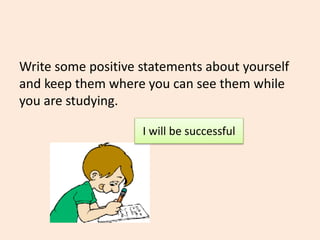
Write some positive statements about yourself
and keep them where you can see them while
you are studying.
I will be successful
Learn to assess your own work.
Passing or failing is not down to luck.
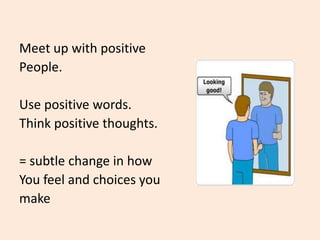
Meet up with positive
People.
Use positive words.
Think positive thoughts.
= subtle change in how
You feel and choices you
make
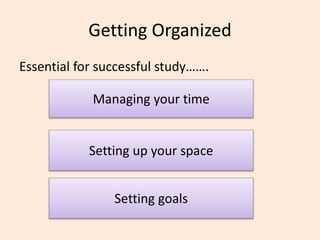
Getting Organized
Essential for successful study…….
Managing your time
Setting up your space
Setting goals
Understanding what motivates you and
managing your stress levels are also important.
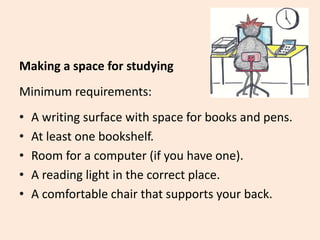
Making a space for studying
Minimum requirements:
• A writing surface with space for books and pens.
• At least one bookshelf.
• Room for a computer (if you have one).
• A reading light in the correct place.
• A comfortable chair that supports your back.
Activity 1
Once you have got the essentials, what else do
you think is important?
In pairs, make a list of items that would help to
make your studying more effective.
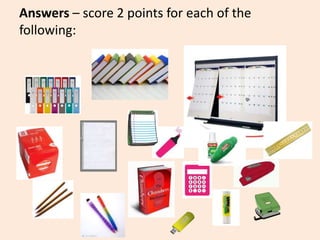
Answers – score 2 points for each of the
following:
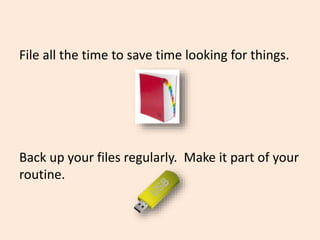
File all the time to save time looking for things.
Back up your files regularly. Make it part of your
routine.
Review your progress regularly.
Don’t put your studying off.
Do the things that relax you and keep fit.
Managing time for studying
Some people find time to do far more than
others – good time management.
Activity 2
Carry out a test to see if you are good at
managing your time.
Ways to improve how you manage your time:
- Do not procrastinate.
- Set achievable goals.
- Keep track of your time.
- Stay focused.
- Get organized.
- Plan to succeed.
Homework task
Time Audit
• Write down everything you do for a week. Add
up all the time you spend on regular tasks such as
sleeping, travelling, working, eating, etc.
• Subtract these chunks of time from the 168 hours
per week.
• How much time do you spend on non essential
things?
• Get a large day-to-a-page diary or make yourself
a 24 hour planner on the PC.
• Put in all commitments on it – include work,
exercise, sleep, family duties and a little ‘slack’.
• Look at the times you have left. Can you create
more time. (in the morning or evening).
• Now write in all your assignment deadlines and
exam dates and plan in all the extra time you will
need to spend on your studying.
• Write in all your studying appointments!
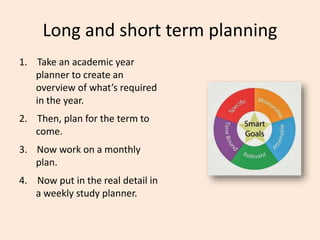
Long and short term planning
1. Take an academic year
planner to create an
overview of what’s required
in the year.
2. Then, plan for the term to
come.
3. Now work on a monthly
plan.
4. Now put in the real detail in
a weekly study planner.
Use your diary to record each time you succeed
in following your ‘new habit’. After 3 to 4 weeks
of consecutively completing your diary, it will
become a HABIT.
The 80 : 20 Rule
20 % = Productive work
80 % = unnecessary, unproductive and lower
priority work
Find your ‘80 %’ and cut out as much of this
work as you can.
Introduce changes
gradually
Make good use of lists – help you not
to forget things and can be motivating
when you cross things off your list.
Tips
• Never rewrite your notes.
• Focus. Don’t spend too much time on relatively simple
or short assignments.
• Be brief – Your notes should not be a word-for-word
repetition of your lecturer or a book.
• Use key words and phrases – not full sentences.
• Be tidy – file away notes as soon as you have written
them.
• Make filing easier. Use a separate piece of paper for
every topic so you can file them in a logical order.
Activity 3
What’s your learning
Style?
Carry out the test.

Getting started - Study Skills

  • 1.
  • 2.
    Many students failto do as well as they could because of a lack of STUDY SKILLS
  • 3.
    STUDY SKILLS canbe learned. They include: Note taking Reading Skills Writing essays Planning Revising for exams Sitting exams
  • 4.
    Study smarter notharder or longer.
  • 5.
    Confidence is alsovery important. Can you visualise your success…….
  • 6.
    Write some positivestatements about yourself and keep them where you can see them while you are studying. I will be successful
  • 7.
    Learn to assessyour own work. Passing or failing is not down to luck.
  • 8.
    Meet up withpositive People. Use positive words. Think positive thoughts. = subtle change in how You feel and choices you make
  • 9.
    Getting Organized Essential forsuccessful study……. Managing your time Setting up your space Setting goals
  • 10.
    Understanding what motivatesyou and managing your stress levels are also important.
  • 11.
    Making a spacefor studying Minimum requirements: • A writing surface with space for books and pens. • At least one bookshelf. • Room for a computer (if you have one). • A reading light in the correct place. • A comfortable chair that supports your back.
  • 12.
    Activity 1 Once youhave got the essentials, what else do you think is important? In pairs, make a list of items that would help to make your studying more effective.
  • 13.
    Answers – score2 points for each of the following:
  • 14.
    File all thetime to save time looking for things. Back up your files regularly. Make it part of your routine.
  • 15.
    Review your progressregularly. Don’t put your studying off. Do the things that relax you and keep fit.
  • 16.
    Managing time forstudying Some people find time to do far more than others – good time management. Activity 2 Carry out a test to see if you are good at managing your time.
  • 17.
    Ways to improvehow you manage your time: - Do not procrastinate. - Set achievable goals. - Keep track of your time. - Stay focused. - Get organized. - Plan to succeed.
  • 18.
    Homework task Time Audit •Write down everything you do for a week. Add up all the time you spend on regular tasks such as sleeping, travelling, working, eating, etc. • Subtract these chunks of time from the 168 hours per week. • How much time do you spend on non essential things?
  • 19.
    • Get alarge day-to-a-page diary or make yourself a 24 hour planner on the PC. • Put in all commitments on it – include work, exercise, sleep, family duties and a little ‘slack’. • Look at the times you have left. Can you create more time. (in the morning or evening). • Now write in all your assignment deadlines and exam dates and plan in all the extra time you will need to spend on your studying. • Write in all your studying appointments!
  • 20.
    Long and shortterm planning 1. Take an academic year planner to create an overview of what’s required in the year. 2. Then, plan for the term to come. 3. Now work on a monthly plan. 4. Now put in the real detail in a weekly study planner.
  • 21.
    Use your diaryto record each time you succeed in following your ‘new habit’. After 3 to 4 weeks of consecutively completing your diary, it will become a HABIT.
  • 22.
    The 80 :20 Rule 20 % = Productive work 80 % = unnecessary, unproductive and lower priority work Find your ‘80 %’ and cut out as much of this work as you can.
  • 23.
    Introduce changes gradually Make gooduse of lists – help you not to forget things and can be motivating when you cross things off your list.
  • 24.
    Tips • Never rewriteyour notes. • Focus. Don’t spend too much time on relatively simple or short assignments. • Be brief – Your notes should not be a word-for-word repetition of your lecturer or a book. • Use key words and phrases – not full sentences. • Be tidy – file away notes as soon as you have written them. • Make filing easier. Use a separate piece of paper for every topic so you can file them in a logical order.
  • 25.
    Activity 3 What’s yourlearning Style? Carry out the test.