Study Skills August 2008 Linsey Irvine
Aims To raise awareness of Study Skills and highlight their importance as a building block of the Learning Process
Objectives To define Study Skills To highlight the importance of Study Skills to both students and staff To identify the 3 major Learning Styles To explore Study Skills resources available at Edinburgh’s Telford College
Definitions Study: ‘ to acquire knowledge and gain competence’ Skill: ‘ a learned and developed activity’ Study Skills : ‘ learned and developed activities which enable learners to acquire knowledge and gain competence’
Benefits to Learners Awareness of ‘learning’ as a skill Improved understanding of subjects Clear understanding of the demands of diverse Learning Tasks  Knowledge of how to improve individual performance Increased self awareness Development of transferable skills Increased confidence  Skillful independent learners
Benefits to Teaching Staff Students become more independent reducing demands on lecturers Students are engaged in their learning Improved performance Improved retention figures Improved SUMS
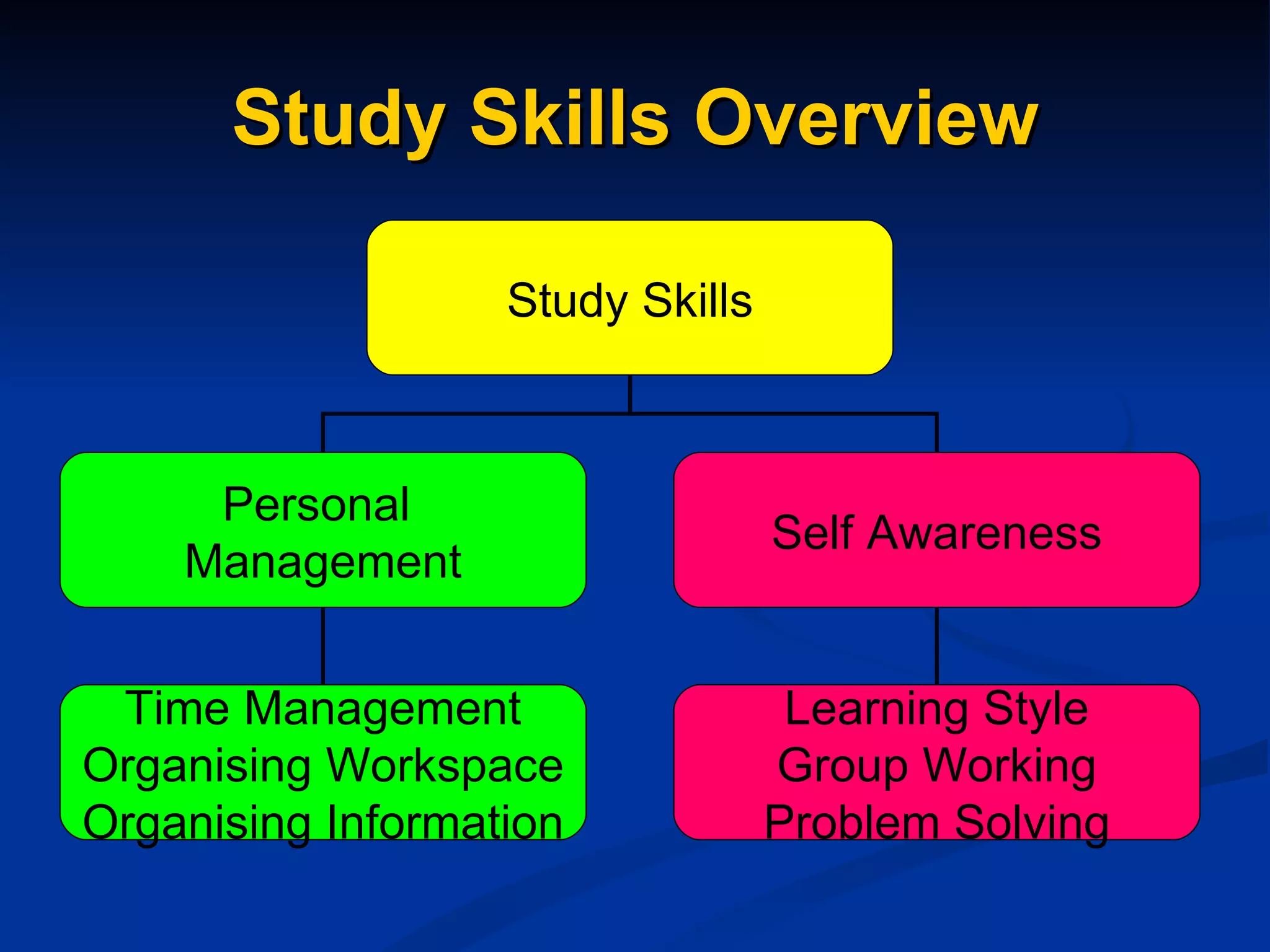
Study Skills Overview Study Skills Personal  Management Self Awareness Time Management Organising Workspace Organising Information Learning Style Group Working Problem Solving
Learning Styles
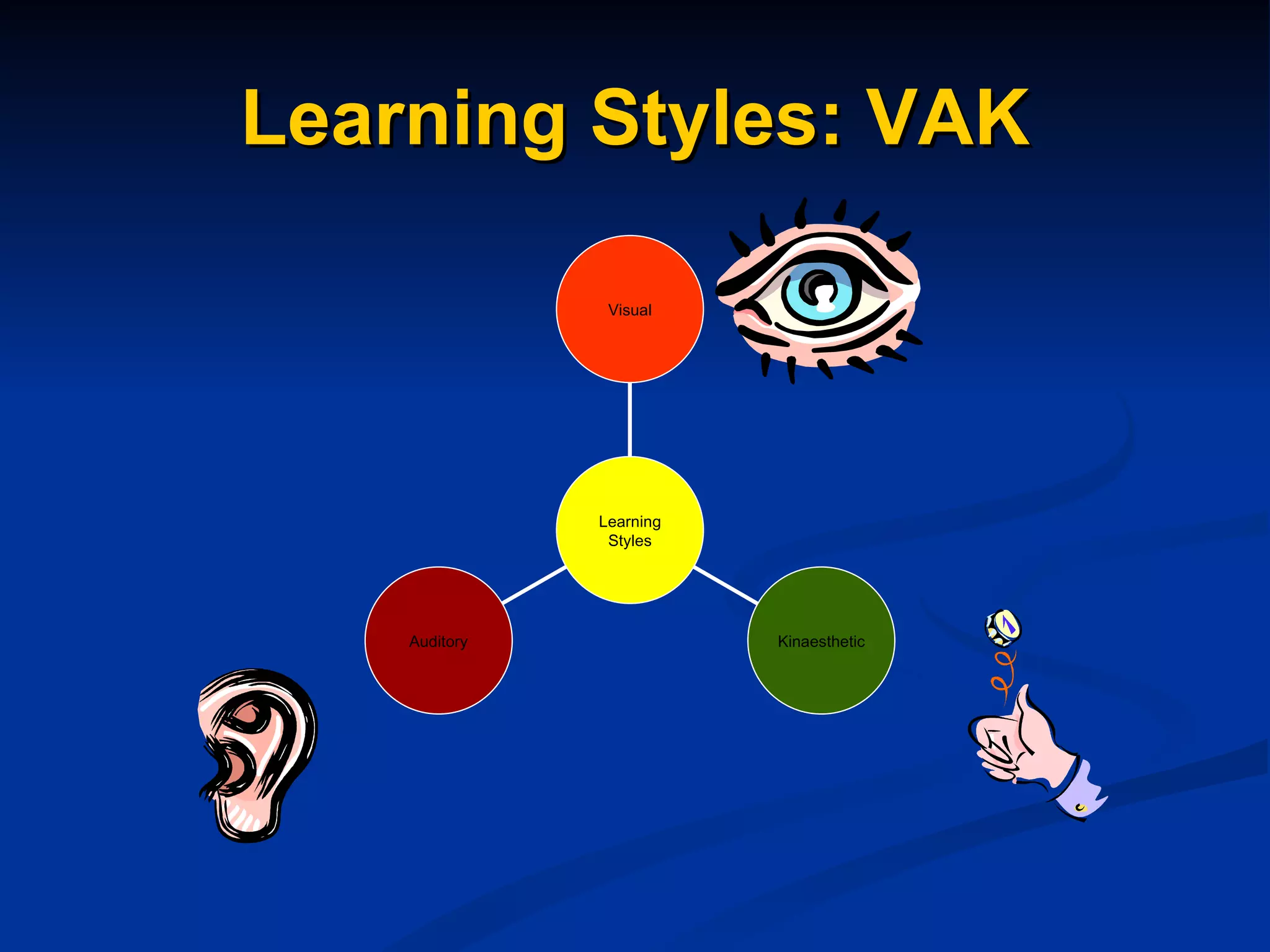
Learning Styles: VAK Auditory Kinaesthetic Visual Learning Styles
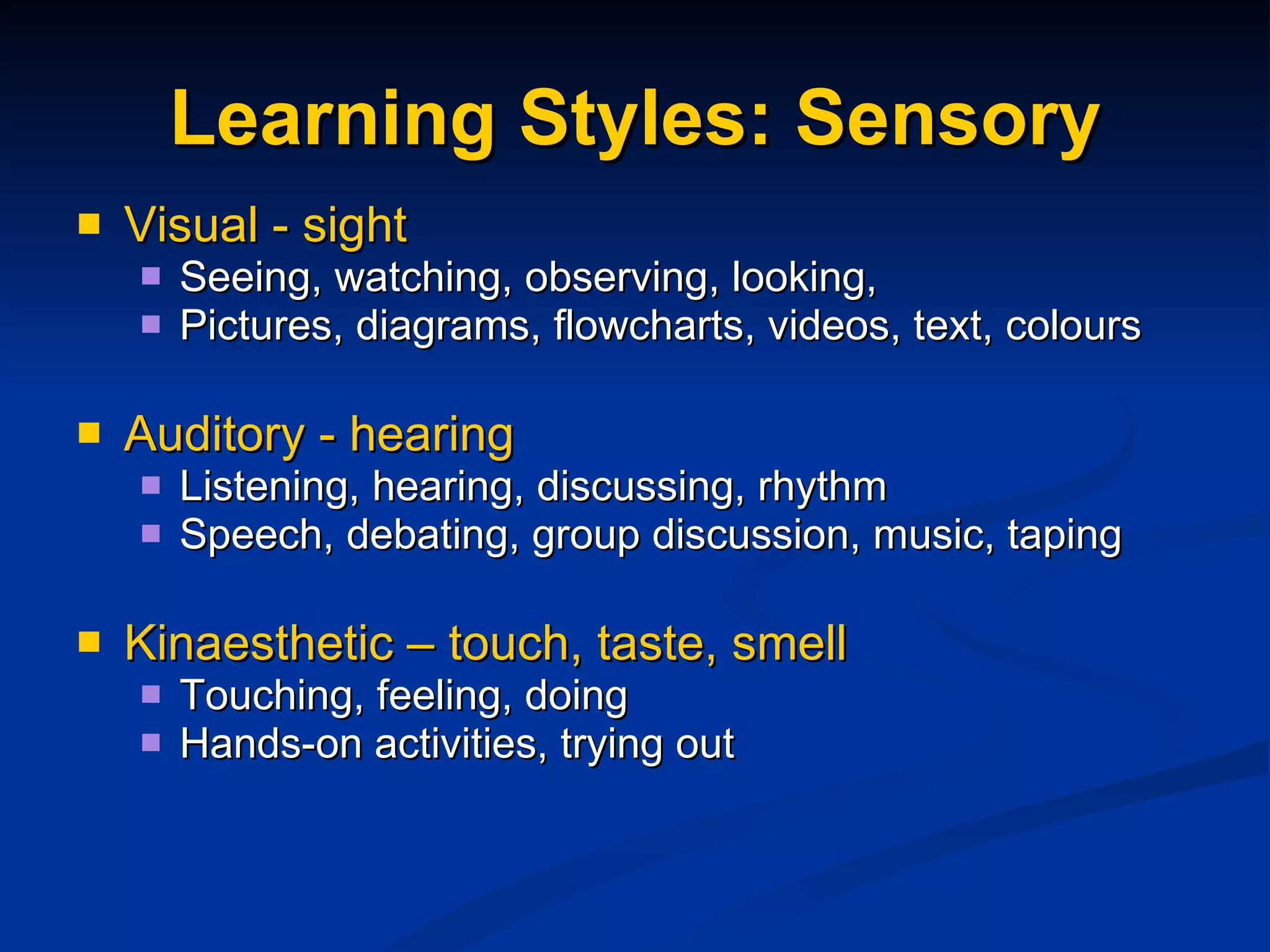
Learning Styles: Sensory Visual - sight Seeing, watching, observing, looking,  Pictures, diagrams, flowcharts, videos, text, colours Auditory - hearing Listening, hearing, discussing, rhythm  Speech, debating, group discussion, music, taping Kinaesthetic – touch, taste, smell Touching, feeling, doing Hands-on activities, trying out
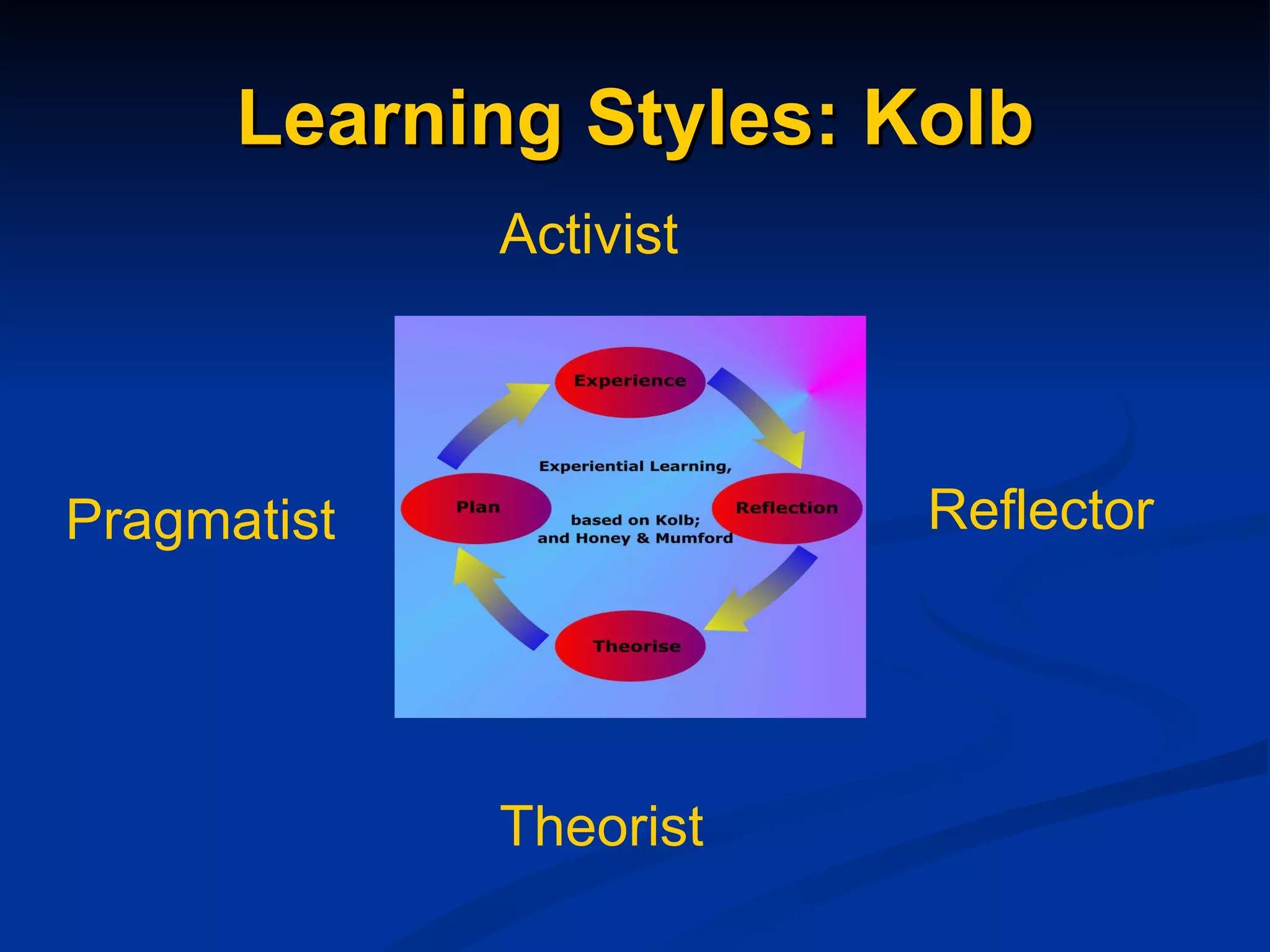
Learning Styles: Kolb Activist Reflector Theorist Pragmatist
Learning Styles: Websites   Barsch Inventory Hyperlink http://ww2.nscc.edu/gerth_d/AAA0000000/barsch_inventory.htm Vark Questionnaire Hyperlink   http://www.vark-learn.com/english/index.asp Kolb Learning Style Hyperlink http://www.brainboxx.co.uk/A2LEARNSTYLES/pages/roughandready.htm
Reading Skills
Reading Skills Set expectations ‘hours/chapters’ per week  Discuss reading materials Indicate recommended reading Active/passive reading  Reading Styles & Techniques Be aware of problems – refer to Learner Support
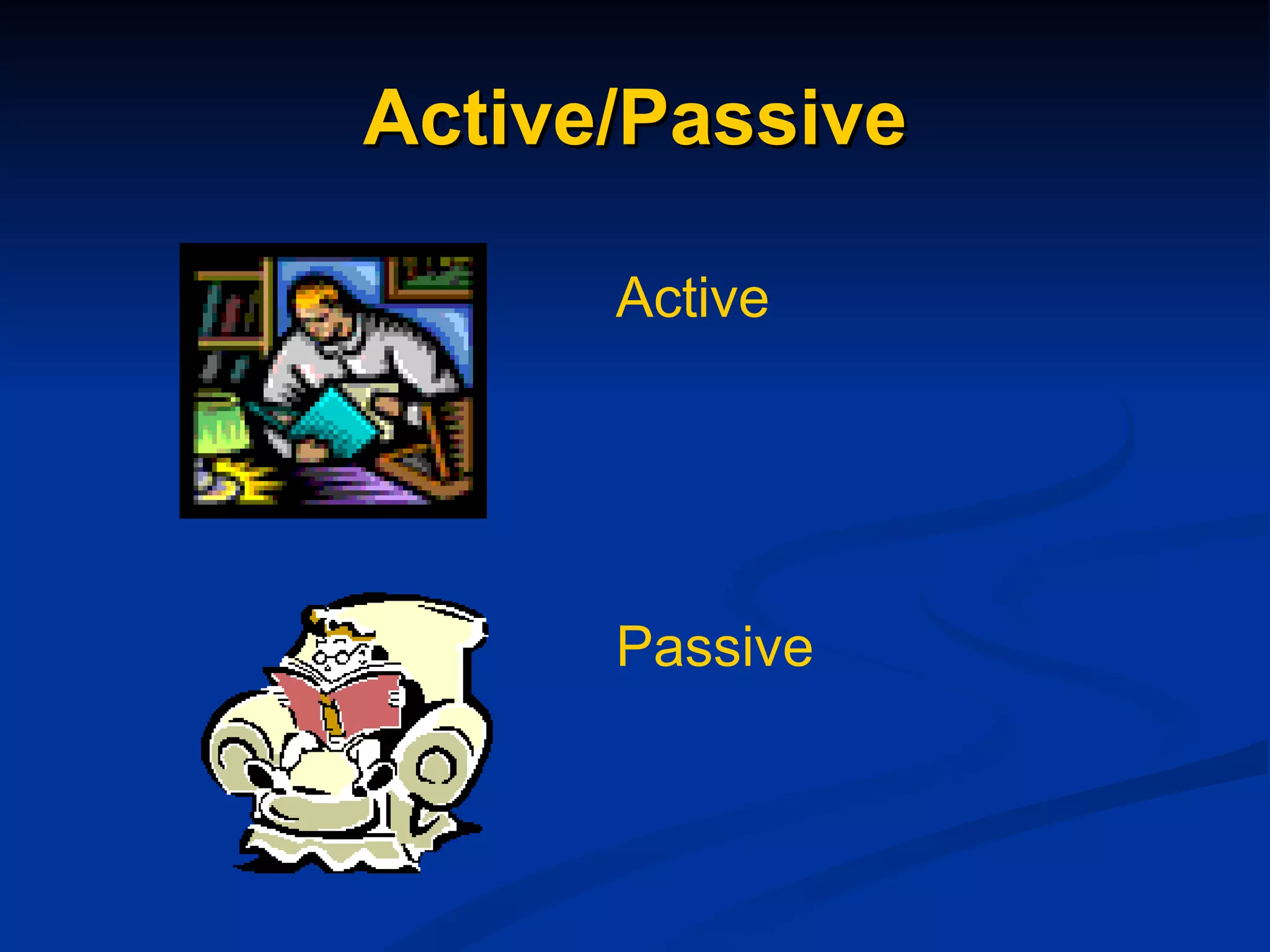
Active/Passive Active Passive
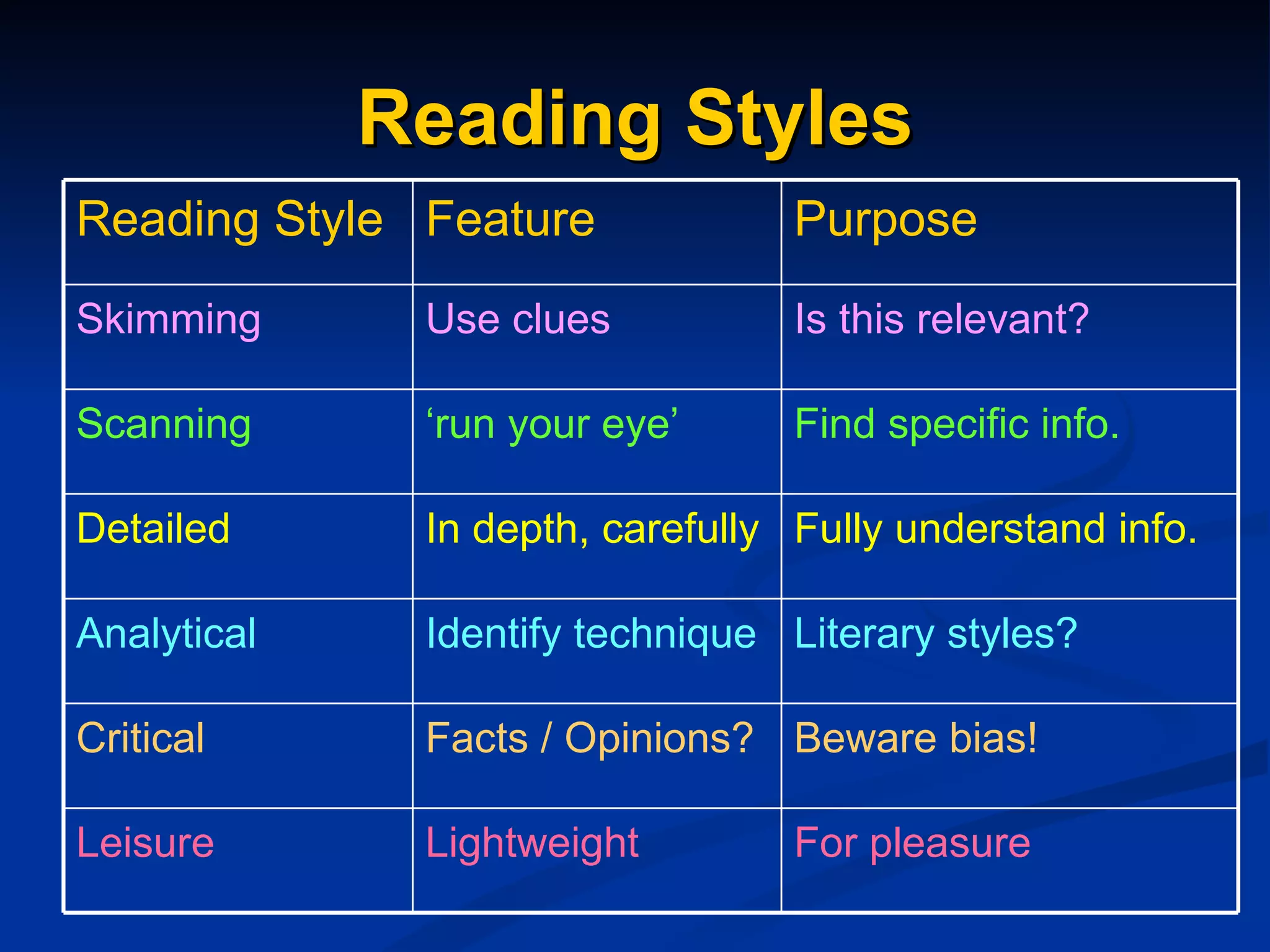
Reading Styles Reading Style Feature Purpose Skimming Use clues Is this relevant? Scanning ‘ run your eye’ Find specific info. Detailed In depth, carefully Fully understand info. Analytical Identify technique Literary styles? Critical Facts / Opinions? Beware bias! Leisure Lightweight For pleasure
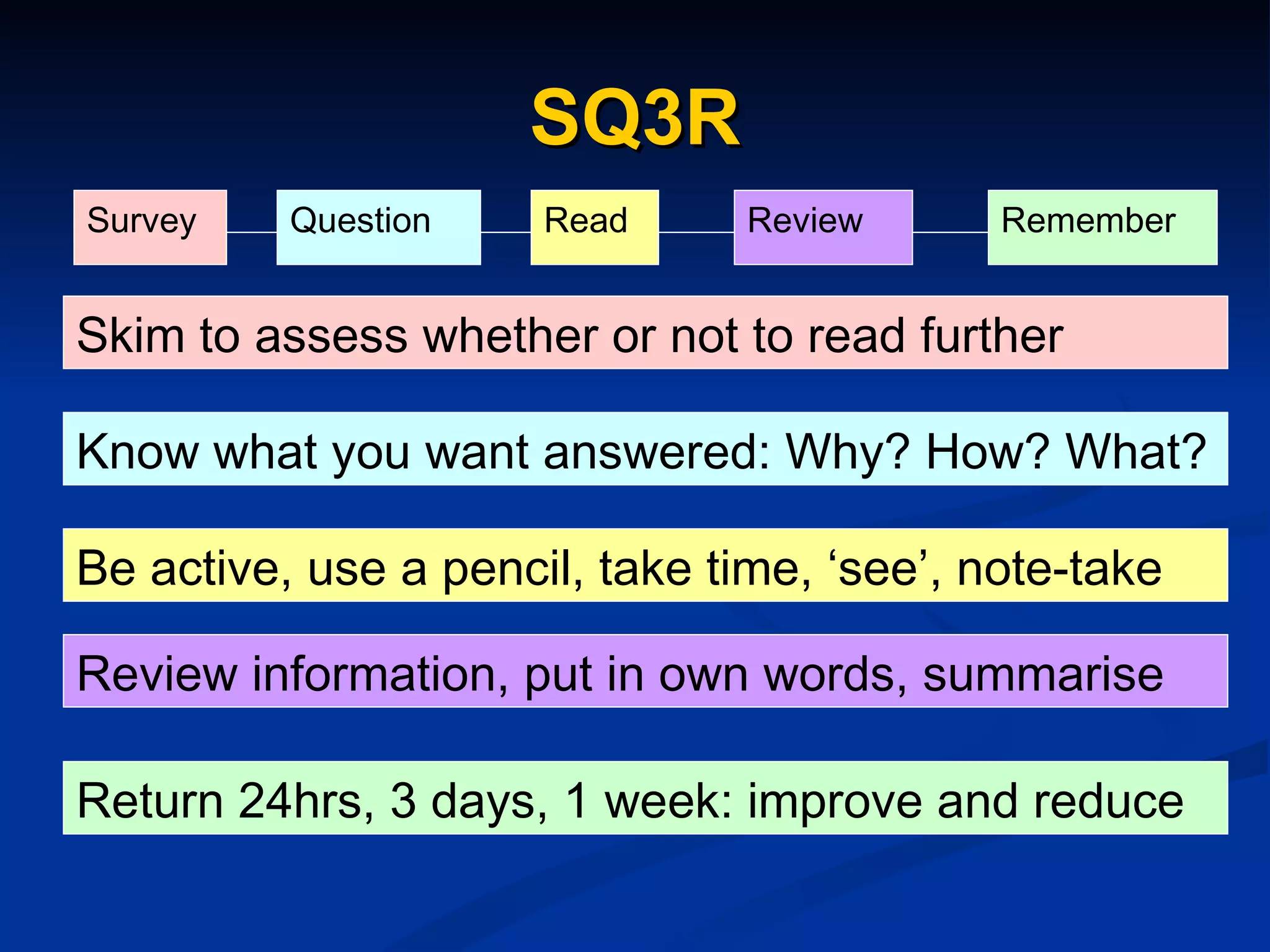
SQ3R Skim to assess whether or not to read further Know what you want answered: Why? How? What? Be active, use a pencil, take time, ‘see’, note-take Review information, put in own words, summarise Return 24hrs, 3 days, 1 week: improve and reduce Survey Question Read Review Remember
Note-Taking Skills
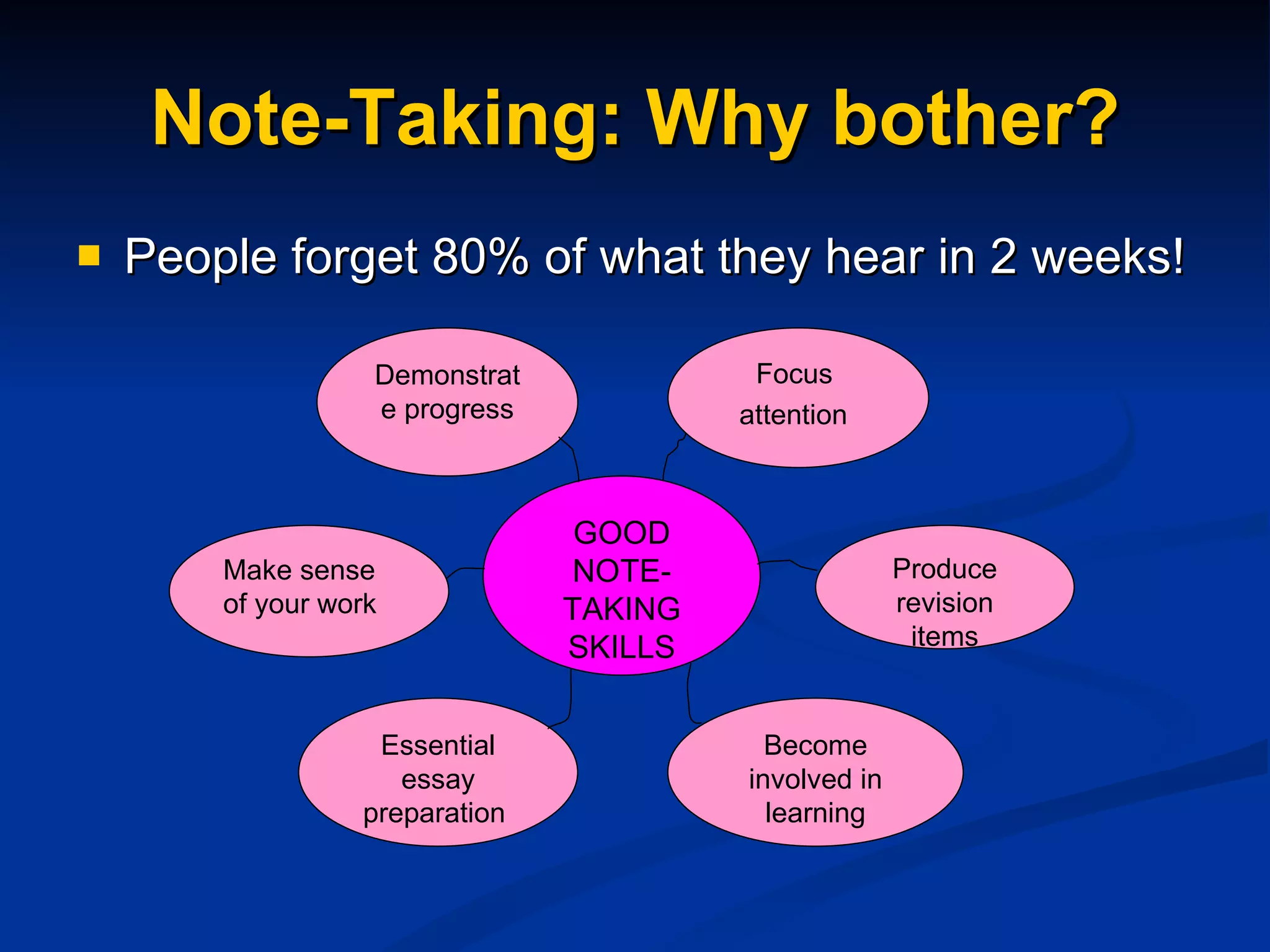
Note-Taking: Why bother? People forget 80% of what they hear in 2 weeks! Become involved in learning Focus  attention   Demonstrate progress Produce revision items Make sense of your work GOOD NOTE-TAKING SKILLS Essential essay preparation
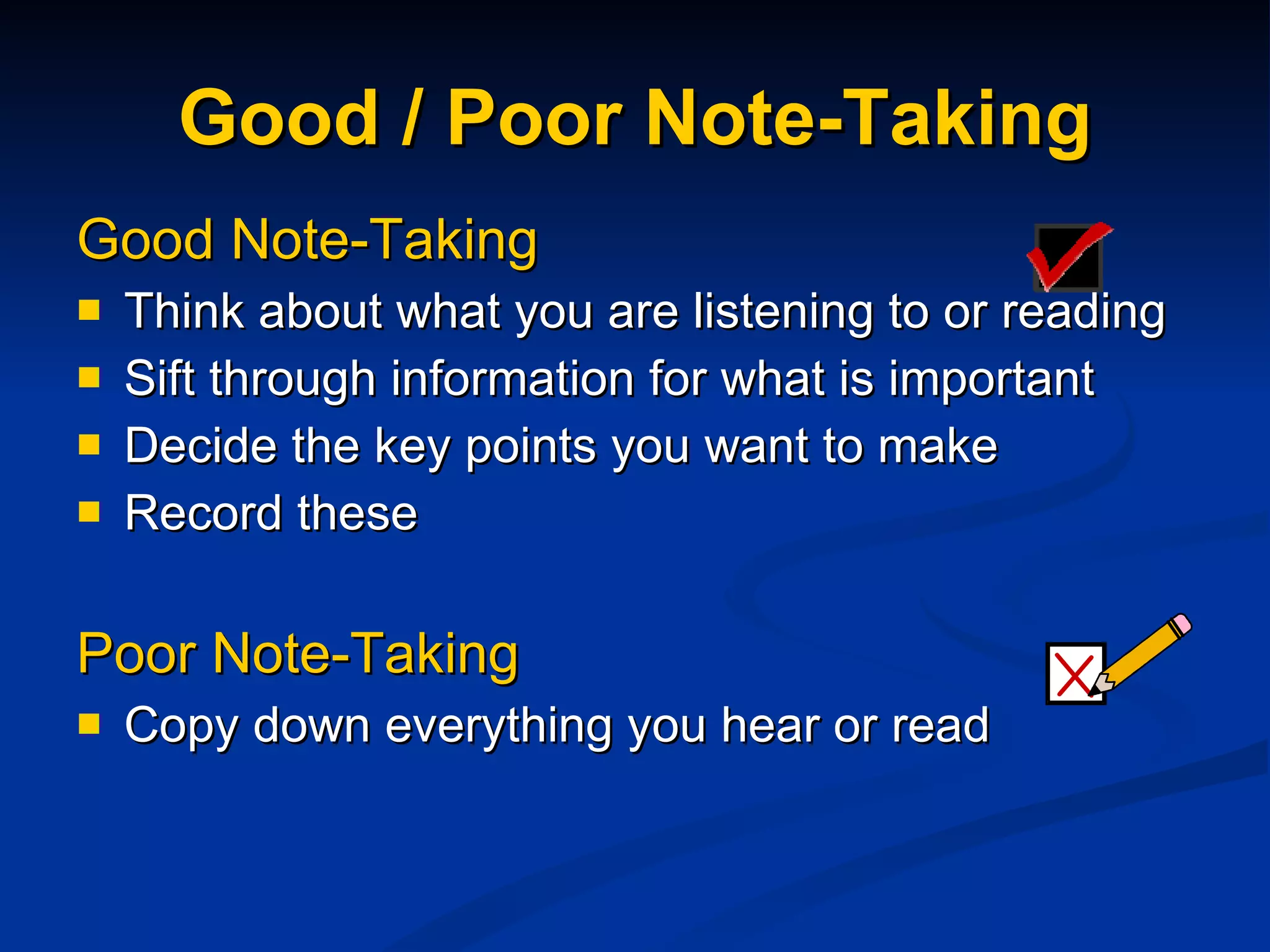
Good / Poor Note-Taking Good Note-Taking Think about what you are listening to or reading Sift through information for what is important Decide the key points you want to make Record these Poor Note-Taking Copy down everything you hear or read
Note-Taking Exemplar Passage entitled ‘Thomas Telford’ Thomas Telford Hyperlink
Note-Taking Styles Highlight Margin Mark Linear Flow chart Spider diagram Mindmap Use a PC Page fold
Essay Writing
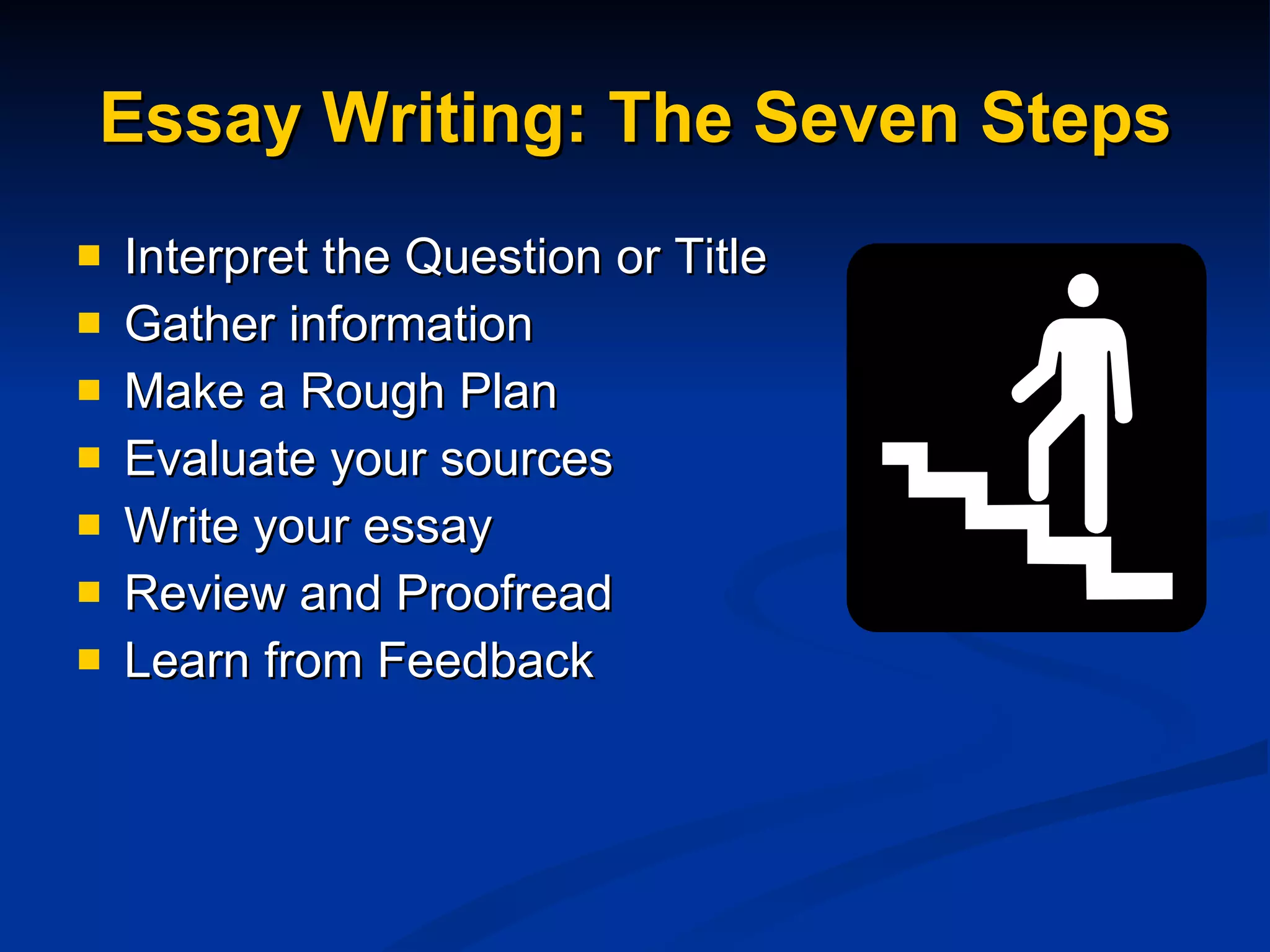
Essay Writing: The Seven Steps Interpret the Question or Title Gather information Make a Rough Plan Evaluate your sources Write your essay Review and Proofread Learn from Feedback
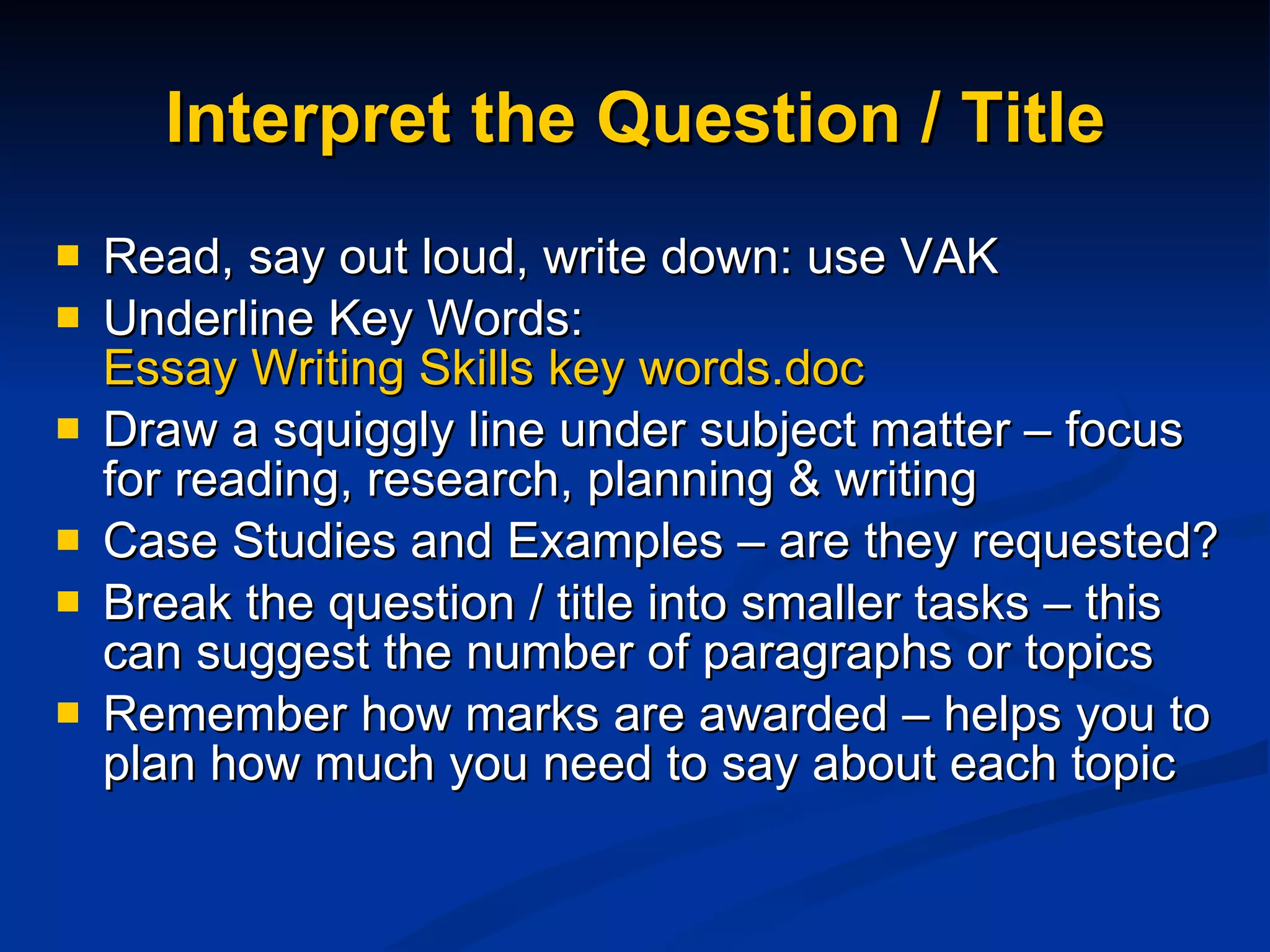
Interpret the Question / Title Read, say out loud, write down: use VAK Underline Key Words:  Essay Writing Skills key words.doc Draw a squiggly line under subject matter – focus for reading, research, planning & writing  Case Studies and Examples – are they requested? Break the question / title into smaller tasks – this can suggest the number of paragraphs or topics Remember how marks are awarded – helps you to plan how much you need to say about each topic
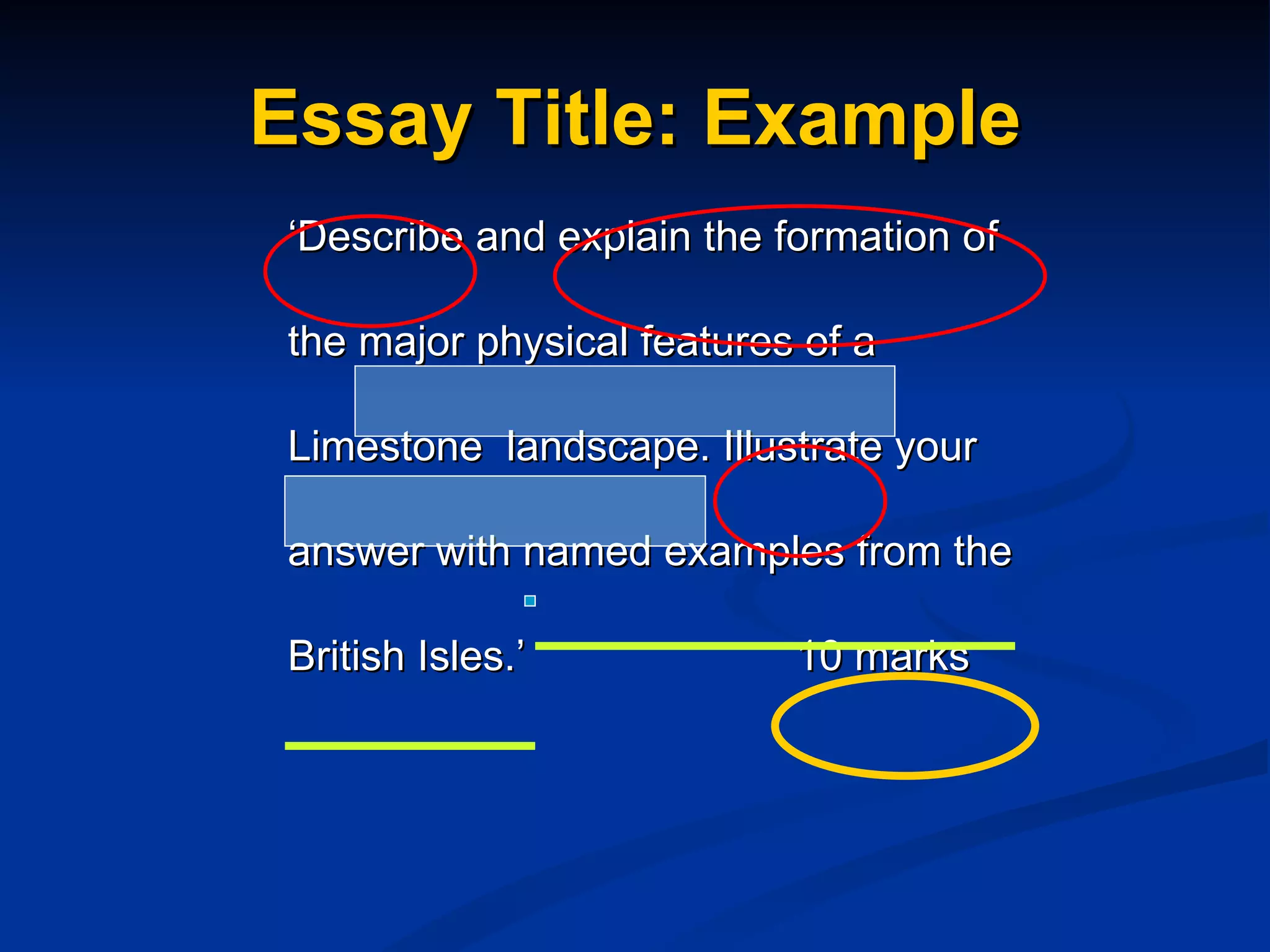
Essay Title: Example ‘ Describe and explain the formation of  the major physical features of a  Limestone  landscape. Illustrate your  answer with named examples from the British Isles.’ 10 marks
Essay Title: Example Essay Writing Skills title.doc
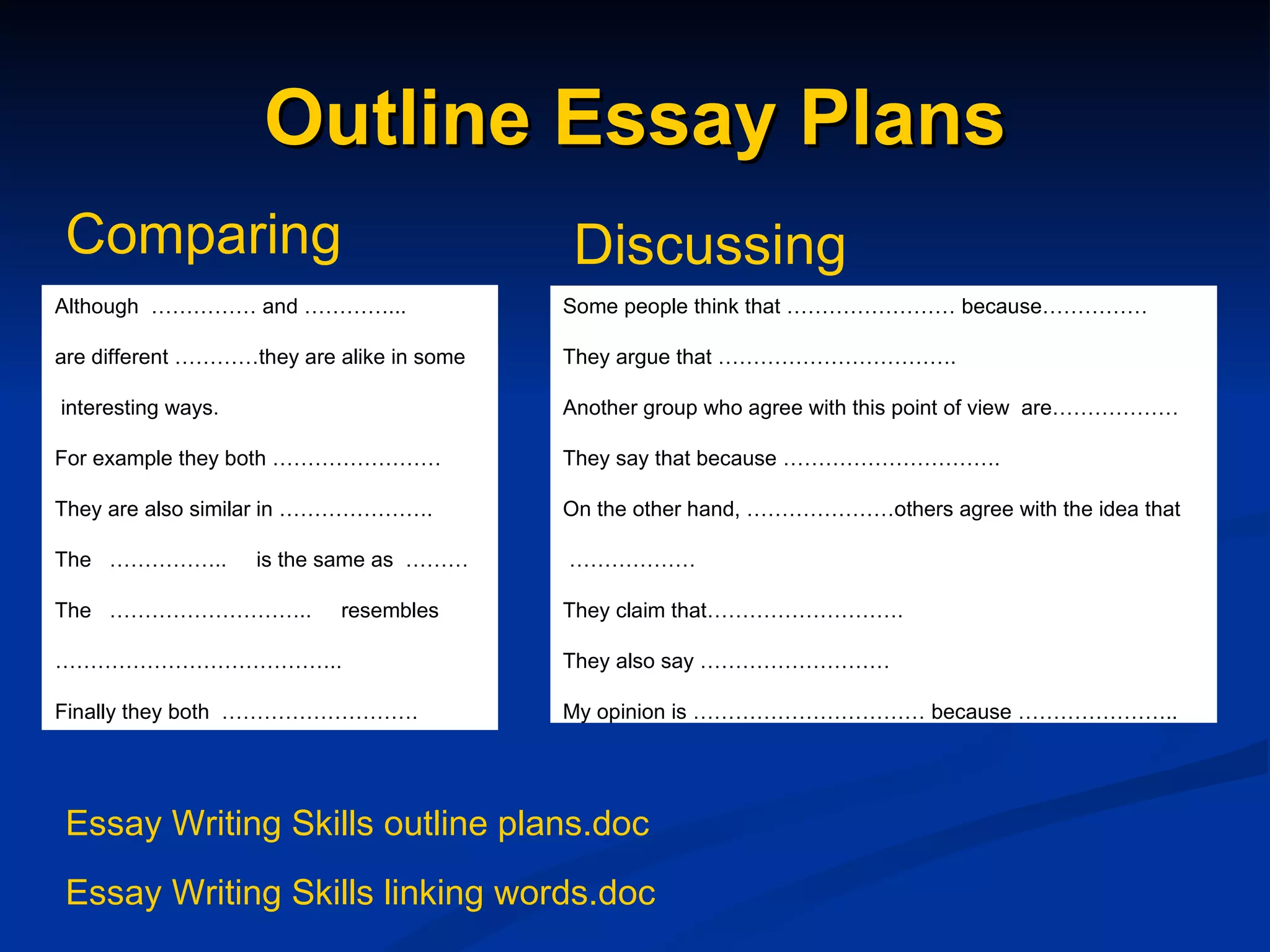
Outline Essay Plans Although  …………… and …………...   are different …………they are alike in some   interesting ways.  For example they both ……………………   They are also similar in ………………….   The  ……………..  is the same as  ………   The  ………………………..  resembles  ………………………………… ..   Finally they both  ……………………….   Some people think that …………………… because……………    They argue that …………………………….   Another group who agree with this point of view  are………………   They say that because ………………………….   On the other hand, …………………others agree with the idea that   ………………   They claim that……………………….   They also say ………………………   My opinion is …………………………… because …………………..   Comparing Discussing Essay Writing Skills outline plans.doc Essay Writing Skills linking words.doc
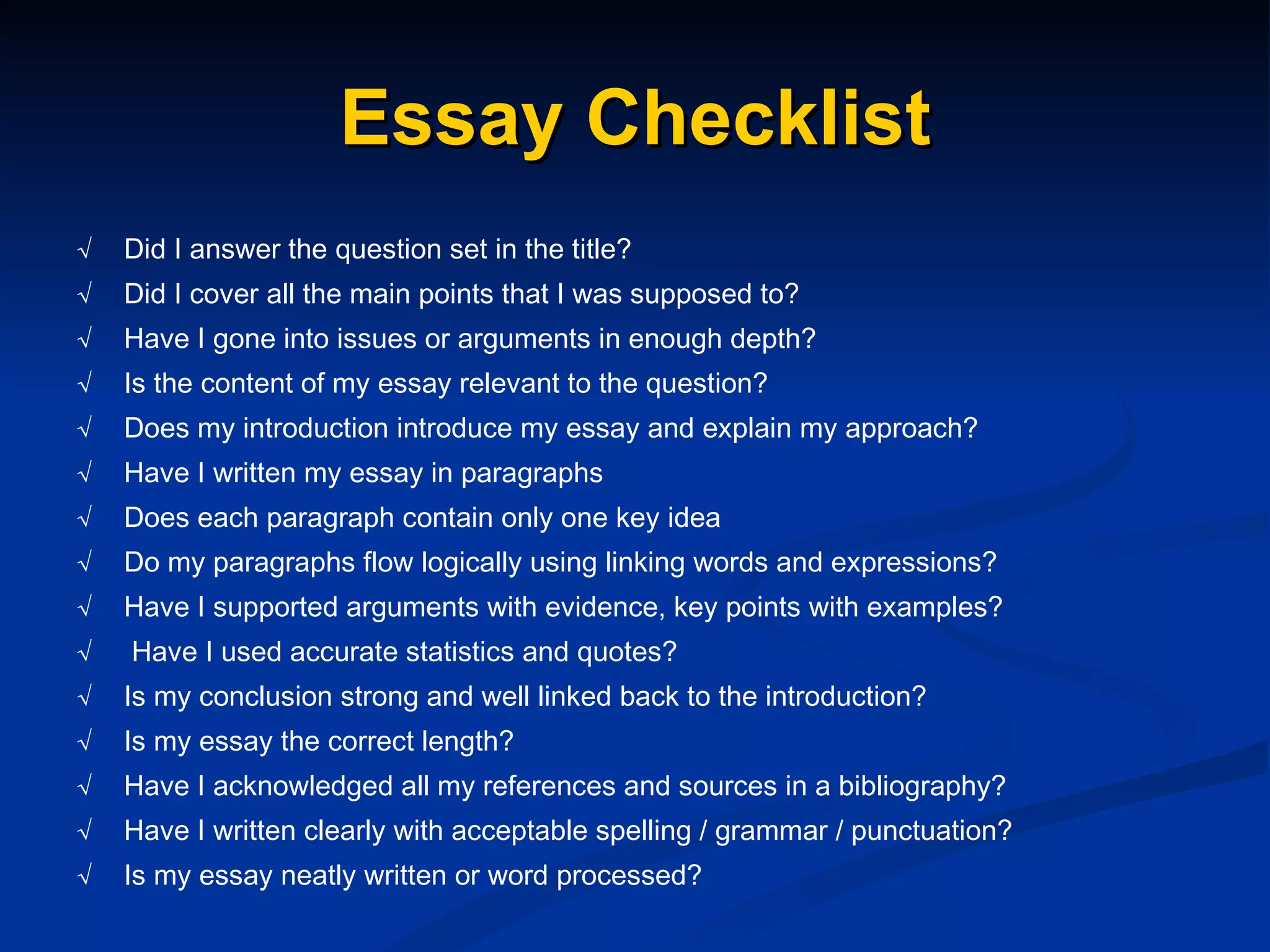
Essay Checklist √   Did I answer the question set in the title? √   Did I cover all the main points that I was supposed to? √   Have I gone into issues or arguments in enough depth? √   Is the content of my essay relevant to the question? √   Does my introduction introduce my essay and explain my approach? √   Have I written my essay in paragraphs √   Does each paragraph contain only one key idea √   Do my paragraphs flow logically using linking words and expressions? √ Have I supported arguments with evidence, key points with examples? √   Have I used accurate statistics and quotes? √   Is my conclusion strong and well linked back to the introduction? √   Is my essay the correct length? √   Have I acknowledged all my references and sources in a bibliography? √   Have I written clearly with acceptable spelling / grammar / punctuation? √   Is my essay neatly written or word processed?
Memory Skills
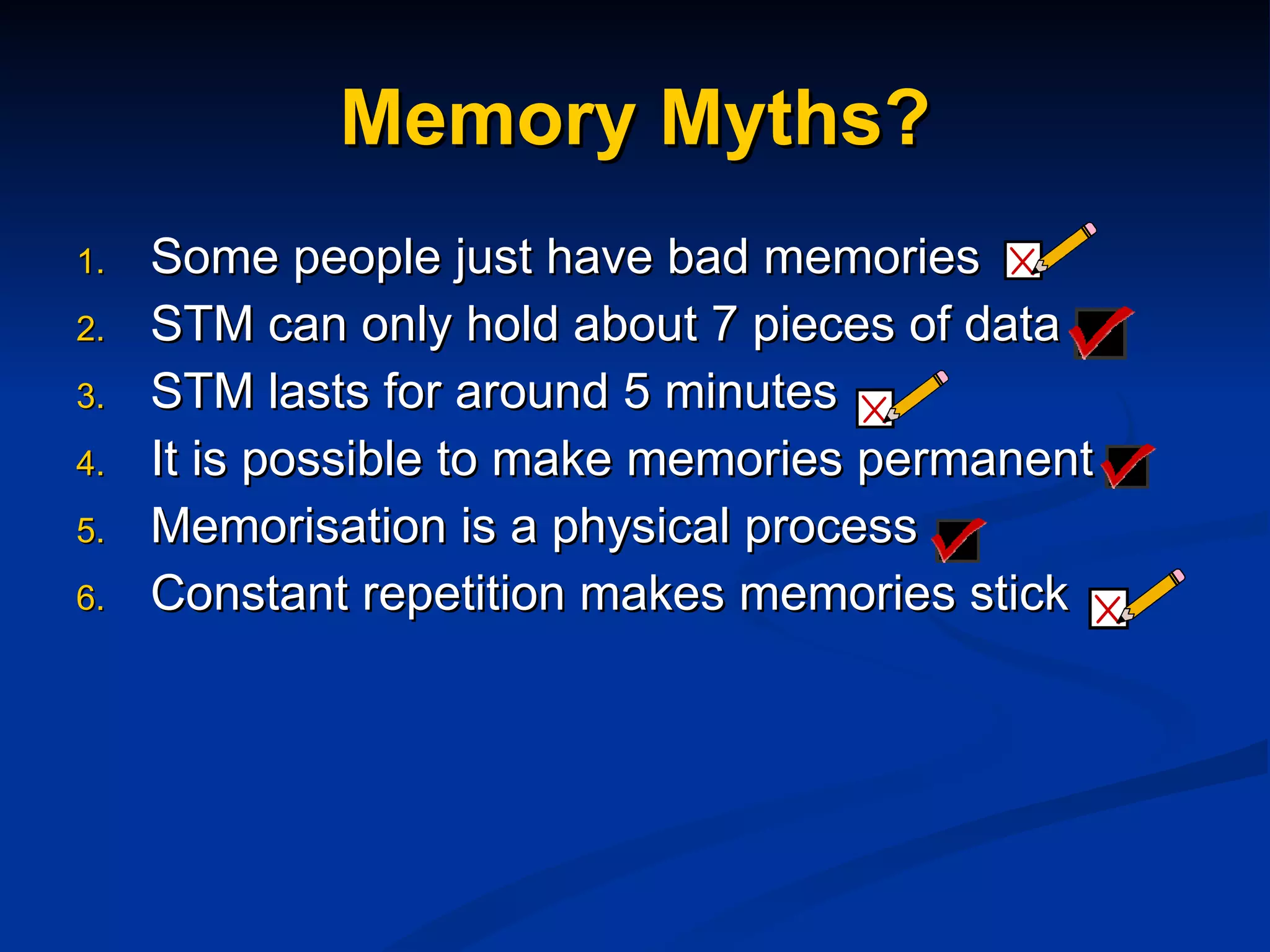
Memory Myths? Some people just have bad memories STM can only hold about 7 pieces of data STM lasts for around 5 minutes It is possible to make memories permanent Memorisation is a physical process Constant repetition makes memories stick
Feeling Fruity? Lemon Kiwi Apple Banana Melon Pineapple Orange Satsuma Cherry
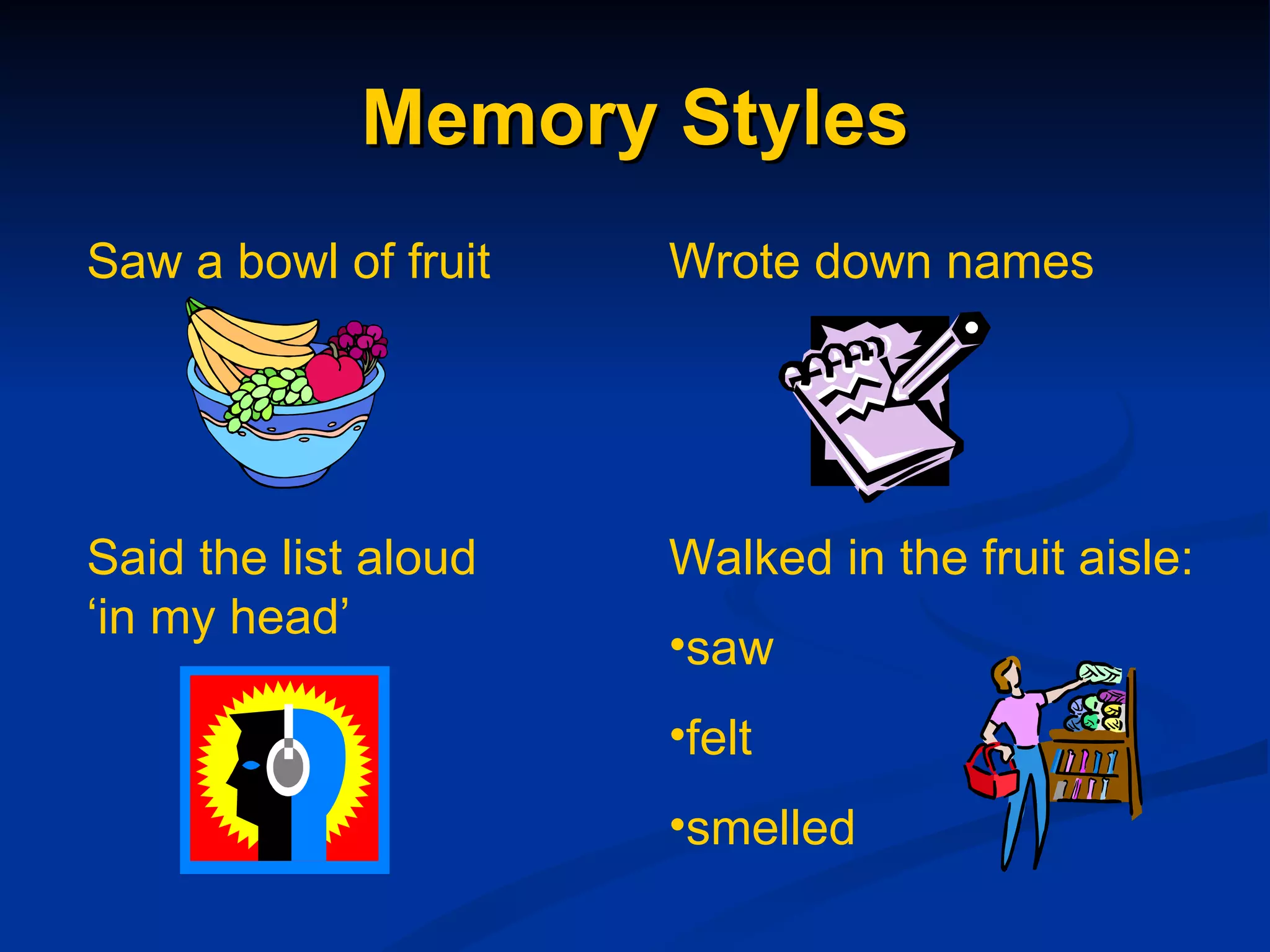
Memory Styles Saw a bowl of fruit Wrote down names Said the list aloud ‘in my head’ Walked in the fruit aisle: saw felt smelled
Effective Strategies to Memorise Information Strategy : Chunking Information Chunking Exercise a watch or a clock – this must have a ‘second’ hand a pen  some paper  Task 1 Task will last 30 seconds
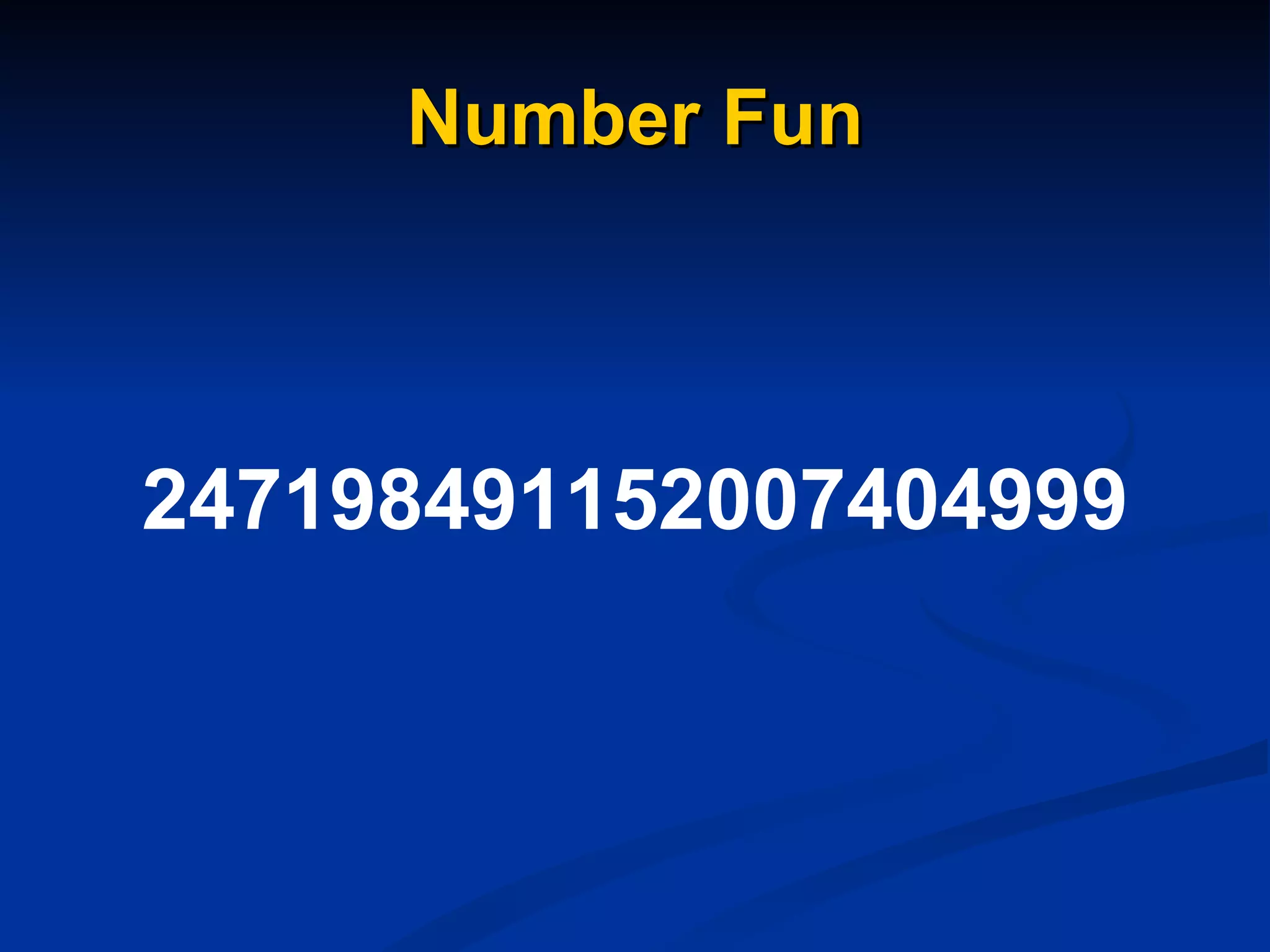
Number Fun 247198491152007404999
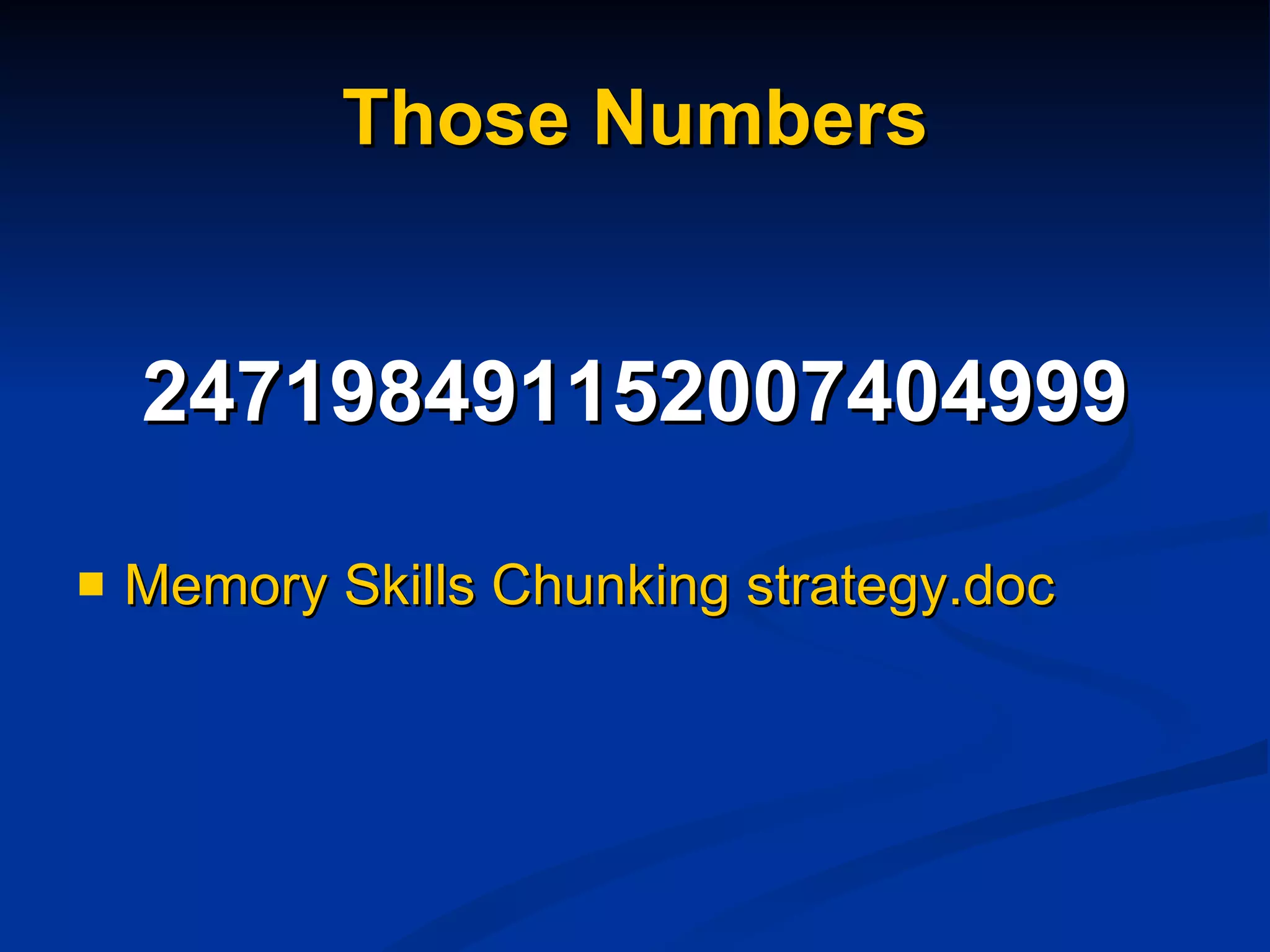
Those Numbers 247198491152007404999 Memory Skills Chunking strategy.doc
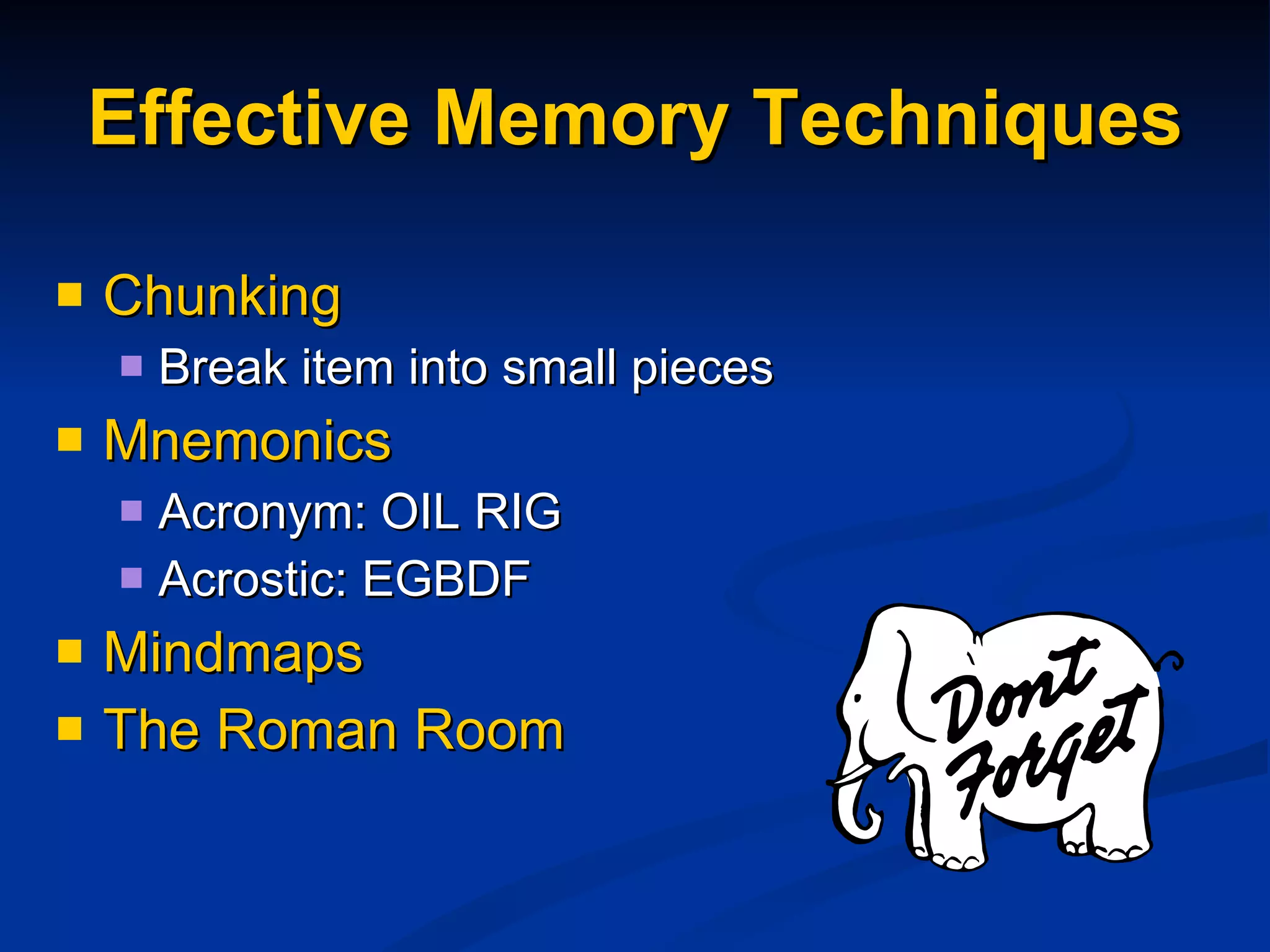
Effective Memory Techniques Chunking Break item into small pieces Mnemonics Acronym: OIL RIG Acrostic: EGBDF Mindmaps The Roman Room
Effective Memory Techniques The Roman Room memory skills Roman Room.doc
Mindmapping Skills
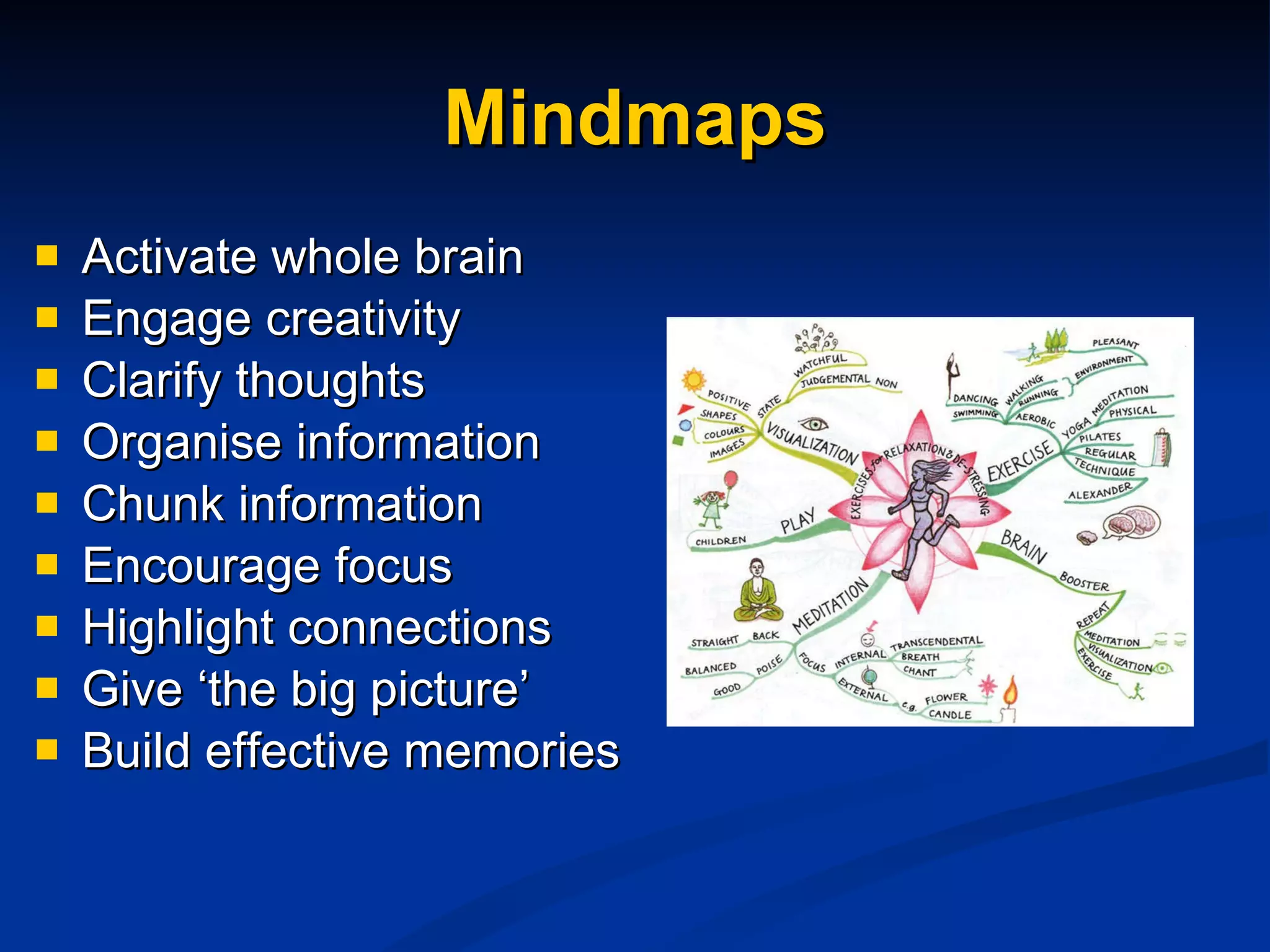
Mindmaps Activate whole brain Engage creativity Clarify thoughts Organise information Chunk information Encourage focus Highlight connections Give ‘the big picture’ Build effective memories
Tony Buzan http://www.youtube.com/user/iMindMap
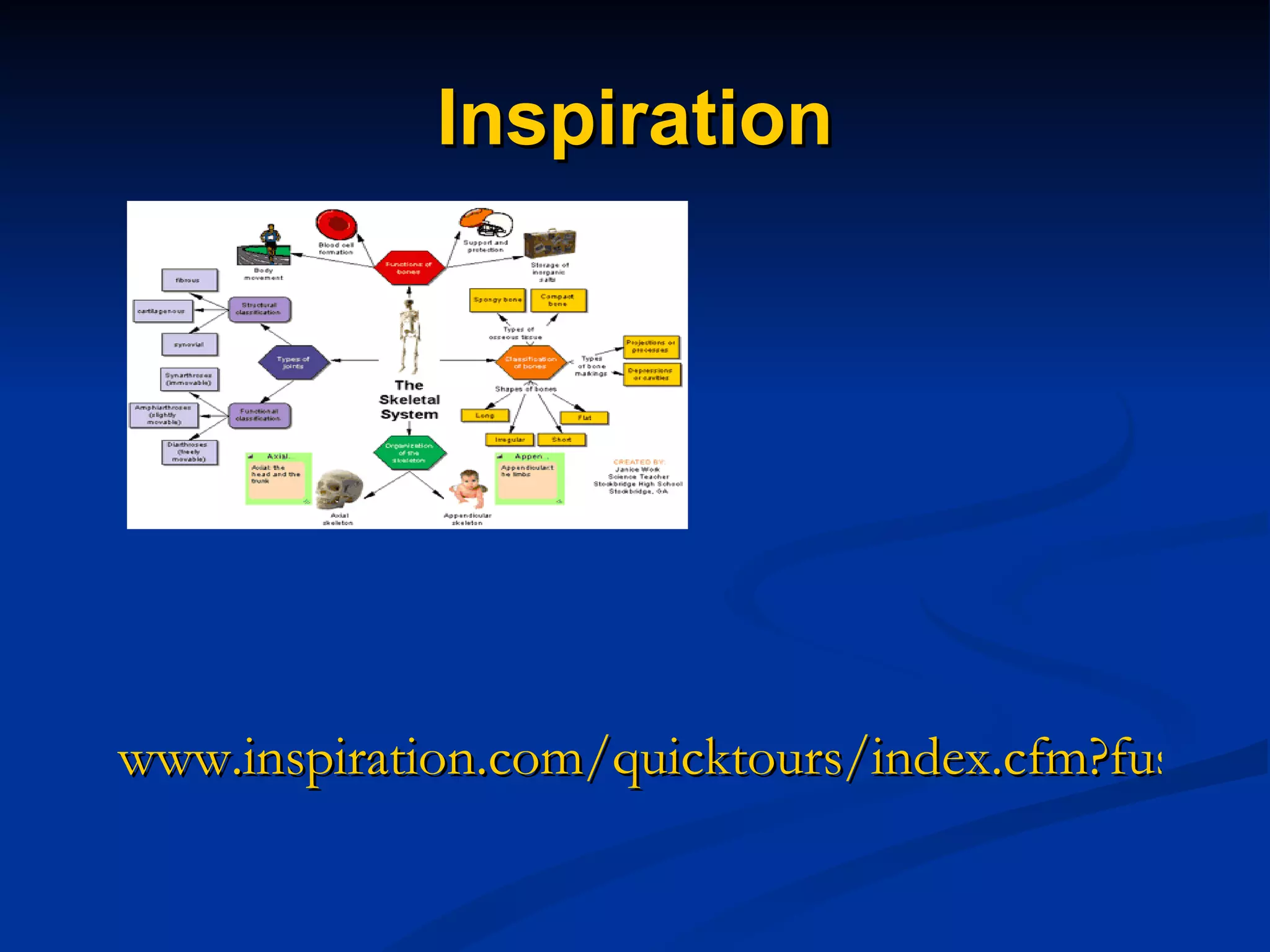
Inspiration www.inspiration.com/quicktours/index.cfm?fuseaction=Insp_Quicktour_QT
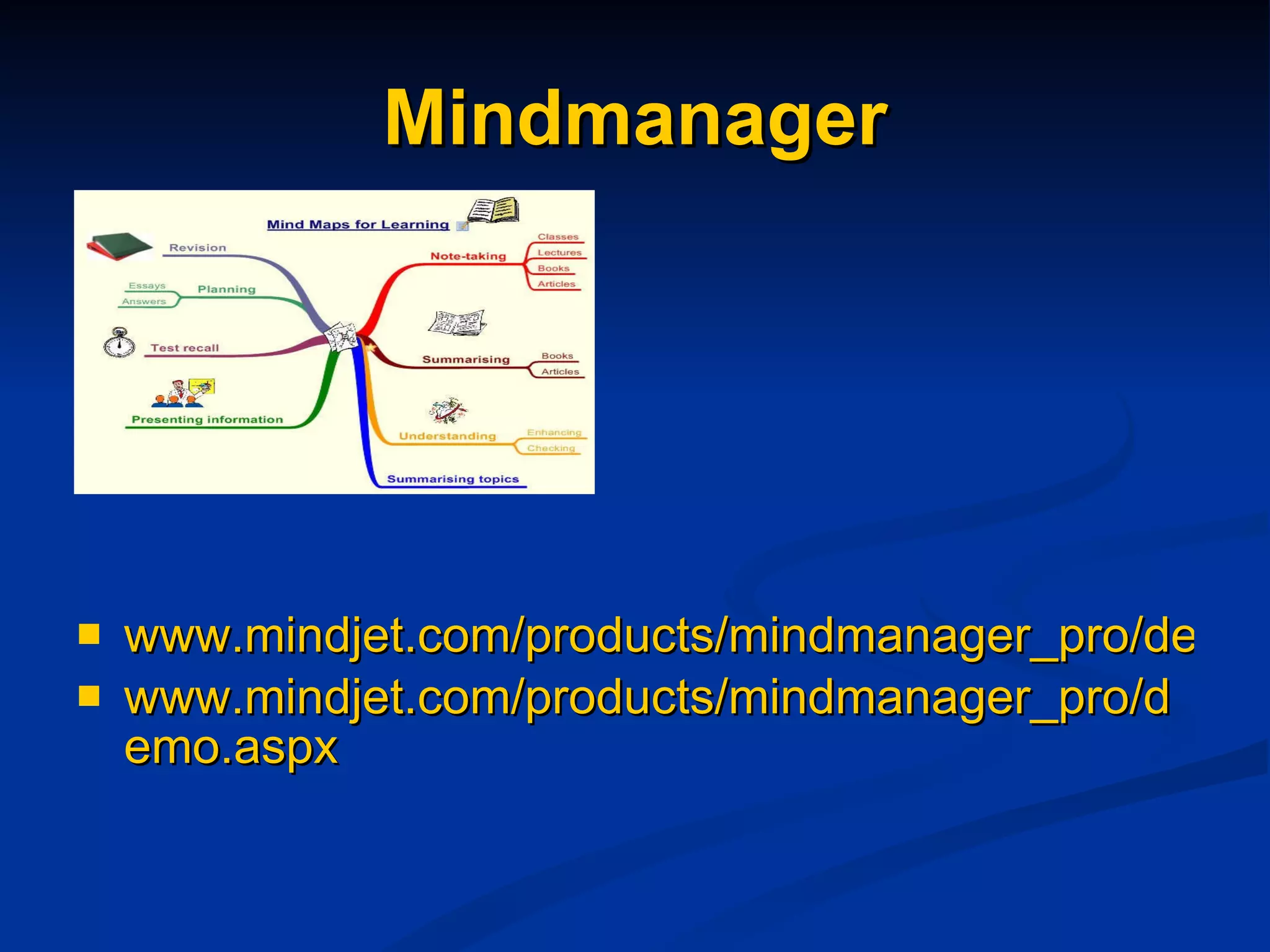
Mindmanager www.mindjet.com/products/mindmanager_pro/demo.aspx www.mindjet.com/products/mindmanager_pro/demo.aspx
Time Management Skills Where does the time go? Planning – use Outlook Calendar Weekly Monthly Whole session Prioritising workload Find a place to work Get equipped for learning Organising course materials
Printing a blank calendar using Outlook On the  File  menu, point to  New , and then click  Folder .  Type a name for the folder.  In the  Folder contains  list, click  Calendar Items .  In the  Select where to place the folder  list, click  Calendar , and then click  OK .  On the  Go  menu, click  Folder List .  In the  Folder List , click the new folder you just created.  On the  File  menu, point to  Page setup , and then click the print style you want.  Select the print style options you want, and then click  Print .
Presentation Skills Planning Preparing Practising Performing Do’s and Don’ts  Top tips on technology
Report Writing Skills What is a Report? The Structure of a Report Ten Steps to Report Writing How to present data How to analyse results How to interpret results
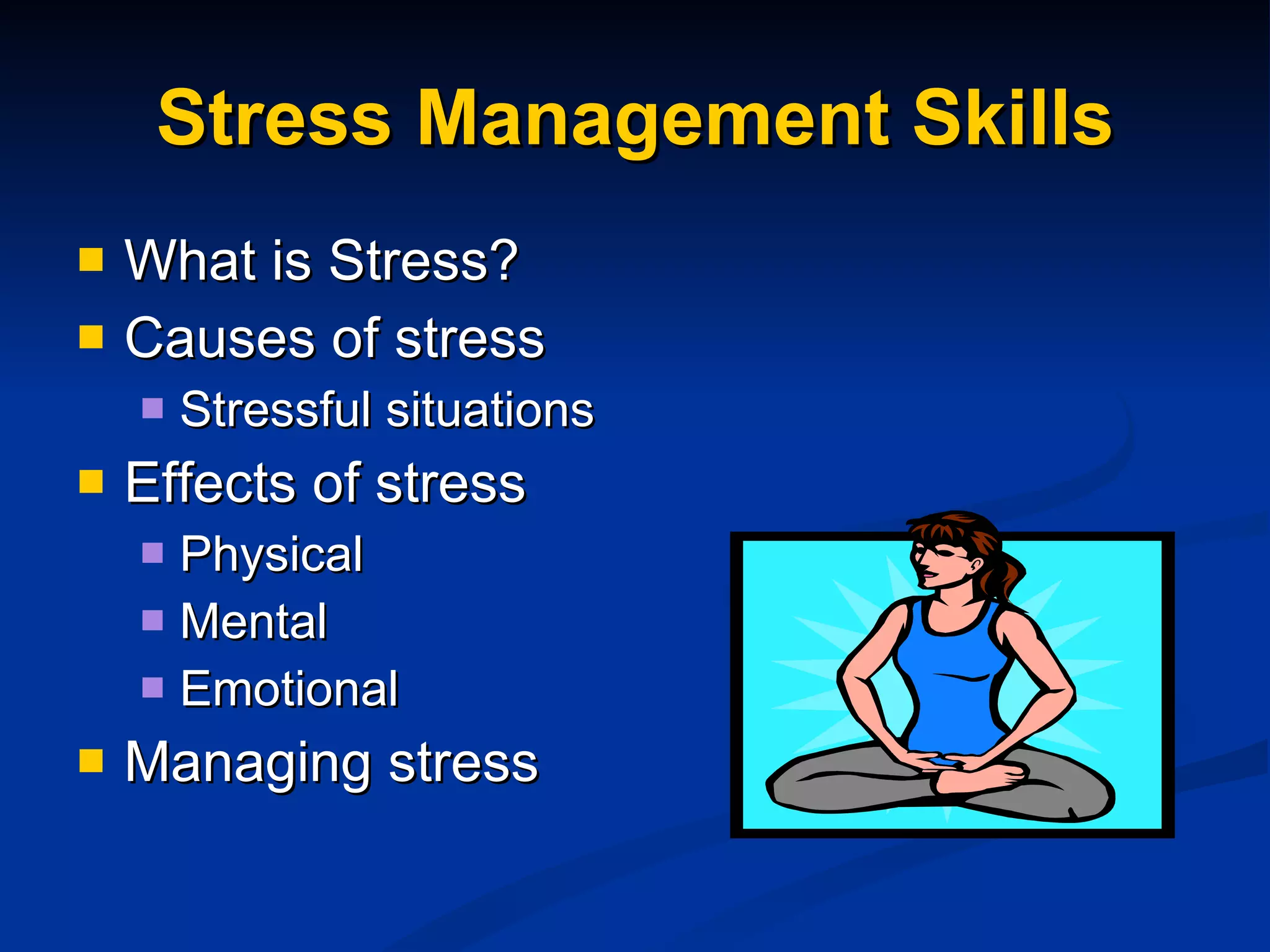
Stress Management Skills What is Stress? Causes of stress Stressful situations Effects of stress Physical Mental Emotional Managing stress

Study Skills Cp F Eb 2010

  • 1.
    Study Skills August2008 Linsey Irvine
  • 2.
    Aims To raiseawareness of Study Skills and highlight their importance as a building block of the Learning Process
  • 3.
    Objectives To defineStudy Skills To highlight the importance of Study Skills to both students and staff To identify the 3 major Learning Styles To explore Study Skills resources available at Edinburgh’s Telford College
  • 4.
    Definitions Study: ‘to acquire knowledge and gain competence’ Skill: ‘ a learned and developed activity’ Study Skills : ‘ learned and developed activities which enable learners to acquire knowledge and gain competence’
  • 5.
    Benefits to LearnersAwareness of ‘learning’ as a skill Improved understanding of subjects Clear understanding of the demands of diverse Learning Tasks Knowledge of how to improve individual performance Increased self awareness Development of transferable skills Increased confidence Skillful independent learners
  • 6.
    Benefits to TeachingStaff Students become more independent reducing demands on lecturers Students are engaged in their learning Improved performance Improved retention figures Improved SUMS
  • 7.
    Study Skills OverviewStudy Skills Personal Management Self Awareness Time Management Organising Workspace Organising Information Learning Style Group Working Problem Solving
  • 8.
  • 9.
    Learning Styles: VAKAuditory Kinaesthetic Visual Learning Styles
  • 10.
    Learning Styles: SensoryVisual - sight Seeing, watching, observing, looking, Pictures, diagrams, flowcharts, videos, text, colours Auditory - hearing Listening, hearing, discussing, rhythm Speech, debating, group discussion, music, taping Kinaesthetic – touch, taste, smell Touching, feeling, doing Hands-on activities, trying out
  • 11.
    Learning Styles: KolbActivist Reflector Theorist Pragmatist
  • 12.
    Learning Styles: Websites Barsch Inventory Hyperlink http://ww2.nscc.edu/gerth_d/AAA0000000/barsch_inventory.htm Vark Questionnaire Hyperlink http://www.vark-learn.com/english/index.asp Kolb Learning Style Hyperlink http://www.brainboxx.co.uk/A2LEARNSTYLES/pages/roughandready.htm
  • 13.
  • 14.
    Reading Skills Setexpectations ‘hours/chapters’ per week Discuss reading materials Indicate recommended reading Active/passive reading Reading Styles & Techniques Be aware of problems – refer to Learner Support
  • 15.
  • 16.
    Reading Styles ReadingStyle Feature Purpose Skimming Use clues Is this relevant? Scanning ‘ run your eye’ Find specific info. Detailed In depth, carefully Fully understand info. Analytical Identify technique Literary styles? Critical Facts / Opinions? Beware bias! Leisure Lightweight For pleasure
  • 17.
    SQ3R Skim toassess whether or not to read further Know what you want answered: Why? How? What? Be active, use a pencil, take time, ‘see’, note-take Review information, put in own words, summarise Return 24hrs, 3 days, 1 week: improve and reduce Survey Question Read Review Remember
  • 18.
  • 19.
    Note-Taking: Why bother?People forget 80% of what they hear in 2 weeks! Become involved in learning Focus attention Demonstrate progress Produce revision items Make sense of your work GOOD NOTE-TAKING SKILLS Essential essay preparation
  • 20.
    Good / PoorNote-Taking Good Note-Taking Think about what you are listening to or reading Sift through information for what is important Decide the key points you want to make Record these Poor Note-Taking Copy down everything you hear or read
  • 21.
    Note-Taking Exemplar Passageentitled ‘Thomas Telford’ Thomas Telford Hyperlink
  • 22.
    Note-Taking Styles HighlightMargin Mark Linear Flow chart Spider diagram Mindmap Use a PC Page fold
  • 23.
  • 24.
    Essay Writing: TheSeven Steps Interpret the Question or Title Gather information Make a Rough Plan Evaluate your sources Write your essay Review and Proofread Learn from Feedback
  • 25.
    Interpret the Question/ Title Read, say out loud, write down: use VAK Underline Key Words: Essay Writing Skills key words.doc Draw a squiggly line under subject matter – focus for reading, research, planning & writing Case Studies and Examples – are they requested? Break the question / title into smaller tasks – this can suggest the number of paragraphs or topics Remember how marks are awarded – helps you to plan how much you need to say about each topic
  • 26.
    Essay Title: Example‘ Describe and explain the formation of the major physical features of a Limestone landscape. Illustrate your answer with named examples from the British Isles.’ 10 marks
  • 27.
    Essay Title: ExampleEssay Writing Skills title.doc
  • 28.
    Outline Essay PlansAlthough …………… and …………...   are different …………they are alike in some   interesting ways. For example they both ……………………   They are also similar in ………………….   The …………….. is the same as ………   The ……………………….. resembles ………………………………… ..   Finally they both ………………………. Some people think that …………………… because……………   They argue that …………………………….   Another group who agree with this point of view are………………   They say that because ………………………….   On the other hand, …………………others agree with the idea that   ………………   They claim that……………………….   They also say ………………………   My opinion is …………………………… because ………………….. Comparing Discussing Essay Writing Skills outline plans.doc Essay Writing Skills linking words.doc
  • 29.
    Essay Checklist √ Did I answer the question set in the title? √ Did I cover all the main points that I was supposed to? √ Have I gone into issues or arguments in enough depth? √ Is the content of my essay relevant to the question? √ Does my introduction introduce my essay and explain my approach? √ Have I written my essay in paragraphs √ Does each paragraph contain only one key idea √ Do my paragraphs flow logically using linking words and expressions? √ Have I supported arguments with evidence, key points with examples? √ Have I used accurate statistics and quotes? √ Is my conclusion strong and well linked back to the introduction? √ Is my essay the correct length? √ Have I acknowledged all my references and sources in a bibliography? √ Have I written clearly with acceptable spelling / grammar / punctuation? √ Is my essay neatly written or word processed?
  • 30.
  • 31.
    Memory Myths? Somepeople just have bad memories STM can only hold about 7 pieces of data STM lasts for around 5 minutes It is possible to make memories permanent Memorisation is a physical process Constant repetition makes memories stick
  • 32.
    Feeling Fruity? LemonKiwi Apple Banana Melon Pineapple Orange Satsuma Cherry
  • 33.
    Memory Styles Sawa bowl of fruit Wrote down names Said the list aloud ‘in my head’ Walked in the fruit aisle: saw felt smelled
  • 34.
    Effective Strategies toMemorise Information Strategy : Chunking Information Chunking Exercise a watch or a clock – this must have a ‘second’ hand a pen some paper Task 1 Task will last 30 seconds
  • 35.
  • 36.
    Those Numbers 247198491152007404999Memory Skills Chunking strategy.doc
  • 37.
    Effective Memory TechniquesChunking Break item into small pieces Mnemonics Acronym: OIL RIG Acrostic: EGBDF Mindmaps The Roman Room
  • 38.
    Effective Memory TechniquesThe Roman Room memory skills Roman Room.doc
  • 39.
  • 40.
    Mindmaps Activate wholebrain Engage creativity Clarify thoughts Organise information Chunk information Encourage focus Highlight connections Give ‘the big picture’ Build effective memories
  • 41.
  • 42.
  • 43.
  • 44.
    Time Management SkillsWhere does the time go? Planning – use Outlook Calendar Weekly Monthly Whole session Prioritising workload Find a place to work Get equipped for learning Organising course materials
  • 45.
    Printing a blankcalendar using Outlook On the File menu, point to New , and then click Folder . Type a name for the folder. In the Folder contains list, click Calendar Items . In the Select where to place the folder list, click Calendar , and then click OK . On the Go menu, click Folder List . In the Folder List , click the new folder you just created. On the File menu, point to Page setup , and then click the print style you want. Select the print style options you want, and then click Print .
  • 46.
    Presentation Skills PlanningPreparing Practising Performing Do’s and Don’ts Top tips on technology
  • 47.
    Report Writing SkillsWhat is a Report? The Structure of a Report Ten Steps to Report Writing How to present data How to analyse results How to interpret results
  • 48.
    Stress Management SkillsWhat is Stress? Causes of stress Stressful situations Effects of stress Physical Mental Emotional Managing stress