STRUCTURAL DESIGN I
STRUCTURAL MECHANICS
LECTURE 1
INTRODUCTION
• Structural mechanics, or the start of structural
design, is concerned with the study of forces and
how these act on a body, in our case – buildings.
• Each building component has weight which is a
load. This load is a downward acting force that
has to be transferred through various building
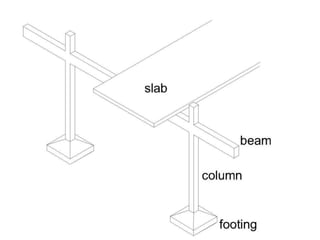
members to the earth. These members are slabs,
beams, columns etc.
• An economical structure is that in which the load
transfer is through the shortest distance.
Common Characteristics Of Structures
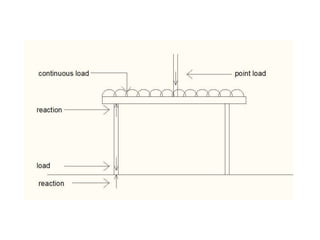
• Structures are designed to support various kinds of loads.
These are self weight of members, live loads on these,
snow loads, water/ earth loads, wind loads, seismic loads,
thermal loads, shrinkage loads and sometimes construction
loads etc.
• All the structural loads are transferred to the ground.
• At the support points structural members generate reaction
forces to resist the various loads.
• External loads and the reactions that resist these loads
produce different kinds of stresses in the structural
member.
• The structural members have to be strong enough to resist
all these external stresses.
• Structural members should not substantively deform under
their own or external applied loads.
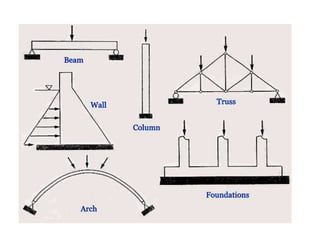
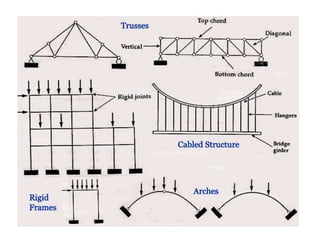
Types of structures.
Schematic representation
• As the structural load is basically a force that
has to be resisted, structural design becomes
a study of forces that act on a structure, the
stresses such forces generate and the
selection and design of materials and forms
that can resist these forces.
• Hence, it becomes important to know the
contemporary use of force units.
UNITS OF FORCE
• The Newton is the unit of force derived in the SI
system.
• it is equal to the amount of net force required to
accelerate a mass of one kilogram at a rate of one
meter per second.
• In dimensional analysis, F=ma, multiplying m (kg) by
a (m/s2).
• The dimension for 1 Newton unit is therefore
• The dimension for 1 Newton unit can be seen as:
– 1 N is the force of Earth’s gravity on an object with a mass
of about 102 g (1⁄9.81 kg) (such as a small apple).
– On Earth's surface, a mass of 1 kg exerts a force of
approximately 9.8 N [down] (or 1.0 kilogram-force; 1
kgf=9.80665 N by definition). The approximation of 1 kg
corresponding to 10 N is sometimes used as a rule of
thumb in everyday life and in engineering.
– The force of Earth's gravity on a human being with a mass
of 70 kg is approximately 686 N.
– It is common to see forces expressed in kilo-newtons or
kN, where 1 kN = 1,000 N.
Classification of forces
1. According to the effect produced by the
force-
a) External force (Push or Pull)
b) Internal force (Resistance)
c) Active force (Cause a body to move or
change its shape)
d) Passive force (prevents the motion or
deformation of a body)
Contd.
2. According to the nature of force
a) Action and Reaction
b) Attraction and Repulsion
c) Pull and Push
3. According to the nature of stress produced in the
body-
a) Tensile force
b) Compressive force
c) Shear force
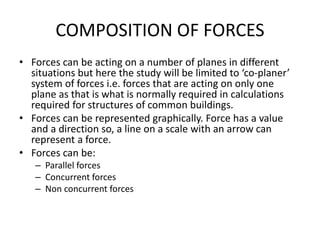
COMPOSITION OF FORCES
• Forces can be acting on a number of planes in different
situations but here the study will be limited to ‘co-planer’
system of forces i.e. forces that are acting on only one
plane as that is what is normally required in calculations
required for structures of common buildings.
• Forces can be represented graphically. Force has a value
and a direction so, a line on a scale with an arrow can
represent a force.
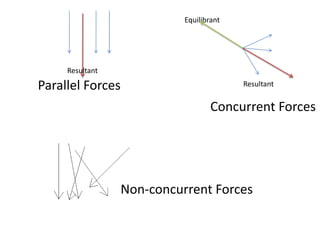
• Forces can be:
– Parallel forces
– Concurrent forces
– Non concurrent forces
Parallel Forces
Resultant
Concurrent Forces
Resultant
Non-concurrent Forces
Equilibrant
• Write a paper on “Structures in Architecture”.

Stucture design -I (Introduction)

  • 1.
    STRUCTURAL DESIGN I STRUCTURALMECHANICS LECTURE 1
  • 2.
    INTRODUCTION • Structural mechanics,or the start of structural design, is concerned with the study of forces and how these act on a body, in our case – buildings. • Each building component has weight which is a load. This load is a downward acting force that has to be transferred through various building members to the earth. These members are slabs, beams, columns etc. • An economical structure is that in which the load transfer is through the shortest distance.
  • 3.
    Common Characteristics OfStructures • Structures are designed to support various kinds of loads. These are self weight of members, live loads on these, snow loads, water/ earth loads, wind loads, seismic loads, thermal loads, shrinkage loads and sometimes construction loads etc. • All the structural loads are transferred to the ground. • At the support points structural members generate reaction forces to resist the various loads. • External loads and the reactions that resist these loads produce different kinds of stresses in the structural member. • The structural members have to be strong enough to resist all these external stresses. • Structural members should not substantively deform under their own or external applied loads.
  • 4.
  • 9.
    • As thestructural load is basically a force that has to be resisted, structural design becomes a study of forces that act on a structure, the stresses such forces generate and the selection and design of materials and forms that can resist these forces. • Hence, it becomes important to know the contemporary use of force units.
  • 10.
    UNITS OF FORCE •The Newton is the unit of force derived in the SI system. • it is equal to the amount of net force required to accelerate a mass of one kilogram at a rate of one meter per second. • In dimensional analysis, F=ma, multiplying m (kg) by a (m/s2). • The dimension for 1 Newton unit is therefore
  • 11.
    • The dimensionfor 1 Newton unit can be seen as: – 1 N is the force of Earth’s gravity on an object with a mass of about 102 g (1⁄9.81 kg) (such as a small apple). – On Earth's surface, a mass of 1 kg exerts a force of approximately 9.8 N [down] (or 1.0 kilogram-force; 1 kgf=9.80665 N by definition). The approximation of 1 kg corresponding to 10 N is sometimes used as a rule of thumb in everyday life and in engineering. – The force of Earth's gravity on a human being with a mass of 70 kg is approximately 686 N. – It is common to see forces expressed in kilo-newtons or kN, where 1 kN = 1,000 N.
  • 12.
    Classification of forces 1.According to the effect produced by the force- a) External force (Push or Pull) b) Internal force (Resistance) c) Active force (Cause a body to move or change its shape) d) Passive force (prevents the motion or deformation of a body)
  • 13.
    Contd. 2. According tothe nature of force a) Action and Reaction b) Attraction and Repulsion c) Pull and Push 3. According to the nature of stress produced in the body- a) Tensile force b) Compressive force c) Shear force
  • 14.
    COMPOSITION OF FORCES •Forces can be acting on a number of planes in different situations but here the study will be limited to ‘co-planer’ system of forces i.e. forces that are acting on only one plane as that is what is normally required in calculations required for structures of common buildings. • Forces can be represented graphically. Force has a value and a direction so, a line on a scale with an arrow can represent a force. • Forces can be: – Parallel forces – Concurrent forces – Non concurrent forces
  • 15.
  • 16.
    • Write apaper on “Structures in Architecture”.