Resolution of Force

“Mechanics is a branch science which deals with the study
of forces and their effects on bodies‟ motion or at rest.

Division of Applied Mechanics / Engineering

Applied mechanics (engineering mechanics)

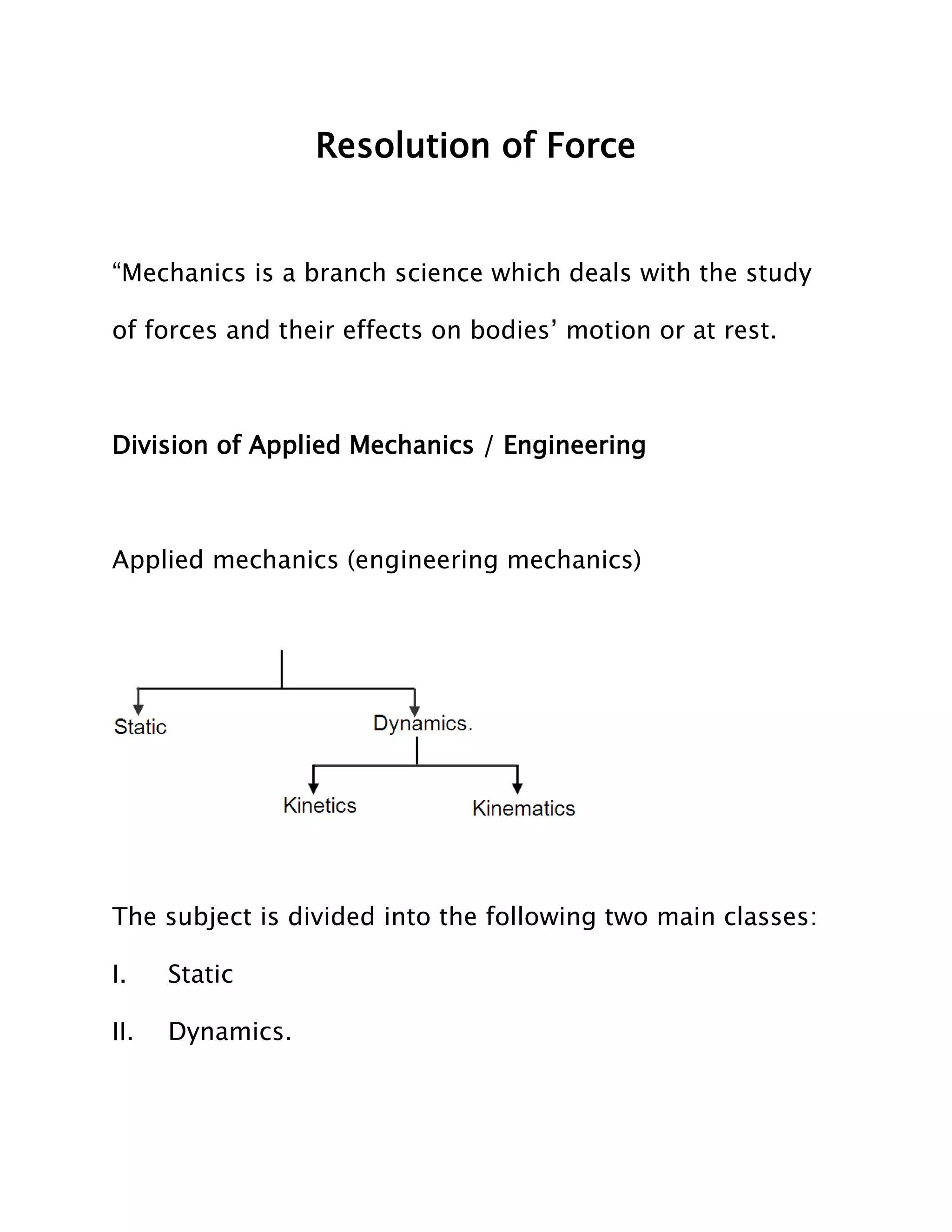
The subject is divided into the following two main classes:
I.

Static

II.

Dynamics.
I.

Statics:
It is that branch of applied mechanics which deals with
action forces on bodies at rest.

II.

Dynamics:
It that branch of applied mechanics which deals with
action forces on bodies in motion.

Dynamics is further divided into two branches:

I.

Kinetics

II.

Kinematics.
I.

Kinetics:
It is that branch of dynamics which deals with action of
forces on bodies in motion considering mass of the
body and forces causing motion.

II.

Kinematics:
It is that branch dynamics which deals with action of
forces on bodies in motion without any considering of
the mass of the body and force causing motion.

Important concepts

Rigid body
It is defined as a body, the particles of which are fixed in
position relative to one another, even when subjected to a
number of forces.
Basics principles
The subject „applied mechanics‟ or „engineering mechanics‟
is based on the following four fundamentals principle on
which further studies are based.
i.

law of parallelogram of forces

ii.

Principle of transmissibility of force.

iii.

Newton law motion.

iv.

Newton law of gravitation.

Concepts of Force And Definition:

Force is defined as “an external agency either pushes or
pulls which changes or tends to change the state of rest or
of uniform motion of a body‟‟ upon which it acts.

Therefore, S.I. unit of force is Newton and is denoted by N.
1

N = 1 Kg * 1m/sec2
M. K. S. unit of force is kilograms force and is denoted by
kgf.
1 kgf = 9.81 N.

Other units of force are:

1 KN (1 kilo Newton) = 103 N
1 MN (1 Mega Newton) = 106 N
1 GN (1 Giga Newton) = 109 N

Unit Newton Force (1 N Force)
“Unite Newton force or 1 N force is that force which when
acts on a body of mass 1 Kg produces an acceleration of 1
m/sec2 in it.”
Characteristics of a force:
1.

Magnitude

2.

Direction:

3.

Direction Sense:
i.

Pull: “it the arrow head is pointed away from the
point of application, the nature (or sense) of the
force is the pull.”
ii.

Push: “if the arrow head is pointed toward the
point of application, the nature (Or sense) of the
force is push.

Keep on visiting www.ednexa.com for more study materials.
- Team Ednexa

Resolution of Force Notes - Engineering Diploma

  • 1.
    Resolution of Force “Mechanicsis a branch science which deals with the study of forces and their effects on bodies‟ motion or at rest. Division of Applied Mechanics / Engineering Applied mechanics (engineering mechanics) The subject is divided into the following two main classes: I. Static II. Dynamics.
  • 2.
    I. Statics: It is thatbranch of applied mechanics which deals with action forces on bodies at rest. II. Dynamics: It that branch of applied mechanics which deals with action forces on bodies in motion. Dynamics is further divided into two branches: I. Kinetics II. Kinematics.
  • 3.
    I. Kinetics: It is thatbranch of dynamics which deals with action of forces on bodies in motion considering mass of the body and forces causing motion. II. Kinematics: It is that branch dynamics which deals with action of forces on bodies in motion without any considering of the mass of the body and force causing motion. Important concepts Rigid body It is defined as a body, the particles of which are fixed in position relative to one another, even when subjected to a number of forces.
  • 4.
    Basics principles The subject„applied mechanics‟ or „engineering mechanics‟ is based on the following four fundamentals principle on which further studies are based. i. law of parallelogram of forces ii. Principle of transmissibility of force. iii. Newton law motion. iv. Newton law of gravitation. Concepts of Force And Definition: Force is defined as “an external agency either pushes or pulls which changes or tends to change the state of rest or of uniform motion of a body‟‟ upon which it acts. Therefore, S.I. unit of force is Newton and is denoted by N. 1 N = 1 Kg * 1m/sec2
  • 5.
    M. K. S.unit of force is kilograms force and is denoted by kgf. 1 kgf = 9.81 N. Other units of force are: 1 KN (1 kilo Newton) = 103 N 1 MN (1 Mega Newton) = 106 N 1 GN (1 Giga Newton) = 109 N Unit Newton Force (1 N Force) “Unite Newton force or 1 N force is that force which when acts on a body of mass 1 Kg produces an acceleration of 1 m/sec2 in it.”
  • 6.
    Characteristics of aforce: 1. Magnitude 2. Direction: 3. Direction Sense: i. Pull: “it the arrow head is pointed away from the point of application, the nature (or sense) of the force is the pull.”
  • 7.
    ii. Push: “if thearrow head is pointed toward the point of application, the nature (Or sense) of the force is push. Keep on visiting www.ednexa.com for more study materials. - Team Ednexa