Fundamental of Engineering Mechanics
Ujjval Kumar
GraduateApprentice (NATS)
Civil Engineering Department
Gaya College of Engineering, Gaya
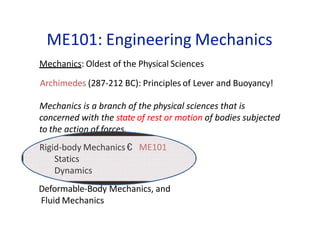
ME101: Engineering Mechanics
Mechanics: Oldest of the Physical Sciences
Archimedes (287-212 BC): Principles of Lever and Buoyancy!
Mechanics is a branch of the physical sciences that is
concerned with the state of rest or motion of bodies subjected
to the action of forces.
ME101
Rigid-body Mechanics €
Statics
Dynamics
Deformable-Body Mechanics, and
Fluid Mechanics
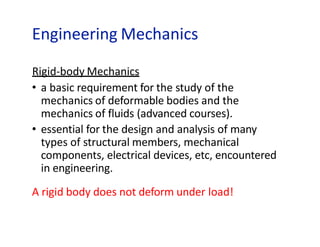
Engineering Mechanics
Rigid-body Mechanics
• a basic requirement for the study of the
mechanics of deformable bodies and the
mechanics of fluids (advanced courses).
• essential for the design and analysis of many
types of structural members, mechanical
components, electrical devices, etc, encountered
in engineering.
A rigid body does not deform under load!
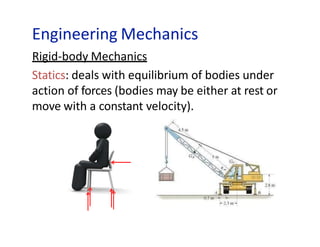
Engineering Mechanics
Rigid-body Mechanics
Statics: deals with equilibrium of bodies under
action of forces (bodies may be either at rest or
move with a constant velocity).
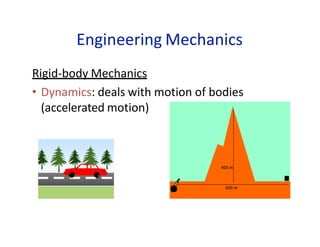
Engineering Mechanics
Rigid-body Mechanics
• Dynamics: deals with motion of bodies
(accelerated motion)
Mechanics: Fundamental Concepts
Length (Space): needed to locate position of a point in space, &
describe size of the physical system € Distances, Geometric
Properties
Time: measure of succession of events € basic quantity in
Dynamics
Mass: quantity of matter in a body € measure of inertia of a
body (its resistance to change in velocity)
Force: represents the action of one body on another €
characterized by its magnitude, direction of its action, and its
point of application
€ Force is a Vector quantity.
Mechanics: Fundamental Concepts
Newtonian Mechanics
Length, Time, and Mass are absolute concepts
independent of each other
Force is a derived concept
not independent of the other fundamental concepts.
Force acting on a body is related to the mass of the body
and the variation of its velocity with time.
Force can also occur between bodies that are physically
separated (Ex: gravitational, electrical, and magnetic forces)
Mechanics: Fundamental Concepts
Remember:
• Mass is a property of matter that does not
change from one location to another.
• Weight refers to the gravitational attraction of
the earth on a body or quantity of mass. Its
magnitude depends upon the elevation at
which the mass is located
• Weight of a body is the gravitational force acting on it.
Mechanics: Idealizations
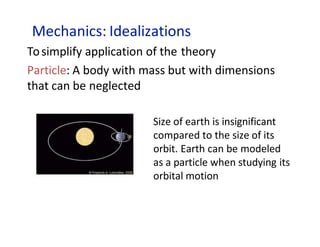
Tosimplify application of the theory
Particle: A body with mass but with dimensions
that can be neglected
Size of earth is insignificant
compared to the size of its
orbit. Earth can be modeled
as a particle when studying its
orbital motion
Mechanics: Idealizations
Rigid Body: A combination of large number of particles in
which all particles remain at a fixed distance (practically)
from one another before and after applying a load.
Material properties of a rigid body are not required to be
considered when analyzing the forces acting on the
body.
In most cases, actual deformations occurring in structures,
machines, mechanisms, etc. are relatively small, and rigid
body assumption is suitable for analysis
Mechanics: Idealizations
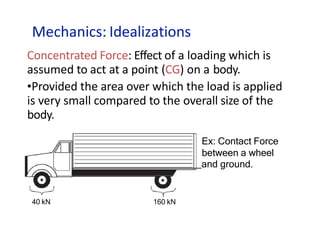
Concentrated Force: Effect of a loading which is
assumed to act at a point (CG) on a body.
•Provided the area over which the load is applied
is very small compared to the overall size of the
body.
Ex: Contact Force
between a wheel
and ground.
40 kN 160 kN
Mechanics: Newton’s Three Laws of Motion
Basis of formulation of rigid body mechanics.
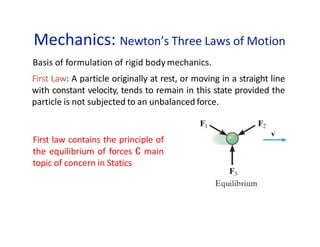
First Law: A particle originally at rest, or moving in a straight line
with constant velocity, tends to remain in this state provided the
particle is not subjected to an unbalanced force.
First law contains the principle of
the equilibrium of forces € main
topic of concern in Statics
Mechanics: Newton’s Three Laws of Motion
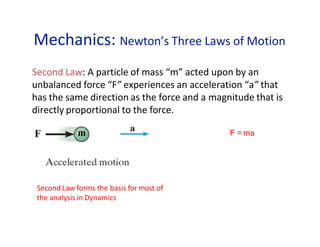
Second Law: A particle of mass “m” acted upon by an
unbalanced force “F” experiences an acceleration “a” that
has the same direction as the force and a magnitude that is
directly proportional to the force.
F = ma
m
Second Law forms the basis for most of
the analysis in Dynamics
Mechanics: Newton’s Three Laws of Motion
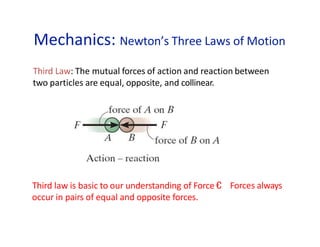
Third law is basic to our understanding of Force €
occur in pairs of equal and opposite forces.
Forces always
Third Law: The mutual forces of action and reaction between
two particles are equal, opposite, and collinear.
Mechanics: Newton’s Law of Gravitational Attraction
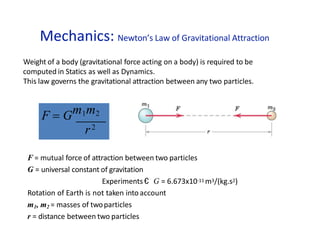
F  Gm1m2
r2
F = mutual force of attraction between two particles
G = universal constant of gravitation
Experiments € G = 6.673x10⁻¹¹ m3/(kg.s2)
Rotation of Earth is not taken into account
m1, m2 = masses of twoparticles
r = distance between two particles
Weight of a body (gravitational force acting on a body) is required to be
computed in Statics as well as Dynamics.
This law governs the gravitational attraction between any two particles.
Gravitational Attraction of the Earth
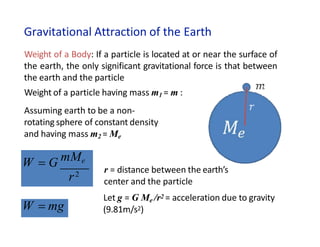
W  G mMe
r2
W  mg
Weight of a Body: If a particle is located at or near the surface of
the earth, the only significant gravitational force is that between
the earth and the particle
Weight of a particle having mass m1 = m :
Assuming earth to be a non-
rotating sphere of constant density
and having mass m2 = Me
r = distance between the earth’s
center and the particle
Let g = G Me /r2 = acceleration due to gravity
(9.81m/s2)
Mechanics: Units
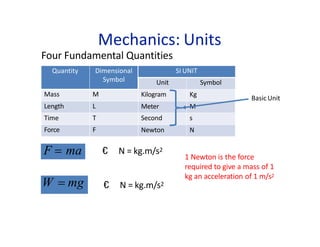
W  mg
F  ma
Four Fundamental Quantities
€ N = kg.m/s2
€ N = kg.m/s2
1 Newton is the force
required to give a mass of 1
kg an acceleration of 1 m/s2
Quantity SI UNIT
Dimensional
Symbol Unit Symbol
Mass M
Length L
Kilogram Kg
Meter M
Time T
Force F
Second s
Newton N
Basic Unit
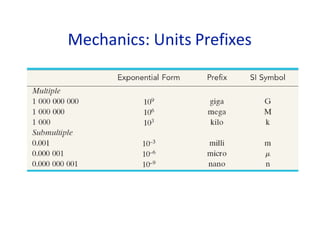
Mechanics: Units Prefixes
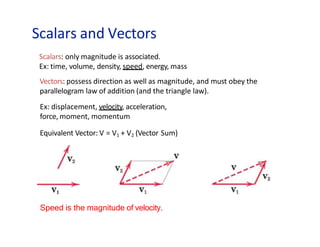
Scalars and Vectors
Speed is the magnitude of velocity.
Scalars: only magnitude is associated.
Ex: time, volume, density, speed, energy, mass
Vectors: possess direction as well as magnitude, and must obey the
parallelogram law of addition (and the triangle law).
Ex: displacement, velocity, acceleration,
force, moment, momentum
Equivalent Vector: V = V1 + V2 (Vector Sum)
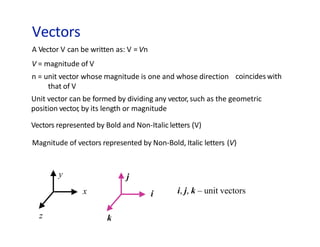
Vectors
y
x
z
j
i
k
i, j, k – unit vectors
coincides with
A Vector V can be written as: V = Vn
V = magnitude of V
n = unit vector whose magnitude is one and whose direction
that of V
Unit vector can be formed by dividing any vector,such as the geometric
position vector, by its length or magnitude
Vectors represented by Bold and Non-Italic letters (V)
Magnitude of vectors represented by Non-Bold, Italic letters (V)
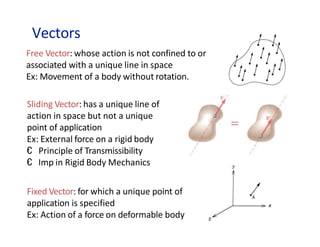
Vectors
Free Vector: whose action is not confined to or
associated with a unique line in space
Ex: Movement of a body without rotation.
Sliding Vector: has a unique line of
action in space but not a unique
point of application
Ex: External force on a rigid body
€ Principle of Transmissibility
€ Imp in Rigid Body Mechanics
Fixed Vector: for which a unique point of
application is specified
Ex: Action of a force on deformable body
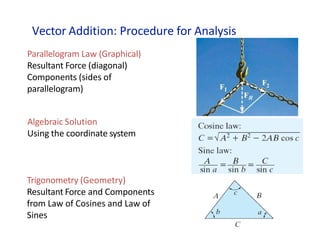
Vector Addition: Procedure for Analysis
Parallelogram Law (Graphical)
Resultant Force (diagonal)
Components (sides of
parallelogram)
Algebraic Solution
Using the coordinate system
Trigonometry (Geometry)
Resultant Force and Components
from Law of Cosines and Law of
Sines
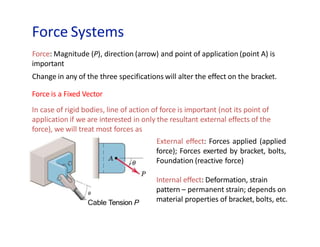
Force Systems
Cable Tension P
Force: Magnitude (P), direction (arrow) and point of application (point A) is
important
Change in any of the three specifications will alter the effect on the bracket.
Force is a Fixed Vector
In case of rigid bodies, line of action of force is important (not its point of
application if we are interested in only the resultant external effects of the
force), we will treat most forces as
External effect: Forces applied (applied
force); Forces exerted by bracket, bolts,
Foundation (reactive force)
Internal effect: Deformation, strain
pattern – permanent strain; depends on
material properties of bracket, bolts, etc.
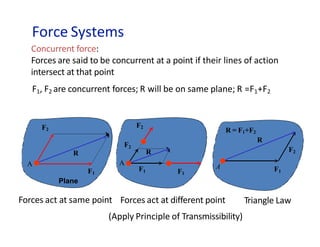
Force Systems
A
F1
F2
R
A F1
F2
R
R = F1+F2
A
F1
F2
R
F2
F1
Concurrent force:
Forces are said to be concurrent at a point if their lines of action
intersect at that point
F1, F2 are concurrent forces; R will be on same plane; R =F1+F2
(Apply Principle of Transmissibility)
Plane
Forces act at same point Forces act at different point Triangle Law
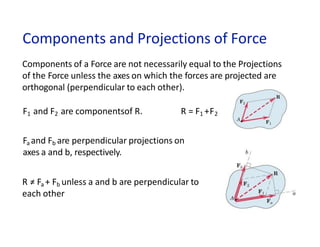
Components and Projections of Force
Components of a Force are not necessarily equal to the Projections
of the Force unless the axes on which the forces are projected are
orthogonal (perpendicular to each other).
F1 and F2 are componentsof R. R = F1 +F2
Fa and Fb are perpendicular projections on
axes a and b, respectively.
R ≠ Fa + Fb unless a and b are perpendicular to
each other
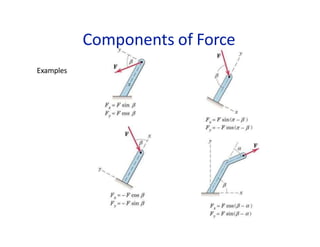
Components of Force
Examples
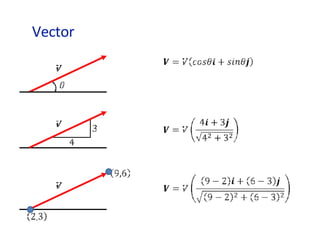
Vector
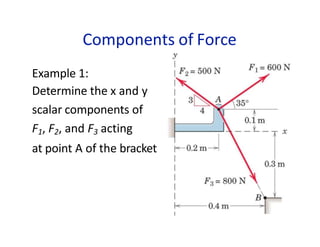
Components of Force
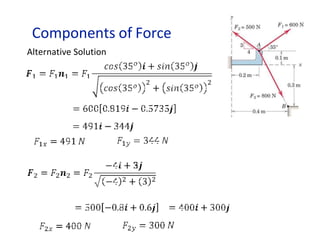
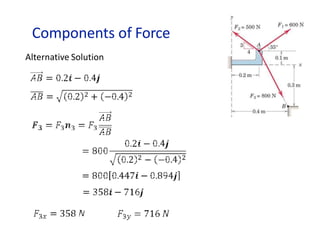
Example 1:
Determine the x and y
scalar components of
F1, F2, and F3 acting
at point A of the bracket
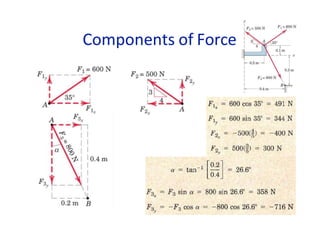
Components of Force
Solution
:
Components of Force
Alternative Solution
Components of Force
Alternative Solution
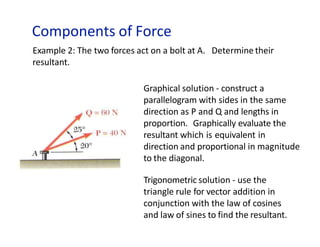
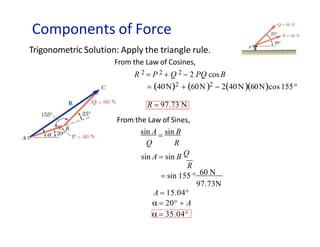
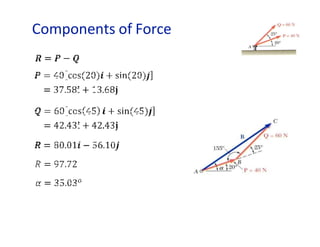
Example 2: The two forces act on a bolt at A. Determine their
resultant.
Graphical solution - construct a
parallelogram with sides in the same
direction as P and Q and lengths in
proportion. Graphically evaluate the
resultant which is equivalent in
direction and proportional in magnitude
to the diagonal.
Trigonometric solution - use the
triangle rule for vector addition in
conjunction with the law of cosines
and law of sines to find the resultant.
Components of Force
Components of Force
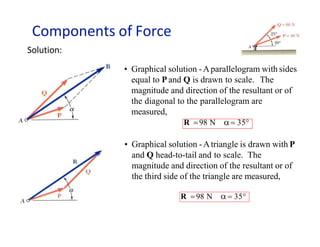
Solution:
• Graphical solution -Aparallelogram with sides
equal to Pand Q is drawn to scale. The
magnitude and direction of the resultant or of
the diagonal to the parallelogram are
measured,
R 98 N  35
• Graphical solution -Atriangle is drawn with P
and Q head-to-tail and to scale. The
magnitude and direction of the resultant or of
the third side of the triangle are measured,
R 98 N   35
Components of Force
Trigonometric Solution: Apply the triangle rule.
From the Law of Cosines,
R 2  P 2  Q 2  2 PQ cosB
 40N2  60N2  240N60Ncos155
R  97.73 N
From the Law of Sines,
sin A  sin B
Q R
sin A  sin B Q
R
 sin 155  60 N
97.73N
A  15.04
 20  A
 35.04
Components of Force
Components of Force
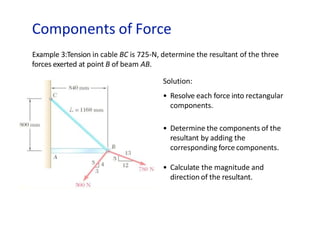
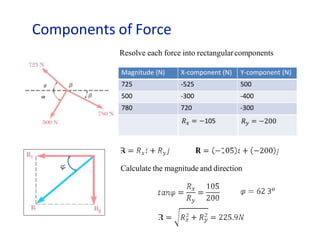
Example 3:Tension in cable BC is 725-N, determine the resultant of the three
forces exerted at point B of beam AB.
Solution:
• Resolve each force into rectangular
components.
• Determine the components of the
resultant by adding the
corresponding force components.
• Calculate the magnitude and
direction of the resultant.
Components of Force
Magnitude (N) X-component (N) Y-component (N)
725 -525 500
500 -300 -400
780 720 -300
Resolve each force into rectangularcomponents
Calculate the magnitude and direction
Components of Force
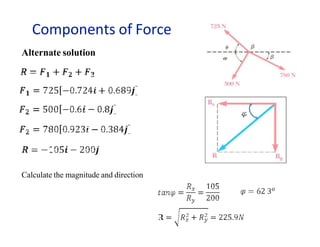
Alternate solution
Calculate the magnitude and direction
Rectangular Components in Space
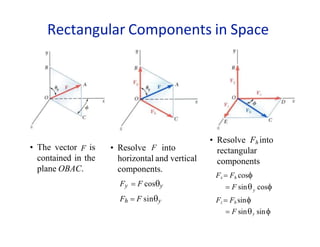
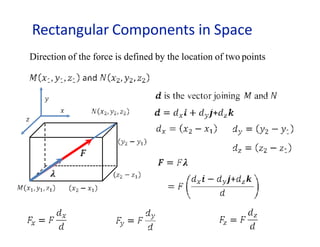
• The vector F is
contained in the
plane OBAC.
• Resolve into
F
horizontal and vertical
components.
Fy  F cosy
Fh  F siny
y
 F sin cos
Fz  Fh sin
 F siny sin
• Resolve Fh into
rectangular
components
Fx  Fh cos
Rectangular Components in Space
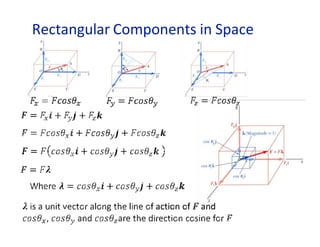
Direction of the force is defined by the location of two points
Rectangular Components in Space
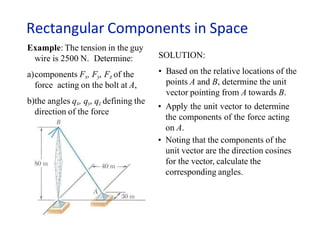
Example: The tension in the guy
wire is 2500 N. Determine:
a)components Fx, Fy, Fz of the
force acting on the bolt at A,
b)the angles qx, qy, qz defining the
direction of the force
SOLUTION:
• Based on the relative locations of the
points A and B, determine the unit
vector pointing from A towards B.
• Apply the unit vector to determine
the components of the force acting
on A.
• Noting that the components of the
unit vector are the direction cosines
for the vector, calculate the
corresponding angles.
Rectangular Components in Space
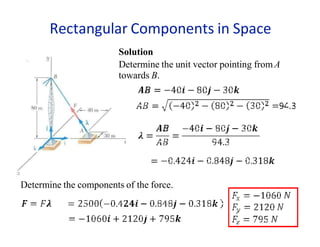
Solution
Determine the unit vector pointing from A
towards B.
Determine the components of the force.
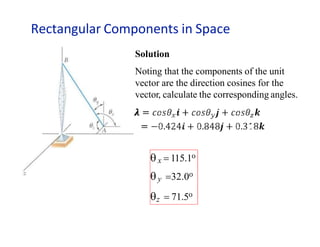
Solution
Noting that the components of the unit
vector are the direction cosines for the
vector, calculate the corresponding angles.
x  115.1o
y 32.0o
z  71.5o
Rectangular Components in Space
Vector Products
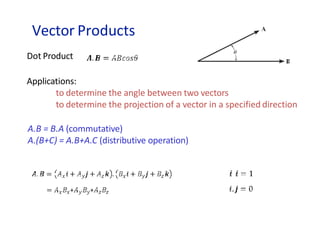
Dot Product
Applications:
to determine the angle between two vectors
to determine the projection of a vector in a specified direction
A.B = B.A (commutative)
A.(B+C) = A.B+A.C (distributive operation)
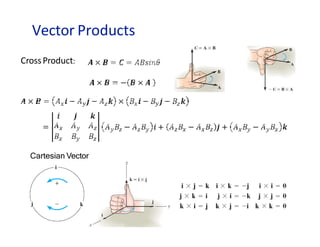
Vector Products
CrossProduct:
Cartesian Vector
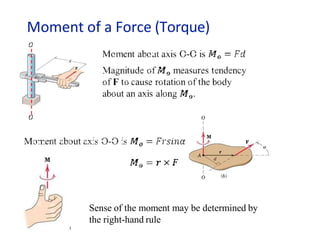
Moment of a Force (Torque)
Sense of the moment may be determined by
the right-hand rule
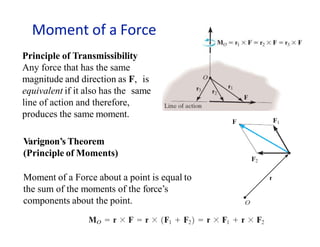
Moment of a Force
Principle of Transmissibility
Any force that has the same
magnitude and direction as F, is
equivalent if it also has the same
line of action and therefore,
produces the same moment.
V
arignon’s Theorem
(Principle of Moments)
Moment of a Force about a point is equal to
the sum of the moments of the force’s
components about the point.
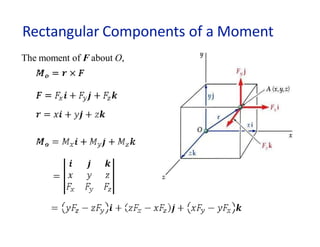
Rectangular Components of a Moment
The moment of F about O,
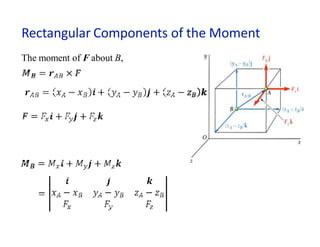
Rectangular Components of the Moment
The moment of F about B,
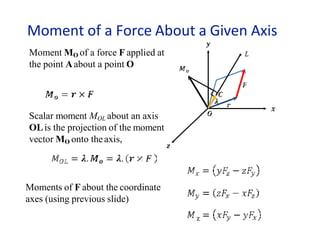
Moment of a Force About a Given Axis
Moment MO of a force F applied at
the point Aabout a point O
Scalar moment MOL about an axis
OLis the projection of the moment
vector MO onto theaxis,
Moments of F about the coordinate
axes (using previous slide)
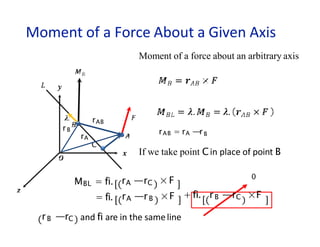
Moment of a Force About a Given Axis
Moment of a force about an arbitrary axis
C
rAB
rA
rAB = rA —rB
rB
If we take point Cin place of point B
MBL = fi. rA —rC
= fi. rA —rB
× F
×F
0
+fi. rB —rC ×F
rB —rC and fi are in the sameline
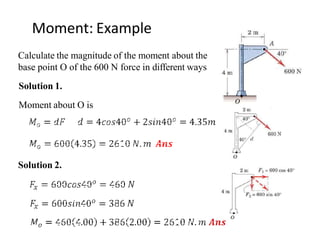
Moment: Example
Calculate the magnitude of the moment about the
base point O of the 600 N force in different ways
Solution 1.
Moment about O is
Solution 2.
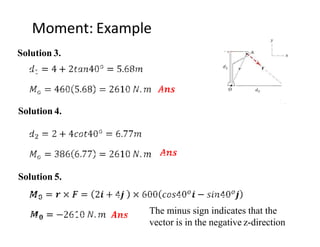
Moment: Example
Solution 3.
Solution 4.
Solution 5.
The minus sign indicates that the
vector is in the negative z-direction
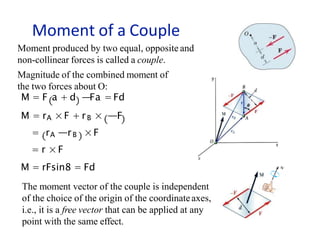
Moment of a Couple
Moment produced by two equal, opposite and
non-collinear forces is called a couple.
Magnitude of the combined moment of
the two forces about O:
M = F a + d —Fa =Fd
M = rA ×F + rB × —F
= rA —rB ×F
= r × F
M = rFsin8 = Fd
The moment vector of the couple is independent
of the choice of the origin of the coordinateaxes,
i.e., it is a free vector that can be applied at any
point with the same effect.
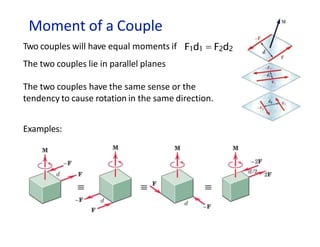
Moment of a Couple
Two couples will have equal moments if
The two couples lie in parallel planes
F1d1 =F2d2
The two couples have the same sense or the
tendency to cause rotation in the same direction.
Examples:
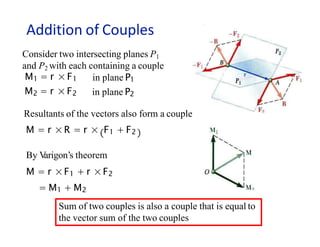
Addition of Couples
Consider two intersecting planes P1
and P2 with each containing a couple
M1 = r × F1
M2 = r × F2
in plane P1
in plane P2
Resultants of the vectors also form a couple
M = r ×R = r × F1 + F2
By V
arigon’s theorem
M = r ×F1 + r ×F2
= M1 + M2
Sum of two couples is also a couple that is equal to
the vector sum of the two couples
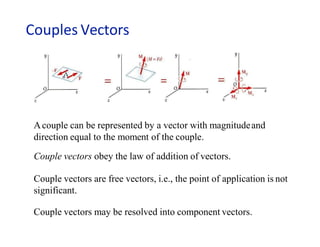
Acouple can be represented by a vector with magnitudeand
direction equal to the moment of the couple.
Couple vectors obey the law of addition of vectors.
Couple vectors are free vectors, i.e., the point of application is not
significant.
Couple vectors may be resolved into component vectors.
Couples Vectors
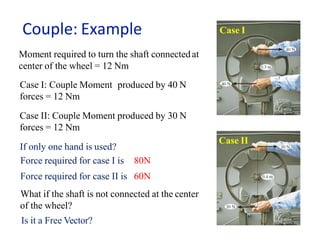
Couple: Example
Moment required to turn the shaft connectedat
center of the wheel = 12 Nm
Case I: Couple Moment produced by 40 N
forces = 12 Nm
Case II: Couple Moment produced by 30 N
forces = 12 Nm
If only one hand is used?
Force required for case I is 80N
Force required for case II is 60N
What if the shaft is not connected at the center
of the wheel?
Is it a Free Vector?
Case I
Case II
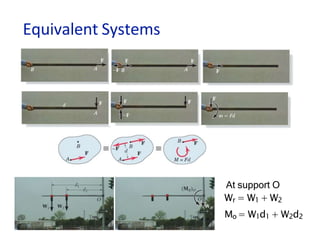
Equivalent Systems
At support O
Wr = W1 + W2
Mo = W1d1 + W2d2
Equivalent Systems: Resultants
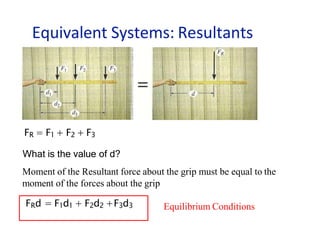
FR = F1 + F2 + F3
What is the value of d?
Moment of the Resultant force about the grip must be equal to the
moment of the forces about the grip
FRd = F1d1 + F2d2 +F3d3 Equilibrium Conditions
Equivalent Systems: Resultants
Equilibrium
Equilibrium of a body is a condition in which the
resultants of all forces acting on the body is zero.
Condition studied in Statics
Equivalent Systems: Resultants
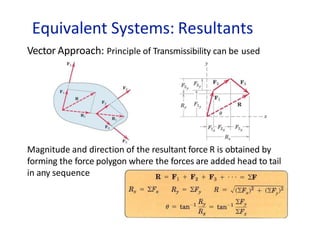
Vector Approach: Principle of Transmissibility can be used
Magnitude and direction of the resultant force R is obtained by
forming the force polygon where the forces are added head to tail
in any sequence
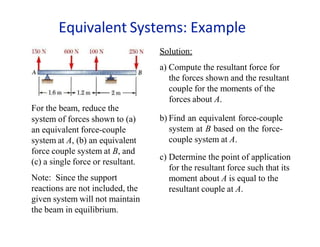
system of forces shown to (a)
an equivalent force-couple
system at A, (b) an equivalent
force couple system at B, and
(c) a single force or resultant.
Note: Since the support
reactions are not included, the
given system will not maintain
the beam in equilibrium.
Solution:
a) Compute the resultant force for
the forces shown and the resultant
couple for the moments of the
forces about A.
For the beam, reduce the
b) Find an equivalent force-couple
system at B based on the force-
couple system at A.
c) Determine the point of application
for the resultant force such that its
moment about A is equal to the
resultant couple at A.
Equivalent Systems: Example
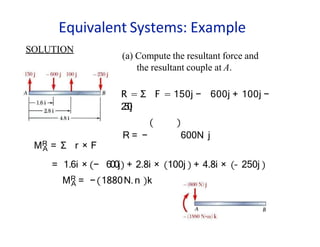
SOLUTION
(a) Compute the resultant force and
the resultant couple at A.
R = Σ F = 150j − 600j + 100j −
2
5
0
j
R = − 600N j
A
MR = Σ r × F
= 1.6i × − 600j + 2.8i × 100j + 4.8i × – 250j
A
MR = − 1880N.n k
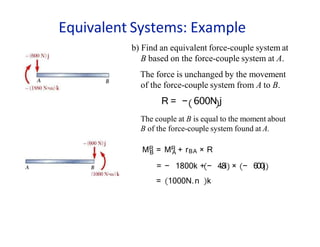
Equivalent Systems: Example
B A
MR = MR + rBA × R
= − 1800k + − 4.
8i
= 1000N.n k
× − 600j
b) Find an equivalent force-couple system at
B based on the force-couple system at A.
The force is unchanged by the movement
of the force-couple system from A to B.
R = − 600N j
The couple at B is equal to the moment about
B of the force-couple system found at A.
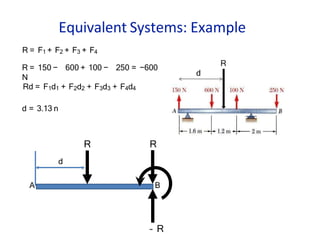
Equivalent Systems: Example
R
d
R = F1 + F2 + F3 + F4
R = 150 − 600 + 100 − 250 = −600
N
Rd = F1d1 + F2d2 + F3d3 + F4d4
d = 3.13 n
R
A B
d
R
– R
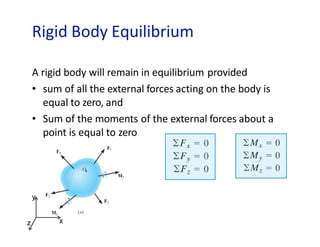
Rigid Body Equilibrium
A rigid body will remain in equilibrium provided
• sum of all the external forces acting on the body is
equal to zero, and
• Sum of the moments of the external forces about a
point is equal to zero
x
y
z
Rigid Body Equilibrium
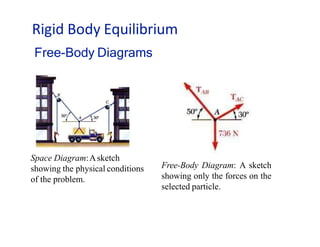
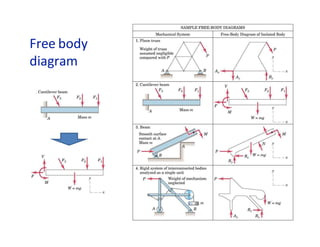
Space Diagram:Asketch
showing the physical conditions
of the problem.
Free-Body Diagram: A sketch
showing only the forces on the
selected particle.
Free-Body Diagrams
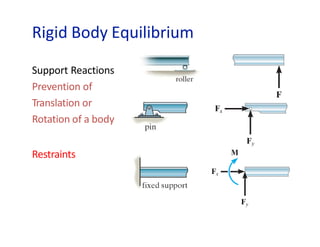
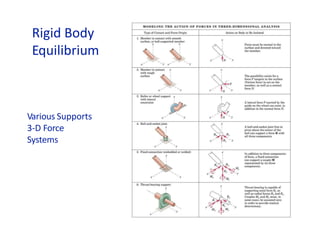
Rigid Body Equilibrium
Support Reactions
Prevention of
Translation or
Rotation of a body
Restraints
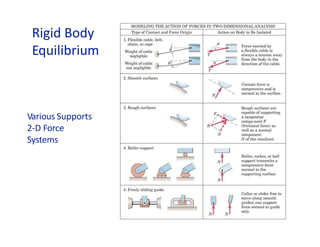
Rigid Body
Equilibrium
Various Supports
2-D Force
Systems
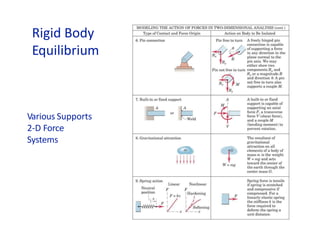
Rigid Body
Equilibrium
Various Supports
2-D Force
Systems
Rigid Body
Equilibrium
Various Supports
3-D Force
Systems
Free body
diagram
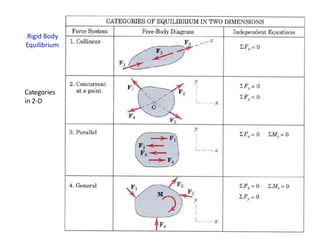
Rigid Body
Equilibrium
Categories
in 2-D
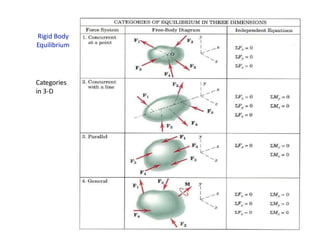
Rigid Body
Equilibrium
Categories
in 3-D
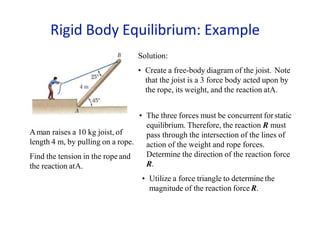
Aman raises a 10 kg joist, of
length 4 m, by pulling on a rope.
Find the tension in the rope and
the reaction atA.
Solution:
• Create a free-body diagram of the joist. Note
that the joist is a 3 force body acted upon by
the rope, its weight, and the reaction atA.
• The three forces must be concurrent forstatic
equilibrium. Therefore, the reaction R must
pass through the intersection of the lines of
action of the weight and rope forces.
Determine the direction of the reaction force
R.
• Utilize a force triangle to determine the
magnitude of the reaction force R.
Rigid Body Equilibrium: Example
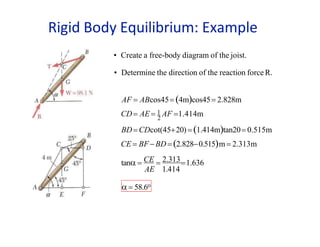
AE 1.414
CD AE  1 AF 1.414m
• Create a free-body diagram of the joist.
• Determine the direction of the reaction force R.
AF  ABcos45 4mcos45 2.828m
2
BD CDcot(4520)  1.414mtan20 0.515m
CE  BFBD  2.8280.515m  2.313m
tan  CE  2.3131.636
 58.6o
Rigid Body Equilibrium: Example
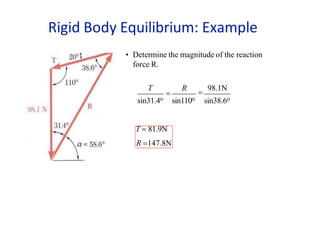
• Determine the magnitude of the reaction
force R.

T R

98.1N
sin31.4o sin110o sin38.6o
T  81.9N
R 147.8N
Rigid Body Equilibrium: Example

Engg-Mechanics-ppt-by-ujjval.pptx

  • 1.
    Fundamental of EngineeringMechanics Ujjval Kumar GraduateApprentice (NATS) Civil Engineering Department Gaya College of Engineering, Gaya
  • 2.
    ME101: Engineering Mechanics Mechanics:Oldest of the Physical Sciences Archimedes (287-212 BC): Principles of Lever and Buoyancy! Mechanics is a branch of the physical sciences that is concerned with the state of rest or motion of bodies subjected to the action of forces. ME101 Rigid-body Mechanics € Statics Dynamics Deformable-Body Mechanics, and Fluid Mechanics
  • 3.
    Engineering Mechanics Rigid-body Mechanics •a basic requirement for the study of the mechanics of deformable bodies and the mechanics of fluids (advanced courses). • essential for the design and analysis of many types of structural members, mechanical components, electrical devices, etc, encountered in engineering. A rigid body does not deform under load!
  • 4.
    Engineering Mechanics Rigid-body Mechanics Statics:deals with equilibrium of bodies under action of forces (bodies may be either at rest or move with a constant velocity).
  • 5.
    Engineering Mechanics Rigid-body Mechanics •Dynamics: deals with motion of bodies (accelerated motion)
  • 6.
    Mechanics: Fundamental Concepts Length(Space): needed to locate position of a point in space, & describe size of the physical system € Distances, Geometric Properties Time: measure of succession of events € basic quantity in Dynamics Mass: quantity of matter in a body € measure of inertia of a body (its resistance to change in velocity) Force: represents the action of one body on another € characterized by its magnitude, direction of its action, and its point of application € Force is a Vector quantity.
  • 7.
    Mechanics: Fundamental Concepts NewtonianMechanics Length, Time, and Mass are absolute concepts independent of each other Force is a derived concept not independent of the other fundamental concepts. Force acting on a body is related to the mass of the body and the variation of its velocity with time. Force can also occur between bodies that are physically separated (Ex: gravitational, electrical, and magnetic forces)
  • 8.
    Mechanics: Fundamental Concepts Remember: •Mass is a property of matter that does not change from one location to another. • Weight refers to the gravitational attraction of the earth on a body or quantity of mass. Its magnitude depends upon the elevation at which the mass is located • Weight of a body is the gravitational force acting on it.
  • 9.
    Mechanics: Idealizations Tosimplify applicationof the theory Particle: A body with mass but with dimensions that can be neglected Size of earth is insignificant compared to the size of its orbit. Earth can be modeled as a particle when studying its orbital motion
  • 10.
    Mechanics: Idealizations Rigid Body:A combination of large number of particles in which all particles remain at a fixed distance (practically) from one another before and after applying a load. Material properties of a rigid body are not required to be considered when analyzing the forces acting on the body. In most cases, actual deformations occurring in structures, machines, mechanisms, etc. are relatively small, and rigid body assumption is suitable for analysis
  • 11.
    Mechanics: Idealizations Concentrated Force:Effect of a loading which is assumed to act at a point (CG) on a body. •Provided the area over which the load is applied is very small compared to the overall size of the body. Ex: Contact Force between a wheel and ground. 40 kN 160 kN
  • 12.
    Mechanics: Newton’s ThreeLaws of Motion Basis of formulation of rigid body mechanics. First Law: A particle originally at rest, or moving in a straight line with constant velocity, tends to remain in this state provided the particle is not subjected to an unbalanced force. First law contains the principle of the equilibrium of forces € main topic of concern in Statics
  • 13.
    Mechanics: Newton’s ThreeLaws of Motion Second Law: A particle of mass “m” acted upon by an unbalanced force “F” experiences an acceleration “a” that has the same direction as the force and a magnitude that is directly proportional to the force. F = ma m Second Law forms the basis for most of the analysis in Dynamics
  • 14.
    Mechanics: Newton’s ThreeLaws of Motion Third law is basic to our understanding of Force € occur in pairs of equal and opposite forces. Forces always Third Law: The mutual forces of action and reaction between two particles are equal, opposite, and collinear.
  • 15.
    Mechanics: Newton’s Lawof Gravitational Attraction F  Gm1m2 r2 F = mutual force of attraction between two particles G = universal constant of gravitation Experiments € G = 6.673x10⁻¹¹ m3/(kg.s2) Rotation of Earth is not taken into account m1, m2 = masses of twoparticles r = distance between two particles Weight of a body (gravitational force acting on a body) is required to be computed in Statics as well as Dynamics. This law governs the gravitational attraction between any two particles.
  • 16.
    Gravitational Attraction ofthe Earth W  G mMe r2 W  mg Weight of a Body: If a particle is located at or near the surface of the earth, the only significant gravitational force is that between the earth and the particle Weight of a particle having mass m1 = m : Assuming earth to be a non- rotating sphere of constant density and having mass m2 = Me r = distance between the earth’s center and the particle Let g = G Me /r2 = acceleration due to gravity (9.81m/s2)
  • 17.
    Mechanics: Units W mg F  ma Four Fundamental Quantities € N = kg.m/s2 € N = kg.m/s2 1 Newton is the force required to give a mass of 1 kg an acceleration of 1 m/s2 Quantity SI UNIT Dimensional Symbol Unit Symbol Mass M Length L Kilogram Kg Meter M Time T Force F Second s Newton N Basic Unit
  • 18.
  • 19.
    Scalars and Vectors Speedis the magnitude of velocity. Scalars: only magnitude is associated. Ex: time, volume, density, speed, energy, mass Vectors: possess direction as well as magnitude, and must obey the parallelogram law of addition (and the triangle law). Ex: displacement, velocity, acceleration, force, moment, momentum Equivalent Vector: V = V1 + V2 (Vector Sum)
  • 20.
    Vectors y x z j i k i, j, k– unit vectors coincides with A Vector V can be written as: V = Vn V = magnitude of V n = unit vector whose magnitude is one and whose direction that of V Unit vector can be formed by dividing any vector,such as the geometric position vector, by its length or magnitude Vectors represented by Bold and Non-Italic letters (V) Magnitude of vectors represented by Non-Bold, Italic letters (V)
  • 21.
    Vectors Free Vector: whoseaction is not confined to or associated with a unique line in space Ex: Movement of a body without rotation. Sliding Vector: has a unique line of action in space but not a unique point of application Ex: External force on a rigid body € Principle of Transmissibility € Imp in Rigid Body Mechanics Fixed Vector: for which a unique point of application is specified Ex: Action of a force on deformable body
  • 22.
    Vector Addition: Procedurefor Analysis Parallelogram Law (Graphical) Resultant Force (diagonal) Components (sides of parallelogram) Algebraic Solution Using the coordinate system Trigonometry (Geometry) Resultant Force and Components from Law of Cosines and Law of Sines
  • 23.
    Force Systems Cable TensionP Force: Magnitude (P), direction (arrow) and point of application (point A) is important Change in any of the three specifications will alter the effect on the bracket. Force is a Fixed Vector In case of rigid bodies, line of action of force is important (not its point of application if we are interested in only the resultant external effects of the force), we will treat most forces as External effect: Forces applied (applied force); Forces exerted by bracket, bolts, Foundation (reactive force) Internal effect: Deformation, strain pattern – permanent strain; depends on material properties of bracket, bolts, etc.
  • 24.
    Force Systems A F1 F2 R A F1 F2 R R= F1+F2 A F1 F2 R F2 F1 Concurrent force: Forces are said to be concurrent at a point if their lines of action intersect at that point F1, F2 are concurrent forces; R will be on same plane; R =F1+F2 (Apply Principle of Transmissibility) Plane Forces act at same point Forces act at different point Triangle Law
  • 25.
    Components and Projectionsof Force Components of a Force are not necessarily equal to the Projections of the Force unless the axes on which the forces are projected are orthogonal (perpendicular to each other). F1 and F2 are componentsof R. R = F1 +F2 Fa and Fb are perpendicular projections on axes a and b, respectively. R ≠ Fa + Fb unless a and b are perpendicular to each other
  • 26.
  • 27.
  • 28.
    Components of Force Example1: Determine the x and y scalar components of F1, F2, and F3 acting at point A of the bracket
  • 29.
  • 30.
  • 31.
  • 32.
    Example 2: Thetwo forces act on a bolt at A. Determine their resultant. Graphical solution - construct a parallelogram with sides in the same direction as P and Q and lengths in proportion. Graphically evaluate the resultant which is equivalent in direction and proportional in magnitude to the diagonal. Trigonometric solution - use the triangle rule for vector addition in conjunction with the law of cosines and law of sines to find the resultant. Components of Force
  • 33.
    Components of Force Solution: •Graphical solution -Aparallelogram with sides equal to Pand Q is drawn to scale. The magnitude and direction of the resultant or of the diagonal to the parallelogram are measured, R 98 N  35 • Graphical solution -Atriangle is drawn with P and Q head-to-tail and to scale. The magnitude and direction of the resultant or of the third side of the triangle are measured, R 98 N   35
  • 34.
    Components of Force TrigonometricSolution: Apply the triangle rule. From the Law of Cosines, R 2  P 2  Q 2  2 PQ cosB  40N2  60N2  240N60Ncos155 R  97.73 N From the Law of Sines, sin A  sin B Q R sin A  sin B Q R  sin 155  60 N 97.73N A  15.04  20  A  35.04
  • 35.
  • 36.
    Components of Force Example3:Tension in cable BC is 725-N, determine the resultant of the three forces exerted at point B of beam AB. Solution: • Resolve each force into rectangular components. • Determine the components of the resultant by adding the corresponding force components. • Calculate the magnitude and direction of the resultant.
  • 37.
    Components of Force Magnitude(N) X-component (N) Y-component (N) 725 -525 500 500 -300 -400 780 720 -300 Resolve each force into rectangularcomponents Calculate the magnitude and direction
  • 38.
    Components of Force Alternatesolution Calculate the magnitude and direction
  • 39.
    Rectangular Components inSpace • The vector F is contained in the plane OBAC. • Resolve into F horizontal and vertical components. Fy  F cosy Fh  F siny y  F sin cos Fz  Fh sin  F siny sin • Resolve Fh into rectangular components Fx  Fh cos
  • 40.
  • 41.
    Rectangular Components inSpace Direction of the force is defined by the location of two points
  • 42.
    Rectangular Components inSpace Example: The tension in the guy wire is 2500 N. Determine: a)components Fx, Fy, Fz of the force acting on the bolt at A, b)the angles qx, qy, qz defining the direction of the force SOLUTION: • Based on the relative locations of the points A and B, determine the unit vector pointing from A towards B. • Apply the unit vector to determine the components of the force acting on A. • Noting that the components of the unit vector are the direction cosines for the vector, calculate the corresponding angles.
  • 43.
    Rectangular Components inSpace Solution Determine the unit vector pointing from A towards B. Determine the components of the force.
  • 44.
    Solution Noting that thecomponents of the unit vector are the direction cosines for the vector, calculate the corresponding angles. x  115.1o y 32.0o z  71.5o Rectangular Components in Space
  • 45.
    Vector Products Dot Product Applications: todetermine the angle between two vectors to determine the projection of a vector in a specified direction A.B = B.A (commutative) A.(B+C) = A.B+A.C (distributive operation)
  • 46.
  • 47.
    Moment of aForce (Torque) Sense of the moment may be determined by the right-hand rule
  • 48.
    Moment of aForce Principle of Transmissibility Any force that has the same magnitude and direction as F, is equivalent if it also has the same line of action and therefore, produces the same moment. V arignon’s Theorem (Principle of Moments) Moment of a Force about a point is equal to the sum of the moments of the force’s components about the point.
  • 49.
    Rectangular Components ofa Moment The moment of F about O,
  • 50.
    Rectangular Components ofthe Moment The moment of F about B,
  • 51.
    Moment of aForce About a Given Axis Moment MO of a force F applied at the point Aabout a point O Scalar moment MOL about an axis OLis the projection of the moment vector MO onto theaxis, Moments of F about the coordinate axes (using previous slide)
  • 52.
    Moment of aForce About a Given Axis Moment of a force about an arbitrary axis C rAB rA rAB = rA —rB rB If we take point Cin place of point B MBL = fi. rA —rC = fi. rA —rB × F ×F 0 +fi. rB —rC ×F rB —rC and fi are in the sameline
  • 53.
    Moment: Example Calculate themagnitude of the moment about the base point O of the 600 N force in different ways Solution 1. Moment about O is Solution 2.
  • 54.
    Moment: Example Solution 3. Solution4. Solution 5. The minus sign indicates that the vector is in the negative z-direction
  • 55.
    Moment of aCouple Moment produced by two equal, opposite and non-collinear forces is called a couple. Magnitude of the combined moment of the two forces about O: M = F a + d —Fa =Fd M = rA ×F + rB × —F = rA —rB ×F = r × F M = rFsin8 = Fd The moment vector of the couple is independent of the choice of the origin of the coordinateaxes, i.e., it is a free vector that can be applied at any point with the same effect.
  • 56.
    Moment of aCouple Two couples will have equal moments if The two couples lie in parallel planes F1d1 =F2d2 The two couples have the same sense or the tendency to cause rotation in the same direction. Examples:
  • 57.
    Addition of Couples Considertwo intersecting planes P1 and P2 with each containing a couple M1 = r × F1 M2 = r × F2 in plane P1 in plane P2 Resultants of the vectors also form a couple M = r ×R = r × F1 + F2 By V arigon’s theorem M = r ×F1 + r ×F2 = M1 + M2 Sum of two couples is also a couple that is equal to the vector sum of the two couples
  • 58.
    Acouple can berepresented by a vector with magnitudeand direction equal to the moment of the couple. Couple vectors obey the law of addition of vectors. Couple vectors are free vectors, i.e., the point of application is not significant. Couple vectors may be resolved into component vectors. Couples Vectors
  • 59.
    Couple: Example Moment requiredto turn the shaft connectedat center of the wheel = 12 Nm Case I: Couple Moment produced by 40 N forces = 12 Nm Case II: Couple Moment produced by 30 N forces = 12 Nm If only one hand is used? Force required for case I is 80N Force required for case II is 60N What if the shaft is not connected at the center of the wheel? Is it a Free Vector? Case I Case II
  • 60.
    Equivalent Systems At supportO Wr = W1 + W2 Mo = W1d1 + W2d2
  • 61.
    Equivalent Systems: Resultants FR= F1 + F2 + F3 What is the value of d? Moment of the Resultant force about the grip must be equal to the moment of the forces about the grip FRd = F1d1 + F2d2 +F3d3 Equilibrium Conditions
  • 62.
    Equivalent Systems: Resultants Equilibrium Equilibriumof a body is a condition in which the resultants of all forces acting on the body is zero. Condition studied in Statics
  • 63.
    Equivalent Systems: Resultants VectorApproach: Principle of Transmissibility can be used Magnitude and direction of the resultant force R is obtained by forming the force polygon where the forces are added head to tail in any sequence
  • 64.
    system of forcesshown to (a) an equivalent force-couple system at A, (b) an equivalent force couple system at B, and (c) a single force or resultant. Note: Since the support reactions are not included, the given system will not maintain the beam in equilibrium. Solution: a) Compute the resultant force for the forces shown and the resultant couple for the moments of the forces about A. For the beam, reduce the b) Find an equivalent force-couple system at B based on the force- couple system at A. c) Determine the point of application for the resultant force such that its moment about A is equal to the resultant couple at A. Equivalent Systems: Example
  • 65.
    Equivalent Systems: Example SOLUTION (a)Compute the resultant force and the resultant couple at A. R = Σ F = 150j − 600j + 100j − 2 5 0 j R = − 600N j A MR = Σ r × F = 1.6i × − 600j + 2.8i × 100j + 4.8i × – 250j A MR = − 1880N.n k
  • 66.
    Equivalent Systems: Example BA MR = MR + rBA × R = − 1800k + − 4. 8i = 1000N.n k × − 600j b) Find an equivalent force-couple system at B based on the force-couple system at A. The force is unchanged by the movement of the force-couple system from A to B. R = − 600N j The couple at B is equal to the moment about B of the force-couple system found at A.
  • 67.
    Equivalent Systems: Example R d R= F1 + F2 + F3 + F4 R = 150 − 600 + 100 − 250 = −600 N Rd = F1d1 + F2d2 + F3d3 + F4d4 d = 3.13 n R A B d R – R
  • 68.
    Rigid Body Equilibrium Arigid body will remain in equilibrium provided • sum of all the external forces acting on the body is equal to zero, and • Sum of the moments of the external forces about a point is equal to zero x y z
  • 69.
    Rigid Body Equilibrium SpaceDiagram:Asketch showing the physical conditions of the problem. Free-Body Diagram: A sketch showing only the forces on the selected particle. Free-Body Diagrams
  • 70.
    Rigid Body Equilibrium SupportReactions Prevention of Translation or Rotation of a body Restraints
  • 71.
  • 72.
  • 73.
  • 74.
  • 75.
  • 76.
  • 77.
    Aman raises a10 kg joist, of length 4 m, by pulling on a rope. Find the tension in the rope and the reaction atA. Solution: • Create a free-body diagram of the joist. Note that the joist is a 3 force body acted upon by the rope, its weight, and the reaction atA. • The three forces must be concurrent forstatic equilibrium. Therefore, the reaction R must pass through the intersection of the lines of action of the weight and rope forces. Determine the direction of the reaction force R. • Utilize a force triangle to determine the magnitude of the reaction force R. Rigid Body Equilibrium: Example
  • 78.
    AE 1.414 CD AE 1 AF 1.414m • Create a free-body diagram of the joist. • Determine the direction of the reaction force R. AF  ABcos45 4mcos45 2.828m 2 BD CDcot(4520)  1.414mtan20 0.515m CE  BFBD  2.8280.515m  2.313m tan  CE  2.3131.636  58.6o Rigid Body Equilibrium: Example
  • 79.
    • Determine themagnitude of the reaction force R.  T R  98.1N sin31.4o sin110o sin38.6o T  81.9N R 147.8N Rigid Body Equilibrium: Example