PROTEINS
11/30/2023 1
CONTENTS
Definition
Classification of proteins
Chemistry of proteins
11/30/2023 2
PROTEINS
DEFINITION
• Protein is derived from a Greek word PROTOS which
means ‘the first or the supreme’.
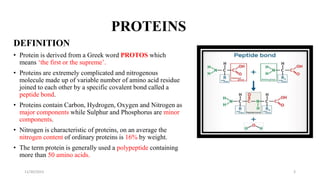
• Proteins are extremely complicated and nitrogenous
molecule made up of variable number of amino acid residue
joined to each other by a specific covalent bond called a
peptide bond.
• Proteins contain Carbon, Hydrogen, Oxygen and Nitrogen as
major components while Sulphur and Phosphorus are minor
components.
• Nitrogen is characteristic of proteins, on an average the
nitrogen content of ordinary proteins is 16% by weight.
• The term protein is generally used a polypeptide containing
more than 50 amino acids.
11/30/2023 3
CLASSIFICATION
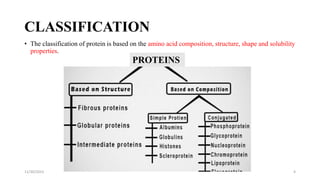
• The classification of protein is based on the amino acid composition, structure, shape and solubility
properties.
PROTEINS
11/30/2023 4
1.FIBROUS PROTEIN
• These proteins are lipid soluble
• They are elongated polypeptide chain generate filamentous sheet like structure
• E.g. : Elastin, Keratin
2.GLOBULAR PROTEIN
• These proteins are water soluble
• They are spherical polypeptide chain
• E.g. : Hemoglobin, Insulin
3.INTERMEDIATE PROTEIN:
• This type of protein have cytoskeleton structure
• They provide support structure to the cells
• E.g. : Desmin, Keratin
11/30/2023 5
4.SIMPLE PROTEIN:
• They have only amino acids, no other non protein components.
• Eg: Albumin, Globulins
5.CONJUGATED PROTEIN:
• They have both amino acids and non protein components.
• Eg: Phosphoprotein, Glycoprotein
11/30/2023 6
CHEMISTRY OF PROTEIN
• Proteins are polymers of L – α – amino acids.
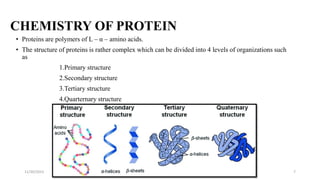
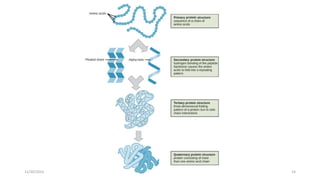
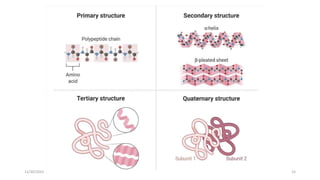
• The structure of proteins is rather complex which can be divided into 4 levels of organizations such
as
1.Primary structure
2.Secondary structure
3.Tertiary structure
4.Quarternary structure
11/30/2023 7
PRIMARY STRUCUTRE
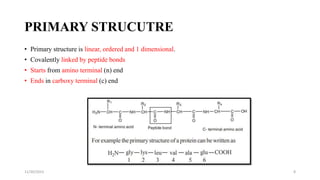
• Primary structure is linear, ordered and 1 dimensional.
• Covalently linked by peptide bonds
• Starts from amino terminal (n) end
• Ends in carboxy terminal (c) end
11/30/2023 8
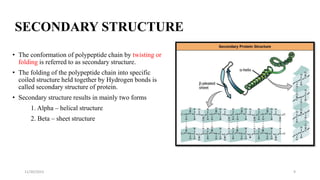
SECONDARY STRUCTURE
• The conformation of polypeptide chain by twisting or
folding is referred to as secondary structure.
• The folding of the polypeptide chain into specific
coiled structure held together by Hydrogen bonds is
called secondary structure of protein.
• Secondary structure results in mainly two forms
1. Alpha – helical structure
2. Beta – sheet structure
11/30/2023 9
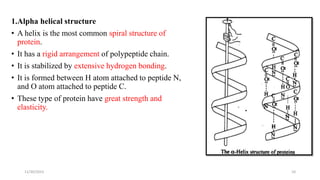
1.Alpha helical structure
• Α helix is the most common spiral structure of
protein.
• It has a rigid arrangement of polypeptide chain.
• It is stabilized by extensive hydrogen bonding.
• It is formed between H atom attached to peptide N,
and O atom attached to peptide C.
• These type of protein have great strength and
elasticity.
11/30/2023 10
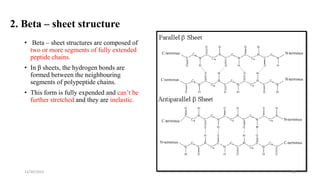
2. Beta – sheet structure
• Beta – sheet structures are composed of
two or more segments of fully extended
peptide chains.
• In β sheets, the hydrogen bonds are
formed between the neighbouring
segments of polypeptide chains.
• This form is fully expended and can’t be
further stretched and they are inelastic.
11/30/2023 11
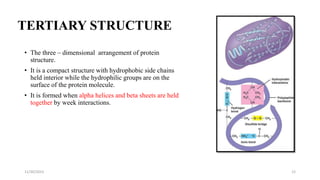
TERTIARY STRUCTURE
• The three – dimensional arrangement of protein
structure.
• It is a compact structure with hydrophobic side chains
held interior while the hydrophilic groups are on the
surface of the protein molecule.
• It is formed when alpha helices and beta sheets are held
together by week interactions.
11/30/2023 12
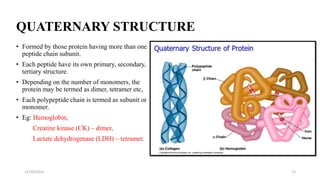
QUATERNARY STRUCTURE
• Formed by those protein having more than one
peptide chain subunit.
• Each peptide have its own primary, secondary,
tertiary structure.
• Depending on the number of monomers, the
protein may be termed as dimer, tetramer etc,
• Each polypeptide chain is termed as subunit or
monomer.
• Eg: Hemoglobin,
Creatine kinase (CK) – dimer,
Lactate dehydrogenase (LDH) – tetramer.
11/30/2023 13
11/30/2023 14
11/30/2023 15
Reference
• Textbook of biochemistry – D M VASUDEVAN
• Fundamentals of biochemistry – Dr. U. Sathyanarayana
11/30/2023 16

Proteins,its types and chemistry

  • 1.
  • 2.
  • 3.
    PROTEINS DEFINITION • Protein isderived from a Greek word PROTOS which means ‘the first or the supreme’. • Proteins are extremely complicated and nitrogenous molecule made up of variable number of amino acid residue joined to each other by a specific covalent bond called a peptide bond. • Proteins contain Carbon, Hydrogen, Oxygen and Nitrogen as major components while Sulphur and Phosphorus are minor components. • Nitrogen is characteristic of proteins, on an average the nitrogen content of ordinary proteins is 16% by weight. • The term protein is generally used a polypeptide containing more than 50 amino acids. 11/30/2023 3
  • 4.
    CLASSIFICATION • The classificationof protein is based on the amino acid composition, structure, shape and solubility properties. PROTEINS 11/30/2023 4
  • 5.
    1.FIBROUS PROTEIN • Theseproteins are lipid soluble • They are elongated polypeptide chain generate filamentous sheet like structure • E.g. : Elastin, Keratin 2.GLOBULAR PROTEIN • These proteins are water soluble • They are spherical polypeptide chain • E.g. : Hemoglobin, Insulin 3.INTERMEDIATE PROTEIN: • This type of protein have cytoskeleton structure • They provide support structure to the cells • E.g. : Desmin, Keratin 11/30/2023 5
  • 6.
    4.SIMPLE PROTEIN: • Theyhave only amino acids, no other non protein components. • Eg: Albumin, Globulins 5.CONJUGATED PROTEIN: • They have both amino acids and non protein components. • Eg: Phosphoprotein, Glycoprotein 11/30/2023 6
  • 7.
    CHEMISTRY OF PROTEIN •Proteins are polymers of L – α – amino acids. • The structure of proteins is rather complex which can be divided into 4 levels of organizations such as 1.Primary structure 2.Secondary structure 3.Tertiary structure 4.Quarternary structure 11/30/2023 7
  • 8.
    PRIMARY STRUCUTRE • Primarystructure is linear, ordered and 1 dimensional. • Covalently linked by peptide bonds • Starts from amino terminal (n) end • Ends in carboxy terminal (c) end 11/30/2023 8
  • 9.
    SECONDARY STRUCTURE • Theconformation of polypeptide chain by twisting or folding is referred to as secondary structure. • The folding of the polypeptide chain into specific coiled structure held together by Hydrogen bonds is called secondary structure of protein. • Secondary structure results in mainly two forms 1. Alpha – helical structure 2. Beta – sheet structure 11/30/2023 9
  • 10.
    1.Alpha helical structure •Α helix is the most common spiral structure of protein. • It has a rigid arrangement of polypeptide chain. • It is stabilized by extensive hydrogen bonding. • It is formed between H atom attached to peptide N, and O atom attached to peptide C. • These type of protein have great strength and elasticity. 11/30/2023 10
  • 11.
    2. Beta –sheet structure • Beta – sheet structures are composed of two or more segments of fully extended peptide chains. • In β sheets, the hydrogen bonds are formed between the neighbouring segments of polypeptide chains. • This form is fully expended and can’t be further stretched and they are inelastic. 11/30/2023 11
  • 12.
    TERTIARY STRUCTURE • Thethree – dimensional arrangement of protein structure. • It is a compact structure with hydrophobic side chains held interior while the hydrophilic groups are on the surface of the protein molecule. • It is formed when alpha helices and beta sheets are held together by week interactions. 11/30/2023 12
  • 13.
    QUATERNARY STRUCTURE • Formedby those protein having more than one peptide chain subunit. • Each peptide have its own primary, secondary, tertiary structure. • Depending on the number of monomers, the protein may be termed as dimer, tetramer etc, • Each polypeptide chain is termed as subunit or monomer. • Eg: Hemoglobin, Creatine kinase (CK) – dimer, Lactate dehydrogenase (LDH) – tetramer. 11/30/2023 13
  • 14.
  • 15.
  • 16.
    Reference • Textbook ofbiochemistry – D M VASUDEVAN • Fundamentals of biochemistry – Dr. U. Sathyanarayana 11/30/2023 16