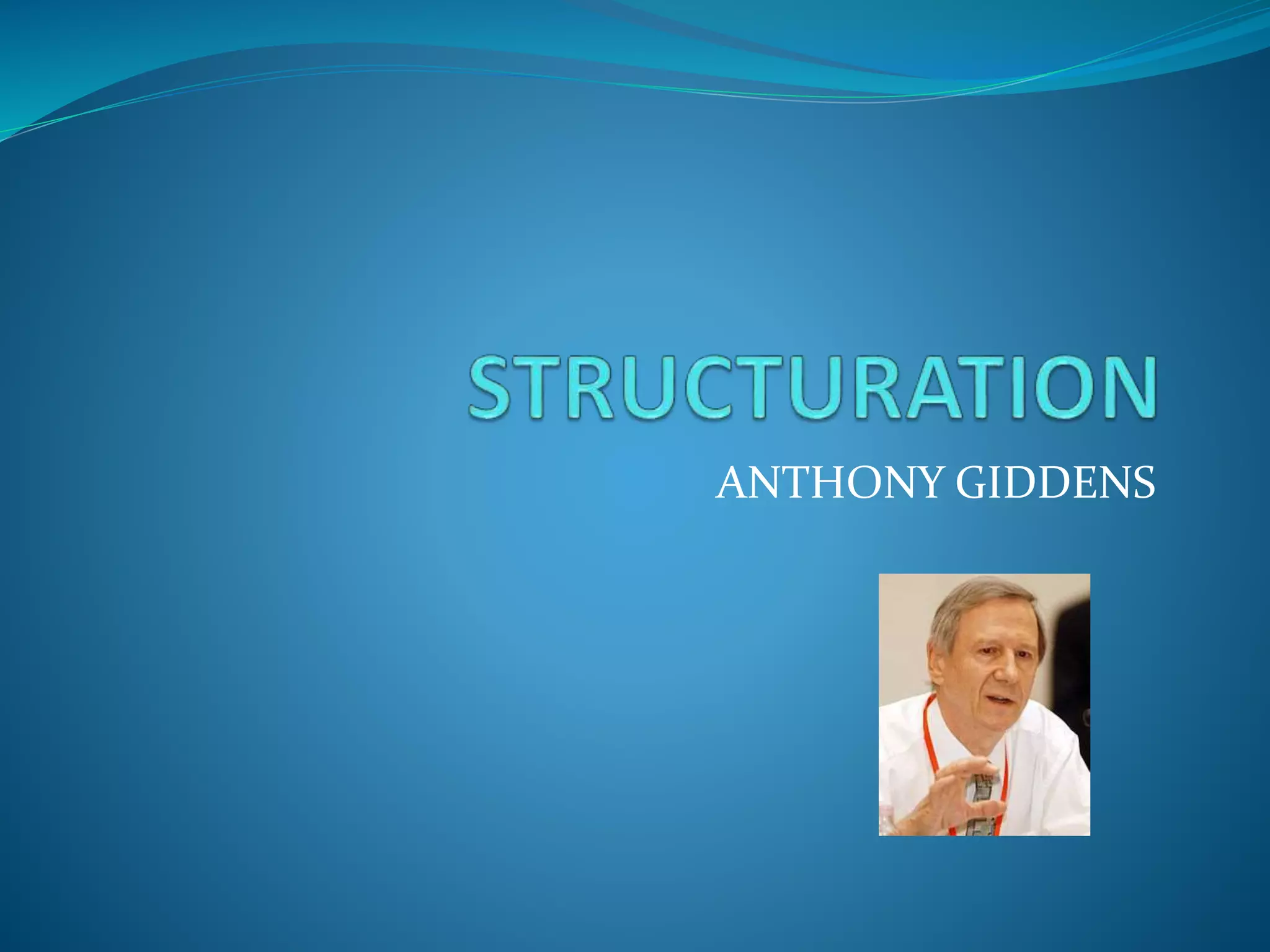
ANTHONY GIDDENS
Structuration
 The ways in which social systems are produced and
reproduced in social interaction.
 The relationship between the individual and society is
of central concern to this theory.
 Giddens defines structuration as “the structuring of
social relations across time and space, in virtue of the
duality of structure” (Giddens, 1984, p. 376)
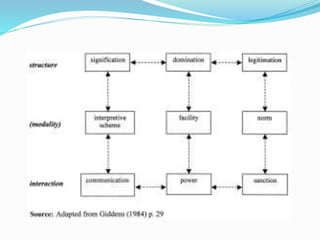
From the image:
 There are three dimensions of structure, which are
signification, domination and legitimation.
 The three dimensions of interaction are described as
communication, power and sanctions.
 The means by which structures are translated into
actions are called modalities, which are interpretive
schemes, facilities and norms. These modalities can
explain why and how interaction is affected.
 In the study of individual social action and interaction,
there are two positions – action and praxis.
 The praxis approach emphasizes the enactment,
performance, or production of social action
 Structuration means changes in practices as well as
regularities and continuation in these. The approach
of Giddens is similar to that of the American
pragmatist John Dewey.
dimensions
 The first dimension refers to production of meaning
 The second to degrees of power
 The third to societal norms
 Modality can be seen as the tools, it makes interaction
possible, and can be influenced along the way. The
result is that social interaction, for example on
communities, is influenced by structure and the three
modalities interpretive schemes, facilities and norms.
The interpretive scheme translates structure into
actions.
Elements of structuration
 Human agency, where the social actor is a rational
actor who has the ability to make decisions.
 Reflexivity-the monitored character of the ongoing
flow of social life
 Structure-These are the patterns in the social world
that affect individuals and are composed of rules,
resources, and agency.
 structure is more specific and detailed than system,
referring to structured practices. Rules and resources
are the two primary features of structures such as
market exchange, class structures, political
organizations and processes, and educational
institutions.
 Procedural rules – how the practice is performed. Give
and take of encounters, language rules, walking in a
crowd.
 Moral rules – appropriate forms of enactment of social
action. Laws, what is permissible and what is not. These
do not refer ultimate values (e.g. spiritual or sacred values),
but refer to appropriate ways of carrying out social action
and interaction.
 Material resources – allocation of resources among
activities and members of society. Means of production,
commodities, income, consumer and capital goods.
 Resources of authority-Formal organizations, how time
and space are organized, production and reproduction,
social mobility, legitimacy, and authority.
 In short, structuration is something that can be set, it’s
organized at the beginning.
Reference book:
http://www.cmecc.com/uploads/%E8%AF%BE%E6%9C
%AC%E5%92%8C%E8%AE%BA%E6%96%87/[43][%E7
%A9%BA%E9%97%B4%E7%A4%BE%E4%BC%9A%E6
%96%87%E5%8C%96]Anthony.Giddens.(1984)The.Con
stitution.of.Society.pdf
Presentation by
ABIRAMI.G(1803029)
M.Phil(2018-2019)
THANK YOU

Structuration ppt

  • 1.
  • 2.
    Structuration  The waysin which social systems are produced and reproduced in social interaction.  The relationship between the individual and society is of central concern to this theory.  Giddens defines structuration as “the structuring of social relations across time and space, in virtue of the duality of structure” (Giddens, 1984, p. 376)
  • 4.
    From the image: There are three dimensions of structure, which are signification, domination and legitimation.  The three dimensions of interaction are described as communication, power and sanctions.  The means by which structures are translated into actions are called modalities, which are interpretive schemes, facilities and norms. These modalities can explain why and how interaction is affected.
  • 5.
     In thestudy of individual social action and interaction, there are two positions – action and praxis.  The praxis approach emphasizes the enactment, performance, or production of social action  Structuration means changes in practices as well as regularities and continuation in these. The approach of Giddens is similar to that of the American pragmatist John Dewey.
  • 6.
    dimensions  The firstdimension refers to production of meaning  The second to degrees of power  The third to societal norms  Modality can be seen as the tools, it makes interaction possible, and can be influenced along the way. The result is that social interaction, for example on communities, is influenced by structure and the three modalities interpretive schemes, facilities and norms. The interpretive scheme translates structure into actions.
  • 7.
    Elements of structuration Human agency, where the social actor is a rational actor who has the ability to make decisions.  Reflexivity-the monitored character of the ongoing flow of social life  Structure-These are the patterns in the social world that affect individuals and are composed of rules, resources, and agency.
  • 8.
     structure ismore specific and detailed than system, referring to structured practices. Rules and resources are the two primary features of structures such as market exchange, class structures, political organizations and processes, and educational institutions.  Procedural rules – how the practice is performed. Give and take of encounters, language rules, walking in a crowd.
  • 9.
     Moral rules– appropriate forms of enactment of social action. Laws, what is permissible and what is not. These do not refer ultimate values (e.g. spiritual or sacred values), but refer to appropriate ways of carrying out social action and interaction.  Material resources – allocation of resources among activities and members of society. Means of production, commodities, income, consumer and capital goods.  Resources of authority-Formal organizations, how time and space are organized, production and reproduction, social mobility, legitimacy, and authority.
  • 10.
     In short,structuration is something that can be set, it’s organized at the beginning. Reference book: http://www.cmecc.com/uploads/%E8%AF%BE%E6%9C %AC%E5%92%8C%E8%AE%BA%E6%96%87/[43][%E7 %A9%BA%E9%97%B4%E7%A4%BE%E4%BC%9A%E6 %96%87%E5%8C%96]Anthony.Giddens.(1984)The.Con stitution.of.Society.pdf
  • 11.