Wikborg Rein’s Shipping Offshore:


                                                                                    Update
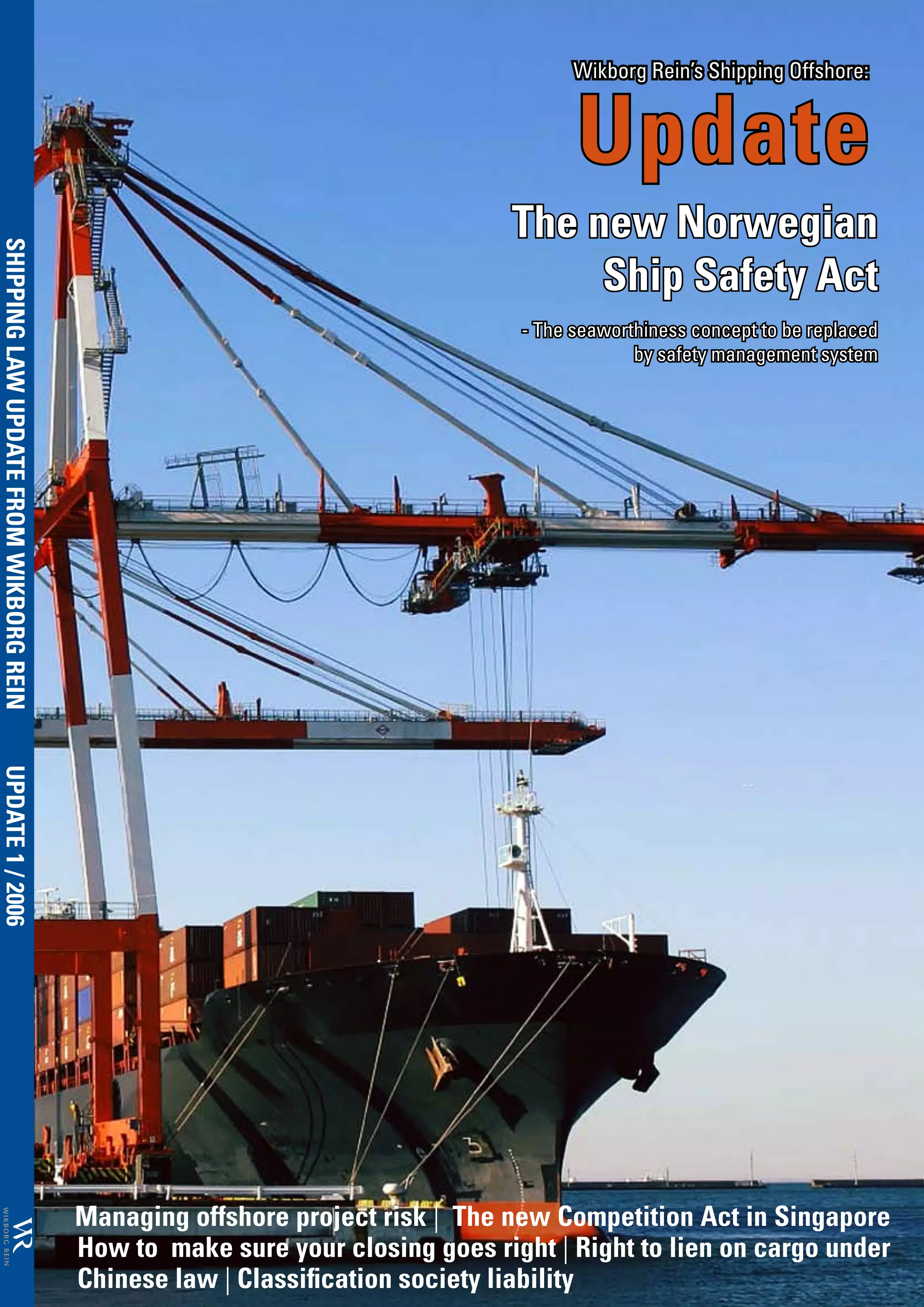
                                                                              The new Norwegian
SHIPPING LAW UPDATE FROM WIKBORG REIN


                                                                                   Ship Safety Act
                                                                              - The seaworthiness concept to be replaced
                                                                                           by safety management system
UPDATE 1 / 2006


                                        Managing offshore project risk | The new Competition Act in Singapore
                                        How to make sure your closing goes right | Right to lien on cargo under
                                        Chinese law | Classification society liability
UPDATE 1/2006
             Contents


                                             An exciting time to be a shipping lawyer 3
       Top ten reasons closings go wrong – and how to make sure yours goes right 4
                                               The new Norwegian Ship Safety Act 6
            Norwegian Accident Investigation Board to investigate accidents at sea 8
                                                         Classification society liability 9
                         Safety at sea and marine insurers’ duty of confidentiality 10
                   The shipboker’s right to commission - change of broker channel 11
                                                      Managing offshore project risk 12
                                           Right to lien on cargo under Chinese law 14
                                        International conventions ratified by China 16
                                     Voice recording using voyage data recorders 17
                                        Notice of readiness under voyage charters 18
     The impact of the new Competition Act in Singapore on international shipping 20
                                   Wikborg Rein’s Shipping Competition Law Team 22
EU Commission moving forward on the repeal of exemption for the shipping industry 23
                                                  The Maritime Trainee Programme 24
                                                                     Personnel news 25
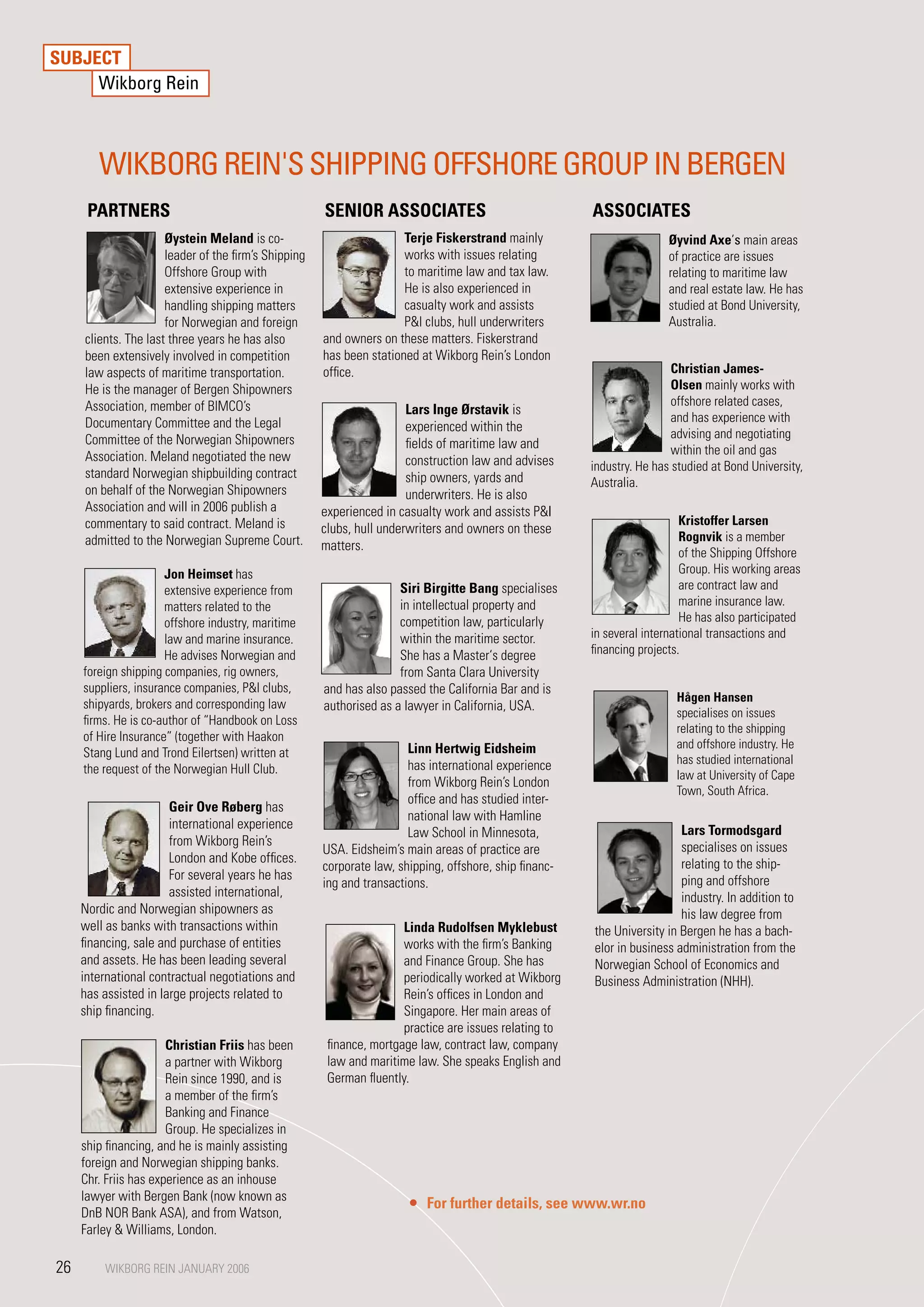
                               Wikborg Rein’s Shipping Offshore Group in Bergen 26


PUBLISHER: Wikborg Rein EDITORIAL STAFF: Gaute Gjelsten, Herman Steen, Stephen N. Lamb DESIGN: Lise Røed   PRINT: HBO
AN ExCITING TIME TO BE A ShIPPING LAWyER
It is an exciting time to be a shipping lawyer at Wikborg Rein. 2005 was one of our busiest years ever in
the firm’s Shipping Offshore department and 2006 holds great promise to be equally challenging.

I have always believed that being a good lawyer was as much about preventing problems as it was about
resolving them after they occur. The article on page 4 is a good example of that principle. Every day --
somewhere in the world -- a Wikborg Rein lawyer is working to make sure that an upcoming closing for a
ship sale and purchase or lease-back goes smoothly. It is a mainstay of our work and the article draws on
our collective experience to outline the most common snags and shoals and how best to avoid them.

While recent years have seen the shipping industry benefit from good economic times, this success has
also, and not surprisingly, more keenly focused the attention of regulators and others on the business. This
issue contains two articles on the competition law efforts of regulators in Asia and Europe. The article on
page 23 examines the EU’s new regulations impacting the shipping industry, and the article on page 20
looks at the effects of the new Competition Act in Singapore on international firms doing business there.

Long the financial capital of Southeast Asia, Singapore has established itself in recent years as the home
to many of the world’s top building yards for offshore rigs. Wikborg Rein partner Finn Bjørnstad, who recently returned
from three years in our Singapore office, writes with partner Kelly Malone, on page 12 about this firm’s body of experience
and expertise with the offshore industry.

Though the economic times may be good, our lawyers are not content to simply accept traditional assumptions about the
liability of those whose negligence causes harm to shipowners and their insurers. This issue contains a thought-provoking
article about the liability of classification societies on page 9. Long assumed to be effectively beyond the reach of tort
and contract liability by many legal observers, our lawyers have been involved in challenging this notion. Negligence by
a classification society, or even a government agency, is no longer something that shipowners must necessarily accept
without recourse.

As our practice has continued to grow, so too has our staff. In addition to six new associates, Anders W. Færden joined
our Oslo office in September as partner. As the article on page 25 explains in more detail, Anders is highly regarded in
maritime law circles, admitted to practice before the Norwegian Supreme Court, and a lawyer who genuinely enjoys
tackling the most difficult and complex of legal questions. We are extremely pleased with his decision to join our firm.

We hope you enjoy this issue of the Update along with our very best wishes for a happy and successful 2006!

Yours truly,
WIKBORG REIN


Trond Eilertsen
Leader of Wikborg Rein’s
Shipping and Offshore group


                                                                                                          WIKBORG REIN JANUARY 2006   3
SUBJECT
   Closings


     WHy CLOSINGS GO WRONG
     - AND HOW TO MAKE SURE yOURS GOES RIGHT
 Imagine sitting in the London conference room of one of the                How to make sure yours goes right
 world’s largest ship registries. The room is crowded with                  The good news is that an overwhelming majority of closings are com-
 representatives from the buyer and seller of the vessel that is            pleted without any major problems. And those problems most com-
 about to change hands, and the nervous small talk has run out              monly encountered can almost always be avoided through proper
 as everyone waits for confirmation that the funds have arrived             preparation and communication. Specifically, this means having deter-
 in the seller’s bank account. The phone rings, but it is not the           mined all of the buyer’s and seller’s main obligations and then nego-
 bank. Instead it’s the buyer’s representatives on board the ves-           tiating and finalizing a tailored memorandum of agreement (“MoA”),
 sel calling to remind the meeting that the vessel is due to be de-         closing memo and document checklist.
 livered under a charterparty in less than 30 minutes. No funds
 – no delivery.                                                             The importance of being well prepared and how to prepare
                                                                            In a perfect world, a closing would not take place until all details are
 It turns out the bank has the wrong account number on the SWIFT            thoroughly planned. But in reality, not all closings take place with the
 interbank payment message. The correct account number is quickly for-      luxury of a schedule that allows for such thorough preparation. The
 warded to the bank and everyone around the table laughs nervously in       usual schedule requires all participants to prioritize by distinguishing
 relief. Then the registrar enters the room and asks: “Which one of you     those matters of importance that must absolutely be dealt with before
 has the original bill of sale....?” No one answers.                        the closing and those less important, which can be dealt with later.
                                                                            When a new sale and purchase transaction arises it can be helpful to
 Most such scenarios end happily with a last-minute solution and only       draw up a chart and check-list showing: (1) buyer’s and seller’s name,
 a minor delay. But on rare occasions, a once-willing buyer or seller has   corporate status and jurisdiction; (2) vessel name, type, flag state and
 become decidedly reluctant and practical difficulties with the closing     any encumbrances (to be discharged or registered); (3) any change of
 are exploited to cancel the transaction altogether.                        flag information; and (4) whether the parties have agreed upon a pay-
                                                                            ment procedure. As the check-list is filled in with information, the next
 Common reasons why closings go wrong                                       steps are easily put in their proper order for the day of closing (e.g.
 What is a “closing”?                                                       MoA, mortgage discharge, vessel deletion, vessel registration and
 “Closing” is a shorthand term for the completion of a transaction.         mortgage registration).
 The term closing can be defined as the conclusion of an object’s sale,
 whereby: (1) payment is made; (2) any previous mortgages discharged;       Tailor the MoA for a smooth closing
 (3) the title to the asset is transferred; and (4) any new mortgages se-   The best way to avoid last minute discussions is to ensure that the
 cured.                                                                     discussions are closed at an early stage with a tightly worded MoA
                                                                            between the seller and the buyer in which they agree upon all material
 The list                                                                   aspects of the deal.
 The below list – although not complete – identifies the most common
 reasons why closings go wrong:                                             A large number of sales are based on MoAs on the “Norwegian Sale-
                                                                            form” which in its original form does not include many guidelines as
 1 Failure to agree in advance on closing and payment                       to how the closing should be completed. It merely lists a suggested
    procedures                                                              set of documents to be delivered to the buyer “in exchange for the
 2 Documents not prepared in advance or not present at                      purchase price” pursuant to clause 8. Failing to discuss or agree on
    closing                                                                 the closing procedure and the documents to be presented may lead
 3 Failure to agree on delivery documents                                   to unpleasant surprises later. Consequently; the parties should ideally
 4 Vessel not physically ready                                              prepare an addendum to the agreement listing the main documents
 5 Documents lost or delayed                                                to be delivered by both parties. Just as important – at least for seller
 6 Documents contain mistakes and / or are not properly                     – is to clearly state that the free and clear certificate of ownership and
    notarised or legalised                                                  encumbrances will not be presented to buyer until after the purchase
 7 Payment is inadequate or delayed                                         price (and payment for bunkers and lubes) are well received in order for
 8 Registries / banks not open or unwilling to open early or stay           the mortgage, if any, to be discharged.
    late
 9 Registry does not produce the documents when expected                    Prepare and finalise a closing memo and a document list
 10 Buyer trying to renegotiate at the last minute or new issues            The next step after finalising the MoA should be to start drafting a
    arising at closing                                                      closing memo and a document checklist (if not included in the MoA as


 4      WIKBORG REIN JANUARY 2006
SUBJECT
                                                                                                                                  Closings


mentioned above). While most closings will involve the buyer also hav-      tion from the registry that all is ready for discharge of the existing
ing to comply with a condition precedent (“CP”) list related to a loan      mortgage and deletion of the vessel (if relevant). If the vessel is bare-
agreement, this article does not deal with that particular aspect. The      boat registered, make sure that deletion is facilitated and documented
main purposes of a closing memo is to outline the closing procedure         pursuant to the requirements of the main register as they may refuse
and to complete the list of documents and serves the important pur-         the delete otherwise.
pose of identifying any obstacles to the closing procedure as all parties   - Ensure that the current mortgagee has facilitated the mortgage dis-
will consider whether they will be able to comply with the obligations      charge and agree on the trigger for the actual discharge. Be prepared
listed. A good closing memo will:                                           that the mortgagee will not normally discharge the mortgage until they
(i) include names and contact details for everyone involved, including      have received the funds outstanding under the relevant loan(s). Make
the ship registries. If a time difference is involved then each party’s     sure the buyer understand the same.
local time should be specified.
                                                                            Buyer’s obligations
(ii) reflect on an accurate payment and closing procedure. Particular       From a strict closing perspective, a buyer’s task is normally easy: de-
attention should be paid to ensuring agreement on these steps, as they      liver a few corporate documents, sign the deposit release, accept the
involve the cooperation of players other than the seller and buyer. 90      delivery documents and the vessel and pay the purchase price, bunkers
% of the world’s fleet is mortgaged, and one should bear in mind that       and lubes and any extras. Nonetheless, the buyers should ensure the
in the event of a mortgage registered against the vessel, the mortga-       following:
gee will not normally discharge the mortgage until repayment of the
loan is made. The wording of the standard clause 8 of the MoA how-          - Prepare the corporate documents in due course, have them pre-ap-
ever, states that delivery of the delivery documents shall take place       proved by the seller, both as drafts and in completed form (notarised
“in exchange for payment”, stating that the payment and delivery ob-        and legalised/apostilled). Bring originals as agreed.
ligations should be performed simultaneously. In practice, this is not       - Agree on the deposit release letter and make sure to bring a power of
possible and it is normally assumed as an obligation of both parties        attorney (pre-approved) or proof of identity empowering a representa-
to ensure that the risks involved are minimized. One procedure used,        tive of the buyer to sign the release letter.
which also ensures a high level of simultaneous performance, is to          - Request to pre sight all seller delivery documents if possible in draft
table all delivery documents and for the buyer (through buyer’s bank)       and completed form.
to present an unconditional and irrevocable payment letter. Delivering      - Agree on the payment procedure also for the balance and bunkers
the payment letter to the seller or seller’s bank (mortgagee) will be       and lubes. Ensure that the financing bank agrees to the payment proce-
regarded as equivalent to payment, and the mortgagee will discharge         dure between the seller and buyer as early as possible. Double check
the mortgage without having to wait for the funds to actually arrive at     the payment details.
sellers account prior to proceeding with the discharge of mortgage and
the release of the other delivery documents. If however a procedure         Even if this is a matter for the buyer; the vessel will either be chang-
is agreed where the buyers will pay the funds to seller (seller’s banks)    ing ownership within the same registry or change flag. In both cir-
account, the mortgagee is often asked to issue an undertaking stat-         cumstances buyer should ensure as early as possible if any of these
ing that they will discharge the mortgage upon receipt of the funds at      procedures requires documents from the seller (in addition to the origi-
the relevant account, also often accompanied by a statement from the        nal/copy of a bill of sale). If so, these documents should be identified
sellers that at the same time the bill of sale will be released and the     and pre-cleared by the registry as early as possible, and if not included
protocol of delivery and acceptance signed. This procedure ensure that      in the document checklist, the buyer will have to rely on the seller’s
both seller and buyer can feel confident they will receive payment and      discretion as to whether they will assist.
a free and clear vessel, respectively.
                                                                            In the likely event that a new mortgage is being registered against the
Seller’s obligations                                                        vessel, this should also be pre-cleared with the registry in advance.
Seller have the most extensive obligations in the closing. In addition      When a second mortgage is to be recorded in favour of a mortgagee
to physically preparing the vessel for delivery, all delivery documents     other than the first priority mortgage, a letter of consent from the first
including the ones representing title to the vessel must be prepared        mortgagee must be presented.
and brought to closing, as well as making the necessary arrangements
with the vessel’s current ship registry. The heading could also have        Final preparations and on the closing day
included “seller’s bank or current mortgagee” as the mortgagee and          If possible, a final check should be made the day before closing; and if
bank are playing important roles in the closing. The main focus of the      possible a final message should be distributed to all parties confirming
seller should be the following:                                             relevant details for the closing. All that is left is to ensure that cell
                                                                            phone batteries are charged, original bill of sales are in hand, and of
- Prepare the delivery documents pursuant to the MoA and request that       course the correct account number on the SWIFT message.
the same are pre-cleared by the buyer in advance both as drafts and
in completed form.
- Make arrangements with the current ship registry and have all docu-                              FOR MORE INFORMATION, CONTACT:
ments required for deletion of the vessel pre-cleared. Obtain confirma-                           Linn Hertwig Eidsheim (lhe@wr.no) or
                                                                                                         Bernhard Haukali (bha@wr.no)


                                                                                                              WIKBORG REIN JANUARY 2006             5
SUBJECT
     Ship Safety Act


    THE NEW NORWEGIAN SHIP SAFETy ACT
    PURPOSE, SCOPE AND SAFETy MANAGEMENT
    The existing Norwegian Seaworthiness Act was originally                    The concept of “safety management” is well known from the ISM
    issued in 1903. While it has been amended frequently since                 Code. The committee states that for those already complying with
    that time in an attempt to reflect the enormous technical,                 the ISM Code, the new Act’s strong emphasis on safety management
    environmental, political, national, international and legal                will not necessarily mean any substantial changes. However, it is
    changes regarding ship safety it is today considered                       important to note that unlike the ISM Code, the new Act introduces
    unsatisfactory in many respects. Consequently, on its 100th                safety management requirements not only for vessel operations, but
    anniversary, a committee was appointed to revise the existing              also vessel engineering and building.
    Act. The committee submitted its unanimous report on 29 June
    2005 (NOU 2005:14) proposing a new Act – the Ship Safety Act.              The new Act prescribes a general duty for the shipowners (in
    The report was sent out for comments until 21 November 2005.               Norwegian: “reder”) to provide for, ensure and develop the
    Based on the few objections received during the comment                    establishment of a sufficient safety management system that can
    period, it is expected that the proposal will most likely be               be verified and documented in order to survey and control the risk
    adopted in its present form. The new Act is expected to enter              as well as to assure that applicable rules are followed. The master
    into force prior to 2007.                                                  and the crew on board the vessel have certain duties to contribute to
                                                                               the establishment of the vessel’s safety management. The concept
    Mandate and purpose                                                        of safety management is generally flexible and comprises the vessel,
    The mandate of the committee focused on drafting of a set of               her management and the qualifications of the crew. Whereas the
    rules which would be in line with international and EU regulations         new Act sets out the concept in more general terms, its details will
    regarding vessel safety management. The committee was charged              be contained in regulations laid down pursuant to the new Act and
    with developing a more uniform regulation and the reduction of the         shall i.a. take into account the particular need of the shipowners and
    level of details in the existing Act by i.a. delegation to the competent   the activity and business they run.
    Ministries. As part of this process the committee evaluated
    modernizing supervision and control, available sanctions against
    infringements of the rules, and the incorporation of other Norwegian
    Acts.

    The purpose of the new Act is to safeguard life, health, property and
    the environment by promoting a high level of ship safety, ensuring
    a safe working environment, preventing pollution from vessels,
    incorporating requirements and responsibilities for vessel’s safety
    management system, establishing and developing appropriate
    supervision and control and arranging for the development of
    regulations in compliance with international law, in particular IMO
    (e.g. SOLAS, MARPOL, the ISM and ISPS Code), ILO and EU rules.

    Material and geographic scope
    The new Act will apply to Norwegian and foreign vessels, except for
    non-commercial vessels with an overall length of less than 24 meters.
    The new Act will apply to Norwegian flagged vessels throughout the
    world while foreign vessels will only be subject to the new Act while
    in Norwegian waters . The government may decide whether and to
    what extent the new Act and regulations laid down pursuant to its
    provisions shall apply to other units and/or vessels like e.g. offshore
    drilling units.

    “Safety Management” versus “Seaworthiness”
    Under the existing Act, safety at sea is linked to the concept of
    “seaworthiness”, which has also been adopted in the Norwegian
    Maritime Code and the Norwegian Marine Insurance Plan. In the new
    Act, this concept is phased out and replaced by the new concept of
    “internal control methodology” which is defined in the new Act as
    “safety management” (in Norwegian: “sikkerhetsstyring”).


6       WIKBORG REIN JANUARY 2006
SUBJECT
                                                                                                                                 Ship Safety Act


          RESPONSIBILITIES, SUPERVISION AND LEGAL CONSEQUENCES
          Part of the mandate of the committee for the revision of the              accordance with the latest EU developments as expressed in the
          existing Norwegian Seaworthiness Act was to stipulate the                 third Maritime Safety Package.
          shipowner’s and master’s responsibilities for the vessel’s
          safety management system. Moreover, the committee had                     Legal consequences
          to evaluate a modernization of the scope and extent of the                The only administrative sanction for infringement provided for in
          vessel’s safety management control and legal consequences                 the current Seaworthiness Act (except for infringement of rules on
          of an infringement of stipulated rules. The existing Act is today         pollution prevention) is detention of the vessel. Detention is only
          seen as too inflexible and ineffective in these respects.                 allowed if the vessel is not seaworthy or the certificates are invalid.
                                                                                    Less serious infringements of the rules are only subject to criminal
          Responsibilities                                                          liability, if any. The new Act de-emphasizes criminal liability as legal
          Following the grounding and subsequent loss of the high speed             consequences for infringement and instead introduces alternative
          passenger catamaran “SLEIPNER” in 1999, it was concluded that             measures: (1) administrative acts (in Norwegian: “forvaltningstiltak”);
          the Norwegian Maritime Directorate was not subject to liability           and (2) administrative sanctions (in Norwegian: “administrative
          under the existing Act. The new Act clarifies that the operation of       sanksjoner”). Administrative acts are – in ascending order according
          the vessel does not lie within the responsibilities of the Directorate    to the degree of seriousness – requests to carry out certain measures,
          but is primarily the responsibility of the shipowner and that the         fines and withdrawal of statutory certificates. Administrative
          latter is liable in case of an infringement of applicable rules. The      sanctions are administrative fines that are implemented in case of
          master is liable in connection with the operation of the vessel, such     an infringement of applicable rules. The current possibility for the
          as navigation and watchkeeping; and the crew may be liable where          vessel’s detention has been upheld in the new Act. Administrative
          they have distinct duties.                                                acts and sanctions apply to Norwegian and foreign vessels; and
                                                                                    foreign vessels may also be denied future access to Norwegian
                    Supervision                                                     waters.
                    Pursuant to the existing Act, vessels of 50 gross ton or more
                    are subject to supervision by the Norwegian Maritime            Since administrative fines may be implemented fast and without
                    Directorate, which has authorized five classifications          the involvement of the prosecuting authorities and courts, they are
                    societies (GL, DNV, ABS, LR, BV) to carry out parts of the      an immediate reaction to an infringement of the vessel’s safety
                    necessary surveys. The committee finds this cooperation         management. Administrative fines may amount to approximately
                    fit and suitable and it is therefore maintained in the new      the same amounts as criminal penalties under the current system.
                    Act. Further, the new Act opens for an authorization of         It is therefore the committee’s view that administrative fines may,
                    approved undertakings and authorities, be they private,         in particular in relation to foreign vessels, be more efficient than
                    foreign (e.g. according to the Paris MOU) or international      criminal penalties and consequently replace the latter in many
                    (such as e.g. the European Maritime Safety Agency               cases.
                    (EMSA)).
                                                                                    Provisions on criminal liability previously set out in the Norwegian
                     The committee emphasises that even though the focus            Criminal Act have been incorporated into the new Act, giving
                     on the shipowner’s responsibilities has increased over         statutory basis for penalties and imprisonment of up to six months
                     the years, e.g. as a result of the ISM Code, it has thus       in case of substantial infringements of certain rules – under
                     far not been sufficient to avoid major discrepancies from      aggravating circumstances up to two years. Criminal liability applies
                     applicable rules. Therefore, safety management without         to the shipowners personally, the shipowning company, the master
                     supervision is not considered satisfactory, and the new        and the crew.
                     Act is based on a “double-track” system: (1) primary
                     supervision of the safety management system, i.e.
                     primarily an inspection and verification of the shipowner’s                       FOR MORE INFORMATION, CONTACT:
                     written documentation and implementation of necessary                                    Simone Trondal (sit@wr.no),
                     measures, along with interviews and evaluations with the                                 Gry Bratvold (gba@wr.no) or
                     shipowner’s management and personnel; and (2) direct                                      Gaute Gjelsten (ggj@wr.no)
                     control by way of inspection of the vessel. The new Act
                     leaves open the possibility that primary supervision may
                     in the future gradually replace direct control. Even though
                     the latter possibility is in accordance with the purpose
                     of the ISM Code, it is questionable whether it is also in
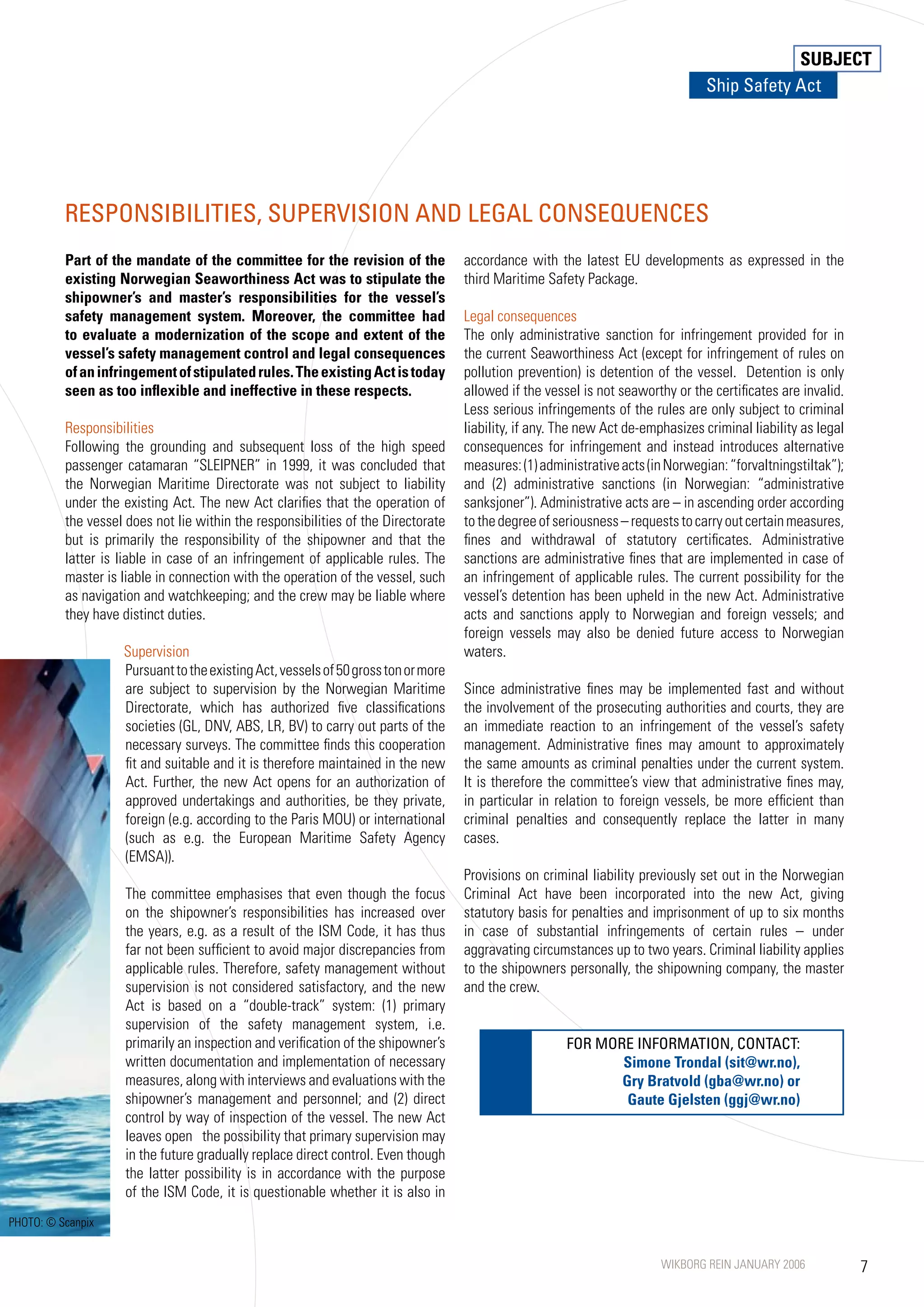
PHOTO: © Scanpix


                                                                                                                         WIKBORG REIN JANUARY 2006
SUBJECT
     Accident investigation


NORWEGIAN ACCIDENT INVESTIGATION BOARD TO
INVESTIGATE ACCIDENTS AT SEA
During 2006/2007 the Norwegian                                               Confidentiality
Accident Investigation Board will                                            The Investigation Board has an extensive duty of confidentiality in
                                                                             conducting its business, with some important exceptions. The duty
be granted authority to investigate                                          of confidentiality is outweighed by “weighty public interest” or “if
accidents at sea in addition to                                              necessary to properly explain the cause of the accident”.
accidents within the aviation, railway                                       New prohibition against removal of wreckage
and road sectors.                                                            Under the new rules removal of wreckage or other material without
                                                                             the prior consent of the Investigation Board or police authorities is
The new legislation to govern these investigations of accidents at sea       prohibited. The only exception from this prohibition is if the object will
has already been passed although they have not yet entered into force.       be lost unless removed immediately.
The new rules focuses on the establishment of the course of events in
order to promote the safety at sea and the purpose of the investigations     About the Investigation Board
carried out shall not be to apportion blame and liability. Included in       The Investigation Board is an independent investigation body with the
the new rules are generally duties to inform the proper authorities of       authority to hand over entire or parts of investigations to foreign states
any accidents at sea, extensive duties to offer testimony or deliver         authorities, to co-operate with foreign authorities, to allow participation
documents to the Investigation Board combined with restrictions on the       of foreign authorities in investigations and further the Investigation
Investigation Board not to use such information for unrelated purposes.      Board can request assistance from local police, courts of justice and
This article will summarize some of the more important of these new          other authorities as well as external expertise necessary to carry out an
rules.                                                                       investigation.

Duty to notify
The new legislation introduces a general duty for “anyone”
who witnesses an accident at sea, wreckage or other
conditions that gives reason to believe an accident at sea
has occurred, to notify the authorities. There rests a heavier
burden on the master of ships and ship-owners to fulfil such
a duty of notification.

Testimony and other evidence
The new rules further impose an extensive general duty to
offer testimony and share documents with the authorities.
“Anyone” has a duty to contribute with all relevant
information, “regardless of duties of confidentiality”. A
party offering such information is entitled to be represented
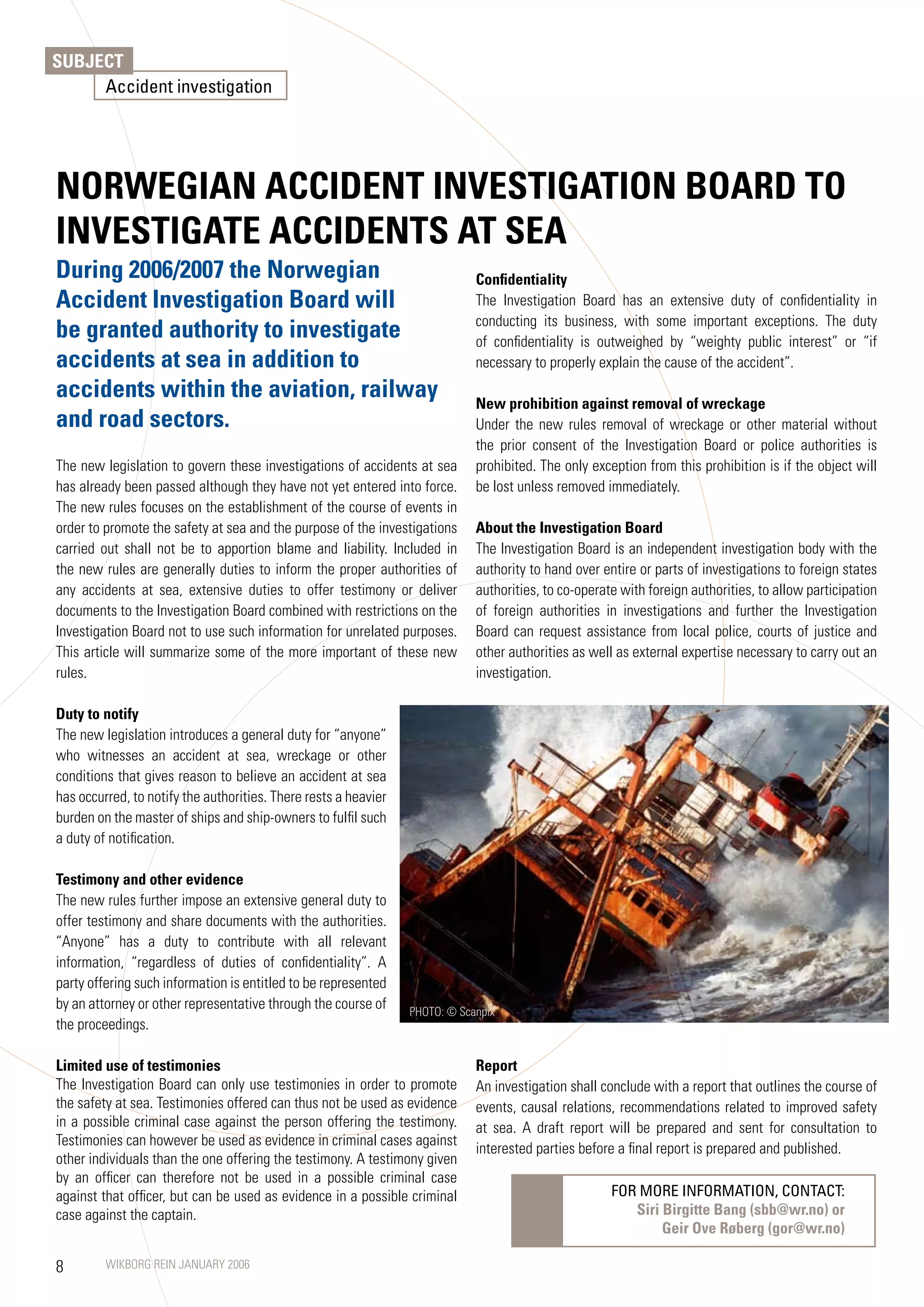
by an attorney or other representative through the course of     PHOTO: © Scanpix
the proceedings.

Limited use of testimonies                                                   Report
The Investigation Board can only use testimonies in order to promote         An investigation shall conclude with a report that outlines the course of
the safety at sea. Testimonies offered can thus not be used as evidence      events, causal relations, recommendations related to improved safety
in a possible criminal case against the person offering the testimony.       at sea. A draft report will be prepared and sent for consultation to
Testimonies can however be used as evidence in criminal cases against
                                                                             interested parties before a final report is prepared and published.
other individuals than the one offering the testimony. A testimony given
by an officer can therefore not be used in a possible criminal case
against that officer, but can be used as evidence in a possible criminal                              FOR MORE INFORMATION, CONTACT:
case against the captain.                                                                                Siri Birgitte Bang (sbb@wr.no) or
                                                                                                              Geir Ove Røberg (gor@wr.no)

8        WIKBORG REIN JANUARY 2006
SUBJECT
                                                                                                                            Class societies


CLASS SOCIETy LIABILITy
As important as they are at times controversial, classification
societies occupy a unique place in the field of maritime law                   In Norway, the authorities have delegated certain control functions
and commerce.                                                                  through the Agreement of 1 July 198 with annexes between the
                                                                               Ministry of Trade and Det Norske Veritas (“DNV”). This delegation
Class enforce statutory requirements on behalf of flag and port                has lead to some questions regarding the role DNV holds. The tasks
states yet the societies are not government agencies themselves.               DnV performs on behalf of the authorities are considered to be more
Classification societies have the power to impose sanctions yet they           of a service than business nature. Activities of a service nature have
also compete for the business of those who come under their scrutiny.          traditionally held a protected position in Norwegian tort law, and
Class make and enforce the rules but also offer consulting services on         there might be reason to ask if this protection has influenced the
how best to comply. Classification societies require the shipowners            discussion on classification societies’ liability for those tasks that are
they scrutinise to have systems of accountability, yet the societies           not performed on behalf of the authorities.
themselves remain largely a stranger to the concept of legal liability


                                                  [                                                             ]
for their own negligence. Classification societies derive nearly all of The claim that classification societies are public spirited service
their maritime revenue – directly or indirectly                                                                             institutions deserving of
– from shipowners yet resist liability when an                                                                              special      treatment     with
owner is wronged through class negligence.                      In today’s world, class                                     regards to liability dates back
Increasingly, this mix of roles and attitudes                   is hardly unique among                                      many years. Today, it must
has struck many observers as problematic in                                                                                 be examined in light of the
the context of the discussion over whether
                                                                professionals who charge                                    fact that hospitals, health
classification societies should be legally liable               relatively small amounts for                                professionals,       accounting
for their negligence.                                           their services, yet still risk                              firms, and even government
                                                                                                                            agencies are all now held
The three most frequently heard arguments                       a considerable economic                                     legally liable for their
against liability are that the relatively small size            liability for losses caused by                              negligence. While certainly
of classification fees cannot justify the potential                                                                         true      that    classification
liability exposure; the shipowner has ultimate
                                                                their negligence.                                           societies perform important
responsibility for vessel seaworthiness; and                                                                                and valuable research on
the “special character” of a public service institution should provide        improving safety at sea, commentators have questioned whether it
relief from legal liability.                                                  is still appropriate for that research to be carried out by each society
                                                                              individually. If classification societies are deserving of special treatment
In today’s world, class is hardly unique among professionals who with regards to liability because of their public mission, then many
charge relatively small amounts for their services, yet still risk a believe the public mission would be more efficiently and effectively
considerable economic liability for losses caused by their negligence. pursued by combining resources through one set of standards rather
Other professionals customarily minimise the risk through different than the societies competing amongst themselves.
forms of insurance arrangements and increasingly class has done
the same. And with earnings sheets that are more comparable to The long simmering debate over classification society liability was
successful businesses than service institutions, today’s classification raised a notch in 2003 when the Spanish government sued the
societies have a more reasonable ratio of fees to exposure than a classification society responsible for classing the Prestige. And there
whole host of organisations and industries.                                   are no signs of it cooling anytime in the near future. As shipowners
                                                                              are increasingly held accountable by class for their performance and
While the shipowner always remains responsible for his vessel’s actions they are expecting nothing less than the same of class. On the
seaworthiness, he or she should be able to rely on the class certificate. legal front, the trend in Norway is in favour of increased liability for
But if the classification society is unwilling to accept legal responsibility government bodies dealing with typically “service nature” and class
for its judgments then how much credibility can an owner or insurer seems unlikely to escape the same fate in the long run.
be reasonably expected to place in the certificate? In the case of
newbuildings, the class representative (customarily paid by the yard)
has not just performed one survey but rather been a regular presence
on site throughout the vessel’s construction. Under such circumstances,                                 FOR MORE INFORMATION, CONTACT:
is it appropriate for a new owner to bear the risk for loss caused by the                                            Gry Bratvold (gba@wr.no),
classification society’s negligence if the vessel is designed, built and                                          Stephen Lamb (stl@wr.no) or
tested in accordance with the classification society’s own rules, and                                               Gaute Gjelsten (ggj@wr.no)
where this control has led to a classification certificate and delivery
of the vessel?


                                                                                                                      WIKBORG REIN JANUARY 2006                9
SUBJECT
     Marine insurance


 Proposed new legislation:
                                                        [      Pursuant to the proposal, the marine insur-
                                                               ance companies will be entitled to exchange
                                                               information on vessels.                                             ]
 SAFETy AT SEA AND
 PROFESSIONAL SECRECy OF MARINE INSURANCE
 The Norwegian Ministry of Commerce recently                         The proposal will not affect marine insurance companies` possible
 proposed new legislation concerning the duty of                     criminal and/or tort liability by e.g. issuing incorrect information.
 confidentiality (aka “professional secrecy”) for                    The proposal was issued by the Ministry on 1 November 2005 with
 marine insurance companies.                                         a comment period closing on 9 December 2005. The new legislation
                                                                     is expected to be implemented into the Norwegian Shipping Act or
 The proposal would provide a limited exemption for insurance com-   the new Norwegian Ship Safety Act. It is expected that the propos-
 panies from the current regulation in Norwegian Insurance Com-      al will be adopted by the Norwegian parliament and subsequently
 panies Act section 1-3. Pursuant to the new legislation, marine     come into force during the second half of 2006.
 insurance companies would
 be allowed to exchange
 certain information about
 vessel safety and also to
 forward such information
 to the relevant public au-
 thorities and classification
 societies without the prior
 consent of their customer.
 The purpose of the proposal
 is to increase the marine
 insurers’ involvement in the
 shipping industry’s efforts
 in limiting so-called sub-
 standard shipping.

 Pursuant to the proposal,
 the marine insurance com-
 panies will be entitled to
 exchange information on
 vessels and will be obliged
 to forward certain informa-
 tion for vessels flying the
 Norwegian flag to relevant
 public authorities. The pro-
 posal defines the relevant
 information as “information
 regarding ship safety”, with
 reference to the proposed
 new Norwegian Ship Safety
 Act. The new professional
 secrecy rules apply both
 to vessels insured by the
 insurance company at the
 relevant time and to vessels previously insured by the insurance                    FOR MORE INFORMATION, CONTACT:
 company, provided such vessels were insured by the insurance com-                        Birgitte Karlsen (bka@wr.no) or
 pany during the last three years before the information is given.                            Trond Eilertsen (tei@wr.no)


10     WIKBORG REIN JANUARY 2006
SUBJECT
                                                                                                                         Shipbroking


 THE SHIPBROKER’S RIGHT TO COMMISSION
 - CHANGE OF BROKER CHANNEL
Under Norwegian law there are four conditions that all must be              This was discussed in the “Fearncoast” case (ND 191 p 233). In
fulfilled in order for a broker to be entitled to commission:               his award Sjur Brækhus, as sole arbitrator, held that a principal
                                                                            can stop the negotiations through one established broker chan-
1 the broker must have been engaged to act as an                            nel when he has a substantial and justifiable reason to do so.
  intermediary,                                                             This would for instance be the situation where it is impossible to
2 a binding contract must have been concluded between the                   continue through this channel. Furthermore he held that change
  buyer and the seller,                                                     of broker channel could be accepted “… where the possibility
3 the conclusion of the contract must be a result of the                    to come to a positive result through the existing channel is far
  broker’s activities, and                                                  worse than the possibilities through other channels.” This test
4 the contract must be the one, or equivalent to the one, the               was later also applied by Brækhus in another arbitration, the
  broker was engaged to negotiate. As under Norwegian law                   “Knock Adoon” case (ND 1994 p 202).
  in general, there is no need for the concluded contract to
  be in writing. The same applies to the contractual                        The underlying principle that a principal has a clear duty towards
  relationship between the principal and the broker.                        the broker first engaged can also be seen in a recent judgment
                                                                            by Borgarting Court of Appeal in March 2005 (LB-2003-1495)
                                  Recently we have seen several cases       where the court held that the principal in question had no valid
                                  where parties have concluded binding      reason to change the broker channel.


                                                           [                                                    ]
                                  contracts either with the assistance
                                  of other brokers than                    To summarise, it can be stated that under Norwegian law a
                                  the broker originally en-                                                             principal, whether
                                  gaged, or without bro-           Only in special circumstances                        seller, buyer, owner,
                                                                                                                        charterer or others,
                                  kers at all. The broker          will the principal be entitled to                    can only change the
                                  originally engaged may
                                  thus be prevented from
                                                                   change the broker channel with-                      broker channel if he
                                  fulfilling all conditions        out being liable towards the bro-                    has a substantial and
                                                                                                                        justifiable reason for
                                  for earning commission.          ker originally engaged.                              doing so. Otherwise
                                  Although brokers often
                                  hesitate to bite the hand                                                             the original broker
                                  that feeds them, such                                                                 may have a claim,
                                  cases frequently give rise to disputes   either as a claim for commission or as a claim for damages for
                                  on whether the original broker is enti- breach of contract, and the principal may end up paying double
                                  tled to commission.                      commission. Consequently, parties that have engaged brokers to
                                                                           assist in any deal should think twice before changing the existing
                                  It is a general principle under Norwe- broker channel.
                                  gian brokerage law that a principal
                                  has a duty to see to it that the bro-
                                  ker is given the opportunity to earn
                                  his commission. This implies that the                     FOR MORE INFORMATION, CONTACT:
                                  principal has a duty of loyalty towards                          Martin Nes (mne@wr.no) or
                                  the broker that has been engaged                              Anders W. Færden (awf@wr.no)
                                  and that he normally must continue
                                  through this channel. Only in special
                                  circumstances will the principal be
                                  entitled to change the broker channel
                                  without being liable towards the bro-
           PHOTO: © O.Kobayashi   ker originally engaged.


                                                                                                         WIKBORG REIN JANUARY 2006          11
SUBJECT
     Offshore management


MANAGING OFFSHORE PROJECT RISK
- A CHECKLIST FOR NORWEGIAN DRILLING COMPANIES OPERATING ABROAD
Wikborg Rein lawyers participate in a wide range                              change and profit repatriation issues that affect contractor’s ability to
of activities related to the offshore sector, which in-                       take out operating revenue from the host country (to the extent contrac-
                                                                              tor receives payment in local currency, and/or through local banks);
creasingly involves drilling and production projects                             Overlapping claim to same territorial waters by neighboring country
located in the developing world.                                              (e.g. dispute between East Timor and Australia in East Timor Sea);
                                                                                Nationalization programs and their risk of interrupting operations (e.g.
These projects require a special understanding and ability of risk as-        Venezuala);
sessment, and very often involve operations in a country with an unsta-         Applicable requirements under any unitization treaty or other form of
ble political situation and unclear legal framework. Our lawyers have         joint development arrangement between host country and other neigh-
experience from many such countries not only with respect to offshore         boring countries (e.g.
projects, but also through our work in the shipping sector generally as       joint develop-
well as gas pipelines, hydropower facilities, oil and gas terminals and       ment of
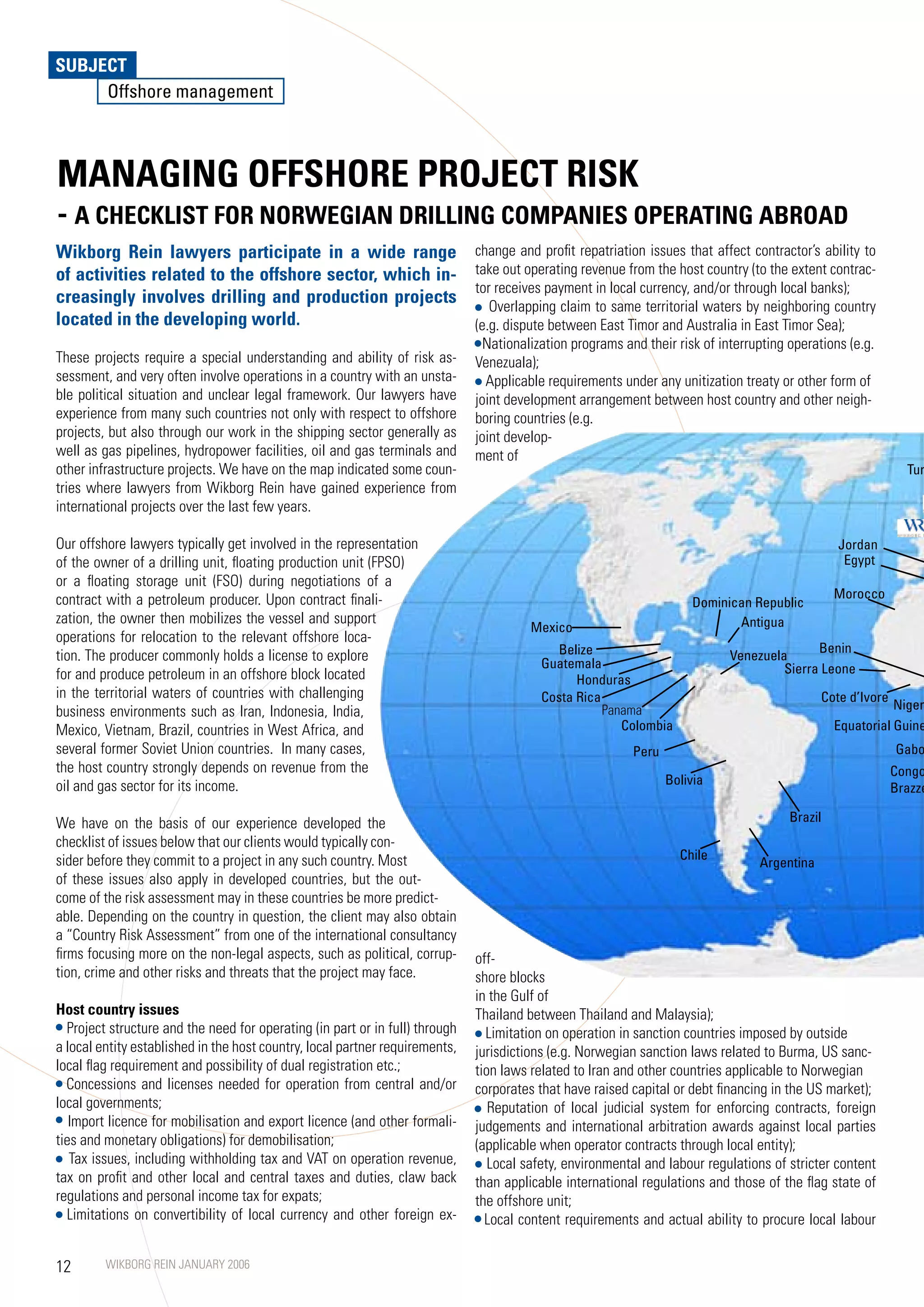
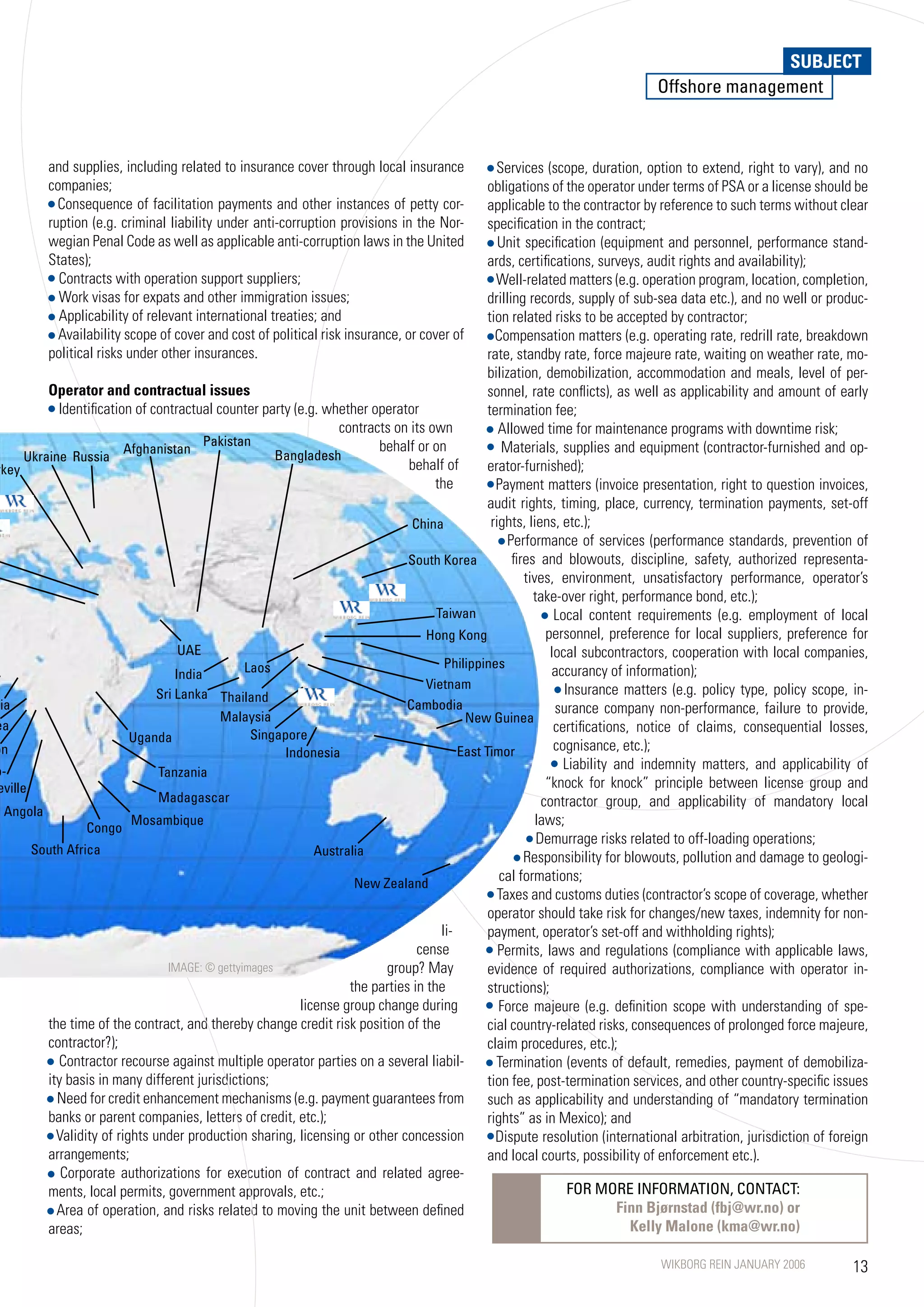
other infrastructure projects. We have on the map indicated some coun-                                                                                         Tur
tries where lawyers from Wikborg Rein have gained experience from
international projects over the last few years.

Our offshore lawyers typically get involved in the representation                                                                                Jordan
of the owner of a drilling unit, floating production unit (FPSO)                                                                                  Egypt
or a floating storage unit (FSO) during negotiations of a
contract with a petroleum producer. Upon contract finali-                                                                                        Morocco
                                                                                                                      Dominican Republic
zation, the owner then mobilizes the vessel and support                                                                      Antigua
                                                                                        Mexico
operations for relocation to the relevant offshore loca-
                                                                                            Belize                                          Benin
tion. The producer commonly holds a license to explore                                    Guatemala
                                                                                                                             Venezuela
for and produce petroleum in an offshore block located                                                                                Sierra Leone
                                                                                                honduras
in the territorial waters of countries with challenging                                   Costa Rica                                          Cote d’Ivore
business environments such as Iran, Indonesia, India,                                                Panama                                                 Niger
Mexico, Vietnam, Brazil, countries in West Africa, and                                                  Colombia                                 Equatorial Guine
several former Soviet Union countries. In many cases,                                                      Peru                                              Gabo
the host country strongly depends on revenue from the                                                                                                        Congo
oil and gas sector for its income.                                                                                Bolivia
                                                                                                                                                             Brazze

We have on the basis of our experience developed the                                                                                    Brazil
checklist of issues below that our clients would typically con-
sider before they commit to a project in any such country. Most                                                     Chile
                                                                                                                                  Argentina
of these issues also apply in developed countries, but the out-
come of the risk assessment may in these countries be more predict-
able. Depending on the country in question, the client may also obtain
a “Country Risk Assessment” from one of the international consultancy
firms focusing more on the non-legal aspects, such as political, corrup-      off-
tion, crime and other risks and threats that the project may face.            shore blocks
                                                                              in the Gulf of
Host country issues                                                           Thailand between Thailand and Malaysia);
  Project structure and the need for operating (in part or in full) through     Limitation on operation in sanction countries imposed by outside
a local entity established in the host country, local partner requirements,   jurisdictions (e.g. Norwegian sanction laws related to Burma, US sanc-
local flag requirement and possibility of dual registration etc.;             tion laws related to Iran and other countries applicable to Norwegian
  Concessions and licenses needed for operation from central and/or           corporates that have raised capital or debt financing in the US market);
local governments;                                                               Reputation of local judicial system for enforcing contracts, foreign
   Import licence for mobilisation and export licence (and other formali-     judgements and international arbitration awards against local parties
ties and monetary obligations) for demobilisation;                            (applicable when operator contracts through local entity);
   Tax issues, including withholding tax and VAT on operation revenue,           Local safety, environmental and labour regulations of stricter content
tax on profit and other local and central taxes and duties, claw back         than applicable international regulations and those of the flag state of
regulations and personal income tax for expats;                               the offshore unit;
  Limitations on convertibility of local currency and other foreign ex-         Local content requirements and actual ability to procure local labour


12       WIKBORG REIN JANUARY 2006
SUBJECT
                                                                                                                               Offshore management


          and supplies, including related to insurance cover through local insurance              Services (scope, duration, option to extend, right to vary), and no
          companies;                                                                            obligations of the operator under terms of PSA or a license should be
            Consequence of facilitation payments and other instances of petty cor-              applicable to the contractor by reference to such terms without clear
          ruption (e.g. criminal liability under anti-corruption provisions in the Nor-         specification in the contract;
          wegian Penal Code as well as applicable anti-corruption laws in the United               Unit specification (equipment and personnel, performance stand-
          States);                                                                              ards, certifications, surveys, audit rights and availability);
            Contracts with operation support suppliers;                                           Well-related matters (e.g. operation program, location, completion,
            Work visas for expats and other immigration issues;                                 drilling records, supply of sub-sea data etc.), and no well or produc-
            Applicability of relevant international treaties; and                               tion related risks to be accepted by contractor;
            Availability scope of cover and cost of political risk insurance, or cover of         Compensation matters (e.g. operating rate, redrill rate, breakdown
          political risks under other insurances.                                               rate, standby rate, force majeure rate, waiting on weather rate, mo-
                                                                                                bilization, demobilization, accommodation and meals, level of per-
          Operator and contractual issues                                                       sonnel, rate conflicts), as well as applicability and amount of early
            Identification of contractual counter party (e.g. whether operator                  termination fee;
                                                                  contracts on its own             Allowed time for maintenance programs with downtime risk;
                                          Pakistan                       behalf or on               Materials, supplies and equipment (contractor-furnished and op-
                          Afghanistan                  Bangladesh
      Ukraine Russia
rkey                                                                           behalf of        erator-furnished);
                                                                                     the          Payment matters (invoice presentation, right to question invoices,
                                                                                                audit rights, timing, place, currency, termination payments, set-off
                                                                                China            rights, liens, etc.);
                                                                                                     Performance of services (performance standards, prevention of
                                                                               South Korea            fires and blowouts, discipline, safety, authorized representa-
                                                                                                         tives, environment, unsatisfactory performance, operator’s
                                                                                                           take-over right, performance bond, etc.);
                                                                                     Taiwan                     Local content requirements (e.g. employment of local
                                                                                   hong Kong                  personnel, preference for local suppliers, preference for
                                     UAE                                                                       local subcontractors, cooperation with local companies,
                                                 Laos                                  Philippines
                                    India                                                                      accurancy of information);
                                                                                   Vietnam                        Insurance matters (e.g. policy type, policy scope, in-
                                Sri Lanka Thailand
ria                                                                           Cambodia                          surance company non-performance, failure to provide,
                                            Malaysia                                       New Guinea
ea                                                                                                              certifications, notice of claims, consequential losses,
                           Uganda                 Singapore
on                                                      Indonesia                         East Timor            cognisance, etc.);
o-                                                                                                                Liability and indemnity matters, and applicability of
                                Tanzania
eville                                                                                                        “knock for knock” principle between license group and
                                Madagascar                                                                   contractor group, and applicability of mandatory local
  Angola
                  Congo
                           Mosambique                                                                       laws;
                                                                                                            Demurrage risks related to off-loading operations;
       South Africa                                           Australia                                  Responsibility for blowouts, pollution and damage to geologi-
                                                                     New Zealand
                                                                                                   cal formations;
                                                                                                   Taxes and customs duties (contractor’s scope of coverage, whether
                                                                                                operator should take risk for changes/new taxes, indemnity for non-
                                                                                      li-       payment, operator’s set-off and withholding rights);
                                                                                 cense             Permits, laws and regulations (compliance with applicable laws,
                                  IMAGE: © gettyimages                    group? May            evidence of required authorizations, compliance with operator in-
                                                                    the parties in the          structions);
                                                           license group change during             Force majeure (e.g. definition scope with understanding of spe-
          the time of the contract, and thereby change credit risk position of the              cial country-related risks, consequences of prolonged force majeure,
          contractor?);                                                                         claim procedures, etc.);
            Contractor recourse against multiple operator parties on a several liabil-            Termination (events of default, remedies, payment of demobiliza-
          ity basis in many different jurisdictions;                                            tion fee, post-termination services, and other country-specific issues
            Need for credit enhancement mechanisms (e.g. payment guarantees from                such as applicability and understanding of “mandatory termination
          banks or parent companies, letters of credit, etc.);                                  rights” as in Mexico); and
            Validity of rights under production sharing, licensing or other concession            Dispute resolution (international arbitration, jurisdiction of foreign
          arrangements;                                                                         and local courts, possibility of enforcement etc.).
             Corporate authorizations for execution of contract and related agree-
          ments, local permits, government approvals, etc.;                                                        FOR MORE INFORMATION, CONTACT:
            Area of operation, and risks related to moving the unit between defined                                          Finn Bjørnstad (fbj@wr.no) or
          areas;                                                                                                               Kelly Malone (kma@wr.no)

                                                                                                                                WIKBORG REIN JANUARY 2006            13
SUBJECT
     Maritime liens


 RIGHT TO LIEN ON CARGO UNDER CHINESE LAW
 - BLESSING OR CURSE?
     Under Chinese law complex questions                                        outstanding freight or other fees incurred at the loading port is more
     arise regarding the carrier’s right to                                     arguable. According to Article 69 and 8 of the Maritime Act, the
                                                                                consignee or holder of a bill of lading shall not be liable for freight
     lien on the cargo and the enforcement                                      or other fees incurred at the loading port, unless his obligation for
     of such lien, often leaving the carrier                                    payment for such is expressly stipulated in the bill of lading. In
                                                                                the judgment issued by the Shanghai High Court regarding China
     with a difficult dilemma of whether or                                     Limber Huadong v. Milena Ship Management Co. Ltd. and Charter
     not to exercise a lien                                                     Harvest Shipping Ltd.
                                                                                199, upholding the
     Right to lien                                                              original judgment from
     Article 8 of the People’s Republic of China (“PRC”) Maritime              Shanghai         Maritime
     Act provides that: “if the freight, contribution in general average,       Court, the court further
     demurrage to be paid to the carrier and other necessary charges            clarifies that even when
     paid by the carrier on behalf of the owner of the goods as well as         a charterparty which
     other charges to be paid to the carrier have not been paid in full, nor    terms are incorporated
     has appropriate security been given, the carrier may have a lien, to       into a bill of lading
     a reasonable extent, on his goods”.                                        makes the consignee
                                                                                or bill of lading holder
     There is one school of opinion that the right to lien arises from the      the liable party for the
     provision of transportation and therefore the carrier shall have the       freight or other fees
     right to lien regardless of the ownership of the cargo. The 1999 PRC       incurred at the loading
     Contract Act adopted this view and stipulated in Article 315 under         port, the consignee or
     the chapter of Contract of Carriage that “when the shipper or the          bill of lading holder shall
     receiver fails to pay the freight and other relevant fees, the carrier     not be bound by such
     has the right to lien on the corresponding goods carried, unless the       provision unless it is
     parties agree otherwise.”                                                  expressly stipulated in
                                                                                the bill of lading.

     However, the prevailing opinion in practice is that a right to             Exercise and
     lien arises only if the goods is owned by the party liable for the         enforcement of lien
     outstanding freight, demurrage, general average contribution or            The carrier is not required
     other relevant charges. Scholars and judges holding this opinion           to resort to judicial
     argue that the wording “his goods” under Article 8 of the Maritime        procedures in order to
     Act indicates that only goods owned by the debtor may be liened. In        exercise his right to lien
                                                                                on cargo. However, the
     case of carriage of goods by sea, the Maritime Act applies in priority
                                                                                carrier is required under
     to the Contract Act.
                                                                                the PRC Guarantee Act
                                                                                to give the debtor a
     In sum, it is widely agreed that whether or not the carrier can            period of no less than
     exercise a lien on the goods depends on whether or not the owner           2 months (the “Performance Period”) to pay off the debt when he
     of the goods in question has the contractual obligation for the            announces the lien.
     outstanding fees.
                                                                                In order to maintain his right to lien, the carrier shall keep the cargo
     In the case of a bill of lading issued under a voyage charterparty,        under his control and has the obligation to take care of the cargo
     therefore, the key to whether or not the carrier may exercise lien lies    under custody. The right to lien will be lost if the cargo leaves the
     is whether the bill of lading holder is liable for the outstanding fees.   custody of the carrier. In practice, the carrier can usually exert control
     The carrier may exercise lien on the cargo for demurrage occurring         over the cargo via the help from its local agent.
     at the discharge port. However, exercise of lien on cargo for


14         WIKBORG REIN JANUARY 2006
SUBJECT
                                                                                                                  Maritime liens


  [        When the carrier intends to exercise the lien on the cargo for outstanding fees and
           expenses occurred at the loading, he could actually be facing considerable risk.
                                                                                                                                         ]
The PRC Guarantee Act grants the carrier the right to enforce lien      Dilemma faced by the carrier
when the debtor fails to pay the outstanding fees by the end of the     As can be seen from above, when the carrier intends to exercise the
Performance Period by sale or auction of the cargo or by agreeing       lien on the cargo for outstanding fees and expenses occurred at the
with the debtor on the value of the cargo and offset the same with      loading, he could actually be facing considerable risk that the lien
the outstanding claims.                                                 will be held illegal by a Chinese court at a later stage. Should the lien
                                                                        be held illegal, the Owners may face claims from the receiver ranging
PRC Maritime Act does not clarify the ways to enforce a lien. The       from storage fee, fines from customs office for late clearance, drop in
                                                                                           price, to the court fees of the proceedings. In order
                                                                                           to avoid providing the cargo receiver the grounds
                                                                                           to claim for a wrongful lien, some Owners might
                                                                                           consider choosing to lien the cargo “quietly”, i.e.
                                                                                           withholding the cargo without formally announcing
                                                                                           the lien. Assuming that the local agent is willing
                                                                                           to convey its full cooperation in the custody of the
                                                                                           cargo and in the refusal of delivery of cargo to the
                                                                                           receivers, the frustrated receiver may still resort
                                                                                           to the court for an injunction to enforce delivery.
                                                                                           Without announcing the lien in the first place, the
                                                                                           Owners will then probably be forced to release the
                                                                                           cargo for lack of justifiable reason to withhold the
                                                                                           cargo, in addition to facing claims for late delivery.

                                                                                          It could indeed be a tough call for the Owners
                                                                                          to decide whether or not to announce the lien
                                                                                          on the cargo. Either way, the Owners will face
                                                                                          considerable risks. A further question might be:
                                                                                          when to officially announce the lien. Various
                                                                                          factors should apparently be evaluated before the
                                                                                          Owners make a decision, e.g. the pressure that the
                                                                                          receiver could exert on the charterer to settle the
                                                                                          outstanding fees to exchange for a timely release
                                                                                          of the goods, the cost and fees for the storage, and
                                                                                          the extent of cooperation the Owners may get from
                                                                                          the local agent or port.

                                                                                         Even if the legitimacy of the lien is not an issue,
                                                                                         when the receiver is the same as the charterer, the
                                                               PHOTO: © O. Kobayashi     Owners may still face difficult situations, e.g. the
                                                                                         storage of the cargo for a period up to two months,
wording of Article 88 of the Act, however, leaves room for some the sale or auction of the cargo. The sale of cargo without the court’s
practitioners to argue that the lien on cargo may be enforced only involvement may be held illegal at a later stage, while the auction of
through a forced auction held by a court. There are conflicting the cargo via judicial proceedings may turn out to be both time and
opinions in this regard among scholars, practitioners and judges and cost consuming.
unfortunately Chinese courts are not bound by previous judgements
on same issues. Consequently, this is far from being a settled In any event, while the right to lien could be an effective way to
issue and the safest approach to the enforcement of a lien remains secure the Owners’ claims, Owners are advised to be cautious when
applying to the court for the auction.                                 they exercise this right, because of the complexities involved.


                                                                                                            WIKBORG REIN JANUARY 2006
                                                                                                           WIKBORG REIN JANUARY 2006           15
                                                                                                                                                15
SUBJECT
      Conventions


     INTERNATIONAL CONVENTIONS RATIFIED By CHINA
     Important shipping related international                                Important shipping related international conventions
     conventions to which China has acceded:                                 to which China has NOT acceded:

     Contract of carriage                                                    Contract of carriage
     • Athens Convention relating to the Carriage of Passengers              • International Convention for the Unification of Certain Rules of Law
     and their Luggage by Sea, 194, as amended by its 196 Pro-             relating to Bills of Lading, 1924 (”Hague Rules”)
     tocol (but not the 1990 and 2002 Protocols)                             • Protocol of 1968 to amend the International Convention for the Unifi-
                                                                             cation of Certain Rules of Law relating to Bills of Lading, 1924 (“Hague-
     Admiralty                                                               Visby Rules”)
     • International Convention for the Unification of Certain Rules         • United Nations Convention on the Carriage of Goods by Sea, 198
     of Law with respect to Collision between Vessels, 1910 (“Col-           (“Hamburg Rules”)
     lision Convention”)
     • International Convention on Certain Rules Concerning Civil            Pollution
     Jurisdiction in Matters of Collision, 1952                              • International Convention on the Establishment of an International
     • International Convention on Salvage, 1989 (“Salvage Con-              Fund for Compensation for Oil Pollution Damage, 191, as amended by
     vention”) (China has made reservations on Article 1 litra a, b          the 1992 Protocol (“1992 Fund Convention”)
     and d)
     • International Convention for the Safety of Life at Sea, 194,         Limitation of liability
     as amended by its 198 and 1988 Protocols (“SOLAS Conven-               • Convention on Limitation of Liability for Maritime Claims, 196
     tion”)                                                                  (“LLMC”) or the 1996 Protocol
     • Convention on the International Regulations for Preventing
     Collisions at Sea, 192 (“COLREG”)                                      Arrest of vessel
                                                                             • International Convention for the Unification of Certain Rules Relating
     Pollution                                                               to the Arrest of Sea-going Ships, 1952 (“Arrest Convention, 1952”)
     • International Convention for the Prevention of Pollution from         • International Convention on Arrest of Ships, 1999 (“Arrest Conven-
     Ships, 193, as modified by the Protocol of 198 (“MARPOL               tion, 1999”)
     3/8”) (China has not acceded Annex IV or VI)
     • International Convention Relating to Intervention on the High         Miscellaneous
     Seas in Cases of Oil Pollution Casualties, 1969, as amended             • International Convention on Liability and Compensation for Damage
     by its 193 Protocol                                                    in Connection with the Carriage of Hazardous and Noxious Substances
     • International Convention on Civil Liability for Oil Pollution         by Sea (“HNS Convention”), 1996
     Damage, 1969, as amended by its 196, 1984 and 1992 Pro-
     tocols (“CLC 92”)

     Miscellaneous
     • International Convention on Maritime Liens and Mortgages,
     1993
                                                                                                 FOR MORE INFORMATION, CONTACT:
                                                                                                        Deborah yu (dyu@wr.no) or
                                                                                                            yafeng Sun (yfs@wr.no)


                This firm [Wikborg Rein] has traditionally had a stronghold in
                the shipping market in Norway according to commentators, and
                is still considered by many to have the best grip on the Norwe-
                gian clients. Chambers Global 2004-05


16        WIKBORG REIN JANUARY 2006
          WIKBORG REIN JANUARY 2006
SUBJECT
                                                                                                         Voyage data recorders


VOICE RECORDING USING VOyAGE DATA RECORDERS
- REQUIRES NOTICE TO THE DATA INSPECTORATE
Like black boxes carried on aircrafts, voyage data                      on international voyages. The following vessels shall, according to
recorders (“VDRs”) enable accident investigators                        the SOLAS regulation, be fitted with VDRs:
to review procedures and instructions in the mo-                        - New passenger ships before they are put into service
ments before an incident and helps to identify the                      - Existing ro-ro passenger ships not later than the first survey for
cause of any accident by, inter alia, recording the                       safety equipment on or after 1 July 2002
conversations on the vessel’s bridge. The SOLAS                         - Existing passenger ships other than ro-ro passenger ships not
convention chapter V regulation 20 requires that                          later than 1 January 2004
                                                                        - Cargo ships of 3,000 gross tonnage and upwards construed on or
certain vessels on international voyages must be                          after 1 July 2002, before they are put into service
fitted with VDRs. Voice recordings conducted with
VDRs fall within the scope of Norwegian legisla-                        Norwegian legislation has a broader scope requiring several other
tion protecting the processing of personal data.                        vessels to be fitted with a VDR under sections 19 A to 19 C in a
Shipowners must therefore notify the Data In-                           regulation issued by the Norwegian Ministry of Trade and Industry
                                                                        of 15 September 1992 no. 01, as amended (“Forskrift om navigas-
spectorate (in Norwegian: “Datatilsynet”) of such                       jonshjelpemidler m.m.”).
systems and comply with other procedures as de-
scribed in this article, to avoid fining.                               In addition to the duty to notify the proper authorities of the use of
                                                                        VDRs, shipowners must comply with the following procedures under
Voice recording performed with electronic equipment fall within the     the Data Protection Act:
scope of the Norwegian Act of 14 April 2000 no. 31 relating to the
Processing of Personal Data (“Personal Data Act”), as such informa-     Shipowners must inform the crew about the data collection, cf.
tion may be linked to a physical person.                                section 19. Shipowners must not store personal data longer than
                                                                        necessary to carry out the purpose of the processing, cf. section
Consequently, recordings through VDRs can only take place if the        28. Recordings by VDR equipment will normally be erased continu-
shipowner (or appointed manager) comply with conditions set out in      ously. Recordings are generally, while not yet erased, subject to
the Personal Data Act. Shipowners must therefore notify the Data        satisfactory data security since access requires special technical
Inspectorate of the use of VDRs. The notification is due 30 days be-    knowledge.
fore any instalment and/or commencement of use of the VDR. Upon
receipt of such notification the Data Inspectorate will give the con-   Furthermore, shipowners must ensure that voice recordings are
troller a receipt of notification.                                      used exclusively for stated purposes, such purposes being objec-
                                                                        tively justified by the activities of the shipowner. As an example, re-
The provisions in the Personal Data Act applies to shipowners es-       cordings cannot be used in a labour dispute with a current or former
tablished in Norway, and to all shipowners established outside the      employee. The recordings must further be adequate, relevant and
European Economic Area who make use of equipment in Norway for          not excessive in relation to the understanding of accident causes.
the purpose of processing personal data. Shipowners based else-
where in the European Economic Area will normally be subject to         The Data Protection Act does not limit the Marine Authorities’ ac-
the data protection laws of the European Economic Area country in       cess to recorded material in the course of an investigation. Other
which they are based.                                                   third party access must be evaluated on a case by case basis. Ac-
                                                                        cess to recordings should always be subject to reasonable controls,
Anyone who wilfully or grossly negligently omits to send notification   which might include passwords, compartmentalised access and ac-
to the Data Inspectorate is liable to fines or/and imprisonment. The    cess logs. Reasonable steps should be taken to detect and prevent
Data Inspectorate has not yet issued any fines for infringement of      unauthorised access. The relevant considerations are throughout
the notification provisions in the Personal Data Act.                   any process confidentiality, integrity and accessibility.

The relevant vessels subject to the duty of notification are vessels
under regulation 20 of the revised SOLAS chapter V; ships engaged                        FOR MORE INFORMATION, CONTACT:
                                                                                             Lars Tormodsgard (lto@wr.no) or
                                                                                               Lars Inge Ørstavik (lio@wr.no)


                                                                                                            WIKBORG REIN JANUARY 2006             1
SUBJECT
     Voyage chartering
                                                                            Wikborg Rein remains (…) in the premier division of
                                                                            shipping law firms, and with offices in Oslo, Shang-
                                                                            hai, London, Singapore and Kobe, has a truly global
                                                                            dimension to its shipping practice. Legal 500 2005


     NOTICE OF READINESS UNDER VOyAGE CHARTERS
     - The four “Ws” under Norwegian law
     In order to minimise the risk of waiting costs at busy ports, many       place for vessels to wait for a berth. Still, many different factors may
     owners add one or more of the four ‘W’s to a standard form               have to be considered in order to decide whether the vessel may be
     charterparty so that notice of readiness (“NOR”), may be tendered        considered as arrived in port. Statutory, fiscal and geographical limits
     (1) whether in port or not; (2) whether in berth or not; (3) whether     may be good starting points, but other factors may also be relevant.
     customs has been cleared or not, and; (4) whether free pratique has      Moreover, the limits and boundaries for a customary waiting place
     been obtained or not. Normally used under charterparties governed        may also be a source for doubts and discussions. By introducing a
     by English law, uncertainty may arise when the clauses are inserted      “whether in port or not” clause owner will be given some leeway
     into contracts governed by different national law.
     This article examines the impact of the clause when
     used in charterparties, such as the Hydro Voyage
     Charter (“Hydrocharter”), which are governed by
     Norwegian law.

     “Whether in berth or not”
     Normally, the Hydrocharter is considered a port
     charter since NOR may be given when the vessel
     has arrived at the loading and/or discharging port(s).
     Invoking a clause saying that NOR may be tendered
     “whether in berth or not”, is thus of less value to
     the owner under the Hydrocharter. Without such a
     clause, the owner may also be entitled to tender a
     NOR before approaching nominated berth.

     However, when the nominated place is undoubtedly
     a berth or terminal, uncertainty may arise as
     to whether the owner has also agreed that an
     effective NOR may not be tendered until the vessel
     actually has arrived at this berth or terminal. In this
     event, a clause stating “whether in berth or not”
     would be to owner’s advantage and clarify that the
     charter should still be considered a port charter.

     A “whether in berth or not” clause is quite
     commonly used in order to make what otherwise
     would be a berth charter into a port charter.

     “Whether in port or not”
     It is more uncommon to add a “whether in port or
     not” clause, and when done the effects are less
     certain. As the question of what constitutes arrival
     at port may not always be easily determined, the          PHOTO: © Tomas Pinås, shipspotting.com
     introduction of a “whether in port or not” clause can
     clarify the issue and hopefully avoid unnecessary
     discussion regarding the issues of arrival at port, tendering of valid in this respect and consequently rest easier that his NOR has been
     NOR and commencement of laytime.                                         tendered effectively.

     Under a port charter, the owner may normally tender an effective         Still, the question of when an effective NOR may be tendered
     NOR when the vessel arrive at a safe place within the jurisdiction       cannot be up to the sole and full discretion of the owner. Even with a
     of the port and/or when the vessel is anchored at the customary          “whether in port or not” clause, the vessel should still be somewhere


18        WIKBORG REIN JANUARY 2006
SUBJECT
                                                                                                               Voyage chartering


                  [    A “whether in berth or not” clause is quite commonly used in order to
                       turn what otherwise would be a berth charter into a port charter.                                             ]
in the close proximity of the port in order for owner to tender a NOR.    “Whether customs cleared or not” –
Otherwise the whole purpose of tendering NOR would be thwarted.          “Whether obtained free pratique or not”
The interpretation will probably be quite similar to the “at or off      Whilst “whether in berth or not” and “whether in port or not”
port” clause that is e.g. found in the Intertankvoy form. Typically,     concerns more the geographical readiness to load, the issues
if there is congestion at the relevant port and also at customary        of “customs cleared” and “free pratique” are of relevance
waiting berth, owner may still anchor outside of the port and tender     when deciding whether the vessel may in fact commence cargo
an effective NOR. However, also without a “whether in port or not”       operations.

                                                                         Problems in obtaining custom clearance or free pratique are
                                                                         normally due to reasons on the owner’s side, i.e. vessel, and the
                                                                         normal regulation under voyage charters is thus that such risk is
                                                                         allocated to the owner. Accordingly, NOR may not be tendered if
                                                                         the vessel is not customs cleared or has not obtained free pratique
                                                                         and, if NOR already has been tendered, any time lost therefrom
                                                                         shall not count as laytime or time on demurrage. However, should
                                                                         problems in obtaining custom clearance be due to issues relating
                                                                         to cargo, stevedores or other circumstances on the part of the
                                                                         charterer, an effective NOR may usually be tendered by the owner
                                                                         even though such hindrances exist. This allocation of risk is also
                                                                         the likely result under the Hydrocharter when using the NMC as
                                                                         background law, cf. section 332 (“ready to receive cargo”) and
                                                                         section 333 (“hindrance on the part of the voyage carrier”).

                                                                         Consequently, by introducing a “whether customs cleared or not”
                                                                         clause and/or “whether obtained free pratique or not” clause risks
                                                                         which usually rest on the owner are shifted over to the charterer,
                                                                         enabling the owner to tender a NOR regardless of which hindrances
                                                                         to cargo operations that exists. Especially for the issue of custom
                                                                         clearance, such a clause might be of significant importance for the
                                                                         risk allocation under a voyage charter.

                                                                         Conclusion
                                                                         Adding one or more of the four “Ws” will generally shift more risk
                                                                         from owner to charterer concerning the tendering of an effective
                                                                         NOR.

                                                                         The clauses “whether in berth or not” or “whether in port or not”
                                                                         will normally not be of significant importance for the allocation
                                                                         of risk between the charterer and the owner, since similar results
                                                                         would also follow from the NMC and/or standard forms as the
                                                                         Hydrocharter. However, introducing the clauses “whether customs
                                                                         cleared or not” and “whether obtained free pratique or not”
                                                                         will shift significant risk to the charterer under a charter on the
clause the charterer under the Hydrocharter would likely bear the        Hydrocharter form with Norwegian background law. Accordingly,
risk for congestion at the nominated port and owner would be able        greater caution should thus be exercised by charterers.
to tender an effective NOR when the vessel is anchored as near
to the port as she may safely get, cf. clause A and the Norwegian
Maritime Code (“NMC”) section 333, first paragraph. Accordingly,                          FOR MORE INFORMATION, CONTACT:
the effects of adding this clause should not be over-emphasised.                              Eirik Thomassen (eth@wr.no) or
                                                                                                   Trond Eilertsen (tei@wr.no)


                                                                                                           WIKBORG REIN JANUARY 2006           19
SUBJECT
     Competition law


     THE IMPACT OF THE NEW COMPETITION ACT IN
     SINGAPORE ON THE SHIPPING INDUSTRy
     On 4 November 2004, the Singapore Parliament heralded the                  However, notwithstanding the above, certain “hardcore” agreements
     dawn of a new era in competition regulation in Singapore                   will always be deemed to have an appreciable adverse effect on
     by passing the Competition Act 2004 (the “Act”). The Act has               competition. These are agreements that directly or indirectly fix
     come into force in phases, with the key substantive provisions             prices, bid-rigging (collusive tendering), market sharing and limiting
     coming into force on 1 January 2006. Provisions relating to                or controlling production or investment.
     mergers and acquisitions will not come into force at least
     until 1 January 2007.                                                      The provisions of any agreement or any decision that violate this
                                                                                section will be rendered void to the extent of the violation.
     The Act introduces substantive provisions to regulate how businesses
     will have to deal with each other in a competitive manner. Additionally,   Abuse of dominant market position
     the Act establishes a new regulatory structure, comprising the             The Guidelines stipulate that conduct that constitutes an abuse
     Competition Commission of Singapore (“CCS”) and the Competition            of a dominant position in a market includes conduct that protects,
     Appeals Board.                                                             enhances or perpetuates the dominant position of an undertaking
                                                                                in ways unrelated to competitive merit. An example is limiting
     The Act prohibits anti-competitive activities that unduly prevent,         production, markets or technical development to the prejudice of
     restrict or distort competition, abuses of dominance by a dominant         consumers. This also applies to undertakings in a dominant position
     undertaking, and anti-competitive mergers. These prohibitions are          outside Singapore, and which abuse that dominant position in a
     found in Part III of the Act, and specifically in:                         market in Singapore.

        - Section 34, which prohibits anti-competitive agreements,              Merger control
          decisions and concerted practices                                     Guidelines on merger control have not been published. However, the
        - Section 4, which prohibits the abuse of a dominant position          section prohibits mergers that have resulted, or may be expected to
        - Section 54, which prohibits anti-competitive mergers                  result, in a substantial lessening of competition within any market in
                                                                                Singapore for goods or services.
     The Act may apply even if the offending agreement (section 34) has
     been entered into outside Singapore or if a party to that agreement is     Market Definition
     outside Singapore; or if the undertaking abusing a dominant position       The Guidelines on the definition of “market” provide that “the relevant
     (section 4) is outside Singapore; or if the offending merger (section     market is in practice no more than an appropriate frame of reference
     54) has taken place outside Singapore or if a party to that merger is      for competition analysis … in practice, defining a market requires
     outside Singapore, provided always that the activity has the effect        an assessment of the various types of evidence and the exercise of
     on the relevant market in Singapore required to make such activity         judgment.”
     prohibited.
                                                                                The approach is broadly in line with that taken by the EU Commission
     To provide guidance on how these essential provisions are to be            who have defined “relevant product market” and “relevant geographic
     interpreted, the CCS has been empowered under the provisions of            market” as follows:
     the Act to issue guidelines. To date, three sets of finalized guidelines
     have been issued, and at least seven more will be issued within the           “A relevant product market comprises all those products
     next few weeks.                                                               and/or services which are regarded as interchangeable
                                                                                   or substitutable by the consumer, by reason of the
     Anti-competitive agreements                                                   products’ characteristics, their prices and their intended
     The Guidelines clarify that anti-competitive agreements which have            use.”
     as their object or effect the appreciable prevention, restriction or
     distortion of competition within Singapore are prohibited. The CCS            “The relevant geographic market comprises the area in
     takes the view that agreements will not usually have an appreciable           which the undertakings concerned are involved in the
     adverse effect on competition in some instances. This includes                supply and demand of products or services, in which the
     agreements where the aggregate market share of the parties does               conditions of competition are sufficiently homogeneous
     not exceed 20% (if the parties are competitors and agreements where           and which can be distinguished from neighbouring areas
     the market share of each of the parties does not exceed 25% (if the           because the conditions of competition are appreciably
     parties are non-competitors), and where the agreement is between              different in those areas.”
     small and medium sized enterprises i.e. businesses with a fixed asset
     investment which does not exceed S$15m (manufacturing) or with an          The definition of markets is important as it sets the parameters
     employment size of not more than 200 workers (services).                   within which the anti-competitive activity or an abuse of dominance
                                                                                is determined.

20         WIKBORG REIN JANUARY 2006
SUBJECT
                                                                                                                         Competition law


         [      The Act seems to be incompatible with the way international shipping business is
                conducted today with pools, conferences, consortia and ship-sharing arrangements,
                to name some of the common practices among shipowners.

Consequences of infringing the Act                                         undertakings concerned the possibility of eliminating competition in
                                                                                                                                               ]
If the CCS determines that there is an infringement and that it was        respect of a substantial part of the goods or services in question.
committed intentionally or negligently, it may impose a financial
penalty on the business. Any financial penalty will not exceed 10%         Two notable parties to have made such submissions are the Singapore
of the turnover of the business in Singapore for each year of the          Shipping Association and the International Chamber of Shipping.
infringement up to a maximum of 3 years. Prohibited provisions of
agreements are void and will not be enforceable in Singapore.              The arguments for and against restrictions on shipping agreements
Infringements may also lead to private action by affected parties.         are not new and the CCS will certainly be looking at the experience of
                                                                           other jurisdictions for guidance. At present it is not clear whether or to
CCS’s investigative powers                                                 what extent shipping agreements will be exempted from the general
The Act gives the CCS strong investigative powers, including the right     prohibition on anti-competitive agreements. We believe the CCS will
to issue a written notice requiring any person to produce a specific       be reluctant to enact a stricter competition regime in Singapore than
document or information and the right to enter business premises for       what is applied in the EU. The EU Commission is currently considering
taking copies of documents and requesting explanations. Failure to         removing the block exemption for liner shipping conferences and
cooperate with the CCS may be a criminal offence.                          the procedural exception of the cabotage and tramp vessel services
                                                                           (Regulation 4056/86) and it claims to have broad support for these
Leniency programme                                                         moves. If these changes are effected, there will be little left of the EU
The CCS has published draft guidelines for the lenient treatment of        exemptions for shipping agreements and Singapore is likely to follow
undertakings        volunteering                                                                            the EU’s lead.
information on cartel activities.
This leniency programme                                                                                   Conclusion and advice
is broadly in line with that                                                                              The Act is being enforced in stages
implemented by the EU                                                                                     to allow the CCS and businesses
Commission. A point to note                                                                               time to prepare for the new law. On
is that the first undertaking to                                                                          1 January 2005, the sections on the
alert the CCS about a cartel                                                                              CCS were brought into force. On 1
like situation can be given a                                                                             September 2005, the sections on
100% immunity from liability.                                                                             appeals were brought into force. The
                                                                                                          government has issued a schedule
Impact on the                                                                                             for the enforcement of the remaining
Shipping industry                                                                                         provisions. On 1 January 2006,
The imminent enforcement                                                                                  the sections on anti-competitive
                                   PHOTO: © O. Kobayashi
of the Act in its present form                                                                            agreements and abuse of dominant
has raised the concerns of the                                                                            market position, among others, will
shipping industry. This is because the Act seems to be incompatible        come into force. The sections on merger control, among others, will
with the way international shipping business is conducted today with       come into force at least 12 months later.
pools, conferences, consortia and ship-sharing arrangements, to
name some of the common practices among shipowners.                        For businesses concerned about the new law, the CCS has this
                                                                           encouragement:
A number of interested parties have made submissions to the CCS with
a view to obtaining a block exemption of such shipping agreements.         “We recognize that businesses should not face undue regulation, which
The Minister has the power to make a block exemption order and the         would add to business costs and reduce Singapore’s international
criteria for block exemptions are set out in section 41 of the Act. Such   competitiveness. The CCS will therefore, instead of attempting to
an exemption will only be applicable where the shipping undertaking is     catch all forms of competitive activity, focus principally on activities
not dominant. To be exempted, the category of agreements in question       or conduct that have an appreciable adverse effect on competition.”
must contribute to improving production or distribution; or promoting
technical or economic progress. At the same time, such agreements                     Wikborg Rein in cooperation with Rajah  Tann
must not impose on the undertakings concerned restrictions which are                          FOR MORE INFORMATION, CONTACT:
not indispensable to the attainment of those objectives; or afford the                         Erlend W. Holstrøm (ewh@wr.no) or
                                                                                                  Stephen W. Fordham (swf@wr.no)


                                                                                                               WIKBORG REIN JANUARY 2006            21
SUBJECT
     Wikborg Rein


 WIKBORG REIN’S SHIPPING COMPETITION LAW TEAM
     Understanding the shipping industry and the relevant mar-
     kets is crucial in arguing competition law issues and our
     dedicated Shipping Competition Team is specialized in this
     legal framework’s application to the shipping industry. Over
     the years we have provided assistance to Norwegian Ship-
     ping Companies in a wide array of matters.

     We have been and are currently assisting our clients in investi-
     gations carried out by Competition Authorities in Norway, the EC
     Commission and the US Department of Justice. We have also repre-
     sented our clients in a variety of other jurisdictions (e.g. several EU
     countries, Canada, Australia, New Zealand, Singapore, Brazil and
     South Korea). We cooperate closely with a network of specialized
     competition law attorneys in all these jurisdictions.

     Our team has already conducted through reviews of various pooling
     arrangements in light of the expected inclusion of tramp shipping
     under EC jurisdiction, (ref. article p. 23 of this Update). The combina-
     tion of our team’s legal expertise and industry experience ensures
     that our clients receive the best possible legal assistance.

     Our assistance includes:
     - General advise on Competition Law for shipowners, brokers,
       maritime and marine insurers as well as shipping banks
     - Review of pooling arrangements, joint ventures and other
       forms of co-operation with actual or potential competitors               Under the direction of Øystein Meland (pictured), partner in Wikborg
     - Tailor made Competition Compliance Manuals for clients,                  Rein, the Shipping Competition Team presently consist of Senior
       including lectures for key personnel highlighting “red flag              Associate Siri Birgitte Bang and associate Lars Tormodsgard in the
       situations”                                                              Bergen office and Senior Associate Aksel J. Hageler and associate
     - Dawn Raid Manuals for clients that prepares them for possible            Mats E. Sæther in the Oslo office. Our lawyers have broad study
       inspection from Competition Authorities                                  and work experience in competition law and the shipping industry
     - Assistance in connection with Dawn Raids and during continued            together with extensive experience in dealing with various Compe-
       investigation by Competition Authorities                                 tition Authorities. We have further integrated economic expertise
     - Application for amnesty or leniency to Competition Authorities           in our Shipping Competition Team with Lars Tormodsgard holding a
     - Advise in connection with mergers and acquisitions including             bachelor in business administration from the Norwegian School of
       merger notification to the relevant Competition Authorities, as          Economics and Business Administration (NHH) in addition to his law
       well as pro-active advise on agreements and corporate                    degree from the University of Bergen.
       structures.


                                                                                                 FOR MORE INFORMATION, CONTACT:
                                                                                                     Øystein Meland (ome@wr.no) or
                                                                                                       Siri Birgitte Bang (sbb@wr.no)
                 Wikborg Rein is one of the few Norwegian firms with
                 a serious international presence. Leading in the fields
                 of maritime and shipping (…), Wikborg Rein is an im-
                 posing presence in the market. PLC Which Lawyer?
                 yearbook 2005


22        WIKBORG REIN JANUARY 2006
          WIKBORG REIN JANUARY 2006
SUBJECT
                                                                                                                   Competition law


EU COMMISSION MOVING FORWARD ON THE REPEAL
OF EXEMPTION FOR THE SHIPPING INDUSTRy
The European Commission has proposed to repeal the                     would constitute an “invitation to collude” between liner shipping
block exemption of liner conferences from the EC Treaty                carriers to the detriment of transport users and final consumers.
competition rules’ ban on restrictive practices (Article 81).
The proposal will now be forwarded to the EU’s Council                 Supported by the study the Commission has now proposed to
of Ministers for adoption by qualified majority and to the             repeal the exemption for liner shipping conferences and further
European Parliament for consultation. After its adaptation             to bring tramp and cabotage services under Council Regulation
the Commission will publish guidelines on the application              1/2003, the common competition implementing rules. This will
of the competition rules to the sector. The Commissions                impose a heavy compliance burden on the shipping industry under
proposal also covers tramp and cabotage services and                   EU competition laws.
guidelines issued would also cover the application of EU
competition rules to such services.                                    Since companies active in this sector of the economy may have
                                                                       very little, if any, experience of the enforcement of competition
This proposal follows a publication of a study undertaken by           law, they may face difficulties in determining whether their
outside consultants on the potential impact of the signalled repeal    operations are compatible with EC competition law. Consequently,
of the Block Exemption Regulation for liner shipping conferences.      the Commission has in a press release of 14 December 2005
The recently published study has found that the signalled repeal is    signalled its intention to issue guidelines for the industry towards
likely to lead to a decline in transport prices and will have either   the end of 200 to smooth the transition to a more competitive
no impact or a positive impact on the competitiveness of European      environment. Such guidelines would also cover the application for
liner shipping firms.                                                  EU competition rules to tramp services. As an interim step, the
                                                                       Commission intends to publish an issues paper on liner shipping
The study was commissioned to analyse the potential impact             in September 2006.
of repealing the Block Exemption Regulation for liner shipping
conferences (Council Regulation 4056/86) and is a result of the        The repeal of exemption and the bringing of tramp and cabotage
combined work of Global Insight, an international consultancy with     services under EU competition rules will mean that a large number
significant experience in liner shipping, the Berlin University of     of the commercial arrangements that currently exist between
Technology and the Institute of Shipping Economics and Logistics       competitor ship owners/operators will have to be rethought and
in Bremen.                                                             then restructured and/or abandoned to ensure compliance.

The main findings on the potential impact on the repeal of the         The report is published in its entirety on: http://europa.eu.int/
Block Exemption of the study are as follows;                           comm/competition/antitrust/others/maritime/shipping_report_
                                                                       26102005.pdf
- transport prices for liner shipping services will decline
- service reliability on deep sea and short sea trades is expected     The press release can be read in its entirety on:
  to improve                                                           http://europa.eu.int/rapid/pressReleasesAction.do?reference=IP/
- service quality will either be unaffected or will improve            05/1586format=HTMLaged=0language=ENguiLanguage=en
- there is either a positive impact or no impact on the
  competitiveness of EU liner shipping firms and
- small liner shipping carriers will not experience particular
  problems
                                                                                       FOR MORE INFORMATION, CONTACT:
- no negative impact or even positive impact on EU ports,
                                                                                          Siri Birgitte Bang (sbb@wr.no) or
  employment, trade and/or developing countries.
                                                                                              Øystein Meland (ome@wr.no)
The report did not accept suggestions by the European Liner Affairs
Association (ELAA), representing more than 0% of the global
liner shipping industry, to replace the current Block Exemption with
an information exchange system. The report found such system


                                                                                                             WIKBORG REIN JANUARY 2006        23
SUBJECT
     Maritime Trainee Programme


     THE MARITIME TRAINEE PROGRAMME
     - AN INNOVATION TO PROMOTE THE NORWEGIAN MARITIME CLUSTER
     In August 2005 the Norwegian maritime industry, with the Nor-          nical aspects of the ship industry; ships, equipment, new building
     wegian Shipowner’s Association at the helm, launched a two-year        and ship design, and visited Aker Yard to see the whole process in
     maritime trainee programme. The programme involves 21 compa-           practice.”
                                nies including ship owners, ship yards,
                                maritime equipment manufacturers, oil       The next gathering will take place in Singapore, and in August
                                rig companies, a classification society,    2006 all the trainees will work 4 months in another trainee com-
                                banks, ship brokers – and one law firm:     pany. During the spring 200 the trainees will spend 4-6 months
                                Wikborg Rein. The programme seeks to        abroad in order to gain international experience. Ms. Lind Groh will
                                provide each trainee with a thorough un-    be assigned to one of Wikborg Rein’s four offices abroad.
                                derstanding of the maritime industry and
                                thus make them capable of mastering         “I have two extremely instructive and challenging years ahead of
                                numerous functions within the maritime      me”, Ms. Lind Groh says, “especially as I at the same time will take
                                industry. Wikborg Rein’s associate Ingrid   part in the busy daily work at Wikborg Rein’s Shipping Offshore
                                Lind Groh is one of 25 trainees attend-     department in Oslo. I feel privileged to be given this possibility,
                                ing the programme. As the only lawyer       and look forward to absorb all this new knowledge and use it in
     among engineers and economists she is entering into a new area         practice in my work as a lawyer.”
     of practice, and she describes her learning outcome as exceptional:
     “For a lawyer working within the maritime field, it is particularly    COMPANIES INVOLVED IN THE MARITIME TRAINEE
     important to understand the practical and technical aspects of the     PROGRAMME:
     business. This programme provides me with new and important
     knowledge, and gives me a broad understanding of the distinctive
     characteristics of the maritime industry in Norway and internation-    Aker yards ASA
     ally.”                                                                 Awilco AS
                                                                            Det Norske Veritas
     During the two-year period, the trainees will have 6 academic          DnB Nor ASA
     gatherings. These courses will mainly focus on three types of          Eidesvik AS
     know-how: Maritime knowledge, business comprehension and               Farstad Shipping ASA
     management expertise.                                                  Fred. Olsen Energy ASA
                                                                            Grieg Billabong AS
     At present Ms. Lind Groh has attended two gatherings. The first        Knutsen OAS Shipping AS
     gathering focused upon the maritime cluster, freight markets, mar-     Kongsberg Maritime AS
     ket analysis, shipbroking and chartering, the history of Norwegian     Leif Höegh  Co AS
     shipping, classification and certification. The trainees also spend    Nordea
     three days manning three racing sail boats. “During these three        Odfjell Drilling AS
     days at sea we learned new things about both ourselves and the         R. S. Platou Shipbrokers AS
     other trainees. It was a real challenge as almost half of the group    Smedvig ASA
     was completely inexperienced sailors, and the weather took a turn      Stolt Offshore AS
     for the worse as soon as we left the port of Hankø, heading for        Teekay Norway AS
     Denmark”, she says.                                                    Tschudi Shipping Company AS
                                                                            Unitor ASA
     “At the second gathering”, Ms. Lind Groh continues, “we looked         Wikborg Rein
     deeper into the Norwegian maritime cluster – in particular the oil     Wilh. Wilhelmsen ASA
     and gas cluster as this gathering took place in Ålesund – and its
     peculiarities, strengths and weaknesses. We also focused on tech-
                                                                                             FOR MORE INFORMATION, CONTACT:
                                                                                                   Ingrid Lind Groh (ilg@wr.no),
                                                                                               Haakon Stang Lund (hsl@wr.no) or
                                                                                                    Gaute Gjelsten (ggj@wr.no)


24      WIKBORG REIN JANUARY 2006
        WIKBORG REIN JANUARY 2006
SUBJECT
                                                                                                                                  SUBJECT
                                                                                                                        Wikborg Rein


Personnel news in the Shipping Offshore Group [from June 2005 to January 2006]
Anders W. Færden, previously partner in the law firm Vogt                in London. Alexander Owesen and Linda Rudolfsen Mykle-
Wiig, has been appointed partner in Wikborg Rein and has joined           bust have been promoted to senior associates at the Oslo and
the firm’s Shipping Offshore Group in Oslo. Finn Bjørnstad has,           Bergen offices, respectively. Louis Skyner, previously a mem-
after two and a half years as resident partner at the firm’s Sin-         ber of the firm’s Energy Natural Resources Group, has joined the
gapore office, rejoined the Oslo office. Erlend W. Holstrøm, the          Shipping Offshore Group in Oslo. Ola Berg Lande has left the
former resident partner at the Shanghai office, has joined the            Oslo office and joined the London office. Anders Monrad has
Singapore office as Bjørnstad’s successor. Birgitte Karlsen has           left Wikborg Rein and accepted partnership in another lawfirm.
left the Oslo office to reinforce the Singapore office. Lars Berge        Hågen Hansen, previously associate in the law firm Simonsen
Andersen has been been appointed chief representative at the              Føyen, has joined the Bergen office. Ena Barder has completed
Shanghai office. After serving three years at the firm’s office in        her Master studies at King’s College London, and has joined the
Kobe, Japan, Henrik Hagberg has returned to the Oslo office.              Oslo office. Ingrid Lind Groh has completed her stay as a re-
Oddbjørn Slinning has succeeded him at the Kobe office. Af-               search assistant at the Scandinavian Institute of Maritime Law,
ter two years at the London office, Linn Eidsheim has rejoined            and has joined the Oslo office as a part of the Maritime Trainee
the Bergen office and been promoted to senior associate. Gøran            Programme under the auspices of the Norwegian Shipowner’s
Lunde Aarvik has left the Bergen office and replaced Eidsheim             Association.


                                                                     New Shipping Offshore partner
                                                                     at Wikborg Rein’s Oslo office
 RATINGS                                                             Wishing to specialise more in the
 Every year the international legal market is
                                                                     fields of shipping and offshore,
 being evaluated in numerous guides, which
                                                                     Anders W. Færden entered the
 publish their rankings broadly. Law firms in
                                                                     partnership of Wikborg Rein in
 most countries worldwide are evaluated, and
                                                                     September 2005. Coming from the
 the guides have proved to be helpful tools
                                                                     well-known law firm Vogt  Wiig,
 when in need of legal assistance abroad.
                                                                     he has extensive experience and
                                                                     expertise to draw upon when as-
 The methods and thoroughness of the guides
                                                                     sisting clients in Wikborg Rein. His
 vary, and so does the validity of the rankings.
                                                                     main areas of practice are matters
 Most guides base their rankings on input
                                                                     relating to insurance law, maritime
 from clients and the law firms themselves.
                                                                     law, contract law and litigation. Mr.
 The well reputed guides reach their conclu-
                                                                     Færden was admitted to the Su-
 sions through thorough interviews, and their
                                                                     preme Court in 2000.
 researchers are constantly up to date on the
 developments in their specific legal area.

 The rankings are divided in certain categories
 which vary from guide to guide. Whilst PLC’s
 Which Lawyer? works with 15 categories, the
 European Legal 500 has 13 and Chambers
 Global only six. All of these three guides are
 highly regarded, and their rankings are often
 published in international media.                                             This firm [Wikborg Rein] has traditionally had a
                                                                               stronghold in the shipping market in Norway ac-
 Throughout this Update you will find quotes                                   cording to commentators, and is still considered by
 from these three guides, giving their evalua-                                 many to have the best grip on the Norwegian clients.
 tion of Wikborg Rein’s expertise on shipping                                  Chambers Global 2004-05
 law. Within the shipping segment, WR is the
 highest ranked Norwegian law firm.

                                                                                                             WIKBORG REIN JANUARY 2006       25
SUBJECT
     Wikborg Rein


        WIKBORG REIN'S ShIPPING OFFShORE GROUP IN BERGEN
      PARTNERS                                        SENIOR ASSOCIATES                                 ASSOCIATES
                      Øystein Meland is co-                           Terje Fiskerstrand mainly                         Øyvind Axe’s main areas
                      leader of the firm’s Shipping                   works with issues relating                        of practice are issues
                      Offshore Group with                             to maritime law and tax law.                      relating to maritime law
                      extensive experience in                         He is also experienced in                         and real estate law. He has
                      handling shipping matters                       casualty work and assists                         studied at Bond University,
                      for Norwegian and foreign                       PI clubs, hull underwriters                      Australia.
     clients. The last three years he has also        and owners on these matters. Fiskerstrand
     been extensively involved in competition         has been stationed at Wikborg Rein’s London
     law aspects of maritime transportation.          office.                                                            Christian James-
     He is the manager of Bergen Shipowners                                                                              Olsen mainly works with
     Association, member of BIMCO’s                                                                                      offshore related cases,
                                                                       Lars Inge Ørstavik is
     Documentary Committee and the Legal                                                                                 and has experience with
                                                                       experienced within the                            advising and negotiating
     Committee of the Norwegian Shipowners                             fields of maritime law and
     Association. Meland negotiated the new                                                                              within the oil and gas
                                                                       construction law and advises     industry. He has studied at Bond University,
     standard Norwegian shipbuilding contract                          ship owners, yards and           Australia.
     on behalf of the Norwegian Shipowners                             underwriters. He is also
     Association and will in 2006 publish a           experienced in casualty work and assists PI
     commentary to said contract. Meland is                                                                                Kristoffer Larsen
                                                      clubs, hull underwriters and owners on these
     admitted to the Norwegian Supreme Court.                                                                              Rognvik is a member
                                                      matters.
                                                                                                                           of the Shipping Offshore
                      Jon Heimset has                                                                                      Group. His working areas
                      extensive experience from                      Siri Birgitte Bang specialises                        are contract law and
                      matters related to the                         in intellectual property and                          marine insurance law.
                      offshore industry, maritime                    competition law, particularly                         He has also participated
                      law and marine insurance.                      within the maritime sector.        in several international transactions and
                      He advises Norwegian and                       She has a Master‘s degree          financing projects.
     foreign shipping companies, rig owners,                         from Santa Clara University
     suppliers, insurance companies, PI clubs,       and has also passed the California Bar and is
                                                                                                                         Hågen Hansen
     shipyards, brokers and corresponding law         authorised as a lawyer in California, USA.                         specialises on issues
     firms. He is co-author of “Handbook on Loss
                                                                                                                         relating to the shipping
     of Hire Insurance” (together with Haakon
                                                                       Linn Hertwig Eidsheim                             and offshore industry. He
     Stang Lund and Trond Eilertsen) written at                                                                          has studied international
     the request of the Norwegian Hull Club.                           has international experience
                                                                                                                         law at University of Cape
                                                                       from Wikborg Rein’s London
                                                                                                                         Town, South Africa.
                                                                       office and has studied inter-
                       Geir Ove Røberg has
                                                                       national law with Hamline
                       international experience                                                                           Lars Tormodsgard
                                                                       Law School in Minnesota,
                       from Wikborg Rein’s                                                                                specialises on issues
                                                      USA. Eidsheim’s main areas of practice are
                       London and Kobe offices.                                                                           relating to the ship-
                                                      corporate law, shipping, offshore, ship financ-
                       For several years he has                                                                           ping and offshore
                                                      ing and transactions.
                       assisted international,                                                                            industry. In addition to
     Nordic and Norwegian shipowners as                                                                                   his law degree from
     well as banks with transactions within                           Linda Rudolfsen Myklebust         the University in Bergen he has a bach-
     financing, sale and purchase of entities                         works with the firm’s Banking     elor in business administration from the
     and assets. He has been leading several                          and Finance Group. She has        Norwegian School of Economics and
     international contractual negotiations and                       periodically worked at Wikborg    Business Administration (NHH).
     has assisted in large projects related to                        Rein’s offices in London and
     ship financing.                                                  Singapore. Her main areas of
                                                                      practice are issues relating to
                       Christian Friis has been        finance, mortgage law, contract law, company
                       a partner with Wikborg          law and maritime law. She speaks English and
                       Rein since 1990, and is         German fluently.
                       a member of the firm’s
                       Banking and Finance
                       Group. He specializes in
     ship financing, and he is mainly assisting
     foreign and Norwegian shipping banks.
     Chr. Friis has experience as an inhouse
     lawyer with Bergen Bank (now known as
                                                                           For further details, see www.wr.no
     DnB NOR Bank ASA), and from Watson,
     Farley  Williams, London.

26       WIKBORG REIN JANUARY 2006
         WIKBORG REIN JANUARY 2006
www.wr.no


COVER PHOTO and photos on pages 10, 14 and 21: © O. Kobayashi (http://shipphoto.exblog.jp), reprinted with his kind permission
THE MEMBERS OF WIKBORG REIN’S SHIPPING OFFSHORE GROUP:

Oslo                            Gry Bratvold
                                                               London
Trond Eilertsen                 (+4) 22 82 5 3, gbr@wr.no   Morten Lund Mathisen
(+4) 22 82 6 12, tei@wr.no                                   (+44) 20 2 36 45 98, mlm@wrco.co.uk
                                Ena Barder
Haakon Stang Lund               (+4) 22 82 5 45, eba@wr.no   Stephen N. Lamb
(+4) 22 82 6 05, hsl@wr.no                                   (+44) 20 2 36 45 98, stl@wrco.co.uk
                                Ingrid Lind Groh
Erling C. Hjort                 (+4) 22 82 5 40, ilg@wr.no   Gøran Lunde Aarvik
(+4) 22 82 6 01, ech@wr.no                                   (+44) 20 2 36 45 98, gla@wrco.co.uk
                                Bergen
Bernhard Haukali                                               Ola Berg Lande
(+4) 22 82 6 16, bha@wr.no    Øystein Meland                 (+44) 20 2 36 45 98, obl@wrco.co.uk
                                (+4) 55 21 52 5, ome@wr.no
Finn Bjørnstad
(+4) 22 82 6 11 , fbj@wr.no   Jon Heimset
                                                               Singapore
                                (+4) 55 21 52 2, jhe@wr.no   Stephen W. Fordham
Johan Rasmussen
                                                               (+65) 64 38 44 98, swf@wr.com.sg
(+4) 22 82 6 35, jra@wr.no    Geir Ove Røberg
                                (+4) 55 21 52 65, gor@wr.no   Erlend Holstrøm
Anders W. Færden
                                                               (+65) 64 38 44 98, ewh@wr.com.sg
(+4) 22 82 5 44, awf@wr.no    Christian Friis
                                (+4) 55 21 52 35, cfr@wr.no   Florence Ong
Gaute Gjelsten
                                                               (+65) 64 38 44 98, flo@wr.com.sg
(+4) 22 82 6 31, ggj@wr.no    Lars Inge Ørstavik
                                (+4) 55 21 52 69, lio@wr.no   Chuen Yee Chee
Marie Efpraxiadis Andersen
                                                               (+65) 64 38 44 98, ccy@wr.com.sg
(+4) 22 82 5 15, mef@wr.no    Siri Birgitte Bang
                                (+4) 55 21 52 1, sbb@wr.no   Probin S. Dass
Eirin M. Inderberg
                                                               (+65) 64 38 44 98, psd@wr.com.sg
(+4) 22 82 6 4, emi@wr.no    Terje Fiskerstrand
                                (+4) 55 21 52 56, tfi@wr.no   Birgitte Karlsen
Anette Jahr
                                                               (+65) 64 38 44 98, bka@wr.com.sg
(+4) 22 82 6 26, aja@wr.no    Linn Hertwig Eidsheim
                                (+4) 55 21 52 96, lhe@wr.no
Martin Nes                                                     Kobe
(+4) 22 82 6 55, mne@wr.no    Linda Rudolfsen Myklebust
                                (+4) 55 21 52 30, lru@wr.no   Oddbjørn Slinning
Henrik Hagberg                                                 (+81) 8 22 1 , osl@wrco.jp
(+4) 22 82 5 52, heh@wr.no    Øyvind Axe

Alexander W. Owesen
                                (+4) 55 21 52 66, axe@wr.no
                                                               Shanghai
(+4) 22 82 6 8, awo@wr.no    Kristoffer Larsen Rognvik
                                                               Yafeng Sun
                                (+4) 55 21 52 68, klr@wr.no
Louis Skyner                                                   (+86) 21 63 39 01 01, yfs@wrco.com.cn
(+4) 22 82 5 95, los@wr.no    Lars Tormodsgard
                                                               Lars Berge Andersen
                                (+4) 55 21 52 0, lto@wr.no
Eirik Thomassen                                                (+86) 21 63 39 01 01, lba@wrco.com.cn
(+4) 22 82 5 31, eth@wr.no    Christian James-Olsen
                                                               Deborah Yu
                                (+4) 55 21 52 50, col@wr.no
Simone Trondal                                                 (+86) 21 63 39 01 01, dyu@wrco.com.cn
(+4) 22 82 6 34, sit@wr.no    Hågen Hansen
                                                               Maggie Pan
                                (+4) 55 21 52 51, hag@wr.no
Mats E. Sæther                                                 (+86) 21 63 39 01 01, mhp@wrco.com.cn
(+4) 22 82 6 86, mes@wr.no
                                                               Joanna Zhao
Herman Steen                                                   (+86) 21 63 39 01 01, jzh@wrco.com.cn
(+4) 22 82 5 94, hst@wr.no


                                                                          www.wr.no

So Update 1 In 2006

  • 1.
    Wikborg Rein’s ShippingOffshore: Update The new Norwegian SHIPPING LAW UPDATE FROM WIKBORG REIN Ship Safety Act - The seaworthiness concept to be replaced by safety management system UPDATE 1 / 2006 Managing offshore project risk | The new Competition Act in Singapore How to make sure your closing goes right | Right to lien on cargo under Chinese law | Classification society liability
  • 2.
    UPDATE 1/2006 Contents An exciting time to be a shipping lawyer 3 Top ten reasons closings go wrong – and how to make sure yours goes right 4 The new Norwegian Ship Safety Act 6 Norwegian Accident Investigation Board to investigate accidents at sea 8 Classification society liability 9 Safety at sea and marine insurers’ duty of confidentiality 10 The shipboker’s right to commission - change of broker channel 11 Managing offshore project risk 12 Right to lien on cargo under Chinese law 14 International conventions ratified by China 16 Voice recording using voyage data recorders 17 Notice of readiness under voyage charters 18 The impact of the new Competition Act in Singapore on international shipping 20 Wikborg Rein’s Shipping Competition Law Team 22 EU Commission moving forward on the repeal of exemption for the shipping industry 23 The Maritime Trainee Programme 24 Personnel news 25 Wikborg Rein’s Shipping Offshore Group in Bergen 26 PUBLISHER: Wikborg Rein EDITORIAL STAFF: Gaute Gjelsten, Herman Steen, Stephen N. Lamb DESIGN: Lise Røed PRINT: HBO
  • 3.
    AN ExCITING TIMETO BE A ShIPPING LAWyER It is an exciting time to be a shipping lawyer at Wikborg Rein. 2005 was one of our busiest years ever in the firm’s Shipping Offshore department and 2006 holds great promise to be equally challenging. I have always believed that being a good lawyer was as much about preventing problems as it was about resolving them after they occur. The article on page 4 is a good example of that principle. Every day -- somewhere in the world -- a Wikborg Rein lawyer is working to make sure that an upcoming closing for a ship sale and purchase or lease-back goes smoothly. It is a mainstay of our work and the article draws on our collective experience to outline the most common snags and shoals and how best to avoid them. While recent years have seen the shipping industry benefit from good economic times, this success has also, and not surprisingly, more keenly focused the attention of regulators and others on the business. This issue contains two articles on the competition law efforts of regulators in Asia and Europe. The article on page 23 examines the EU’s new regulations impacting the shipping industry, and the article on page 20 looks at the effects of the new Competition Act in Singapore on international firms doing business there. Long the financial capital of Southeast Asia, Singapore has established itself in recent years as the home to many of the world’s top building yards for offshore rigs. Wikborg Rein partner Finn Bjørnstad, who recently returned from three years in our Singapore office, writes with partner Kelly Malone, on page 12 about this firm’s body of experience and expertise with the offshore industry. Though the economic times may be good, our lawyers are not content to simply accept traditional assumptions about the liability of those whose negligence causes harm to shipowners and their insurers. This issue contains a thought-provoking article about the liability of classification societies on page 9. Long assumed to be effectively beyond the reach of tort and contract liability by many legal observers, our lawyers have been involved in challenging this notion. Negligence by a classification society, or even a government agency, is no longer something that shipowners must necessarily accept without recourse. As our practice has continued to grow, so too has our staff. In addition to six new associates, Anders W. Færden joined our Oslo office in September as partner. As the article on page 25 explains in more detail, Anders is highly regarded in maritime law circles, admitted to practice before the Norwegian Supreme Court, and a lawyer who genuinely enjoys tackling the most difficult and complex of legal questions. We are extremely pleased with his decision to join our firm. We hope you enjoy this issue of the Update along with our very best wishes for a happy and successful 2006! Yours truly, WIKBORG REIN Trond Eilertsen Leader of Wikborg Rein’s Shipping and Offshore group WIKBORG REIN JANUARY 2006 3
  • 4.
    SUBJECT Closings WHy CLOSINGS GO WRONG - AND HOW TO MAKE SURE yOURS GOES RIGHT Imagine sitting in the London conference room of one of the How to make sure yours goes right world’s largest ship registries. The room is crowded with The good news is that an overwhelming majority of closings are com- representatives from the buyer and seller of the vessel that is pleted without any major problems. And those problems most com- about to change hands, and the nervous small talk has run out monly encountered can almost always be avoided through proper as everyone waits for confirmation that the funds have arrived preparation and communication. Specifically, this means having deter- in the seller’s bank account. The phone rings, but it is not the mined all of the buyer’s and seller’s main obligations and then nego- bank. Instead it’s the buyer’s representatives on board the ves- tiating and finalizing a tailored memorandum of agreement (“MoA”), sel calling to remind the meeting that the vessel is due to be de- closing memo and document checklist. livered under a charterparty in less than 30 minutes. No funds – no delivery. The importance of being well prepared and how to prepare In a perfect world, a closing would not take place until all details are It turns out the bank has the wrong account number on the SWIFT thoroughly planned. But in reality, not all closings take place with the interbank payment message. The correct account number is quickly for- luxury of a schedule that allows for such thorough preparation. The warded to the bank and everyone around the table laughs nervously in usual schedule requires all participants to prioritize by distinguishing relief. Then the registrar enters the room and asks: “Which one of you those matters of importance that must absolutely be dealt with before has the original bill of sale....?” No one answers. the closing and those less important, which can be dealt with later. When a new sale and purchase transaction arises it can be helpful to Most such scenarios end happily with a last-minute solution and only draw up a chart and check-list showing: (1) buyer’s and seller’s name, a minor delay. But on rare occasions, a once-willing buyer or seller has corporate status and jurisdiction; (2) vessel name, type, flag state and become decidedly reluctant and practical difficulties with the closing any encumbrances (to be discharged or registered); (3) any change of are exploited to cancel the transaction altogether. flag information; and (4) whether the parties have agreed upon a pay- ment procedure. As the check-list is filled in with information, the next Common reasons why closings go wrong steps are easily put in their proper order for the day of closing (e.g. What is a “closing”? MoA, mortgage discharge, vessel deletion, vessel registration and “Closing” is a shorthand term for the completion of a transaction. mortgage registration). The term closing can be defined as the conclusion of an object’s sale, whereby: (1) payment is made; (2) any previous mortgages discharged; Tailor the MoA for a smooth closing (3) the title to the asset is transferred; and (4) any new mortgages se- The best way to avoid last minute discussions is to ensure that the cured. discussions are closed at an early stage with a tightly worded MoA between the seller and the buyer in which they agree upon all material The list aspects of the deal. The below list – although not complete – identifies the most common reasons why closings go wrong: A large number of sales are based on MoAs on the “Norwegian Sale- form” which in its original form does not include many guidelines as 1 Failure to agree in advance on closing and payment to how the closing should be completed. It merely lists a suggested procedures set of documents to be delivered to the buyer “in exchange for the 2 Documents not prepared in advance or not present at purchase price” pursuant to clause 8. Failing to discuss or agree on closing the closing procedure and the documents to be presented may lead 3 Failure to agree on delivery documents to unpleasant surprises later. Consequently; the parties should ideally 4 Vessel not physically ready prepare an addendum to the agreement listing the main documents 5 Documents lost or delayed to be delivered by both parties. Just as important – at least for seller 6 Documents contain mistakes and / or are not properly – is to clearly state that the free and clear certificate of ownership and notarised or legalised encumbrances will not be presented to buyer until after the purchase 7 Payment is inadequate or delayed price (and payment for bunkers and lubes) are well received in order for 8 Registries / banks not open or unwilling to open early or stay the mortgage, if any, to be discharged. late 9 Registry does not produce the documents when expected Prepare and finalise a closing memo and a document list 10 Buyer trying to renegotiate at the last minute or new issues The next step after finalising the MoA should be to start drafting a arising at closing closing memo and a document checklist (if not included in the MoA as 4 WIKBORG REIN JANUARY 2006
  • 5.
    SUBJECT Closings mentioned above). While most closings will involve the buyer also hav- tion from the registry that all is ready for discharge of the existing ing to comply with a condition precedent (“CP”) list related to a loan mortgage and deletion of the vessel (if relevant). If the vessel is bare- agreement, this article does not deal with that particular aspect. The boat registered, make sure that deletion is facilitated and documented main purposes of a closing memo is to outline the closing procedure pursuant to the requirements of the main register as they may refuse and to complete the list of documents and serves the important pur- the delete otherwise. pose of identifying any obstacles to the closing procedure as all parties - Ensure that the current mortgagee has facilitated the mortgage dis- will consider whether they will be able to comply with the obligations charge and agree on the trigger for the actual discharge. Be prepared listed. A good closing memo will: that the mortgagee will not normally discharge the mortgage until they (i) include names and contact details for everyone involved, including have received the funds outstanding under the relevant loan(s). Make the ship registries. If a time difference is involved then each party’s sure the buyer understand the same. local time should be specified. Buyer’s obligations (ii) reflect on an accurate payment and closing procedure. Particular From a strict closing perspective, a buyer’s task is normally easy: de- attention should be paid to ensuring agreement on these steps, as they liver a few corporate documents, sign the deposit release, accept the involve the cooperation of players other than the seller and buyer. 90 delivery documents and the vessel and pay the purchase price, bunkers % of the world’s fleet is mortgaged, and one should bear in mind that and lubes and any extras. Nonetheless, the buyers should ensure the in the event of a mortgage registered against the vessel, the mortga- following: gee will not normally discharge the mortgage until repayment of the loan is made. The wording of the standard clause 8 of the MoA how- - Prepare the corporate documents in due course, have them pre-ap- ever, states that delivery of the delivery documents shall take place proved by the seller, both as drafts and in completed form (notarised “in exchange for payment”, stating that the payment and delivery ob- and legalised/apostilled). Bring originals as agreed. ligations should be performed simultaneously. In practice, this is not - Agree on the deposit release letter and make sure to bring a power of possible and it is normally assumed as an obligation of both parties attorney (pre-approved) or proof of identity empowering a representa- to ensure that the risks involved are minimized. One procedure used, tive of the buyer to sign the release letter. which also ensures a high level of simultaneous performance, is to - Request to pre sight all seller delivery documents if possible in draft table all delivery documents and for the buyer (through buyer’s bank) and completed form. to present an unconditional and irrevocable payment letter. Delivering - Agree on the payment procedure also for the balance and bunkers the payment letter to the seller or seller’s bank (mortgagee) will be and lubes. Ensure that the financing bank agrees to the payment proce- regarded as equivalent to payment, and the mortgagee will discharge dure between the seller and buyer as early as possible. Double check the mortgage without having to wait for the funds to actually arrive at the payment details. sellers account prior to proceeding with the discharge of mortgage and the release of the other delivery documents. If however a procedure Even if this is a matter for the buyer; the vessel will either be chang- is agreed where the buyers will pay the funds to seller (seller’s banks) ing ownership within the same registry or change flag. In both cir- account, the mortgagee is often asked to issue an undertaking stat- cumstances buyer should ensure as early as possible if any of these ing that they will discharge the mortgage upon receipt of the funds at procedures requires documents from the seller (in addition to the origi- the relevant account, also often accompanied by a statement from the nal/copy of a bill of sale). If so, these documents should be identified sellers that at the same time the bill of sale will be released and the and pre-cleared by the registry as early as possible, and if not included protocol of delivery and acceptance signed. This procedure ensure that in the document checklist, the buyer will have to rely on the seller’s both seller and buyer can feel confident they will receive payment and discretion as to whether they will assist. a free and clear vessel, respectively. In the likely event that a new mortgage is being registered against the Seller’s obligations vessel, this should also be pre-cleared with the registry in advance. Seller have the most extensive obligations in the closing. In addition When a second mortgage is to be recorded in favour of a mortgagee to physically preparing the vessel for delivery, all delivery documents other than the first priority mortgage, a letter of consent from the first including the ones representing title to the vessel must be prepared mortgagee must be presented. and brought to closing, as well as making the necessary arrangements with the vessel’s current ship registry. The heading could also have Final preparations and on the closing day included “seller’s bank or current mortgagee” as the mortgagee and If possible, a final check should be made the day before closing; and if bank are playing important roles in the closing. The main focus of the possible a final message should be distributed to all parties confirming seller should be the following: relevant details for the closing. All that is left is to ensure that cell phone batteries are charged, original bill of sales are in hand, and of - Prepare the delivery documents pursuant to the MoA and request that course the correct account number on the SWIFT message. the same are pre-cleared by the buyer in advance both as drafts and in completed form. - Make arrangements with the current ship registry and have all docu- FOR MORE INFORMATION, CONTACT: ments required for deletion of the vessel pre-cleared. Obtain confirma- Linn Hertwig Eidsheim (lhe@wr.no) or Bernhard Haukali (bha@wr.no) WIKBORG REIN JANUARY 2006 5
  • 6.
    SUBJECT Ship Safety Act THE NEW NORWEGIAN SHIP SAFETy ACT PURPOSE, SCOPE AND SAFETy MANAGEMENT The existing Norwegian Seaworthiness Act was originally The concept of “safety management” is well known from the ISM issued in 1903. While it has been amended frequently since Code. The committee states that for those already complying with that time in an attempt to reflect the enormous technical, the ISM Code, the new Act’s strong emphasis on safety management environmental, political, national, international and legal will not necessarily mean any substantial changes. However, it is changes regarding ship safety it is today considered important to note that unlike the ISM Code, the new Act introduces unsatisfactory in many respects. Consequently, on its 100th safety management requirements not only for vessel operations, but anniversary, a committee was appointed to revise the existing also vessel engineering and building. Act. The committee submitted its unanimous report on 29 June 2005 (NOU 2005:14) proposing a new Act – the Ship Safety Act. The new Act prescribes a general duty for the shipowners (in The report was sent out for comments until 21 November 2005. Norwegian: “reder”) to provide for, ensure and develop the Based on the few objections received during the comment establishment of a sufficient safety management system that can period, it is expected that the proposal will most likely be be verified and documented in order to survey and control the risk adopted in its present form. The new Act is expected to enter as well as to assure that applicable rules are followed. The master into force prior to 2007. and the crew on board the vessel have certain duties to contribute to the establishment of the vessel’s safety management. The concept Mandate and purpose of safety management is generally flexible and comprises the vessel, The mandate of the committee focused on drafting of a set of her management and the qualifications of the crew. Whereas the rules which would be in line with international and EU regulations new Act sets out the concept in more general terms, its details will regarding vessel safety management. The committee was charged be contained in regulations laid down pursuant to the new Act and with developing a more uniform regulation and the reduction of the shall i.a. take into account the particular need of the shipowners and level of details in the existing Act by i.a. delegation to the competent the activity and business they run. Ministries. As part of this process the committee evaluated modernizing supervision and control, available sanctions against infringements of the rules, and the incorporation of other Norwegian Acts. The purpose of the new Act is to safeguard life, health, property and the environment by promoting a high level of ship safety, ensuring a safe working environment, preventing pollution from vessels, incorporating requirements and responsibilities for vessel’s safety management system, establishing and developing appropriate supervision and control and arranging for the development of regulations in compliance with international law, in particular IMO (e.g. SOLAS, MARPOL, the ISM and ISPS Code), ILO and EU rules. Material and geographic scope The new Act will apply to Norwegian and foreign vessels, except for non-commercial vessels with an overall length of less than 24 meters. The new Act will apply to Norwegian flagged vessels throughout the world while foreign vessels will only be subject to the new Act while in Norwegian waters . The government may decide whether and to what extent the new Act and regulations laid down pursuant to its provisions shall apply to other units and/or vessels like e.g. offshore drilling units. “Safety Management” versus “Seaworthiness” Under the existing Act, safety at sea is linked to the concept of “seaworthiness”, which has also been adopted in the Norwegian Maritime Code and the Norwegian Marine Insurance Plan. In the new Act, this concept is phased out and replaced by the new concept of “internal control methodology” which is defined in the new Act as “safety management” (in Norwegian: “sikkerhetsstyring”). 6 WIKBORG REIN JANUARY 2006
  • 7.
    SUBJECT Ship Safety Act RESPONSIBILITIES, SUPERVISION AND LEGAL CONSEQUENCES Part of the mandate of the committee for the revision of the accordance with the latest EU developments as expressed in the existing Norwegian Seaworthiness Act was to stipulate the third Maritime Safety Package. shipowner’s and master’s responsibilities for the vessel’s safety management system. Moreover, the committee had Legal consequences to evaluate a modernization of the scope and extent of the The only administrative sanction for infringement provided for in vessel’s safety management control and legal consequences the current Seaworthiness Act (except for infringement of rules on of an infringement of stipulated rules. The existing Act is today pollution prevention) is detention of the vessel. Detention is only seen as too inflexible and ineffective in these respects. allowed if the vessel is not seaworthy or the certificates are invalid. Less serious infringements of the rules are only subject to criminal Responsibilities liability, if any. The new Act de-emphasizes criminal liability as legal Following the grounding and subsequent loss of the high speed consequences for infringement and instead introduces alternative passenger catamaran “SLEIPNER” in 1999, it was concluded that measures: (1) administrative acts (in Norwegian: “forvaltningstiltak”); the Norwegian Maritime Directorate was not subject to liability and (2) administrative sanctions (in Norwegian: “administrative under the existing Act. The new Act clarifies that the operation of sanksjoner”). Administrative acts are – in ascending order according the vessel does not lie within the responsibilities of the Directorate to the degree of seriousness – requests to carry out certain measures, but is primarily the responsibility of the shipowner and that the fines and withdrawal of statutory certificates. Administrative latter is liable in case of an infringement of applicable rules. The sanctions are administrative fines that are implemented in case of master is liable in connection with the operation of the vessel, such an infringement of applicable rules. The current possibility for the as navigation and watchkeeping; and the crew may be liable where vessel’s detention has been upheld in the new Act. Administrative they have distinct duties. acts and sanctions apply to Norwegian and foreign vessels; and foreign vessels may also be denied future access to Norwegian Supervision waters. Pursuant to the existing Act, vessels of 50 gross ton or more are subject to supervision by the Norwegian Maritime Since administrative fines may be implemented fast and without Directorate, which has authorized five classifications the involvement of the prosecuting authorities and courts, they are societies (GL, DNV, ABS, LR, BV) to carry out parts of the an immediate reaction to an infringement of the vessel’s safety necessary surveys. The committee finds this cooperation management. Administrative fines may amount to approximately fit and suitable and it is therefore maintained in the new the same amounts as criminal penalties under the current system. Act. Further, the new Act opens for an authorization of It is therefore the committee’s view that administrative fines may, approved undertakings and authorities, be they private, in particular in relation to foreign vessels, be more efficient than foreign (e.g. according to the Paris MOU) or international criminal penalties and consequently replace the latter in many (such as e.g. the European Maritime Safety Agency cases. (EMSA)). Provisions on criminal liability previously set out in the Norwegian The committee emphasises that even though the focus Criminal Act have been incorporated into the new Act, giving on the shipowner’s responsibilities has increased over statutory basis for penalties and imprisonment of up to six months the years, e.g. as a result of the ISM Code, it has thus in case of substantial infringements of certain rules – under far not been sufficient to avoid major discrepancies from aggravating circumstances up to two years. Criminal liability applies applicable rules. Therefore, safety management without to the shipowners personally, the shipowning company, the master supervision is not considered satisfactory, and the new and the crew. Act is based on a “double-track” system: (1) primary supervision of the safety management system, i.e. primarily an inspection and verification of the shipowner’s FOR MORE INFORMATION, CONTACT: written documentation and implementation of necessary Simone Trondal (sit@wr.no), measures, along with interviews and evaluations with the Gry Bratvold (gba@wr.no) or shipowner’s management and personnel; and (2) direct Gaute Gjelsten (ggj@wr.no) control by way of inspection of the vessel. The new Act leaves open the possibility that primary supervision may in the future gradually replace direct control. Even though the latter possibility is in accordance with the purpose of the ISM Code, it is questionable whether it is also in PHOTO: © Scanpix WIKBORG REIN JANUARY 2006
  • 8.
    SUBJECT Accident investigation NORWEGIAN ACCIDENT INVESTIGATION BOARD TO INVESTIGATE ACCIDENTS AT SEA During 2006/2007 the Norwegian Confidentiality Accident Investigation Board will The Investigation Board has an extensive duty of confidentiality in conducting its business, with some important exceptions. The duty be granted authority to investigate of confidentiality is outweighed by “weighty public interest” or “if accidents at sea in addition to necessary to properly explain the cause of the accident”. accidents within the aviation, railway New prohibition against removal of wreckage and road sectors. Under the new rules removal of wreckage or other material without the prior consent of the Investigation Board or police authorities is The new legislation to govern these investigations of accidents at sea prohibited. The only exception from this prohibition is if the object will has already been passed although they have not yet entered into force. be lost unless removed immediately. The new rules focuses on the establishment of the course of events in order to promote the safety at sea and the purpose of the investigations About the Investigation Board carried out shall not be to apportion blame and liability. Included in The Investigation Board is an independent investigation body with the the new rules are generally duties to inform the proper authorities of authority to hand over entire or parts of investigations to foreign states any accidents at sea, extensive duties to offer testimony or deliver authorities, to co-operate with foreign authorities, to allow participation documents to the Investigation Board combined with restrictions on the of foreign authorities in investigations and further the Investigation Investigation Board not to use such information for unrelated purposes. Board can request assistance from local police, courts of justice and This article will summarize some of the more important of these new other authorities as well as external expertise necessary to carry out an rules. investigation. Duty to notify The new legislation introduces a general duty for “anyone” who witnesses an accident at sea, wreckage or other conditions that gives reason to believe an accident at sea has occurred, to notify the authorities. There rests a heavier burden on the master of ships and ship-owners to fulfil such a duty of notification. Testimony and other evidence The new rules further impose an extensive general duty to offer testimony and share documents with the authorities. “Anyone” has a duty to contribute with all relevant information, “regardless of duties of confidentiality”. A party offering such information is entitled to be represented by an attorney or other representative through the course of PHOTO: © Scanpix the proceedings. Limited use of testimonies Report The Investigation Board can only use testimonies in order to promote An investigation shall conclude with a report that outlines the course of the safety at sea. Testimonies offered can thus not be used as evidence events, causal relations, recommendations related to improved safety in a possible criminal case against the person offering the testimony. at sea. A draft report will be prepared and sent for consultation to Testimonies can however be used as evidence in criminal cases against interested parties before a final report is prepared and published. other individuals than the one offering the testimony. A testimony given by an officer can therefore not be used in a possible criminal case against that officer, but can be used as evidence in a possible criminal FOR MORE INFORMATION, CONTACT: case against the captain. Siri Birgitte Bang (sbb@wr.no) or Geir Ove Røberg (gor@wr.no) 8 WIKBORG REIN JANUARY 2006
  • 9.
    SUBJECT Class societies CLASS SOCIETy LIABILITy As important as they are at times controversial, classification societies occupy a unique place in the field of maritime law In Norway, the authorities have delegated certain control functions and commerce. through the Agreement of 1 July 198 with annexes between the Ministry of Trade and Det Norske Veritas (“DNV”). This delegation Class enforce statutory requirements on behalf of flag and port has lead to some questions regarding the role DNV holds. The tasks states yet the societies are not government agencies themselves. DnV performs on behalf of the authorities are considered to be more Classification societies have the power to impose sanctions yet they of a service than business nature. Activities of a service nature have also compete for the business of those who come under their scrutiny. traditionally held a protected position in Norwegian tort law, and Class make and enforce the rules but also offer consulting services on there might be reason to ask if this protection has influenced the how best to comply. Classification societies require the shipowners discussion on classification societies’ liability for those tasks that are they scrutinise to have systems of accountability, yet the societies not performed on behalf of the authorities. themselves remain largely a stranger to the concept of legal liability [ ] for their own negligence. Classification societies derive nearly all of The claim that classification societies are public spirited service their maritime revenue – directly or indirectly institutions deserving of – from shipowners yet resist liability when an special treatment with owner is wronged through class negligence. In today’s world, class regards to liability dates back Increasingly, this mix of roles and attitudes is hardly unique among many years. Today, it must has struck many observers as problematic in be examined in light of the the context of the discussion over whether professionals who charge fact that hospitals, health classification societies should be legally liable relatively small amounts for professionals, accounting for their negligence. their services, yet still risk firms, and even government agencies are all now held The three most frequently heard arguments a considerable economic legally liable for their against liability are that the relatively small size liability for losses caused by negligence. While certainly of classification fees cannot justify the potential true that classification liability exposure; the shipowner has ultimate their negligence. societies perform important responsibility for vessel seaworthiness; and and valuable research on the “special character” of a public service institution should provide improving safety at sea, commentators have questioned whether it relief from legal liability. is still appropriate for that research to be carried out by each society individually. If classification societies are deserving of special treatment In today’s world, class is hardly unique among professionals who with regards to liability because of their public mission, then many charge relatively small amounts for their services, yet still risk a believe the public mission would be more efficiently and effectively considerable economic liability for losses caused by their negligence. pursued by combining resources through one set of standards rather Other professionals customarily minimise the risk through different than the societies competing amongst themselves. forms of insurance arrangements and increasingly class has done the same. And with earnings sheets that are more comparable to The long simmering debate over classification society liability was successful businesses than service institutions, today’s classification raised a notch in 2003 when the Spanish government sued the societies have a more reasonable ratio of fees to exposure than a classification society responsible for classing the Prestige. And there whole host of organisations and industries. are no signs of it cooling anytime in the near future. As shipowners are increasingly held accountable by class for their performance and While the shipowner always remains responsible for his vessel’s actions they are expecting nothing less than the same of class. On the seaworthiness, he or she should be able to rely on the class certificate. legal front, the trend in Norway is in favour of increased liability for But if the classification society is unwilling to accept legal responsibility government bodies dealing with typically “service nature” and class for its judgments then how much credibility can an owner or insurer seems unlikely to escape the same fate in the long run. be reasonably expected to place in the certificate? In the case of newbuildings, the class representative (customarily paid by the yard) has not just performed one survey but rather been a regular presence on site throughout the vessel’s construction. Under such circumstances, FOR MORE INFORMATION, CONTACT: is it appropriate for a new owner to bear the risk for loss caused by the Gry Bratvold (gba@wr.no), classification society’s negligence if the vessel is designed, built and Stephen Lamb (stl@wr.no) or tested in accordance with the classification society’s own rules, and Gaute Gjelsten (ggj@wr.no) where this control has led to a classification certificate and delivery of the vessel? WIKBORG REIN JANUARY 2006 9
  • 10.
    SUBJECT Marine insurance Proposed new legislation: [ Pursuant to the proposal, the marine insur- ance companies will be entitled to exchange information on vessels. ] SAFETy AT SEA AND PROFESSIONAL SECRECy OF MARINE INSURANCE The Norwegian Ministry of Commerce recently The proposal will not affect marine insurance companies` possible proposed new legislation concerning the duty of criminal and/or tort liability by e.g. issuing incorrect information. confidentiality (aka “professional secrecy”) for The proposal was issued by the Ministry on 1 November 2005 with marine insurance companies. a comment period closing on 9 December 2005. The new legislation is expected to be implemented into the Norwegian Shipping Act or The proposal would provide a limited exemption for insurance com- the new Norwegian Ship Safety Act. It is expected that the propos- panies from the current regulation in Norwegian Insurance Com- al will be adopted by the Norwegian parliament and subsequently panies Act section 1-3. Pursuant to the new legislation, marine come into force during the second half of 2006. insurance companies would be allowed to exchange certain information about vessel safety and also to forward such information to the relevant public au- thorities and classification societies without the prior consent of their customer. The purpose of the proposal is to increase the marine insurers’ involvement in the shipping industry’s efforts in limiting so-called sub- standard shipping. Pursuant to the proposal, the marine insurance com- panies will be entitled to exchange information on vessels and will be obliged to forward certain informa- tion for vessels flying the Norwegian flag to relevant public authorities. The pro- posal defines the relevant information as “information regarding ship safety”, with reference to the proposed new Norwegian Ship Safety Act. The new professional secrecy rules apply both to vessels insured by the insurance company at the relevant time and to vessels previously insured by the insurance FOR MORE INFORMATION, CONTACT: company, provided such vessels were insured by the insurance com- Birgitte Karlsen (bka@wr.no) or pany during the last three years before the information is given. Trond Eilertsen (tei@wr.no) 10 WIKBORG REIN JANUARY 2006
  • 11.
    SUBJECT Shipbroking THE SHIPBROKER’S RIGHT TO COMMISSION - CHANGE OF BROKER CHANNEL Under Norwegian law there are four conditions that all must be This was discussed in the “Fearncoast” case (ND 191 p 233). In fulfilled in order for a broker to be entitled to commission: his award Sjur Brækhus, as sole arbitrator, held that a principal can stop the negotiations through one established broker chan- 1 the broker must have been engaged to act as an nel when he has a substantial and justifiable reason to do so. intermediary, This would for instance be the situation where it is impossible to 2 a binding contract must have been concluded between the continue through this channel. Furthermore he held that change buyer and the seller, of broker channel could be accepted “… where the possibility 3 the conclusion of the contract must be a result of the to come to a positive result through the existing channel is far broker’s activities, and worse than the possibilities through other channels.” This test 4 the contract must be the one, or equivalent to the one, the was later also applied by Brækhus in another arbitration, the broker was engaged to negotiate. As under Norwegian law “Knock Adoon” case (ND 1994 p 202). in general, there is no need for the concluded contract to be in writing. The same applies to the contractual The underlying principle that a principal has a clear duty towards relationship between the principal and the broker. the broker first engaged can also be seen in a recent judgment by Borgarting Court of Appeal in March 2005 (LB-2003-1495) Recently we have seen several cases where the court held that the principal in question had no valid where parties have concluded binding reason to change the broker channel. [ ] contracts either with the assistance of other brokers than To summarise, it can be stated that under Norwegian law a the broker originally en- principal, whether gaged, or without bro- Only in special circumstances seller, buyer, owner, charterer or others, kers at all. The broker will the principal be entitled to can only change the originally engaged may thus be prevented from change the broker channel with- broker channel if he fulfilling all conditions out being liable towards the bro- has a substantial and justifiable reason for for earning commission. ker originally engaged. doing so. Otherwise Although brokers often hesitate to bite the hand the original broker that feeds them, such may have a claim, cases frequently give rise to disputes either as a claim for commission or as a claim for damages for on whether the original broker is enti- breach of contract, and the principal may end up paying double tled to commission. commission. Consequently, parties that have engaged brokers to assist in any deal should think twice before changing the existing It is a general principle under Norwe- broker channel. gian brokerage law that a principal has a duty to see to it that the bro- ker is given the opportunity to earn his commission. This implies that the FOR MORE INFORMATION, CONTACT: principal has a duty of loyalty towards Martin Nes (mne@wr.no) or the broker that has been engaged Anders W. Færden (awf@wr.no) and that he normally must continue through this channel. Only in special circumstances will the principal be entitled to change the broker channel without being liable towards the bro- PHOTO: © O.Kobayashi ker originally engaged. WIKBORG REIN JANUARY 2006 11
  • 12.
    SUBJECT Offshore management MANAGING OFFSHORE PROJECT RISK - A CHECKLIST FOR NORWEGIAN DRILLING COMPANIES OPERATING ABROAD Wikborg Rein lawyers participate in a wide range change and profit repatriation issues that affect contractor’s ability to of activities related to the offshore sector, which in- take out operating revenue from the host country (to the extent contrac- tor receives payment in local currency, and/or through local banks); creasingly involves drilling and production projects Overlapping claim to same territorial waters by neighboring country located in the developing world. (e.g. dispute between East Timor and Australia in East Timor Sea); Nationalization programs and their risk of interrupting operations (e.g. These projects require a special understanding and ability of risk as- Venezuala); sessment, and very often involve operations in a country with an unsta- Applicable requirements under any unitization treaty or other form of ble political situation and unclear legal framework. Our lawyers have joint development arrangement between host country and other neigh- experience from many such countries not only with respect to offshore boring countries (e.g. projects, but also through our work in the shipping sector generally as joint develop- well as gas pipelines, hydropower facilities, oil and gas terminals and ment of other infrastructure projects. We have on the map indicated some coun- Tur tries where lawyers from Wikborg Rein have gained experience from international projects over the last few years. Our offshore lawyers typically get involved in the representation Jordan of the owner of a drilling unit, floating production unit (FPSO) Egypt or a floating storage unit (FSO) during negotiations of a contract with a petroleum producer. Upon contract finali- Morocco Dominican Republic zation, the owner then mobilizes the vessel and support Antigua Mexico operations for relocation to the relevant offshore loca- Belize Benin tion. The producer commonly holds a license to explore Guatemala Venezuela for and produce petroleum in an offshore block located Sierra Leone honduras in the territorial waters of countries with challenging Costa Rica Cote d’Ivore business environments such as Iran, Indonesia, India, Panama Niger Mexico, Vietnam, Brazil, countries in West Africa, and Colombia Equatorial Guine several former Soviet Union countries. In many cases, Peru Gabo the host country strongly depends on revenue from the Congo oil and gas sector for its income. Bolivia Brazze We have on the basis of our experience developed the Brazil checklist of issues below that our clients would typically con- sider before they commit to a project in any such country. Most Chile Argentina of these issues also apply in developed countries, but the out- come of the risk assessment may in these countries be more predict- able. Depending on the country in question, the client may also obtain a “Country Risk Assessment” from one of the international consultancy firms focusing more on the non-legal aspects, such as political, corrup- off- tion, crime and other risks and threats that the project may face. shore blocks in the Gulf of Host country issues Thailand between Thailand and Malaysia); Project structure and the need for operating (in part or in full) through Limitation on operation in sanction countries imposed by outside a local entity established in the host country, local partner requirements, jurisdictions (e.g. Norwegian sanction laws related to Burma, US sanc- local flag requirement and possibility of dual registration etc.; tion laws related to Iran and other countries applicable to Norwegian Concessions and licenses needed for operation from central and/or corporates that have raised capital or debt financing in the US market); local governments; Reputation of local judicial system for enforcing contracts, foreign Import licence for mobilisation and export licence (and other formali- judgements and international arbitration awards against local parties ties and monetary obligations) for demobilisation; (applicable when operator contracts through local entity); Tax issues, including withholding tax and VAT on operation revenue, Local safety, environmental and labour regulations of stricter content tax on profit and other local and central taxes and duties, claw back than applicable international regulations and those of the flag state of regulations and personal income tax for expats; the offshore unit; Limitations on convertibility of local currency and other foreign ex- Local content requirements and actual ability to procure local labour 12 WIKBORG REIN JANUARY 2006
  • 13.
    SUBJECT Offshore management and supplies, including related to insurance cover through local insurance Services (scope, duration, option to extend, right to vary), and no companies; obligations of the operator under terms of PSA or a license should be Consequence of facilitation payments and other instances of petty cor- applicable to the contractor by reference to such terms without clear ruption (e.g. criminal liability under anti-corruption provisions in the Nor- specification in the contract; wegian Penal Code as well as applicable anti-corruption laws in the United Unit specification (equipment and personnel, performance stand- States); ards, certifications, surveys, audit rights and availability); Contracts with operation support suppliers; Well-related matters (e.g. operation program, location, completion, Work visas for expats and other immigration issues; drilling records, supply of sub-sea data etc.), and no well or produc- Applicability of relevant international treaties; and tion related risks to be accepted by contractor; Availability scope of cover and cost of political risk insurance, or cover of Compensation matters (e.g. operating rate, redrill rate, breakdown political risks under other insurances. rate, standby rate, force majeure rate, waiting on weather rate, mo- bilization, demobilization, accommodation and meals, level of per- Operator and contractual issues sonnel, rate conflicts), as well as applicability and amount of early Identification of contractual counter party (e.g. whether operator termination fee; contracts on its own Allowed time for maintenance programs with downtime risk; Pakistan behalf or on Materials, supplies and equipment (contractor-furnished and op- Afghanistan Bangladesh Ukraine Russia rkey behalf of erator-furnished); the Payment matters (invoice presentation, right to question invoices, audit rights, timing, place, currency, termination payments, set-off China rights, liens, etc.); Performance of services (performance standards, prevention of South Korea fires and blowouts, discipline, safety, authorized representa- tives, environment, unsatisfactory performance, operator’s take-over right, performance bond, etc.); Taiwan Local content requirements (e.g. employment of local hong Kong personnel, preference for local suppliers, preference for UAE local subcontractors, cooperation with local companies, Laos Philippines India accurancy of information); Vietnam Insurance matters (e.g. policy type, policy scope, in- Sri Lanka Thailand ria Cambodia surance company non-performance, failure to provide, Malaysia New Guinea ea certifications, notice of claims, consequential losses, Uganda Singapore on Indonesia East Timor cognisance, etc.); o- Liability and indemnity matters, and applicability of Tanzania eville “knock for knock” principle between license group and Madagascar contractor group, and applicability of mandatory local Angola Congo Mosambique laws; Demurrage risks related to off-loading operations; South Africa Australia Responsibility for blowouts, pollution and damage to geologi- New Zealand cal formations; Taxes and customs duties (contractor’s scope of coverage, whether operator should take risk for changes/new taxes, indemnity for non- li- payment, operator’s set-off and withholding rights); cense Permits, laws and regulations (compliance with applicable laws, IMAGE: © gettyimages group? May evidence of required authorizations, compliance with operator in- the parties in the structions); license group change during Force majeure (e.g. definition scope with understanding of spe- the time of the contract, and thereby change credit risk position of the cial country-related risks, consequences of prolonged force majeure, contractor?); claim procedures, etc.); Contractor recourse against multiple operator parties on a several liabil- Termination (events of default, remedies, payment of demobiliza- ity basis in many different jurisdictions; tion fee, post-termination services, and other country-specific issues Need for credit enhancement mechanisms (e.g. payment guarantees from such as applicability and understanding of “mandatory termination banks or parent companies, letters of credit, etc.); rights” as in Mexico); and Validity of rights under production sharing, licensing or other concession Dispute resolution (international arbitration, jurisdiction of foreign arrangements; and local courts, possibility of enforcement etc.). Corporate authorizations for execution of contract and related agree- ments, local permits, government approvals, etc.; FOR MORE INFORMATION, CONTACT: Area of operation, and risks related to moving the unit between defined Finn Bjørnstad (fbj@wr.no) or areas; Kelly Malone (kma@wr.no) WIKBORG REIN JANUARY 2006 13
  • 14.
    SUBJECT Maritime liens RIGHT TO LIEN ON CARGO UNDER CHINESE LAW - BLESSING OR CURSE? Under Chinese law complex questions outstanding freight or other fees incurred at the loading port is more arise regarding the carrier’s right to arguable. According to Article 69 and 8 of the Maritime Act, the consignee or holder of a bill of lading shall not be liable for freight lien on the cargo and the enforcement or other fees incurred at the loading port, unless his obligation for of such lien, often leaving the carrier payment for such is expressly stipulated in the bill of lading. In the judgment issued by the Shanghai High Court regarding China with a difficult dilemma of whether or Limber Huadong v. Milena Ship Management Co. Ltd. and Charter not to exercise a lien Harvest Shipping Ltd. 199, upholding the Right to lien original judgment from Article 8 of the People’s Republic of China (“PRC”) Maritime Shanghai Maritime Act provides that: “if the freight, contribution in general average, Court, the court further demurrage to be paid to the carrier and other necessary charges clarifies that even when paid by the carrier on behalf of the owner of the goods as well as a charterparty which other charges to be paid to the carrier have not been paid in full, nor terms are incorporated has appropriate security been given, the carrier may have a lien, to into a bill of lading a reasonable extent, on his goods”. makes the consignee or bill of lading holder There is one school of opinion that the right to lien arises from the the liable party for the provision of transportation and therefore the carrier shall have the freight or other fees right to lien regardless of the ownership of the cargo. The 1999 PRC incurred at the loading Contract Act adopted this view and stipulated in Article 315 under port, the consignee or the chapter of Contract of Carriage that “when the shipper or the bill of lading holder shall receiver fails to pay the freight and other relevant fees, the carrier not be bound by such has the right to lien on the corresponding goods carried, unless the provision unless it is parties agree otherwise.” expressly stipulated in the bill of lading. However, the prevailing opinion in practice is that a right to Exercise and lien arises only if the goods is owned by the party liable for the enforcement of lien outstanding freight, demurrage, general average contribution or The carrier is not required other relevant charges. Scholars and judges holding this opinion to resort to judicial argue that the wording “his goods” under Article 8 of the Maritime procedures in order to Act indicates that only goods owned by the debtor may be liened. In exercise his right to lien on cargo. However, the case of carriage of goods by sea, the Maritime Act applies in priority carrier is required under to the Contract Act. the PRC Guarantee Act to give the debtor a In sum, it is widely agreed that whether or not the carrier can period of no less than exercise a lien on the goods depends on whether or not the owner 2 months (the “Performance Period”) to pay off the debt when he of the goods in question has the contractual obligation for the announces the lien. outstanding fees. In order to maintain his right to lien, the carrier shall keep the cargo In the case of a bill of lading issued under a voyage charterparty, under his control and has the obligation to take care of the cargo therefore, the key to whether or not the carrier may exercise lien lies under custody. The right to lien will be lost if the cargo leaves the is whether the bill of lading holder is liable for the outstanding fees. custody of the carrier. In practice, the carrier can usually exert control The carrier may exercise lien on the cargo for demurrage occurring over the cargo via the help from its local agent. at the discharge port. However, exercise of lien on cargo for 14 WIKBORG REIN JANUARY 2006
  • 15.
    SUBJECT Maritime liens [ When the carrier intends to exercise the lien on the cargo for outstanding fees and expenses occurred at the loading, he could actually be facing considerable risk. ] The PRC Guarantee Act grants the carrier the right to enforce lien Dilemma faced by the carrier when the debtor fails to pay the outstanding fees by the end of the As can be seen from above, when the carrier intends to exercise the Performance Period by sale or auction of the cargo or by agreeing lien on the cargo for outstanding fees and expenses occurred at the with the debtor on the value of the cargo and offset the same with loading, he could actually be facing considerable risk that the lien the outstanding claims. will be held illegal by a Chinese court at a later stage. Should the lien be held illegal, the Owners may face claims from the receiver ranging PRC Maritime Act does not clarify the ways to enforce a lien. The from storage fee, fines from customs office for late clearance, drop in price, to the court fees of the proceedings. In order to avoid providing the cargo receiver the grounds to claim for a wrongful lien, some Owners might consider choosing to lien the cargo “quietly”, i.e. withholding the cargo without formally announcing the lien. Assuming that the local agent is willing to convey its full cooperation in the custody of the cargo and in the refusal of delivery of cargo to the receivers, the frustrated receiver may still resort to the court for an injunction to enforce delivery. Without announcing the lien in the first place, the Owners will then probably be forced to release the cargo for lack of justifiable reason to withhold the cargo, in addition to facing claims for late delivery. It could indeed be a tough call for the Owners to decide whether or not to announce the lien on the cargo. Either way, the Owners will face considerable risks. A further question might be: when to officially announce the lien. Various factors should apparently be evaluated before the Owners make a decision, e.g. the pressure that the receiver could exert on the charterer to settle the outstanding fees to exchange for a timely release of the goods, the cost and fees for the storage, and the extent of cooperation the Owners may get from the local agent or port. Even if the legitimacy of the lien is not an issue, when the receiver is the same as the charterer, the PHOTO: © O. Kobayashi Owners may still face difficult situations, e.g. the storage of the cargo for a period up to two months, wording of Article 88 of the Act, however, leaves room for some the sale or auction of the cargo. The sale of cargo without the court’s practitioners to argue that the lien on cargo may be enforced only involvement may be held illegal at a later stage, while the auction of through a forced auction held by a court. There are conflicting the cargo via judicial proceedings may turn out to be both time and opinions in this regard among scholars, practitioners and judges and cost consuming. unfortunately Chinese courts are not bound by previous judgements on same issues. Consequently, this is far from being a settled In any event, while the right to lien could be an effective way to issue and the safest approach to the enforcement of a lien remains secure the Owners’ claims, Owners are advised to be cautious when applying to the court for the auction. they exercise this right, because of the complexities involved. WIKBORG REIN JANUARY 2006 WIKBORG REIN JANUARY 2006 15 15
  • 16.
    SUBJECT Conventions INTERNATIONAL CONVENTIONS RATIFIED By CHINA Important shipping related international Important shipping related international conventions conventions to which China has acceded: to which China has NOT acceded: Contract of carriage Contract of carriage • Athens Convention relating to the Carriage of Passengers • International Convention for the Unification of Certain Rules of Law and their Luggage by Sea, 194, as amended by its 196 Pro- relating to Bills of Lading, 1924 (”Hague Rules”) tocol (but not the 1990 and 2002 Protocols) • Protocol of 1968 to amend the International Convention for the Unifi- cation of Certain Rules of Law relating to Bills of Lading, 1924 (“Hague- Admiralty Visby Rules”) • International Convention for the Unification of Certain Rules • United Nations Convention on the Carriage of Goods by Sea, 198 of Law with respect to Collision between Vessels, 1910 (“Col- (“Hamburg Rules”) lision Convention”) • International Convention on Certain Rules Concerning Civil Pollution Jurisdiction in Matters of Collision, 1952 • International Convention on the Establishment of an International • International Convention on Salvage, 1989 (“Salvage Con- Fund for Compensation for Oil Pollution Damage, 191, as amended by vention”) (China has made reservations on Article 1 litra a, b the 1992 Protocol (“1992 Fund Convention”) and d) • International Convention for the Safety of Life at Sea, 194, Limitation of liability as amended by its 198 and 1988 Protocols (“SOLAS Conven- • Convention on Limitation of Liability for Maritime Claims, 196 tion”) (“LLMC”) or the 1996 Protocol • Convention on the International Regulations for Preventing Collisions at Sea, 192 (“COLREG”) Arrest of vessel • International Convention for the Unification of Certain Rules Relating Pollution to the Arrest of Sea-going Ships, 1952 (“Arrest Convention, 1952”) • International Convention for the Prevention of Pollution from • International Convention on Arrest of Ships, 1999 (“Arrest Conven- Ships, 193, as modified by the Protocol of 198 (“MARPOL tion, 1999”) 3/8”) (China has not acceded Annex IV or VI) • International Convention Relating to Intervention on the High Miscellaneous Seas in Cases of Oil Pollution Casualties, 1969, as amended • International Convention on Liability and Compensation for Damage by its 193 Protocol in Connection with the Carriage of Hazardous and Noxious Substances • International Convention on Civil Liability for Oil Pollution by Sea (“HNS Convention”), 1996 Damage, 1969, as amended by its 196, 1984 and 1992 Pro- tocols (“CLC 92”) Miscellaneous • International Convention on Maritime Liens and Mortgages, 1993 FOR MORE INFORMATION, CONTACT: Deborah yu (dyu@wr.no) or yafeng Sun (yfs@wr.no) This firm [Wikborg Rein] has traditionally had a stronghold in the shipping market in Norway according to commentators, and is still considered by many to have the best grip on the Norwe- gian clients. Chambers Global 2004-05 16 WIKBORG REIN JANUARY 2006 WIKBORG REIN JANUARY 2006
  • 17.
    SUBJECT Voyage data recorders VOICE RECORDING USING VOyAGE DATA RECORDERS - REQUIRES NOTICE TO THE DATA INSPECTORATE Like black boxes carried on aircrafts, voyage data on international voyages. The following vessels shall, according to recorders (“VDRs”) enable accident investigators the SOLAS regulation, be fitted with VDRs: to review procedures and instructions in the mo- - New passenger ships before they are put into service ments before an incident and helps to identify the - Existing ro-ro passenger ships not later than the first survey for cause of any accident by, inter alia, recording the safety equipment on or after 1 July 2002 conversations on the vessel’s bridge. The SOLAS - Existing passenger ships other than ro-ro passenger ships not convention chapter V regulation 20 requires that later than 1 January 2004 - Cargo ships of 3,000 gross tonnage and upwards construed on or certain vessels on international voyages must be after 1 July 2002, before they are put into service fitted with VDRs. Voice recordings conducted with VDRs fall within the scope of Norwegian legisla- Norwegian legislation has a broader scope requiring several other tion protecting the processing of personal data. vessels to be fitted with a VDR under sections 19 A to 19 C in a Shipowners must therefore notify the Data In- regulation issued by the Norwegian Ministry of Trade and Industry of 15 September 1992 no. 01, as amended (“Forskrift om navigas- spectorate (in Norwegian: “Datatilsynet”) of such jonshjelpemidler m.m.”). systems and comply with other procedures as de- scribed in this article, to avoid fining. In addition to the duty to notify the proper authorities of the use of VDRs, shipowners must comply with the following procedures under Voice recording performed with electronic equipment fall within the the Data Protection Act: scope of the Norwegian Act of 14 April 2000 no. 31 relating to the Processing of Personal Data (“Personal Data Act”), as such informa- Shipowners must inform the crew about the data collection, cf. tion may be linked to a physical person. section 19. Shipowners must not store personal data longer than necessary to carry out the purpose of the processing, cf. section Consequently, recordings through VDRs can only take place if the 28. Recordings by VDR equipment will normally be erased continu- shipowner (or appointed manager) comply with conditions set out in ously. Recordings are generally, while not yet erased, subject to the Personal Data Act. Shipowners must therefore notify the Data satisfactory data security since access requires special technical Inspectorate of the use of VDRs. The notification is due 30 days be- knowledge. fore any instalment and/or commencement of use of the VDR. Upon receipt of such notification the Data Inspectorate will give the con- Furthermore, shipowners must ensure that voice recordings are troller a receipt of notification. used exclusively for stated purposes, such purposes being objec- tively justified by the activities of the shipowner. As an example, re- The provisions in the Personal Data Act applies to shipowners es- cordings cannot be used in a labour dispute with a current or former tablished in Norway, and to all shipowners established outside the employee. The recordings must further be adequate, relevant and European Economic Area who make use of equipment in Norway for not excessive in relation to the understanding of accident causes. the purpose of processing personal data. Shipowners based else- where in the European Economic Area will normally be subject to The Data Protection Act does not limit the Marine Authorities’ ac- the data protection laws of the European Economic Area country in cess to recorded material in the course of an investigation. Other which they are based. third party access must be evaluated on a case by case basis. Ac- cess to recordings should always be subject to reasonable controls, Anyone who wilfully or grossly negligently omits to send notification which might include passwords, compartmentalised access and ac- to the Data Inspectorate is liable to fines or/and imprisonment. The cess logs. Reasonable steps should be taken to detect and prevent Data Inspectorate has not yet issued any fines for infringement of unauthorised access. The relevant considerations are throughout the notification provisions in the Personal Data Act. any process confidentiality, integrity and accessibility. The relevant vessels subject to the duty of notification are vessels under regulation 20 of the revised SOLAS chapter V; ships engaged FOR MORE INFORMATION, CONTACT: Lars Tormodsgard (lto@wr.no) or Lars Inge Ørstavik (lio@wr.no) WIKBORG REIN JANUARY 2006 1
  • 18.
    SUBJECT Voyage chartering Wikborg Rein remains (…) in the premier division of shipping law firms, and with offices in Oslo, Shang- hai, London, Singapore and Kobe, has a truly global dimension to its shipping practice. Legal 500 2005 NOTICE OF READINESS UNDER VOyAGE CHARTERS - The four “Ws” under Norwegian law In order to minimise the risk of waiting costs at busy ports, many place for vessels to wait for a berth. Still, many different factors may owners add one or more of the four ‘W’s to a standard form have to be considered in order to decide whether the vessel may be charterparty so that notice of readiness (“NOR”), may be tendered considered as arrived in port. Statutory, fiscal and geographical limits (1) whether in port or not; (2) whether in berth or not; (3) whether may be good starting points, but other factors may also be relevant. customs has been cleared or not, and; (4) whether free pratique has Moreover, the limits and boundaries for a customary waiting place been obtained or not. Normally used under charterparties governed may also be a source for doubts and discussions. By introducing a by English law, uncertainty may arise when the clauses are inserted “whether in port or not” clause owner will be given some leeway into contracts governed by different national law. This article examines the impact of the clause when used in charterparties, such as the Hydro Voyage Charter (“Hydrocharter”), which are governed by Norwegian law. “Whether in berth or not” Normally, the Hydrocharter is considered a port charter since NOR may be given when the vessel has arrived at the loading and/or discharging port(s). Invoking a clause saying that NOR may be tendered “whether in berth or not”, is thus of less value to the owner under the Hydrocharter. Without such a clause, the owner may also be entitled to tender a NOR before approaching nominated berth. However, when the nominated place is undoubtedly a berth or terminal, uncertainty may arise as to whether the owner has also agreed that an effective NOR may not be tendered until the vessel actually has arrived at this berth or terminal. In this event, a clause stating “whether in berth or not” would be to owner’s advantage and clarify that the charter should still be considered a port charter. A “whether in berth or not” clause is quite commonly used in order to make what otherwise would be a berth charter into a port charter. “Whether in port or not” It is more uncommon to add a “whether in port or not” clause, and when done the effects are less certain. As the question of what constitutes arrival at port may not always be easily determined, the PHOTO: © Tomas Pinås, shipspotting.com introduction of a “whether in port or not” clause can clarify the issue and hopefully avoid unnecessary discussion regarding the issues of arrival at port, tendering of valid in this respect and consequently rest easier that his NOR has been NOR and commencement of laytime. tendered effectively. Under a port charter, the owner may normally tender an effective Still, the question of when an effective NOR may be tendered NOR when the vessel arrive at a safe place within the jurisdiction cannot be up to the sole and full discretion of the owner. Even with a of the port and/or when the vessel is anchored at the customary “whether in port or not” clause, the vessel should still be somewhere 18 WIKBORG REIN JANUARY 2006
  • 19.
    SUBJECT Voyage chartering [ A “whether in berth or not” clause is quite commonly used in order to turn what otherwise would be a berth charter into a port charter. ] in the close proximity of the port in order for owner to tender a NOR. “Whether customs cleared or not” – Otherwise the whole purpose of tendering NOR would be thwarted. “Whether obtained free pratique or not” The interpretation will probably be quite similar to the “at or off Whilst “whether in berth or not” and “whether in port or not” port” clause that is e.g. found in the Intertankvoy form. Typically, concerns more the geographical readiness to load, the issues if there is congestion at the relevant port and also at customary of “customs cleared” and “free pratique” are of relevance waiting berth, owner may still anchor outside of the port and tender when deciding whether the vessel may in fact commence cargo an effective NOR. However, also without a “whether in port or not” operations. Problems in obtaining custom clearance or free pratique are normally due to reasons on the owner’s side, i.e. vessel, and the normal regulation under voyage charters is thus that such risk is allocated to the owner. Accordingly, NOR may not be tendered if the vessel is not customs cleared or has not obtained free pratique and, if NOR already has been tendered, any time lost therefrom shall not count as laytime or time on demurrage. However, should problems in obtaining custom clearance be due to issues relating to cargo, stevedores or other circumstances on the part of the charterer, an effective NOR may usually be tendered by the owner even though such hindrances exist. This allocation of risk is also the likely result under the Hydrocharter when using the NMC as background law, cf. section 332 (“ready to receive cargo”) and section 333 (“hindrance on the part of the voyage carrier”). Consequently, by introducing a “whether customs cleared or not” clause and/or “whether obtained free pratique or not” clause risks which usually rest on the owner are shifted over to the charterer, enabling the owner to tender a NOR regardless of which hindrances to cargo operations that exists. Especially for the issue of custom clearance, such a clause might be of significant importance for the risk allocation under a voyage charter. Conclusion Adding one or more of the four “Ws” will generally shift more risk from owner to charterer concerning the tendering of an effective NOR. The clauses “whether in berth or not” or “whether in port or not” will normally not be of significant importance for the allocation of risk between the charterer and the owner, since similar results would also follow from the NMC and/or standard forms as the Hydrocharter. However, introducing the clauses “whether customs cleared or not” and “whether obtained free pratique or not” will shift significant risk to the charterer under a charter on the clause the charterer under the Hydrocharter would likely bear the Hydrocharter form with Norwegian background law. Accordingly, risk for congestion at the nominated port and owner would be able greater caution should thus be exercised by charterers. to tender an effective NOR when the vessel is anchored as near to the port as she may safely get, cf. clause A and the Norwegian Maritime Code (“NMC”) section 333, first paragraph. Accordingly, FOR MORE INFORMATION, CONTACT: the effects of adding this clause should not be over-emphasised. Eirik Thomassen (eth@wr.no) or Trond Eilertsen (tei@wr.no) WIKBORG REIN JANUARY 2006 19
  • 20.
    SUBJECT Competition law THE IMPACT OF THE NEW COMPETITION ACT IN SINGAPORE ON THE SHIPPING INDUSTRy On 4 November 2004, the Singapore Parliament heralded the However, notwithstanding the above, certain “hardcore” agreements dawn of a new era in competition regulation in Singapore will always be deemed to have an appreciable adverse effect on by passing the Competition Act 2004 (the “Act”). The Act has competition. These are agreements that directly or indirectly fix come into force in phases, with the key substantive provisions prices, bid-rigging (collusive tendering), market sharing and limiting coming into force on 1 January 2006. Provisions relating to or controlling production or investment. mergers and acquisitions will not come into force at least until 1 January 2007. The provisions of any agreement or any decision that violate this section will be rendered void to the extent of the violation. The Act introduces substantive provisions to regulate how businesses will have to deal with each other in a competitive manner. Additionally, Abuse of dominant market position the Act establishes a new regulatory structure, comprising the The Guidelines stipulate that conduct that constitutes an abuse Competition Commission of Singapore (“CCS”) and the Competition of a dominant position in a market includes conduct that protects, Appeals Board. enhances or perpetuates the dominant position of an undertaking in ways unrelated to competitive merit. An example is limiting The Act prohibits anti-competitive activities that unduly prevent, production, markets or technical development to the prejudice of restrict or distort competition, abuses of dominance by a dominant consumers. This also applies to undertakings in a dominant position undertaking, and anti-competitive mergers. These prohibitions are outside Singapore, and which abuse that dominant position in a found in Part III of the Act, and specifically in: market in Singapore. - Section 34, which prohibits anti-competitive agreements, Merger control decisions and concerted practices Guidelines on merger control have not been published. However, the - Section 4, which prohibits the abuse of a dominant position section prohibits mergers that have resulted, or may be expected to - Section 54, which prohibits anti-competitive mergers result, in a substantial lessening of competition within any market in Singapore for goods or services. The Act may apply even if the offending agreement (section 34) has been entered into outside Singapore or if a party to that agreement is Market Definition outside Singapore; or if the undertaking abusing a dominant position The Guidelines on the definition of “market” provide that “the relevant (section 4) is outside Singapore; or if the offending merger (section market is in practice no more than an appropriate frame of reference 54) has taken place outside Singapore or if a party to that merger is for competition analysis … in practice, defining a market requires outside Singapore, provided always that the activity has the effect an assessment of the various types of evidence and the exercise of on the relevant market in Singapore required to make such activity judgment.” prohibited. The approach is broadly in line with that taken by the EU Commission To provide guidance on how these essential provisions are to be who have defined “relevant product market” and “relevant geographic interpreted, the CCS has been empowered under the provisions of market” as follows: the Act to issue guidelines. To date, three sets of finalized guidelines have been issued, and at least seven more will be issued within the “A relevant product market comprises all those products next few weeks. and/or services which are regarded as interchangeable or substitutable by the consumer, by reason of the Anti-competitive agreements products’ characteristics, their prices and their intended The Guidelines clarify that anti-competitive agreements which have use.” as their object or effect the appreciable prevention, restriction or distortion of competition within Singapore are prohibited. The CCS “The relevant geographic market comprises the area in takes the view that agreements will not usually have an appreciable which the undertakings concerned are involved in the adverse effect on competition in some instances. This includes supply and demand of products or services, in which the agreements where the aggregate market share of the parties does conditions of competition are sufficiently homogeneous not exceed 20% (if the parties are competitors and agreements where and which can be distinguished from neighbouring areas the market share of each of the parties does not exceed 25% (if the because the conditions of competition are appreciably parties are non-competitors), and where the agreement is between different in those areas.” small and medium sized enterprises i.e. businesses with a fixed asset investment which does not exceed S$15m (manufacturing) or with an The definition of markets is important as it sets the parameters employment size of not more than 200 workers (services). within which the anti-competitive activity or an abuse of dominance is determined. 20 WIKBORG REIN JANUARY 2006
  • 21.
    SUBJECT Competition law [ The Act seems to be incompatible with the way international shipping business is conducted today with pools, conferences, consortia and ship-sharing arrangements, to name some of the common practices among shipowners. Consequences of infringing the Act undertakings concerned the possibility of eliminating competition in ] If the CCS determines that there is an infringement and that it was respect of a substantial part of the goods or services in question. committed intentionally or negligently, it may impose a financial penalty on the business. Any financial penalty will not exceed 10% Two notable parties to have made such submissions are the Singapore of the turnover of the business in Singapore for each year of the Shipping Association and the International Chamber of Shipping. infringement up to a maximum of 3 years. Prohibited provisions of agreements are void and will not be enforceable in Singapore. The arguments for and against restrictions on shipping agreements Infringements may also lead to private action by affected parties. are not new and the CCS will certainly be looking at the experience of other jurisdictions for guidance. At present it is not clear whether or to CCS’s investigative powers what extent shipping agreements will be exempted from the general The Act gives the CCS strong investigative powers, including the right prohibition on anti-competitive agreements. We believe the CCS will to issue a written notice requiring any person to produce a specific be reluctant to enact a stricter competition regime in Singapore than document or information and the right to enter business premises for what is applied in the EU. The EU Commission is currently considering taking copies of documents and requesting explanations. Failure to removing the block exemption for liner shipping conferences and cooperate with the CCS may be a criminal offence. the procedural exception of the cabotage and tramp vessel services (Regulation 4056/86) and it claims to have broad support for these Leniency programme moves. If these changes are effected, there will be little left of the EU The CCS has published draft guidelines for the lenient treatment of exemptions for shipping agreements and Singapore is likely to follow undertakings volunteering the EU’s lead. information on cartel activities. This leniency programme Conclusion and advice is broadly in line with that The Act is being enforced in stages implemented by the EU to allow the CCS and businesses Commission. A point to note time to prepare for the new law. On is that the first undertaking to 1 January 2005, the sections on the alert the CCS about a cartel CCS were brought into force. On 1 like situation can be given a September 2005, the sections on 100% immunity from liability. appeals were brought into force. The government has issued a schedule Impact on the for the enforcement of the remaining Shipping industry provisions. On 1 January 2006, The imminent enforcement the sections on anti-competitive PHOTO: © O. Kobayashi of the Act in its present form agreements and abuse of dominant has raised the concerns of the market position, among others, will shipping industry. This is because the Act seems to be incompatible come into force. The sections on merger control, among others, will with the way international shipping business is conducted today with come into force at least 12 months later. pools, conferences, consortia and ship-sharing arrangements, to name some of the common practices among shipowners. For businesses concerned about the new law, the CCS has this encouragement: A number of interested parties have made submissions to the CCS with a view to obtaining a block exemption of such shipping agreements. “We recognize that businesses should not face undue regulation, which The Minister has the power to make a block exemption order and the would add to business costs and reduce Singapore’s international criteria for block exemptions are set out in section 41 of the Act. Such competitiveness. The CCS will therefore, instead of attempting to an exemption will only be applicable where the shipping undertaking is catch all forms of competitive activity, focus principally on activities not dominant. To be exempted, the category of agreements in question or conduct that have an appreciable adverse effect on competition.” must contribute to improving production or distribution; or promoting technical or economic progress. At the same time, such agreements Wikborg Rein in cooperation with Rajah Tann must not impose on the undertakings concerned restrictions which are FOR MORE INFORMATION, CONTACT: not indispensable to the attainment of those objectives; or afford the Erlend W. Holstrøm (ewh@wr.no) or Stephen W. Fordham (swf@wr.no) WIKBORG REIN JANUARY 2006 21
  • 22.
    SUBJECT Wikborg Rein WIKBORG REIN’S SHIPPING COMPETITION LAW TEAM Understanding the shipping industry and the relevant mar- kets is crucial in arguing competition law issues and our dedicated Shipping Competition Team is specialized in this legal framework’s application to the shipping industry. Over the years we have provided assistance to Norwegian Ship- ping Companies in a wide array of matters. We have been and are currently assisting our clients in investi- gations carried out by Competition Authorities in Norway, the EC Commission and the US Department of Justice. We have also repre- sented our clients in a variety of other jurisdictions (e.g. several EU countries, Canada, Australia, New Zealand, Singapore, Brazil and South Korea). We cooperate closely with a network of specialized competition law attorneys in all these jurisdictions. Our team has already conducted through reviews of various pooling arrangements in light of the expected inclusion of tramp shipping under EC jurisdiction, (ref. article p. 23 of this Update). The combina- tion of our team’s legal expertise and industry experience ensures that our clients receive the best possible legal assistance. Our assistance includes: - General advise on Competition Law for shipowners, brokers, maritime and marine insurers as well as shipping banks - Review of pooling arrangements, joint ventures and other forms of co-operation with actual or potential competitors Under the direction of Øystein Meland (pictured), partner in Wikborg - Tailor made Competition Compliance Manuals for clients, Rein, the Shipping Competition Team presently consist of Senior including lectures for key personnel highlighting “red flag Associate Siri Birgitte Bang and associate Lars Tormodsgard in the situations” Bergen office and Senior Associate Aksel J. Hageler and associate - Dawn Raid Manuals for clients that prepares them for possible Mats E. Sæther in the Oslo office. Our lawyers have broad study inspection from Competition Authorities and work experience in competition law and the shipping industry - Assistance in connection with Dawn Raids and during continued together with extensive experience in dealing with various Compe- investigation by Competition Authorities tition Authorities. We have further integrated economic expertise - Application for amnesty or leniency to Competition Authorities in our Shipping Competition Team with Lars Tormodsgard holding a - Advise in connection with mergers and acquisitions including bachelor in business administration from the Norwegian School of merger notification to the relevant Competition Authorities, as Economics and Business Administration (NHH) in addition to his law well as pro-active advise on agreements and corporate degree from the University of Bergen. structures. FOR MORE INFORMATION, CONTACT: Øystein Meland (ome@wr.no) or Siri Birgitte Bang (sbb@wr.no) Wikborg Rein is one of the few Norwegian firms with a serious international presence. Leading in the fields of maritime and shipping (…), Wikborg Rein is an im- posing presence in the market. PLC Which Lawyer? yearbook 2005 22 WIKBORG REIN JANUARY 2006 WIKBORG REIN JANUARY 2006
  • 23.
    SUBJECT Competition law EU COMMISSION MOVING FORWARD ON THE REPEAL OF EXEMPTION FOR THE SHIPPING INDUSTRy The European Commission has proposed to repeal the would constitute an “invitation to collude” between liner shipping block exemption of liner conferences from the EC Treaty carriers to the detriment of transport users and final consumers. competition rules’ ban on restrictive practices (Article 81). The proposal will now be forwarded to the EU’s Council Supported by the study the Commission has now proposed to of Ministers for adoption by qualified majority and to the repeal the exemption for liner shipping conferences and further European Parliament for consultation. After its adaptation to bring tramp and cabotage services under Council Regulation the Commission will publish guidelines on the application 1/2003, the common competition implementing rules. This will of the competition rules to the sector. The Commissions impose a heavy compliance burden on the shipping industry under proposal also covers tramp and cabotage services and EU competition laws. guidelines issued would also cover the application of EU competition rules to such services. Since companies active in this sector of the economy may have very little, if any, experience of the enforcement of competition This proposal follows a publication of a study undertaken by law, they may face difficulties in determining whether their outside consultants on the potential impact of the signalled repeal operations are compatible with EC competition law. Consequently, of the Block Exemption Regulation for liner shipping conferences. the Commission has in a press release of 14 December 2005 The recently published study has found that the signalled repeal is signalled its intention to issue guidelines for the industry towards likely to lead to a decline in transport prices and will have either the end of 200 to smooth the transition to a more competitive no impact or a positive impact on the competitiveness of European environment. Such guidelines would also cover the application for liner shipping firms. EU competition rules to tramp services. As an interim step, the Commission intends to publish an issues paper on liner shipping The study was commissioned to analyse the potential impact in September 2006. of repealing the Block Exemption Regulation for liner shipping conferences (Council Regulation 4056/86) and is a result of the The repeal of exemption and the bringing of tramp and cabotage combined work of Global Insight, an international consultancy with services under EU competition rules will mean that a large number significant experience in liner shipping, the Berlin University of of the commercial arrangements that currently exist between Technology and the Institute of Shipping Economics and Logistics competitor ship owners/operators will have to be rethought and in Bremen. then restructured and/or abandoned to ensure compliance. The main findings on the potential impact on the repeal of the The report is published in its entirety on: http://europa.eu.int/ Block Exemption of the study are as follows; comm/competition/antitrust/others/maritime/shipping_report_ 26102005.pdf - transport prices for liner shipping services will decline - service reliability on deep sea and short sea trades is expected The press release can be read in its entirety on: to improve http://europa.eu.int/rapid/pressReleasesAction.do?reference=IP/ - service quality will either be unaffected or will improve 05/1586format=HTMLaged=0language=ENguiLanguage=en - there is either a positive impact or no impact on the competitiveness of EU liner shipping firms and - small liner shipping carriers will not experience particular problems FOR MORE INFORMATION, CONTACT: - no negative impact or even positive impact on EU ports, Siri Birgitte Bang (sbb@wr.no) or employment, trade and/or developing countries. Øystein Meland (ome@wr.no) The report did not accept suggestions by the European Liner Affairs Association (ELAA), representing more than 0% of the global liner shipping industry, to replace the current Block Exemption with an information exchange system. The report found such system WIKBORG REIN JANUARY 2006 23
  • 24.
    SUBJECT Maritime Trainee Programme THE MARITIME TRAINEE PROGRAMME - AN INNOVATION TO PROMOTE THE NORWEGIAN MARITIME CLUSTER In August 2005 the Norwegian maritime industry, with the Nor- nical aspects of the ship industry; ships, equipment, new building wegian Shipowner’s Association at the helm, launched a two-year and ship design, and visited Aker Yard to see the whole process in maritime trainee programme. The programme involves 21 compa- practice.” nies including ship owners, ship yards, maritime equipment manufacturers, oil The next gathering will take place in Singapore, and in August rig companies, a classification society, 2006 all the trainees will work 4 months in another trainee com- banks, ship brokers – and one law firm: pany. During the spring 200 the trainees will spend 4-6 months Wikborg Rein. The programme seeks to abroad in order to gain international experience. Ms. Lind Groh will provide each trainee with a thorough un- be assigned to one of Wikborg Rein’s four offices abroad. derstanding of the maritime industry and thus make them capable of mastering “I have two extremely instructive and challenging years ahead of numerous functions within the maritime me”, Ms. Lind Groh says, “especially as I at the same time will take industry. Wikborg Rein’s associate Ingrid part in the busy daily work at Wikborg Rein’s Shipping Offshore Lind Groh is one of 25 trainees attend- department in Oslo. I feel privileged to be given this possibility, ing the programme. As the only lawyer and look forward to absorb all this new knowledge and use it in among engineers and economists she is entering into a new area practice in my work as a lawyer.” of practice, and she describes her learning outcome as exceptional: “For a lawyer working within the maritime field, it is particularly COMPANIES INVOLVED IN THE MARITIME TRAINEE important to understand the practical and technical aspects of the PROGRAMME: business. This programme provides me with new and important knowledge, and gives me a broad understanding of the distinctive characteristics of the maritime industry in Norway and internation- Aker yards ASA ally.” Awilco AS Det Norske Veritas During the two-year period, the trainees will have 6 academic DnB Nor ASA gatherings. These courses will mainly focus on three types of Eidesvik AS know-how: Maritime knowledge, business comprehension and Farstad Shipping ASA management expertise. Fred. Olsen Energy ASA Grieg Billabong AS At present Ms. Lind Groh has attended two gatherings. The first Knutsen OAS Shipping AS gathering focused upon the maritime cluster, freight markets, mar- Kongsberg Maritime AS ket analysis, shipbroking and chartering, the history of Norwegian Leif Höegh Co AS shipping, classification and certification. The trainees also spend Nordea three days manning three racing sail boats. “During these three Odfjell Drilling AS days at sea we learned new things about both ourselves and the R. S. Platou Shipbrokers AS other trainees. It was a real challenge as almost half of the group Smedvig ASA was completely inexperienced sailors, and the weather took a turn Stolt Offshore AS for the worse as soon as we left the port of Hankø, heading for Teekay Norway AS Denmark”, she says. Tschudi Shipping Company AS Unitor ASA “At the second gathering”, Ms. Lind Groh continues, “we looked Wikborg Rein deeper into the Norwegian maritime cluster – in particular the oil Wilh. Wilhelmsen ASA and gas cluster as this gathering took place in Ålesund – and its peculiarities, strengths and weaknesses. We also focused on tech- FOR MORE INFORMATION, CONTACT: Ingrid Lind Groh (ilg@wr.no), Haakon Stang Lund (hsl@wr.no) or Gaute Gjelsten (ggj@wr.no) 24 WIKBORG REIN JANUARY 2006 WIKBORG REIN JANUARY 2006
  • 25.
    SUBJECT SUBJECT Wikborg Rein Personnel news in the Shipping Offshore Group [from June 2005 to January 2006] Anders W. Færden, previously partner in the law firm Vogt in London. Alexander Owesen and Linda Rudolfsen Mykle- Wiig, has been appointed partner in Wikborg Rein and has joined bust have been promoted to senior associates at the Oslo and the firm’s Shipping Offshore Group in Oslo. Finn Bjørnstad has, Bergen offices, respectively. Louis Skyner, previously a mem- after two and a half years as resident partner at the firm’s Sin- ber of the firm’s Energy Natural Resources Group, has joined the gapore office, rejoined the Oslo office. Erlend W. Holstrøm, the Shipping Offshore Group in Oslo. Ola Berg Lande has left the former resident partner at the Shanghai office, has joined the Oslo office and joined the London office. Anders Monrad has Singapore office as Bjørnstad’s successor. Birgitte Karlsen has left Wikborg Rein and accepted partnership in another lawfirm. left the Oslo office to reinforce the Singapore office. Lars Berge Hågen Hansen, previously associate in the law firm Simonsen Andersen has been been appointed chief representative at the Føyen, has joined the Bergen office. Ena Barder has completed Shanghai office. After serving three years at the firm’s office in her Master studies at King’s College London, and has joined the Kobe, Japan, Henrik Hagberg has returned to the Oslo office. Oslo office. Ingrid Lind Groh has completed her stay as a re- Oddbjørn Slinning has succeeded him at the Kobe office. Af- search assistant at the Scandinavian Institute of Maritime Law, ter two years at the London office, Linn Eidsheim has rejoined and has joined the Oslo office as a part of the Maritime Trainee the Bergen office and been promoted to senior associate. Gøran Programme under the auspices of the Norwegian Shipowner’s Lunde Aarvik has left the Bergen office and replaced Eidsheim Association. New Shipping Offshore partner at Wikborg Rein’s Oslo office RATINGS Wishing to specialise more in the Every year the international legal market is fields of shipping and offshore, being evaluated in numerous guides, which Anders W. Færden entered the publish their rankings broadly. Law firms in partnership of Wikborg Rein in most countries worldwide are evaluated, and September 2005. Coming from the the guides have proved to be helpful tools well-known law firm Vogt Wiig, when in need of legal assistance abroad. he has extensive experience and expertise to draw upon when as- The methods and thoroughness of the guides sisting clients in Wikborg Rein. His vary, and so does the validity of the rankings. main areas of practice are matters Most guides base their rankings on input relating to insurance law, maritime from clients and the law firms themselves. law, contract law and litigation. Mr. The well reputed guides reach their conclu- Færden was admitted to the Su- sions through thorough interviews, and their preme Court in 2000. researchers are constantly up to date on the developments in their specific legal area. The rankings are divided in certain categories which vary from guide to guide. Whilst PLC’s Which Lawyer? works with 15 categories, the European Legal 500 has 13 and Chambers Global only six. All of these three guides are highly regarded, and their rankings are often published in international media. This firm [Wikborg Rein] has traditionally had a stronghold in the shipping market in Norway ac- Throughout this Update you will find quotes cording to commentators, and is still considered by from these three guides, giving their evalua- many to have the best grip on the Norwegian clients. tion of Wikborg Rein’s expertise on shipping Chambers Global 2004-05 law. Within the shipping segment, WR is the highest ranked Norwegian law firm. WIKBORG REIN JANUARY 2006 25
  • 26.
    SUBJECT Wikborg Rein WIKBORG REIN'S ShIPPING OFFShORE GROUP IN BERGEN PARTNERS SENIOR ASSOCIATES ASSOCIATES Øystein Meland is co- Terje Fiskerstrand mainly Øyvind Axe’s main areas leader of the firm’s Shipping works with issues relating of practice are issues Offshore Group with to maritime law and tax law. relating to maritime law extensive experience in He is also experienced in and real estate law. He has handling shipping matters casualty work and assists studied at Bond University, for Norwegian and foreign PI clubs, hull underwriters Australia. clients. The last three years he has also and owners on these matters. Fiskerstrand been extensively involved in competition has been stationed at Wikborg Rein’s London law aspects of maritime transportation. office. Christian James- He is the manager of Bergen Shipowners Olsen mainly works with Association, member of BIMCO’s offshore related cases, Lars Inge Ørstavik is Documentary Committee and the Legal and has experience with experienced within the advising and negotiating Committee of the Norwegian Shipowners fields of maritime law and Association. Meland negotiated the new within the oil and gas construction law and advises industry. He has studied at Bond University, standard Norwegian shipbuilding contract ship owners, yards and Australia. on behalf of the Norwegian Shipowners underwriters. He is also Association and will in 2006 publish a experienced in casualty work and assists PI commentary to said contract. Meland is Kristoffer Larsen clubs, hull underwriters and owners on these admitted to the Norwegian Supreme Court. Rognvik is a member matters. of the Shipping Offshore Jon Heimset has Group. His working areas extensive experience from Siri Birgitte Bang specialises are contract law and matters related to the in intellectual property and marine insurance law. offshore industry, maritime competition law, particularly He has also participated law and marine insurance. within the maritime sector. in several international transactions and He advises Norwegian and She has a Master‘s degree financing projects. foreign shipping companies, rig owners, from Santa Clara University suppliers, insurance companies, PI clubs, and has also passed the California Bar and is Hågen Hansen shipyards, brokers and corresponding law authorised as a lawyer in California, USA. specialises on issues firms. He is co-author of “Handbook on Loss relating to the shipping of Hire Insurance” (together with Haakon Linn Hertwig Eidsheim and offshore industry. He Stang Lund and Trond Eilertsen) written at has studied international the request of the Norwegian Hull Club. has international experience law at University of Cape from Wikborg Rein’s London Town, South Africa. office and has studied inter- Geir Ove Røberg has national law with Hamline international experience Lars Tormodsgard Law School in Minnesota, from Wikborg Rein’s specialises on issues USA. Eidsheim’s main areas of practice are London and Kobe offices. relating to the ship- corporate law, shipping, offshore, ship financ- For several years he has ping and offshore ing and transactions. assisted international, industry. In addition to Nordic and Norwegian shipowners as his law degree from well as banks with transactions within Linda Rudolfsen Myklebust the University in Bergen he has a bach- financing, sale and purchase of entities works with the firm’s Banking elor in business administration from the and assets. He has been leading several and Finance Group. She has Norwegian School of Economics and international contractual negotiations and periodically worked at Wikborg Business Administration (NHH). has assisted in large projects related to Rein’s offices in London and ship financing. Singapore. Her main areas of practice are issues relating to Christian Friis has been finance, mortgage law, contract law, company a partner with Wikborg law and maritime law. She speaks English and Rein since 1990, and is German fluently. a member of the firm’s Banking and Finance Group. He specializes in ship financing, and he is mainly assisting foreign and Norwegian shipping banks. Chr. Friis has experience as an inhouse lawyer with Bergen Bank (now known as For further details, see www.wr.no DnB NOR Bank ASA), and from Watson, Farley Williams, London. 26 WIKBORG REIN JANUARY 2006 WIKBORG REIN JANUARY 2006
  • 27.
    www.wr.no COVER PHOTO andphotos on pages 10, 14 and 21: © O. Kobayashi (http://shipphoto.exblog.jp), reprinted with his kind permission
  • 28.
    THE MEMBERS OFWIKBORG REIN’S SHIPPING OFFSHORE GROUP: Oslo Gry Bratvold London Trond Eilertsen (+4) 22 82 5 3, gbr@wr.no Morten Lund Mathisen (+4) 22 82 6 12, tei@wr.no (+44) 20 2 36 45 98, mlm@wrco.co.uk Ena Barder Haakon Stang Lund (+4) 22 82 5 45, eba@wr.no Stephen N. Lamb (+4) 22 82 6 05, hsl@wr.no (+44) 20 2 36 45 98, stl@wrco.co.uk Ingrid Lind Groh Erling C. Hjort (+4) 22 82 5 40, ilg@wr.no Gøran Lunde Aarvik (+4) 22 82 6 01, ech@wr.no (+44) 20 2 36 45 98, gla@wrco.co.uk Bergen Bernhard Haukali Ola Berg Lande (+4) 22 82 6 16, bha@wr.no Øystein Meland (+44) 20 2 36 45 98, obl@wrco.co.uk (+4) 55 21 52 5, ome@wr.no Finn Bjørnstad (+4) 22 82 6 11 , fbj@wr.no Jon Heimset Singapore (+4) 55 21 52 2, jhe@wr.no Stephen W. Fordham Johan Rasmussen (+65) 64 38 44 98, swf@wr.com.sg (+4) 22 82 6 35, jra@wr.no Geir Ove Røberg (+4) 55 21 52 65, gor@wr.no Erlend Holstrøm Anders W. Færden (+65) 64 38 44 98, ewh@wr.com.sg (+4) 22 82 5 44, awf@wr.no Christian Friis (+4) 55 21 52 35, cfr@wr.no Florence Ong Gaute Gjelsten (+65) 64 38 44 98, flo@wr.com.sg (+4) 22 82 6 31, ggj@wr.no Lars Inge Ørstavik (+4) 55 21 52 69, lio@wr.no Chuen Yee Chee Marie Efpraxiadis Andersen (+65) 64 38 44 98, ccy@wr.com.sg (+4) 22 82 5 15, mef@wr.no Siri Birgitte Bang (+4) 55 21 52 1, sbb@wr.no Probin S. Dass Eirin M. Inderberg (+65) 64 38 44 98, psd@wr.com.sg (+4) 22 82 6 4, emi@wr.no Terje Fiskerstrand (+4) 55 21 52 56, tfi@wr.no Birgitte Karlsen Anette Jahr (+65) 64 38 44 98, bka@wr.com.sg (+4) 22 82 6 26, aja@wr.no Linn Hertwig Eidsheim (+4) 55 21 52 96, lhe@wr.no Martin Nes Kobe (+4) 22 82 6 55, mne@wr.no Linda Rudolfsen Myklebust (+4) 55 21 52 30, lru@wr.no Oddbjørn Slinning Henrik Hagberg (+81) 8 22 1 , osl@wrco.jp (+4) 22 82 5 52, heh@wr.no Øyvind Axe Alexander W. Owesen (+4) 55 21 52 66, axe@wr.no Shanghai (+4) 22 82 6 8, awo@wr.no Kristoffer Larsen Rognvik Yafeng Sun (+4) 55 21 52 68, klr@wr.no Louis Skyner (+86) 21 63 39 01 01, yfs@wrco.com.cn (+4) 22 82 5 95, los@wr.no Lars Tormodsgard Lars Berge Andersen (+4) 55 21 52 0, lto@wr.no Eirik Thomassen (+86) 21 63 39 01 01, lba@wrco.com.cn (+4) 22 82 5 31, eth@wr.no Christian James-Olsen Deborah Yu (+4) 55 21 52 50, col@wr.no Simone Trondal (+86) 21 63 39 01 01, dyu@wrco.com.cn (+4) 22 82 6 34, sit@wr.no Hågen Hansen Maggie Pan (+4) 55 21 52 51, hag@wr.no Mats E. Sæther (+86) 21 63 39 01 01, mhp@wrco.com.cn (+4) 22 82 6 86, mes@wr.no Joanna Zhao Herman Steen (+86) 21 63 39 01 01, jzh@wrco.com.cn (+4) 22 82 5 94, hst@wr.no www.wr.no