Light Weight Concrete
What is light weight concrete ?
• Light weight concrete is a special concrete which weighs lighter than
conventional concrete.
• Density of this concrete is considerably low (300 kg/m3 to 1850
kg/m3) when compared to normal concrete (2200kg/m3 to
2600kg/m3).
• (What a great difference !)
• Lightweight concrete mixture is made with a lightweight coarse
aggregate and sometimes a portion or entire fine aggregates may
be lightweight instead of normal aggregates.
Light Weight Concrete-Density
• Structural lightweight concrete has an in-place density (unit weight)
on the order of 1440 to 1840 kg/m³.
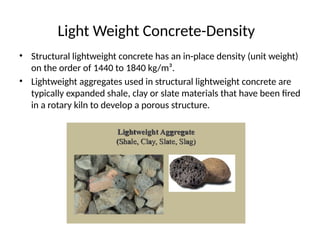
• Lightweight aggregates used in structural lightweight concrete are
typically expanded shale, clay or slate materials that have been fired
in a rotary kiln to develop a porous structure.
Light Weight Concrete –Density
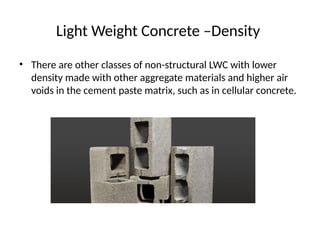
• There are other classes of non-structural LWC with lower
density made with other aggregate materials and higher air
voids in the cement paste matrix, such as in cellular concrete.
Materials for Light Weight Concrete
• Binding material: The ordinary Portland cement and it varieties can
be used as binding material. If local binding material such as lime-
slag, lime-cinder, etc. is available, the same can also be adopted as
the binding material.
• Aggregates: For lightweight concrete, the loose porous materials
are used as the aggregates. The natural porous aggregates can be
obtained by crushing lightweight rocks. The artificial porous
aggregates can be obtained from industrial wastes.
Materials for Light Weight Concrete
• Steel: The lightweight concrete is highly porous and hence it leads
to the corrosion of reinforcement, if not properly protected. Hence
the light weight concrete should be made adequately dense when
used for R.C.C. work. Sometimes the reinforcement is coated with
anti-corrosive compounds, when lightweight concrete is adopted.
• Water: It is necessary to use pure drinking water to prepare
lightweight concrete. The strength of lightweight concrete mainly
depends on the amount of water in the mix. The water-cement ratio
for achieving optimum strength of lightweight concrete should be
carefully worked out.
Types of Light Weight Concrete
• It is convenient to classify the various types of lightweight concrete
by their method of production.
These are :
• By using porous lightweight aggregate of low apparent specific
gravity, i.e. lower than 2.6. This type of concrete is known
as lightweight aggregate concrete.
• By introducing large voids within the concrete or mortar
massknows as aerated, cellular, foamed or gas concrete.
• By omitting the fine aggregate from the mix so that a large number
of interstitial voids is present known as no -fines concrete.
Types of Light Weight Concrete
LIGHTWEIGHT AGGREGATE CONCRETE.
• One of the oldest and common method of producing L.W.C.
• Light weight aggregates, either Natural or Artificial,are used in
concrete.
• There are naturally available aggregates, like
• Pumice
• Dolomite
• Scoria
• Volcanic cinders
• Saw dust
• Rice dust
Types of Light Weight Concrete
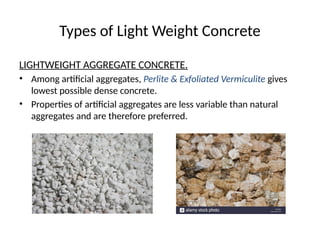
LIGHTWEIGHT AGGREGATE CONCRETE.
• Among artificial aggregates, Perlite & Exfoliated Vermiculite gives
lowest possible dense concrete.
• Properties of artificial aggregates are less variable than natural
aggregates and are therefore preferred.
Types of Light Weight Concrete
AERATED, CELLULAR, FOAMED OR GAS CONCRETE.
• Produced by introducing air into the concrete.
• It is made by either a physical or a chemical process during which either
air or gas is introduced into a slurry, which generally contains no coarse
material.
• Aerated concrete is a lightweight, cellular material consisting of cement
and/or lime and sand or other silicious material.
• Aerated concrete has the lowest density, thermal conductivity and
strength. Like timber it can be sawn, screwed and nailed, but there are
non-combustible.
Types of Light Weight Concrete
AERATED, CELLULAR, FOAMED OR GAS CONCRETE.
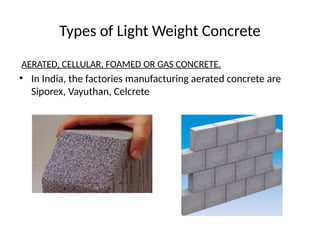
• In India, the factories manufacturing aerated concrete are
Siporex, Vayuthan, Celcrete
Types of Light Weight Concrete
AERATED, CELLULAR, FOAMED OR GAS CONCRETE.
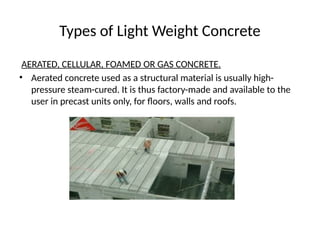
• Aerated concrete used as a structural material is usually high-
pressure steam-cured. It is thus factory-made and available to the
user in precast units only, for floors, walls and roofs.
Types of Light Weight Concrete
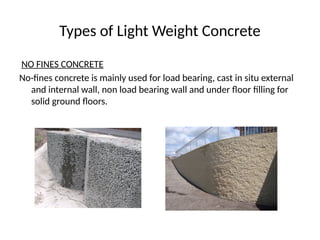
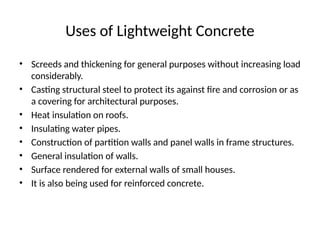
NO FINES CONCRETE
• It is a type of light weight concrete produced by omitting the fine
aggregates from conventional concrete.
• This concrete has only cement, coarse aggregate and water.
• Due to absence of fine aggregates, concrete will have large voids,
resulting in light weight.
Types of Light Weight Concrete
NO FINES CONCRETE
No-fines concrete is mainly used for load bearing, cast in situ external
and internal wall, non load bearing wall and under floor filling for
solid ground floors.
Uses of Lightweight Concrete
• Screeds and thickening for general purposes without increasing load
considerably.
• Casting structural steel to protect its against fire and corrosion or as
a covering for architectural purposes.
• Heat insulation on roofs.
• Insulating water pipes.
• Construction of partition walls and panel walls in frame structures.
• General insulation of walls.
• Surface rendered for external walls of small houses.
• It is also being used for reinforced concrete.
Advantages of Lightweight Concrete
• Reduces the dead load of the building.
• Easy to handle and hence reduces the cost of transportation and
handling.
• Increases progress of work due to less weight.
• Relatively low thermal and sound conductivity
• Comparatively more durable. But less resistant to abrasion.
• Has applications in pre-stressed concrete, high rise buildings &
shell roofs.
• Good resistance to freezing & thawing action when compared to
conventional concrete.
• Helps in disposal of industrial wastes like fly ash, clinker, slag etc.
Durability and Limitations
• It is generally move porous than the ordinary Portland cement. It is
not recommended for use below damp-course.
• Drying shrinkage commonly causes cracking of LWC if suitable
precautions are not taken.
• Brittle nature: they need to be handled more carefully than clay
bricks to avoid breakage.
• Attachments: the brittle nature of the blocks requires longer,
thinner screws when fitting cabinets and wall hangings and wood-
suitable drill bits or hammering in.
Thank you

Light Weight Concrete-presentation 1.pptx

  • 1.
  • 2.
    What is lightweight concrete ? • Light weight concrete is a special concrete which weighs lighter than conventional concrete. • Density of this concrete is considerably low (300 kg/m3 to 1850 kg/m3) when compared to normal concrete (2200kg/m3 to 2600kg/m3). • (What a great difference !) • Lightweight concrete mixture is made with a lightweight coarse aggregate and sometimes a portion or entire fine aggregates may be lightweight instead of normal aggregates.
  • 3.
    Light Weight Concrete-Density •Structural lightweight concrete has an in-place density (unit weight) on the order of 1440 to 1840 kg/m³. • Lightweight aggregates used in structural lightweight concrete are typically expanded shale, clay or slate materials that have been fired in a rotary kiln to develop a porous structure.
  • 4.
    Light Weight Concrete–Density • There are other classes of non-structural LWC with lower density made with other aggregate materials and higher air voids in the cement paste matrix, such as in cellular concrete.
  • 5.
    Materials for LightWeight Concrete • Binding material: The ordinary Portland cement and it varieties can be used as binding material. If local binding material such as lime- slag, lime-cinder, etc. is available, the same can also be adopted as the binding material. • Aggregates: For lightweight concrete, the loose porous materials are used as the aggregates. The natural porous aggregates can be obtained by crushing lightweight rocks. The artificial porous aggregates can be obtained from industrial wastes.
  • 6.
    Materials for LightWeight Concrete • Steel: The lightweight concrete is highly porous and hence it leads to the corrosion of reinforcement, if not properly protected. Hence the light weight concrete should be made adequately dense when used for R.C.C. work. Sometimes the reinforcement is coated with anti-corrosive compounds, when lightweight concrete is adopted. • Water: It is necessary to use pure drinking water to prepare lightweight concrete. The strength of lightweight concrete mainly depends on the amount of water in the mix. The water-cement ratio for achieving optimum strength of lightweight concrete should be carefully worked out.
  • 7.
    Types of LightWeight Concrete • It is convenient to classify the various types of lightweight concrete by their method of production. These are : • By using porous lightweight aggregate of low apparent specific gravity, i.e. lower than 2.6. This type of concrete is known as lightweight aggregate concrete. • By introducing large voids within the concrete or mortar massknows as aerated, cellular, foamed or gas concrete. • By omitting the fine aggregate from the mix so that a large number of interstitial voids is present known as no -fines concrete.
  • 8.
    Types of LightWeight Concrete LIGHTWEIGHT AGGREGATE CONCRETE. • One of the oldest and common method of producing L.W.C. • Light weight aggregates, either Natural or Artificial,are used in concrete. • There are naturally available aggregates, like • Pumice • Dolomite • Scoria • Volcanic cinders • Saw dust • Rice dust
  • 9.
    Types of LightWeight Concrete LIGHTWEIGHT AGGREGATE CONCRETE. • Among artificial aggregates, Perlite & Exfoliated Vermiculite gives lowest possible dense concrete. • Properties of artificial aggregates are less variable than natural aggregates and are therefore preferred.
  • 10.
    Types of LightWeight Concrete AERATED, CELLULAR, FOAMED OR GAS CONCRETE. • Produced by introducing air into the concrete. • It is made by either a physical or a chemical process during which either air or gas is introduced into a slurry, which generally contains no coarse material. • Aerated concrete is a lightweight, cellular material consisting of cement and/or lime and sand or other silicious material. • Aerated concrete has the lowest density, thermal conductivity and strength. Like timber it can be sawn, screwed and nailed, but there are non-combustible.
  • 11.
    Types of LightWeight Concrete AERATED, CELLULAR, FOAMED OR GAS CONCRETE. • In India, the factories manufacturing aerated concrete are Siporex, Vayuthan, Celcrete
  • 12.
    Types of LightWeight Concrete AERATED, CELLULAR, FOAMED OR GAS CONCRETE. • Aerated concrete used as a structural material is usually high- pressure steam-cured. It is thus factory-made and available to the user in precast units only, for floors, walls and roofs.
  • 13.
    Types of LightWeight Concrete NO FINES CONCRETE • It is a type of light weight concrete produced by omitting the fine aggregates from conventional concrete. • This concrete has only cement, coarse aggregate and water. • Due to absence of fine aggregates, concrete will have large voids, resulting in light weight.
  • 14.
    Types of LightWeight Concrete NO FINES CONCRETE No-fines concrete is mainly used for load bearing, cast in situ external and internal wall, non load bearing wall and under floor filling for solid ground floors.
  • 15.
    Uses of LightweightConcrete • Screeds and thickening for general purposes without increasing load considerably. • Casting structural steel to protect its against fire and corrosion or as a covering for architectural purposes. • Heat insulation on roofs. • Insulating water pipes. • Construction of partition walls and panel walls in frame structures. • General insulation of walls. • Surface rendered for external walls of small houses. • It is also being used for reinforced concrete.
  • 16.
    Advantages of LightweightConcrete • Reduces the dead load of the building. • Easy to handle and hence reduces the cost of transportation and handling. • Increases progress of work due to less weight. • Relatively low thermal and sound conductivity • Comparatively more durable. But less resistant to abrasion. • Has applications in pre-stressed concrete, high rise buildings & shell roofs. • Good resistance to freezing & thawing action when compared to conventional concrete. • Helps in disposal of industrial wastes like fly ash, clinker, slag etc.
  • 17.
    Durability and Limitations •It is generally move porous than the ordinary Portland cement. It is not recommended for use below damp-course. • Drying shrinkage commonly causes cracking of LWC if suitable precautions are not taken. • Brittle nature: they need to be handled more carefully than clay bricks to avoid breakage. • Attachments: the brittle nature of the blocks requires longer, thinner screws when fitting cabinets and wall hangings and wood- suitable drill bits or hammering in.
  • 18.