PRESENTED BY GURURAJ KULKARNI ADVOCATE
KALBURAGI KARNATAKA INDIA
INTRODUCTION
 Admiralty: 1. A court that exercises jurisdiction over
all maritime contracts, torts, injuries, or offenses.
 2. The system of jurisprudence that has grown out of
the practice of admiralty courts.
 3. Narrowly, the rules governing contract, tort, and
workers'-compensation claims arising out of
commerce on or over navigable water.
 The term, admiralty, specifically refers to the British
courts in England.
 Separate courts that traditionally exercised
jurisdiction over all regulations and handling of
disputes relating to sea navigation and commerce
 Maritime law: the body of law governing marine
commerce and navigation, the carriage at sea of
persons and property, and marine affairs in general;
the rules governing contract, tort, and workers'-
compensation claims or relating to commerce on or
over water.
 Also termed admiralty, admiralty law, sea law.
 Law of the sea: the body of international law
governing how countries use and control the sea and
its resources.
 Admiralty, or maritime law, is the private law of
navigation and shipping and covers inland as well as
marine waters.
 It is the entire body of laws, rules, legal concepts and
procedures that relate to the use of marine resources,
ocean commerce, and navigation.
 Maritime law was shaped by the practical needs of
those countries bordering the Mediterranean Sea
involved in maritime commerce, the roots of which are
traced as far back as 900 B.C.
 The development of the Merchant Shipping Law in
India has had a long history of over a century. The first
Act on the subject, passed by the British Parliament,
was the Lascars Act, 1823 (4 Geo. 4, c.80).
 This Act, which was partly repealed later, enabled rules
to be made by the Indian Legislature to be observed by
“Masters and Officers, Owners of ships and vessels
trading under the authority of the Act.”
 There was further legislation enacted by the British
Parliament e.g. 3 and 4 Vict. c. 56, under the authority
of which the Indian Registration of Ships Act of 1841
was passed in India.
 Similarly, in 1855, by virtue of a British Act (18 and 19
Vict. c.119), the Indian Sea Passengers Act of 1855 was
enacted
 The Merchant Shipping Act, 1894 (57 & 58 Vict. c. 60)
has been the most important Act of the British
Parliament relating to Merchant Shipping and this Act
has consolidated all the earlier Parliamentary
legislation and also defined the application of the
British Acts to India and other parts of the British
Empire.
The basis of the present Indian Law
 The British laws were basically sound in their technical
application and merit and the I.M.S. Act of 1958 rightly
takes its inspiration from the following two major
sources :
 A. International Conventions :
 B. The U.K. law on Merchant Shipping:
A. International Conventions :
 The merchant shipping law deals mainly with
technical matters and many of these are regulated by
International Conventions like the Safety Pollution,
Limitation of Liability, Prevention of Collisions and
Loadline Convention, the I.L.O. Conventions, etc.
The U.K. law on Merchant Shipping
 In 1931, the U.K. and the various Dominion
Governments entered into the Commonwealth
Merchant Shipping Agreement which provided that
for various matters like registration, standards of
safety, ship’s articles, certificates of officers, ship
enquiries, etc., the law throughout the Commonwealth
should as far as possible, be uniform. Although India
was not a party to this Agreement as she was not a
Dominion in 1931, she had adhered to the
Commonwealth arrangements to the extent that was
possible and desirable.
 The Indian Legislature has replaced the British
statutes by enacting the Merchant Shipping Act, 1958.
Power to enforce detention of ship
Section 444.
 (1) Where under this Act a ship is authorised or
ordered to be detained, any commissioned officer of
the Indian Navy or any port officer. pilot harbour
master, conservator of port of customs collector may
detain the ship.
 (2) If any ship after detention, or after service on the
master of any notice of, or order for, such detention
proceeds to sea before she is released by competent
authority, the master of the ship shall be guilty of an
offence under this sub-section.
 (3) When a ship so proceeding to sea takes to sea,
when on board thereof in the execution of his duty any
person authorised under this Act to detain or survey
the ship, the owner, master or agent of such ship shall
each be liable to pay all expenses of, and incidental to,
such person being so taken to sea and shall also be
guilty of an offence under this sub-section
 (4) When any owner, or master or agent is convicted of
an offence under sub-section (3), the convicting
magistrate may inquire into and determine the
amount payable on account of expenses by such
owner, master or agent under that sub-section and
may direct that the same shall be recovered from him
in the manner provided for the recovery of fines.
LAWS APPLICABLE TO MARITIME
LAW
 The various laws of India dealing with transport of
goods by sea are:
 The Merchant Shipping Act, 1958,
 The Indian Carriage of Goods by Sea Act, 1925,
 The Indian Bills of Lading Act, 1856,
 And general statutes, such as the Marine Insurance
Act, 1963,
 The Evidence Act, 1872,
 The Code of Civil Procedure, 1908,
 The Contract Act, 1872
 The Indian Penal Code, 1860,
 The Criminal Procedure Code, 1973,
 The Companies Act, 1956 etc. as well as the general
principles of law such as the law of torts, public and
private international law etc.
 In India, the Admiralty Jurisdiction is confined only to
few courts.
 Initially the High Courts of Bombay (Mumbai),
Madras (Chennai),
 Calcutta (Kolkata) exercise jurisdiction over maritime
matters.
 Which was later extended to the High Courts of
Gujarat (Ahmedabad), Andhra Pradesh (Hyderabad),
Orissa (Cuttack) and Kerala (Cochin).
 These courts can make orders with respect to the
vessels within the waters of Indian Territory.
 The power of most of these High Courts is confined
only to vessels which can be located within the
domestic limit of their territorial waters.
 For instance, Madras High Court is empowered to
arrest a vessel found in the waters of Tamil Nadu only.
 The maritime law of India is largely based on the
principles of the admiralty jurisdiction of England.
 The Admiralty jurisdiction of the High Courts at
Calcutta, Madras and Bombay were based on the
Admiralty jurisdiction of the High Court in England.
 The Admiralty jurisdiction exercised by the High
Courts in the Indian Republic is still governed by the
obsolete English Admiralty Courts Act, 1861 applied by
(English) Colonial Courts of Admiralty Act, 1890.
 The two conventions which deal with the arrest of a
shipping vessel are the Arrest Convention 1952 and the
Arrest Convention 1999.
 India is not a signatory to any of these Conventions.
 However, the Supreme Court in the case of M.V.
Elizabeth v. Harwan Investment & Trading
Pvt. Ltd. held that since India is a common law
country, the International Convention of the Arrest of
Seagoing Ships, Brussels, 10 May 1952 can be applied to
India to enforce the claims of maritime law against the
foreign ships.
 Further, in the case of M.V. Sea Success, the Supreme
Court of India laid down that the principles of the 1999
Geneva Arrest Convention were applicable for
arresting a ship in India.
 Of all the claims listed in the Arrest Conventions 1952
and 1999, the vessel can be arrested for claims relating
to damage done by a ship, loss of goods in transit,
salvage, master’s wages, disbursements and bottomry
irrespective of any change in the ownership of the
vessel.
 In respect of the other claims, if there has been a
change in the ownership of the vessel, the claim will
fail, and no arrest can be made unless there was a
fraud committed with respect to the change of
ownership.
Documents required for Arrest Procedure.
 The most important requirement for ship arrest is that
the claimant needs to issue a Power of Attorney in
favour of local attorneys other that the lawyers
instructed who will have the power to sign all the
necessary court documents.
 The Attorney then has to sign a Vakalatnama (Note of
appearance) authorising a lawyer to act, appear and
plead the case in Court on behalf of the Claimant.
 The next step is filing a substantive suit.
 The Claimant has to state the detailed facts, the nature
of the dispute, the particulars of the claim, etc. in such
a suit along with all the documents supporting his
claim such as the original contract, type of vessel,
document regarding payment, etc.
 This suit essentially represents the substantive portion
of the claim.
 The last part of the suit must contain the prayer of the
claimant seeking arrest of the defendant, the sale of
the vessel, the amount of compensation.
 The Plaintiff also needs to pay the court fees
depending on the amount of the claim which will
differ from court to court.
 The plaintiff then has to file an affidavit supporting his
plaint, a copy of the order of the judge requiring the
arrest of the vessel along with an affidavit, a Warrant
of Arrest issued by the court pursuant to the Judge’s
order and served upon the vessel and an Undertaking
to pay compensation in case of wrongful arrest.
 The plaintiff does not need to pay compensation
merely because the court had set aside the arrest but
only when the Court holds that the arrest was
wrongful for instance, if the plaintiff himself was at
fault or when the plaintiff acted with bad intention.
 Further, an application for ex-parte arrest can be made
upon plaintiff submitting Certificate from the
Admiralty Registrar signifying there is no caveat issued
against the arrest of the vessel with the Registry.
 Also any claim for wages, possession, etc. requires an
issuance of notice to the Consulate of the Country in
which the vessel is registered.
 If the plaintiff wishes for an immediate arrest of the
vessel, he can apply to the Court for an order of arrest
on an urgent basis either on the same day of filing an
application or the following day depending on the
Court’s discretion.
 Generally, the courts make an order on the same day of
filing application.
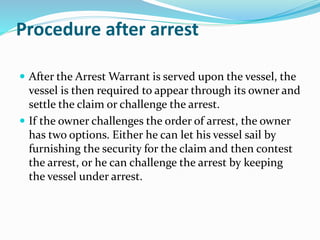
 Once the court orders the arrest of the vessel, the
judge will sign the order on the basis of which an
Arrest Warrant will be issued by the Registry.
 The Court Bailiff to serve the Warrant of Arrest upon
the vessel which is required to be arrested.
 The warrant also has to be served on the customs and
the port authorities requiring them not to allow the
vessel to sail.
 The Bailiff after serving the Warrant of Arrest upon
the vessel and the port authorities will file an affidavit
stating that he has performed his duty.
Procedure after arrest
 After the Arrest Warrant is served upon the vessel, the
vessel is then required to appear through its owner and
settle the claim or challenge the arrest.
 If the owner challenges the order of arrest, the owner
has two options. Either he can let his vessel sail by
furnishing the security for the claim and then contest
the arrest, or he can challenge the arrest by keeping
the vessel under arrest.
 In the case of default of owner, the court can make an
order for the sale of the vessel and the sale proceeds
can thereby be utilised to settle the claims of the
Plaintiff.
 In the case of any surplus, it must be paid back to the
owner.
Procedures for release of Aressted
Ship
 Property arrested under admiralty jurisdiction by a
warrant may be ordered to be released
(i) at the request of the plaintiff, before an appearance
in person or a vakalatnama is filed by the defendant;
or
(ii) on the defendant paying into Court the amount
claimed in the suit; or
(iii) on the defendant giving such security for the
amount claimed in the suit as the Court may direct; or
(iv) on any other ground that the Court may deem just.
 The master of an arrested ship can represent the ship
in taking steps to have it released.
 The bank guarantee, unless discharged, will have to
continue to remain in force till the suit is finally
disposed of and for a period of one year thereafter.
 It is possible to substitute a bank guarantee for the
cash deposit. In the case of a cash deposit it is usual for
the court, at the instance of the parties, to invest the
amount on an interest-bearing term deposit, pending
the disposal of the suit.
Maritime law

Maritime law

  • 1.
    PRESENTED BY GURURAJKULKARNI ADVOCATE KALBURAGI KARNATAKA INDIA
  • 3.
    INTRODUCTION  Admiralty: 1.A court that exercises jurisdiction over all maritime contracts, torts, injuries, or offenses.  2. The system of jurisprudence that has grown out of the practice of admiralty courts.  3. Narrowly, the rules governing contract, tort, and workers'-compensation claims arising out of commerce on or over navigable water.
  • 4.
     The term,admiralty, specifically refers to the British courts in England.  Separate courts that traditionally exercised jurisdiction over all regulations and handling of disputes relating to sea navigation and commerce
  • 5.
     Maritime law:the body of law governing marine commerce and navigation, the carriage at sea of persons and property, and marine affairs in general; the rules governing contract, tort, and workers'- compensation claims or relating to commerce on or over water.  Also termed admiralty, admiralty law, sea law.
  • 6.
     Law ofthe sea: the body of international law governing how countries use and control the sea and its resources.
  • 7.
     Admiralty, ormaritime law, is the private law of navigation and shipping and covers inland as well as marine waters.  It is the entire body of laws, rules, legal concepts and procedures that relate to the use of marine resources, ocean commerce, and navigation.  Maritime law was shaped by the practical needs of those countries bordering the Mediterranean Sea involved in maritime commerce, the roots of which are traced as far back as 900 B.C.
  • 8.
     The developmentof the Merchant Shipping Law in India has had a long history of over a century. The first Act on the subject, passed by the British Parliament, was the Lascars Act, 1823 (4 Geo. 4, c.80).  This Act, which was partly repealed later, enabled rules to be made by the Indian Legislature to be observed by “Masters and Officers, Owners of ships and vessels trading under the authority of the Act.”
  • 9.
     There wasfurther legislation enacted by the British Parliament e.g. 3 and 4 Vict. c. 56, under the authority of which the Indian Registration of Ships Act of 1841 was passed in India.  Similarly, in 1855, by virtue of a British Act (18 and 19 Vict. c.119), the Indian Sea Passengers Act of 1855 was enacted
  • 10.
     The MerchantShipping Act, 1894 (57 & 58 Vict. c. 60) has been the most important Act of the British Parliament relating to Merchant Shipping and this Act has consolidated all the earlier Parliamentary legislation and also defined the application of the British Acts to India and other parts of the British Empire.
  • 11.
    The basis ofthe present Indian Law  The British laws were basically sound in their technical application and merit and the I.M.S. Act of 1958 rightly takes its inspiration from the following two major sources :  A. International Conventions :  B. The U.K. law on Merchant Shipping:
  • 12.
    A. International Conventions:  The merchant shipping law deals mainly with technical matters and many of these are regulated by International Conventions like the Safety Pollution, Limitation of Liability, Prevention of Collisions and Loadline Convention, the I.L.O. Conventions, etc.
  • 13.
    The U.K. lawon Merchant Shipping  In 1931, the U.K. and the various Dominion Governments entered into the Commonwealth Merchant Shipping Agreement which provided that for various matters like registration, standards of safety, ship’s articles, certificates of officers, ship enquiries, etc., the law throughout the Commonwealth should as far as possible, be uniform. Although India was not a party to this Agreement as she was not a Dominion in 1931, she had adhered to the Commonwealth arrangements to the extent that was possible and desirable.
  • 14.
     The IndianLegislature has replaced the British statutes by enacting the Merchant Shipping Act, 1958.
  • 15.
    Power to enforcedetention of ship Section 444.  (1) Where under this Act a ship is authorised or ordered to be detained, any commissioned officer of the Indian Navy or any port officer. pilot harbour master, conservator of port of customs collector may detain the ship.  (2) If any ship after detention, or after service on the master of any notice of, or order for, such detention proceeds to sea before she is released by competent authority, the master of the ship shall be guilty of an offence under this sub-section.
  • 16.
     (3) Whena ship so proceeding to sea takes to sea, when on board thereof in the execution of his duty any person authorised under this Act to detain or survey the ship, the owner, master or agent of such ship shall each be liable to pay all expenses of, and incidental to, such person being so taken to sea and shall also be guilty of an offence under this sub-section
  • 17.
     (4) Whenany owner, or master or agent is convicted of an offence under sub-section (3), the convicting magistrate may inquire into and determine the amount payable on account of expenses by such owner, master or agent under that sub-section and may direct that the same shall be recovered from him in the manner provided for the recovery of fines.
  • 18.
    LAWS APPLICABLE TOMARITIME LAW  The various laws of India dealing with transport of goods by sea are:  The Merchant Shipping Act, 1958,  The Indian Carriage of Goods by Sea Act, 1925,  The Indian Bills of Lading Act, 1856,  And general statutes, such as the Marine Insurance Act, 1963,  The Evidence Act, 1872,  The Code of Civil Procedure, 1908,  The Contract Act, 1872
  • 19.
     The IndianPenal Code, 1860,  The Criminal Procedure Code, 1973,  The Companies Act, 1956 etc. as well as the general principles of law such as the law of torts, public and private international law etc.
  • 20.
     In India,the Admiralty Jurisdiction is confined only to few courts.  Initially the High Courts of Bombay (Mumbai), Madras (Chennai),  Calcutta (Kolkata) exercise jurisdiction over maritime matters.  Which was later extended to the High Courts of Gujarat (Ahmedabad), Andhra Pradesh (Hyderabad), Orissa (Cuttack) and Kerala (Cochin).
  • 21.
     These courtscan make orders with respect to the vessels within the waters of Indian Territory.  The power of most of these High Courts is confined only to vessels which can be located within the domestic limit of their territorial waters.  For instance, Madras High Court is empowered to arrest a vessel found in the waters of Tamil Nadu only.
  • 22.
     The maritimelaw of India is largely based on the principles of the admiralty jurisdiction of England.  The Admiralty jurisdiction of the High Courts at Calcutta, Madras and Bombay were based on the Admiralty jurisdiction of the High Court in England.
  • 23.
     The Admiraltyjurisdiction exercised by the High Courts in the Indian Republic is still governed by the obsolete English Admiralty Courts Act, 1861 applied by (English) Colonial Courts of Admiralty Act, 1890.
  • 24.
     The twoconventions which deal with the arrest of a shipping vessel are the Arrest Convention 1952 and the Arrest Convention 1999.  India is not a signatory to any of these Conventions.
  • 25.
     However, theSupreme Court in the case of M.V. Elizabeth v. Harwan Investment & Trading Pvt. Ltd. held that since India is a common law country, the International Convention of the Arrest of Seagoing Ships, Brussels, 10 May 1952 can be applied to India to enforce the claims of maritime law against the foreign ships.
  • 26.
     Further, inthe case of M.V. Sea Success, the Supreme Court of India laid down that the principles of the 1999 Geneva Arrest Convention were applicable for arresting a ship in India.  Of all the claims listed in the Arrest Conventions 1952 and 1999, the vessel can be arrested for claims relating to damage done by a ship, loss of goods in transit, salvage, master’s wages, disbursements and bottomry irrespective of any change in the ownership of the vessel.
  • 27.
     In respectof the other claims, if there has been a change in the ownership of the vessel, the claim will fail, and no arrest can be made unless there was a fraud committed with respect to the change of ownership.
  • 28.
    Documents required forArrest Procedure.  The most important requirement for ship arrest is that the claimant needs to issue a Power of Attorney in favour of local attorneys other that the lawyers instructed who will have the power to sign all the necessary court documents.
  • 29.
     The Attorneythen has to sign a Vakalatnama (Note of appearance) authorising a lawyer to act, appear and plead the case in Court on behalf of the Claimant.  The next step is filing a substantive suit.  The Claimant has to state the detailed facts, the nature of the dispute, the particulars of the claim, etc. in such a suit along with all the documents supporting his claim such as the original contract, type of vessel, document regarding payment, etc.
  • 30.
     This suitessentially represents the substantive portion of the claim.  The last part of the suit must contain the prayer of the claimant seeking arrest of the defendant, the sale of the vessel, the amount of compensation.
  • 31.
     The Plaintiffalso needs to pay the court fees depending on the amount of the claim which will differ from court to court.  The plaintiff then has to file an affidavit supporting his plaint, a copy of the order of the judge requiring the arrest of the vessel along with an affidavit, a Warrant of Arrest issued by the court pursuant to the Judge’s order and served upon the vessel and an Undertaking to pay compensation in case of wrongful arrest.
  • 32.
     The plaintiffdoes not need to pay compensation merely because the court had set aside the arrest but only when the Court holds that the arrest was wrongful for instance, if the plaintiff himself was at fault or when the plaintiff acted with bad intention.
  • 33.
     Further, anapplication for ex-parte arrest can be made upon plaintiff submitting Certificate from the Admiralty Registrar signifying there is no caveat issued against the arrest of the vessel with the Registry.  Also any claim for wages, possession, etc. requires an issuance of notice to the Consulate of the Country in which the vessel is registered.
  • 34.
     If theplaintiff wishes for an immediate arrest of the vessel, he can apply to the Court for an order of arrest on an urgent basis either on the same day of filing an application or the following day depending on the Court’s discretion.  Generally, the courts make an order on the same day of filing application.
  • 35.
     Once thecourt orders the arrest of the vessel, the judge will sign the order on the basis of which an Arrest Warrant will be issued by the Registry.  The Court Bailiff to serve the Warrant of Arrest upon the vessel which is required to be arrested.
  • 36.
     The warrantalso has to be served on the customs and the port authorities requiring them not to allow the vessel to sail.  The Bailiff after serving the Warrant of Arrest upon the vessel and the port authorities will file an affidavit stating that he has performed his duty.
  • 37.
    Procedure after arrest After the Arrest Warrant is served upon the vessel, the vessel is then required to appear through its owner and settle the claim or challenge the arrest.  If the owner challenges the order of arrest, the owner has two options. Either he can let his vessel sail by furnishing the security for the claim and then contest the arrest, or he can challenge the arrest by keeping the vessel under arrest.
  • 38.
     In thecase of default of owner, the court can make an order for the sale of the vessel and the sale proceeds can thereby be utilised to settle the claims of the Plaintiff.  In the case of any surplus, it must be paid back to the owner.
  • 39.
    Procedures for releaseof Aressted Ship  Property arrested under admiralty jurisdiction by a warrant may be ordered to be released (i) at the request of the plaintiff, before an appearance in person or a vakalatnama is filed by the defendant; or (ii) on the defendant paying into Court the amount claimed in the suit; or (iii) on the defendant giving such security for the amount claimed in the suit as the Court may direct; or (iv) on any other ground that the Court may deem just.
  • 40.
     The masterof an arrested ship can represent the ship in taking steps to have it released.  The bank guarantee, unless discharged, will have to continue to remain in force till the suit is finally disposed of and for a period of one year thereafter.  It is possible to substitute a bank guarantee for the cash deposit. In the case of a cash deposit it is usual for the court, at the instance of the parties, to invest the amount on an interest-bearing term deposit, pending the disposal of the suit.