Psychology 101 project
Stress
Done by: Sally Suliman
(211410555), Nouf Alsahil
(214511389), Layan
Alzaben(215410347) ,
Lamess Alotabi (212410226),
The greatest weapon
against stress is the
ability to choose one
thought over
another.
William james
What is stress?
Stress is simply a reaction to a stimulus
that disturbs our physical or mental
equilibrium. In other words, it's an
omnipresent part of life. A stressful event
can trigger the “fight-or-flight” response,
causing hormones such as adrenaline
and cortisol to surge through the body.
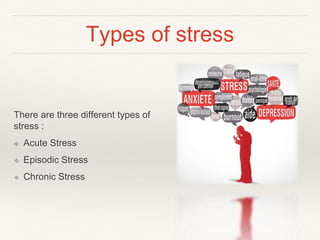
Types of stress
There are three different types of
stress :
âť– Acute Stress
âť– Episodic Stress
âť– Chronic Stress
Acute Stress
âť– Acute stress is the most widely experienced one, since
it typically is caused by the daily demands and
pressures encountered by each one of us. While the
word “stress” connotes a negative impression, acute
stress is what actually brings about excitement, joy and
thrill in our lives.
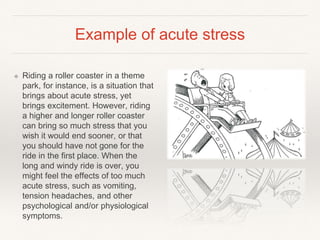
Example of acute stress
âť– Riding a roller coaster in a theme
park, for instance, is a situation that
brings about acute stress, yet
brings excitement. However, riding
a higher and longer roller coaster
can bring so much stress that you
wish it would end sooner, or that
you should have not gone for the
ride in the first place. When the
long and windy ride is over, you
might feel the effects of too much
acute stress, such as vomiting,
tension headaches, and other
psychological and/or physiological
symptoms.
âť– Because acute stress occurs only at a very short period of
time, these symptoms might only come out when the stress
has already accumulated:
âť– , such as anger, anxiety, irritability, and
acute periods of depression
âť– Physical problems, such as headache, pain, stomach
upset, dizziness, heart palpitations, shortness of breath,
hypertension and bowel disorders
Chronic Stress
❖ Chronic stress is the total opposite of acute stress; it’s not exciting and
thrilling, but dangerous and unhealthy. Chronic stress tears the life of a
person apart his mind, body or spirit.
âť– This type of stress is brought about by long-term exposure to stressors,
such as unhappy marriage, traumatic experiences, unwanted career or
job, stress of poverty, chronic illnesses, relationship conflicts, political
problems, and dysfunctional families. These stressful situations seem to
be unending, and the accumulated stress that results from exposure to
them can be life-threatening, and can even lead a person to resort to
violence, suicide and self-harm. Serious illnesses like stroke, heart
attack, cancer, and psychological problems such as clinical depression
and post-traumatic disorder can originate from chronic stress.
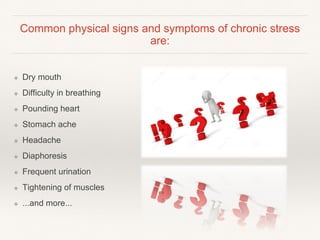
Common physical signs and symptoms of chronic stress
are:
âť– Dry mouth
âť– Difficulty in breathing
âť– Pounding heart
âť– Stomach ache
âť– Headache
âť– Diaphoresis
âť– Frequent urination
âť– Tightening of muscles
âť– ...and more...
Mental signs and symptoms include:
âť– Sudden irritability
âť– Tension
âť– Problems with concentration
âť– Difficulty in sleeping
âť– Narrowed perception
âť– Frequent feelings of fatigue
Stress Causes
and Effects
What causes stress?
Does stress affect everyone
the same?
What does stress ffect ?
What causes Stress?
âť– Stress can be caused by a physical or emotional change, or a
change in your environment that requires you to adjust or
respond. Things that make you feel stressed are called
"stressors."
âť– Stressors can be minor hassles, major lifestyle changes, or a
combination of both. Being able to identify stressors in your life
and releasing the tension they cause are the keys to managing
stress.
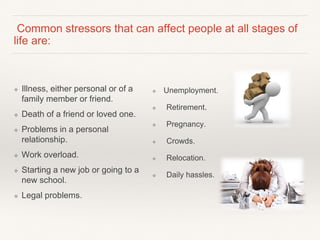
Common stressors that can affect people at all stages of
life are:
âť– Illness, either personal or of a
family member or friend.
âť– Death of a friend or loved one.
âť– Problems in a personal
relationship.
âť– Work overload.
âť– Starting a new job or going to a
new school.
âť– Legal problems.
âť– Unemployment.
âť– Retirement.
âť– Pregnancy.
âť– Crowds.
âť– Relocation.
âť– Daily hassles.
Does stress affect everyone the same?
No. People respond in different ways to events and situations. One person
may find an event joyful and gratifying, but another person may find the
same event miserable and frustrating. Sometimes, people may handle
stress in ways that make bad situations worse by reacting with feelings of
anger, guilt, fear, hostility, anxiety, and moodiness. Others may face life's
challenges with ease.
Stress Effects
On body :
âť– Depression
âť– Heart Attack
âť– High Blood Pressure
âť– Headache
âť– Heartburn
On brain:
âť– Chronic stress makes you
forgetful and emotional.
âť– Stress halts the production of
new brain cells.
âť– Chronic stress shrinks your
brain.
âť– Chronic stress increases your
risk of dementia and
Alzheimer’s.
How to Avoid Stress?
âť– Manage your time.
âť– Look at your lifestyle: 1- Balance between personal, work, and family needs.
2- Find sense of purpose/meaning through connections with family/friends,
and spirituality/volunteer work. 3- Get enough sleep. 4- Adopt healthy habits
through eating healthy and exercising. 5- Get support (love, trust, and advice)
from family, friends, or coworkers.
âť– Change your thinking: 1- Cognitive Behavior Therapy (CBT) helps in coping by
changing the way you think. 2- Problem Solving helps identify stressful events
& find ways to be able to change/deal with things you can’t change. 3-
Assertive Communication helps express your feelings. Not being able to talk
creates stress and makes negative feelings worse.
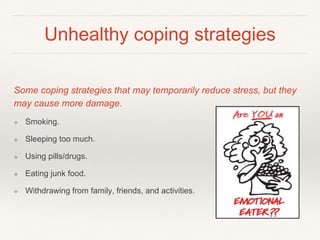
Unhealthy coping strategies
Some coping strategies that may temporarily reduce stress, but they
may cause more damage.
âť– Smoking.
âť– Sleeping too much.
âť– Using pills/drugs.
âť– Eating junk food.
âť– Withdrawing from family, friends, and activities.
Sometimes a person may feel there’s
nothing to do about stress. However, we all
respond to stress differently.
Ways to Fight
Stress
1. Get moving: go for a walk, go to the gym, do yoga or
any other physical activity.
2. Engage socially: have lunch with a family member, call
a friend, or help someone.
3. Avoid stressor: learn to say “no”, or avoid people who
stress you out.
4. Make time for fun: play games, or watch some comedy.
5. Make time for relaxation: listen to music, breathe
deeply, meditate, spend time in nature, or take a long
bath.
6. Do something you enjoy: ride a bike, or play piano.
7. Adopt healthy lifestyle: eat healthy (reduce caffeine,
cigarettes), and get enough sleep.
References:
âť– http://www.helpguide.org/articles/stress/stress-management.htm
âť– http://www.webmd.com/balance/stress-management/stress-management-avoiding-unnecessary-
stress
âť– http://www.webmd.com/balance/guide/blissing-out-10-relaxation-techniques-reduce-stress-spot
âť– https://explorable.com/three-different-kinds-of-stress
âť– http://www.healthline.com/health/whats-your-stress-type#2
âť– http://www.medicinenet.com/stress_and_heart_disease/page2.htm
âť– https://www.psychologytoday.com/basics/stress

Psy 101 project (Stress)

  • 1.
    Psychology 101 project Stress Doneby: Sally Suliman (211410555), Nouf Alsahil (214511389), Layan Alzaben(215410347) , Lamess Alotabi (212410226),
  • 2.
    The greatest weapon againststress is the ability to choose one thought over another. William james
  • 3.
    What is stress? Stressis simply a reaction to a stimulus that disturbs our physical or mental equilibrium. In other words, it's an omnipresent part of life. A stressful event can trigger the “fight-or-flight” response, causing hormones such as adrenaline and cortisol to surge through the body.
  • 4.
    Types of stress Thereare three different types of stress : âť– Acute Stress âť– Episodic Stress âť– Chronic Stress
  • 5.
    Acute Stress ❖ Acutestress is the most widely experienced one, since it typically is caused by the daily demands and pressures encountered by each one of us. While the word “stress” connotes a negative impression, acute stress is what actually brings about excitement, joy and thrill in our lives.
  • 6.
    Example of acutestress âť– Riding a roller coaster in a theme park, for instance, is a situation that brings about acute stress, yet brings excitement. However, riding a higher and longer roller coaster can bring so much stress that you wish it would end sooner, or that you should have not gone for the ride in the first place. When the long and windy ride is over, you might feel the effects of too much acute stress, such as vomiting, tension headaches, and other psychological and/or physiological symptoms.
  • 7.
    âť– Because acutestress occurs only at a very short period of time, these symptoms might only come out when the stress has already accumulated: âť– , such as anger, anxiety, irritability, and acute periods of depression âť– Physical problems, such as headache, pain, stomach upset, dizziness, heart palpitations, shortness of breath, hypertension and bowel disorders
  • 8.
    Chronic Stress ❖ Chronicstress is the total opposite of acute stress; it’s not exciting and thrilling, but dangerous and unhealthy. Chronic stress tears the life of a person apart his mind, body or spirit. ❖ This type of stress is brought about by long-term exposure to stressors, such as unhappy marriage, traumatic experiences, unwanted career or job, stress of poverty, chronic illnesses, relationship conflicts, political problems, and dysfunctional families. These stressful situations seem to be unending, and the accumulated stress that results from exposure to them can be life-threatening, and can even lead a person to resort to violence, suicide and self-harm. Serious illnesses like stroke, heart attack, cancer, and psychological problems such as clinical depression and post-traumatic disorder can originate from chronic stress.
  • 9.
    Common physical signsand symptoms of chronic stress are: âť– Dry mouth âť– Difficulty in breathing âť– Pounding heart âť– Stomach ache âť– Headache âť– Diaphoresis âť– Frequent urination âť– Tightening of muscles âť– ...and more...
  • 10.
    Mental signs andsymptoms include: âť– Sudden irritability âť– Tension âť– Problems with concentration âť– Difficulty in sleeping âť– Narrowed perception âť– Frequent feelings of fatigue
  • 11.
    Stress Causes and Effects Whatcauses stress? Does stress affect everyone the same? What does stress ffect ?
  • 12.
    What causes Stress? âť–Stress can be caused by a physical or emotional change, or a change in your environment that requires you to adjust or respond. Things that make you feel stressed are called "stressors." âť– Stressors can be minor hassles, major lifestyle changes, or a combination of both. Being able to identify stressors in your life and releasing the tension they cause are the keys to managing stress.
  • 13.
    Common stressors thatcan affect people at all stages of life are: âť– Illness, either personal or of a family member or friend. âť– Death of a friend or loved one. âť– Problems in a personal relationship. âť– Work overload. âť– Starting a new job or going to a new school. âť– Legal problems. âť– Unemployment. âť– Retirement. âť– Pregnancy. âť– Crowds. âť– Relocation. âť– Daily hassles.
  • 14.
    Does stress affecteveryone the same? No. People respond in different ways to events and situations. One person may find an event joyful and gratifying, but another person may find the same event miserable and frustrating. Sometimes, people may handle stress in ways that make bad situations worse by reacting with feelings of anger, guilt, fear, hostility, anxiety, and moodiness. Others may face life's challenges with ease.
  • 15.
    Stress Effects On body: ❖ Depression ❖ Heart Attack ❖ High Blood Pressure ❖ Headache ❖ Heartburn On brain: ❖ Chronic stress makes you forgetful and emotional. ❖ Stress halts the production of new brain cells. ❖ Chronic stress shrinks your brain. ❖ Chronic stress increases your risk of dementia and Alzheimer’s.
  • 16.
    How to AvoidStress? ❖ Manage your time. ❖ Look at your lifestyle: 1- Balance between personal, work, and family needs. 2- Find sense of purpose/meaning through connections with family/friends, and spirituality/volunteer work. 3- Get enough sleep. 4- Adopt healthy habits through eating healthy and exercising. 5- Get support (love, trust, and advice) from family, friends, or coworkers. ❖ Change your thinking: 1- Cognitive Behavior Therapy (CBT) helps in coping by changing the way you think. 2- Problem Solving helps identify stressful events & find ways to be able to change/deal with things you can’t change. 3- Assertive Communication helps express your feelings. Not being able to talk creates stress and makes negative feelings worse.
  • 17.
    Unhealthy coping strategies Somecoping strategies that may temporarily reduce stress, but they may cause more damage. âť– Smoking. âť– Sleeping too much. âť– Using pills/drugs. âť– Eating junk food. âť– Withdrawing from family, friends, and activities.
  • 18.
    Sometimes a personmay feel there’s nothing to do about stress. However, we all respond to stress differently. Ways to Fight Stress 1. Get moving: go for a walk, go to the gym, do yoga or any other physical activity. 2. Engage socially: have lunch with a family member, call a friend, or help someone. 3. Avoid stressor: learn to say “no”, or avoid people who stress you out. 4. Make time for fun: play games, or watch some comedy. 5. Make time for relaxation: listen to music, breathe deeply, meditate, spend time in nature, or take a long bath. 6. Do something you enjoy: ride a bike, or play piano. 7. Adopt healthy lifestyle: eat healthy (reduce caffeine, cigarettes), and get enough sleep.
  • 19.
    References: âť– http://www.helpguide.org/articles/stress/stress-management.htm âť– http://www.webmd.com/balance/stress-management/stress-management-avoiding-unnecessary- stress âť–http://www.webmd.com/balance/guide/blissing-out-10-relaxation-techniques-reduce-stress-spot âť– https://explorable.com/three-different-kinds-of-stress âť– http://www.healthline.com/health/whats-your-stress-type#2 âť– http://www.medicinenet.com/stress_and_heart_disease/page2.htm âť– https://www.psychologytoday.com/basics/stress