Stress and Time
Management
GROUP GUIDANCE
Stress Management
Adapted from the books:
“Stress Solution: An Action Plan To Manage The Stress In Your Life” by Lyle H. Mller, Ph.D., and Alma
Dell Smith, Ph.D., ABPP, with Larry Rothstein, Ed.D.
“Stress Management: A Comprehensive Guide to Wellness” by Edward A Charlesworth, Ph. D. &
Ronald G. Nathan, Ph.D.
Before we start:
Reset what you’ve learned in
the past
FACT OR MYTH?
Stress is the same for everybody.
MYTH
FACT OR MYTH?
There is a good stress.
FACT
FACT OR MYTH?
Stress is everywhere, so you can’t do
anything about it
MYTH
FACT OR MYTH?
The most popular methods for
reducing stress are the best ones.
MYTH
FACT OR MYTH?
No symptoms, no stress.
MYTH
FACT OR MYTH?
Only major symptoms of stress require
attention.
MYTH
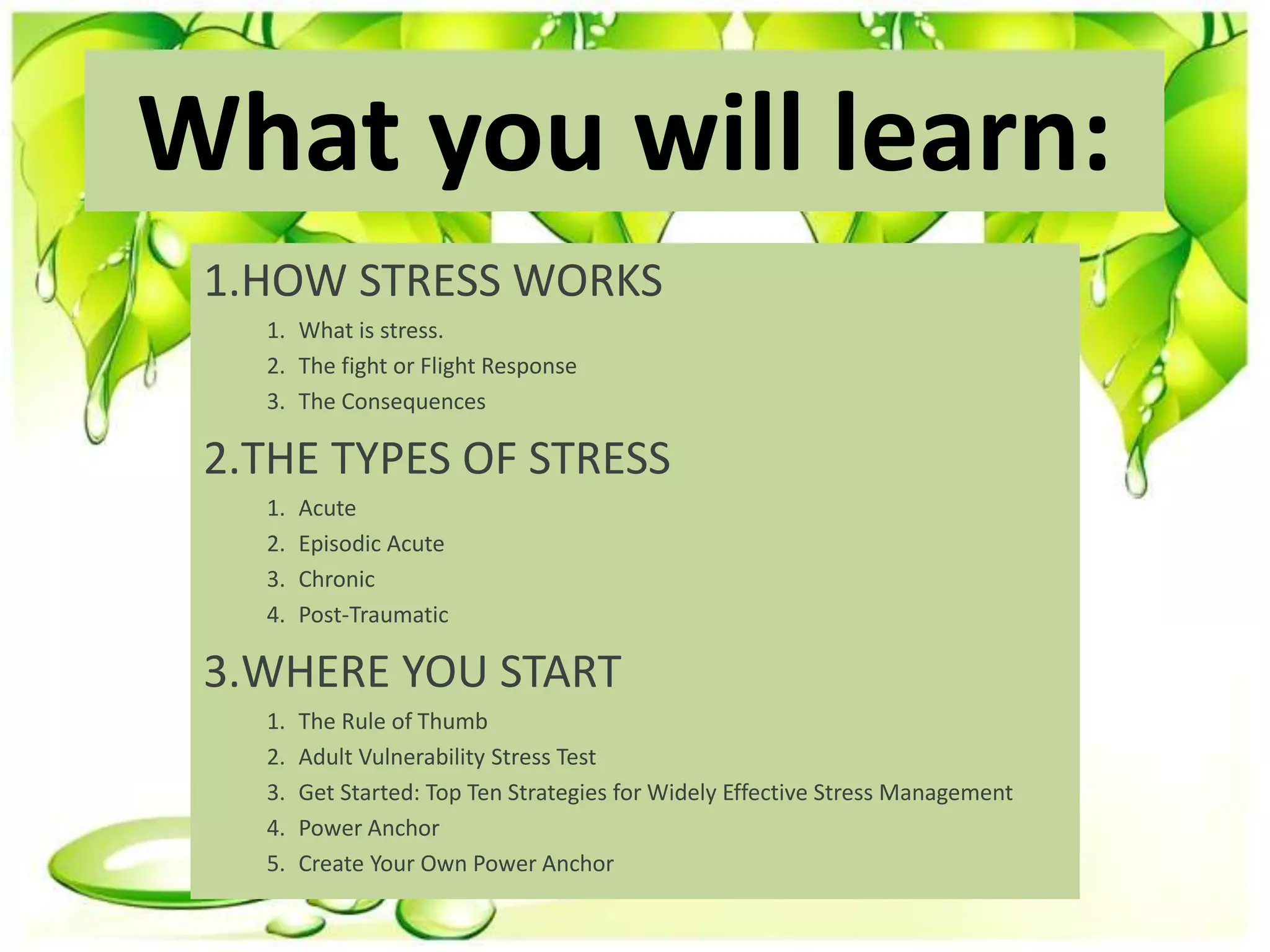
What you will learn:
1.HOW STRESS WORKS
1. What is stress.
2. The fight or Flight Response
3. The Consequences
2.THE TYPES OF STRESS
1. Acute
2. Episodic Acute
3. Chronic
4. Post-Traumatic
3.WHERE YOU START
1. The Rule of Thumb
2. Adult Vulnerability Stress Test
3. Get Started: Top Ten Strategies for Widely Effective Stress Management
4. Power Anchor
5. Create Your Own Power Anchor
HOW STRESS WORKS
What is stress?
The state of dynamic tension created when you
respond to perceived demands and pressures
from outside (External) and from
within yourself (Internal)
HOW STRESS WORKS
What is stress?
External Demands and Pressures
Stressors that comes from outside of us
•Physical Demands and Pressures
HOW STRESS WORKS
What is stress?
External Demands and Pressures
Stressors that comes from outside of us
•Psychosocial Demands and Pressures
HOW STRESS WORKS
What is stress?
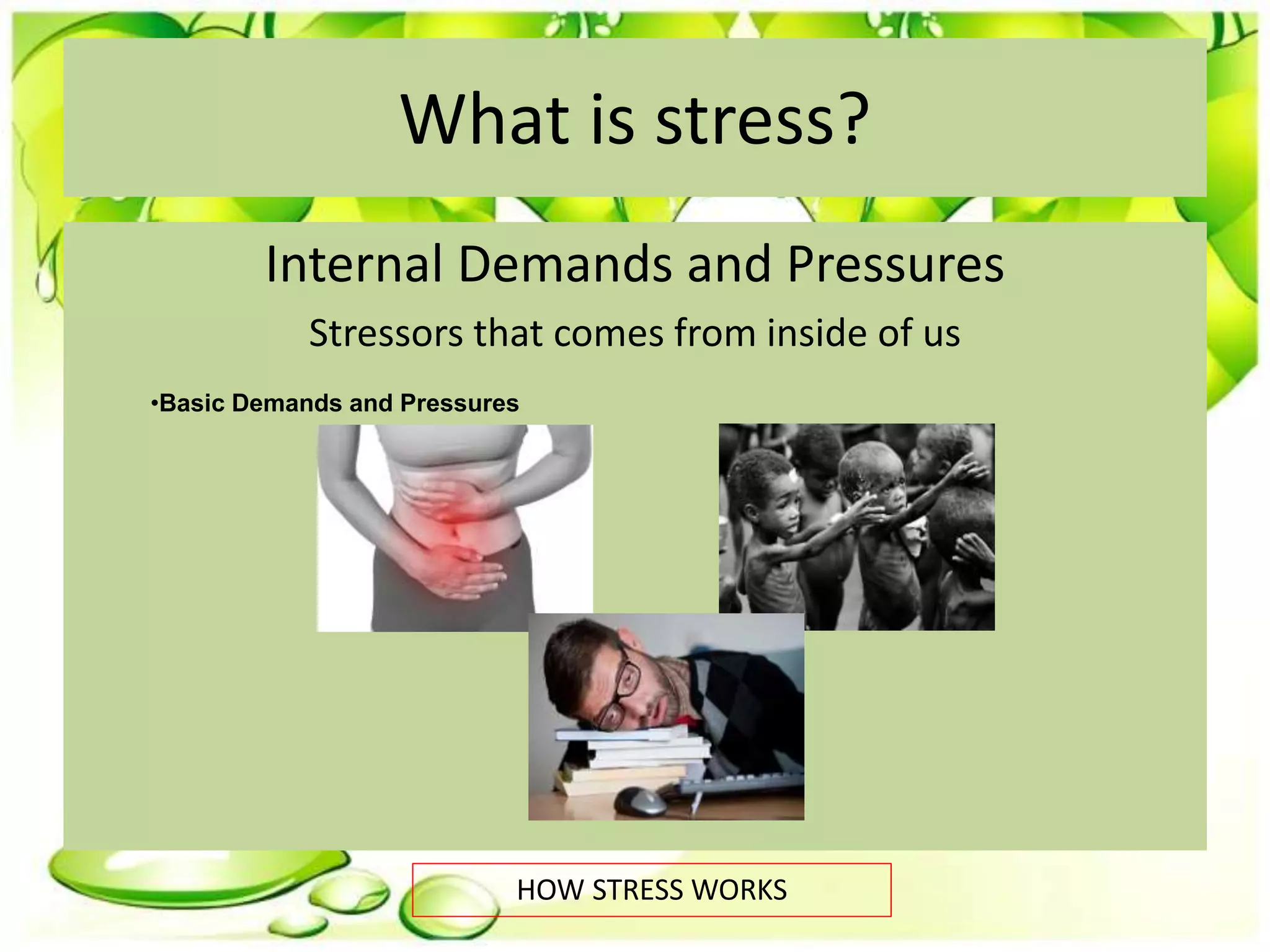
Internal Demands and Pressures
Stressors that comes from inside of us
HOW STRESS WORKS
•Basic Demands and Pressures
What is stress?
Internal Demands and Pressures
Stressors that comes from inside of us
HOW STRESS WORKS
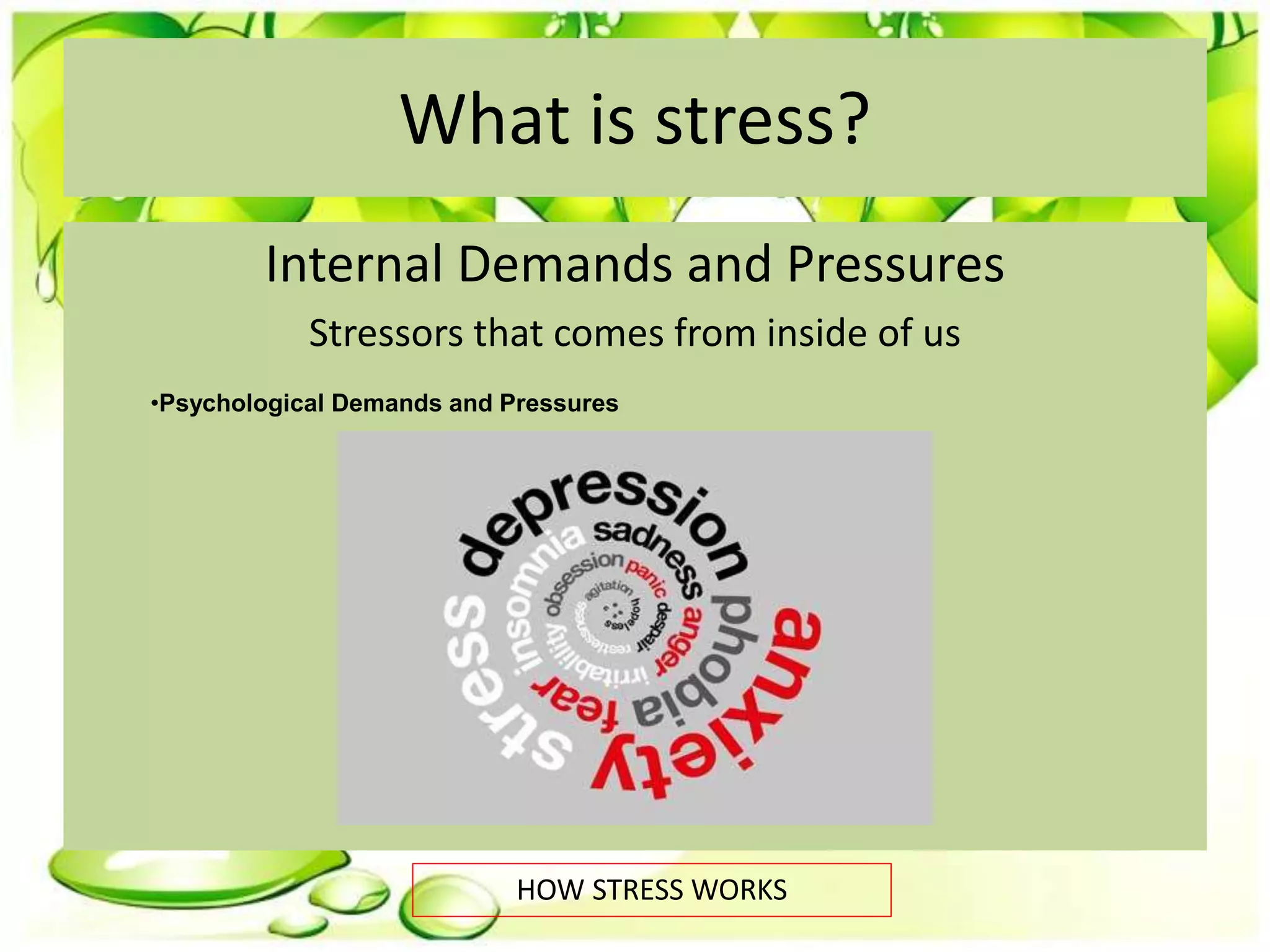
•Psychological Demands and Pressures
What is stress?
Internal Demands and Pressures
Stressors that comes from inside of us
HOW STRESS WORKS
•Self-Fulfilment Demands and Pressures
Stress Facts
Psychological research shows that we can pay
attention only to seven items, plus or minus two, at
a time.
HOW STRESS WORKS
Stress happens when demands and pressures
compete for attention.
Your internal and external demands and pressures
mixed up producing a burden of demands and
pressures competing for your attention.
Situation
HOW STRESS WORKS
A scheduled dinner date with a girlfriend/boyfriend.
ERROR 404:
NO
GIRLFRIEND/BOYFRIEND
FOUND
Situation
HOW STRESS WORKS
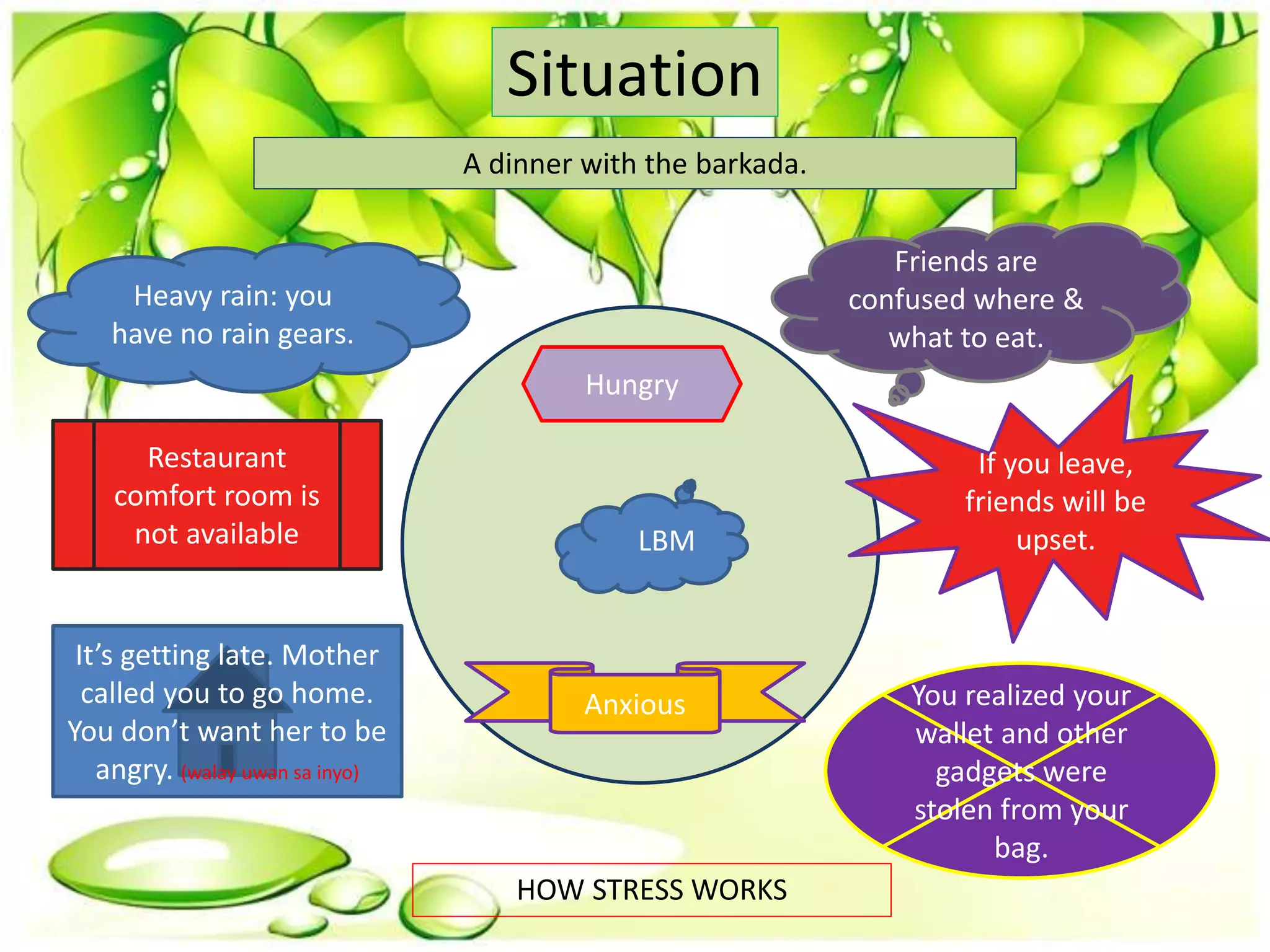
A dinner with the barkada.
Hungry
Heavy rain: you
have no rain gears.
Friends are
confused where &
what to eat.
Restaurant
comfort room is
not available
It’s getting late. Mother
called you to go home.
You don’t want her to be
angry. (walay uwan sa inyo)
If you leave,
friends will be
upset.
You realized your
wallet and other
gadgets were
stolen from your
bag.
LBM
Anxious
The Fight or Flight Response
HOW STRESS WORKS
Stimulus
(through sensory organs)
Nervous System Activates the brain,
especially the hypothalamus
Adrenal Gland Secretes cortisol, epinephrine
and norepinephrine
Liver
(converts glycogen to glucose)
Heart
(increase heartbeat)
Lungs
(speeds up breathing)
Digestive System
(slows down digestion)
Muscular System
(responds to the threat through
reflexes)
The Consequences
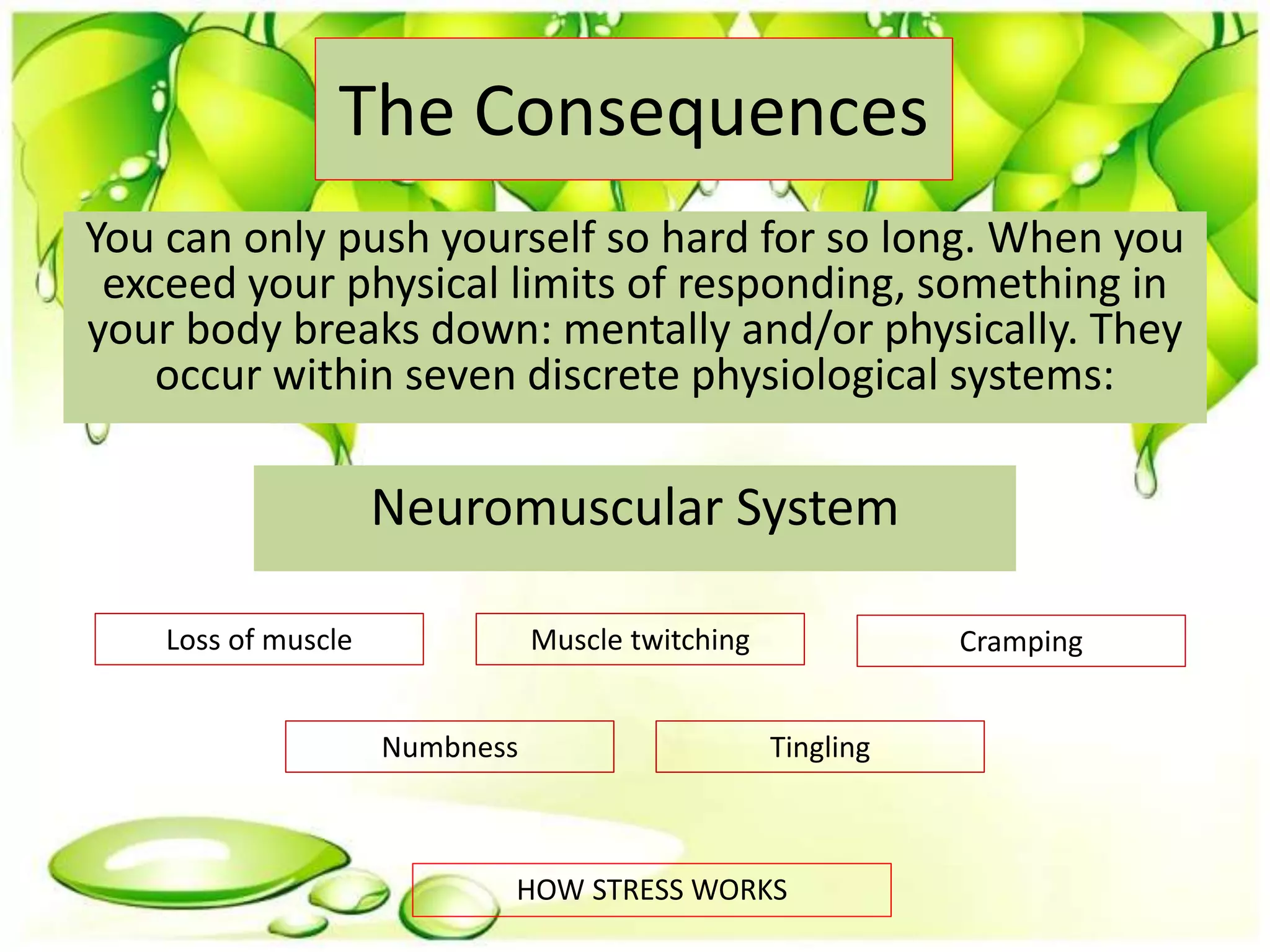
You can only push yourself so hard for so long. When you
exceed your physical limits of responding, something in
your body breaks down: mentally and/or physically. They
occur within seven discrete physiological systems:
HOW STRESS WORKS
Neuromuscular System
Loss of muscle Muscle twitching Cramping
Numbness Tingling
The Consequences
HOW STRESS WORKS
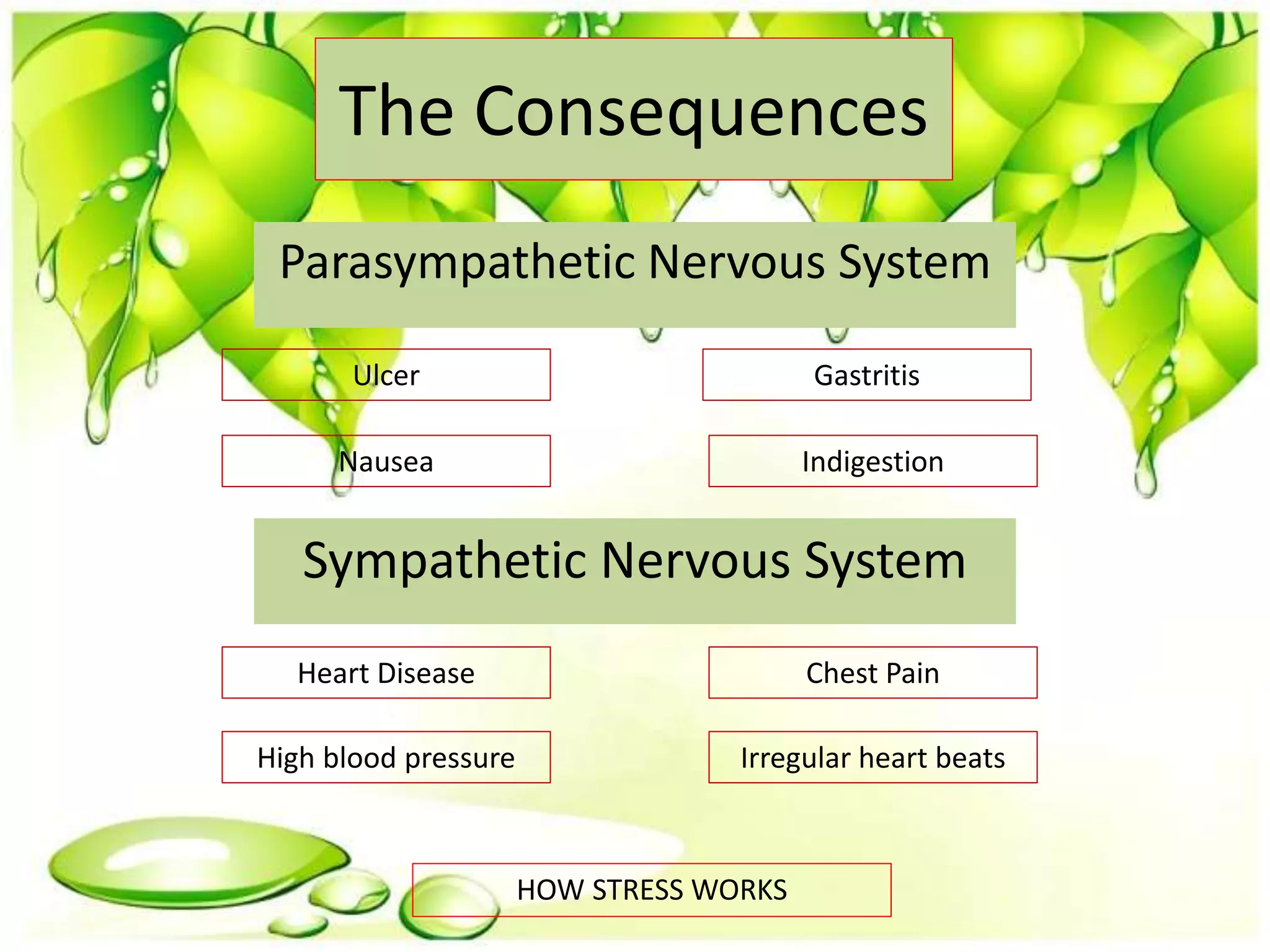
Parasympathetic Nervous System
Ulcer Gastritis
IndigestionNausea
Sympathetic Nervous System
Heart Disease
High blood pressure
Chest Pain
Irregular heart beats
The Consequences
HOW STRESS WORKS
Limbic System
Anxiety Irritability
AggressionMood swings
Neocortical System
Disorientation
Memory loss
Inability to learn Loss of focus
Inability to sleep Linked with Alzheimer's
The Consequences
HOW STRESS WORKS
Endocrine System
Diabetes Irregular menstruation
Loss of appetiteLoss of sexual desire
TYPES OF STRESS
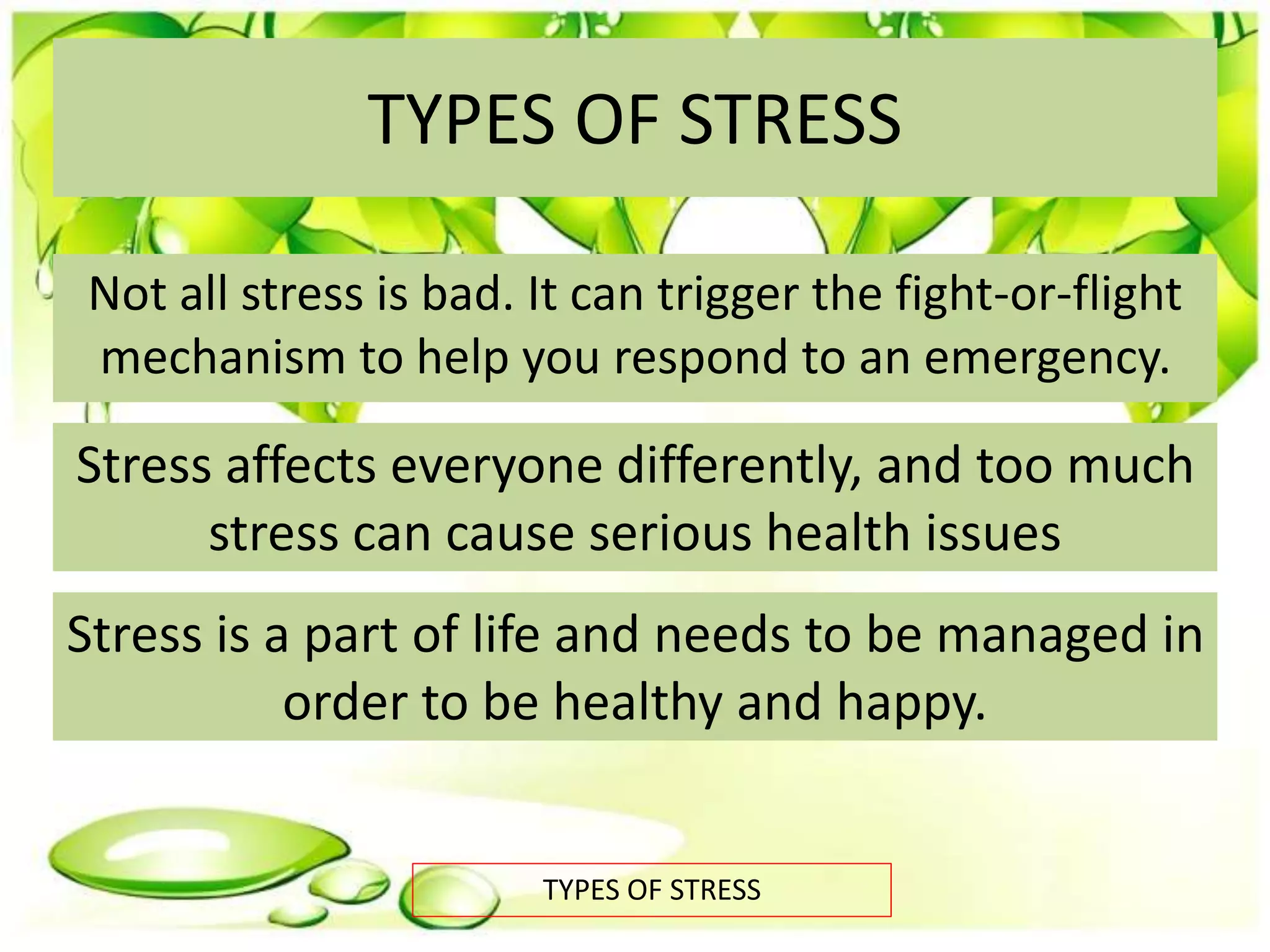
Not all stress is bad. It can trigger the fight-or-flight
mechanism to help you respond to an emergency.
TYPES OF STRESS
Stress affects everyone differently, and too much
stress can cause serious health issues
Stress is a part of life and needs to be managed in
order to be healthy and happy.
ACUTE STRESS
Short-lived and beneficial
TYPES OF STRESS
Symptoms includes:
Headache Stomach Aches Sweating
Heart palpitation Breathlessness Dizziness
Treatment:
Rest Relaxation
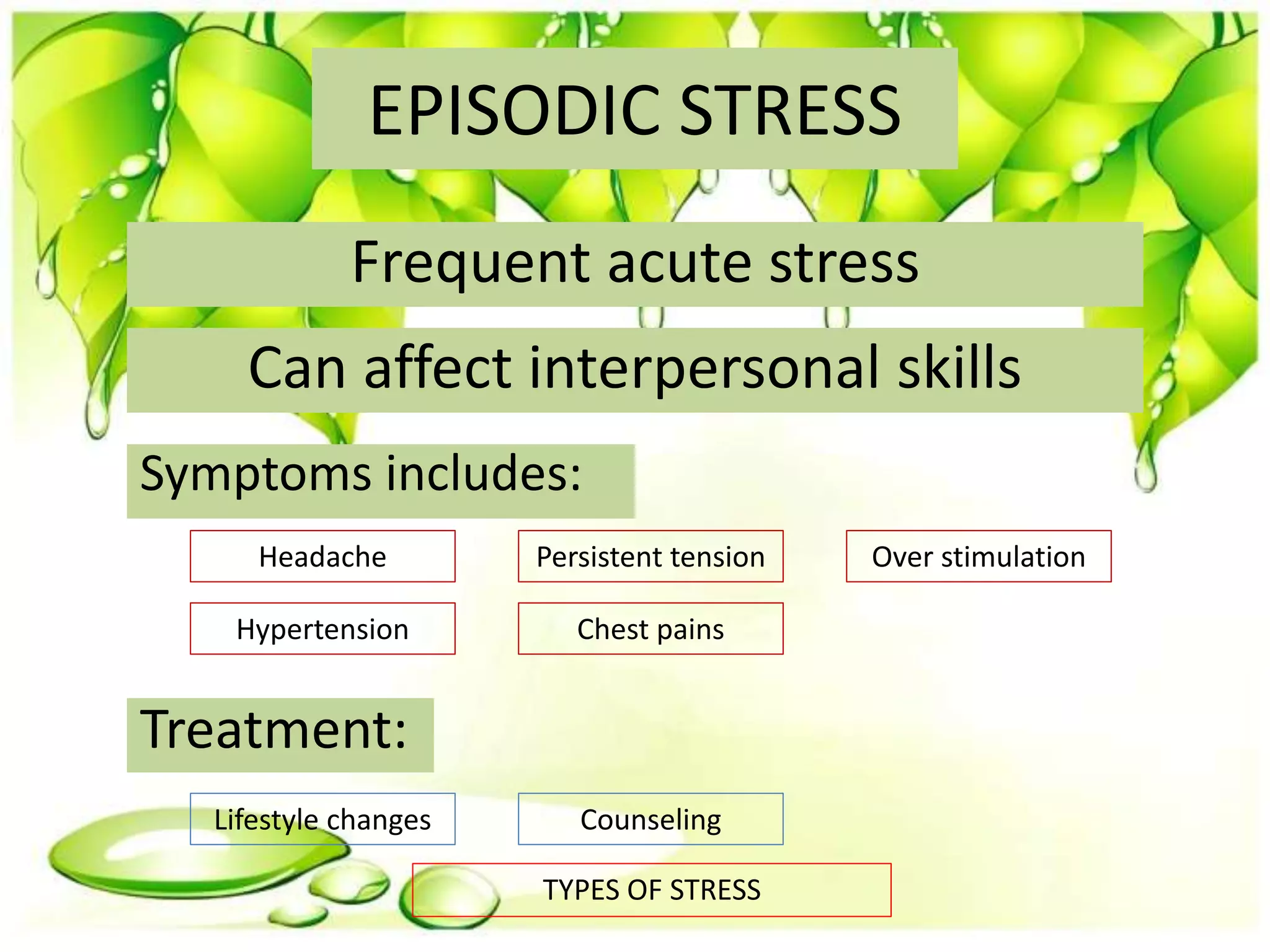
EPISODIC STRESS
Frequent acute stress
TYPES OF STRESS
Symptoms includes:
Headache Persistent tension Over stimulation
Hypertension Chest pains
Treatment:
Lifestyle changes Counseling
Can affect interpersonal skills
CHRONIC STRESS
Suffering from demands and pressures for a
prolonged period of time
TYPES OF STRESS
Feeling:
Depressed Miserable Disheartened
Treatment:
Medication Counseling
Associated with:
Ill health Drug use Violence Suicide
Targeted Behavioral Therapy
POST-TRAUMATIC STRESS DISORDER
A serious potentially debilitating condition that can
occur in people who have experienced or witnessed:
TYPES OF STRESS
Natural Disaster Serious Accident Terrorist Incident
Treatment:
Medication Psychotherapy
Feeling:
Guilt Mental Distress Anxiety Depression
Loss of loved one
War Violence Rape Life-threatening events
Or Both
WHERE YOU START
WHERE YOU START
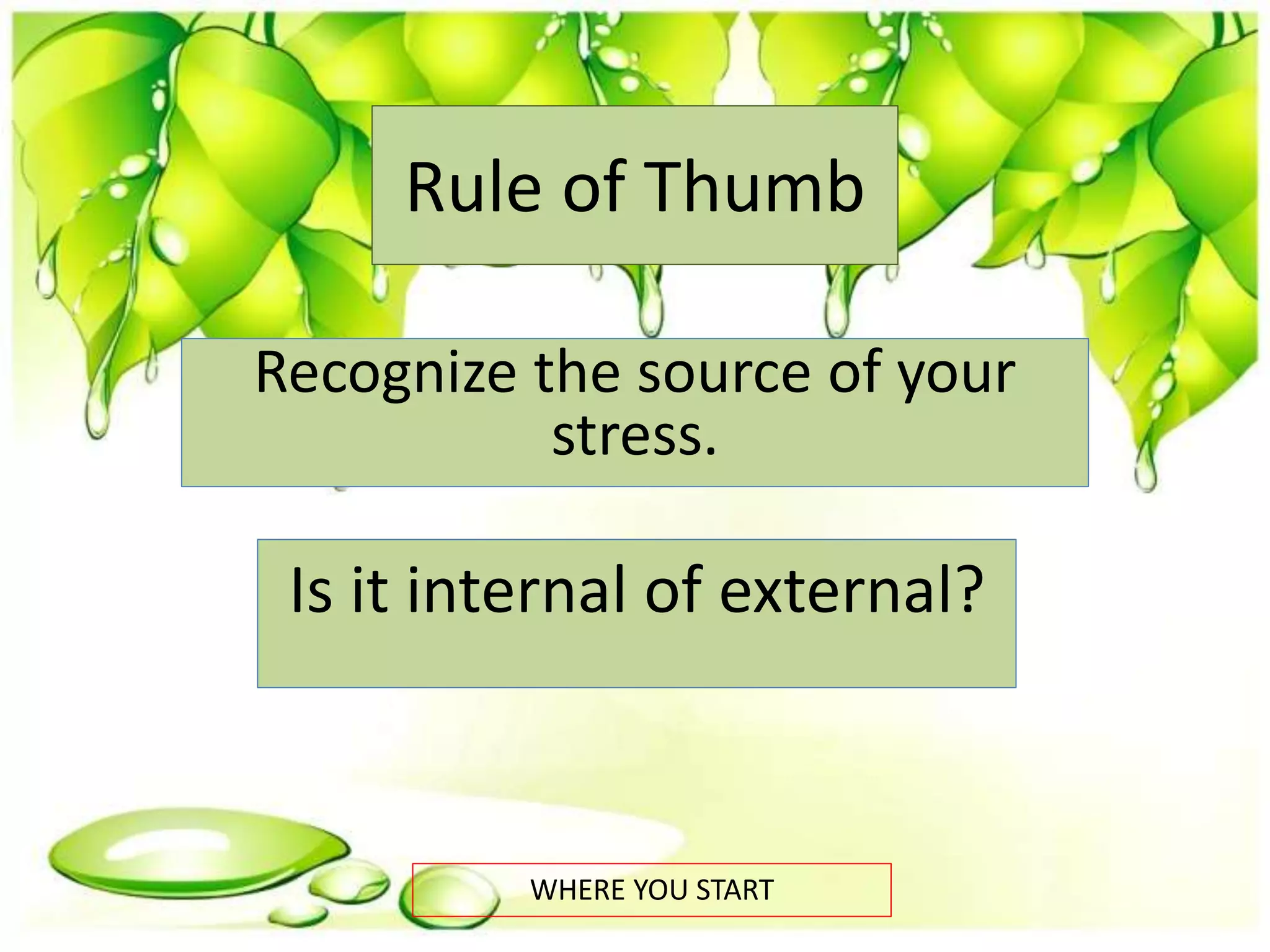
Rule of Thumb
Recognize the source of your
stress.
WHERE YOU START
Is it internal of external?
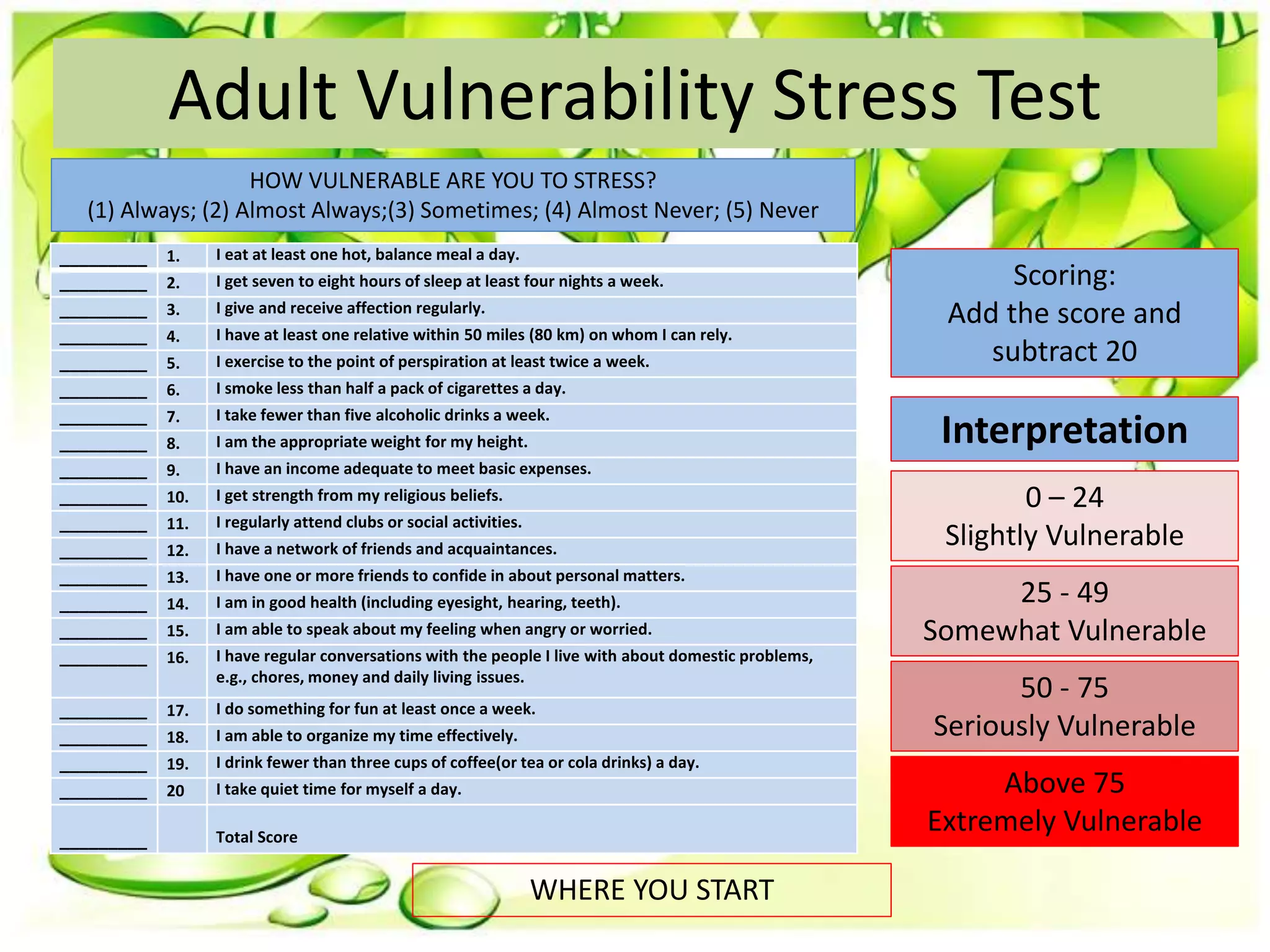
Adult Vulnerability Stress Test
WHERE YOU START
_________ 1. 1I eat at least one hot, balance meal a day.
_________ 2. I get seven to eight hours of sleep at least four nights a week.
_________ 3. I give and receive affection regularly.
_________ 4. I have at least one relative within 50 miles (80 km) on whom I can rely.
_________ 5. I exercise to the point of perspiration at least twice a week.
_________ 6. I smoke less than half a pack of cigarettes a day.
_________ 7. I take fewer than five alcoholic drinks a week.
_________ 8. I am the appropriate weight for my height.
_________ 9. I have an income adequate to meet basic expenses.
_________ 10. I get strength from my religious beliefs.
_________ 11. I regularly attend clubs or social activities.
_________ 12. I have a network of friends and acquaintances.
_________ 13. I have one or more friends to confide in about personal matters.
_________ 14. I am in good health (including eyesight, hearing, teeth).
_________ 15. I am able to speak about my feeling when angry or worried.
_________ 16. I have regular conversations with the people I live with about domestic problems,
e.g., chores, money and daily living issues.
_________ 17. I do something for fun at least once a week.
_________ 18. I am able to organize my time effectively.
_________ 19. I drink fewer than three cups of coffee(or tea or cola drinks) a day.
_________ 20 I take quiet time for myself a day.
_________ Total Score
HOW VULNERABLE ARE YOU TO STRESS?
(1) Always; (2) Almost Always;(3) Sometimes; (4) Almost Never; (5) Never
Scoring:
Add the score and
subtract 20
Interpretation
0 – 24
Slightly Vulnerable
25 - 49
Somewhat Vulnerable
50 - 75
Seriously Vulnerable
Above 75
Extremely Vulnerable
Get Started
WHERE YOU START
Organize Yourself
Control Your Environment
Love Yourself
Reward Your Body
Exercise Your Body
Relax Yourself
Rest Yourself
Be Aware of Yourself
Feed Yourself
(Do not Poison your body)
Enjoy Yourself
Ten Strategies for
Stress
Management
Power Anchor
The Four Steps to Anchoring:
• Elicit powerful desired state
• Anchor: provide a specific stimulus (touch, sign or sound) as the state
changes and time it as the person approaches the peak of the state
• Revert the person’s state to the baseline or “break state”
• Set off the anchor to test
Mnemonic: EARS
WHERE YOU START
The Five Keys to Anchoring:
• The Intensity of the Experience
• The Timing of the Anchor
• The Uniqueness of the Anchor
• The Replication of the Stimulus
• Number of times (repetition can substitute for intensity)
Mnemonic: I-TURN
Power Anchor
Practical Personal Anchors
• Set-up other anchors using different/unique body
movement that are practical and can be elicited anytime.
Examples of practical body movements and positive
anchors are:
WHERE YOU START
1 Point finger to the top of your head -anchor “I’m intelligent”
2. Nod your head -anchor “I can”
3. Sit-up or stand-up straight -anchor “I’m confident”
4. Hands in prayer position -anchor “I’m close to God”
5 . Open and close hand -anchor “I’m curious”
6. Karate chop -anchor “time’s up!”
7. Body in relax position -anchor “I’m peaceful or relaxed”
Create Your Own Power Anchor
Step 1: Powerful Emotions to Anchor
List at least 1 memorable experience per emotion.
• Love and Warmth ___________________________________________
• Gratitude ___________________________________________
• Curiosity ___________________________________________
• Excitement/Passion ___________________________________________
• Determination ___________________________________________
• Flexibility ___________________________________________
• Confidence ___________________________________________
• Cheerfulness ___________________________________________
• Vitality ___________________________________________
• Contribution ___________________________________________
Step 2: Choose your personal body movement
Step 3: Chose your personal positive anchor
Step 4: Anchor your Powerful Emotions
Close your eyes and think about the feelings you had in every memorable experience. Memorize it.
Feel it. Then, anchor your personal body movement and personal positive anchor to it.
WHERE YOU START
Time Management
What you will learn:
1.SETTING YOUR GOALS
1.How to set your goals
2.SET PRIORITIES
1. Six steps of Prioritization
3.THE PRIORITY MATRIX
4.CREATE YOUR OWN PLAN
SETTING YOUR GOAL
Goals motivate us to ACT.
Goals help us overcome the
barriers to our personal and
business productivity.
SETTING YOUR GOAL
How to set your goal
Be S.M.A.R.T.
S - Specific
SETTING YOUR GOAL
M - Measurable
A - Attainable
R - Realistic
T – Time bound
SET PRIORITIES
Prioritization
is the process of doing the
important first
SET PRIORITIES
Six Steps of Prioritization
A “To-Do” list is the main tool to help you set goals and
priorities. Use a pad of paper. Remember to:
SET PRIORITIES
1. Write one item per line
2. Put a date on the paper
3. Keep your list where you can see it
4. Cross out finished task
5. Transfer unfinished task to a new list
6. Make a new list for each day
THE PRIORITY MATRIX
THE PRIORITY MATRIX
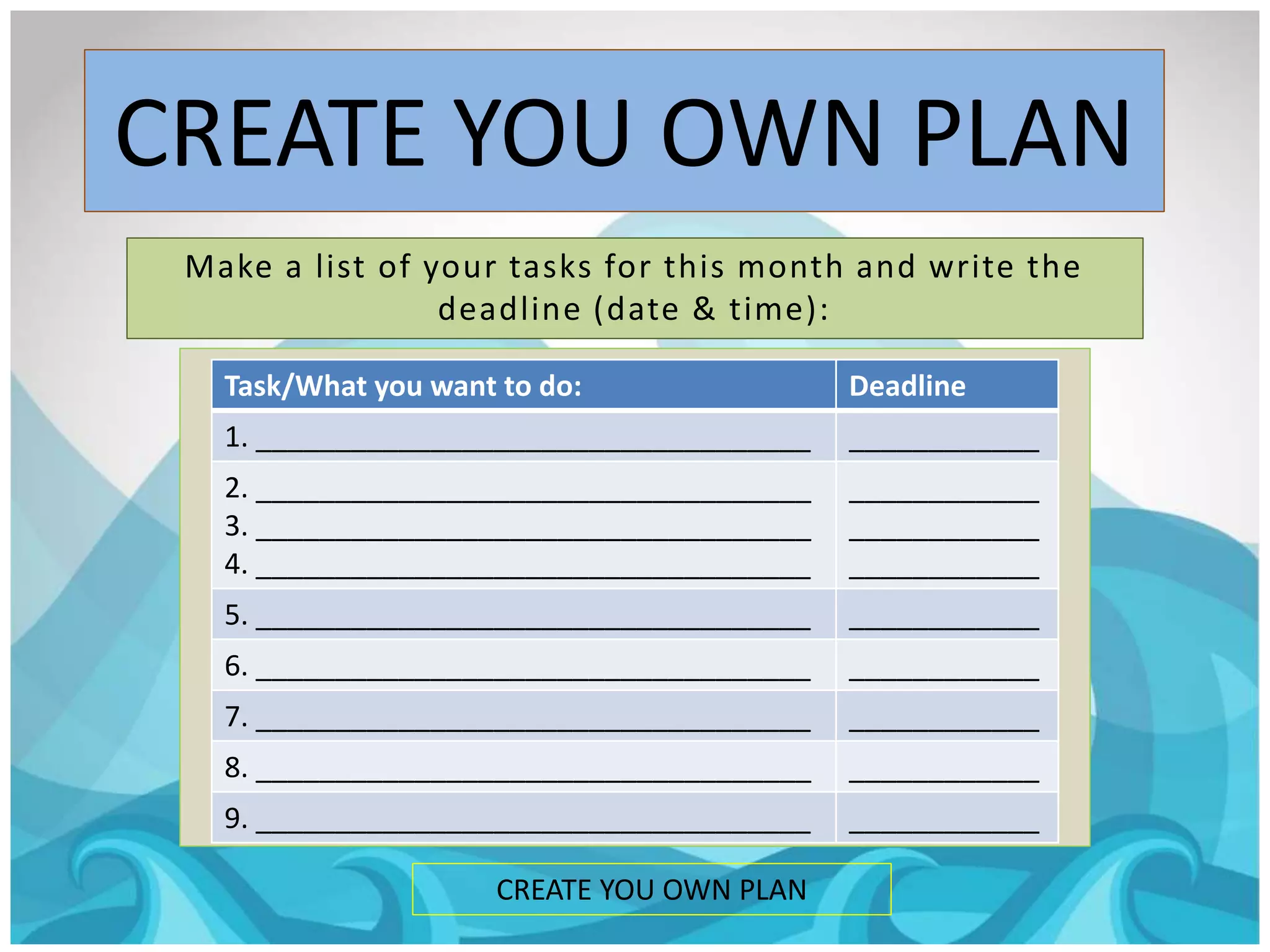
CREATE YOU OWN PLAN
CREATE YOU OWN PLAN
Make a list of your tasks for this month and write the
deadline (date & time):
Task/What you want to do: Deadline
1. ___________________________________ ____________
2. ___________________________________
3. ___________________________________
4. ___________________________________
____________
____________
____________
5. ___________________________________ ____________
6. ___________________________________ ____________
7. ___________________________________ ____________
8. ___________________________________ ____________
9. ___________________________________ ____________
Plot you tasks
CREATE YOU OWN PLAN
MY PRIORITY MATRIX
Date Time Task
____ ____ _______________
____ ____ _______________
Date Time Task
____ ____ _______________
____ ____ _______________
Date Time Task
____ ____ _______________
____ ____ _______________
Date Time Task
____ ____ _______________
____ ____ _______________
Ora et Labora
Like us on Facebook:
www.facebook.com/spcsacoffice

Stress management and Time Management

  • 1.
  • 2.
    Stress Management Adapted fromthe books: “Stress Solution: An Action Plan To Manage The Stress In Your Life” by Lyle H. Mller, Ph.D., and Alma Dell Smith, Ph.D., ABPP, with Larry Rothstein, Ed.D. “Stress Management: A Comprehensive Guide to Wellness” by Edward A Charlesworth, Ph. D. & Ronald G. Nathan, Ph.D.
  • 3.
    Before we start: Resetwhat you’ve learned in the past
  • 4.
    FACT OR MYTH? Stressis the same for everybody. MYTH
  • 5.
    FACT OR MYTH? Thereis a good stress. FACT
  • 6.
    FACT OR MYTH? Stressis everywhere, so you can’t do anything about it MYTH
  • 7.
    FACT OR MYTH? Themost popular methods for reducing stress are the best ones. MYTH
  • 8.
    FACT OR MYTH? Nosymptoms, no stress. MYTH
  • 9.
    FACT OR MYTH? Onlymajor symptoms of stress require attention. MYTH
  • 10.
    What you willlearn: 1.HOW STRESS WORKS 1. What is stress. 2. The fight or Flight Response 3. The Consequences 2.THE TYPES OF STRESS 1. Acute 2. Episodic Acute 3. Chronic 4. Post-Traumatic 3.WHERE YOU START 1. The Rule of Thumb 2. Adult Vulnerability Stress Test 3. Get Started: Top Ten Strategies for Widely Effective Stress Management 4. Power Anchor 5. Create Your Own Power Anchor
  • 11.
    HOW STRESS WORKS Whatis stress? The state of dynamic tension created when you respond to perceived demands and pressures from outside (External) and from within yourself (Internal) HOW STRESS WORKS
  • 12.
    What is stress? ExternalDemands and Pressures Stressors that comes from outside of us •Physical Demands and Pressures HOW STRESS WORKS
  • 13.
    What is stress? ExternalDemands and Pressures Stressors that comes from outside of us •Psychosocial Demands and Pressures HOW STRESS WORKS
  • 14.
    What is stress? InternalDemands and Pressures Stressors that comes from inside of us HOW STRESS WORKS •Basic Demands and Pressures
  • 15.
    What is stress? InternalDemands and Pressures Stressors that comes from inside of us HOW STRESS WORKS •Psychological Demands and Pressures
  • 16.
    What is stress? InternalDemands and Pressures Stressors that comes from inside of us HOW STRESS WORKS •Self-Fulfilment Demands and Pressures
  • 17.
    Stress Facts Psychological researchshows that we can pay attention only to seven items, plus or minus two, at a time. HOW STRESS WORKS Stress happens when demands and pressures compete for attention. Your internal and external demands and pressures mixed up producing a burden of demands and pressures competing for your attention.
  • 18.
    Situation HOW STRESS WORKS Ascheduled dinner date with a girlfriend/boyfriend. ERROR 404: NO GIRLFRIEND/BOYFRIEND FOUND
  • 19.
    Situation HOW STRESS WORKS Adinner with the barkada. Hungry Heavy rain: you have no rain gears. Friends are confused where & what to eat. Restaurant comfort room is not available It’s getting late. Mother called you to go home. You don’t want her to be angry. (walay uwan sa inyo) If you leave, friends will be upset. You realized your wallet and other gadgets were stolen from your bag. LBM Anxious
  • 20.
    The Fight orFlight Response HOW STRESS WORKS Stimulus (through sensory organs) Nervous System Activates the brain, especially the hypothalamus Adrenal Gland Secretes cortisol, epinephrine and norepinephrine Liver (converts glycogen to glucose) Heart (increase heartbeat) Lungs (speeds up breathing) Digestive System (slows down digestion) Muscular System (responds to the threat through reflexes)
  • 21.
    The Consequences You canonly push yourself so hard for so long. When you exceed your physical limits of responding, something in your body breaks down: mentally and/or physically. They occur within seven discrete physiological systems: HOW STRESS WORKS Neuromuscular System Loss of muscle Muscle twitching Cramping Numbness Tingling
  • 22.
    The Consequences HOW STRESSWORKS Parasympathetic Nervous System Ulcer Gastritis IndigestionNausea Sympathetic Nervous System Heart Disease High blood pressure Chest Pain Irregular heart beats
  • 23.
    The Consequences HOW STRESSWORKS Limbic System Anxiety Irritability AggressionMood swings Neocortical System Disorientation Memory loss Inability to learn Loss of focus Inability to sleep Linked with Alzheimer's
  • 24.
    The Consequences HOW STRESSWORKS Endocrine System Diabetes Irregular menstruation Loss of appetiteLoss of sexual desire
  • 25.
    TYPES OF STRESS Notall stress is bad. It can trigger the fight-or-flight mechanism to help you respond to an emergency. TYPES OF STRESS Stress affects everyone differently, and too much stress can cause serious health issues Stress is a part of life and needs to be managed in order to be healthy and happy.
  • 26.
    ACUTE STRESS Short-lived andbeneficial TYPES OF STRESS Symptoms includes: Headache Stomach Aches Sweating Heart palpitation Breathlessness Dizziness Treatment: Rest Relaxation
  • 27.
    EPISODIC STRESS Frequent acutestress TYPES OF STRESS Symptoms includes: Headache Persistent tension Over stimulation Hypertension Chest pains Treatment: Lifestyle changes Counseling Can affect interpersonal skills
  • 28.
    CHRONIC STRESS Suffering fromdemands and pressures for a prolonged period of time TYPES OF STRESS Feeling: Depressed Miserable Disheartened Treatment: Medication Counseling Associated with: Ill health Drug use Violence Suicide Targeted Behavioral Therapy
  • 29.
    POST-TRAUMATIC STRESS DISORDER Aserious potentially debilitating condition that can occur in people who have experienced or witnessed: TYPES OF STRESS Natural Disaster Serious Accident Terrorist Incident Treatment: Medication Psychotherapy Feeling: Guilt Mental Distress Anxiety Depression Loss of loved one War Violence Rape Life-threatening events Or Both
  • 30.
  • 31.
    Rule of Thumb Recognizethe source of your stress. WHERE YOU START Is it internal of external?
  • 32.
    Adult Vulnerability StressTest WHERE YOU START _________ 1. 1I eat at least one hot, balance meal a day. _________ 2. I get seven to eight hours of sleep at least four nights a week. _________ 3. I give and receive affection regularly. _________ 4. I have at least one relative within 50 miles (80 km) on whom I can rely. _________ 5. I exercise to the point of perspiration at least twice a week. _________ 6. I smoke less than half a pack of cigarettes a day. _________ 7. I take fewer than five alcoholic drinks a week. _________ 8. I am the appropriate weight for my height. _________ 9. I have an income adequate to meet basic expenses. _________ 10. I get strength from my religious beliefs. _________ 11. I regularly attend clubs or social activities. _________ 12. I have a network of friends and acquaintances. _________ 13. I have one or more friends to confide in about personal matters. _________ 14. I am in good health (including eyesight, hearing, teeth). _________ 15. I am able to speak about my feeling when angry or worried. _________ 16. I have regular conversations with the people I live with about domestic problems, e.g., chores, money and daily living issues. _________ 17. I do something for fun at least once a week. _________ 18. I am able to organize my time effectively. _________ 19. I drink fewer than three cups of coffee(or tea or cola drinks) a day. _________ 20 I take quiet time for myself a day. _________ Total Score HOW VULNERABLE ARE YOU TO STRESS? (1) Always; (2) Almost Always;(3) Sometimes; (4) Almost Never; (5) Never Scoring: Add the score and subtract 20 Interpretation 0 – 24 Slightly Vulnerable 25 - 49 Somewhat Vulnerable 50 - 75 Seriously Vulnerable Above 75 Extremely Vulnerable
  • 33.
    Get Started WHERE YOUSTART Organize Yourself Control Your Environment Love Yourself Reward Your Body Exercise Your Body Relax Yourself Rest Yourself Be Aware of Yourself Feed Yourself (Do not Poison your body) Enjoy Yourself Ten Strategies for Stress Management
  • 34.
    Power Anchor The FourSteps to Anchoring: • Elicit powerful desired state • Anchor: provide a specific stimulus (touch, sign or sound) as the state changes and time it as the person approaches the peak of the state • Revert the person’s state to the baseline or “break state” • Set off the anchor to test Mnemonic: EARS WHERE YOU START The Five Keys to Anchoring: • The Intensity of the Experience • The Timing of the Anchor • The Uniqueness of the Anchor • The Replication of the Stimulus • Number of times (repetition can substitute for intensity) Mnemonic: I-TURN
  • 35.
    Power Anchor Practical PersonalAnchors • Set-up other anchors using different/unique body movement that are practical and can be elicited anytime. Examples of practical body movements and positive anchors are: WHERE YOU START 1 Point finger to the top of your head -anchor “I’m intelligent” 2. Nod your head -anchor “I can” 3. Sit-up or stand-up straight -anchor “I’m confident” 4. Hands in prayer position -anchor “I’m close to God” 5 . Open and close hand -anchor “I’m curious” 6. Karate chop -anchor “time’s up!” 7. Body in relax position -anchor “I’m peaceful or relaxed”
  • 36.
    Create Your OwnPower Anchor Step 1: Powerful Emotions to Anchor List at least 1 memorable experience per emotion. • Love and Warmth ___________________________________________ • Gratitude ___________________________________________ • Curiosity ___________________________________________ • Excitement/Passion ___________________________________________ • Determination ___________________________________________ • Flexibility ___________________________________________ • Confidence ___________________________________________ • Cheerfulness ___________________________________________ • Vitality ___________________________________________ • Contribution ___________________________________________ Step 2: Choose your personal body movement Step 3: Chose your personal positive anchor Step 4: Anchor your Powerful Emotions Close your eyes and think about the feelings you had in every memorable experience. Memorize it. Feel it. Then, anchor your personal body movement and personal positive anchor to it. WHERE YOU START
  • 37.
  • 38.
    What you willlearn: 1.SETTING YOUR GOALS 1.How to set your goals 2.SET PRIORITIES 1. Six steps of Prioritization 3.THE PRIORITY MATRIX 4.CREATE YOUR OWN PLAN
  • 39.
    SETTING YOUR GOAL Goalsmotivate us to ACT. Goals help us overcome the barriers to our personal and business productivity. SETTING YOUR GOAL
  • 40.
    How to setyour goal Be S.M.A.R.T. S - Specific SETTING YOUR GOAL M - Measurable A - Attainable R - Realistic T – Time bound
  • 41.
    SET PRIORITIES Prioritization is theprocess of doing the important first SET PRIORITIES
  • 42.
    Six Steps ofPrioritization A “To-Do” list is the main tool to help you set goals and priorities. Use a pad of paper. Remember to: SET PRIORITIES 1. Write one item per line 2. Put a date on the paper 3. Keep your list where you can see it 4. Cross out finished task 5. Transfer unfinished task to a new list 6. Make a new list for each day
  • 43.
    THE PRIORITY MATRIX THEPRIORITY MATRIX
  • 44.
    CREATE YOU OWNPLAN CREATE YOU OWN PLAN Make a list of your tasks for this month and write the deadline (date & time): Task/What you want to do: Deadline 1. ___________________________________ ____________ 2. ___________________________________ 3. ___________________________________ 4. ___________________________________ ____________ ____________ ____________ 5. ___________________________________ ____________ 6. ___________________________________ ____________ 7. ___________________________________ ____________ 8. ___________________________________ ____________ 9. ___________________________________ ____________
  • 45.
    Plot you tasks CREATEYOU OWN PLAN MY PRIORITY MATRIX Date Time Task ____ ____ _______________ ____ ____ _______________ Date Time Task ____ ____ _______________ ____ ____ _______________ Date Time Task ____ ____ _______________ ____ ____ _______________ Date Time Task ____ ____ _______________ ____ ____ _______________
  • 46.
    Ora et Labora Likeus on Facebook: www.facebook.com/spcsacoffice

Editor's Notes

  • #21 The good stress.
  • #27 Kung mu-abot si crush
  • #30 Symptoms associated with PTSD can often be very severe and have a huge negative impact on a person’s day to day life. (Through the depletion of physical and mental attrition). The treatment for PTSD may generally be divided into psychotherapy (includes anxiety management, cognitive therapy and exposure therapy) and medication. Some patients respond well to one treatment modality, while other patients require both modalities.