Stress Management The art of taking care of oneself!
Objectives To understand the nature of stress and how it affects us. To understand stress associated with crisis counseling. To develop a personal stress management program
What is Stress? Stress is tension, strain, or pressure from a situation that requires us to use, adapt, or develop new coping skills. Stress can be positive or negative. Perception plays a key role in interpreting how stressful situations are.
Why Do We Need to Be Concerned about Stress? The biochemistry of stress The conflict  between modern life and primitive instincts Stressors are multiple and overlap or occur simultaneously The influence of beliefs, attitudes, and motivations and our interpretation of events Stress results in “wear and tear on the body”  Hans Selye
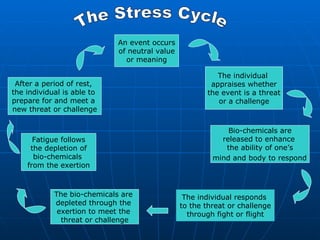
The Stress Cycle An event occurs of neutral value  or meaning The individual  appraises whether the event is a threat or a challenge Bio-chemicals are released to enhance  the ability of one’s mind and body to respond   The individual responds  to the threat or challenge through fight or flight  The bio-chemicals are  depleted through the  exertion to meet the  threat or challenge Fatigue follows the depletion of  bio-chemicals  from the exertion After a period of rest,  the individual is able to  prepare for and meet a  new threat or challenge
Common Stress Reactions A Self-assessment Behavioral Physical Psychological Cognitive Social
Patterns in Stress Responses Individual stress responses tend to cluster and form a repeated pattern – sleeplessness, upset stomach, isolating, etc. The greater or lengthier (intensity or duration) the stress, and the less likely that relief is nearby, the more likely that responses will broaden beyond those of which we are most often aware.
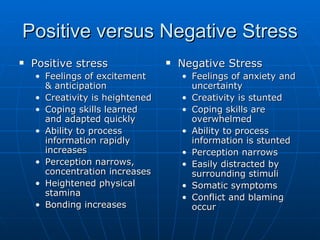
Positive versus Negative Stress Positive stress Feelings of excitement & anticipation Creativity is heightened Coping skills learned and adapted quickly Ability to process information rapidly increases Perception narrows, concentration increases Heightened physical stamina Bonding increases Negative Stress Feelings of anxiety and uncertainty Creativity is stunted Coping skills are overwhelmed Ability to process information is stunted Perception narrows Easily distracted by surrounding stimuli Somatic symptoms Conflict and blaming occur
Other Factors that Influence Stress Personal resilience – healthy detachment Perception of threat or challenge Compounding events Cumulative stimuli Historical similarities Thoughts and images
Stress and the Crisis Counseling Role
Stress Vulnerabilities of Crisis Counseling Cumulative stress from repeatedly hearing the stories of victims, survivors, bystanders, and others. Chronic stress from approaching strangers whose responses to the offer of help cannot be anticipated. Feeling overwhelmed by the depth of others’ grief and sadness. Over-identification with the consumer. Feeling helpless to take the pain of loss away. Uncertainty about whether or how talking helps. Disturbing images from the stories people share.
How Do You Know You Are in Trouble? You start providing concrete services. You can’t shake the images from your mind. You work increasingly long hours. Work becomes more important than family and friends. You feel angry at “the system.” You are irritable and impatient.
Coping with Stress Developing a personal Stress Management Program Self-awareness and self-monitoring A balanced lifestyle Nutrition, exercise and rest
Self-Monitoring What combination of symptoms do I seem to experience habitually when under stress? How do my thoughts, attitudes, and reactions seem to change under stress? How long a period of time can I work under stress before my performance begins to suffer? How do I develop a conscious awareness of how I am thinking, feeling, reacting, and functioning under stress?
A Balanced Lifestyle Each day we need to: Engage in productive activity Address our spiritual needs Seek intellectual challenge Play
Productive Activity Productive activity can encompass paid employment, volunteerism, hobbies, etc. We derive a sense of accomplishment from the tasks performed We derive a sense of contribution or completion from the activity
Spiritual Needs Spiritual activities feed the soul and are often contained in daily rituals or comfort routines. They can encompass meditation, prayer, poetry, formal religious services, a 12 step meeting, etc. They can be the “wow” of a sunrise, the calm of a warm bath, or the wisdom of a child’s observation.
Intellectual Challenge Intellectual challenge opens us up to new ideas and perspectives – new approaches to familiar problems. Intellectual challenge encompasses learning something new each day, gaining mastery over a new skill, or exercising our minds beyond what we commonly experience in our daily routines.
Play Leisure is to be engaged in an activity in which the process is more important than the product. In leisure, we lose ourselves and our concerns. In play, we celebrate the child in all of us.
Additional Considerations Nutrition Exercise Rest
Nutrition Stress Suppresses the Immune System Avoid fat, sugar, caffeine, nicotine, and alcohol. Eat many small meals rather than one or two big ones. Increase the intake of fruit, vegetables, and whole grain foods. Carry healthy snacks – fresh fruit, nuts, granola, trail mix. Drink lots of water.
Exercise Exercise depletes the bio-chemicals produced under stress. Exercise can also serve as a form of meditation. Exercise increases mental acuity.
Rest Rest counteracts the depression that follows the “adrenalin rush,” especially if the rush has been sustained over several days. Can’t sleep? Resting quietly can still be an effective alternative. Develop relaxation routines if sleep is difficult.
Strategies to Counteract Stress Realistic expectation – help versus responsibility. Buddy systems Maintain fundamental priorities – self, family, and friends first. Stay within established work hours. Discuss concerns with supervisors Participate fully in stress management related activities in staff meetings and training events. Be clear with family and friends about what you are comfortable discussing about your work. Practice a personal stress management program daily.

Stress Management

  • 1.
    Stress Management Theart of taking care of oneself!
  • 2.
    Objectives To understandthe nature of stress and how it affects us. To understand stress associated with crisis counseling. To develop a personal stress management program
  • 3.
    What is Stress?Stress is tension, strain, or pressure from a situation that requires us to use, adapt, or develop new coping skills. Stress can be positive or negative. Perception plays a key role in interpreting how stressful situations are.
  • 4.
    Why Do WeNeed to Be Concerned about Stress? The biochemistry of stress The conflict between modern life and primitive instincts Stressors are multiple and overlap or occur simultaneously The influence of beliefs, attitudes, and motivations and our interpretation of events Stress results in “wear and tear on the body” Hans Selye
  • 5.
    The Stress CycleAn event occurs of neutral value or meaning The individual appraises whether the event is a threat or a challenge Bio-chemicals are released to enhance the ability of one’s mind and body to respond The individual responds to the threat or challenge through fight or flight The bio-chemicals are depleted through the exertion to meet the threat or challenge Fatigue follows the depletion of bio-chemicals from the exertion After a period of rest, the individual is able to prepare for and meet a new threat or challenge
  • 6.
    Common Stress ReactionsA Self-assessment Behavioral Physical Psychological Cognitive Social
  • 7.
    Patterns in StressResponses Individual stress responses tend to cluster and form a repeated pattern – sleeplessness, upset stomach, isolating, etc. The greater or lengthier (intensity or duration) the stress, and the less likely that relief is nearby, the more likely that responses will broaden beyond those of which we are most often aware.
  • 8.
    Positive versus NegativeStress Positive stress Feelings of excitement & anticipation Creativity is heightened Coping skills learned and adapted quickly Ability to process information rapidly increases Perception narrows, concentration increases Heightened physical stamina Bonding increases Negative Stress Feelings of anxiety and uncertainty Creativity is stunted Coping skills are overwhelmed Ability to process information is stunted Perception narrows Easily distracted by surrounding stimuli Somatic symptoms Conflict and blaming occur
  • 9.
    Other Factors thatInfluence Stress Personal resilience – healthy detachment Perception of threat or challenge Compounding events Cumulative stimuli Historical similarities Thoughts and images
  • 10.
    Stress and theCrisis Counseling Role
  • 11.
    Stress Vulnerabilities ofCrisis Counseling Cumulative stress from repeatedly hearing the stories of victims, survivors, bystanders, and others. Chronic stress from approaching strangers whose responses to the offer of help cannot be anticipated. Feeling overwhelmed by the depth of others’ grief and sadness. Over-identification with the consumer. Feeling helpless to take the pain of loss away. Uncertainty about whether or how talking helps. Disturbing images from the stories people share.
  • 12.
    How Do YouKnow You Are in Trouble? You start providing concrete services. You can’t shake the images from your mind. You work increasingly long hours. Work becomes more important than family and friends. You feel angry at “the system.” You are irritable and impatient.
  • 13.
    Coping with StressDeveloping a personal Stress Management Program Self-awareness and self-monitoring A balanced lifestyle Nutrition, exercise and rest
  • 14.
    Self-Monitoring What combinationof symptoms do I seem to experience habitually when under stress? How do my thoughts, attitudes, and reactions seem to change under stress? How long a period of time can I work under stress before my performance begins to suffer? How do I develop a conscious awareness of how I am thinking, feeling, reacting, and functioning under stress?
  • 15.
    A Balanced LifestyleEach day we need to: Engage in productive activity Address our spiritual needs Seek intellectual challenge Play
  • 16.
    Productive Activity Productiveactivity can encompass paid employment, volunteerism, hobbies, etc. We derive a sense of accomplishment from the tasks performed We derive a sense of contribution or completion from the activity
  • 17.
    Spiritual Needs Spiritualactivities feed the soul and are often contained in daily rituals or comfort routines. They can encompass meditation, prayer, poetry, formal religious services, a 12 step meeting, etc. They can be the “wow” of a sunrise, the calm of a warm bath, or the wisdom of a child’s observation.
  • 18.
    Intellectual Challenge Intellectualchallenge opens us up to new ideas and perspectives – new approaches to familiar problems. Intellectual challenge encompasses learning something new each day, gaining mastery over a new skill, or exercising our minds beyond what we commonly experience in our daily routines.
  • 19.
    Play Leisure isto be engaged in an activity in which the process is more important than the product. In leisure, we lose ourselves and our concerns. In play, we celebrate the child in all of us.
  • 20.
  • 21.
    Nutrition Stress Suppressesthe Immune System Avoid fat, sugar, caffeine, nicotine, and alcohol. Eat many small meals rather than one or two big ones. Increase the intake of fruit, vegetables, and whole grain foods. Carry healthy snacks – fresh fruit, nuts, granola, trail mix. Drink lots of water.
  • 22.
    Exercise Exercise depletesthe bio-chemicals produced under stress. Exercise can also serve as a form of meditation. Exercise increases mental acuity.
  • 23.
    Rest Rest counteractsthe depression that follows the “adrenalin rush,” especially if the rush has been sustained over several days. Can’t sleep? Resting quietly can still be an effective alternative. Develop relaxation routines if sleep is difficult.
  • 24.
    Strategies to CounteractStress Realistic expectation – help versus responsibility. Buddy systems Maintain fundamental priorities – self, family, and friends first. Stay within established work hours. Discuss concerns with supervisors Participate fully in stress management related activities in staff meetings and training events. Be clear with family and friends about what you are comfortable discussing about your work. Practice a personal stress management program daily.