Positive Psychology and Happiness
States of Affect “I am now the most miserable man living.  If what I feel were equally distributed to the whole human family, there would not be one cheerful face on earth.  Whether I shall ever be better, I cannot tell; I awfully forebode I shall not.  To remain as I am is impossible.  I must die or be better, it appears to me.”
Is Misery Increasing? If you had fallen asleep in 1960 and awakened today, what would you find?
1960 – 2000:   •  2 X  Divorce Rate •  3 X Teen Suicide •  4 X Reported Violent Crime •  5 X Prison Population. •  6 X  Babies Born to Unmarried Parents. •  7 X Cohabitation (a predictor of future divorce). • 10 X Depression Myers, David G. (April 24, 2000)  Wanting More in an Age of Plenty.  Christianity Today Dr. David Myers  Hope College
Depression: Incidence / Prevalence Lifetime prevalence: 17% - 25%  8 million new cases of depression / year Antidepressants among most commonly prescribed drugs with over 90% being prescribed by PCPs.  Depression rapidly increasing worldwide (Cohort born 1925 had 4% lifetime prevalence)  Bent & Masters, ibid.
Increasing Risk of Depression Each generation since 1900 has seen a higher incidence of depression. 1 /25 ca. 1900; 1/5 or greater ca. 2000.  Seen in  all  industrialized countries Exceptions?: Maybe tightly knit non-industrial groups Reason is unknown: Possibly change in social values? Change in diet: depression as an inflammatory disease?  Klerman, G.L. & Weissman, M.M. (1989) Increasing rates of depression.  Journal of the American Medical Association, 261 , 2229-35.
A dysfunctional person is one who has lost the capacity to give and receive love, and to love oneself.
What Good is Happiness? Happy people are shallow and uninteresting? (Woody Allen,  Annie Hall ) Happy people are in denial? The suffering artist, the anguished intellectual. Happy people are passive?
You Should Know: Happy people are smarter and more creative. Happy people have more stable and happy marriages. Happy people make more money. Happy people are healthier and live longer. Happy people are generous.
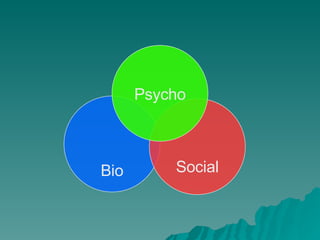
Bio Social Psycho
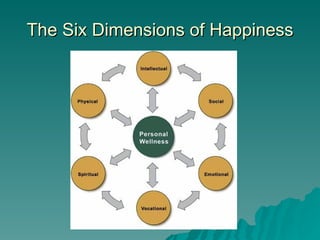
The Six Dimensions of Happiness
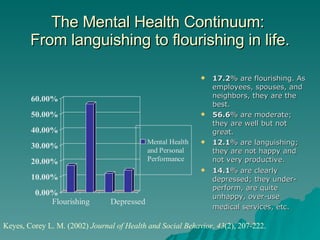
The Mental Health Continuum:  From languishing to flourishing in life. 17.2 % are flourishing. As employees, spouses, and neighbors, they are the best. 56.6 % are moderate; they are well but not great. 12.1 % are languishing; they are not happy and not very productive. 14.1 % are clearly depressed; they under-perform, are quite unhappy, over-use medical services, etc.   Keyes, Corey L. M. (2002)  Journal of Health and Social Behavior .  43 (2), 207-222.
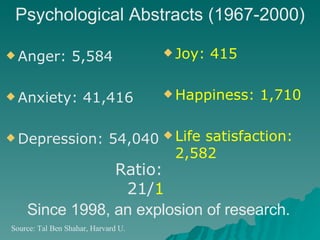
Anger: 5,584 Anxiety: 41,416 Depression: 54,040 Psychological Abstracts (1967-2000) Joy: 415 Happiness: 1,710 Life satisfaction: 2,582 Ratio: 21/ 1 Source: Tal Ben Shahar, Harvard U. Since 1998, an explosion of research.
Are Happy People Healthier? Do they really live longer?
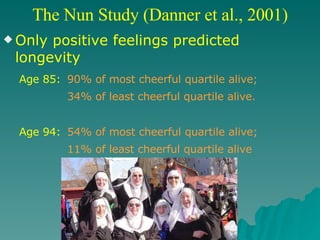
The Nun Study (Danner et al., 2001) Only positive feelings predicted longevity Age 85: 90% of most cheerful quartile alive;    34% of least cheerful quartile alive. Age 94:   54% of most cheerful quartile alive;  11% of least cheerful quartile alive
“ God started my life off well by bestowing upon me grace of inestimable value... The past year which I spent as a candidate studying at Notre Dame has been a very happy one.  Now I look forward with eager joy to receiving the Holy Habit of Our Lady and to a life of union with Love Divine.” Celia O’Payne “ I was born on September 26, 1909, the eldest of seven children, five girls and two boys... My candidate year was spent in the mother-house, teaching chemistry and second year Latin at Notre Dame Institute.  With God’s grace, I intend to do my best for our Order, for the spread of religion and for my personal sanctification.”   Marguerite Donnelly
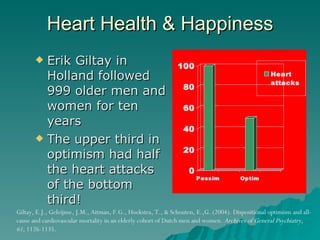
Heart Health & Happiness Erik Giltay in Holland followed 999 older men and women for ten years The upper third in optimism had half the heart attacks of the bottom third! Giltay, E.J., Geleijnse, J.M., Aitman, F.G., Hoekstra, T., & Schouten, E.,G. (2004). Dispositional optimism and all-cause and cardiovascular mortality in an elderly cohort of Dutch men and women.  Archives of General Psychiatry, 61 , 1126-1135.
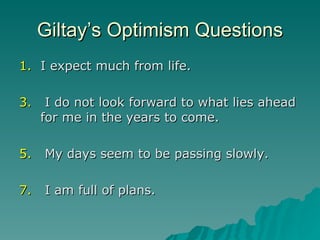
Giltay’s Optimism Questions I expect much from life. I do not look forward to what lies ahead for me in the years to come. My days seem to be passing slowly. I am full of plans.
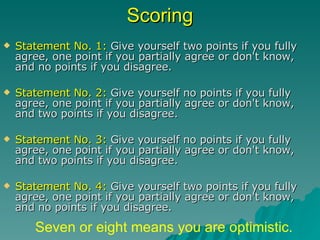
Scoring Statement No. 1:  Give yourself two points if you fully agree, one point if you partially agree or don't know, and no points if you disagree. Statement No. 2:  Give yourself no points if you fully agree, one point if you partially agree or don't know, and two points if you disagree. Statement No. 3:  Give yourself no points if you fully agree, one point if you partially agree or don't know, and two points if you disagree. Statement No. 4:  Give yourself two points if you fully agree, one point if you partially agree or don't know, and no points if you disagree. Seven or eight means you are optimistic.
Creativity & Intelligence
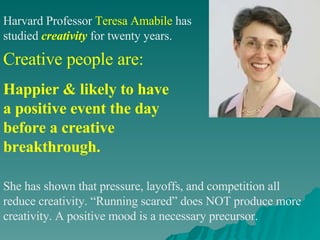
Harvard Professor  Teresa Amabile  has studied  creativity  for twenty years. Creative people are: Happier & likely to have  a positive event the day before a creative breakthrough.  She has shown that pressure, layoffs, and competition all reduce creativity. “Running scared” does NOT produce more creativity. A positive mood is a necessary precursor.
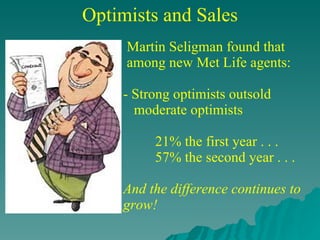
Optimists and Sales Martin Seligman found that  among new Met Life agents:  - Strong optimists outsold    moderate optimists 21% the first year . . . 57% the second year . . .   And the difference continues to grow!
Happiness & Relationships Happier people cause happy marriages. More likely to have a large circle of friends. More attractive, independent of physical beauty. More likely to marry & stay married. Easier to feel passionately committed. Lynbomirsky, S. (2008)  The How of Happiness . New York: Penguin, pp 138-146.
What Increases Happiness? Moderate pleasure . Social skills   -   being involved w/ people: Wide range of acquaintances; Appreciate & enjoy others; Deep connection with spouse.  Optimism & Zest: Expect good to multiply & bad to pass quickly.  A Sense of Mission Do more of what you are good at. Gratitude   Reframing bad toward good. Gratitude diary & service
Worrying is using your imagination to create something you do not want.
Organic   Functional
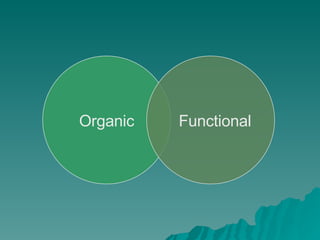
Organic Functional
Can We Teach Happiness & Optimism?
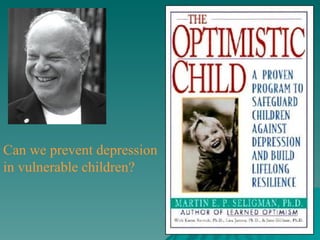
Can we prevent depression in vulnerable children?
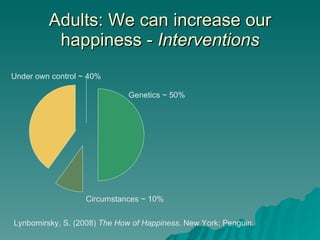
Adults: We can increase our happiness -  Interventions Genetics ~ 50% Circumstances ~ 10% Under own control ~ 40% Lynbomirsky, S. (2008)  The How of Happiness . New York: Penguin.
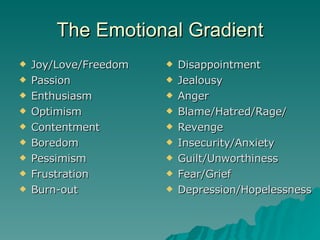
The Emotional Gradient Joy/Love/Freedom Passion Enthusiasm Optimism Contentment Boredom Pessimism Frustration Burn-out Disappointment Jealousy Anger Blame/Hatred/Rage/ Revenge Insecurity/Anxiety Guilt/Unworthiness Fear/Grief Depression/Hopelessness
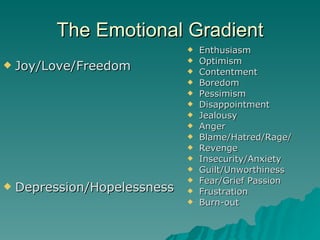
The Emotional Gradient Joy/Love/Freedom Depression/Hopelessness Enthusiasm Optimism Contentment Boredom Pessimism Disappointment Jealousy Anger Blame/Hatred/Rage/ Revenge Insecurity/Anxiety Guilt/Unworthiness Fear/Grief Passion Frustration Burn-out
Don’t worry, be happy.

Happiness Presentation

  • 1.
  • 2.
    States of Affect“I am now the most miserable man living. If what I feel were equally distributed to the whole human family, there would not be one cheerful face on earth. Whether I shall ever be better, I cannot tell; I awfully forebode I shall not. To remain as I am is impossible. I must die or be better, it appears to me.”
  • 3.
    Is Misery Increasing?If you had fallen asleep in 1960 and awakened today, what would you find?
  • 4.
    1960 – 2000: • 2 X Divorce Rate • 3 X Teen Suicide • 4 X Reported Violent Crime • 5 X Prison Population. • 6 X Babies Born to Unmarried Parents. • 7 X Cohabitation (a predictor of future divorce). • 10 X Depression Myers, David G. (April 24, 2000) Wanting More in an Age of Plenty. Christianity Today Dr. David Myers Hope College
  • 5.
    Depression: Incidence /Prevalence Lifetime prevalence: 17% - 25% 8 million new cases of depression / year Antidepressants among most commonly prescribed drugs with over 90% being prescribed by PCPs. Depression rapidly increasing worldwide (Cohort born 1925 had 4% lifetime prevalence) Bent & Masters, ibid.
  • 6.
    Increasing Risk ofDepression Each generation since 1900 has seen a higher incidence of depression. 1 /25 ca. 1900; 1/5 or greater ca. 2000. Seen in all industrialized countries Exceptions?: Maybe tightly knit non-industrial groups Reason is unknown: Possibly change in social values? Change in diet: depression as an inflammatory disease? Klerman, G.L. & Weissman, M.M. (1989) Increasing rates of depression. Journal of the American Medical Association, 261 , 2229-35.
  • 7.
    A dysfunctional personis one who has lost the capacity to give and receive love, and to love oneself.
  • 8.
    What Good isHappiness? Happy people are shallow and uninteresting? (Woody Allen, Annie Hall ) Happy people are in denial? The suffering artist, the anguished intellectual. Happy people are passive?
  • 9.
    You Should Know:Happy people are smarter and more creative. Happy people have more stable and happy marriages. Happy people make more money. Happy people are healthier and live longer. Happy people are generous.
  • 10.
  • 11.
    The Six Dimensionsof Happiness
  • 12.
    The Mental HealthContinuum: From languishing to flourishing in life. 17.2 % are flourishing. As employees, spouses, and neighbors, they are the best. 56.6 % are moderate; they are well but not great. 12.1 % are languishing; they are not happy and not very productive. 14.1 % are clearly depressed; they under-perform, are quite unhappy, over-use medical services, etc. Keyes, Corey L. M. (2002) Journal of Health and Social Behavior . 43 (2), 207-222.
  • 13.
    Anger: 5,584 Anxiety:41,416 Depression: 54,040 Psychological Abstracts (1967-2000) Joy: 415 Happiness: 1,710 Life satisfaction: 2,582 Ratio: 21/ 1 Source: Tal Ben Shahar, Harvard U. Since 1998, an explosion of research.
  • 14.
    Are Happy PeopleHealthier? Do they really live longer?
  • 15.
    The Nun Study(Danner et al., 2001) Only positive feelings predicted longevity Age 85: 90% of most cheerful quartile alive; 34% of least cheerful quartile alive. Age 94: 54% of most cheerful quartile alive; 11% of least cheerful quartile alive
  • 16.
    “ God startedmy life off well by bestowing upon me grace of inestimable value... The past year which I spent as a candidate studying at Notre Dame has been a very happy one. Now I look forward with eager joy to receiving the Holy Habit of Our Lady and to a life of union with Love Divine.” Celia O’Payne “ I was born on September 26, 1909, the eldest of seven children, five girls and two boys... My candidate year was spent in the mother-house, teaching chemistry and second year Latin at Notre Dame Institute. With God’s grace, I intend to do my best for our Order, for the spread of religion and for my personal sanctification.” Marguerite Donnelly
  • 17.
    Heart Health &Happiness Erik Giltay in Holland followed 999 older men and women for ten years The upper third in optimism had half the heart attacks of the bottom third! Giltay, E.J., Geleijnse, J.M., Aitman, F.G., Hoekstra, T., & Schouten, E.,G. (2004). Dispositional optimism and all-cause and cardiovascular mortality in an elderly cohort of Dutch men and women. Archives of General Psychiatry, 61 , 1126-1135.
  • 18.
    Giltay’s Optimism QuestionsI expect much from life. I do not look forward to what lies ahead for me in the years to come. My days seem to be passing slowly. I am full of plans.
  • 19.
    Scoring Statement No.1: Give yourself two points if you fully agree, one point if you partially agree or don't know, and no points if you disagree. Statement No. 2: Give yourself no points if you fully agree, one point if you partially agree or don't know, and two points if you disagree. Statement No. 3: Give yourself no points if you fully agree, one point if you partially agree or don't know, and two points if you disagree. Statement No. 4: Give yourself two points if you fully agree, one point if you partially agree or don't know, and no points if you disagree. Seven or eight means you are optimistic.
  • 20.
  • 21.
    Harvard Professor Teresa Amabile has studied creativity for twenty years. Creative people are: Happier & likely to have a positive event the day before a creative breakthrough. She has shown that pressure, layoffs, and competition all reduce creativity. “Running scared” does NOT produce more creativity. A positive mood is a necessary precursor.
  • 22.
    Optimists and SalesMartin Seligman found that among new Met Life agents: - Strong optimists outsold moderate optimists 21% the first year . . . 57% the second year . . . And the difference continues to grow!
  • 23.
    Happiness & RelationshipsHappier people cause happy marriages. More likely to have a large circle of friends. More attractive, independent of physical beauty. More likely to marry & stay married. Easier to feel passionately committed. Lynbomirsky, S. (2008) The How of Happiness . New York: Penguin, pp 138-146.
  • 24.
    What Increases Happiness?Moderate pleasure . Social skills - being involved w/ people: Wide range of acquaintances; Appreciate & enjoy others; Deep connection with spouse. Optimism & Zest: Expect good to multiply & bad to pass quickly. A Sense of Mission Do more of what you are good at. Gratitude Reframing bad toward good. Gratitude diary & service
  • 25.
    Worrying is usingyour imagination to create something you do not want.
  • 26.
    Organic Functional
  • 27.
  • 28.
    Can We TeachHappiness & Optimism?
  • 29.
    Can we preventdepression in vulnerable children?
  • 30.
    Adults: We canincrease our happiness - Interventions Genetics ~ 50% Circumstances ~ 10% Under own control ~ 40% Lynbomirsky, S. (2008) The How of Happiness . New York: Penguin.
  • 31.
    The Emotional GradientJoy/Love/Freedom Passion Enthusiasm Optimism Contentment Boredom Pessimism Frustration Burn-out Disappointment Jealousy Anger Blame/Hatred/Rage/ Revenge Insecurity/Anxiety Guilt/Unworthiness Fear/Grief Depression/Hopelessness
  • 32.
    The Emotional GradientJoy/Love/Freedom Depression/Hopelessness Enthusiasm Optimism Contentment Boredom Pessimism Disappointment Jealousy Anger Blame/Hatred/Rage/ Revenge Insecurity/Anxiety Guilt/Unworthiness Fear/Grief Passion Frustration Burn-out
  • 33.