Engaging communities to 
talk about suicide 
Jaelea Skehan 
Director 
Hunter Institute of Mental Health
The Hunter Institute of 
Mental Health is a leading 
National organisation 
dedicated to reducing 
mental illness and suicide 
and improving wellbeing 
for all Australians.
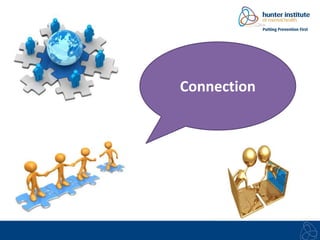
Connection
Some reflections across 
community conversations 
and media coverage
Some assumptions 
• Given suicide is a preventable cause of death which is 
important to communities, saying NOTHING about how to 
prevent it makes no sense. 
• If you are worried that someone may be at risk of suicide, 
saying NOTHING makes no sense. 
• If you know someone who has experienced a loss, saying 
NOTHING makes no sense. 
• Given suicide is an issue that affects everyone, having a media 
that reports NOTHING about the issue makes no sense.
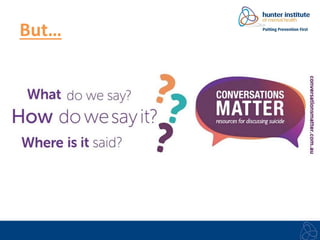
But…
Talking about suicide 
• Suicide is an important issue of community concern; 
• It is important that as a community we are engaged with the 
issue; 
• Often confusion about what is meant by “discussing” or 
“talking about” suicide, and confusion about the evidence; 
• Need to ensure we are not 
“too afraid” to talk about 
suicide, while respecting 
and understanding the 
risks.
Talking about suicide 
The risk associated with the “discussion” seems to be related to: 
 The focus of the information (about death, about how to cope 
with a death, about the broader issue); 
 The status of the individual receiving the information (little 
interest, vulnerable, bereaved by suicide); 
 The format they receive the information (face-to-face, media); 
 The place they receive the information.
4 broad groups for communication: 
1. Not affected and not interested; 
2. Some level of interest or connection to the issue; 
3. Vulnerable, at risk; ** 
4. Those affected or bereaved.
What we know and don’t know 
We know: 
• Talking to someone, one-on-one, directly about suicide will not increase 
their suicide risk (although the empirical evidence is weak); 
• Media reporting of suicide deaths has been associated with increased 
risk for those who are vulnerable to suicide; 
We don’t know: 
• Whether group presentation about suicide will increase or decrease 
suicide risk (e.g. evidence from schools); 
• Whether more general media reporting about suicide (or awareness 
campaigns) will increase or decrease risk.
Media challenges 
• While talking about suicide will not generally increase risk, 
media is not a conversation, it is one way communication; 
• Messages in editorial are not “market tested”. That is, we 
have no way of monitoring how the story is being interpreted 
by people sitting in their own homes; 
• People may take away different messages than those that 
were intended; 
• Raising awareness on its own (e.g. increasing reporting) is not 
enough to change behaviours; 
• Not all media are the same – they don’t all have the capacity 
to cover the issues well.
Positive role of media? 
• The media has a role to play in raising awareness of suicide, but 
there is generally a lack of evidence supporting any positive 
benefits. 
• But some studies or expert opinion suggest that: 
– Personal stories about someone who has managed suicidal 
risk as protective; 
– Focussing on the impact suicide could be protective; 
– Adding help-seeking information can be helpful; 
– Adding information about risk factors and warning signs can 
be helpful.
One-on-one conversations 
• People have reported avoiding the conversation for fear of saying 
the wrong thing or most likely to talk to others about the person. 
• If you are worried about someone or know someone who has 
been affected or bereaved by suicide it is better to reach out 
than avoid the person. 
• Avoiding the discussion can lead to people feeling more isolated.
One-on-one conversations 
 Decide to talk to the person, preferably face-to-face; 
 Listen without judgement and don’t try to fix the situation. 
People want understanding rather than solutions; 
 If you are worried they are thinking about suicide, then ask 
directly and be prepared for the answer; 
 Talk to the person about who else to involve so they can be 
supported and encourage them to seek help. 
 Take care of yourself. These conversations can be difficult and 
you may need support as well.
Group conversations 
 Understand the purpose of the discussion and the setting; 
 Plan messages carefully – the larger the group, the less likely 
you can monitor the response; 
– Messages will have different impacts depending on the 
group and the reason they are coming together 
– We need to alert rather than alarm 
 Think about the words you use and details about suicide that 
are given; 
 Use an experienced facilitator who can manage responses; 
 Think about how you will support people.
Conversations Matter 
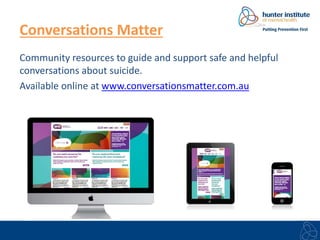
Community resources to guide and support safe and helpful 
conversations about suicide. 
Available online at www.conversationsmatter.com.au
Conversations Matter 
The resources will assist 
communities when: 
 They want to know how to talk 
about suicide more generally. 
 They are worried about 
someone and want to know 
what to say and do. 
 There has been a death and 
they want to know how best to 
handle individual and 
community level conversations. 
Resources available as: 
• Online presentation 
• Printed fact sheets 
• Podcast 
Also has: 
• Links to services 
• Supporting 
factsheets 
• Research reports
Our connection to others is what builds us up 
and keeps us strong. 
Having people sit beside us when times are 
good and when times are bad can make all 
the difference. 
 Connect with others 
 Connect with community 
 Connect with services
Contact Us: 
Email: 
Jaelea.Skehan@hnehealth.nsw.gov.au 
Mindframe@hnehealth.nsw.gov.au 
himh@hnehealth.nsw.gov.au 
Twitter: 
@jaeleaskehan 
@HInstMH 
@MindframeMedia 
Websites: 
www.himh.org.au 
www.mindframe-media.info 
www.conversationsmatter.com.au

World Suicide Prevention Day Presentation

  • 1.
    Engaging communities to talk about suicide Jaelea Skehan Director Hunter Institute of Mental Health
  • 2.
    The Hunter Instituteof Mental Health is a leading National organisation dedicated to reducing mental illness and suicide and improving wellbeing for all Australians.
  • 3.
  • 4.
    Some reflections across community conversations and media coverage
  • 5.
    Some assumptions •Given suicide is a preventable cause of death which is important to communities, saying NOTHING about how to prevent it makes no sense. • If you are worried that someone may be at risk of suicide, saying NOTHING makes no sense. • If you know someone who has experienced a loss, saying NOTHING makes no sense. • Given suicide is an issue that affects everyone, having a media that reports NOTHING about the issue makes no sense.
  • 6.
  • 7.
    Talking about suicide • Suicide is an important issue of community concern; • It is important that as a community we are engaged with the issue; • Often confusion about what is meant by “discussing” or “talking about” suicide, and confusion about the evidence; • Need to ensure we are not “too afraid” to talk about suicide, while respecting and understanding the risks.
  • 8.
    Talking about suicide The risk associated with the “discussion” seems to be related to:  The focus of the information (about death, about how to cope with a death, about the broader issue);  The status of the individual receiving the information (little interest, vulnerable, bereaved by suicide);  The format they receive the information (face-to-face, media);  The place they receive the information.
  • 9.
    4 broad groupsfor communication: 1. Not affected and not interested; 2. Some level of interest or connection to the issue; 3. Vulnerable, at risk; ** 4. Those affected or bereaved.
  • 10.
    What we knowand don’t know We know: • Talking to someone, one-on-one, directly about suicide will not increase their suicide risk (although the empirical evidence is weak); • Media reporting of suicide deaths has been associated with increased risk for those who are vulnerable to suicide; We don’t know: • Whether group presentation about suicide will increase or decrease suicide risk (e.g. evidence from schools); • Whether more general media reporting about suicide (or awareness campaigns) will increase or decrease risk.
  • 11.
    Media challenges •While talking about suicide will not generally increase risk, media is not a conversation, it is one way communication; • Messages in editorial are not “market tested”. That is, we have no way of monitoring how the story is being interpreted by people sitting in their own homes; • People may take away different messages than those that were intended; • Raising awareness on its own (e.g. increasing reporting) is not enough to change behaviours; • Not all media are the same – they don’t all have the capacity to cover the issues well.
  • 12.
    Positive role ofmedia? • The media has a role to play in raising awareness of suicide, but there is generally a lack of evidence supporting any positive benefits. • But some studies or expert opinion suggest that: – Personal stories about someone who has managed suicidal risk as protective; – Focussing on the impact suicide could be protective; – Adding help-seeking information can be helpful; – Adding information about risk factors and warning signs can be helpful.
  • 13.
    One-on-one conversations •People have reported avoiding the conversation for fear of saying the wrong thing or most likely to talk to others about the person. • If you are worried about someone or know someone who has been affected or bereaved by suicide it is better to reach out than avoid the person. • Avoiding the discussion can lead to people feeling more isolated.
  • 14.
    One-on-one conversations Decide to talk to the person, preferably face-to-face;  Listen without judgement and don’t try to fix the situation. People want understanding rather than solutions;  If you are worried they are thinking about suicide, then ask directly and be prepared for the answer;  Talk to the person about who else to involve so they can be supported and encourage them to seek help.  Take care of yourself. These conversations can be difficult and you may need support as well.
  • 15.
    Group conversations Understand the purpose of the discussion and the setting;  Plan messages carefully – the larger the group, the less likely you can monitor the response; – Messages will have different impacts depending on the group and the reason they are coming together – We need to alert rather than alarm  Think about the words you use and details about suicide that are given;  Use an experienced facilitator who can manage responses;  Think about how you will support people.
  • 16.
    Conversations Matter Communityresources to guide and support safe and helpful conversations about suicide. Available online at www.conversationsmatter.com.au
  • 17.
    Conversations Matter Theresources will assist communities when:  They want to know how to talk about suicide more generally.  They are worried about someone and want to know what to say and do.  There has been a death and they want to know how best to handle individual and community level conversations. Resources available as: • Online presentation • Printed fact sheets • Podcast Also has: • Links to services • Supporting factsheets • Research reports
  • 18.
    Our connection toothers is what builds us up and keeps us strong. Having people sit beside us when times are good and when times are bad can make all the difference.  Connect with others  Connect with community  Connect with services
  • 19.
    Contact Us: Email: Jaelea.Skehan@hnehealth.nsw.gov.au Mindframe@hnehealth.nsw.gov.au himh@hnehealth.nsw.gov.au Twitter: @jaeleaskehan @HInstMH @MindframeMedia Websites: www.himh.org.au www.mindframe-media.info www.conversationsmatter.com.au