
SPEAKERS:
Cristine Joy Ballesteros
Charlene Revidad
Pauline Abordo
Jonnel Bernardez
Resty John Carl Briola
TRUE or FALSE
• Stress or stressor in whatever
form is always bad for our
health.
• Doing nothing often leads to
boredom, this could be very
stressful to many.
FALSE
TRUE
• A very rich man-with billion
pesos-choosing the right color for
his twenty-fifth car will not
experience any kind of stress.
• Stress cannot be overcome
because as Selye said: " Complete
freedom from stress is death. "
• One can view stressors as
challenges and not be let down.
FALSE
TRUE
TRUE
8/25/2015 4
WHAT IS STRESS?
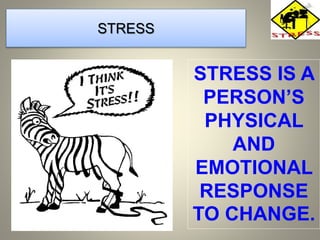
STRESS IS A
PERSON’S
PHYSICAL
AND
EMOTIONAL
RESPONSE
TO CHANGE.
What is
stress??????STRESS
S enseless T hought R epeated
E ndlessly S urrounding S elf
 Physiological terms, a collection of bodily
responses, including a more rapid heart rate,
elevated blood pressure, rapid breathing,
sweating palms and increased tension.
 General Adaptation Syndrome (Fight or
Flight response)
 Any situation, GOOD or BAD that causes you
to readjust.
 It is the reaction of people that have
excessive pressure or other types of demand
placed upon them. It arises when they worry
that they can't cope.
Stress = Pressure > Resourse
 Type A personality VS Type B personality
( Which is more stressful?)
 Stress is not an illness-it is a state. However if
stress becomes too excessive and prolong
mental and physical illness may develop.
 Stress is irresistible thus
it can be controlled;
excessive stress can be
reduced; and stress
reaction can be
managed.
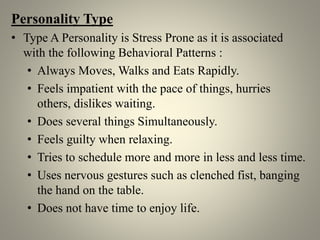
Personality Type
• Type A Personality is Stress Prone as it is associated
with the following Behavioral Patterns :
• Always Moves, Walks and Eats Rapidly.
• Feels impatient with the pace of things, hurries
others, dislikes waiting.
• Does several things Simultaneously.
• Feels guilty when relaxing.
• Tries to schedule more and more in less and less time.
• Uses nervous gestures such as clenched fist, banging
the hand on the table.
• Does not have time to enjoy life.
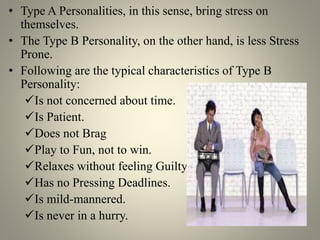
• Type A Personalities, in this sense, bring stress on
themselves.
• The Type B Personality, on the other hand, is less Stress
Prone.
• Following are the typical characteristics of Type B
Personality:
Is not concerned about time.
Is Patient.
Does not Brag
Play to Fun, not to win.
Relaxes without feeling Guilty.
Has no Pressing Deadlines.
Is mild-mannered.
Is never in a hurry.
• Change in financial status
• Change of job / work
• Mortgage or loan
• Foreclosure of mortgage/loan
• Change in responsibilities
• Moving house
• Holidays
• Christmas
• Minor violations of the law
• Death of a loved one
• Divorce / separation
• Imprisonment
• Injury/illness ( self / family )
• Marriage/ engagement
• Loss of job
• Retirement
• Pregnancy
• Sexual Problems
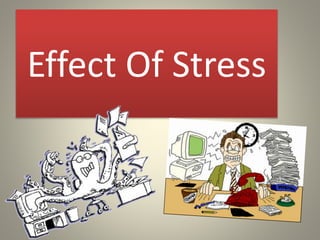
Effect Of Stress
Stress has Behavioral, cognitive
and Physiological Consequences.
Research Studies indicate that
Stress is negatively related to
Job Satisfaction,
Organizational Commitment
and Performance and
positively related to Turnover.
Burnout
Burnout is a troublesome
outcome of Stress.
Burnout is a state of mind
resulting from prolonged
exposure to emotional stress.
It manifests through Emotional
Exhaustion and a combination
of Negative Attitudes.
• Burnouts occurs due to prolonged
exposure to Stress and that too in
phases.
• The Three key phases of Burnout
are
• Emotional Exhaustion
• Depersonalization
• Feeling a lack of Personal
Accomplishment
• Emotional Exhaustion is due to a
combination of Personal, Job
and Organizational Stressors.
• People who expect a lot from
themselves and the Organization
in which they work tend to create
more internal stress, which in
turn leads to Emotional
Exhaustion
• Emotional Exhaustion is fuelled by
having too much work to do, by
role conflict and by the type of
interpersonal interactions
encountered at work.
• Overtime, Emotional Exhaustion
leads to Depersonalization, which is
the state of psychologically
withdrawing from one’s job.
• This finally results in a feeling
of being unappreciated,
ineffective or inadequate.
• The addictive effect of these
three phases is a host of
negative attitudinal and
behavioral outcomes.
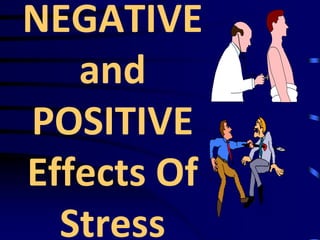
NEGATIVE
and
POSITIVE
Effects Of
Stress
NEGATIVE STRESS
It is a contributory factor in minor
conditions, such as headaches,
digestive problems, skin
complaints, insomnia and ulcers.
Excessive, prolonged and
unrelieved stress can have a
harmful effect on mental, physical
and spiritual health.
POSITIVE STRESS
Stress can also have a positive effect,
spurring motivation and awareness,
providing the stimulation to cope with
challenging situations.
Stress also provides the sense of
urgency and alertness needed for
survival when confronting threatening
situations.
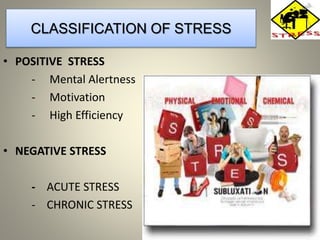
CLASSIFICATION OF STRESS
• POSITIVE STRESS
- Mental Alertness
- Motivation
- High Efficiency
• NEGATIVE STRESS
- ACUTE STRESS
- CHRONIC STRESS
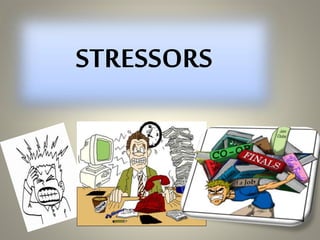
STRESSORS
FRUSTRATION
• Refers to emotional state induced when
one is blocked from reaching a goal.
PRESSURE
• An emotional state induced when one is
confronted by personal responsibilities.
BOREDOM or Understimulation
• This the opposite of pressure, but it too can
be a stressor, especially if it continues for
a long time.
TRAUMA
• A shocking physical or emotional
experience, such as rape , military combat,
fire typhoon, torture etc.
CONFLICT
• An emotional state induced when
one is one is torn between two or
more potential courses of action.
• Gestalt psychologist Kurt Lewin
identified 3 kinds of conflicts:
Approach-approach
Avoidance-avoidance
Approach-avoidance
Approach-approach
 When one is torn between two desirable courses
of actions
 Least stressful, because both options are
desirable
Avoidance-avoidance
 When one is forced to choose between two
unpleasant courses of action.
 Such as going to dentist or suffering from a
toothache
Approach-avoidance
When one is simultaneously drawn to and
repelled by the same goal
CHANGE
•Separation
•Illness in the family
•Unemployment
•Moving to a new city
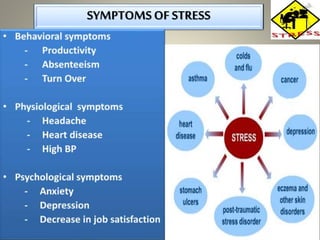
SYMPTOMSOF STRESS
Sources of Stress
1. Biological Deprivation - extreme hunger can cause deep
physical and emotional disturbances.
2. Danger (real or imagined) - “Combat exhaustion” is a
term use to describe a break down in behavior resulting
from danger experiences which rapidly produce stress.
3. Threats to self-esteem- these threats are often affected by
age and personality factors.
4. Overload – this results from too much stimulation. City
dwellers adapt to stress by paying less attention to their
surroundings than do rural people.
5. Crises and stresses that company normal social and
personal development – as we grow up, we worry about
our ability to meet the new demands and new roles that
each stage of life presents.
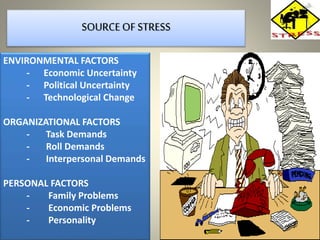
SOURCE OF STRESS
ENVIRONMENTAL FACTORS
- Economic Uncertainty
- Political Uncertainty
- Technological Change
ORGANIZATIONAL FACTORS
- Task Demands
- Roll Demands
- Interpersonal Demands
PERSONAL FACTORS
- Family Problems
- Economic Problems
- Personality
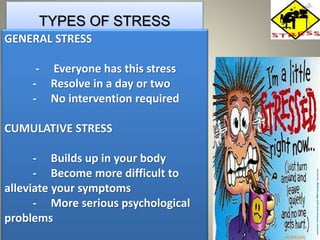
TYPES OF STRESS
GENERAL STRESS
- Everyone has this stress
- Resolve in a day or two
- No intervention required
CUMULATIVE STRESS
- Builds up in your body
- Become more difficult to
alleviate your symptoms
- More serious psychological
problems
Coping up
with Stress
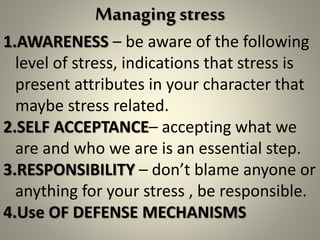
Managing stress
1.AWARENESS – be aware of the following
level of stress, indications that stress is
present attributes in your character that
maybe stress related.
2.SELF ACCEPTANCE– accepting what we
are and who we are is an essential step.
3.RESPONSIBILITY – don’t blame anyone or
anything for your stress , be responsible.
4.Use OF DEFENSE MECHANISMS
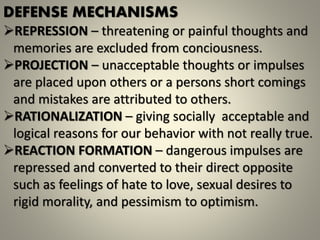
DEFENSE MECHANISMS
REPRESSION – threatening or painful thoughts and
memories are excluded from conciousness.
PROJECTION – unacceptable thoughts or impulses
are placed upon others or a persons short comings
and mistakes are attributed to others.
RATIONALIZATION – giving socially acceptable and
logical reasons for our behavior with not really true.
REACTION FORMATION – dangerous impulses are
repressed and converted to their direct opposite
such as feelings of hate to love, sexual desires to
rigid morality, and pessimism to optimism.
DISPLACEMENT – straight forward substitution of
one goal or object for another.
COMPENSATION – this is a more socially desirable
defense mechanism whereby one endeavors to
make up for weakness in one function by by
excelling in some other.
REGRESSION – retreat to an earlier stage of
development and adoption of less mature types of
behavior.
SUBLIMATION – form of displacement of
instinctual energy from the id into higher social
and cultural achievements.
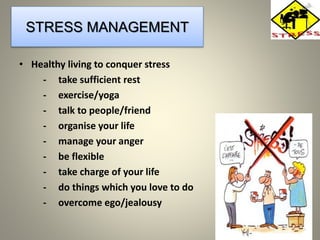
STRESS MANAGEMENT
• Healthy living to conquer stress
- take sufficient rest
- exercise/yoga
- talk to people/friend
- organise your life
- manage your anger
- be flexible
- take charge of your life
- do things which you love to do
- overcome ego/jealousy
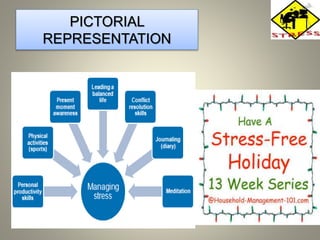
PICTORIAL
REPRESENTATION
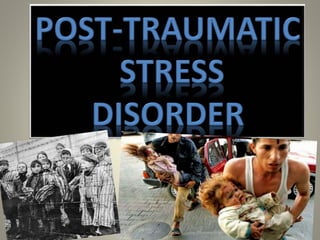
PTSDIs a common disorder which
person experiences disabling
anxiety after a traumatic
event.
Traumatic Events
• Military Combat
• Rape or Sexual abuse
• Kidnapping or Torture
• Car accident
• Natural Disaster
Symptoms
• Startle easily
• Feel emotional numb
• Act irritable
• Lose interest in things he used to
enjoy
• Become aggressive or even violent
• Sleeping difficulties and nightmares
• Feelings of guilt for having survived
an accident where other people
died.
• Difficulty on trusting others.
• Avoiding people, places or things
that remind of the incident, as well
as the anniversaries of the incident.
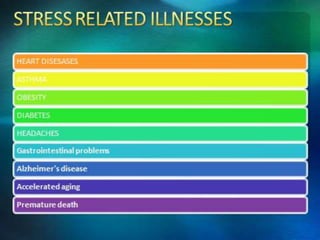
Physical Symptoms
• Headaches
• Gastroinstestinal distress
• Immune system problems
• Dizziness, chest pain or discomfort
in other parts of the body
Effect
•Low self-esteem
•Suicidal thoughts
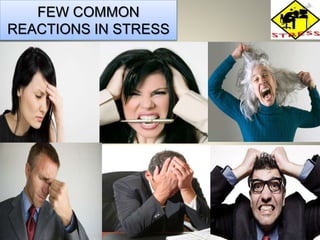
FEW COMMON
REACTIONS IN STRESS
Stress

Stress

  • 1.
    SPEAKERS: Cristine Joy Ballesteros CharleneRevidad Pauline Abordo Jonnel Bernardez Resty John Carl Briola
  • 2.
    TRUE or FALSE •Stress or stressor in whatever form is always bad for our health. • Doing nothing often leads to boredom, this could be very stressful to many. FALSE TRUE
  • 3.
    • A veryrich man-with billion pesos-choosing the right color for his twenty-fifth car will not experience any kind of stress. • Stress cannot be overcome because as Selye said: " Complete freedom from stress is death. " • One can view stressors as challenges and not be let down. FALSE TRUE TRUE
  • 4.
  • 5.
  • 6.
    S enseless Thought R epeated E ndlessly S urrounding S elf  Physiological terms, a collection of bodily responses, including a more rapid heart rate, elevated blood pressure, rapid breathing, sweating palms and increased tension.  General Adaptation Syndrome (Fight or Flight response)  Any situation, GOOD or BAD that causes you to readjust.
  • 7.
     It isthe reaction of people that have excessive pressure or other types of demand placed upon them. It arises when they worry that they can't cope. Stress = Pressure > Resourse  Type A personality VS Type B personality ( Which is more stressful?)  Stress is not an illness-it is a state. However if stress becomes too excessive and prolong mental and physical illness may develop.
  • 8.
     Stress isirresistible thus it can be controlled; excessive stress can be reduced; and stress reaction can be managed.
  • 9.
    Personality Type • TypeA Personality is Stress Prone as it is associated with the following Behavioral Patterns : • Always Moves, Walks and Eats Rapidly. • Feels impatient with the pace of things, hurries others, dislikes waiting. • Does several things Simultaneously. • Feels guilty when relaxing. • Tries to schedule more and more in less and less time. • Uses nervous gestures such as clenched fist, banging the hand on the table. • Does not have time to enjoy life.
  • 10.
    • Type APersonalities, in this sense, bring stress on themselves. • The Type B Personality, on the other hand, is less Stress Prone. • Following are the typical characteristics of Type B Personality: Is not concerned about time. Is Patient. Does not Brag Play to Fun, not to win. Relaxes without feeling Guilty. Has no Pressing Deadlines. Is mild-mannered. Is never in a hurry.
  • 13.
    • Change infinancial status • Change of job / work • Mortgage or loan • Foreclosure of mortgage/loan • Change in responsibilities • Moving house • Holidays • Christmas • Minor violations of the law
  • 14.
    • Death ofa loved one • Divorce / separation • Imprisonment • Injury/illness ( self / family ) • Marriage/ engagement • Loss of job • Retirement • Pregnancy • Sexual Problems
  • 15.
  • 16.
    Stress has Behavioral,cognitive and Physiological Consequences. Research Studies indicate that Stress is negatively related to Job Satisfaction, Organizational Commitment and Performance and positively related to Turnover.
  • 17.
    Burnout Burnout is atroublesome outcome of Stress. Burnout is a state of mind resulting from prolonged exposure to emotional stress. It manifests through Emotional Exhaustion and a combination of Negative Attitudes.
  • 18.
    • Burnouts occursdue to prolonged exposure to Stress and that too in phases. • The Three key phases of Burnout are • Emotional Exhaustion • Depersonalization • Feeling a lack of Personal Accomplishment
  • 19.
    • Emotional Exhaustionis due to a combination of Personal, Job and Organizational Stressors. • People who expect a lot from themselves and the Organization in which they work tend to create more internal stress, which in turn leads to Emotional Exhaustion
  • 20.
    • Emotional Exhaustionis fuelled by having too much work to do, by role conflict and by the type of interpersonal interactions encountered at work. • Overtime, Emotional Exhaustion leads to Depersonalization, which is the state of psychologically withdrawing from one’s job.
  • 21.
    • This finallyresults in a feeling of being unappreciated, ineffective or inadequate. • The addictive effect of these three phases is a host of negative attitudinal and behavioral outcomes.
  • 22.
  • 23.
    NEGATIVE STRESS It isa contributory factor in minor conditions, such as headaches, digestive problems, skin complaints, insomnia and ulcers. Excessive, prolonged and unrelieved stress can have a harmful effect on mental, physical and spiritual health.
  • 24.
    POSITIVE STRESS Stress canalso have a positive effect, spurring motivation and awareness, providing the stimulation to cope with challenging situations. Stress also provides the sense of urgency and alertness needed for survival when confronting threatening situations.
  • 25.
    CLASSIFICATION OF STRESS •POSITIVE STRESS - Mental Alertness - Motivation - High Efficiency • NEGATIVE STRESS - ACUTE STRESS - CHRONIC STRESS
  • 26.
  • 28.
    FRUSTRATION • Refers toemotional state induced when one is blocked from reaching a goal. PRESSURE • An emotional state induced when one is confronted by personal responsibilities.
  • 29.
    BOREDOM or Understimulation •This the opposite of pressure, but it too can be a stressor, especially if it continues for a long time. TRAUMA • A shocking physical or emotional experience, such as rape , military combat, fire typhoon, torture etc.
  • 30.
    CONFLICT • An emotionalstate induced when one is one is torn between two or more potential courses of action. • Gestalt psychologist Kurt Lewin identified 3 kinds of conflicts: Approach-approach Avoidance-avoidance Approach-avoidance
  • 31.
    Approach-approach  When oneis torn between two desirable courses of actions  Least stressful, because both options are desirable Avoidance-avoidance  When one is forced to choose between two unpleasant courses of action.  Such as going to dentist or suffering from a toothache Approach-avoidance When one is simultaneously drawn to and repelled by the same goal
  • 32.
    CHANGE •Separation •Illness in thefamily •Unemployment •Moving to a new city
  • 34.
  • 35.
    Sources of Stress 1.Biological Deprivation - extreme hunger can cause deep physical and emotional disturbances. 2. Danger (real or imagined) - “Combat exhaustion” is a term use to describe a break down in behavior resulting from danger experiences which rapidly produce stress. 3. Threats to self-esteem- these threats are often affected by age and personality factors. 4. Overload – this results from too much stimulation. City dwellers adapt to stress by paying less attention to their surroundings than do rural people. 5. Crises and stresses that company normal social and personal development – as we grow up, we worry about our ability to meet the new demands and new roles that each stage of life presents.
  • 36.
    SOURCE OF STRESS ENVIRONMENTALFACTORS - Economic Uncertainty - Political Uncertainty - Technological Change ORGANIZATIONAL FACTORS - Task Demands - Roll Demands - Interpersonal Demands PERSONAL FACTORS - Family Problems - Economic Problems - Personality
  • 37.
    TYPES OF STRESS GENERALSTRESS - Everyone has this stress - Resolve in a day or two - No intervention required CUMULATIVE STRESS - Builds up in your body - Become more difficult to alleviate your symptoms - More serious psychological problems
  • 38.
  • 39.
    Managing stress 1.AWARENESS –be aware of the following level of stress, indications that stress is present attributes in your character that maybe stress related. 2.SELF ACCEPTANCE– accepting what we are and who we are is an essential step. 3.RESPONSIBILITY – don’t blame anyone or anything for your stress , be responsible. 4.Use OF DEFENSE MECHANISMS
  • 40.
    DEFENSE MECHANISMS REPRESSION –threatening or painful thoughts and memories are excluded from conciousness. PROJECTION – unacceptable thoughts or impulses are placed upon others or a persons short comings and mistakes are attributed to others. RATIONALIZATION – giving socially acceptable and logical reasons for our behavior with not really true. REACTION FORMATION – dangerous impulses are repressed and converted to their direct opposite such as feelings of hate to love, sexual desires to rigid morality, and pessimism to optimism.
  • 41.
    DISPLACEMENT – straightforward substitution of one goal or object for another. COMPENSATION – this is a more socially desirable defense mechanism whereby one endeavors to make up for weakness in one function by by excelling in some other. REGRESSION – retreat to an earlier stage of development and adoption of less mature types of behavior. SUBLIMATION – form of displacement of instinctual energy from the id into higher social and cultural achievements.
  • 42.
    STRESS MANAGEMENT • Healthyliving to conquer stress - take sufficient rest - exercise/yoga - talk to people/friend - organise your life - manage your anger - be flexible - take charge of your life - do things which you love to do - overcome ego/jealousy
  • 43.
  • 45.
    PTSDIs a commondisorder which person experiences disabling anxiety after a traumatic event.
  • 46.
    Traumatic Events • MilitaryCombat • Rape or Sexual abuse • Kidnapping or Torture • Car accident • Natural Disaster
  • 47.
    Symptoms • Startle easily •Feel emotional numb • Act irritable • Lose interest in things he used to enjoy • Become aggressive or even violent
  • 48.
    • Sleeping difficultiesand nightmares • Feelings of guilt for having survived an accident where other people died. • Difficulty on trusting others. • Avoiding people, places or things that remind of the incident, as well as the anniversaries of the incident.
  • 49.
    Physical Symptoms • Headaches •Gastroinstestinal distress • Immune system problems • Dizziness, chest pain or discomfort in other parts of the body
  • 50.
  • 52.