Promising presentation - Rana AbdullahTahan
PHD researcher
https://orcid.org/0000-0002-1093-7740
Stress
Managing stress
All external factors that put pressure on the psychological state of the individual
to the extent that he or she is in a state of tension, anxiety and negative impact in
his ability to achieve integration and balance in his personality, in addition to the
loss of emotional balance and the emergence of behavior patterns that must be
new, and these pressures appear when confronting an individual something of a
correct response to him or a demand that does not have enough durability to
meet him, or that it falls beyond his or her limits, which is the negative feeling
that affects the human being when exposed to pressures that exceed his or her
endurance, It varies from person to person depending on the personality and
endurance of the human being, and from the different in its type and severity
from person to person.
.
1. Stress is a process that has interconnected and overlapping stages that can be
dealt with individually.
2.The process of stress shows the importance of how a person realizes the
situation of the environment, which is important that athletes are equally aware of
attitudes and events.
3- When you look at psychological pressures as a process, it means that we treat
them as a good or bad emotional appearance, but we treat them as the results of
modernity that lead to certain actions or behavior that may represent a positive,
negative or even neutral form according to the behavior resulting from the athlete's
response.
- Anxiety: is a negative emotional state.
Spielberger 1976 defined anxiety as a self-emotional state in which the individual
feels scared and stressed and this situation can change in severity from time to
time.
- While the feature of anxiety is known:
- as a relatively permanent personal readiness to perceive certain environmental
positions as threatening or stressful and the tendency to respond to these
positions at different levels of anxiety
Anxiety has a negative characteristic, whether a person shows a state of anxiety
for a short time, where he or she will have a general willingness to respond to
these situations)
Anxiety symptoms are characterized by two types
1 - physical anxiety: -
multiple physical symptoms such as sweat, increased heart rate.
2- Cognitive anxiety:
- it means psychological symptoms such as discomfort, distraction, negative
thought processes.
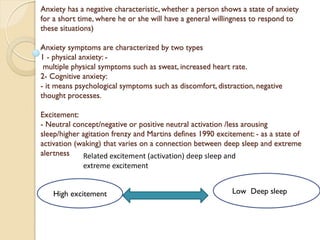
Excitement:
- Neutral concept/negative or positive neutral activation /less arousing
sleep/higher agitation frenzy and Martins defines 1990 excitement: - as a state of
activation (waking) that varies on a connection between deep sleep and extreme
alertness
Low Deep sleep
High excitement
Related excitement (activation) deep sleep and
extreme excitement
The training, which is characterized by high intensity and lasts for a long time,
makes it difficult for the athlete to adapt to it and this leads to a decline in the
level of the athlete in addition to the emergence of some negative psychological
and physiological symptoms:
1.The decline in the level of athletes is caused by the pressures of overtraining 2.
4. Excessive training begins to turn into the beginning of the phenomenon of
emotional stress when the athlete is the negative explanation of the results of
the overtraining
5. It is expected that the result of interpretation or negative perception of
symptoms is excessive training, low level, insensitive value of effort, lack of
reward and appreciation....
6.When the previous situation lasts a long time, it means that the athlete
will be more vulnerable to the phenomenon of psychological combustion
where negative perceptions increase and the athlete makes the decision to
withdraw.
Types of withdrawal as a result of the phenomenon of combustion
1 - partial withdrawal: it means the transfer of the athlete to another sport
or continue in the same sport in response to external pressures (coach,
bonus, social status ... Etc., but less enthusiastic, energy, less tender, more
prone to psychological problems and injury
2 - total withdrawal:
It is to leave sports altogether and consider it a negative experience and a
source of tension, frustration, failure and loss of self-confidence in leaving
the sport and may look for another alternative activity for sports or the
negative effects may continue to have a negative impact on his life.
The reasons for psychological pressures
1 - environment:
When the player says that the coach pressured him a lot or watched a large
audience I felt very scared here tends to blame events in his environment to explain
the causes of pressures and have a process mechanism for the way of thinking to
explain these pressures and this is a big mistake
2 - perception:
is the player perceiving the events either in a positive way or in a negative way
3 - response :
Is the response of individuals to the environment in the form of provoking those
that represent after severity of behavior and use the term arousal here in the sense
of the state of physiological and behavioral activation of the person.
Physiological, psychological and behavioral changes common to increased arousal
resulting from stress
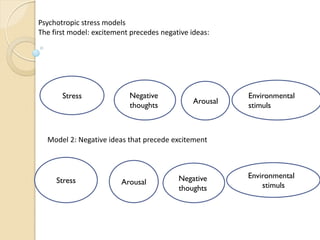
Environmental
stimuls
Arousal
Negative
thoughts
Stress
Environmental
stimuls
Negative
thoughts
Stress Arousal
Model 2: Negative ideas that precede excitement
Psychotropic stress models
The first model: excitement precedes negative ideas:
Causes of stress
1- Environment:
When the player says that the coach pressured him a lot or watched a
large audience felt very scared here tends to blame events in his
environment to explain the causes of pressures, and he has a process
mechanism for the way of thinking to explain these pressures and this is a
big mistake
2- Perception:
The player is aware of the events either in a positive way or in a negative
way.
3. Response:
Is the response of individuals to the environment in the form of
provoking those that represent after distress behavior and use the term
arousal here in the sense of the state of physiological and behavioral
activation of the person.
Conclusion
The environment itself seems to be the cause of stress, but the most important and
most influential is how the environment is interpreted or how it understands the
environment, which makes it a source of respiratory threat and pressure.
This does not negate the existence of environmental conditions that are the most
source of psychological pressure, but also depends on perception and negative
interpretation.
Thank you for listening so well.

Stress

  • 1.
    Promising presentation -Rana AbdullahTahan PHD researcher https://orcid.org/0000-0002-1093-7740 Stress
  • 2.
    Managing stress All externalfactors that put pressure on the psychological state of the individual to the extent that he or she is in a state of tension, anxiety and negative impact in his ability to achieve integration and balance in his personality, in addition to the loss of emotional balance and the emergence of behavior patterns that must be new, and these pressures appear when confronting an individual something of a correct response to him or a demand that does not have enough durability to meet him, or that it falls beyond his or her limits, which is the negative feeling that affects the human being when exposed to pressures that exceed his or her endurance, It varies from person to person depending on the personality and endurance of the human being, and from the different in its type and severity from person to person.
  • 3.
    . 1. Stress isa process that has interconnected and overlapping stages that can be dealt with individually. 2.The process of stress shows the importance of how a person realizes the situation of the environment, which is important that athletes are equally aware of attitudes and events. 3- When you look at psychological pressures as a process, it means that we treat them as a good or bad emotional appearance, but we treat them as the results of modernity that lead to certain actions or behavior that may represent a positive, negative or even neutral form according to the behavior resulting from the athlete's response. - Anxiety: is a negative emotional state. Spielberger 1976 defined anxiety as a self-emotional state in which the individual feels scared and stressed and this situation can change in severity from time to time. - While the feature of anxiety is known: - as a relatively permanent personal readiness to perceive certain environmental positions as threatening or stressful and the tendency to respond to these positions at different levels of anxiety
  • 4.
    Anxiety has anegative characteristic, whether a person shows a state of anxiety for a short time, where he or she will have a general willingness to respond to these situations) Anxiety symptoms are characterized by two types 1 - physical anxiety: - multiple physical symptoms such as sweat, increased heart rate. 2- Cognitive anxiety: - it means psychological symptoms such as discomfort, distraction, negative thought processes. Excitement: - Neutral concept/negative or positive neutral activation /less arousing sleep/higher agitation frenzy and Martins defines 1990 excitement: - as a state of activation (waking) that varies on a connection between deep sleep and extreme alertness Low Deep sleep High excitement Related excitement (activation) deep sleep and extreme excitement
  • 5.
    The training, whichis characterized by high intensity and lasts for a long time, makes it difficult for the athlete to adapt to it and this leads to a decline in the level of the athlete in addition to the emergence of some negative psychological and physiological symptoms: 1.The decline in the level of athletes is caused by the pressures of overtraining 2. 4. Excessive training begins to turn into the beginning of the phenomenon of emotional stress when the athlete is the negative explanation of the results of the overtraining
  • 6.
    5. It isexpected that the result of interpretation or negative perception of symptoms is excessive training, low level, insensitive value of effort, lack of reward and appreciation.... 6.When the previous situation lasts a long time, it means that the athlete will be more vulnerable to the phenomenon of psychological combustion where negative perceptions increase and the athlete makes the decision to withdraw. Types of withdrawal as a result of the phenomenon of combustion 1 - partial withdrawal: it means the transfer of the athlete to another sport or continue in the same sport in response to external pressures (coach, bonus, social status ... Etc., but less enthusiastic, energy, less tender, more prone to psychological problems and injury 2 - total withdrawal: It is to leave sports altogether and consider it a negative experience and a source of tension, frustration, failure and loss of self-confidence in leaving the sport and may look for another alternative activity for sports or the negative effects may continue to have a negative impact on his life.
  • 7.
    The reasons forpsychological pressures 1 - environment: When the player says that the coach pressured him a lot or watched a large audience I felt very scared here tends to blame events in his environment to explain the causes of pressures and have a process mechanism for the way of thinking to explain these pressures and this is a big mistake 2 - perception: is the player perceiving the events either in a positive way or in a negative way 3 - response : Is the response of individuals to the environment in the form of provoking those that represent after severity of behavior and use the term arousal here in the sense of the state of physiological and behavioral activation of the person. Physiological, psychological and behavioral changes common to increased arousal resulting from stress
  • 8.
    Environmental stimuls Arousal Negative thoughts Stress Environmental stimuls Negative thoughts Stress Arousal Model 2:Negative ideas that precede excitement Psychotropic stress models The first model: excitement precedes negative ideas:
  • 9.
    Causes of stress 1-Environment: When the player says that the coach pressured him a lot or watched a large audience felt very scared here tends to blame events in his environment to explain the causes of pressures, and he has a process mechanism for the way of thinking to explain these pressures and this is a big mistake 2- Perception: The player is aware of the events either in a positive way or in a negative way. 3. Response: Is the response of individuals to the environment in the form of provoking those that represent after distress behavior and use the term arousal here in the sense of the state of physiological and behavioral activation of the person.
  • 10.
    Conclusion The environment itselfseems to be the cause of stress, but the most important and most influential is how the environment is interpreted or how it understands the environment, which makes it a source of respiratory threat and pressure. This does not negate the existence of environmental conditions that are the most source of psychological pressure, but also depends on perception and negative interpretation.
  • 11.
    Thank you forlistening so well.