Properties Of Concrete
Strength Evaluation of Existing Structures
Presentation
Group 2
Shahrukh Niaz 17
Taimoor Shaheen 18
Hasnian Manzoor 16
Ahsan Javed 14
Muhammad Ansar 10
Muhammad Arshad 12
Muhammad Salman 15
Qasib Ali 13
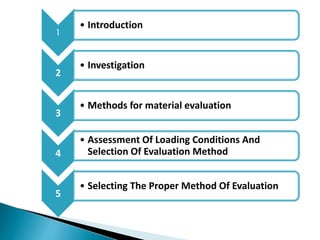
1
• Introduction
2
• Investigation
3
• Methods for material evaluation
4
• Assessment Of Loading Conditions And
Selection Of Evaluation Method
5
• Selecting The Proper Method Of Evaluation
What is Evaluation?
 The making of a judgement about the
amount, number, or value of something;
assessment.
 The main objective of the evaluation, in
addition to having an overview of past or
existing initiatives, is to allow for reflection
and help identify future changes.
1 •Introduction
 There are a number of different characteristics of an existing
concrete structure that can be evaluated. These include:
 Stability of the entire structure
 Stability of individual components of the structure
 Strength and safety of individual structural element
 Stiffness of the entire structure
 Stiffness of individual structural elements
 Dynamic response of individual structural elements
 Durability of the structure
 Fire resistance of the structure
1.1 •Categories of evaluation
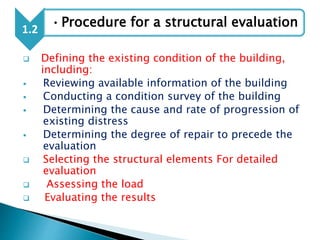
 Defining the existing condition of the building,
including:
 Reviewing available information of the building
 Conducting a condition survey of the building
 Determining the cause and rate of progression of
existing distress
 Determining the degree of repair to precede the
evaluation
 Selecting the structural elements For detailed
evaluation
 Assessing the load
 Evaluating the results
1.2
•Procedure for a structural evaluation
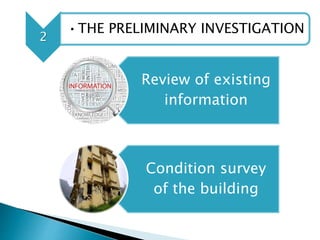
2
•THE PRELIMINARY INVESTIGATION
Review of existing
information
Condition survey
of the building
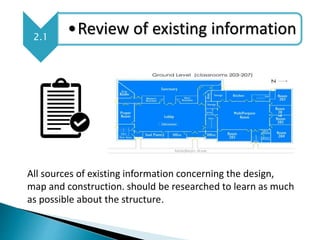
2.1
•Review of existing information
All sources of existing information concerning the design,
map and construction. should be researched to learn as much
as possible about the structure.
It is intended as a guide only. It should be recognized that each
source need not be consulted in a strength evaluation.
Following are some sources of existing information:
Structural design calculations
Construction materials
Field inspection reports
Contractor and subcontractor diaries
Job progress photographs
compressive strength test reports
Field slump test reports
Maintenance records
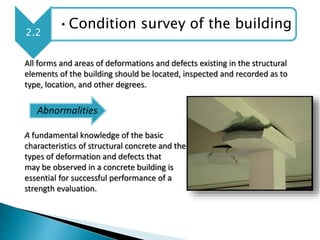
2.2
•Condition survey of the building
A fundamental knowledge of the basic
characteristics of structural concrete and the
types of deformation and defects that
may be observed in a concrete building is
essential for successful performance of a
strength evaluation.
Abnormalities
All forms and areas of deformations and defects existing in the structural
elements of the building should be located, inspected and recorded as to
type, location, and other degrees.
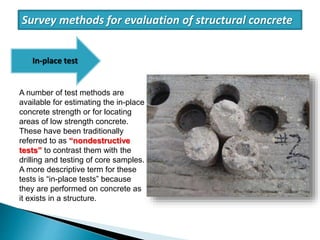
A number of test methods are
available for estimating the in-place
concrete strength or for locating
areas of low strength concrete.
These have been traditionally
referred to as “nondestructive
tests” to contrast them with the
drilling and testing of core samples.
A more descriptive term for these
tests is “in-place tests” because
they are performed on concrete as
it exists in a structure.
Survey methods for evaluation of structural concrete
In-place test
Rebound Hammer
test
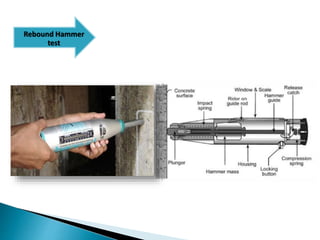
Explanation:
The test instrument consists of a metal housing, a spring-loaded mass
(the hammer) and a steel rod (the plunger). To perform a test, the
plunger is placed perpendicular to the concrete surface and the
housing is pushed toward the concrete. This action causes the
extension of a spring connected to the hammer. When the instrument
is pushed to its limit, the hammer is propelled toward the concrete and
it impacts a shoulder on the plunger. The hammer rebounds, and the
rebound distance is measured on a scale numbered from 10 to 100.
The rebound distance is recorded as the “rebound number” indicated
on the scale.
The greater the amount of absorbed energy by concrete, the lower
the rebound number.
A test performed directly above a hard particle of coarse aggregate
results in a higher rebound number than a test over mortar.
Rebound hammer
Pulse velocity Test
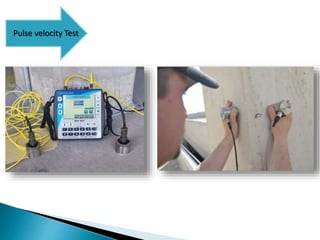
Explanation
In this test, the strength and quality of concrete is assessed by measuring
the velocity of an ultrasonic pulse passing through a concrete
structure.The test equipment includes a transmitter, a receiver, and
electronic instrumentation. The test consists of measuring the time it takes
for a pulse of vibrational energy to travel through a concrete member. The
vibrational energy is introduced into the concrete by the transmitter,
detected by the receivier. The distance between them is divided by the
transit time to obtain the pulse velocity through the concrete under test.
 Greater the velocity more will be the Strength.
 An increase in moisture content increases the pulse velocity and this
could be incorrectly interpreted as an increase in compressive
strength.
 The presence of reinforcing steel aligned with the pulse travel path
can also significantly increase pulse velocity.
 Cracking and Honeycombing can also be detected by this method.
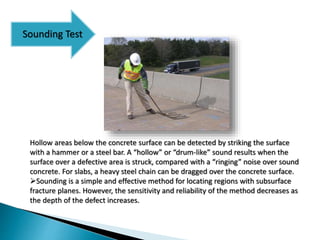
Sounding Test
Hollow areas below the concrete surface can be detected by striking the surface
with a hammer or a steel bar. A “hollow” or “drum-like” sound results when the
surface over a defective area is struck, compared with a “ringing” noise over sound
concrete. For slabs, a heavy steel chain can be dragged over the concrete surface.
Sounding is a simple and effective method for locating regions with subsurface
fracture planes. However, the sensitivity and reliability of the method decreases as
the depth of the defect increases.
3
•Methods for material evaluation
Concrete
Reinforcing
steel
Sampling techniques and tests of concrete are available to assess the
mechanical properties and Strength of concrete and steel.
Techniques for proper sampling of concrete
Samples are retrieved to determined strength as well as physical and
chemical properties. It is essential that samples be obtained, handled,
stored and identified in a proper way of prevent damage or
contamination.
 Methods of testing:
 Rebound Hammer
 Pulse Velocity Test
 Sounding Test
3.1
•Concrete
3.2
•Reinforcing steel
Locational survey method:
The size, number and location of steel bars can be determined by following
methods
•Magnetic test
•Radiographic evaluation
Magnetic test
•Magnetic instrument for location of steel bars in concrete are based on
the fact that presence of steel affects alternating magnetic field
produced by a hand-held search unit.
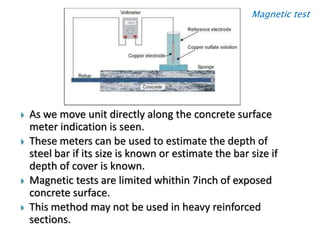
Magnetic test
 As we move unit directly along the concrete surface
meter indication is seen.
 These meters can be used to estimate the depth of
steel bar if its size is known or estimate the bar size if
depth of cover is known.
 Magnetic tests are limited whithin 7inch of exposed
concrete surface.
 This method may not be used in heavy reinforced
sections.
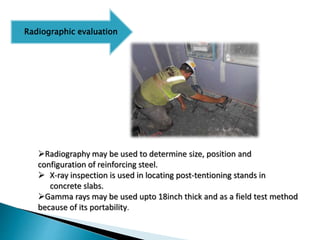
Radiographic evaluation
Radiography may be used to determine size, position and
configuration of reinforcing steel.
 X-ray inspection is used in locating post-tentioning stands in
concrete slabs.
Gamma rays may be used upto 18inch thick and as a field test method
because of its portability.
4
•ASSESSMENT OF LOADING ,CONDITIONS
4
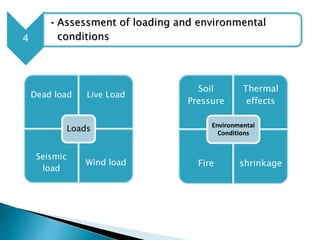
•Assessment of loading and environmental
conditions
Dead load Live Load
Seismic
load
Wind load
Loads
Soil
Pressure
Thermal
effects
Fire shrinkage
Environmental
Conditions
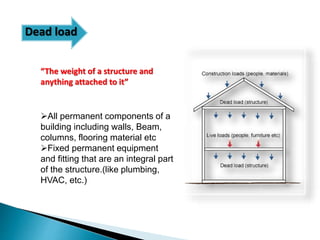
Dead load
“The weight of a structure and
anything attached to it”
All permanent components of a
building including walls, Beam,
columns, flooring material etc
Fixed permanent equipment
and fitting that are an integral part
of the structure.(like plumbing,
HVAC, etc.)
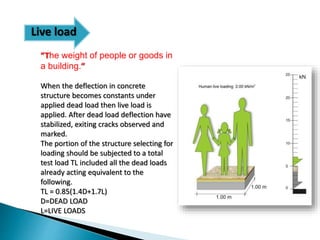
Live load
“The weight of people or goods in
a building.”
When the deflection in concrete
structure becomes constants under
applied dead load then live load is
applied. After dead load deflection have
stabilized, exiting cracks observed and
marked.
The portion of the structure selecting for
loading should be subjected to a total
test load TL included all the dead loads
already acting equivalent to the
following.
TL = 0.85(1.4D+1.7L)
D=DEAD LOAD
L=LIVE LOADS
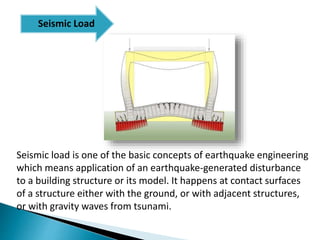
Seismic load is one of the basic concepts of earthquake engineering
which means application of an earthquake-generated disturbance
to a building structure or its model. It happens at contact surfaces
of a structure either with the ground, or with adjacent structures,
or with gravity waves from tsunami.
Seismic Load
Wind Load
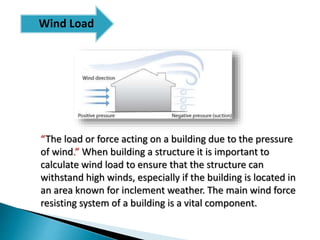
“The load or force acting on a building due to the pressure
of wind.” When building a structure it is important to
calculate wind load to ensure that the structure can
withstand high winds, especially if the building is located in
an area known for inclement weather. The main wind force
resisting system of a building is a vital component.
5
•Selecting The Proper Method Of Evaluation
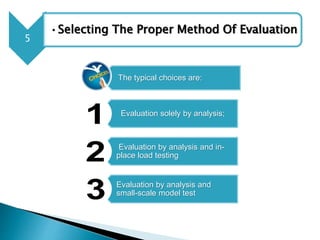
The typical choices are:
Evaluation solely by analysis;
Evaluation by analysis and in-
place load testing
Evaluation by analysis and
small-scale model test
5.1
•Evaluation solely by analysis
Evaluation solely by analysis is recommended where:
 Load testing is impractical or unsafe for the load and testing
arrangements required for the test.
 Members are suspected of being suddenly fail. A load test
in such a case would endanger the safety of the structure and
those persons conducting the test. Failure by compression is
usually sudden.
 Sufficient information is available, or obtainable by field
investigation, about the physical characteristics and material
properties.
5.2
•Evaluation by analysis and in-place load testing
Evaluation by analysis and in-place load testing is
recommended in the following cases:
• The complexity of the design concept and lack of
experience with the types of structural elements present make
evaluation solely by analytical methods impractical or
uncertain;
• The loading and material characteristics of the structural
element(s) cannot be readily determined;
• The existing distress introduces significant uncertainties into
the parameters necessary to perform an analytical evaluation;
• Where there is doubt concerning adequacy of structural
elements for new loading that exceeds the allowable stresses
calculated using the original design.
• Evaluation by analysis and Small-scale models
5.3
Evaluation by analysis and small-scale models.
•In the past, the construction and testing of small-
scale models provided a feasible alternative to
conducting a full-scale load test.
• Modern computational techniques have essentially
replaced load testing of small-scale models.
•Presently, load tests on small-scale models are
rarely performed by practicing engineers and are
used primarily in research environments.
Strength evaluation of existing structures

Strength evaluation of existing structures

  • 2.
  • 3.
    Strength Evaluation ofExisting Structures Presentation Group 2 Shahrukh Niaz 17 Taimoor Shaheen 18 Hasnian Manzoor 16 Ahsan Javed 14 Muhammad Ansar 10 Muhammad Arshad 12 Muhammad Salman 15 Qasib Ali 13
  • 4.
    1 • Introduction 2 • Investigation 3 •Methods for material evaluation 4 • Assessment Of Loading Conditions And Selection Of Evaluation Method 5 • Selecting The Proper Method Of Evaluation
  • 5.
    What is Evaluation? The making of a judgement about the amount, number, or value of something; assessment.  The main objective of the evaluation, in addition to having an overview of past or existing initiatives, is to allow for reflection and help identify future changes. 1 •Introduction
  • 6.
     There area number of different characteristics of an existing concrete structure that can be evaluated. These include:  Stability of the entire structure  Stability of individual components of the structure  Strength and safety of individual structural element  Stiffness of the entire structure  Stiffness of individual structural elements  Dynamic response of individual structural elements  Durability of the structure  Fire resistance of the structure 1.1 •Categories of evaluation
  • 7.
     Defining theexisting condition of the building, including:  Reviewing available information of the building  Conducting a condition survey of the building  Determining the cause and rate of progression of existing distress  Determining the degree of repair to precede the evaluation  Selecting the structural elements For detailed evaluation  Assessing the load  Evaluating the results 1.2 •Procedure for a structural evaluation
  • 8.
    2 •THE PRELIMINARY INVESTIGATION Reviewof existing information Condition survey of the building
  • 9.
    2.1 •Review of existinginformation All sources of existing information concerning the design, map and construction. should be researched to learn as much as possible about the structure.
  • 10.
    It is intendedas a guide only. It should be recognized that each source need not be consulted in a strength evaluation. Following are some sources of existing information: Structural design calculations Construction materials Field inspection reports Contractor and subcontractor diaries Job progress photographs compressive strength test reports Field slump test reports Maintenance records
  • 11.
    2.2 •Condition survey ofthe building A fundamental knowledge of the basic characteristics of structural concrete and the types of deformation and defects that may be observed in a concrete building is essential for successful performance of a strength evaluation. Abnormalities All forms and areas of deformations and defects existing in the structural elements of the building should be located, inspected and recorded as to type, location, and other degrees.
  • 12.
    A number oftest methods are available for estimating the in-place concrete strength or for locating areas of low strength concrete. These have been traditionally referred to as “nondestructive tests” to contrast them with the drilling and testing of core samples. A more descriptive term for these tests is “in-place tests” because they are performed on concrete as it exists in a structure. Survey methods for evaluation of structural concrete In-place test
  • 13.
  • 14.
    Explanation: The test instrumentconsists of a metal housing, a spring-loaded mass (the hammer) and a steel rod (the plunger). To perform a test, the plunger is placed perpendicular to the concrete surface and the housing is pushed toward the concrete. This action causes the extension of a spring connected to the hammer. When the instrument is pushed to its limit, the hammer is propelled toward the concrete and it impacts a shoulder on the plunger. The hammer rebounds, and the rebound distance is measured on a scale numbered from 10 to 100. The rebound distance is recorded as the “rebound number” indicated on the scale. The greater the amount of absorbed energy by concrete, the lower the rebound number. A test performed directly above a hard particle of coarse aggregate results in a higher rebound number than a test over mortar. Rebound hammer
  • 15.
  • 16.
    Explanation In this test,the strength and quality of concrete is assessed by measuring the velocity of an ultrasonic pulse passing through a concrete structure.The test equipment includes a transmitter, a receiver, and electronic instrumentation. The test consists of measuring the time it takes for a pulse of vibrational energy to travel through a concrete member. The vibrational energy is introduced into the concrete by the transmitter, detected by the receivier. The distance between them is divided by the transit time to obtain the pulse velocity through the concrete under test.  Greater the velocity more will be the Strength.  An increase in moisture content increases the pulse velocity and this could be incorrectly interpreted as an increase in compressive strength.  The presence of reinforcing steel aligned with the pulse travel path can also significantly increase pulse velocity.  Cracking and Honeycombing can also be detected by this method.
  • 17.
    Sounding Test Hollow areasbelow the concrete surface can be detected by striking the surface with a hammer or a steel bar. A “hollow” or “drum-like” sound results when the surface over a defective area is struck, compared with a “ringing” noise over sound concrete. For slabs, a heavy steel chain can be dragged over the concrete surface. Sounding is a simple and effective method for locating regions with subsurface fracture planes. However, the sensitivity and reliability of the method decreases as the depth of the defect increases.
  • 18.
    3 •Methods for materialevaluation Concrete Reinforcing steel
  • 19.
    Sampling techniques andtests of concrete are available to assess the mechanical properties and Strength of concrete and steel. Techniques for proper sampling of concrete Samples are retrieved to determined strength as well as physical and chemical properties. It is essential that samples be obtained, handled, stored and identified in a proper way of prevent damage or contamination.  Methods of testing:  Rebound Hammer  Pulse Velocity Test  Sounding Test 3.1 •Concrete
  • 20.
    3.2 •Reinforcing steel Locational surveymethod: The size, number and location of steel bars can be determined by following methods •Magnetic test •Radiographic evaluation Magnetic test •Magnetic instrument for location of steel bars in concrete are based on the fact that presence of steel affects alternating magnetic field produced by a hand-held search unit.
  • 21.
    Magnetic test  Aswe move unit directly along the concrete surface meter indication is seen.  These meters can be used to estimate the depth of steel bar if its size is known or estimate the bar size if depth of cover is known.  Magnetic tests are limited whithin 7inch of exposed concrete surface.  This method may not be used in heavy reinforced sections.
  • 22.
    Radiographic evaluation Radiography maybe used to determine size, position and configuration of reinforcing steel.  X-ray inspection is used in locating post-tentioning stands in concrete slabs. Gamma rays may be used upto 18inch thick and as a field test method because of its portability.
  • 23.
  • 24.
    4 •Assessment of loadingand environmental conditions Dead load Live Load Seismic load Wind load Loads Soil Pressure Thermal effects Fire shrinkage Environmental Conditions
  • 25.
    Dead load “The weightof a structure and anything attached to it” All permanent components of a building including walls, Beam, columns, flooring material etc Fixed permanent equipment and fitting that are an integral part of the structure.(like plumbing, HVAC, etc.)
  • 26.
    Live load “The weightof people or goods in a building.” When the deflection in concrete structure becomes constants under applied dead load then live load is applied. After dead load deflection have stabilized, exiting cracks observed and marked. The portion of the structure selecting for loading should be subjected to a total test load TL included all the dead loads already acting equivalent to the following. TL = 0.85(1.4D+1.7L) D=DEAD LOAD L=LIVE LOADS
  • 27.
    Seismic load isone of the basic concepts of earthquake engineering which means application of an earthquake-generated disturbance to a building structure or its model. It happens at contact surfaces of a structure either with the ground, or with adjacent structures, or with gravity waves from tsunami. Seismic Load
  • 28.
    Wind Load “The loador force acting on a building due to the pressure of wind.” When building a structure it is important to calculate wind load to ensure that the structure can withstand high winds, especially if the building is located in an area known for inclement weather. The main wind force resisting system of a building is a vital component.
  • 29.
    5 •Selecting The ProperMethod Of Evaluation The typical choices are: Evaluation solely by analysis; Evaluation by analysis and in- place load testing Evaluation by analysis and small-scale model test
  • 30.
    5.1 •Evaluation solely byanalysis Evaluation solely by analysis is recommended where:  Load testing is impractical or unsafe for the load and testing arrangements required for the test.  Members are suspected of being suddenly fail. A load test in such a case would endanger the safety of the structure and those persons conducting the test. Failure by compression is usually sudden.  Sufficient information is available, or obtainable by field investigation, about the physical characteristics and material properties.
  • 31.
    5.2 •Evaluation by analysisand in-place load testing Evaluation by analysis and in-place load testing is recommended in the following cases: • The complexity of the design concept and lack of experience with the types of structural elements present make evaluation solely by analytical methods impractical or uncertain; • The loading and material characteristics of the structural element(s) cannot be readily determined; • The existing distress introduces significant uncertainties into the parameters necessary to perform an analytical evaluation; • Where there is doubt concerning adequacy of structural elements for new loading that exceeds the allowable stresses calculated using the original design.
  • 32.
    • Evaluation byanalysis and Small-scale models 5.3 Evaluation by analysis and small-scale models. •In the past, the construction and testing of small- scale models provided a feasible alternative to conducting a full-scale load test. • Modern computational techniques have essentially replaced load testing of small-scale models. •Presently, load tests on small-scale models are rarely performed by practicing engineers and are used primarily in research environments.