By Jill Costley
The Clean
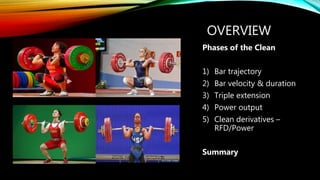
OVERVIEW
Phases of the Clean
1) Bar trajectory
2) Bar velocity & duration
3) Triple extension
4) Power output
5) Clean derivatives –
RFD/Power
Summary
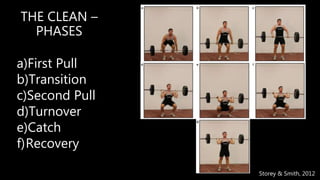
THE CLEAN –
PHASES
a)First Pull
b)Transition
c)Second Pull
d)Turnover
e)Catch
f)Recovery
Storey & Smith, 2012
BAR TRAJECTORY
Garhammer, 1985; Winchester et al., 2005; Storey & Smith, 2012
Vertical Displacement
 skill level and anthropometry dependent
 ~55–65% of the lifter’s height
Horizontal Displacement
 Towards – away – towards
 Limit horizontal bar displacement
1984 Olympic Games: Male Gold Medallists
Initial towards: 3 to 7cm
Away position 1 to -9cm
Latter towards: 8 to -6cm
97.7kg lifter – 217.5kg clean: 4, -4, 2
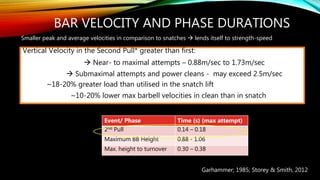
BAR VELOCITY AND PHASE DURATIONS
Vertical Velocity in the Second Pull* greater than first:
 Near- to maximal attempts – 0.88m/sec to 1.73m/sec
 Submaximal attempts and power cleans - may exceed 2.5m/sec
~18-20% greater load than utilised in the snatch lift
~10-20% lower max barbell velocities in clean than in snatch
Garhammer; 1985; Storey & Smith, 2012
Event/ Phase Time (s) (max attempt)
2nd Pull 0.14 – 0.18
Maximum BB Height 0.88 - 1.06
Max. height to turnover 0.30 – 0.38
Smaller peak and average velocities in comparison to snatches  lends itself to strength-speed
TRIPLE EXTENSION
• Hip, knee, ankle extension at the end of pulling
phase
• Similar action of many sporting actions e.g. shot
put, driving out of starting blocks
Weyand, 2000; Young et al., 2001; Souza et al., 2002; Hori et al.,2008; Frounfelter, 2009
Relative 1RM hang power clean (Hori et
al., 2008)
- CMJ peak power output (relative to
BW)*, 40kg CMJ peak power output
(relative to BW)* & CMJ height* (r = 0.58, r
= 0.60 & r = 0.51 respectively)
- 20m sprint speed* (r=-0.57)
 Sprint performance highly
influenced by ability to
produce high vertical GRF
Garhammer, 1991
1978 World Championships
• Snatch – Males
Pull average: 34.4 +/- 2.5 W/kg
Second Pull: 52.7 +/- 4.5 W/kg
• Clean – Males
Pull average: 34.2 +/- 3.6 W/kg
Second Pull: 52.5 +/- 8.9 W/kg
1987 World Championships
• Snatch – Women
Pull average:22.5 +/- 1.7 W/kg
Second Pull: 40.1 +/- 5.0 W/kg
• Clean – Women
Pull average: 21.0 +/- 1.8 W/kg
Second Pull: 38.2 +/- 3.3W/kg
 2nd pull average power
output: 3691W (45.12W/kg)
(1.53 times BW)
POWER
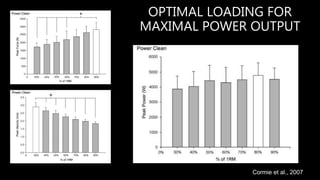
OPTIMAL LOADING FOR
MAXIMAL POWER OUTPUT
Cormie et al., 2007
Comfort et al., 2011
CLEAN DERIVATIVES
RFD/ POWER
**@60% 1RM**
SUMMARY
• Towards – Away- Towards
Limit horizontal component
• Triple extension is a fundamental movement of many sports and is carried out
within the clean
• There is a correlation between 1RM clean and sprint and jump ability
• Power output of the second pull is greater than any other phase within the clean
• The load that elicits maximal power output within the clean is approximately 80%
• Clean derivatives can change the characteristics of the exercise
REFERENCES
• Comfort, P., Allen, M., & Graham-Smith, P. (2011). Comparisons of peak ground reaction force and rate of force development during variations
of the power clean. The Journal of Strength & Conditioning Research, 25(5), 1235-1239.
• Cormie, P., McCaulley, G. O., Triplett, N. T., & McBride, J. M. (2007). Optimal loading for maximal power output during lower-body resistance
exercises. Medicine and Science In Sports and Exercise, 39(2), 340.
• Frounfelter, G. (2009). Triple extension: The key to athletic power. NSCA Performance Journal, 8, 14-15.
• Garhammer, J. (1985). Biomechanical profiles of Olympic weightlifters. International Journal of Sport Biomechanics, 1(2), 122-130.
• Garhammer, J. (1991). A comparison of maximal power outputs between elite male and female weightlifters in competition. International Journal
of Sport Biomechanics, 7, 3-11.
• Hori, N., Newton, R. U., Andrews, W. A., Kawamori, N., McGuigan, M. R., & Nosaka, K. (2008). Does performance of hang power clean
differentiate performance of jumping, sprinting, and changing of direction?. The Journal of Strength & Conditioning Research, 22(2), 412-418.
• Souza, A. L., Shimada, S. D., & Koontz, A. (2002). Ground reaction forces during the power clean. The Journal of Strength & Conditioning
Research, 16(3), 423-427.
• Storey, A., & Smith, H. K. (2012). Unique aspects of competitive weightlifting. Sports Medicine, 42(9), 769-790.
• Weyand, P. G., Sternlight, D. B., Bellizzi, M. J., & Wright, S. (2000). Faster top running speeds are achieved with greater ground forces not more
rapid leg movements. Journal of Applied Physiology, 89(5), 1991-1999.
• Winchester, J. B., Erickson, T. M., Blaak, J. B., & McBride, J. M. (2005). Changes in bar-path kinematics and kinetics after power-clean training. The
Journal of Strength & Conditioning Research, 19(1), 177-183.
• Young, W., Benton, D., & John Pryor, M. (2001). Resistance training for short sprints and maximum-speed sprints. Strength & Conditioning
Journal, 23(2), 7.
THANKS FOR LISTENING

Olympic Weightlifting - the Clean

  • 1.
  • 2.
    OVERVIEW Phases of theClean 1) Bar trajectory 2) Bar velocity & duration 3) Triple extension 4) Power output 5) Clean derivatives – RFD/Power Summary
  • 3.
    THE CLEAN – PHASES a)FirstPull b)Transition c)Second Pull d)Turnover e)Catch f)Recovery Storey & Smith, 2012
  • 4.
    BAR TRAJECTORY Garhammer, 1985;Winchester et al., 2005; Storey & Smith, 2012 Vertical Displacement  skill level and anthropometry dependent  ~55–65% of the lifter’s height Horizontal Displacement  Towards – away – towards  Limit horizontal bar displacement 1984 Olympic Games: Male Gold Medallists Initial towards: 3 to 7cm Away position 1 to -9cm Latter towards: 8 to -6cm 97.7kg lifter – 217.5kg clean: 4, -4, 2
  • 5.
    BAR VELOCITY ANDPHASE DURATIONS Vertical Velocity in the Second Pull* greater than first:  Near- to maximal attempts – 0.88m/sec to 1.73m/sec  Submaximal attempts and power cleans - may exceed 2.5m/sec ~18-20% greater load than utilised in the snatch lift ~10-20% lower max barbell velocities in clean than in snatch Garhammer; 1985; Storey & Smith, 2012 Event/ Phase Time (s) (max attempt) 2nd Pull 0.14 – 0.18 Maximum BB Height 0.88 - 1.06 Max. height to turnover 0.30 – 0.38 Smaller peak and average velocities in comparison to snatches  lends itself to strength-speed
  • 6.
    TRIPLE EXTENSION • Hip,knee, ankle extension at the end of pulling phase • Similar action of many sporting actions e.g. shot put, driving out of starting blocks Weyand, 2000; Young et al., 2001; Souza et al., 2002; Hori et al.,2008; Frounfelter, 2009 Relative 1RM hang power clean (Hori et al., 2008) - CMJ peak power output (relative to BW)*, 40kg CMJ peak power output (relative to BW)* & CMJ height* (r = 0.58, r = 0.60 & r = 0.51 respectively) - 20m sprint speed* (r=-0.57)  Sprint performance highly influenced by ability to produce high vertical GRF
  • 7.
    Garhammer, 1991 1978 WorldChampionships • Snatch – Males Pull average: 34.4 +/- 2.5 W/kg Second Pull: 52.7 +/- 4.5 W/kg • Clean – Males Pull average: 34.2 +/- 3.6 W/kg Second Pull: 52.5 +/- 8.9 W/kg 1987 World Championships • Snatch – Women Pull average:22.5 +/- 1.7 W/kg Second Pull: 40.1 +/- 5.0 W/kg • Clean – Women Pull average: 21.0 +/- 1.8 W/kg Second Pull: 38.2 +/- 3.3W/kg  2nd pull average power output: 3691W (45.12W/kg) (1.53 times BW) POWER
  • 8.
    OPTIMAL LOADING FOR MAXIMALPOWER OUTPUT Cormie et al., 2007
  • 9.
    Comfort et al.,2011 CLEAN DERIVATIVES RFD/ POWER **@60% 1RM**
  • 10.
    SUMMARY • Towards –Away- Towards Limit horizontal component • Triple extension is a fundamental movement of many sports and is carried out within the clean • There is a correlation between 1RM clean and sprint and jump ability • Power output of the second pull is greater than any other phase within the clean • The load that elicits maximal power output within the clean is approximately 80% • Clean derivatives can change the characteristics of the exercise
  • 11.
    REFERENCES • Comfort, P.,Allen, M., & Graham-Smith, P. (2011). Comparisons of peak ground reaction force and rate of force development during variations of the power clean. The Journal of Strength & Conditioning Research, 25(5), 1235-1239. • Cormie, P., McCaulley, G. O., Triplett, N. T., & McBride, J. M. (2007). Optimal loading for maximal power output during lower-body resistance exercises. Medicine and Science In Sports and Exercise, 39(2), 340. • Frounfelter, G. (2009). Triple extension: The key to athletic power. NSCA Performance Journal, 8, 14-15. • Garhammer, J. (1985). Biomechanical profiles of Olympic weightlifters. International Journal of Sport Biomechanics, 1(2), 122-130. • Garhammer, J. (1991). A comparison of maximal power outputs between elite male and female weightlifters in competition. International Journal of Sport Biomechanics, 7, 3-11. • Hori, N., Newton, R. U., Andrews, W. A., Kawamori, N., McGuigan, M. R., & Nosaka, K. (2008). Does performance of hang power clean differentiate performance of jumping, sprinting, and changing of direction?. The Journal of Strength & Conditioning Research, 22(2), 412-418. • Souza, A. L., Shimada, S. D., & Koontz, A. (2002). Ground reaction forces during the power clean. The Journal of Strength & Conditioning Research, 16(3), 423-427. • Storey, A., & Smith, H. K. (2012). Unique aspects of competitive weightlifting. Sports Medicine, 42(9), 769-790. • Weyand, P. G., Sternlight, D. B., Bellizzi, M. J., & Wright, S. (2000). Faster top running speeds are achieved with greater ground forces not more rapid leg movements. Journal of Applied Physiology, 89(5), 1991-1999. • Winchester, J. B., Erickson, T. M., Blaak, J. B., & McBride, J. M. (2005). Changes in bar-path kinematics and kinetics after power-clean training. The Journal of Strength & Conditioning Research, 19(1), 177-183. • Young, W., Benton, D., & John Pryor, M. (2001). Resistance training for short sprints and maximum-speed sprints. Strength & Conditioning Journal, 23(2), 7.
  • 12.