Training Design and
Periodization
The Link Between Planning and Preparedness
WILLIAM A. SANDS, PHD, FACSM
“In a crisis, you don’t rise to the
occasion.
You sink to the level of your
training.”
John Rennie, Scientific American, 2000, 283(3), p 6.
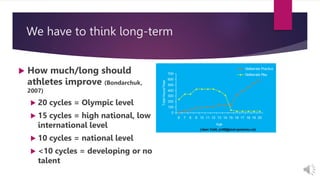
We have to think long-term
 How much/long should
athletes improve (Bondarchuk,
2007)
 20 cycles = Olympic level
 15 cycles = high national, low
international level
 10 cycles = national level
 <10 cycles = developing or no
talent
0
100
200
300
400
500
600
700
6 7 8 9 10 11 12 13 14 15 16 17 18 19 20
Age
Total
Hours/Year
Deliberate Practice
Deliberate Play
(Jean Coté, jc46@post.queensu.ca)
We want to
predict and
thereby control
the future
“IT’S HARD TO MAKE
PREDICTIONS, ESPECIALLY
ABOUT THE FUTURE.”
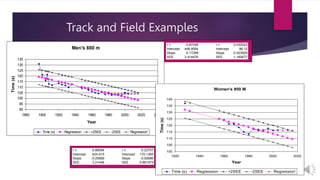
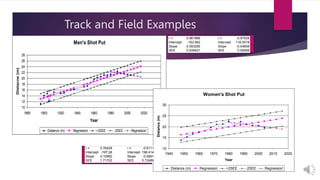
Track and Field Examples
Men's 800 m
90
95
100
105
110
115
120
125
130
135
1880 1900 1920 1940 1960 1980 2000 2020 2040
Year
Time
(s)
Time (s) Regression +2SEE -2SEE Regression'
r = -0.87258 r = 0.032022
Intercept 446.9054 Intercept 96.12
Slope -0.17288 Slope 0.003929
SEE 3.414476 SEE 1.160677
Women's 800 M
100
105
110
115
120
125
130
135
140
1920 1940 1960 1980 2000 2020
Year
Time
(s)
Time (s) Regression +2SEE -2SEE Regression'
r = -0.86094 r = -0.22757
Intercept 624.915 Intercept 170.1365
Slope -0.25569 Slope -0.02686
SEE 3.21448 SEE 0.961479
Track and Field Examples
Men's Shot Put
10
12
14
16
18
20
22
24
26
28
1880 1900 1920 1940 1960 1980 2000 2020 2040
Year
Distacne
(m)
Distance (m) Regression +2SEE -2SEE Regression'
r = 0.961888 r = -0.97529
Intercept -163.982 Intercept 118.5018
Slope 0.093285 Slope -0.04858
SEE 0.935621 SEE 0.06959
Women's Shot Put
10
15
20
25
30
1940 1950 1960 1970 1980 1990 2000 2010 2020
Year
Distance
(m)
Distance (m) Regression +2SEE -2SEE Regression'
r = 0.76428 r = -0.6111
Intercept -197.28 Intercept 198.414
Slope 0.10962 Slope -0.0891
SEE 1.71702 SEE 0.72489
Enter …
Periodization
Periodization
Developed by Eastern Europeans
Important structural approach to athlete development
Can you win simply because you have a better plan?
Plans usually don’t survive the first contact with the enemy,
but the military still plans in order to prepare for all
contingencies
Why Periodization?
Training is complicated
 Just do it!!! (Nike advertisement)
Just do what?
Why Periodization?
 Organized vs unorganized
 Simple linear increases don’t work.
 All training activities suffer “wear.”
 Acquisition and decay of fitness
 Individual differences exist
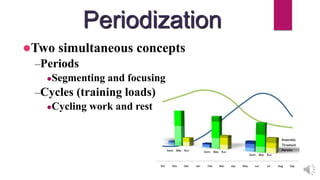
Periodization
Two simultaneous concepts
–Periods
Segmenting and focusing
–Cycles (training loads)
Cycling work and rest
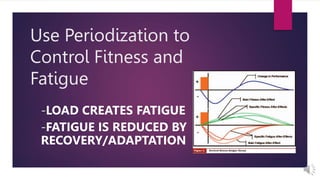
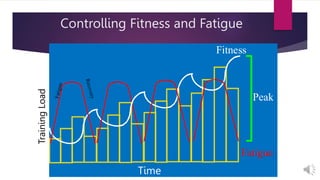
Use Periodization to
Control Fitness and
Fatigue
-LOAD CREATES FATIGUE
-FATIGUE IS REDUCED BY
RECOVERY/ADAPTATION
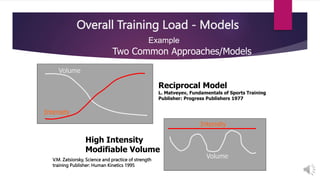
Overall Training Load - Models
Two Common Approaches/Models
Reciprocal Model
L. Matveyev, Fundamentals of Sports Training
Publisher: Progress Publishers 1977
Volume
Intensity
High Intensity
Modifiable Volume
Example
Volume
Intensity
V.M. Zatsiorsky, Science and practice of strength
training Publisher: Human Kinetics 1995
So, what’s this stuff
based on?
A small detour for clarity…
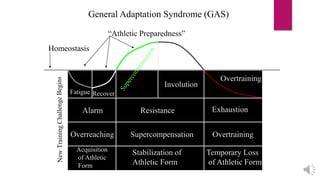
General Adaptation Syndrome
Hans Selye
His contributions are important
However, they’ve been
oversimplified and misapplied.
He knew there were problems with
his theory of GAS
Hans Selye
 General Adaptation Syndrome (GAS)
 Ranges from alertness to fatigue
 Extended periods of stress
 Adrenocortical hypertrophy
 Thymicolymphatic involution
 Gastrointestinal ulceration and weight loss
 Importance of inflammatory and immune response for adaptation
 Most important for short-term viability
 Long-term inflammatory and immune response ->
 Range of disease states, Nervous tics, Sleep disturbances, Feeding abnormalities, GI
disturbances, Migraine headaches, Hypertension, Chronic worry
 Knew that “homeostasis” was inadequate – “heterostasis”
 Predictive homeostasis
Hans Selye – what happened?
Allostasis New/Better
Paradigm
Allostatic Mechanisms
 “Allostatic mechanisms involve the organismic control of
many variables, some of which are in conflict and which
may lead to allostatic load. Allostatic mechanisms compute
tradeoffs among variables, computing many factors at
once. These include many hormonal signals, which are in
conflict with one another. Allostasis reflects stability
through change, central coordinated effects and
anticipatory responses.”
 "On the other hand, when measurements of the internal
milieu are made in an intact, unanaesthetized organism,
the results fit the homeostatic model very poorly." p 631
 Sterling, P., & Eyer, J. (1988). Allostasis: A new paradigm to explain arousal pathology. In S. Fisher & J. Reason (Eds.),
Handbook of Life Stress Cognition and Health (pp. 629-649). New York, NY: John-Wiley & Sons.
More about
allostasis later…
Training is a Gold-I-Locks Problem
Optimization
General Adaptation Syndrome (GAS)
Homeostasis
Alarm Resistance Exhaustion
Overreaching Supercompensation Overtraining
Acquisition
of Athletic
Form
Stabilization of
Athletic Form
Temporary Loss
of Athletic Form
Fatigue Recover
Overtraining
“Athletic Preparedness”
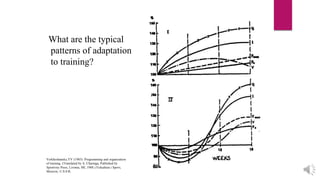
What are the typical
patterns of adaptation
to training?
Verkhoshansky,YV (1985): Programming and organization
of training. (Translated by A. Charniga, Published by

Sportivny Press, Livonia, MI, 1988.) Fizkultura i Spovt,
Moscow, U.S.S.R.
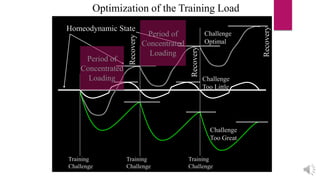
Optimization of the Training Load
Training
Challenge
Training
Challenge
Training
Challenge
Homeodynamic State
Challenge
Optimal
Challenge
Too Great
Challenge
Too Little
Period of
Concentrated
Loading
Period of
Concentrated
Loading
Recovery
Recovery
Recovery
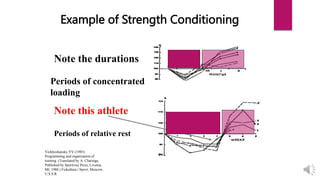
Note the durations
Note this athlete
Periods of concentrated
loading
Example of Strength Conditioning
Periods of relative rest
Verkhoshansky,YV (1985):
Programming and organization of
training. (Translated by A. Charniga,

Published by Sportivny Press, Livonia,
MI, 1988.) Fizkultura i Spovt, Moscow,
U.S.S.R.
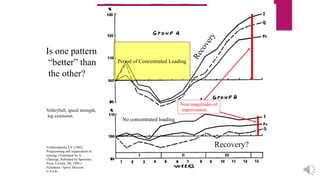
Is one pattern
“better” than
the other?
Verkhoshansky,YV (1985):
Programming and organization of
training. (Translated by A.
Charniga, Published by Sportivny
Press, Livonia, MI, 1988.)
Fizkultura i Spovt, Moscow,
U.S.S.R.
Volleyball, speed strength,
leg extension.
Period of Concentrated Loading
No concentrated loading
Note magnitudes of
improvement.
Recovery?
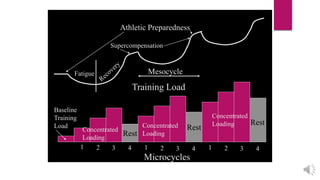
Rest
Rest
Fatigue
Supercompensation
Baseline
Training
Load
1 2 3 4 1 2 3 4
1 2 3 4
Microcycles
Athletic Preparedness
Training Load
Concentrated
Loading
Concentrated
Loading
Concentrated
Loading Rest
Mesocycle
Controlling Fitness and Fatigue
Fitness
Fatigue
Training Load
Peak
Time
Training
Load
Back to Planning
HOW DO YOU APPLY THIS INFORMATION?
Summated Microcycles:
4 Mesocycles – 16 Weeks
0
2000
4000
6000
8000
10000
12000
14000
16000
18000
BLOCK1 BLOCK2 BLOCK3 BLOCK4
WK1
WK2
WK3
WK4
Volume
Load
Performance
Fatigue
Traditional: General Preparation Period
Emphasizing Strength Gains – Early Phases of Plan
Recovery
Recovery
Recovery
Recovery
Dr. Mike Stone
Recovery
Summated Microcycles:
4 Mesocycles – 16 Weeks
0
2000
4000
6000
8000
10000
12000
14000
16000
18000
BLOCK1 BLOCK2 BLOCK3 BLOCK4
WK1
WK2
WK3
WK4
Volume
Load
Fatigue
Performance
Following Maximum Strength Phase
Used to Focus Training to Power and Speed
Relatively
New
Dr. Mike Stone
0
500
1000
1500
2000
2500
3000
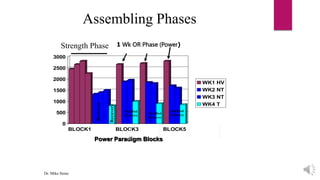
BLOCK1 BLOCK3 BLOCK5
WK1 HV
WK2 NT
WK3 NT
WK4 T
1 Wk OR Phase (Power)
Power Paradigm Blocks
Strength Phase
Assembling Phases
Recovery
Recovery
Recovery
Recovery
Recovery
Recovery
Modified
Recovery
Modified
Recovery
Modified
Recovery
Dr. Mike Stone
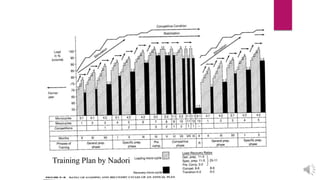
Training Plan by Nadori
THEORETICAL RATIONALE FOR USING 4 WEEK BLOCKS
(4 WK SUMMATED MICROCYCLES)
Matveyev (In Kukushkin 1983) suggests the existence of natural monthly
biocycles as a rationale for constructing training cycles that are
approximately 1-month (4 wks) in duration, each consisting of 3-6
subcycles of approximately 1-week duration, in order to exploit cumulative
training effects
Viru (1995) cites the half-life of training effect involution as the rationale
for a 24-28 day cyclic training structure consisting of 4-6 subcycles, each 4-
7 days in duration, in order to summate their training effects
Zatsiorsky (1995) cites the need to structure training cycles around a 4
[±2] week window in order to superimpose the delayed training effects of
distinct targets distributed over that time
OBSERVATIONAL/EXPERIENTIAL DATA
Dr. Mike Stone
1. Haff GG, Hobbs RT, Haff EE, W.A. S, Pierce KC, and Stone MH. Cluster training: a novel method for introducing training program variation. Strength Cond J 30: 67-76, 2008.
2. Henschen KP, Sands WA, and Shultz BB. Psychological demands of women's training. Technique 9: 4-6, 1989.
3. Jemni M and Sands WA. Training principles in gymnastics, in: The Science of Gymnastics. M Jemni, ed. London, UK: Routledge, 2011, pp 26-31.
4. McNeal JR and Sands WA. Managing training time. Technique 22(6): 12-13, 2002.
5. Painter KB, Haff GG, M.W. R, McBride J, Triplett T, Sands WA, H.S. L, Stone ME, and Stone MH. Strength gains: Block vs DUP weight-training among track and field athletes. International Journal of Sport
Physiology and Performance 7: 161-169, 2012.
6. Sands B. Plyometrics. Gymnastics Safety Update 3: 3-4, 1988.
7. Sands WA. Planning for international gymnastics competition: When the perfect plan may not be the best plan. US Elite Coaches Association for Women's Gymnastics Newsletter: 1-10, 1988.
8. Sands WA. National women's tracking program pt. 2 - response. Technique 10: 23-27, 1990.
9. Sands WA. Monitoring elite gymnastics athletes via rule based computer systems, in: Masters of Innovation III. Northbrook, IL: Zenith Data Systems, 1991, p 92.
10. Sands WA. Monitoring the elite female gymnast. Nat Strength Cond Assoc J 13: 66-71, 1991.
11. Sands WA. AI and athletics. PC AI 6: 52-54, 1992.
12. Sands WA. Periodization and planning of training. American Ski Coach 15: 9-17, 1992.
13. Sands WA. Periodization: What is periodization, Part 2. Ironman 53(8): 92-93, 1994.
14. Sands WA. Periodization: What is periodization? Ironman 53(7): 122-123, 1994.
15. Sands WA. Periodization: How can you tell if a training program is good? Ironman 55(4): 174-176, 1996.
16. Sands WA. A prescription for bodybuilding. Ironman 55(5): 119,122, 1996.
17. Sands WA. The training lesson. Inside USA Diving 4: 10-11, 1996.
18. Sands WA. Mesocycle planning. Inside USA Diving 4: 6,25, 1997.
19. Sands WA. Planning the microcycle. Inside USA Diving 4: 10-11, 1997.
20. Sands WA. A look at training models. Technique 19(9): 6-8, 1999.
21. Sands WA. The week before. Technique 19(9): 10-13, 1999.
22. Sands WA. Training - definitions, objectives, tasks, and principles, in: USA Diving Coach Development Reference Manual. RM Malina, JL Gabriel, eds. Indianapolis, IN: USA Diving, 2007, pp 77-93.
23. Sands WA. Fitness model of high level gymnasts, in: The Science of Gymnastics. M Jemni, ed. Abingdon Oxon, UK: Routledge, 2017, pp 45-48.
24. Sands WA, Henschen KP, and Shultz BB. National women's tracking program. Technique 9: 14-19, 1989.
25. Sands WA, Irvin RC, and Major JA. What the sport scientist can really tell about your percent fat and an alternative method for assessing body composition, in: 1992 USGF Sport Science Congress Proceedings. JL
McNitt-Gray, R Girandola, J Callaghan, eds. Indianapolis, IN: USGF Publications, 1992, pp 54-62.
26. Sands WA, Irvin RC, and Major JA. Women's gymnastics: The time course of fitness acquisition. A 1-year study. J Strength Cond Res 9: 110-115, 1995.
27. Sands WA, Major J, Irvin R, Lemons P, and Abramowitz R. Conditioning programs, U.S. elite gymnastics. Technique 11: 12-14, 1991.
28. Sands WA and McNeal JR. Predicting athlete preparation and performance: A theoretical perspective. J Sport Behav 23: 1-22, 2000.
29. Sands WA and McNeal JR. Introduction to gymnastics coaching theory. Indianapolis, IN: USA Gymnastics, 2001.
30. Sands WA, Newman AP, Harner C, Paulos LE, and Shultz BB. Two year study of injury in collegiate women's gymnastics. Technique 7: 4-10, 1987.
31. Sands WA, Wurth JJ, and Hewit JK. The National Strength and Conditioning Association’s (NSCA) Basics of Strength and Conditioning Manual. Colorado Springs, CO: National Strength and Conditioning
Association, 2012.
32. Stone MH, Pierce KC, Sands WA, and Stone ME. Weightlifting: A brief overview. Strength and Conditioning Journal 28: 50-66, 2006.
33. Stone MH, Pierce KP, Sands WA, and Stone ME. Weightlifting: Program design. Strength and Conditioning Journal 28: 10-17, 2006.
34. Stone MH, Stone M, and Sands WA. Cycling your periodization plan. Olympic Coach 20: 12-15, 2008.
35. Stone MH, Stone ME, and Sands WA. Monitoring resistance training, in: Principles and Practice of Resistance Training. Champaign, IL: Human Kinetics, 2007, pp 181-199.
36. Stone MH, Stone ME, and Sands WA. Principles and Practice of Resistance Training. Champaign, IL: Human Kinetics, 2007.
37. Travis SK, Mizuguchi S, Stone MH, Sands WA, and Bazyler CD. Preparing for a National Weightlifting Championship: A Case Series. J Strength Cond Res, 2019.
I’ve written a little on periodization and planning

Periodization and Planning.pptx

  • 2.
    Training Design and Periodization TheLink Between Planning and Preparedness WILLIAM A. SANDS, PHD, FACSM
  • 3.
    “In a crisis,you don’t rise to the occasion. You sink to the level of your training.” John Rennie, Scientific American, 2000, 283(3), p 6.
  • 4.
    We have tothink long-term  How much/long should athletes improve (Bondarchuk, 2007)  20 cycles = Olympic level  15 cycles = high national, low international level  10 cycles = national level  <10 cycles = developing or no talent 0 100 200 300 400 500 600 700 6 7 8 9 10 11 12 13 14 15 16 17 18 19 20 Age Total Hours/Year Deliberate Practice Deliberate Play (Jean Coté, jc46@post.queensu.ca)
  • 5.
    We want to predictand thereby control the future “IT’S HARD TO MAKE PREDICTIONS, ESPECIALLY ABOUT THE FUTURE.”
  • 6.
    Track and FieldExamples Men's 800 m 90 95 100 105 110 115 120 125 130 135 1880 1900 1920 1940 1960 1980 2000 2020 2040 Year Time (s) Time (s) Regression +2SEE -2SEE Regression' r = -0.87258 r = 0.032022 Intercept 446.9054 Intercept 96.12 Slope -0.17288 Slope 0.003929 SEE 3.414476 SEE 1.160677 Women's 800 M 100 105 110 115 120 125 130 135 140 1920 1940 1960 1980 2000 2020 Year Time (s) Time (s) Regression +2SEE -2SEE Regression' r = -0.86094 r = -0.22757 Intercept 624.915 Intercept 170.1365 Slope -0.25569 Slope -0.02686 SEE 3.21448 SEE 0.961479
  • 7.
    Track and FieldExamples Men's Shot Put 10 12 14 16 18 20 22 24 26 28 1880 1900 1920 1940 1960 1980 2000 2020 2040 Year Distacne (m) Distance (m) Regression +2SEE -2SEE Regression' r = 0.961888 r = -0.97529 Intercept -163.982 Intercept 118.5018 Slope 0.093285 Slope -0.04858 SEE 0.935621 SEE 0.06959 Women's Shot Put 10 15 20 25 30 1940 1950 1960 1970 1980 1990 2000 2010 2020 Year Distance (m) Distance (m) Regression +2SEE -2SEE Regression' r = 0.76428 r = -0.6111 Intercept -197.28 Intercept 198.414 Slope 0.10962 Slope -0.0891 SEE 1.71702 SEE 0.72489
  • 8.
  • 9.
    Periodization Developed by EasternEuropeans Important structural approach to athlete development Can you win simply because you have a better plan? Plans usually don’t survive the first contact with the enemy, but the military still plans in order to prepare for all contingencies
  • 10.
    Why Periodization? Training iscomplicated  Just do it!!! (Nike advertisement) Just do what?
  • 11.
    Why Periodization?  Organizedvs unorganized  Simple linear increases don’t work.  All training activities suffer “wear.”  Acquisition and decay of fitness  Individual differences exist
  • 12.
    Periodization Two simultaneous concepts –Periods Segmentingand focusing –Cycles (training loads) Cycling work and rest
  • 13.
    Use Periodization to ControlFitness and Fatigue -LOAD CREATES FATIGUE -FATIGUE IS REDUCED BY RECOVERY/ADAPTATION
  • 14.
    Overall Training Load- Models Two Common Approaches/Models Reciprocal Model L. Matveyev, Fundamentals of Sports Training Publisher: Progress Publishers 1977 Volume Intensity High Intensity Modifiable Volume Example Volume Intensity V.M. Zatsiorsky, Science and practice of strength training Publisher: Human Kinetics 1995
  • 15.
    So, what’s thisstuff based on? A small detour for clarity…
  • 16.
    General Adaptation Syndrome HansSelye His contributions are important However, they’ve been oversimplified and misapplied. He knew there were problems with his theory of GAS
  • 17.
    Hans Selye  GeneralAdaptation Syndrome (GAS)  Ranges from alertness to fatigue  Extended periods of stress  Adrenocortical hypertrophy  Thymicolymphatic involution  Gastrointestinal ulceration and weight loss  Importance of inflammatory and immune response for adaptation  Most important for short-term viability  Long-term inflammatory and immune response ->  Range of disease states, Nervous tics, Sleep disturbances, Feeding abnormalities, GI disturbances, Migraine headaches, Hypertension, Chronic worry  Knew that “homeostasis” was inadequate – “heterostasis”  Predictive homeostasis
  • 18.
    Hans Selye –what happened?
  • 19.
  • 20.
    Allostatic Mechanisms  “Allostaticmechanisms involve the organismic control of many variables, some of which are in conflict and which may lead to allostatic load. Allostatic mechanisms compute tradeoffs among variables, computing many factors at once. These include many hormonal signals, which are in conflict with one another. Allostasis reflects stability through change, central coordinated effects and anticipatory responses.”  "On the other hand, when measurements of the internal milieu are made in an intact, unanaesthetized organism, the results fit the homeostatic model very poorly." p 631  Sterling, P., & Eyer, J. (1988). Allostasis: A new paradigm to explain arousal pathology. In S. Fisher & J. Reason (Eds.), Handbook of Life Stress Cognition and Health (pp. 629-649). New York, NY: John-Wiley & Sons. More about allostasis later…
  • 21.
    Training is aGold-I-Locks Problem Optimization
  • 22.
    General Adaptation Syndrome(GAS) Homeostasis Alarm Resistance Exhaustion Overreaching Supercompensation Overtraining Acquisition of Athletic Form Stabilization of Athletic Form Temporary Loss of Athletic Form Fatigue Recover Overtraining “Athletic Preparedness”
  • 23.
    What are thetypical patterns of adaptation to training? Verkhoshansky,YV (1985): Programming and organization of training. (Translated by A. Charniga, Published by Sportivny Press, Livonia, MI, 1988.) Fizkultura i Spovt, Moscow, U.S.S.R.
  • 24.
    Optimization of theTraining Load Training Challenge Training Challenge Training Challenge Homeodynamic State Challenge Optimal Challenge Too Great Challenge Too Little Period of Concentrated Loading Period of Concentrated Loading Recovery Recovery Recovery
  • 25.
    Note the durations Notethis athlete Periods of concentrated loading Example of Strength Conditioning Periods of relative rest Verkhoshansky,YV (1985): Programming and organization of training. (Translated by A. Charniga, Published by Sportivny Press, Livonia, MI, 1988.) Fizkultura i Spovt, Moscow, U.S.S.R.
  • 26.
    Is one pattern “better”than the other? Verkhoshansky,YV (1985): Programming and organization of training. (Translated by A. Charniga, Published by Sportivny Press, Livonia, MI, 1988.) Fizkultura i Spovt, Moscow, U.S.S.R. Volleyball, speed strength, leg extension. Period of Concentrated Loading No concentrated loading Note magnitudes of improvement. Recovery?
  • 27.
    Rest Rest Fatigue Supercompensation Baseline Training Load 1 2 34 1 2 3 4 1 2 3 4 Microcycles Athletic Preparedness Training Load Concentrated Loading Concentrated Loading Concentrated Loading Rest Mesocycle
  • 28.
    Controlling Fitness andFatigue Fitness Fatigue Training Load Peak Time Training Load
  • 29.
    Back to Planning HOWDO YOU APPLY THIS INFORMATION?
  • 30.
    Summated Microcycles: 4 Mesocycles– 16 Weeks 0 2000 4000 6000 8000 10000 12000 14000 16000 18000 BLOCK1 BLOCK2 BLOCK3 BLOCK4 WK1 WK2 WK3 WK4 Volume Load Performance Fatigue Traditional: General Preparation Period Emphasizing Strength Gains – Early Phases of Plan Recovery Recovery Recovery Recovery Dr. Mike Stone Recovery
  • 31.
    Summated Microcycles: 4 Mesocycles– 16 Weeks 0 2000 4000 6000 8000 10000 12000 14000 16000 18000 BLOCK1 BLOCK2 BLOCK3 BLOCK4 WK1 WK2 WK3 WK4 Volume Load Fatigue Performance Following Maximum Strength Phase Used to Focus Training to Power and Speed Relatively New Dr. Mike Stone
  • 32.
    0 500 1000 1500 2000 2500 3000 BLOCK1 BLOCK3 BLOCK5 WK1HV WK2 NT WK3 NT WK4 T 1 Wk OR Phase (Power) Power Paradigm Blocks Strength Phase Assembling Phases Recovery Recovery Recovery Recovery Recovery Recovery Modified Recovery Modified Recovery Modified Recovery Dr. Mike Stone
  • 33.
  • 34.
    THEORETICAL RATIONALE FORUSING 4 WEEK BLOCKS (4 WK SUMMATED MICROCYCLES) Matveyev (In Kukushkin 1983) suggests the existence of natural monthly biocycles as a rationale for constructing training cycles that are approximately 1-month (4 wks) in duration, each consisting of 3-6 subcycles of approximately 1-week duration, in order to exploit cumulative training effects Viru (1995) cites the half-life of training effect involution as the rationale for a 24-28 day cyclic training structure consisting of 4-6 subcycles, each 4- 7 days in duration, in order to summate their training effects Zatsiorsky (1995) cites the need to structure training cycles around a 4 [±2] week window in order to superimpose the delayed training effects of distinct targets distributed over that time OBSERVATIONAL/EXPERIENTIAL DATA Dr. Mike Stone
  • 35.
    1. Haff GG,Hobbs RT, Haff EE, W.A. S, Pierce KC, and Stone MH. Cluster training: a novel method for introducing training program variation. Strength Cond J 30: 67-76, 2008. 2. Henschen KP, Sands WA, and Shultz BB. Psychological demands of women's training. Technique 9: 4-6, 1989. 3. Jemni M and Sands WA. Training principles in gymnastics, in: The Science of Gymnastics. M Jemni, ed. London, UK: Routledge, 2011, pp 26-31. 4. McNeal JR and Sands WA. Managing training time. Technique 22(6): 12-13, 2002. 5. Painter KB, Haff GG, M.W. R, McBride J, Triplett T, Sands WA, H.S. L, Stone ME, and Stone MH. Strength gains: Block vs DUP weight-training among track and field athletes. International Journal of Sport Physiology and Performance 7: 161-169, 2012. 6. Sands B. Plyometrics. Gymnastics Safety Update 3: 3-4, 1988. 7. Sands WA. Planning for international gymnastics competition: When the perfect plan may not be the best plan. US Elite Coaches Association for Women's Gymnastics Newsletter: 1-10, 1988. 8. Sands WA. National women's tracking program pt. 2 - response. Technique 10: 23-27, 1990. 9. Sands WA. Monitoring elite gymnastics athletes via rule based computer systems, in: Masters of Innovation III. Northbrook, IL: Zenith Data Systems, 1991, p 92. 10. Sands WA. Monitoring the elite female gymnast. Nat Strength Cond Assoc J 13: 66-71, 1991. 11. Sands WA. AI and athletics. PC AI 6: 52-54, 1992. 12. Sands WA. Periodization and planning of training. American Ski Coach 15: 9-17, 1992. 13. Sands WA. Periodization: What is periodization, Part 2. Ironman 53(8): 92-93, 1994. 14. Sands WA. Periodization: What is periodization? Ironman 53(7): 122-123, 1994. 15. Sands WA. Periodization: How can you tell if a training program is good? Ironman 55(4): 174-176, 1996. 16. Sands WA. A prescription for bodybuilding. Ironman 55(5): 119,122, 1996. 17. Sands WA. The training lesson. Inside USA Diving 4: 10-11, 1996. 18. Sands WA. Mesocycle planning. Inside USA Diving 4: 6,25, 1997. 19. Sands WA. Planning the microcycle. Inside USA Diving 4: 10-11, 1997. 20. Sands WA. A look at training models. Technique 19(9): 6-8, 1999. 21. Sands WA. The week before. Technique 19(9): 10-13, 1999. 22. Sands WA. Training - definitions, objectives, tasks, and principles, in: USA Diving Coach Development Reference Manual. RM Malina, JL Gabriel, eds. Indianapolis, IN: USA Diving, 2007, pp 77-93. 23. Sands WA. Fitness model of high level gymnasts, in: The Science of Gymnastics. M Jemni, ed. Abingdon Oxon, UK: Routledge, 2017, pp 45-48. 24. Sands WA, Henschen KP, and Shultz BB. National women's tracking program. Technique 9: 14-19, 1989. 25. Sands WA, Irvin RC, and Major JA. What the sport scientist can really tell about your percent fat and an alternative method for assessing body composition, in: 1992 USGF Sport Science Congress Proceedings. JL McNitt-Gray, R Girandola, J Callaghan, eds. Indianapolis, IN: USGF Publications, 1992, pp 54-62. 26. Sands WA, Irvin RC, and Major JA. Women's gymnastics: The time course of fitness acquisition. A 1-year study. J Strength Cond Res 9: 110-115, 1995. 27. Sands WA, Major J, Irvin R, Lemons P, and Abramowitz R. Conditioning programs, U.S. elite gymnastics. Technique 11: 12-14, 1991. 28. Sands WA and McNeal JR. Predicting athlete preparation and performance: A theoretical perspective. J Sport Behav 23: 1-22, 2000. 29. Sands WA and McNeal JR. Introduction to gymnastics coaching theory. Indianapolis, IN: USA Gymnastics, 2001. 30. Sands WA, Newman AP, Harner C, Paulos LE, and Shultz BB. Two year study of injury in collegiate women's gymnastics. Technique 7: 4-10, 1987. 31. Sands WA, Wurth JJ, and Hewit JK. The National Strength and Conditioning Association’s (NSCA) Basics of Strength and Conditioning Manual. Colorado Springs, CO: National Strength and Conditioning Association, 2012. 32. Stone MH, Pierce KC, Sands WA, and Stone ME. Weightlifting: A brief overview. Strength and Conditioning Journal 28: 50-66, 2006. 33. Stone MH, Pierce KP, Sands WA, and Stone ME. Weightlifting: Program design. Strength and Conditioning Journal 28: 10-17, 2006. 34. Stone MH, Stone M, and Sands WA. Cycling your periodization plan. Olympic Coach 20: 12-15, 2008. 35. Stone MH, Stone ME, and Sands WA. Monitoring resistance training, in: Principles and Practice of Resistance Training. Champaign, IL: Human Kinetics, 2007, pp 181-199. 36. Stone MH, Stone ME, and Sands WA. Principles and Practice of Resistance Training. Champaign, IL: Human Kinetics, 2007. 37. Travis SK, Mizuguchi S, Stone MH, Sands WA, and Bazyler CD. Preparing for a National Weightlifting Championship: A Case Series. J Strength Cond Res, 2019. I’ve written a little on periodization and planning