The First Step in Information Management
looker.com
Produced by:
MONTHLY SERIES
In partnership with:
Data Lake Architecture
October 5, 2017
Topics for Today’s Analytics Webinar
 Benefits and Risks of a Data Lake
 Data Lake Reference Architecture
 Lab and the Factory
 Base Environment for Batch Analytics, Streaming and Real-Time Data
 Critical Governance Components
 Key Take-Aways
 Q&A
pg 2© 2017 First San Francisco Partners www.firstsanfranciscopartners.com
Polling Questions
 Do you have a data lake?
− Yes
− No
− Unsure
 If yes, is it:
− Operational and regularly used for analytics
− Informally used, like a lab or sandbox
− Unsure
pg 3© 2017 First San Francisco Partners www.firstsanfranciscopartners.com
Defining the Data Lake
 A data lake is a collection of storage instances of various data assets additional to the
originating data sources. These assets are stored in a near-exact, or even exact, copy
of the source format.
 The purpose of a data lake is to present an unrefined view of data to only the most
highly skilled analysts, to help them explore their data refinement and analysis
techniques independent of any of the system-of-record compromises that may exist
in a traditional analytic data store (such as a data mart or data warehouse).
 A data lake can support either/or exploratory analytics and operational uses of data.
pg 4© 2017 First San Francisco Partners www.firstsanfranciscopartners.com
Source: Gartner IT Glossary
www.firstsanfranciscopartners.com
Benefits and Risks of the Data Lake
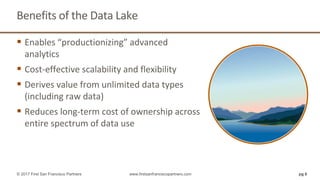
Benefits of the Data Lake
pg 6© 2017 First San Francisco Partners www.firstsanfranciscopartners.com
 Enables “productionizing” advanced
analytics
 Cost-effective scalability and flexibility
 Derives value from unlimited data types
(including raw data)
 Reduces long-term cost of ownership across
entire spectrum of data use
Risks of the Data Lake
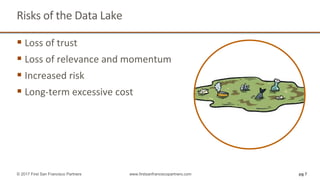
 Loss of trust
 Loss of relevance and momentum
 Increased risk
 Long-term excessive cost
pg 7© 2017 First San Francisco Partners www.firstsanfranciscopartners.com
www.firstsanfranciscopartners.com
Data Lake Reference Architecture
Modern Reality of the Data Lake
pg 9© 2017 First San Francisco Partners www.firstsanfranciscopartners.com
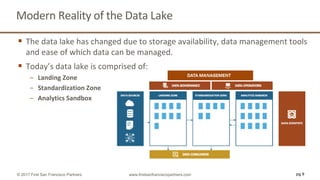
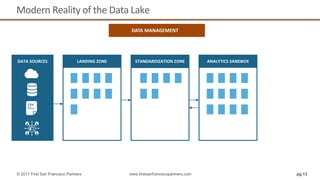
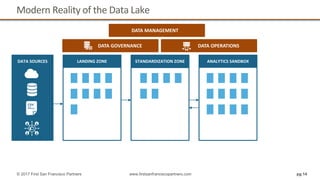
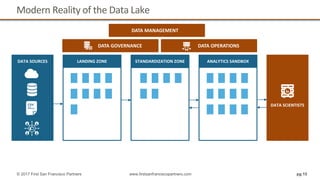
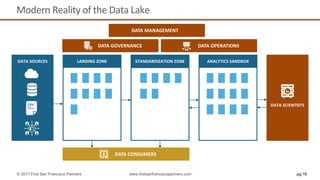
 The data lake has changed due to storage availability, data management tools
and ease of which data can be managed.
 Today’s data lake is comprised of:
‒ Landing Zone
‒ Standardization Zone
‒ Analytics Sandbox
Modern Reality of the Data Lake
pg 10© 2017 First San Francisco Partners www.firstsanfranciscopartners.com
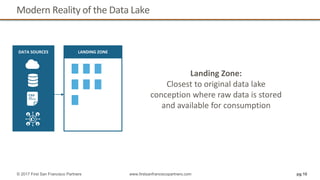
LANDING ZONEDATA SOURCES
Landing Zone:
Closest to original data lake
conception where raw data is stored
and available for consumption
Modern Reality of the Data Lake
pg 11© 2017 First San Francisco Partners www.firstsanfranciscopartners.com
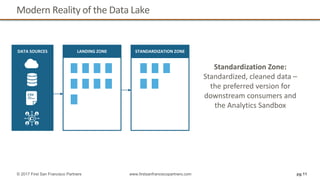
LANDING ZONE STANDARDIZATION ZONEDATA SOURCES
Standardization Zone:
Standardized, cleaned data –
the preferred version for
downstream consumers and
the Analytics Sandbox
Modern Reality of the Data Lake
pg 12© 2017 First San Francisco Partners www.firstsanfranciscopartners.com
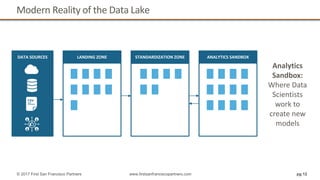
LANDING ZONE STANDARDIZATION ZONE ANALYTICS SANDBOXDATA SOURCES
Analytics
Sandbox:
Where Data
Scientists
work to
create new
models
Modern Reality of the Data Lake
pg 13© 2017 First San Francisco Partners www.firstsanfranciscopartners.com
LANDING ZONE STANDARDIZATION ZONE ANALYTICS SANDBOXDATA SOURCES
DATA MANAGEMENT
Modern Reality of the Data Lake
pg 14© 2017 First San Francisco Partners www.firstsanfranciscopartners.com
LANDING ZONE STANDARDIZATION ZONE ANALYTICS SANDBOX
DATA GOVERNANCE DATA OPERATIONS
DATA SOURCES
DATA MANAGEMENT
Modern Reality of the Data Lake
pg 15© 2017 First San Francisco Partners www.firstsanfranciscopartners.com
LANDING ZONE STANDARDIZATION ZONE ANALYTICS SANDBOX
DATA GOVERNANCE DATA OPERATIONS
DATA SOURCES
DATA SCIENTISTS
DATA MANAGEMENT
Modern Reality of the Data Lake
pg 16© 2017 First San Francisco Partners www.firstsanfranciscopartners.com
LANDING ZONE STANDARDIZATION ZONE ANALYTICS SANDBOX
DATA GOVERNANCE
DATA CONSUMERS
DATA OPERATIONS
DATA SOURCES
DATA SCIENTISTS
DATA MANAGEMENT
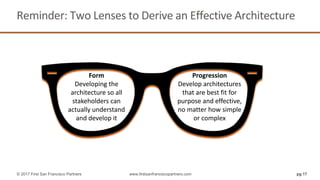
Reminder: Two Lenses to Derive an Effective Architecture
pg 17© 2017 First San Francisco Partners www.firstsanfranciscopartners.com
Form
Developing the
architecture so all
stakeholders can
actually understand
and develop it
Progression
Develop architectures
that are best fit for
purpose and effective,
no matter how simple
or complex
www.firstsanfranciscopartners.com
Lab and the Factory
Why is This Topic Important?
 A key to successful data lake management is understanding if it is a lab,
a factory or both.
 There are architectural, governance and organizational impacts.
 You must clearly identify if you are evolving from a lab to a factory or intend
to keep them separate.
pg 19© 2017 First San Francisco Partners www.firstsanfranciscopartners.com
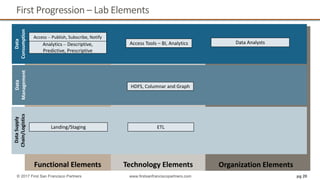
First Progression – Lab Elements
pg 20© 2017 First San Francisco Partners www.firstsanfranciscopartners.com
Organization ElementsFunctional Elements Technology Elements
Data
Consumption
DataSupply
Chain/Logistics
Data
Management
Landing/Staging ETL
Data Analysts
Access – Publish, Subscribe, Notify
Access Tools – BI, AnalyticsAnalytics – Descriptive,
Predictive, Prescriptive
HDFS, Columnar and Graph
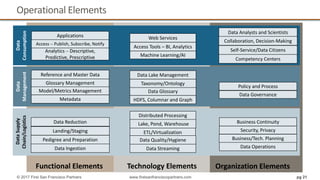
Operational Elements
pg 21© 2017 First San Francisco Partners www.firstsanfranciscopartners.com
Organization ElementsFunctional Elements Technology Elements
Data
Consumption
DataSupply
Chain/Logistics
Data
Management
Pedigree and Preparation
Landing/Staging
Model/Metrics Management
Data Reduction
Glossary Management
Machine Learning/AI
Data Governance
Data OperationsData Ingestion
Reference and Master Data
Competency Centers
Self-Service/Data Citizens
ETL/Virtualization
Distributed Processing
Metadata
Data Quality/Hygiene
Lake, Pond, Warehouse
HDFS, Columnar and Graph
Data Streaming
Data Glossary
Data Lake Management
Taxonomy/Ontology
Web Services
Policy and Process
Data Analysts and Scientists
Collaboration, Decision-Making
Access – Publish, Subscribe, Notify
Access Tools – BI, Analytics
Applications
Analytics – Descriptive,
Predictive, Prescriptive
Business/Tech. Planning
Security, Privacy
Business Continuity
pg 22
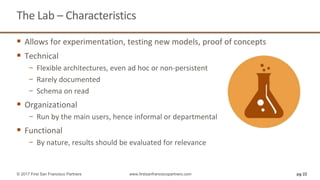
The Lab – Characteristics
 Allows for experimentation, testing new models, proof of concepts
 Technical
− Flexible architectures, even ad hoc or non-persistent
− Rarely documented
− Schema on read
 Organizational
− Run by the main users, hence informal or departmental
 Functional
− By nature, results should be evaluated for relevance
© 2017 First San Francisco Partners www.firstsanfranciscopartners.com
pg 23
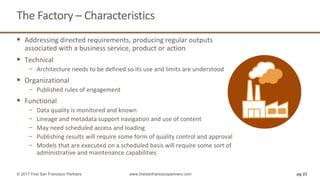
The Factory – Characteristics
© 2017 First San Francisco Partners www.firstsanfranciscopartners.com
 Addressing directed requirements, producing regular outputs
associated with a business service, product or action
 Technical
− Architecture needs to be defined so its use and limits are understood
 Organizational
− Published rules of engagement
 Functional
− Data quality is monitored and known
− Lineage and metadata support navigation and use of content
− May need scheduled access and loading
− Publishing results will require some form of quality control and approval
− Models that are executed on a scheduled basis will require some sort of
administrative and maintenance capabilities
www.firstsanfranciscopartners.com
Base Environment for Batch Analytics,
Streaming and Real-Time Data
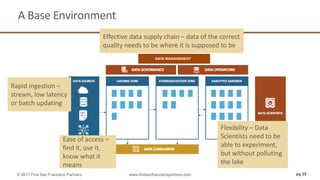
A Base Environment
pg 25© 2017 First San Francisco Partners www.firstsanfranciscopartners.com
Data Governance Data Operations
Rapid ingestion –
stream, low latency
or batch updating
Ease of access –
find it, use it,
know what it
means
Effective data supply chain – data of the correct
quality needs to be where it is supposed to be
Flexibility – Data
Scientists need to be
able to experiment,
but without polluting
the lake
Additional Components for Real-time Analytics
and Ingesting Streaming Data
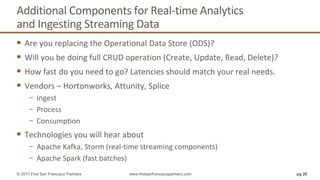
 Are you replacing the Operational Data Store (ODS)?
 Will you be doing full CRUD operation (Create, Update, Read, Delete)?
 How fast do you need to go? Latencies should match your real needs.
 Vendors – Hortonworks, Attunity, Splice
− Ingest
− Process
− Consumption
 Technologies you will hear about
− Apache Kafka, Storm (real-time streaming components)
− Apache Spark (fast batches)
pg 26© 2017 First San Francisco Partners www.firstsanfranciscopartners.com
www.firstsanfranciscopartners.com
Critical Governance Components
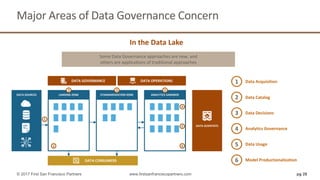
Major Areas of Data Governance Concern
pg 28© 2017 First San Francisco Partners www.firstsanfranciscopartners.com
In the Data Lake
LANDING ZONE STANDARDIZATION ZONE ANALYTICS SANDBOX
DATA GOVERNANCE
DATA CONSUMERS
DATA OPERATIONS
DATA SOURCES
DATA SCIENTISTS
1
2
3 3 3
4
5
6
1
2
3
4
5
6
Data Acquisition
Data Catalog
Data Decisions
Analytics Governance
Data Usage
Model Productionalization
Some Data Governance approaches are new, and
others are applications of traditional approaches
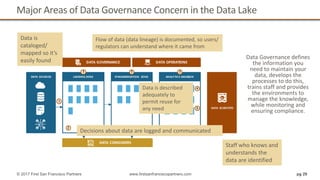
Major Areas of Data Governance Concern in the Data Lake
pg 29© 2017 First San Francisco Partners www.firstsanfranciscopartners.com
Data is
cataloged/
mapped so it’s
easily found
Data is described
adequately to
permit reuse for
any need
Decisions about data are logged and communicated
Flow of data (data lineage) is documented, so users/
regulators can understand where it came from
Staff who knows and
understands the
data are identified
Data Governance defines
the information you
need to maintain your
data, develops the
processes to do this,
trains staff and provides
the environments to
manage the knowledge,
while monitoring and
ensuring compliance.
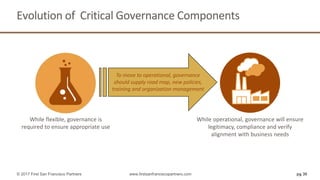
Evolution of Critical Governance Components
pg 30© 2017 First San Francisco Partners www.firstsanfranciscopartners.com
While flexible, governance is
required to ensure appropriate use
While operational, governance will ensure
legitimacy, compliance and verify
alignment with business needs
To move to operational, governance
should supply road map, new policies,
training and organization management
www.firstsanfranciscopartners.com
Key Take-Aways
Key Take-Aways
 Make sure you offer up business benefits in addition to
traditional “access to data” – such as lower costs, more
nimble reactions.
 Avoid additional data risks by providing oversight of data
quality and sources. Do not take a causal approach to
managing the data lake assets.
 Understand that the architectural aspect of the data lake
(as it is evolving) is becoming a standard, much like the data
warehouse.
 Maintain an open mind for supporting technologies, because
they are changing every day.
 Implement Data Governance. It is a critical success factor, no
matter how you view the data lake.
pg 32© 2017 First San Francisco Partners www.firstsanfranciscopartners.com
Questions?
© 2017 First San Francisco Partners www.firstsanfranciscopartners.com
MONTHLY SERIES
Thank you for joining today!
Please join us Thursday, Nov. 2 for the
Keys to Effective Data Visualization webinar.
John Ladley @jladley
john@firstsanfranciscopartners.com
Kelle O’Neal @kellezoneal
kelle@firstsanfranciscopartners.com

Data Lake Architecture

  • 1.
    The First Stepin Information Management looker.com Produced by: MONTHLY SERIES In partnership with: Data Lake Architecture October 5, 2017
  • 2.
    Topics for Today’sAnalytics Webinar  Benefits and Risks of a Data Lake  Data Lake Reference Architecture  Lab and the Factory  Base Environment for Batch Analytics, Streaming and Real-Time Data  Critical Governance Components  Key Take-Aways  Q&A pg 2© 2017 First San Francisco Partners www.firstsanfranciscopartners.com
  • 3.
    Polling Questions  Doyou have a data lake? − Yes − No − Unsure  If yes, is it: − Operational and regularly used for analytics − Informally used, like a lab or sandbox − Unsure pg 3© 2017 First San Francisco Partners www.firstsanfranciscopartners.com
  • 4.
    Defining the DataLake  A data lake is a collection of storage instances of various data assets additional to the originating data sources. These assets are stored in a near-exact, or even exact, copy of the source format.  The purpose of a data lake is to present an unrefined view of data to only the most highly skilled analysts, to help them explore their data refinement and analysis techniques independent of any of the system-of-record compromises that may exist in a traditional analytic data store (such as a data mart or data warehouse).  A data lake can support either/or exploratory analytics and operational uses of data. pg 4© 2017 First San Francisco Partners www.firstsanfranciscopartners.com Source: Gartner IT Glossary
  • 5.
  • 6.
    Benefits of theData Lake pg 6© 2017 First San Francisco Partners www.firstsanfranciscopartners.com  Enables “productionizing” advanced analytics  Cost-effective scalability and flexibility  Derives value from unlimited data types (including raw data)  Reduces long-term cost of ownership across entire spectrum of data use
  • 7.
    Risks of theData Lake  Loss of trust  Loss of relevance and momentum  Increased risk  Long-term excessive cost pg 7© 2017 First San Francisco Partners www.firstsanfranciscopartners.com
  • 8.
  • 9.
    Modern Reality ofthe Data Lake pg 9© 2017 First San Francisco Partners www.firstsanfranciscopartners.com  The data lake has changed due to storage availability, data management tools and ease of which data can be managed.  Today’s data lake is comprised of: ‒ Landing Zone ‒ Standardization Zone ‒ Analytics Sandbox
  • 10.
    Modern Reality ofthe Data Lake pg 10© 2017 First San Francisco Partners www.firstsanfranciscopartners.com LANDING ZONEDATA SOURCES Landing Zone: Closest to original data lake conception where raw data is stored and available for consumption
  • 11.
    Modern Reality ofthe Data Lake pg 11© 2017 First San Francisco Partners www.firstsanfranciscopartners.com LANDING ZONE STANDARDIZATION ZONEDATA SOURCES Standardization Zone: Standardized, cleaned data – the preferred version for downstream consumers and the Analytics Sandbox
  • 12.
    Modern Reality ofthe Data Lake pg 12© 2017 First San Francisco Partners www.firstsanfranciscopartners.com LANDING ZONE STANDARDIZATION ZONE ANALYTICS SANDBOXDATA SOURCES Analytics Sandbox: Where Data Scientists work to create new models
  • 13.
    Modern Reality ofthe Data Lake pg 13© 2017 First San Francisco Partners www.firstsanfranciscopartners.com LANDING ZONE STANDARDIZATION ZONE ANALYTICS SANDBOXDATA SOURCES DATA MANAGEMENT
  • 14.
    Modern Reality ofthe Data Lake pg 14© 2017 First San Francisco Partners www.firstsanfranciscopartners.com LANDING ZONE STANDARDIZATION ZONE ANALYTICS SANDBOX DATA GOVERNANCE DATA OPERATIONS DATA SOURCES DATA MANAGEMENT
  • 15.
    Modern Reality ofthe Data Lake pg 15© 2017 First San Francisco Partners www.firstsanfranciscopartners.com LANDING ZONE STANDARDIZATION ZONE ANALYTICS SANDBOX DATA GOVERNANCE DATA OPERATIONS DATA SOURCES DATA SCIENTISTS DATA MANAGEMENT
  • 16.
    Modern Reality ofthe Data Lake pg 16© 2017 First San Francisco Partners www.firstsanfranciscopartners.com LANDING ZONE STANDARDIZATION ZONE ANALYTICS SANDBOX DATA GOVERNANCE DATA CONSUMERS DATA OPERATIONS DATA SOURCES DATA SCIENTISTS DATA MANAGEMENT
  • 17.
    Reminder: Two Lensesto Derive an Effective Architecture pg 17© 2017 First San Francisco Partners www.firstsanfranciscopartners.com Form Developing the architecture so all stakeholders can actually understand and develop it Progression Develop architectures that are best fit for purpose and effective, no matter how simple or complex
  • 18.
  • 19.
    Why is ThisTopic Important?  A key to successful data lake management is understanding if it is a lab, a factory or both.  There are architectural, governance and organizational impacts.  You must clearly identify if you are evolving from a lab to a factory or intend to keep them separate. pg 19© 2017 First San Francisco Partners www.firstsanfranciscopartners.com
  • 20.
    First Progression –Lab Elements pg 20© 2017 First San Francisco Partners www.firstsanfranciscopartners.com Organization ElementsFunctional Elements Technology Elements Data Consumption DataSupply Chain/Logistics Data Management Landing/Staging ETL Data Analysts Access – Publish, Subscribe, Notify Access Tools – BI, AnalyticsAnalytics – Descriptive, Predictive, Prescriptive HDFS, Columnar and Graph
  • 21.
    Operational Elements pg 21©2017 First San Francisco Partners www.firstsanfranciscopartners.com Organization ElementsFunctional Elements Technology Elements Data Consumption DataSupply Chain/Logistics Data Management Pedigree and Preparation Landing/Staging Model/Metrics Management Data Reduction Glossary Management Machine Learning/AI Data Governance Data OperationsData Ingestion Reference and Master Data Competency Centers Self-Service/Data Citizens ETL/Virtualization Distributed Processing Metadata Data Quality/Hygiene Lake, Pond, Warehouse HDFS, Columnar and Graph Data Streaming Data Glossary Data Lake Management Taxonomy/Ontology Web Services Policy and Process Data Analysts and Scientists Collaboration, Decision-Making Access – Publish, Subscribe, Notify Access Tools – BI, Analytics Applications Analytics – Descriptive, Predictive, Prescriptive Business/Tech. Planning Security, Privacy Business Continuity
  • 22.
    pg 22 The Lab– Characteristics  Allows for experimentation, testing new models, proof of concepts  Technical − Flexible architectures, even ad hoc or non-persistent − Rarely documented − Schema on read  Organizational − Run by the main users, hence informal or departmental  Functional − By nature, results should be evaluated for relevance © 2017 First San Francisco Partners www.firstsanfranciscopartners.com
  • 23.
    pg 23 The Factory– Characteristics © 2017 First San Francisco Partners www.firstsanfranciscopartners.com  Addressing directed requirements, producing regular outputs associated with a business service, product or action  Technical − Architecture needs to be defined so its use and limits are understood  Organizational − Published rules of engagement  Functional − Data quality is monitored and known − Lineage and metadata support navigation and use of content − May need scheduled access and loading − Publishing results will require some form of quality control and approval − Models that are executed on a scheduled basis will require some sort of administrative and maintenance capabilities
  • 24.
    www.firstsanfranciscopartners.com Base Environment forBatch Analytics, Streaming and Real-Time Data
  • 25.
    A Base Environment pg25© 2017 First San Francisco Partners www.firstsanfranciscopartners.com Data Governance Data Operations Rapid ingestion – stream, low latency or batch updating Ease of access – find it, use it, know what it means Effective data supply chain – data of the correct quality needs to be where it is supposed to be Flexibility – Data Scientists need to be able to experiment, but without polluting the lake
  • 26.
    Additional Components forReal-time Analytics and Ingesting Streaming Data  Are you replacing the Operational Data Store (ODS)?  Will you be doing full CRUD operation (Create, Update, Read, Delete)?  How fast do you need to go? Latencies should match your real needs.  Vendors – Hortonworks, Attunity, Splice − Ingest − Process − Consumption  Technologies you will hear about − Apache Kafka, Storm (real-time streaming components) − Apache Spark (fast batches) pg 26© 2017 First San Francisco Partners www.firstsanfranciscopartners.com
  • 27.
  • 28.
    Major Areas ofData Governance Concern pg 28© 2017 First San Francisco Partners www.firstsanfranciscopartners.com In the Data Lake LANDING ZONE STANDARDIZATION ZONE ANALYTICS SANDBOX DATA GOVERNANCE DATA CONSUMERS DATA OPERATIONS DATA SOURCES DATA SCIENTISTS 1 2 3 3 3 4 5 6 1 2 3 4 5 6 Data Acquisition Data Catalog Data Decisions Analytics Governance Data Usage Model Productionalization Some Data Governance approaches are new, and others are applications of traditional approaches
  • 29.
    Major Areas ofData Governance Concern in the Data Lake pg 29© 2017 First San Francisco Partners www.firstsanfranciscopartners.com Data is cataloged/ mapped so it’s easily found Data is described adequately to permit reuse for any need Decisions about data are logged and communicated Flow of data (data lineage) is documented, so users/ regulators can understand where it came from Staff who knows and understands the data are identified Data Governance defines the information you need to maintain your data, develops the processes to do this, trains staff and provides the environments to manage the knowledge, while monitoring and ensuring compliance.
  • 30.
    Evolution of CriticalGovernance Components pg 30© 2017 First San Francisco Partners www.firstsanfranciscopartners.com While flexible, governance is required to ensure appropriate use While operational, governance will ensure legitimacy, compliance and verify alignment with business needs To move to operational, governance should supply road map, new policies, training and organization management
  • 31.
  • 32.
    Key Take-Aways  Makesure you offer up business benefits in addition to traditional “access to data” – such as lower costs, more nimble reactions.  Avoid additional data risks by providing oversight of data quality and sources. Do not take a causal approach to managing the data lake assets.  Understand that the architectural aspect of the data lake (as it is evolving) is becoming a standard, much like the data warehouse.  Maintain an open mind for supporting technologies, because they are changing every day.  Implement Data Governance. It is a critical success factor, no matter how you view the data lake. pg 32© 2017 First San Francisco Partners www.firstsanfranciscopartners.com
  • 33.
    Questions? © 2017 FirstSan Francisco Partners www.firstsanfranciscopartners.com MONTHLY SERIES
  • 34.
    Thank you forjoining today! Please join us Thursday, Nov. 2 for the Keys to Effective Data Visualization webinar. John Ladley @jladley john@firstsanfranciscopartners.com Kelle O’Neal @kellezoneal kelle@firstsanfranciscopartners.com