Rummindei Pillar Inscription
Dr. Priyanka Singh
Banaras Hindu University, Varanasi
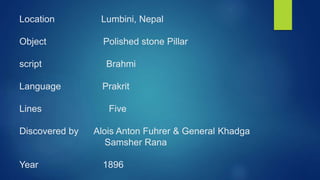
Location Lumbini, Nepal
Object Polished stone Pillar
script Brahmi
Language Prakrit
Lines Five
Discovered by Alois Anton Fuhrer & General Khadga
Samsher Rana
Year 1896
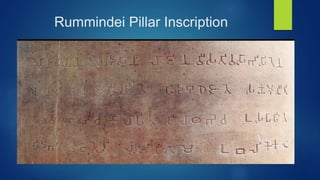
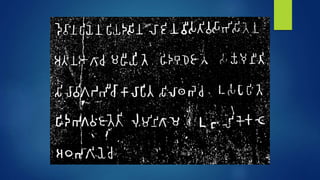
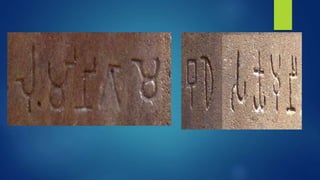
Rummindei Pillar Inscription
Text
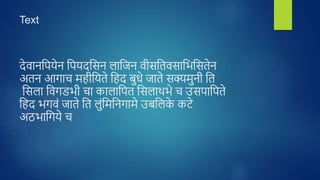
देवानपियेन पियदपिन लापिन वीिपिविापिपििेन
अिन आगाच महीपयिे पहद बुधे िािे िक्यमुनी पि
पिला पवगडिी चा कालापिि पिलाथिे च उििापििे
पहद िगवं िािे पि लुंपमपनगामे उबपलक
े कटे
अठिापगये च
Translation:
king Priyadarsin, beloved of the God, twenty years after the
consecration has come to this land and worshipped ( this spot)
because the Buddha shakyamuni was born here. He raised here a
stone wall and stone pillar . Here the Buddha was born, therefore he
made the village of Lumbini free from taxes and paying only an eight
share of the produce .
Silāvigadabhichā
There is much controversy over the word Silavigadabhicha -
. E. Hultzsch translates it as Stone bearing horse.
. R. G. Bhandarkar translates it as an enclosure or railing made of
stone.
. Rajabali Panday & D.C. Sircar interpreted the word as the railing
of stone.
J.F. Fleet – Stone wall
. B.M. Barua- Crowing stone- figure of young elephant
Ashoka’s Pilgrimage
According to Buddhist text Divyāvadān, Ashoka started on a
Pilgrimage to Lumbini in the company of his preceptor,
Upagupta. On their arrival, Upagupta, pointing to the tree
under which the mother of the Buddha had stood holding on
to a branch while delivering her child, said,‘ Oh Maharaja!
Here the Blessed one was born’.
In Lumbini , he erected a sandstone pillar with an inscription
to memorialize his visit .
Chinese Travellers
. Zhi Sengai- the Yuchi monk Zhi Sengzai is known to be the
first Chinese person to visit Lumbini. The account in the shui-
ching-chu ( shuijing-Zhu) provides more information about
Lumbini during Zhi-Sengzai’s visit.
. Faxian– Faxian, a Buddhist monk native in the Shansi
province in China, came to Lumbini at the beginning of the
fifth century CE.
. Xuanzang- In the seventh century CE Xuanzang the most
important pilgrim monk visited Lumbini. He left detailed
descriptions of Lumbini in his travel account. He calls
Lumbini the La-fa-ni. Xuan Zang mentions the stone pillar but
does not say anything about the inscription on it.
Other Chinese visitors
. Wu-kong
. Fang chi
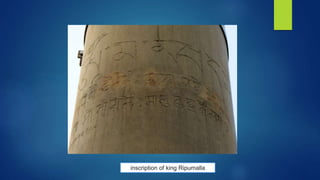
Pilgrimage of Ripumalla
on the uppermost portion on the eastern side of the Ashokan
pillar is an inscription from the bebinning of the 14th century
CE. Ripumalla , a Prince of the Nagaraja dynasty of western
Nepal, got his name and a prayer engraved. The inscription
reads:
om Mani Padme Hum
Sri Ripu Malla chidam jayatu
Sangrama Malla
inscription of king Ripumalla
Om Mani Padme Hum is a Mahayana Buddhist prayer.
Sri Ripumalla chidam jayatu- ‘ May Prince Ripumalla be long
victorious.
This inscription indicate that up to the time of the Ripumalla,
Lumbini was widely known as the Birth place of Lord Buddha.