Republican States
Dr. Virag Sontakke
Assistant Professor
Center for Advanced Studies
Department of A.I.H.C. & Archaeology,
Banaras Hindu University
Republic States
Theme of the Subject
Introduction:
Sources:
Historical
Background:
Buddha Views
On Republic
Important
Republics
Polity and
Administrations of
Republics
Lichacchavis
Sakyas
Republican
States
What is Republican State?
• A state in which supreme power is held by the people
and their elected representatives,.
• The term democracy is derived from two Greek words
'Demos' and Kratos. Demos mean 'people' and Kratos
means 'rule'.
• As Montesquieu puts it, “The republican system is
that in which sovereign power is possessed by either
the whole people or some part of it”.
• The people may delegate power to a single man or a
group of selected men.
• In either case, they should be the men of the choice of
the people, exercising authority in moderation.
Introduction
• It was believed that the Ancient Indian People knew
only the monarchy.
• Monarchical and non-monarchical (democratic) form
of the state prevailing in India.
• In the sixth century B.C., we find a large number of
states in northern India.
• These were the most ancient existing states not only of
India but of the world
• Republics known as: Ganas (group of people)
• Sangha: used in the republic sense
Source
1. Buddhist Literature
2. Mahabharata
3. Greek Historians
4. Panini, Katyayan, Patanjali,
5. Arthashashtra
6. Inscriptions
7. Coins
The Vedic Gana
• Sangha and Gana are two terms used for the non-monarchical
systems of government.
• The word Gana has been used forty six times in the Rigveda,
nine times in the Atharvaveda and in several places in the
Brahmans.
• The Smritis understand Gana as assemblage of families.
• Dr Jayaswal understands Gana as ‘numbers’ : Ganarajya will
therefore mean ‘rule of numbers’, ‘the rule of many’.
• According to Dr. B. K. Sarkar the term implies the regnum of the
whole people.
• Buhler translated it as an autonomous corporation of tradesmen
• Dr. Fleet and other scholars interpreted it as an autonomous
tribe or a self-governing community.
• Ganarajya was consequently denoted, government by assembly.
According to Greek Writers
1. Greek historians observed both Monarchy and
Republics in ancient India.
2. Greek Historians also suggest the Republican States
in the N-W area.
According to Greek writers
1. Puru was republic
2. Nyasa was also kind of Republic (oligarchy)
3. Lot of Republic states in the area of Indus River
Sabha & Samiti
• In Vedic period, A few democratic elements curtailed the
absolute power of the king in many ways.
• The Vedic Assemblies consisted of two Houses: the twin
daughters of Lord Prajaprati,
• Samiti
1. Election of the King,
2. Re-election of a king who had been banished and
3. Discussion of the State matters
• Sabha
1. It is just possible that while the Samiti was probably national
assembly, the Sabha was its standing body.
Later Vedic period
• Aitareya Brahman:
• People near the Himalayas like Uttar Kurus and the
Uttar-madras had a Virat (Kingless) state.
• Vairajya: Kingless
• Heads of the founder family, were consecrated for
the rulership.
• Uttar-madras, continued to be republican states upto
the 4th C. CE.
Historical References
1. Mahabharata refers to the Gana Raja or the rule of the Republics.
2. Panini, the celebrated author of the Sanskrit Grammar (600 B. C.),
mentions a number of republics that existed in his time
3. The whole of Buddhist literature abounds with references to the
republics then exist ting
4. The Buddha himself was born in a republican people
5. He called the community which he founded “Bhikkhu Sangha”, or
the Republic of Bikkhu
6. Avadanasataka: A mercheants told to king who travelled to Deccan
from Madhydesha “these are some countries are Gana or republican
States.
7. Acharangsutra: Warned Jain monk to avoid to visit where no kings
or Gana form of government.
8. Numures coins of Yaudehyas and Malvas bears the name of “Gana”
(Arjunayananam Jayah)
Buddhist literature
• In various places of Buddhist literature the main
features of the republics have been described.
• Magadha King wanted to know the opinion of the
Buddha for invading the three Republics of the Vajjis ,
the Lichchhavis and Videhas,
1. As long as these republics had these strong points the
King could not suppress them.
2. He enumerates the strong points as follow……
Buddha’s View on Republican States
1. To hold full and frequent public Assemblies
2. To meet together in concord,
3. Rise in concord and to carry out their undertakings concord;
4. To enact nothing not already established,
5. Abrogate nothing that has been already enacted and act in
accordance with the ancient institutions of the Vajjians as
established in former days
6. To honour, esteem, revere, and support the Vajjian elders and hold
it a point of duty to harken to their words
7. To support the old shrines in town or country
8. To honour women and not detain them by force or abduction.
• This passage thus points out that the requisites for the success of a
republic in those days were :
1. The respect of its members for their Parliament,
2. They should meet often and,
3. They were fully attended for their ancient laws, customs and
institutions, for seniority and experience and its internal harmony
in policy and administration
Republics form and constitution
• A few scholars have expressed the opinion that every
adult of the population participated in the
administration;
• Some others maintain that only Kshatriyas had this
right;
• Others have expressed the view that only head of a
joint-family was allowed to participate in the
administration.
• Mostly the opinions of scholars are divided on the basis
of the above mentioned differences of views.
Dr Jayaswal’s view on Republic
1. Democracies or pure Gana, wherein the total adult-
population participated in the administration;
2. Aristocracies or pure Kula, wherein only some
selected families participated in the administration;
and
3. Mixed aristocracies and democracies or a mixture of
Kula and Gana, wherein the administration was the
mixture of the two.
Dr. Bhandarkar’s view on Republic
• The republics were basically divided into two types,
1. Pure republics and
2. Kshatriya aristocracies.
• Then each of them was further divided into two parts.
• Both the republics and the aristocracies were of two
types,
1. Unitary: called City-republics or Nigamas
2. Federal: called State-republics or Janapadas
Important Republics
1. The Mallas of Pava
2. Licchavis of Vaishali
3. The shakya of Kapilvastu
4. The Koliya of Ramagrama
5. The Bhagya of
Sunsamagiri
6. The Mauryas of
Piphalivana
7. The Kalama of Suputa
8. The Videhas of Mithila
8. The Ghvatrikas of
Kollanga
9. The Asmakas,
10. The Malavas,
11. The Kshudrakas,
12. The Arjunayanas,
13. The Mushikas,
14. The Yaudheys
15. The Madrakas
Administrative Body
Republics
Assembly
Executive
Council
Administrations of Republics
Executive
Council
Assembly
Republics
• Limited Members
• To handle
confidential issues
• Large members
• General matter of
the state
• Small size
• Bigger size
Administration of Small Republicans
• The Moriya, the Koliyas and the Sakyas were small
republics.
• Contain a few area (number of villages; modern districts?)
• Their Administration might be different than the bigger
republics like Malavas and Yaudheyas.
• These republic states having assembly hall (Santhagaras)
• Frequent meetings were prevalent in Santhagaras
• Members of the Central Assembly probably lived in
Capital, near to the Santhagaras.
• Each member of the aristocratic order called as a Raja.
• Jatka: one of members son called as Upraja.
• Sakhya town and villages has their own Assembly meetings
(Santhagaras)
Administration of Bigger Republics
• Bigger state like Yaudheyas or the Malvas were divided into
a) Provinces,
b) Cities,
c) Villages.
• Each provinces has separate Governor.
• The cities also completely autonomous and administrated
by their own men.
• City council probably consist: Traders, Artisan, Peasants.
• In village council, headman of the village probably a
member of ruling class.
• Members of the Village council may belonged to the
different trades and professions.
Members of the Assembly
1. Members number varies according to the size of state.
2. Yaudheyas: 5000 members
3. Licchhvis: 7707 members
4. Kshudrakas: sent 150 men to negotiate peace with
Alexander.
5. Probably every citizen has right to attend the meeting
like Greek and Athens
6. Yaudheyas 5000, Licchhvis 7707 members plausibly
progenies of the founder members who were
probably Raja.
7. Jataka: there were twice 84,000 nobles at Vaishali.
8. Small City like Nyasa had 30 Councilors.
Role of Assembly
1. To look after general issues of the State
2. To see Social, economic and religious system
3. It controlled foreign affairs
4. Entertained foreign Ambassadors
5. Handle the issue of Peace and War
Examples:
a. 150 Ambassadors Kshudrkas to Alexzander
b. Ambashthas elected three brave military leaders to
fight against Alexzander
Procedure of Assembly
1. The members of the assembly framed laws
2. Discussion was carried out all important matters
3. Decision on issues was made by a majority vote.
4. If there was no unanimity of opinion and elected the
members of the executive.
5. Then, probably by open or secret ballot.
Assembly Hall
• At Assembly Hall various issue of state were discussed
• Political issues
• Religious issues
• Social issues
• Economic issues
• Assembly divided by various parties
• Decision was taken by Presidents
• Example:
a) Lichchhavis: invited Buddha for opening of new
Assembly Hall
b) Malla of Kushinagar: Discuss the funeral of Buddha.
• In big republics like Licchavis and Ambashtha decision
was taken on opinion of elders not by vote.
Executive Council
• According to some writers there was an Executive
council/Committee to deal, important issues.
• To maintain secrecy
• Like war and peace
• Treaty
• Warfare plans and
• Foreign policy
• Secret Service
• Treasury
• Justice
• Police and Revenue
Executive Council
• Members varies as per size and traditions
• Small Malla republic had 4 members
• Lichchhavis had 9 members (Assembly Members 7707)
• Videha had 18 members
• Patanjali: Panchakah (5), Dasakah (10) and vimsakah
(20)
• Mahavagga: five different kind of Sangha with
executive had four, five , ten, twenty etc. members.
Qualifications of members of
Executive Council:
i. Executive must capable to guide the State
ii. They should be well-versed in warfare activity
iii. Capable enough to guide a state in emergency
iv. Energetic in action
v. Firm in Resolutions
vi. Well grounded in the laws, customs and tradition
of the country.
vii. Later times members seems hereditary
Members of the Executive Council
• The members of the Assembly may elected the
members of the Executive Council,
• They like modern Commander-in-Chief of the forces,
• The Treasurer, etc.
• members of Executive Council were consulted in all
important matters of the state such as that of peace
and war.
• The members of the Executive Council were called
Rajana and
• The head of Executive Council was sometimes given
the title of Raja (King).
Rules of Procedure
• A Buddhist chapter required a quorum of 20.
• Similar rule may prevailed in political assembly of
Republics
• The Sanghmukhya (President) of the assembly
• He was initiated and presided debate of parties
• He should be strict and neutral
• In Buddhist Sangha motion was thrice proposed and
passed.
• In case of difference of opinions voting was done
Voting Rights
• In Buddhist sangha voting was done by secret method
(gulhaka)
• Sometimes by whispering method (sakarnajapakam)
• Sometime, open method (vivatakam)
• Voting tickets were various colour
• A person called Salaka-grahka collected them
• Subsequently, tickets were counted by the President
• Probably similar process was followed by republics
The Sakyas of Kapilavastu
• This was an important republican state of ancient India.
• It was situated near the border of Nepal in the Terai region
of the Himalayas.
• Mahatma Buddha belonged to the family of the Sakyas.
• The republican state of the Sakyas had a federal
constitution.
• Its head was elected and was given the title of King.
• Every Sakya adult participated in its administration and all
important matters were decided by the assembly of all.
• Attendance of a fixed number of members was necessary to
complete the quorum.
• The Sakya republic had eighty thousand families living
within its territories and had several cities as well.
The Lichchavis of Vaisali:
• It considered first Republic of the World.
• It was the largest and the most powerful republican state of
that time.
• Vaisali was the capital of the Lichchhavis,
• Wherein lived nearly 42,000 families and was a beautiful
and prosperous city.
• The head of the state was elected and was titled King.
• It had another 7,707 Rajans who were, probably, the chief
officers of their territories.
• It was such a powerful state that Ajatasatru, the ruler of the
Magadha, had to make military and diplomatic
preparations for years before he could succeed in annexing
it.
• And that, too, could be achieved when his diplomacy
succeeded in dividing the Lichchhavis.
Ideal Republic
• According to the Shantiparv:
1. Adults shall be properly educated
2. Youth were taught proper manners
3. They must follows the path of virtue
4. Experiences statemen should be valor
5. They should given proper administrative posts
6. They shall be responsible for delicate and secrecy issues
7. Spies and ambassadors were selected with great care
8. Attention must paid for growth for economy of the state.
9. Ensure the prosperity of the state and the people.
Republic Administrations
Republic
Central
Assembly
Deals with the
general issues
Large number
of members
Voting was
done on
important issue
Executive
Council
Deals with the
Delicate issues
Elders
considerations
Limited
numbers
Smaller or
Bigger
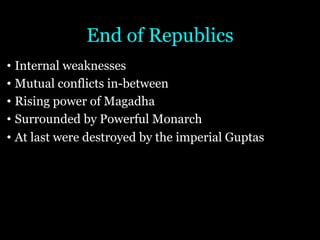
End of Republics
• Internal weaknesses
• Mutual conflicts in-between
• Rising power of Magadha
• Surrounded by Powerful Monarch
• At last were destroyed by the imperial Guptas
Conclusion
• Each of the republic drew their name from the name of
its ruling family.
• They generally permitted all respectable citizens in
administration and framing of laws.
• Republican generally followed the broad pattern of
elections.
• Cities, villages probably had their own autonomous
system of governance.
• Evidence of one of the oldest republics of the World.

Republican State in Ancient India

  • 1.
    Republican States Dr. ViragSontakke Assistant Professor Center for Advanced Studies Department of A.I.H.C. & Archaeology, Banaras Hindu University
  • 2.
  • 3.
    Theme of theSubject Introduction: Sources: Historical Background: Buddha Views On Republic Important Republics Polity and Administrations of Republics Lichacchavis Sakyas Republican States
  • 4.
    What is RepublicanState? • A state in which supreme power is held by the people and their elected representatives,. • The term democracy is derived from two Greek words 'Demos' and Kratos. Demos mean 'people' and Kratos means 'rule'. • As Montesquieu puts it, “The republican system is that in which sovereign power is possessed by either the whole people or some part of it”. • The people may delegate power to a single man or a group of selected men. • In either case, they should be the men of the choice of the people, exercising authority in moderation.
  • 5.
    Introduction • It wasbelieved that the Ancient Indian People knew only the monarchy. • Monarchical and non-monarchical (democratic) form of the state prevailing in India. • In the sixth century B.C., we find a large number of states in northern India. • These were the most ancient existing states not only of India but of the world • Republics known as: Ganas (group of people) • Sangha: used in the republic sense
  • 6.
    Source 1. Buddhist Literature 2.Mahabharata 3. Greek Historians 4. Panini, Katyayan, Patanjali, 5. Arthashashtra 6. Inscriptions 7. Coins
  • 7.
    The Vedic Gana •Sangha and Gana are two terms used for the non-monarchical systems of government. • The word Gana has been used forty six times in the Rigveda, nine times in the Atharvaveda and in several places in the Brahmans. • The Smritis understand Gana as assemblage of families. • Dr Jayaswal understands Gana as ‘numbers’ : Ganarajya will therefore mean ‘rule of numbers’, ‘the rule of many’. • According to Dr. B. K. Sarkar the term implies the regnum of the whole people. • Buhler translated it as an autonomous corporation of tradesmen • Dr. Fleet and other scholars interpreted it as an autonomous tribe or a self-governing community. • Ganarajya was consequently denoted, government by assembly.
  • 8.
    According to GreekWriters 1. Greek historians observed both Monarchy and Republics in ancient India. 2. Greek Historians also suggest the Republican States in the N-W area. According to Greek writers 1. Puru was republic 2. Nyasa was also kind of Republic (oligarchy) 3. Lot of Republic states in the area of Indus River
  • 9.
    Sabha & Samiti •In Vedic period, A few democratic elements curtailed the absolute power of the king in many ways. • The Vedic Assemblies consisted of two Houses: the twin daughters of Lord Prajaprati, • Samiti 1. Election of the King, 2. Re-election of a king who had been banished and 3. Discussion of the State matters • Sabha 1. It is just possible that while the Samiti was probably national assembly, the Sabha was its standing body.
  • 10.
    Later Vedic period •Aitareya Brahman: • People near the Himalayas like Uttar Kurus and the Uttar-madras had a Virat (Kingless) state. • Vairajya: Kingless • Heads of the founder family, were consecrated for the rulership. • Uttar-madras, continued to be republican states upto the 4th C. CE.
  • 11.
    Historical References 1. Mahabharatarefers to the Gana Raja or the rule of the Republics. 2. Panini, the celebrated author of the Sanskrit Grammar (600 B. C.), mentions a number of republics that existed in his time 3. The whole of Buddhist literature abounds with references to the republics then exist ting 4. The Buddha himself was born in a republican people 5. He called the community which he founded “Bhikkhu Sangha”, or the Republic of Bikkhu 6. Avadanasataka: A mercheants told to king who travelled to Deccan from Madhydesha “these are some countries are Gana or republican States. 7. Acharangsutra: Warned Jain monk to avoid to visit where no kings or Gana form of government. 8. Numures coins of Yaudehyas and Malvas bears the name of “Gana” (Arjunayananam Jayah)
  • 12.
    Buddhist literature • Invarious places of Buddhist literature the main features of the republics have been described. • Magadha King wanted to know the opinion of the Buddha for invading the three Republics of the Vajjis , the Lichchhavis and Videhas, 1. As long as these republics had these strong points the King could not suppress them. 2. He enumerates the strong points as follow……
  • 13.
    Buddha’s View onRepublican States 1. To hold full and frequent public Assemblies 2. To meet together in concord, 3. Rise in concord and to carry out their undertakings concord; 4. To enact nothing not already established, 5. Abrogate nothing that has been already enacted and act in accordance with the ancient institutions of the Vajjians as established in former days 6. To honour, esteem, revere, and support the Vajjian elders and hold it a point of duty to harken to their words 7. To support the old shrines in town or country 8. To honour women and not detain them by force or abduction. • This passage thus points out that the requisites for the success of a republic in those days were : 1. The respect of its members for their Parliament, 2. They should meet often and, 3. They were fully attended for their ancient laws, customs and institutions, for seniority and experience and its internal harmony in policy and administration
  • 14.
    Republics form andconstitution • A few scholars have expressed the opinion that every adult of the population participated in the administration; • Some others maintain that only Kshatriyas had this right; • Others have expressed the view that only head of a joint-family was allowed to participate in the administration. • Mostly the opinions of scholars are divided on the basis of the above mentioned differences of views.
  • 15.
    Dr Jayaswal’s viewon Republic 1. Democracies or pure Gana, wherein the total adult- population participated in the administration; 2. Aristocracies or pure Kula, wherein only some selected families participated in the administration; and 3. Mixed aristocracies and democracies or a mixture of Kula and Gana, wherein the administration was the mixture of the two.
  • 16.
    Dr. Bhandarkar’s viewon Republic • The republics were basically divided into two types, 1. Pure republics and 2. Kshatriya aristocracies. • Then each of them was further divided into two parts. • Both the republics and the aristocracies were of two types, 1. Unitary: called City-republics or Nigamas 2. Federal: called State-republics or Janapadas
  • 17.
    Important Republics 1. TheMallas of Pava 2. Licchavis of Vaishali 3. The shakya of Kapilvastu 4. The Koliya of Ramagrama 5. The Bhagya of Sunsamagiri 6. The Mauryas of Piphalivana 7. The Kalama of Suputa 8. The Videhas of Mithila 8. The Ghvatrikas of Kollanga 9. The Asmakas, 10. The Malavas, 11. The Kshudrakas, 12. The Arjunayanas, 13. The Mushikas, 14. The Yaudheys 15. The Madrakas
  • 18.
  • 19.
    Administrations of Republics Executive Council Assembly Republics •Limited Members • To handle confidential issues • Large members • General matter of the state • Small size • Bigger size
  • 20.
    Administration of SmallRepublicans • The Moriya, the Koliyas and the Sakyas were small republics. • Contain a few area (number of villages; modern districts?) • Their Administration might be different than the bigger republics like Malavas and Yaudheyas. • These republic states having assembly hall (Santhagaras) • Frequent meetings were prevalent in Santhagaras • Members of the Central Assembly probably lived in Capital, near to the Santhagaras. • Each member of the aristocratic order called as a Raja. • Jatka: one of members son called as Upraja. • Sakhya town and villages has their own Assembly meetings (Santhagaras)
  • 21.
    Administration of BiggerRepublics • Bigger state like Yaudheyas or the Malvas were divided into a) Provinces, b) Cities, c) Villages. • Each provinces has separate Governor. • The cities also completely autonomous and administrated by their own men. • City council probably consist: Traders, Artisan, Peasants. • In village council, headman of the village probably a member of ruling class. • Members of the Village council may belonged to the different trades and professions.
  • 22.
    Members of theAssembly 1. Members number varies according to the size of state. 2. Yaudheyas: 5000 members 3. Licchhvis: 7707 members 4. Kshudrakas: sent 150 men to negotiate peace with Alexander. 5. Probably every citizen has right to attend the meeting like Greek and Athens 6. Yaudheyas 5000, Licchhvis 7707 members plausibly progenies of the founder members who were probably Raja. 7. Jataka: there were twice 84,000 nobles at Vaishali. 8. Small City like Nyasa had 30 Councilors.
  • 23.
    Role of Assembly 1.To look after general issues of the State 2. To see Social, economic and religious system 3. It controlled foreign affairs 4. Entertained foreign Ambassadors 5. Handle the issue of Peace and War Examples: a. 150 Ambassadors Kshudrkas to Alexzander b. Ambashthas elected three brave military leaders to fight against Alexzander
  • 24.
    Procedure of Assembly 1.The members of the assembly framed laws 2. Discussion was carried out all important matters 3. Decision on issues was made by a majority vote. 4. If there was no unanimity of opinion and elected the members of the executive. 5. Then, probably by open or secret ballot.
  • 25.
    Assembly Hall • AtAssembly Hall various issue of state were discussed • Political issues • Religious issues • Social issues • Economic issues • Assembly divided by various parties • Decision was taken by Presidents • Example: a) Lichchhavis: invited Buddha for opening of new Assembly Hall b) Malla of Kushinagar: Discuss the funeral of Buddha. • In big republics like Licchavis and Ambashtha decision was taken on opinion of elders not by vote.
  • 26.
    Executive Council • Accordingto some writers there was an Executive council/Committee to deal, important issues. • To maintain secrecy • Like war and peace • Treaty • Warfare plans and • Foreign policy • Secret Service • Treasury • Justice • Police and Revenue
  • 27.
    Executive Council • Membersvaries as per size and traditions • Small Malla republic had 4 members • Lichchhavis had 9 members (Assembly Members 7707) • Videha had 18 members • Patanjali: Panchakah (5), Dasakah (10) and vimsakah (20) • Mahavagga: five different kind of Sangha with executive had four, five , ten, twenty etc. members.
  • 28.
    Qualifications of membersof Executive Council: i. Executive must capable to guide the State ii. They should be well-versed in warfare activity iii. Capable enough to guide a state in emergency iv. Energetic in action v. Firm in Resolutions vi. Well grounded in the laws, customs and tradition of the country. vii. Later times members seems hereditary
  • 29.
    Members of theExecutive Council • The members of the Assembly may elected the members of the Executive Council, • They like modern Commander-in-Chief of the forces, • The Treasurer, etc. • members of Executive Council were consulted in all important matters of the state such as that of peace and war. • The members of the Executive Council were called Rajana and • The head of Executive Council was sometimes given the title of Raja (King).
  • 30.
    Rules of Procedure •A Buddhist chapter required a quorum of 20. • Similar rule may prevailed in political assembly of Republics • The Sanghmukhya (President) of the assembly • He was initiated and presided debate of parties • He should be strict and neutral • In Buddhist Sangha motion was thrice proposed and passed. • In case of difference of opinions voting was done
  • 31.
    Voting Rights • InBuddhist sangha voting was done by secret method (gulhaka) • Sometimes by whispering method (sakarnajapakam) • Sometime, open method (vivatakam) • Voting tickets were various colour • A person called Salaka-grahka collected them • Subsequently, tickets were counted by the President • Probably similar process was followed by republics
  • 32.
    The Sakyas ofKapilavastu • This was an important republican state of ancient India. • It was situated near the border of Nepal in the Terai region of the Himalayas. • Mahatma Buddha belonged to the family of the Sakyas. • The republican state of the Sakyas had a federal constitution. • Its head was elected and was given the title of King. • Every Sakya adult participated in its administration and all important matters were decided by the assembly of all. • Attendance of a fixed number of members was necessary to complete the quorum. • The Sakya republic had eighty thousand families living within its territories and had several cities as well.
  • 37.
    The Lichchavis ofVaisali: • It considered first Republic of the World. • It was the largest and the most powerful republican state of that time. • Vaisali was the capital of the Lichchhavis, • Wherein lived nearly 42,000 families and was a beautiful and prosperous city. • The head of the state was elected and was titled King. • It had another 7,707 Rajans who were, probably, the chief officers of their territories. • It was such a powerful state that Ajatasatru, the ruler of the Magadha, had to make military and diplomatic preparations for years before he could succeed in annexing it. • And that, too, could be achieved when his diplomacy succeeded in dividing the Lichchhavis.
  • 42.
    Ideal Republic • Accordingto the Shantiparv: 1. Adults shall be properly educated 2. Youth were taught proper manners 3. They must follows the path of virtue 4. Experiences statemen should be valor 5. They should given proper administrative posts 6. They shall be responsible for delicate and secrecy issues 7. Spies and ambassadors were selected with great care 8. Attention must paid for growth for economy of the state. 9. Ensure the prosperity of the state and the people.
  • 43.
    Republic Administrations Republic Central Assembly Deals withthe general issues Large number of members Voting was done on important issue Executive Council Deals with the Delicate issues Elders considerations Limited numbers Smaller or Bigger
  • 44.
    End of Republics •Internal weaknesses • Mutual conflicts in-between • Rising power of Magadha • Surrounded by Powerful Monarch • At last were destroyed by the imperial Guptas
  • 45.
    Conclusion • Each ofthe republic drew their name from the name of its ruling family. • They generally permitted all respectable citizens in administration and framing of laws. • Republican generally followed the broad pattern of elections. • Cities, villages probably had their own autonomous system of governance. • Evidence of one of the oldest republics of the World.