What Is Stratification?


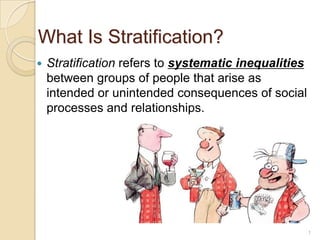
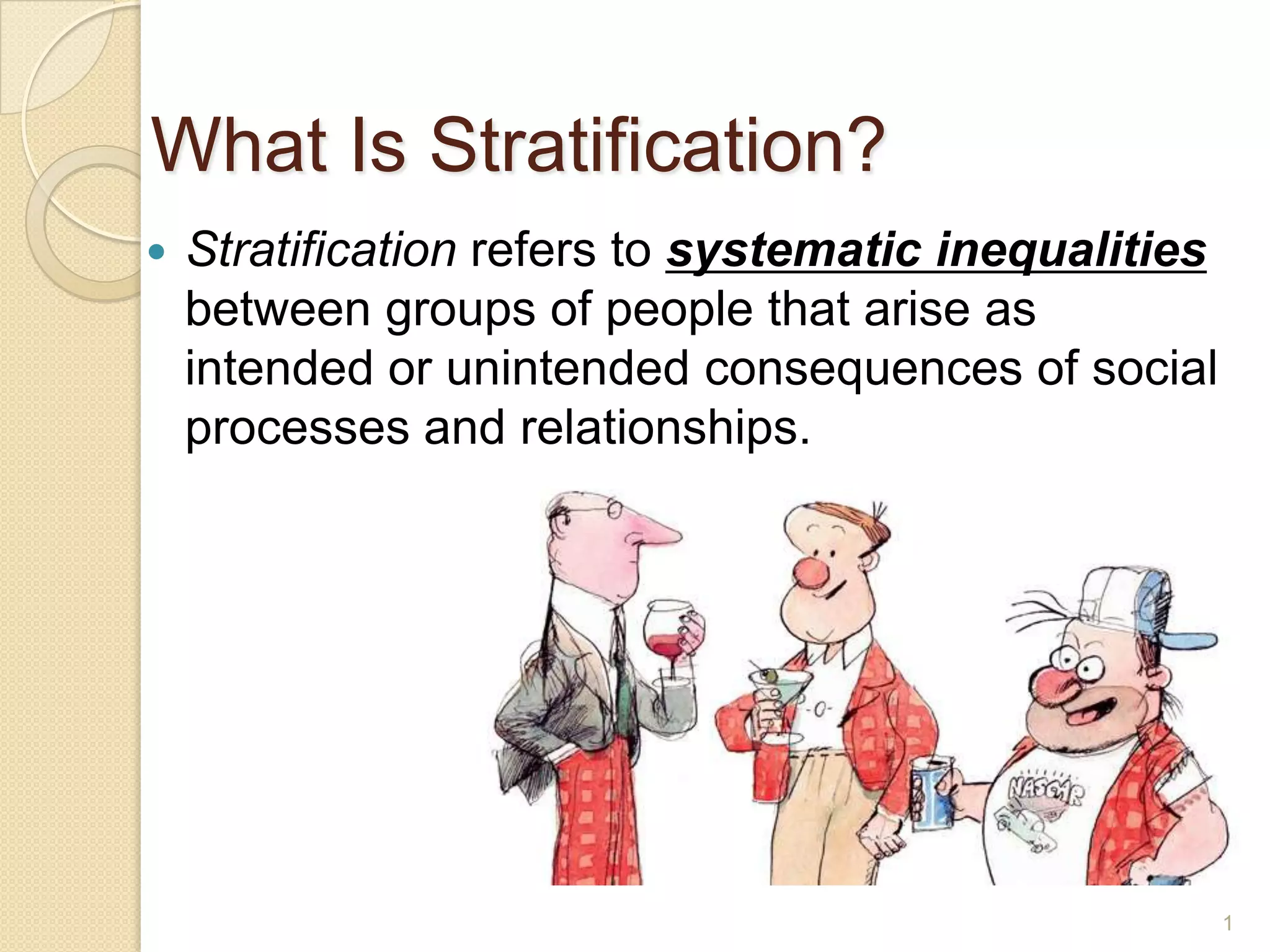
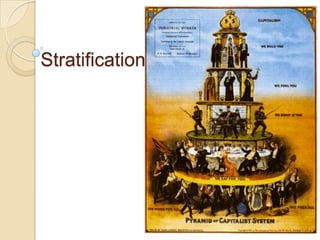
Stratification refers to systematic inequalities
between groups of people that arise as
intended or unintended consequences of social
processes and relationships.

1
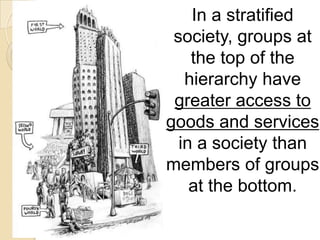
In a stratified
society, groups at
the top of the
hierarchy have
greater access to
goods and services
in a society than
members of groups
at the bottom.
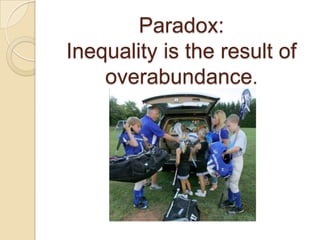
Paradox:
Inequality is the result of
overabundance.
Stratification
Social Stratification


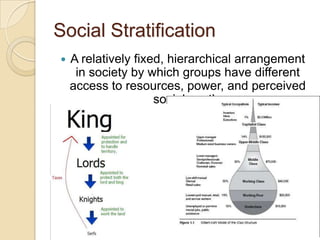
A relatively fixed, hierarchical arrangement
in society by which groups have different
access to resources, power, and perceived
social worth.
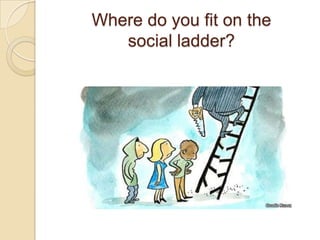
Where do you fit on the
social ladder?
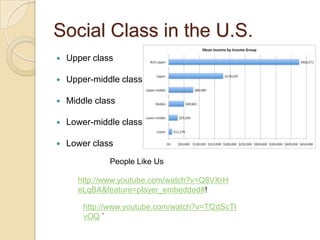
Social Class in the U.S.


Upper class



Upper-middle class



Middle class



Lower-middle class



Lower class
People Like Us
http://www.youtube.com/watch?v=Q8VXrH
eLqBA&feature=player_embedded#!
http://www.youtube.com/watch?v=Tf2dScTl
vOQ `
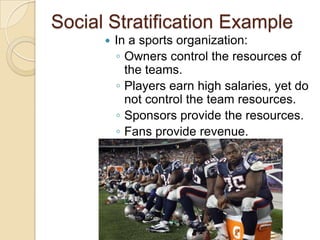
Social Stratification Example


In a sports organization:
◦ Owners control the resources of
the teams.
◦ Players earn high salaries, yet do
not control the team resources.
◦ Sponsors provide the resources.
◦ Fans provide revenue.
Diverse Sources of
Stratification
Race, class, and gender are overlapping
systems of stratification.
 Class position is manifested differently,
depending on race and gender.
 Example: A Black middle-class man who is
stopped by police when driving through a
White middle-class neighborhood may feel
his racial status is his most outstanding
characteristic, but his race, class, and
gender always influence his life chances.

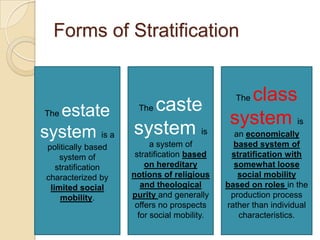
Forms of Stratification

estate
system is a
The

politically based
system of
stratification
characterized by
limited social
mobility.

caste
system is
The

a system of
stratification based
on hereditary
notions of religious
and theological
purity and generally
offers no prospects
for social mobility.

class
system is
The

an economically
based system of
stratification with
somewhat loose
social mobility
based on roles in the
production process
rather than individual
characteristics.
10
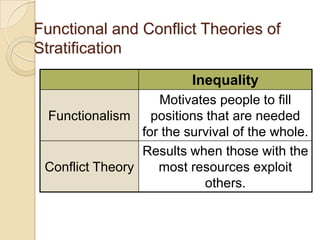
Functional and Conflict Theories of
Stratification
Inequality
Motivates people to fill
Functionalism
positions that are needed
for the survival of the whole.
Results when those with the
Conflict Theory
most resources exploit
others.
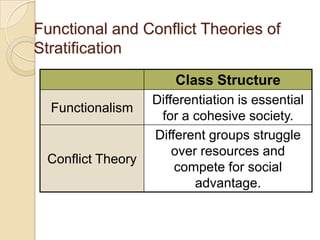
Functional and Conflict Theories of
Stratification
Class Structure
Functionalism

Conflict Theory

Differentiation is essential
for a cohesive society.
Different groups struggle
over resources and
compete for social
advantage.
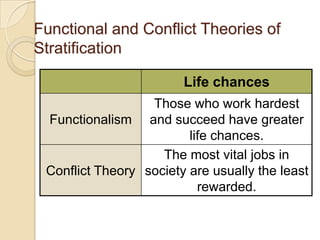
Functional and Conflict Theories of
Stratification
Life chances
Those who work hardest
Functionalism and succeed have greater
life chances.
The most vital jobs in
Conflict Theory society are usually the least
rewarded.
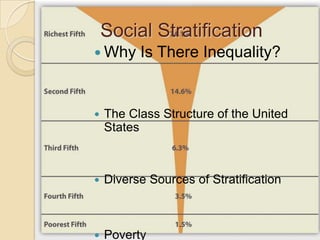
Social Stratification
 Why

Is There Inequality?



The Class Structure of the United
States



Diverse Sources of Stratification



Poverty
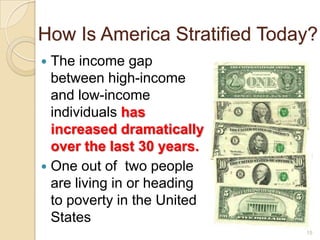
How Is America Stratified Today?
The income gap
between high-income
and low-income
individuals has
increased dramatically
over the last 30 years.
 One out of two people
are living in or heading
to poverty in the United
States


15
Inequality in the United
States
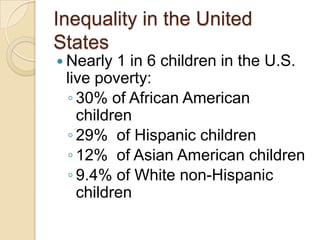
 Nearly

1 in 6 children in the U.S.
live poverty:
◦ 30% of African American
children
◦ 29% of Hispanic children
◦ 12% of Asian American children
◦ 9.4% of White non-Hispanic
children
Inequality in the United
States
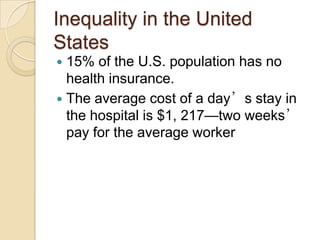
15% of the U.S. population has no
health insurance.
 The average cost of a day’s stay in
the hospital is $1, 217—two weeks’
pay for the average worker

Inequality in the United
States
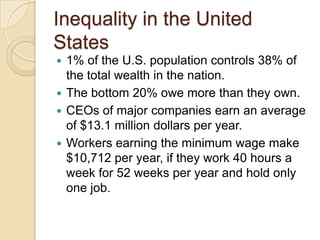
1% of the U.S. population controls 38% of
the total wealth in the nation.
 The bottom 20% owe more than they own.
 CEOs of major companies earn an average
of $13.1 million dollars per year.
 Workers earning the minimum wage make
$10,712 per year, if they work 40 hours a
week for 52 weeks per year and hold only
one job.

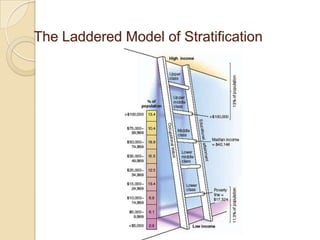
The Laddered Model of Stratification
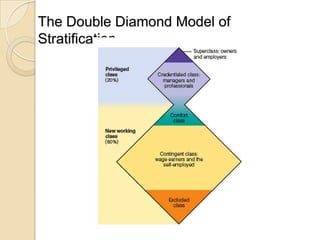
The Double Diamond Model of
Stratification
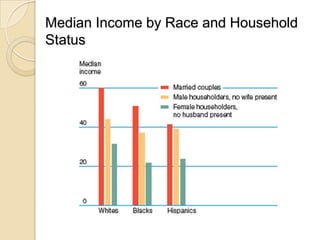
Median Income by Race and Household
Status
Wealth and Income


Wealth is the monetary value of
everything one owns, minus debt.
◦ It is calculated by adding all financial
assets and subtracting all debts.



Income is the amount of money
brought into a household from various
sources during a given period.
Distribution of Wealth and
Income
The wealthiest 1% own 38% of all net
worth; the bottom 80% control only
17%.
 The top 1% also owns almost half of
all stock; the bottom 80% own only 4%
of total stock holdings.

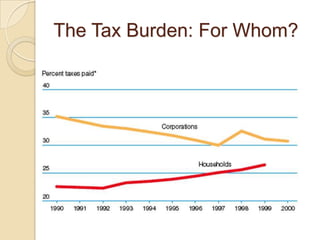
The Tax Burden: For Whom?
Defining Social Mobility
Social mobility is a person’s movement
over time from one class to another.
 Social mobility can be up or down, although
the American dream emphasizes upward
movement.
 Mobility can also be either
intergenerational, occurring between
generations; or intragenerational, occurring
within a generation.

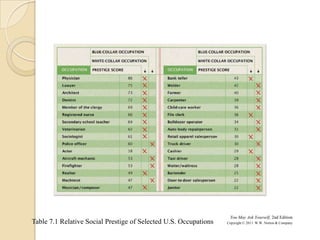
Table 7.1 Relative Social Prestige of Selected U.S. Occupations

You May Ask Yourself, 2nd Edition
Copyright © 2011 W.W. Norton & Company
Social Mobility
Mobility is a collective effort that involves
kin and sometimes community.
 Upward Mobility
◦ People who are upwardly mobile are often
expected to distance themselves from
their origins.
 Downward Mobility
◦ As income distribution is becoming more
skewed toward the top, many in the
middle class are experiencing mobility
downward.

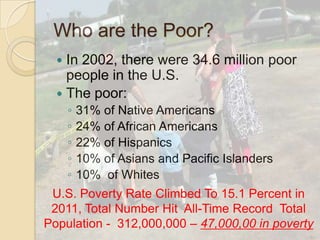
Who are the Poor?
In 2002, there were 34.6 million poor
people in the U.S.
 The poor:


◦
◦
◦
◦
◦

31% of Native Americans
24% of African Americans
22% of Hispanics
10% of Asians and Pacific Islanders
10% of Whites

U.S. Poverty Rate Climbed To 15.1 Percent in
2011, Total Number Hit All-Time Record Total
Population - 312,000,000 – 47,000,00 in poverty
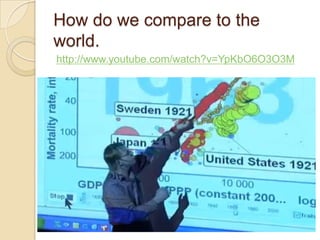
How do we compare to the
world.
http://www.youtube.com/watch?v=YpKbO6O3O3M
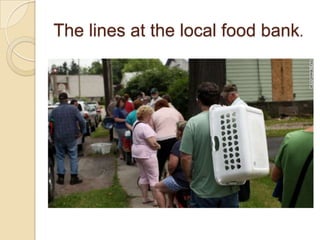
The lines at the local food bank.
Who are the Homeless?


A 2001 survey of 27 cities found that
the homeless population is:
◦
◦
◦
◦
◦

50% African American
35% White
12% Hispanic
2% Native American
1% Asian
Who are the Homeless?
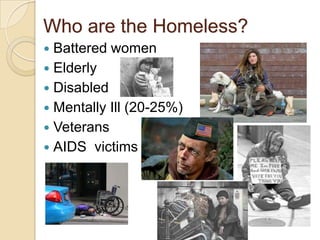
Battered women
 Elderly
 Disabled
 Mentally Ill (20-25%)
 Veterans
 AIDS victims

What do you think are the
Reasons for Homelessness?
 Unemployment

and/or eviction
 Reductions in federal support for
affordable housing
 Eroding work opportunities
 Inadequate housing for lowincome people
What do you think are the
Reasons for Homelessness
 Reductions

in public assistance
 Inadequate health care
 Domestic violence
 Addiction
http://www.youtube.com/watch?v=E
-naXAOUslM
http://www.youtube.com/watch?v=I
Cx3AfSlc-w&feature=related
Explanations of Poverty
Culture of poverty - poverty is a way
of life that is transferred from
generation to generation.
 Structural causes of poverty poverty is caused by economic and
social transformations taking place in
the U.S.

Arguments Against
“The Culture of Poverty”
Fewer than 5% of the poor are
chronically poor.
 41% of the able-bodied poor work.
 The pattern of “welfare cycling” is
promoted by wages too low to support
a family.


Stratification Chapter 7

  • 1.
    What Is Stratification?  Stratificationrefers to systematic inequalities between groups of people that arise as intended or unintended consequences of social processes and relationships. 1
  • 2.
    In a stratified society,groups at the top of the hierarchy have greater access to goods and services in a society than members of groups at the bottom.
  • 3.
    Paradox: Inequality is theresult of overabundance.
  • 4.
  • 5.
    Social Stratification  A relativelyfixed, hierarchical arrangement in society by which groups have different access to resources, power, and perceived social worth.
  • 6.
    Where do youfit on the social ladder?
  • 7.
    Social Class inthe U.S.  Upper class  Upper-middle class  Middle class  Lower-middle class  Lower class People Like Us http://www.youtube.com/watch?v=Q8VXrH eLqBA&feature=player_embedded#! http://www.youtube.com/watch?v=Tf2dScTl vOQ `
  • 8.
    Social Stratification Example  Ina sports organization: ◦ Owners control the resources of the teams. ◦ Players earn high salaries, yet do not control the team resources. ◦ Sponsors provide the resources. ◦ Fans provide revenue.
  • 9.
    Diverse Sources of Stratification Race,class, and gender are overlapping systems of stratification.  Class position is manifested differently, depending on race and gender.  Example: A Black middle-class man who is stopped by police when driving through a White middle-class neighborhood may feel his racial status is his most outstanding characteristic, but his race, class, and gender always influence his life chances. 
  • 10.
    Forms of Stratification estate systemis a The politically based system of stratification characterized by limited social mobility. caste system is The a system of stratification based on hereditary notions of religious and theological purity and generally offers no prospects for social mobility. class system is The an economically based system of stratification with somewhat loose social mobility based on roles in the production process rather than individual characteristics. 10
  • 11.
    Functional and ConflictTheories of Stratification Inequality Motivates people to fill Functionalism positions that are needed for the survival of the whole. Results when those with the Conflict Theory most resources exploit others.
  • 12.
    Functional and ConflictTheories of Stratification Class Structure Functionalism Conflict Theory Differentiation is essential for a cohesive society. Different groups struggle over resources and compete for social advantage.
  • 13.
    Functional and ConflictTheories of Stratification Life chances Those who work hardest Functionalism and succeed have greater life chances. The most vital jobs in Conflict Theory society are usually the least rewarded.
  • 14.
    Social Stratification  Why IsThere Inequality?  The Class Structure of the United States  Diverse Sources of Stratification  Poverty
  • 15.
    How Is AmericaStratified Today? The income gap between high-income and low-income individuals has increased dramatically over the last 30 years.  One out of two people are living in or heading to poverty in the United States  15
  • 16.
    Inequality in theUnited States  Nearly 1 in 6 children in the U.S. live poverty: ◦ 30% of African American children ◦ 29% of Hispanic children ◦ 12% of Asian American children ◦ 9.4% of White non-Hispanic children
  • 17.
    Inequality in theUnited States 15% of the U.S. population has no health insurance.  The average cost of a day’s stay in the hospital is $1, 217—two weeks’ pay for the average worker 
  • 18.
    Inequality in theUnited States 1% of the U.S. population controls 38% of the total wealth in the nation.  The bottom 20% owe more than they own.  CEOs of major companies earn an average of $13.1 million dollars per year.  Workers earning the minimum wage make $10,712 per year, if they work 40 hours a week for 52 weeks per year and hold only one job. 
  • 19.
    The Laddered Modelof Stratification
  • 20.
    The Double DiamondModel of Stratification
  • 21.
    Median Income byRace and Household Status
  • 22.
    Wealth and Income  Wealthis the monetary value of everything one owns, minus debt. ◦ It is calculated by adding all financial assets and subtracting all debts.  Income is the amount of money brought into a household from various sources during a given period.
  • 23.
    Distribution of Wealthand Income The wealthiest 1% own 38% of all net worth; the bottom 80% control only 17%.  The top 1% also owns almost half of all stock; the bottom 80% own only 4% of total stock holdings. 
  • 24.
    The Tax Burden:For Whom?
  • 25.
    Defining Social Mobility Socialmobility is a person’s movement over time from one class to another.  Social mobility can be up or down, although the American dream emphasizes upward movement.  Mobility can also be either intergenerational, occurring between generations; or intragenerational, occurring within a generation. 
  • 26.
    Table 7.1 RelativeSocial Prestige of Selected U.S. Occupations You May Ask Yourself, 2nd Edition Copyright © 2011 W.W. Norton & Company
  • 27.
    Social Mobility Mobility isa collective effort that involves kin and sometimes community.  Upward Mobility ◦ People who are upwardly mobile are often expected to distance themselves from their origins.  Downward Mobility ◦ As income distribution is becoming more skewed toward the top, many in the middle class are experiencing mobility downward. 
  • 28.
    Who are thePoor? In 2002, there were 34.6 million poor people in the U.S.  The poor:  ◦ ◦ ◦ ◦ ◦ 31% of Native Americans 24% of African Americans 22% of Hispanics 10% of Asians and Pacific Islanders 10% of Whites U.S. Poverty Rate Climbed To 15.1 Percent in 2011, Total Number Hit All-Time Record Total Population - 312,000,000 – 47,000,00 in poverty
  • 29.
    How do wecompare to the world. http://www.youtube.com/watch?v=YpKbO6O3O3M
  • 30.
    The lines atthe local food bank.
  • 31.
    Who are theHomeless?  A 2001 survey of 27 cities found that the homeless population is: ◦ ◦ ◦ ◦ ◦ 50% African American 35% White 12% Hispanic 2% Native American 1% Asian
  • 32.
    Who are theHomeless? Battered women  Elderly  Disabled  Mentally Ill (20-25%)  Veterans  AIDS victims 
  • 33.
    What do youthink are the Reasons for Homelessness?  Unemployment and/or eviction  Reductions in federal support for affordable housing  Eroding work opportunities  Inadequate housing for lowincome people
  • 34.
    What do youthink are the Reasons for Homelessness  Reductions in public assistance  Inadequate health care  Domestic violence  Addiction http://www.youtube.com/watch?v=E -naXAOUslM http://www.youtube.com/watch?v=I Cx3AfSlc-w&feature=related
  • 35.
    Explanations of Poverty Cultureof poverty - poverty is a way of life that is transferred from generation to generation.  Structural causes of poverty poverty is caused by economic and social transformations taking place in the U.S. 
  • 36.
    Arguments Against “The Cultureof Poverty” Fewer than 5% of the poor are chronically poor.  41% of the able-bodied poor work.  The pattern of “welfare cycling” is promoted by wages too low to support a family. 

Editor's Notes

  • #2 Social stratification is a characteristic of society; it persists over generations, and it is maintained through beliefs that are widely shared by members of society. In a stratified society, groups at the top of the hierarchy have greater access to goods and services in a society than members of groups at the bottom.
  • #11 The estate system is a politically based system of stratification characterized by limited social mobility that is best exemplified in the social organization of feudal Europe and the pre–Civil War American South.The caste system is a system of stratification based on hereditary notions of religious and theological purity and generally offers no prospects for social mobility. The varna system in India is the most common example of a caste system today.The class system is an economically based system of stratification characterized by somewhat loose social mobility and categories based on roles in the production process rather than individual characteristics.
  • #16 Image: http://commons.wikimedia.org/wiki/File:USCurrency_Federal_Reserve.jpg