What informs oursense of what is true?
1. Values and Norms
2. Journalism
3. Personal Experience
4. Fiction
3.
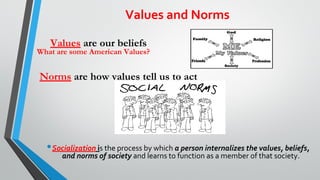
Values and Norms
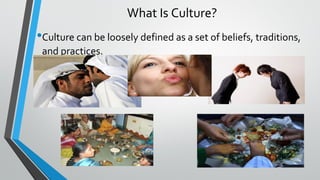
•Socializationis the process by which a person internalizes the values, beliefs,
and norms of society and learns to function as a member of that society.
Values are our beliefs
Norms are how values tell us to act
What are some American Values?
5.
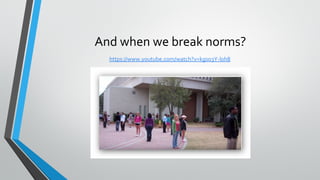
And when webreak norms?
https://www.youtube.com/watch?v=kgso3Y-l0h8
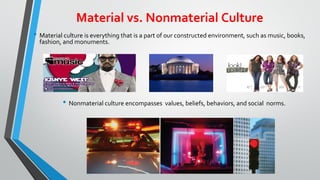
Material vs. NonmaterialCulture
• Material culture is everything that is a part of our constructed environment, such as music, books,
fashion, and monuments.
• Nonmaterial culture encompasses values, beliefs, behaviors, and social norms.
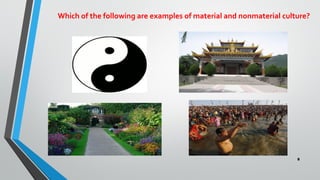
8.
Which of thefollowing are examples of material and nonmaterial culture?
8
9.
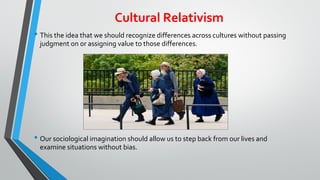
Cultural Relativism
• Thisthe idea that we should recognize differences across cultures without passing
judgment on or assigning value to those differences.
• Our sociological imagination should allow us to step back from our lives and
examine situations without bias.
10.
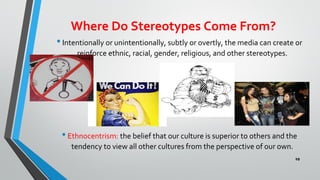
Where Do StereotypesCome From?
•Intentionally or unintentionally, subtly or overtly, the media can create or
reinforce ethnic, racial, gender, religious, and other stereotypes.
•Ethnocentrism: the belief that our culture is superior to others and the
tendency to view all other cultures from the perspective of our own.
10
11.
• The termwas coined by American Yale professor, William Graham Sumner
• Sumner defined ethnocentrism as:
"[The] view of things in which one´s group is the center of
everything, and others are scaled and rated with reference
to it. Each group nourishes its own pride and vanity, boasts
itself superior, exalts its own divinities and looks with
contempt on outsiders."
Ethnocentrism is a very “Anything you can do, we can
do it better” point of view concerning ethnicity.
https://www.youtube.com/watch?v=zSJFBeVFtak
12.
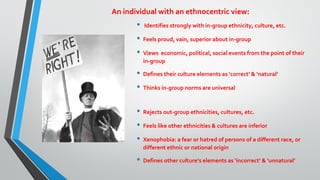
An individual withan ethnocentric view:
• Identifies strongly with in-group ethnicity, culture, etc.
• Feels proud, vain, superior about in-group
• Views economic, political, social events from the point of their
in-group
• Defines their culture elements as ‘correct’ & ‘natural’
• Thinks in-group norms are universal
• Rejects out-group ethnicities, cultures, etc.
• Feels like other ethnicities & cultures are inferior
• Xenophobia: a fear or hatred of persons of a different race, or
different ethnic or national origin
• Defines other culture’s elements as ‘incorrect’ & ‘unnatural’
13.
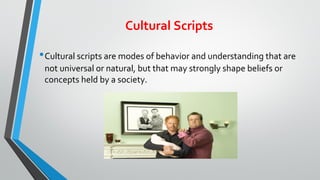
Cultural Scripts
•Cultural scriptsare modes of behavior and understanding that are
not universal or natural, but that may strongly shape beliefs or
concepts held by a society.
14.
Ethnocentrism occurs frequentlyhere at home
Examples:
•Capitalism vs. Communism: for years, the US has fought to end communism
because they believe capitalism trumps (no pun intended) all
•Driving: Ethnocentric Americans say that driving on the left side of the road is
the ‘wrong side’ & that the right side is the ‘correct side’
American Ethnocentrism
15.
More examples:
•Accents: EthnocentricAmericans may say that another person has an accent,
implying that the other person speaks different, strange, & un-American
•Legal Age of Alcohol Consumption: the US has a higher drinking age of most
other countries & does not emulate other countries by lowering the legal age
because they think it is the best age for a person to be able to start consuming
alcohol
American Ethnocentrism
16.
Extreme examples:
➢ Americansare obese & uneducated
➢ Canadians say ‘eh’
➢ Rich people are snobby & members of country clubs
➢ Asians are geniuses & bad drivers
➢ English people drink tea & have bad teeth
➢ Women are bad drivers & emotional
➢ Men are strong & smarter than women
Ethnocentric Stereotypes
17.
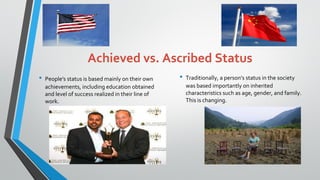
Achieved vs. AscribedStatus
• People's status is based mainly on their own
achievements, including education obtained
and level of success realized in their line of
work.
• Traditionally, a person's status in the society
was based importantly on inherited
characteristics such as age, gender, and family.
This is changing.
17
18.
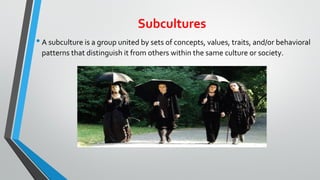
Subcultures
•A subculture isa group united by sets of concepts, values, traits, and/or behavioral
patterns that distinguish it from others within the same culture or society.
19.
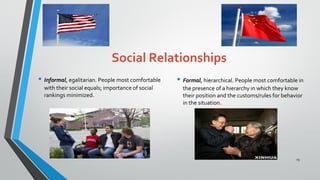
Social Relationships
• Informal,egalitarian. People most comfortable
with their social equals; importance of social
rankings minimized.
• Formal, hierarchical. People most comfortable in
the presence of a hierarchy in which they know
their position and the customs/rules for behavior
in the situation.
19
20.
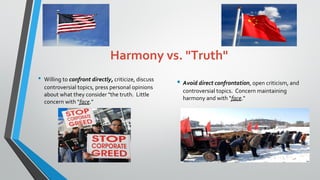
Harmony vs. "Truth"
•Willing to confront directly, criticize, discuss
controversial topics, press personal opinions
about what they consider "the truth. Little
concern with "face."
• Avoid direct confrontation, open criticism, and
controversial topics. Concern maintaining
harmony and with "face."
20
21.
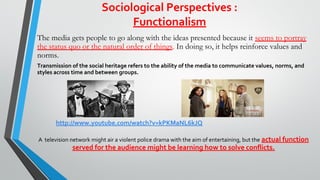
Sociological Perspectives :
Functionalism
Themedia gets people to go along with the ideas presented because it seems to portray
the status quo or the natural order of things. In doing so, it helps reinforce values and
norms.
Transmission of the social heritage refers to the ability of the media to communicate values, norms, and
styles across time and between groups.
A television network might air a violent police drama with the aim of entertaining, but the actual function
served for the audience might be learning how to solve conflicts.
http://www.youtube.com/watch?v=kPKMaNL6kJQ
22.
Sociological Perspectives:
Conflict
From aMarxist viewpoint, status-symbol chocolate advertising exemplifies how “commodity
fetishism” helps maintain capitalism. Such advertising legitimizes the elite class by reinforcing the
image of upper-class superiority and by presenting the luxurious lifestyle as something to aspire to.
22
Godiva promotes the idea that consumers of their chocolates are somehow “higher class” and more “tasteful”
than people who do not consume them. As a result, their chocolates have a higher exchange value than the
everyday, $1 chocolates meant for middle and lower-class consumers. Can you say “Starbucks?”
23.
Sociological Perspectives:
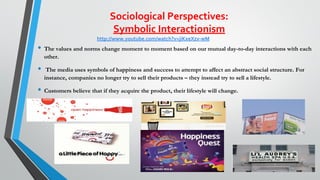
Symbolic Interactionism
•The values and norms change moment to moment based on our mutual day-to-day interactions with each
other.
• The media uses symbols of happiness and success to attempt to affect an abstract social structure. For
instance, companies no longer try to sell their products – they instead try to sell a lifestyle.
• Customers believe that if they acquire the product, their lifestyle will change.
23
http://www.youtube.com/watch?v=jiKxeXzv-wM
24.
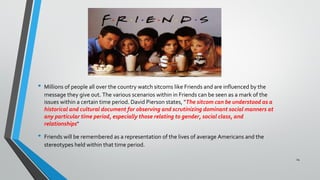
• Millions ofpeople all over the country watch sitcoms like Friends and are influenced by the
message they give out. The various scenarios within in Friends can be seen as a mark of the
issues within a certain time period. David Pierson states, "The sitcom can be understood as a
historical and cultural document for observing and scrutinizing dominant social manners at
any particular time period, especially those relating to gender, social class, and
relationships"
• Friends will be remembered as a representation of the lives of average Americans and the
stereotypes held within that time period.
24
25.
Mostly we don’tthink about it
and we are not always sure of the source of our information
Structural Functionalism
Talcott ParsonsEmile Durkheim
•Social institutions play a key role in keeping society alive and stable.
• Institutions train individuals into their social roles
• Educational institutions train people for their future statuses or jobs they will fill
• The family is in charge of socializing new members of society.
• Religion helps reaffirm values and morals to maintain social ties.
28.
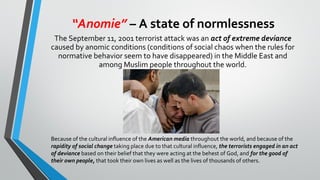
“Anomie” – Astate of normlessness
The September 11, 2001 terrorist attack was an act of extreme deviance
caused by anomic conditions (conditions of social chaos when the rules for
normative behavior seem to have disappeared) in the Middle East and
among Muslim people throughout the world.
Because of the cultural influence of the American media throughout the world, and because of the
rapidity of social change taking place due to that cultural influence, the terrorists engaged in an act
of deviance based on their belief that they were acting at the behest of God, and for the good of
their own people, that took their own lives as well as the lives of thousands of others.
29.
According to functionalists….
Evendysfunction and deviance has a purpose.
•Question: How could the drug trade, prostitution, war, cat-fishing be
somehow functional to society?
30.
The war inIraq according to the
Functionalist paradigm,
was fought in order to maintain security and stability
in the US by keeping terrorism at bay thousands of
miles away.
31.
The Conflict Perspective
KarlMarx Feminist Theorists
• Dominant classes subordinate the lower classes
• The structure of society is a source of inequality
• The focus is on how institutions promote division and inequality
• Conflict is the basic , animating force for social change and society in general.
Are the opportunities/consequences the same for all?
32.
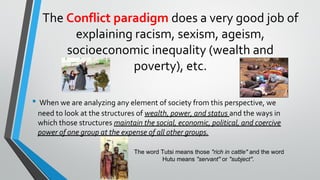
The Conflict paradigmdoes a very good job of
explaining racism, sexism, ageism,
socioeconomic inequality (wealth and
poverty), etc.
• When we are analyzing any element of society from this perspective, we
need to look at the structures of wealth, power, and status and the ways in
which those structures maintain the social, economic, political, and coercive
power of one group at the expense of all other groups.
The word Tutsi means those "rich in cattle" and the word
Hutu means "servant" or "subject".
33.
Conflict: The warin Iraq
The Bourgeoisie (the United States and most of Western Europe) has exploited
for decades the people and natural resources of the Middle East without
offering economic and educational support to the people. The U.S. and
Western Europe have supported dictatorial regimes, ignored human rights
abuses, and generally turned their backs on the plight of the majority of Middle
Easterners and Muslims in general throughout the world.
Thus, the terrorists (as representatives of the Proletariat), attacked, or attempted
to attack, the centers of American power: the World Trade Center (economic
power), the Pentagon (military power), and the U.S. Capital (political power).
34.
The war inIraq which began in 2003, according to
the Conflict paradigm, was being fought in order to
extend the power and control of the United States,
and to create an American empire in the non-white,
non-Christian world.
35.
The September 11,2001 terrorist attack was caused
by American foreign policy vis á vis the Middle East
as a whole, the first Gulf War, American support of
the Israeli government and Israel’s treatment of its
Palestinian population.
36.
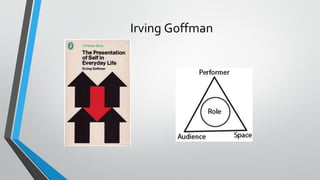
Symbolic Interaction
Blumer Goffman
•Unlike functionalism and conflict which are macro approaches to structures in society,
SI examines the micro-level, day to day interaction with people.
• Takes place within a world of symbolic communication.
• The symbols we use, language, gestures, posture are influences by the larger group or
society.
• Society emerges from countless interpersonal communications that individuals have.
• When you play the role as the student and I as the professor, we reinforce the larger
institution of the University.
37.
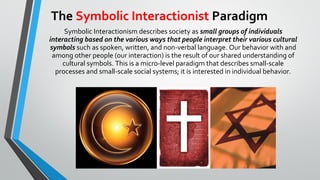
The Symbolic InteractionistParadigm
Symbolic Interactionism describes society as small groups of individuals
interacting based on the various ways that people interpret their various cultural
symbols such as spoken, written, and non-verbal language. Our behavior with and
among other people (our interaction) is the result of our shared understanding of
cultural symbols. This is a micro-level paradigm that describes small-scale
processes and small-scale social systems; it is interested in individual behavior.
38.
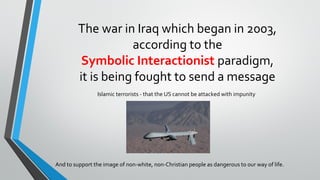
The war inIraq which began in 2003,
according to the
Symbolic Interactionist paradigm,
it is being fought to send a message
Islamic terrorists - that the US cannot be attacked with impunity
And to support the image of non-white, non-Christian people as dangerous to our way of life.

![• The term was coined by American Yale professor, William Graham Sumner
• Sumner defined ethnocentrism as:
"[The] view of things in which one´s group is the center of
everything, and others are scaled and rated with reference
to it. Each group nourishes its own pride and vanity, boasts
itself superior, exalts its own divinities and looks with
contempt on outsiders."
Ethnocentrism is a very “Anything you can do, we can
do it better” point of view concerning ethnicity.
https://www.youtube.com/watch?v=zSJFBeVFtak](https://image.slidesharecdn.com/sociologicalperspectiveswcccrev2018-180809125240/85/Sociological-Perspectives-WCCC-rev2018-11-320.jpg)










![Awareness of social contemporary issues [autosaved]](https://cdn.slidesharecdn.com/ss_thumbnails/awarenessofsocialcontemporaryissuesautosaved-170610134951-thumbnail.jpg?width=640&height=640&fit=bounds)


