Copyright ©2013 W.W. Norton, Inc.
You
May Ask
Yourself
Core Third Edition
Dalton Conley
You
May Ask
Yourself
Third Edition
Dalton Conley
Chapter 3
Culture and
Media
2Copyright ©2013 W.W. Norton, Inc.
Paradox
3Copyright ©2013 W.W. Norton, Inc.
What Is Culture?
• Culture can be loosely defined as a
set of beliefs, traditions, and
practices.
4Copyright ©2013 W.W. Norton, Inc.
What Is Culture?
• The concept of culture has evolved and
expanded throughout history.
• The oldest understandings of culture focus
on the distinction between:
– natural environment and
– what is modified or created by humans.
5Copyright ©2013 W.W. Norton, Inc.
What Is Culture?
• As Europeans came into contact with non-
Westerners, culture evolved in terms of
differences between peoples, which could be
viewed positively or negatively.
• In the eighteenth and nineteenth centuries, a
new dimension was added to the concept of
culture – the idea that culture involved the
pursuit of intellectual refinement.
6Copyright ©2013 W.W. Norton, Inc.
Material vs.
Nonmaterial Culture
• Material culture is everything that is a part of
our constructed environment, such as books,
fashion, and monuments.
• Nonmaterial culture encompasses values,
beliefs, behaviors, and social norms.
7Copyright ©2013 W.W. Norton, Inc.
Cultural Relativism
• Coined by Ruth Benedict in the 1930s,
this is the idea that we should recognize
differences across cultures without
passing judgment on or assigning value
to those differences.
8Copyright ©2013 W.W. Norton, Inc.
Cultural Scripts
• Cultural scripts are modes of behavior and
understanding that are not universal or natural,
but that may strongly shape beliefs or
concepts held by a society.
9Copyright ©2013 W.W. Norton, Inc.
Subcultures
• A subculture is a group united by sets of
concepts, values, traits, and/or behavioral
patterns that distinguish it from others within
the same culture or society.
10Copyright ©2013 W.W. Norton, Inc.
Values and Norms
• Values are moral beliefs.
• Norms are how values tell us to act.
• Socialization is the process by which a
person internalizes the values, beliefs,
and norms of society and learns to
function as a member of that society.
11Copyright ©2013 W.W. Norton, Inc.
Reflection Theory
• Reflection theory states that culture is a
projection of social structures and
relationships into the public sphere.
• A Marxist version of reflection theory argues
that cultural objects reflect the material labor
and production relationships that went into
making them.
12Copyright ©2013 W.W. Norton, Inc.
What Is Media?
• Media are any formats or vehicles that carry,
present, or communicate information – books,
posters, Web pages, clay tablets, and radio.
• Mass media refers to any form of media that
reaches the mass of the people.
13Copyright ©2013 W.W. Norton, Inc.
Media
• Hegemony refers to the impact of media on
culture and how people and societies shape,
and are shaped by, the dominant culture.
14Copyright ©2013 W.W. Norton, Inc.
The Media Life Cycle
• Media studies open paths of investigation,
including:
– textual analysis and audience studies
– how people create media and the biases
involved in that creation
– how media reflect the culture in which
they exist
– how individuals and groups use the media
to change culture
15Copyright ©2013 W.W. Norton, Inc.
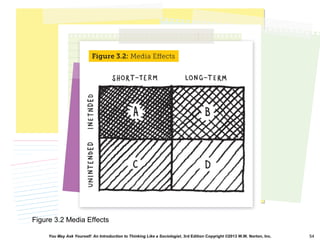
Media Effects
• Media effects can be placed into four
categories according to their duration and
intention:
– short-term and deliberate
– long-term and deliberate
– short-term and unintentional
– long-term and unintentional
16Copyright ©2013 W.W. Norton, Inc.
Where Do Stereotypes
Come From?
• Intentionally or unintentionally, subtly or
overtly, the media can create or reinforce
ethnic, racial, gender, religious, and other
stereotypes.
17Copyright ©2013 W.W. Norton, Inc.
Political Economy of the
Media
• Media ownership in the United
States is in the hands of six
companies.
• Those companies affect the
information and messages
communicated to the public.
18Copyright ©2013 W.W. Norton, Inc.
Political Economy of the
Media
• The media, especially
advertisements, play a large role in
the maintenance of consumerism:
the belief that happiness and
fulfillment can be achieved through
acquisition of material possessions.
19Copyright ©2013 W.W. Norton, Inc.
Interview
Allison Pugh
20Copyright ©2013 W.W. Norton, Inc.
Political Economy of the
Media
• The globalization of the media has
spread American culture around the
world. This has effects on culture, values,
and ideas on others' behavior, and it has
experienced a drop in popularity
recently because of some American
foreign policies.
21Copyright ©2013 W.W. Norton, Inc.
Political Economy of the
Media
• Culture jamming
is one example of
subverting the
power of media
22Copyright ©2013 W.W. Norton, Inc.
Concept Quiz
1. Which of the following is an example of
material culture?
a) Buddhist temple
b) music Web site
c) English garden
d) all of the above
23Copyright ©2013 W.W. Norton, Inc.
Concept Quiz
2. Ideology can be described as _____.
a) an aspect of material culture
b) a system of concepts and relationships that guides
an individual or large group
c) an extreme point of view on a given topic
d) none of the above
24Copyright ©2013 W.W. Norton, Inc.
Concept Quiz
3. Cultural scripts are _____.
a) modes of behavior and understanding that are not
universal or natural
b) a type of role-playing that helps people learn
about different cultures
c) a type of study developed by sociologists to
catalog cultural differences
d) patterns of behavior that can be found in almost
all cultures
25Copyright ©2013 W.W. Norton, Inc.
Concept Quiz
4. Examples of media include _____.
a) television, websites, and radio
b) books, magazines, and ancient scrolls
c) records, cave paintings, and streaming video
d) all of the above
26Copyright ©2013 W.W. Norton, Inc.
Concept Quiz
5. True or false? The globalization of the media
has spread American culture around the
world.
a) true
b) false
27Copyright ©2013 W.W. Norton, Inc.
Discussion Questions
1. Have you traveled to another country?
a) yes
b) no
28Copyright ©2013 W.W. Norton, Inc.
Discussion Questions
2. In your opinion, how does the media impact
culture?
a) The media creates culture (we do what we see on
TV).
b) The media simply shows us culture (we don’t
mimic TV – TV mimics us).
c) Both of the above: TV shows us our culture, and
then we mimic what we see.
d) None of the above: the media has no impact on
culture.
You May Ask Yourself: An Introduction to Thinking Like a Sociologist, 3rd Edition Copyright ©2013 W.W. Norton, Inc. 29
Chapter opener
You May Ask Yourself: An Introduction to Thinking Like a Sociologist, 3rd Edition Copyright ©2013 W.W. Norton, Inc. 30
Jill and Kevin head down the aisle to Chris Brown’s “Forever.”
You May Ask Yourself: An Introduction to Thinking Like a Sociologist, 3rd Edition Copyright ©2013 W.W. Norton, Inc. 31
A sixteenth-century Aztec’s drawing of the conquistador Hernán Cortés. Why did Western
definitions of culture change during the age of exploration?
You May Ask Yourself: An Introduction to Thinking Like a Sociologist, 3rd Edition Copyright ©2013 W.W. Norton, Inc. 32
U.S. Capitol, Washington, D.C.
You May Ask Yourself: An Introduction to Thinking Like a Sociologist, 3rd Edition Copyright ©2013 W.W. Norton, Inc. 33
Lincoln Memorial, Washington, D.C.
You May Ask Yourself: An Introduction to Thinking Like a Sociologist, 3rd Edition Copyright ©2013 W.W. Norton, Inc. 34
Toltec columns, Tula, Mexico
You May Ask Yourself: An Introduction to Thinking Like a Sociologist, 3rd Edition Copyright ©2013 W.W. Norton, Inc. 35
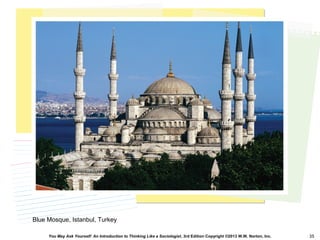
Blue Mosque, Istanbul, Turkey
You May Ask Yourself: An Introduction to Thinking Like a Sociologist, 3rd Edition Copyright ©2013 W.W. Norton, Inc. 36
Ingres’ La Grande Odalisque (1814)
You May Ask Yourself: An Introduction to Thinking Like a Sociologist, 3rd Edition Copyright ©2013 W.W. Norton, Inc. 37
Table 3.1 Emotions
You May Ask Yourself: An Introduction to Thinking Like a Sociologist, 3rd Edition Copyright ©2013 W.W. Norton, Inc. 38
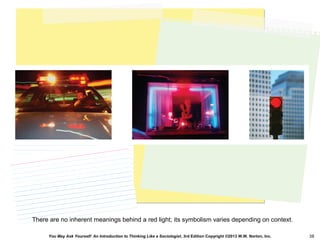
There are no inherent meanings behind a red light; its symbolism varies depending on context.
You May Ask Yourself: An Introduction to Thinking Like a Sociologist, 3rd Edition Copyright ©2013 W.W. Norton, Inc. 39
A page from the satirical newspaper The Onion that appeared after Jonathan Franzen criticized
Oprah Winfrey’s book club as middlebrow.
You May Ask Yourself: An Introduction to Thinking Like a Sociologist, 3rd Edition Copyright ©2013 W.W. Norton, Inc. 40
Margaret Mead with two Samoan women, 1926.
You May Ask Yourself: An Introduction to Thinking Like a Sociologist, 3rd Edition Copyright ©2013 W.W. Norton, Inc. 41
A cockfight in Bali, Indonesia. How are roosters central to Bali’s symbolic culture?
You May Ask Yourself: An Introduction to Thinking Like a Sociologist, 3rd Edition Copyright ©2013 W.W. Norton, Inc. 42
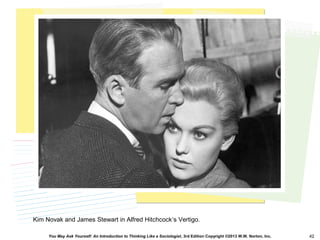
Kim Novak and James Stewart in Alfred Hitchcock’s Vertigo.
You May Ask Yourself: An Introduction to Thinking Like a Sociologist, 3rd Edition Copyright ©2013 W.W. Norton, Inc. 43
Figure 3.1 Popularity of the Name Kim
You May Ask Yourself: An Introduction to Thinking Like a Sociologist, 3rd Edition Copyright ©2013 W.W. Norton, Inc. 44
Cary Grant
You May Ask Yourself: An Introduction to Thinking Like a Sociologist, 3rd Edition Copyright ©2013 W.W. Norton, Inc. 45
Goths in Germany (left) and Japan. What characteristics of Goth culture make it a subculture?
You May Ask Yourself: An Introduction to Thinking Like a Sociologist, 3rd Edition Copyright ©2013 W.W. Norton, Inc. 46
Why might performers like Lil’ Wayne use reflection theory to defend their lyrics? What are some
of the limitations to this theory?
You May Ask Yourself: An Introduction to Thinking Like a Sociologist, 3rd Edition Copyright ©2013 W.W. Norton, Inc. 47
How has the cultural significance of Shakespeare’s plays changed over the last 400 years?
Compare the poster for an 1884 performance of Macbeth (left) with a 1944 photo of
Laurence Olivier as Henry V.
You May Ask Yourself: An Introduction to Thinking Like a Sociologist, 3rd Edition Copyright ©2013 W.W. Norton, Inc. 48
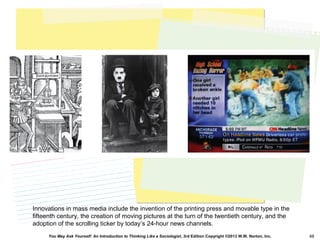
Innovations in mass media include the invention of the printing press and movable type in the
fifteenth century, the creation of moving pictures at the turn of the twentieth century, and the
adoption of the scrolling ticker by today’s 24-hour news channels.
You May Ask Yourself: An Introduction to Thinking Like a Sociologist, 3rd Edition Copyright ©2013 W.W. Norton, Inc. 49
In 1963, for the first time televisions beamed images such as this photo of police officers attacking
a student in Birmingham, Alabama. How did television influence the reaction to events
such as the civil rights movement?
You May Ask Yourself: An Introduction to Thinking Like a Sociologist, 3rd Edition Copyright ©2013 W.W. Norton, Inc. 50
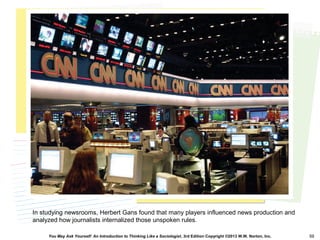
In studying newsrooms, Herbert Gans found that many players influenced news production and
analyzed how journalists internalized those unspoken rules.
You May Ask Yourself: An Introduction to Thinking Like a Sociologist, 3rd Edition Copyright ©2013 W.W. Norton, Inc. 51
“When I’m good, I’m very good, but when I’m bad, I’m better.” —ACTRESS MAE WEST
You May Ask Yourself: An Introduction to Thinking Like a Sociologist, 3rd Edition Copyright ©2013 W.W. Norton, Inc. 52
Lucille Ball and Desi Arnaz in the 1950s hit television comedy I Love Lucy. Even though their
characters were married, they still did not share a bed.
You May Ask Yourself: An Introduction to Thinking Like a Sociologist, 3rd Edition Copyright ©2013 W.W. Norton, Inc. 53
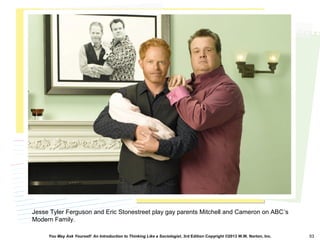
Jesse Tyler Ferguson and Eric Stonestreet play gay parents Mitchell and Cameron on ABC’s
Modern Family.
You May Ask Yourself: An Introduction to Thinking Like a Sociologist, 3rd Edition Copyright ©2013 W.W. Norton, Inc. 54
Figure 3.2 Media Effects
You May Ask Yourself: An Introduction to Thinking Like a Sociologist, 3rd Edition Copyright ©2013 W.W. Norton, Inc. 55
The controversial O.J. Simpson arrest photo. Time magazine was accused of darkening his
features for their cover.
You May Ask Yourself: An Introduction to Thinking Like a Sociologist, 3rd Edition Copyright ©2013 W.W. Norton, Inc. 56
The photo above, published by the Associated Press, showed a young African American wading
through chest-high water toting groceries; the caption proclaimed that the man had just been
“looting a grocery store.” The second, which pictured a Caucasian couple doing the same thing
stated that the two were photographed “after finding bread and soda at a local grocery store.”
You May Ask Yourself: An Introduction to Thinking Like a Sociologist, 3rd Edition Copyright ©2013 W.W. Norton, Inc. 57
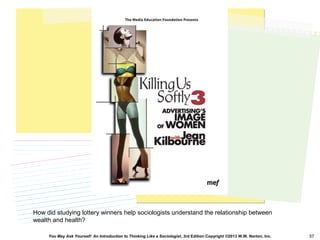
How did studying lottery winners help sociologists understand the relationship between
wealth and health?
You May Ask Yourself: An Introduction to Thinking Like a Sociologist, 3rd Edition Copyright ©2013 W.W. Norton, Inc. 58
A 2005 billboard from Dove soap’s advertising campaign featuring women who are not
professional models.
You May Ask Yourself: An Introduction to Thinking Like a Sociologist, 3rd Edition Copyright ©2013 W.W. Norton, Inc. 59
You May Ask Yourself: An Introduction to Thinking Like a Sociologist, 3rd Edition Copyright ©2013 W.W. Norton, Inc. 60
Two satirical ads from Adbusters magazine. How do these ads critique or subvert the tobacco
and fashion industries?
You May Ask Yourself: An Introduction to Thinking Like a Sociologist, 3rd Edition Copyright ©2013 W.W. Norton, Inc. 61
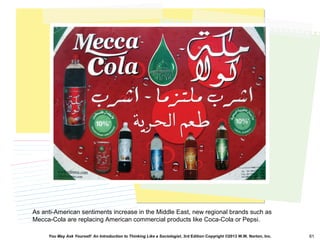
As anti-American sentiments increase in the Middle East, new regional brands such as
Mecca-Cola are replacing American commercial products like Coca-Cola or Pepsi.
This concludes the
Lecture PowerPoint
presentation for:
You
May Ask
Yourself
Core Third Edition
Dalton Conley
You
May Ask
Yourself
Third Edition
Dalton Conley
Visit the StudySpace at:
wwnorton.com/studyspace
For more learning resources, please
visit the StudySpace site for
You May Ask Yourself
Chapter 3
Culture and Media
62

Chapter 3

  • 1.
    Copyright ©2013 W.W.Norton, Inc. You May Ask Yourself Core Third Edition Dalton Conley You May Ask Yourself Third Edition Dalton Conley Chapter 3 Culture and Media
  • 2.
    2Copyright ©2013 W.W.Norton, Inc. Paradox
  • 3.
    3Copyright ©2013 W.W.Norton, Inc. What Is Culture? • Culture can be loosely defined as a set of beliefs, traditions, and practices.
  • 4.
    4Copyright ©2013 W.W.Norton, Inc. What Is Culture? • The concept of culture has evolved and expanded throughout history. • The oldest understandings of culture focus on the distinction between: – natural environment and – what is modified or created by humans.
  • 5.
    5Copyright ©2013 W.W.Norton, Inc. What Is Culture? • As Europeans came into contact with non- Westerners, culture evolved in terms of differences between peoples, which could be viewed positively or negatively. • In the eighteenth and nineteenth centuries, a new dimension was added to the concept of culture – the idea that culture involved the pursuit of intellectual refinement.
  • 6.
    6Copyright ©2013 W.W.Norton, Inc. Material vs. Nonmaterial Culture • Material culture is everything that is a part of our constructed environment, such as books, fashion, and monuments. • Nonmaterial culture encompasses values, beliefs, behaviors, and social norms.
  • 7.
    7Copyright ©2013 W.W.Norton, Inc. Cultural Relativism • Coined by Ruth Benedict in the 1930s, this is the idea that we should recognize differences across cultures without passing judgment on or assigning value to those differences.
  • 8.
    8Copyright ©2013 W.W.Norton, Inc. Cultural Scripts • Cultural scripts are modes of behavior and understanding that are not universal or natural, but that may strongly shape beliefs or concepts held by a society.
  • 9.
    9Copyright ©2013 W.W.Norton, Inc. Subcultures • A subculture is a group united by sets of concepts, values, traits, and/or behavioral patterns that distinguish it from others within the same culture or society.
  • 10.
    10Copyright ©2013 W.W.Norton, Inc. Values and Norms • Values are moral beliefs. • Norms are how values tell us to act. • Socialization is the process by which a person internalizes the values, beliefs, and norms of society and learns to function as a member of that society.
  • 11.
    11Copyright ©2013 W.W.Norton, Inc. Reflection Theory • Reflection theory states that culture is a projection of social structures and relationships into the public sphere. • A Marxist version of reflection theory argues that cultural objects reflect the material labor and production relationships that went into making them.
  • 12.
    12Copyright ©2013 W.W.Norton, Inc. What Is Media? • Media are any formats or vehicles that carry, present, or communicate information – books, posters, Web pages, clay tablets, and radio. • Mass media refers to any form of media that reaches the mass of the people.
  • 13.
    13Copyright ©2013 W.W.Norton, Inc. Media • Hegemony refers to the impact of media on culture and how people and societies shape, and are shaped by, the dominant culture.
  • 14.
    14Copyright ©2013 W.W.Norton, Inc. The Media Life Cycle • Media studies open paths of investigation, including: – textual analysis and audience studies – how people create media and the biases involved in that creation – how media reflect the culture in which they exist – how individuals and groups use the media to change culture
  • 15.
    15Copyright ©2013 W.W.Norton, Inc. Media Effects • Media effects can be placed into four categories according to their duration and intention: – short-term and deliberate – long-term and deliberate – short-term and unintentional – long-term and unintentional
  • 16.
    16Copyright ©2013 W.W.Norton, Inc. Where Do Stereotypes Come From? • Intentionally or unintentionally, subtly or overtly, the media can create or reinforce ethnic, racial, gender, religious, and other stereotypes.
  • 17.
    17Copyright ©2013 W.W.Norton, Inc. Political Economy of the Media • Media ownership in the United States is in the hands of six companies. • Those companies affect the information and messages communicated to the public.
  • 18.
    18Copyright ©2013 W.W.Norton, Inc. Political Economy of the Media • The media, especially advertisements, play a large role in the maintenance of consumerism: the belief that happiness and fulfillment can be achieved through acquisition of material possessions.
  • 19.
    19Copyright ©2013 W.W.Norton, Inc. Interview Allison Pugh
  • 20.
    20Copyright ©2013 W.W.Norton, Inc. Political Economy of the Media • The globalization of the media has spread American culture around the world. This has effects on culture, values, and ideas on others' behavior, and it has experienced a drop in popularity recently because of some American foreign policies.
  • 21.
    21Copyright ©2013 W.W.Norton, Inc. Political Economy of the Media • Culture jamming is one example of subverting the power of media
  • 22.
    22Copyright ©2013 W.W.Norton, Inc. Concept Quiz 1. Which of the following is an example of material culture? a) Buddhist temple b) music Web site c) English garden d) all of the above
  • 23.
    23Copyright ©2013 W.W.Norton, Inc. Concept Quiz 2. Ideology can be described as _____. a) an aspect of material culture b) a system of concepts and relationships that guides an individual or large group c) an extreme point of view on a given topic d) none of the above
  • 24.
    24Copyright ©2013 W.W.Norton, Inc. Concept Quiz 3. Cultural scripts are _____. a) modes of behavior and understanding that are not universal or natural b) a type of role-playing that helps people learn about different cultures c) a type of study developed by sociologists to catalog cultural differences d) patterns of behavior that can be found in almost all cultures
  • 25.
    25Copyright ©2013 W.W.Norton, Inc. Concept Quiz 4. Examples of media include _____. a) television, websites, and radio b) books, magazines, and ancient scrolls c) records, cave paintings, and streaming video d) all of the above
  • 26.
    26Copyright ©2013 W.W.Norton, Inc. Concept Quiz 5. True or false? The globalization of the media has spread American culture around the world. a) true b) false
  • 27.
    27Copyright ©2013 W.W.Norton, Inc. Discussion Questions 1. Have you traveled to another country? a) yes b) no
  • 28.
    28Copyright ©2013 W.W.Norton, Inc. Discussion Questions 2. In your opinion, how does the media impact culture? a) The media creates culture (we do what we see on TV). b) The media simply shows us culture (we don’t mimic TV – TV mimics us). c) Both of the above: TV shows us our culture, and then we mimic what we see. d) None of the above: the media has no impact on culture.
  • 29.
    You May AskYourself: An Introduction to Thinking Like a Sociologist, 3rd Edition Copyright ©2013 W.W. Norton, Inc. 29 Chapter opener
  • 30.
    You May AskYourself: An Introduction to Thinking Like a Sociologist, 3rd Edition Copyright ©2013 W.W. Norton, Inc. 30 Jill and Kevin head down the aisle to Chris Brown’s “Forever.”
  • 31.
    You May AskYourself: An Introduction to Thinking Like a Sociologist, 3rd Edition Copyright ©2013 W.W. Norton, Inc. 31 A sixteenth-century Aztec’s drawing of the conquistador Hernán Cortés. Why did Western definitions of culture change during the age of exploration?
  • 32.
    You May AskYourself: An Introduction to Thinking Like a Sociologist, 3rd Edition Copyright ©2013 W.W. Norton, Inc. 32 U.S. Capitol, Washington, D.C.
  • 33.
    You May AskYourself: An Introduction to Thinking Like a Sociologist, 3rd Edition Copyright ©2013 W.W. Norton, Inc. 33 Lincoln Memorial, Washington, D.C.
  • 34.
    You May AskYourself: An Introduction to Thinking Like a Sociologist, 3rd Edition Copyright ©2013 W.W. Norton, Inc. 34 Toltec columns, Tula, Mexico
  • 35.
    You May AskYourself: An Introduction to Thinking Like a Sociologist, 3rd Edition Copyright ©2013 W.W. Norton, Inc. 35 Blue Mosque, Istanbul, Turkey
  • 36.
    You May AskYourself: An Introduction to Thinking Like a Sociologist, 3rd Edition Copyright ©2013 W.W. Norton, Inc. 36 Ingres’ La Grande Odalisque (1814)
  • 37.
    You May AskYourself: An Introduction to Thinking Like a Sociologist, 3rd Edition Copyright ©2013 W.W. Norton, Inc. 37 Table 3.1 Emotions
  • 38.
    You May AskYourself: An Introduction to Thinking Like a Sociologist, 3rd Edition Copyright ©2013 W.W. Norton, Inc. 38 There are no inherent meanings behind a red light; its symbolism varies depending on context.
  • 39.
    You May AskYourself: An Introduction to Thinking Like a Sociologist, 3rd Edition Copyright ©2013 W.W. Norton, Inc. 39 A page from the satirical newspaper The Onion that appeared after Jonathan Franzen criticized Oprah Winfrey’s book club as middlebrow.
  • 40.
    You May AskYourself: An Introduction to Thinking Like a Sociologist, 3rd Edition Copyright ©2013 W.W. Norton, Inc. 40 Margaret Mead with two Samoan women, 1926.
  • 41.
    You May AskYourself: An Introduction to Thinking Like a Sociologist, 3rd Edition Copyright ©2013 W.W. Norton, Inc. 41 A cockfight in Bali, Indonesia. How are roosters central to Bali’s symbolic culture?
  • 42.
    You May AskYourself: An Introduction to Thinking Like a Sociologist, 3rd Edition Copyright ©2013 W.W. Norton, Inc. 42 Kim Novak and James Stewart in Alfred Hitchcock’s Vertigo.
  • 43.
    You May AskYourself: An Introduction to Thinking Like a Sociologist, 3rd Edition Copyright ©2013 W.W. Norton, Inc. 43 Figure 3.1 Popularity of the Name Kim
  • 44.
    You May AskYourself: An Introduction to Thinking Like a Sociologist, 3rd Edition Copyright ©2013 W.W. Norton, Inc. 44 Cary Grant
  • 45.
    You May AskYourself: An Introduction to Thinking Like a Sociologist, 3rd Edition Copyright ©2013 W.W. Norton, Inc. 45 Goths in Germany (left) and Japan. What characteristics of Goth culture make it a subculture?
  • 46.
    You May AskYourself: An Introduction to Thinking Like a Sociologist, 3rd Edition Copyright ©2013 W.W. Norton, Inc. 46 Why might performers like Lil’ Wayne use reflection theory to defend their lyrics? What are some of the limitations to this theory?
  • 47.
    You May AskYourself: An Introduction to Thinking Like a Sociologist, 3rd Edition Copyright ©2013 W.W. Norton, Inc. 47 How has the cultural significance of Shakespeare’s plays changed over the last 400 years? Compare the poster for an 1884 performance of Macbeth (left) with a 1944 photo of Laurence Olivier as Henry V.
  • 48.
    You May AskYourself: An Introduction to Thinking Like a Sociologist, 3rd Edition Copyright ©2013 W.W. Norton, Inc. 48 Innovations in mass media include the invention of the printing press and movable type in the fifteenth century, the creation of moving pictures at the turn of the twentieth century, and the adoption of the scrolling ticker by today’s 24-hour news channels.
  • 49.
    You May AskYourself: An Introduction to Thinking Like a Sociologist, 3rd Edition Copyright ©2013 W.W. Norton, Inc. 49 In 1963, for the first time televisions beamed images such as this photo of police officers attacking a student in Birmingham, Alabama. How did television influence the reaction to events such as the civil rights movement?
  • 50.
    You May AskYourself: An Introduction to Thinking Like a Sociologist, 3rd Edition Copyright ©2013 W.W. Norton, Inc. 50 In studying newsrooms, Herbert Gans found that many players influenced news production and analyzed how journalists internalized those unspoken rules.
  • 51.
    You May AskYourself: An Introduction to Thinking Like a Sociologist, 3rd Edition Copyright ©2013 W.W. Norton, Inc. 51 “When I’m good, I’m very good, but when I’m bad, I’m better.” —ACTRESS MAE WEST
  • 52.
    You May AskYourself: An Introduction to Thinking Like a Sociologist, 3rd Edition Copyright ©2013 W.W. Norton, Inc. 52 Lucille Ball and Desi Arnaz in the 1950s hit television comedy I Love Lucy. Even though their characters were married, they still did not share a bed.
  • 53.
    You May AskYourself: An Introduction to Thinking Like a Sociologist, 3rd Edition Copyright ©2013 W.W. Norton, Inc. 53 Jesse Tyler Ferguson and Eric Stonestreet play gay parents Mitchell and Cameron on ABC’s Modern Family.
  • 54.
    You May AskYourself: An Introduction to Thinking Like a Sociologist, 3rd Edition Copyright ©2013 W.W. Norton, Inc. 54 Figure 3.2 Media Effects
  • 55.
    You May AskYourself: An Introduction to Thinking Like a Sociologist, 3rd Edition Copyright ©2013 W.W. Norton, Inc. 55 The controversial O.J. Simpson arrest photo. Time magazine was accused of darkening his features for their cover.
  • 56.
    You May AskYourself: An Introduction to Thinking Like a Sociologist, 3rd Edition Copyright ©2013 W.W. Norton, Inc. 56 The photo above, published by the Associated Press, showed a young African American wading through chest-high water toting groceries; the caption proclaimed that the man had just been “looting a grocery store.” The second, which pictured a Caucasian couple doing the same thing stated that the two were photographed “after finding bread and soda at a local grocery store.”
  • 57.
    You May AskYourself: An Introduction to Thinking Like a Sociologist, 3rd Edition Copyright ©2013 W.W. Norton, Inc. 57 How did studying lottery winners help sociologists understand the relationship between wealth and health?
  • 58.
    You May AskYourself: An Introduction to Thinking Like a Sociologist, 3rd Edition Copyright ©2013 W.W. Norton, Inc. 58 A 2005 billboard from Dove soap’s advertising campaign featuring women who are not professional models.
  • 59.
    You May AskYourself: An Introduction to Thinking Like a Sociologist, 3rd Edition Copyright ©2013 W.W. Norton, Inc. 59
  • 60.
    You May AskYourself: An Introduction to Thinking Like a Sociologist, 3rd Edition Copyright ©2013 W.W. Norton, Inc. 60 Two satirical ads from Adbusters magazine. How do these ads critique or subvert the tobacco and fashion industries?
  • 61.
    You May AskYourself: An Introduction to Thinking Like a Sociologist, 3rd Edition Copyright ©2013 W.W. Norton, Inc. 61 As anti-American sentiments increase in the Middle East, new regional brands such as Mecca-Cola are replacing American commercial products like Coca-Cola or Pepsi.
  • 62.
    This concludes the LecturePowerPoint presentation for: You May Ask Yourself Core Third Edition Dalton Conley You May Ask Yourself Third Edition Dalton Conley Visit the StudySpace at: wwnorton.com/studyspace For more learning resources, please visit the StudySpace site for You May Ask Yourself Chapter 3 Culture and Media 62

Editor's Notes

  • #3 Narrated by Dalton Conley, these brief animations explain the chapter-opening paradox and synthesize the research covered in the chapter. These animations are also on the free student StudySpace.
  • #4 Culture includes things like: the way we speak, the food we eat, the way we dress. Also, it is important to note that culture is not biological. Rather, it is passed down from one generation to the next through communication – we learn culture from our families and other institutions in society.
  • #6 Sociologists take caution not be judgmental when evaluating other cultures. Our job is not to determine which culture is best, but rather, to understand how and why cultures may be similar or different. We’ll talk more about this in a minute.
  • #7 Items in a culture do not have meaning inherently – we assign meaning to them. For example, in American culture, we know that a chair is for sitting in. But could it not also be used as a step ladder, or a weapon, or a decoration? We have assigned meaning to it, and that makes it valuable in a certain way in our culture. Nonmaterial culture works in a similar way. As a society, we determine the values, beliefs, behaviors, and social norms that we find appropriate and acceptable. Culture includes language, the meanings we assign to words, and concepts such as class, inequality, and ownership. Nonmaterial culture can take the form of ideology, which is a system of concepts and relationships that includes an understanding of cause and effect.
  • #8 As previously mentioned, we take great caution not to judge other cultures as being inferior or superior. This is one of the biggest benefits of utilizing our sociological imagination – we have the ability to step back from our own lives and examine situations without bias.
  • #9 Gender roles, which we will talk about when we get to Chapter 8, are examples of cultural scripts. Acting masculine or femininely may seem “natural,” but these roles are strongly influenced by culture and society, and these behaviors aren’t universal – roles may be very different for men and women in other cultures or societies.
  • #10 Sometimes members of subcultures are marginalized from society, but oftentimes, these individuals interact with other members of society without notice – they just have characteristics that make them different from members of the larger, dominant culture.Some examples could be people who listen to punk music, people with a naval piercing, or vegetarians. Generally, these individuals still work, go to school, go grocery shopping, and interact normally with individuals in the dominant culture, without incident.
  • #11 We begin learning values and norms at an early age – likely before we are even able to talk! This happens through the process of socialization. Our family socializes us, then schools and teachers, friends, religion, the media, and others continue to socialize us through the course of our lives.
  • #12 The media could be a great example for reflection theory, and we’re going to talk more about that in just a minute. Some reporters might say that they don’t make the stories up, they simply tell the stories that already exist. Of course, reporters do sometimes pick and choose which stories to tell, so we can question whether the media reflects culture or creates culture – or both. We’ll talk more about the media in a little later.
  • #14 Many critics of the media often argue that not all aspects or perspectives are equally disseminated or valued in the media. Instead, only the dominant culture is reinforced through the media. Granted, the media’s power is not an example of domination – it doesn’t force anyone to do or believe anything. Rather, according to critics, the media gets people to go along with the ideas presented because it seems to portray the status quo or the natural order of things.
  • #15 The media (and the effects of the media) give sociologists many avenues for research. Some of those avenues are listed here.
  • #16 It is very difficult to determine a causation between the media and behaviors, but we can see correlations and associations, and those can happen in different ways, as you see on this slide. Some examples of these include: short-term and deliberate: advertising (buy our product next time you go to the store) long-term and deliberate: a campaign (“Give a Hoot, Don’t Pollute,” “Take a Bite Out of Crime”) short-term and unintentional: violence in the media encourages violent behavior long-term and unintentional: prejudices, stereotypes, desensitization to violence
  • #17 Sometimes, in the process, the media distract people’s attention from foundational issues or tensions that need to be addressed. The media is sometimes blamed for creating a “false consciousness,” or allowing people to become distracted and disenfranchised, believing that social issues aren’t that important or that there is nothing they can do to help anyway.
  • #18 These companies are often called media conglomerates, because they control, not only television, but also websites, magazines, newspapers, radio stations, and more. If so much of our information is coming from so few sources, are we comfortable in the belief that we are getting fair and accurate information?
  • #19 Many companies no longer try to sell their products – they instead try to sell a lifestyle. Customers believe that if they acquire the product, their lifestyle will change.
  • #20 Allison Pugh discusses how the self-sustaining consumer culture among children plays out differently for low-income and high-income families. Quotations from this interview are included in Chapter 3.
  • #21 With the global reach of media today, American culture can be found in the farthest corners of the world. This soft power – the effects of culture, values, and ideas on others' behavior – has experienced a drop in popularity recently, in part due to negative reactions to certain American foreign policy measures.
  • #22 Culture jamming has similarities to vandalism, but it is different in the way that the jammers are trying to convey a social message – by rallying against the advertisers or the products they endorse.
  • #23 Answer: D
  • #24 Answer: B
  • #25 Answer: A
  • #26 Answer: D
  • #27 Answer: A
  • #28 Depending on the percentage of the class answering yes, if students will share their experiences, you may be able to generate a discussion about how American culture varies from others.