Race versus Ethnicity
• Race is based on Biological Characteristics
 ▫ Based on Skin color, eye color, hair, sizes/shapes
 ▫ Categories seem natural, but vary by culture
 ▫ Originally divided into Caucasians, Mongoloids, and
   Negroids
• Ethnicity is based on Cultural Characteristics
 ▫ Based on Common Ancestry, Cultural Heritage, and
   common Nations of Origin
 ▫ Examples in the US are Jews, Asian Americas,
   Italians, Irish Americans, Native Americans, etc

                                                     1
Myths about Race
 • Myth 1 = the Idea That Any Race is
   Superior
  ▫ Actually, All Races Have both Geniuses and Idiots


 • Myth 2 = Idea that Any Race is Pure
  ▫ Actually, Human Characteristics Flow Endlessly
    Together on a continuum
  ▫ over 99.9% of biology is the same between races
  ▫ There is more physiological difference within races
    than between races
  ▫ Some researchers claim there are 2 races, some claim
    there are 2,000 races
  ▫ Whites in South India often have darker skin than
    many Australian aborigines who are classified as
    black, so race varies by culture


  ...Hence, Race is a social construction                  2
Minority versus
 Dominant Groups
• Minority Group = People Singled Out for
  Unequal Treatment
 • Not Necessarily the Numerical Minority
• Dominant Group = Does the
  Discriminating to minority groups
  ▫ Has the most power, privileges, & highest
    social status


                                                3
Constructing Racial-Ethnic
Identity
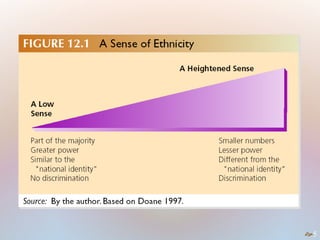
• One's Sense of Ethnicity is based on:
 ▫   Relative Size of the ethnic group
 ▫   Power of the ethnic group
 ▫   Appearance of the ethnic group
 ▫   Discrimination enacted towards the
     ethnic group

• Ethnic Work = activities to discover,
  enhance, or maintain ethnic identity

                                          4
5
Prejudice vs Discrimination
  • Prejudice is an Attitude
   ▫ It is Learned, not inherent
   ▫ Internalizing dominant norms occurs
     when one is prejudiced against their
     own group, usually unconsciously
  • Discrimination is an Action or behavior
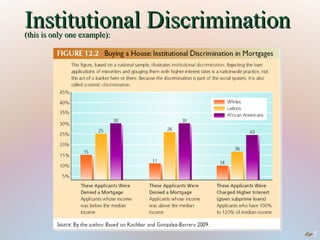
   ▫ Institutional Discrimination is rooted
     in societal structures, not on an
     individual basis
                                              6
Institutional Discrimination
(this is only one example):


                               7
Theories of Prejudice
 Psychological Perspectives:
 • Frustration & Scapegoats
 • The Authoritarian Personality
Sociological Perspectives:
• Functionalism argues that prejudice occurs in
situations that encourage it through the structure
 • Conflict Theory argues that the races are pitted
   against each other (and that minority groups stay
  complacent due to a fear of non-physical punishment)
• Symbolic Interactionism argues that derogatory
  slang labels and stereotypes produce prejudice and a
  self-fulfilling prophecy

                                                         8
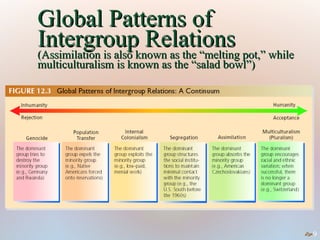
Global Patterns of
Intergroup Relations
(Assimilation is also known as the “melting pot,” while
multiculturalism is known as the “salad bowl”)

 • Segregation

 • Assimilation

 • Multiculturalism (Pluralism)


                                                          9
Race and Ethnic Relations in
the United States: Europeans Americans

 • Nation’s Founders Included Only
   Those from England (WASPs: White
  Anglo-Saxon Protestants)
 • Other “White” Europeans were
   originally considered Inferior


                                         10
Race and Ethnic Relations in
the United States: Latinos (Hispanics)
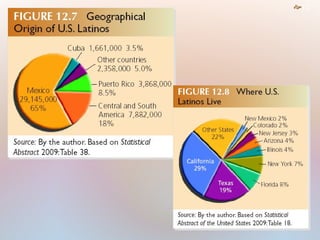
  • Latinos are an Ethnic group, not a race
  • Largest minority group in US
  • US has many Latino undocumented
    immigrants, but most Latino
    immigrants are legal
  • Not a homogenous group; instead, are a very
    diverse group with widely varying customs based on
    their many countries of origin


                                                         11
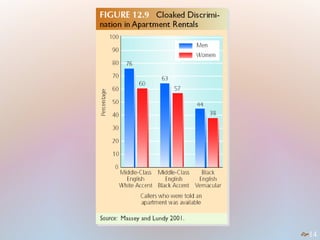
12
Race and Ethnic Relations in
the United States: African-Americans
  • Struggle for Civil Rights
  • Continued Gains, but still not equal
  • Racism in everyday life (such as the resume
   study where employers were more likely to call back
   “normal” named applicants, rather than racially-charged
   applicant names, while the rest of the resumes were
   identical)
    ▫ Overt (obvious, blatant, used more in past generations) versus
      Covert (subtle, disguised, used more today) Discrimination
    ▫ Myth of post-race society perpetuates the idea that race is
      not important in our society, despite research which
      suggests otherwise
  • Racial differences persist even when
    controlling for social class                                  13
14
Race and Ethnic Relations in
the United States: Asian-Americans
• History of Discrimination
 ▫ Especially during railroad expansion
• Reasons for Success Now:
 ▫ Family life and culture that emphasize
   Educational achievement, Discipline, and
   community
 ▫ Assimilation
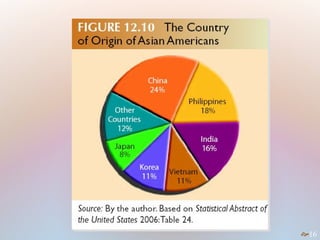
• Not a homogenous group; Diverse
  depending on country of origin and
  culture
                                              15
16
Race and Ethnic Relations in
the United States: Native Americans
 • From Treaties to Genocide, Population
   Transfer
 • The Invisible Minority (small population,
  sometimes physically separated on reservations)

 • Not a homogenous group; Diverse
 • Pan-Indianism focuses on common
   themes between various groups and
   aims to promote the status of all
   Native Americans, despite differences
                                                    17

Race & Ethnicity Mini-Lecture

  • 1.
    Race versus Ethnicity •Race is based on Biological Characteristics ▫ Based on Skin color, eye color, hair, sizes/shapes ▫ Categories seem natural, but vary by culture ▫ Originally divided into Caucasians, Mongoloids, and Negroids • Ethnicity is based on Cultural Characteristics ▫ Based on Common Ancestry, Cultural Heritage, and common Nations of Origin ▫ Examples in the US are Jews, Asian Americas, Italians, Irish Americans, Native Americans, etc 1
  • 2.
    Myths about Race • Myth 1 = the Idea That Any Race is Superior ▫ Actually, All Races Have both Geniuses and Idiots • Myth 2 = Idea that Any Race is Pure ▫ Actually, Human Characteristics Flow Endlessly Together on a continuum ▫ over 99.9% of biology is the same between races ▫ There is more physiological difference within races than between races ▫ Some researchers claim there are 2 races, some claim there are 2,000 races ▫ Whites in South India often have darker skin than many Australian aborigines who are classified as black, so race varies by culture ...Hence, Race is a social construction 2
  • 3.
    Minority versus DominantGroups • Minority Group = People Singled Out for Unequal Treatment • Not Necessarily the Numerical Minority • Dominant Group = Does the Discriminating to minority groups ▫ Has the most power, privileges, & highest social status 3
  • 4.
    Constructing Racial-Ethnic Identity • One'sSense of Ethnicity is based on: ▫ Relative Size of the ethnic group ▫ Power of the ethnic group ▫ Appearance of the ethnic group ▫ Discrimination enacted towards the ethnic group • Ethnic Work = activities to discover, enhance, or maintain ethnic identity 4
  • 5.
  • 6.
    Prejudice vs Discrimination • Prejudice is an Attitude ▫ It is Learned, not inherent ▫ Internalizing dominant norms occurs when one is prejudiced against their own group, usually unconsciously • Discrimination is an Action or behavior ▫ Institutional Discrimination is rooted in societal structures, not on an individual basis 6
  • 7.
  • 8.
    Theories of Prejudice Psychological Perspectives: • Frustration & Scapegoats • The Authoritarian Personality Sociological Perspectives: • Functionalism argues that prejudice occurs in situations that encourage it through the structure • Conflict Theory argues that the races are pitted against each other (and that minority groups stay complacent due to a fear of non-physical punishment) • Symbolic Interactionism argues that derogatory slang labels and stereotypes produce prejudice and a self-fulfilling prophecy 8
  • 9.
    Global Patterns of IntergroupRelations (Assimilation is also known as the “melting pot,” while multiculturalism is known as the “salad bowl”) • Segregation • Assimilation • Multiculturalism (Pluralism) 9
  • 10.
    Race and EthnicRelations in the United States: Europeans Americans • Nation’s Founders Included Only Those from England (WASPs: White Anglo-Saxon Protestants) • Other “White” Europeans were originally considered Inferior 10
  • 11.
    Race and EthnicRelations in the United States: Latinos (Hispanics) • Latinos are an Ethnic group, not a race • Largest minority group in US • US has many Latino undocumented immigrants, but most Latino immigrants are legal • Not a homogenous group; instead, are a very diverse group with widely varying customs based on their many countries of origin 11
  • 12.
  • 13.
    Race and EthnicRelations in the United States: African-Americans • Struggle for Civil Rights • Continued Gains, but still not equal • Racism in everyday life (such as the resume study where employers were more likely to call back “normal” named applicants, rather than racially-charged applicant names, while the rest of the resumes were identical) ▫ Overt (obvious, blatant, used more in past generations) versus Covert (subtle, disguised, used more today) Discrimination ▫ Myth of post-race society perpetuates the idea that race is not important in our society, despite research which suggests otherwise • Racial differences persist even when controlling for social class 13
  • 14.
  • 15.
    Race and EthnicRelations in the United States: Asian-Americans • History of Discrimination ▫ Especially during railroad expansion • Reasons for Success Now: ▫ Family life and culture that emphasize Educational achievement, Discipline, and community ▫ Assimilation • Not a homogenous group; Diverse depending on country of origin and culture 15
  • 16.
  • 17.
    Race and EthnicRelations in the United States: Native Americans • From Treaties to Genocide, Population Transfer • The Invisible Minority (small population, sometimes physically separated on reservations) • Not a homogenous group; Diverse • Pan-Indianism focuses on common themes between various groups and aims to promote the status of all Native Americans, despite differences 17