Chapter 9:
Race and Ethnicity
       Ross Martin
      Sabrina Hodnett
         Nate Jack
       Tamisha Lee
The Difference Between
         Race and Ethnicity

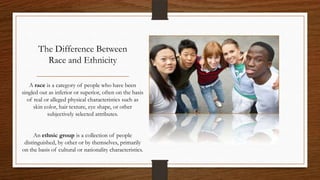
   A race is a category of people who have been
singled out as inferior or superior, often on the basis
  of real or alleged physical characteristics such as
     skin color, hair texture, eye shape, or other
           subjectively selected attributes.


     An ethnic group is a collection of people
 distinguished, by other or by themselves, primarily
on the basis of cultural or nationality characteristics.
The Social Significance of Race and
                  Ethnicity

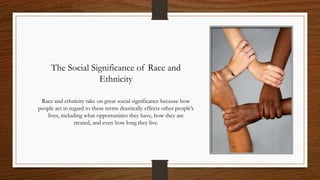
 Race and ethnicity take on great social significance because how
people act in regard to these terms drastically effects other people’s
   lives, including what opportunities they have, how they are
                treated, and even how long they live.
Historically class rank based on race and ethnicity has strongly affected all aspects of
political, economic, and social life. Think of sports. Throughout the early history of the game
of baseball, many African Americans had outstanding skills as players but were categorically
excluded from Major League teams because of their skin color. Even after Jackie Robinson
broke the “color line” and became the first African American in the Major Leagues in 1947,
his experience was ruined by racial slurs, hate letters, death threats against his infant son, and
assaults on his wife.
     With more and more professional athletes from diverse racial-ethnic categories having
multimillion-dollar contracts and endorsement deals, its easy to assume that racism in sports is
past, but the commercialization of sports doesn’t mean that racial prejudice and discrimination
is over.
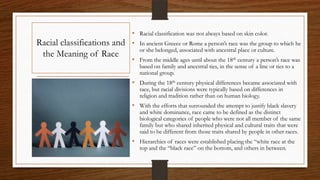
• Racial classification was not always based on skin color.
Racial classifications and   • In ancient Greece or Rome a person’s race was the group to which he
                                or she belonged, associated with ancestral place or culture.
 the Meaning of Race
                             • From the middle ages until about the 18th century a person’s race was
                                based on family and ancestral ties, in the sense of a line or ties to a
                                national group.
                             • During the 18th century physical differences became associated with
                                race, but racial divisions were typically based on differences in
                                religion and tradition rather than on human biology.
                             • With the efforts that surrounded the attempt to justify black slavery
                                and white dominance, race came to be defined as the distinct
                                biological categories of people who were not all member of the same
                                family but who shared inherited physical and cultural traits that were
                                said to be different from those traits shared by people in other races.
                             • Hierarchies of races were established placing the “white race at the
                                top and the “black race” on the bottom, and others in between.
Dominant and Subordinate Groups
                   (Majority's and Minority’s)
• A dominate group (majority) is one that is advantaged and has superior resources
  and rights in a society.
• In the United States whites with Northern European ancestry have been considered
  to be the dominant group for many years.
• A subordinate group (minority) is one whose members, are disadvantaged and
  subjected to unequal treatment by the dominant group and who regard themselves
  as object of collective discrimination.
• Historically African Americans and other persons of color have been considered to
  be subordinate group members, especially when they are from lower income
  categories.
Prejudice, Stereotype, Discrimination and Racism

• Prejudice is a negative attitude based on faulty generalizations about members of
  specific racial, ethnic, or other groups.
• Stereotypes are over generalizations about appearance, behavior, or other
  characteristics of members of particular categories. (stereotypes can be either
  positive or negative)
• Racism is a set of attitudes, beliefs, and practices that is used to justify the superior
  treatment of one racial or ethnic group and the inferior treatment of another racial
  or ethnic group.
• Discrimination involves actions or practices of dominant-group members (or their
  representatives) that have a harmful effect on members of a subordinate group.
Native America
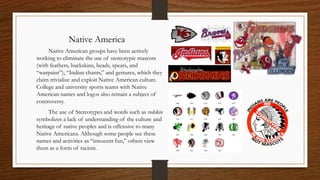
     Native American groups have been actively
working to eliminate the use of stereotypic mascots
(with feathers, buckskins, beads, spears, and
“warpaint”), “Indian chants,” and gestures, which they
claim trivialize and exploit Native American culture.
College and university sports teams with Native
American names and logos also remain a subject of
controversy.
      The use of Stereotypes and words such as redskin
symbolizes a lack of understanding of the culture and
heritage of native peoples and is offensive to many
Native Americans. Although some people see these
names and activities as “innocent fun,” others view
them as a form of racism.
African Americans
• The African American experience has been one marked by slavery,
  segregation, and persistent discrimination.
• Gaining freedom did not give African Americans freedom equality with
  whites. They were subjected to many indignities because of race, through
  informal practices in the north and Jim Crow laws in the south African
  Americans experienced a lot of segregation.
• In the 20th century the live of many African Americans were changed by the
  civil rights movement.
African American

 “People could not even register to vote when we came back here
 in 1963 for the March on Washington. And I was here when Dr.
                      King stood and said,
 “ I have a dream today,” a dream deeply rooted in the American
dream. And to come back [to Washington for the inauguration of
President Barack Obama] 45 years later, it is almost too much. It is
                        almost too much”
        ~Representative John Lewis Democrat of Georgia
On January 20, 2009 Barack Obama was sworn in as the President
 of the United States, becoming the first person of color ever to
                           hold office.
Global Racial and Ethnic Inequality in the
                    Future

• Throughout the world, many racial and ethnic groups
 seek self-determination– the right to choose their own
 way of life. Because many nations are currently
 structured, self-determination is impossible.
Racial and ethnic diversity is increasing in the united states.
     African Americans, Latinos/as, Asian Americans


   Racial and ethnic diversity is increasing in the United States. African Americans, Latinos, and Native Americans
constitute one-fourth of the U.S. Population, whereas whites are a shrinking population. Today White Americans make
   up 70% of the population in contrast to 80% in 1980. It is projected that in 2056, the roots of the average U.S.
   resident will be in Africa, Asia, Hispanic countries, the Pacific Islands, and the Middle East. Not white Europe.


                         What effect will these changes have on racial and ethnic relations?

Chapter 9: Race and Ethnicity

  • 1.
    Chapter 9: Race andEthnicity Ross Martin Sabrina Hodnett Nate Jack Tamisha Lee
  • 2.
    The Difference Between Race and Ethnicity A race is a category of people who have been singled out as inferior or superior, often on the basis of real or alleged physical characteristics such as skin color, hair texture, eye shape, or other subjectively selected attributes. An ethnic group is a collection of people distinguished, by other or by themselves, primarily on the basis of cultural or nationality characteristics.
  • 3.
    The Social Significanceof Race and Ethnicity Race and ethnicity take on great social significance because how people act in regard to these terms drastically effects other people’s lives, including what opportunities they have, how they are treated, and even how long they live.
  • 4.
    Historically class rankbased on race and ethnicity has strongly affected all aspects of political, economic, and social life. Think of sports. Throughout the early history of the game of baseball, many African Americans had outstanding skills as players but were categorically excluded from Major League teams because of their skin color. Even after Jackie Robinson broke the “color line” and became the first African American in the Major Leagues in 1947, his experience was ruined by racial slurs, hate letters, death threats against his infant son, and assaults on his wife. With more and more professional athletes from diverse racial-ethnic categories having multimillion-dollar contracts and endorsement deals, its easy to assume that racism in sports is past, but the commercialization of sports doesn’t mean that racial prejudice and discrimination is over.
  • 6.
    • Racial classificationwas not always based on skin color. Racial classifications and • In ancient Greece or Rome a person’s race was the group to which he or she belonged, associated with ancestral place or culture. the Meaning of Race • From the middle ages until about the 18th century a person’s race was based on family and ancestral ties, in the sense of a line or ties to a national group. • During the 18th century physical differences became associated with race, but racial divisions were typically based on differences in religion and tradition rather than on human biology. • With the efforts that surrounded the attempt to justify black slavery and white dominance, race came to be defined as the distinct biological categories of people who were not all member of the same family but who shared inherited physical and cultural traits that were said to be different from those traits shared by people in other races. • Hierarchies of races were established placing the “white race at the top and the “black race” on the bottom, and others in between.
  • 7.
    Dominant and SubordinateGroups (Majority's and Minority’s) • A dominate group (majority) is one that is advantaged and has superior resources and rights in a society. • In the United States whites with Northern European ancestry have been considered to be the dominant group for many years. • A subordinate group (minority) is one whose members, are disadvantaged and subjected to unequal treatment by the dominant group and who regard themselves as object of collective discrimination. • Historically African Americans and other persons of color have been considered to be subordinate group members, especially when they are from lower income categories.
  • 8.
    Prejudice, Stereotype, Discriminationand Racism • Prejudice is a negative attitude based on faulty generalizations about members of specific racial, ethnic, or other groups. • Stereotypes are over generalizations about appearance, behavior, or other characteristics of members of particular categories. (stereotypes can be either positive or negative) • Racism is a set of attitudes, beliefs, and practices that is used to justify the superior treatment of one racial or ethnic group and the inferior treatment of another racial or ethnic group. • Discrimination involves actions or practices of dominant-group members (or their representatives) that have a harmful effect on members of a subordinate group.
  • 10.
    Native America Native American groups have been actively working to eliminate the use of stereotypic mascots (with feathers, buckskins, beads, spears, and “warpaint”), “Indian chants,” and gestures, which they claim trivialize and exploit Native American culture. College and university sports teams with Native American names and logos also remain a subject of controversy. The use of Stereotypes and words such as redskin symbolizes a lack of understanding of the culture and heritage of native peoples and is offensive to many Native Americans. Although some people see these names and activities as “innocent fun,” others view them as a form of racism.
  • 12.
    African Americans • TheAfrican American experience has been one marked by slavery, segregation, and persistent discrimination. • Gaining freedom did not give African Americans freedom equality with whites. They were subjected to many indignities because of race, through informal practices in the north and Jim Crow laws in the south African Americans experienced a lot of segregation. • In the 20th century the live of many African Americans were changed by the civil rights movement.
  • 13.
    African American “Peoplecould not even register to vote when we came back here in 1963 for the March on Washington. And I was here when Dr. King stood and said, “ I have a dream today,” a dream deeply rooted in the American dream. And to come back [to Washington for the inauguration of President Barack Obama] 45 years later, it is almost too much. It is almost too much” ~Representative John Lewis Democrat of Georgia On January 20, 2009 Barack Obama was sworn in as the President of the United States, becoming the first person of color ever to hold office.
  • 14.
    Global Racial andEthnic Inequality in the Future • Throughout the world, many racial and ethnic groups seek self-determination– the right to choose their own way of life. Because many nations are currently structured, self-determination is impossible.
  • 15.
    Racial and ethnicdiversity is increasing in the united states. African Americans, Latinos/as, Asian Americans Racial and ethnic diversity is increasing in the United States. African Americans, Latinos, and Native Americans constitute one-fourth of the U.S. Population, whereas whites are a shrinking population. Today White Americans make up 70% of the population in contrast to 80% in 1980. It is projected that in 2056, the roots of the average U.S. resident will be in Africa, Asia, Hispanic countries, the Pacific Islands, and the Middle East. Not white Europe. What effect will these changes have on racial and ethnic relations?