Creating a strategy is inspirational
John van der Laan
Slide master
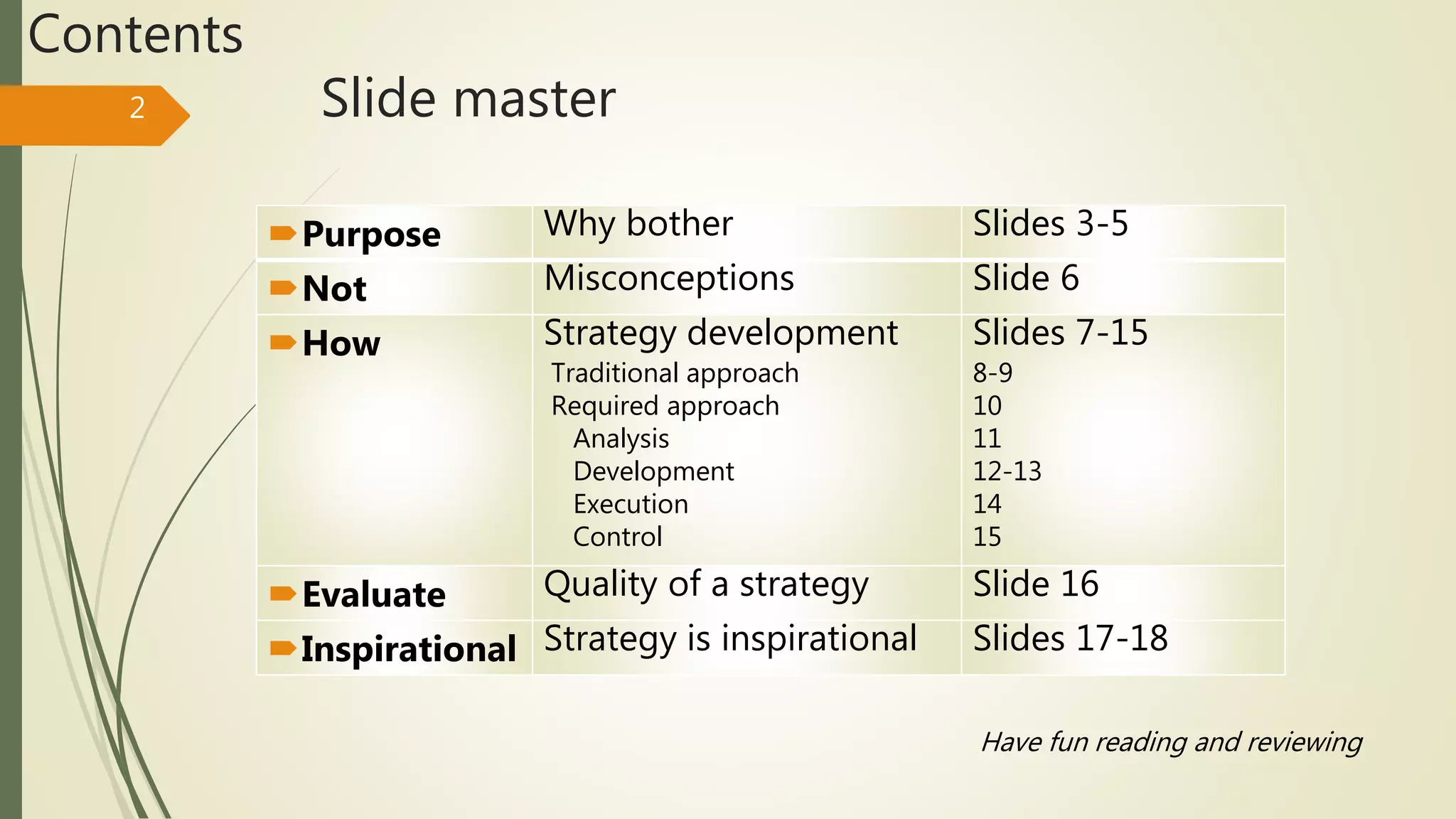
Contents
Purpose Why bother Slides 3-5
Not Misconceptions Slide 6
How Strategy development
Traditional approach
Required approach
Analysis
Development
Execution
Control
Slides 7-15
8-9
10
11
12-13
14
15
Evaluate Quality of a strategy Slide 16
Inspirational Strategy is inspirational Slides 17-18
2
Have fun reading and reviewing
Challenge your (company) strategy3
Why
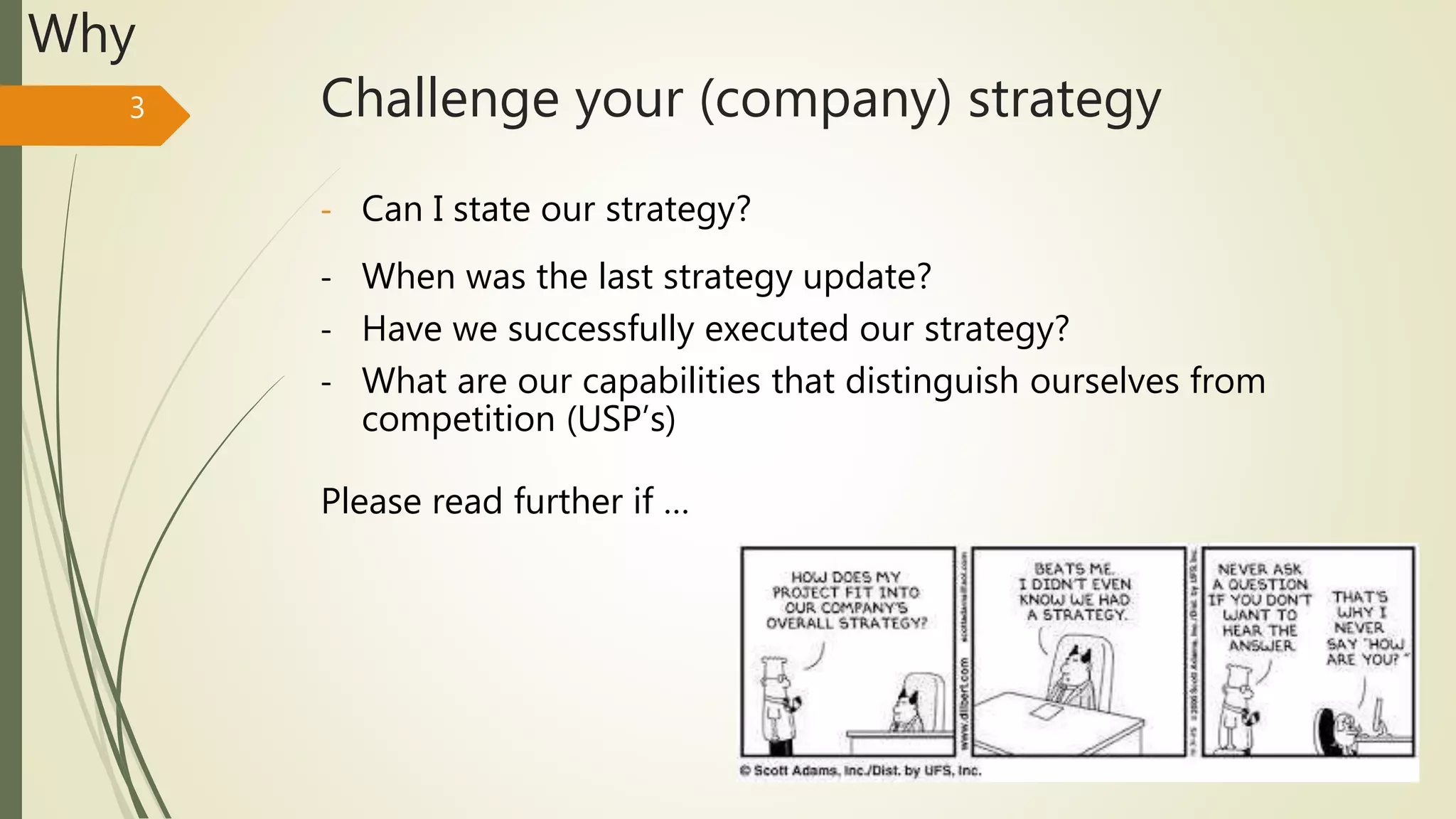
- Can I state our strategy?
- When was the last strategy update?
- Have we successfully executed our strategy?
- What are our capabilities that distinguish ourselves from
competition (USP’s)
Please read further if …
What is a Strategy4
Purpose
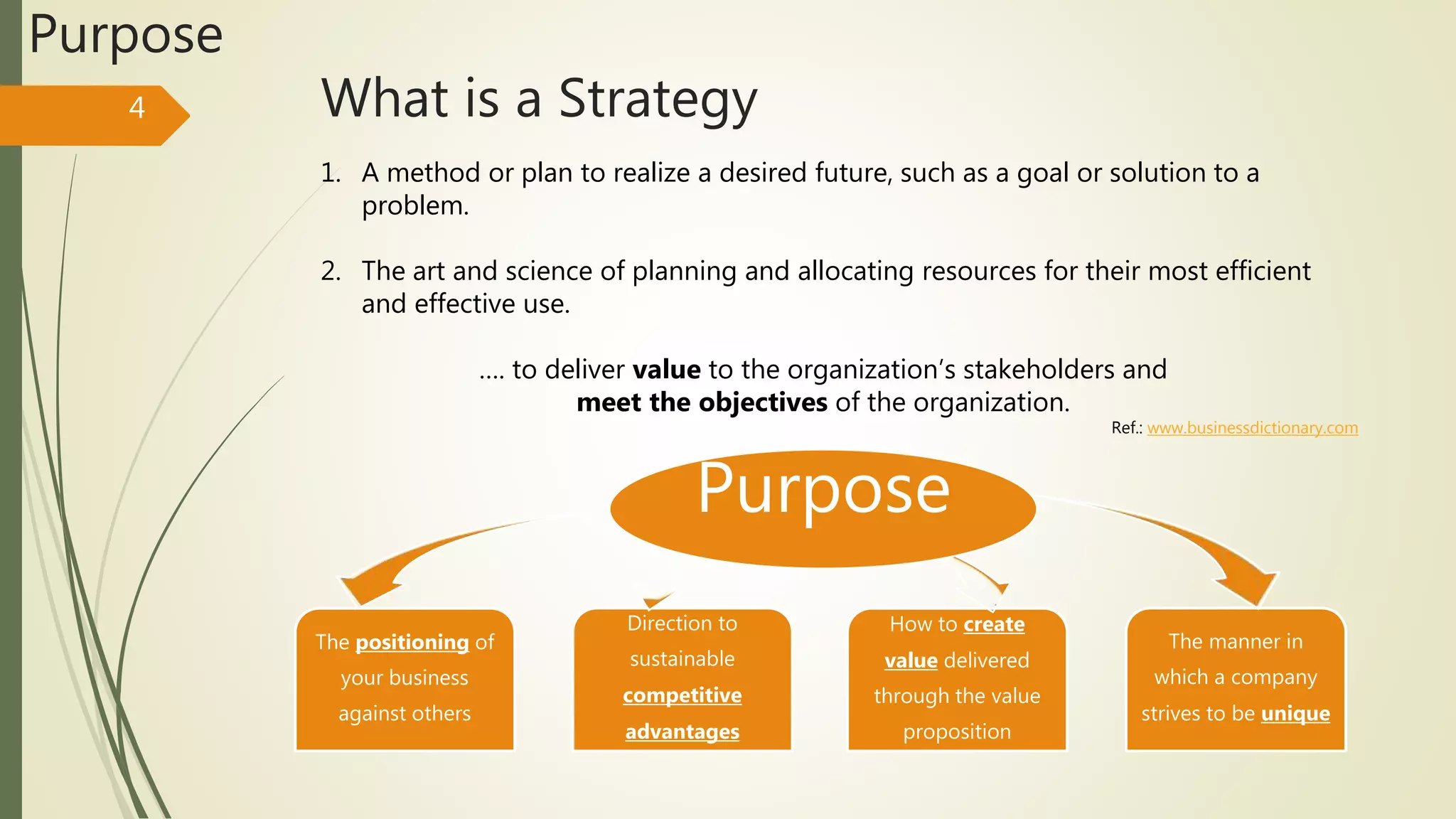
1. A method or plan to realize a desired future, such as a goal or solution to a
problem.
2. The art and science of planning and allocating resources for their most efficient
and effective use.
…. to deliver value to the organization’s stakeholders and
meet the objectives of the organization.
The positioning of
your business
against others
Direction to
sustainable
competitive
advantages
How to create
value delivered
through the value
proposition
The manner in
which a company
strives to be unique
Ref.: www.businessdictionary.com
Purpose
Why bother?
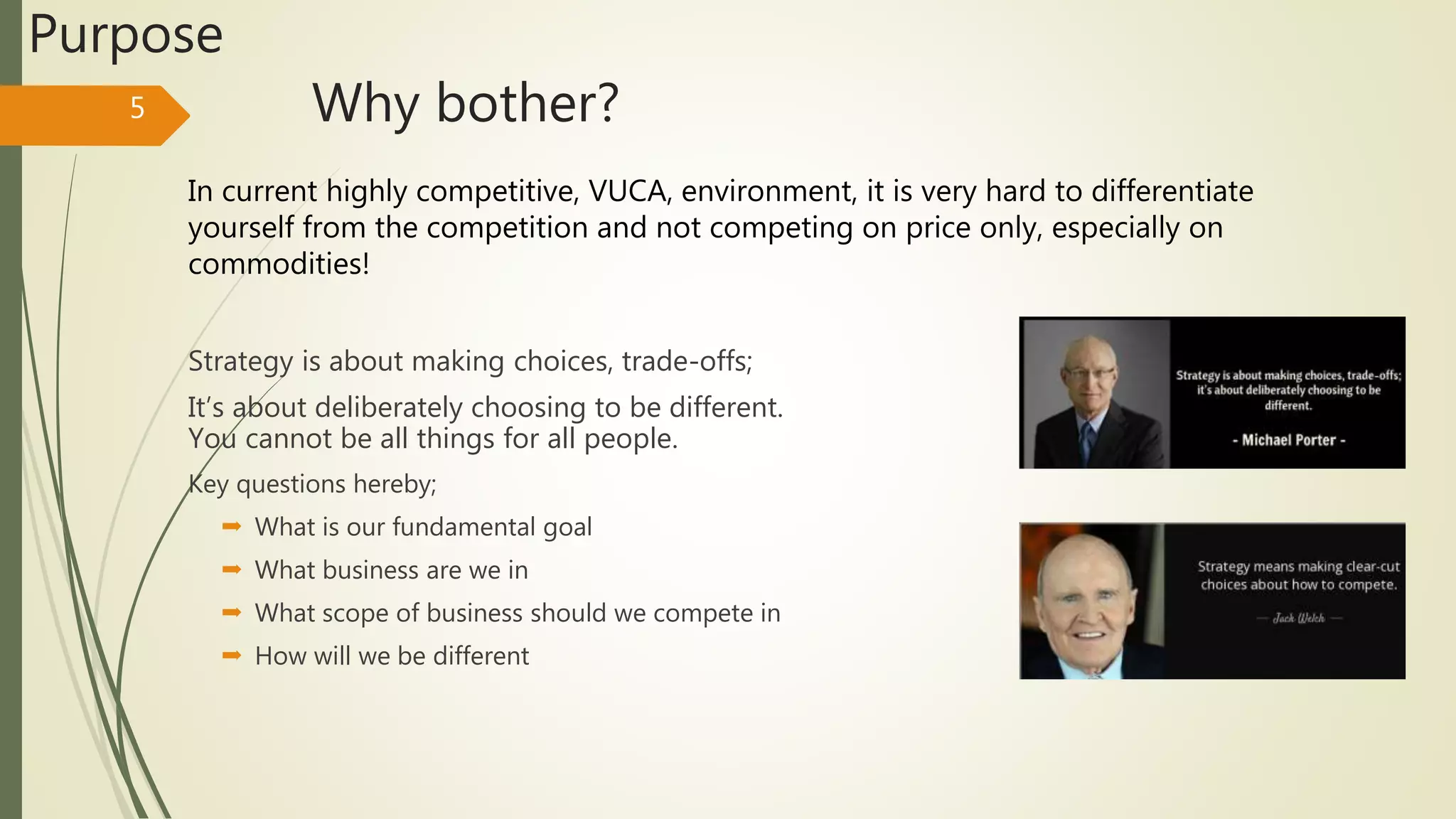
Strategy is about making choices, trade-offs;
It’s about deliberately choosing to be different.
You cannot be all things for all people.
Key questions hereby;
 What is our fundamental goal
 What business are we in
 What scope of business should we compete in
 How will we be different
5
Purpose
In current highly competitive, VUCA, environment, it is very hard to differentiate
yourself from the competition and not competing on price only, especially on
commodities!
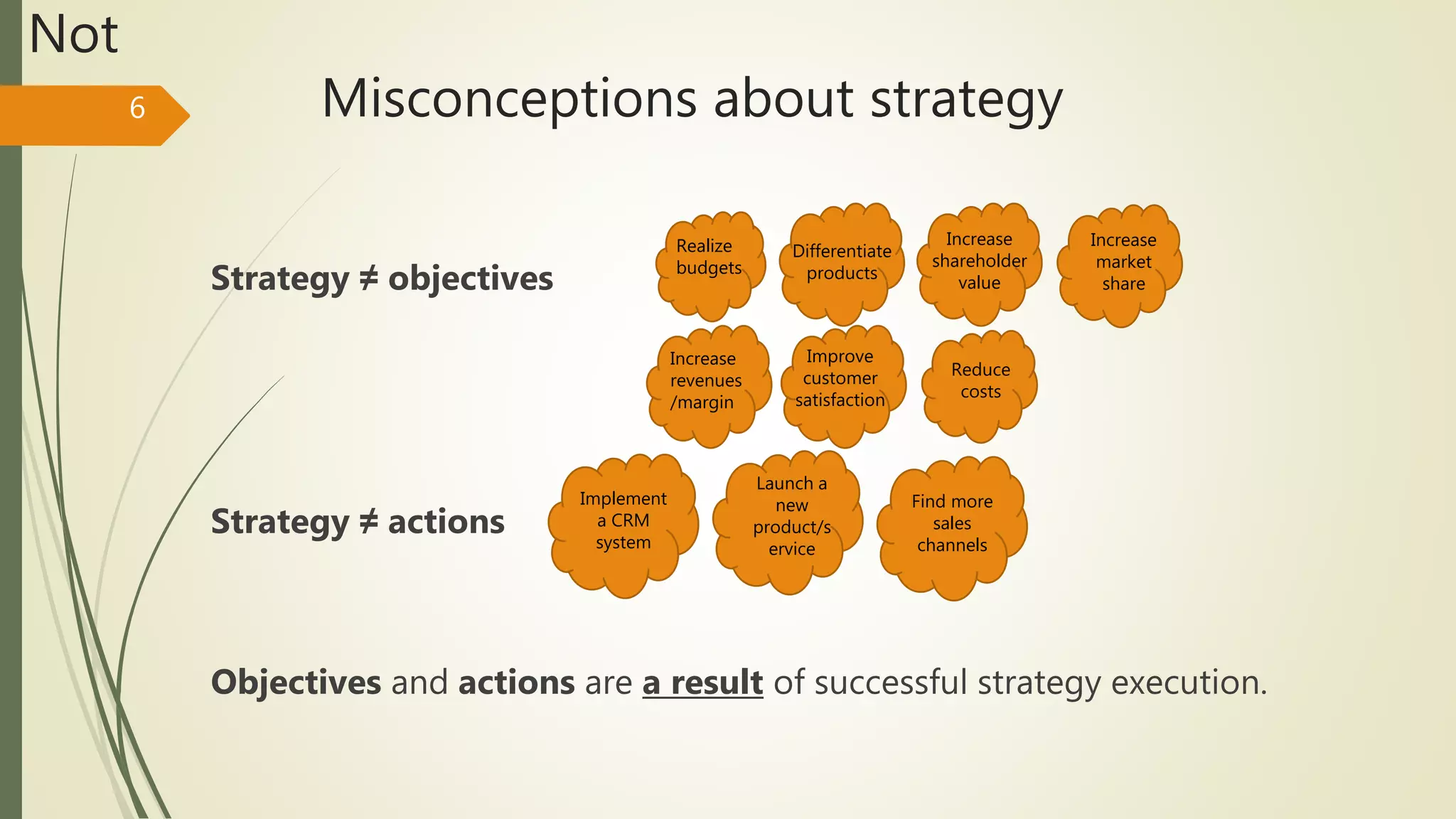
Misconceptions about strategy
Strategy ≠ objectives
Strategy ≠ actions
Objectives and actions are a result of successful strategy execution.
6
Not
Realize
budgets
Increase
revenues
/margin
Improve
customer
satisfaction
Differentiate
products
Increase
shareholder
value
Increase
market
share
Reduce
costs
Launch a
new
product/s
ervice
Find more
sales
channels
Implement
a CRM
system
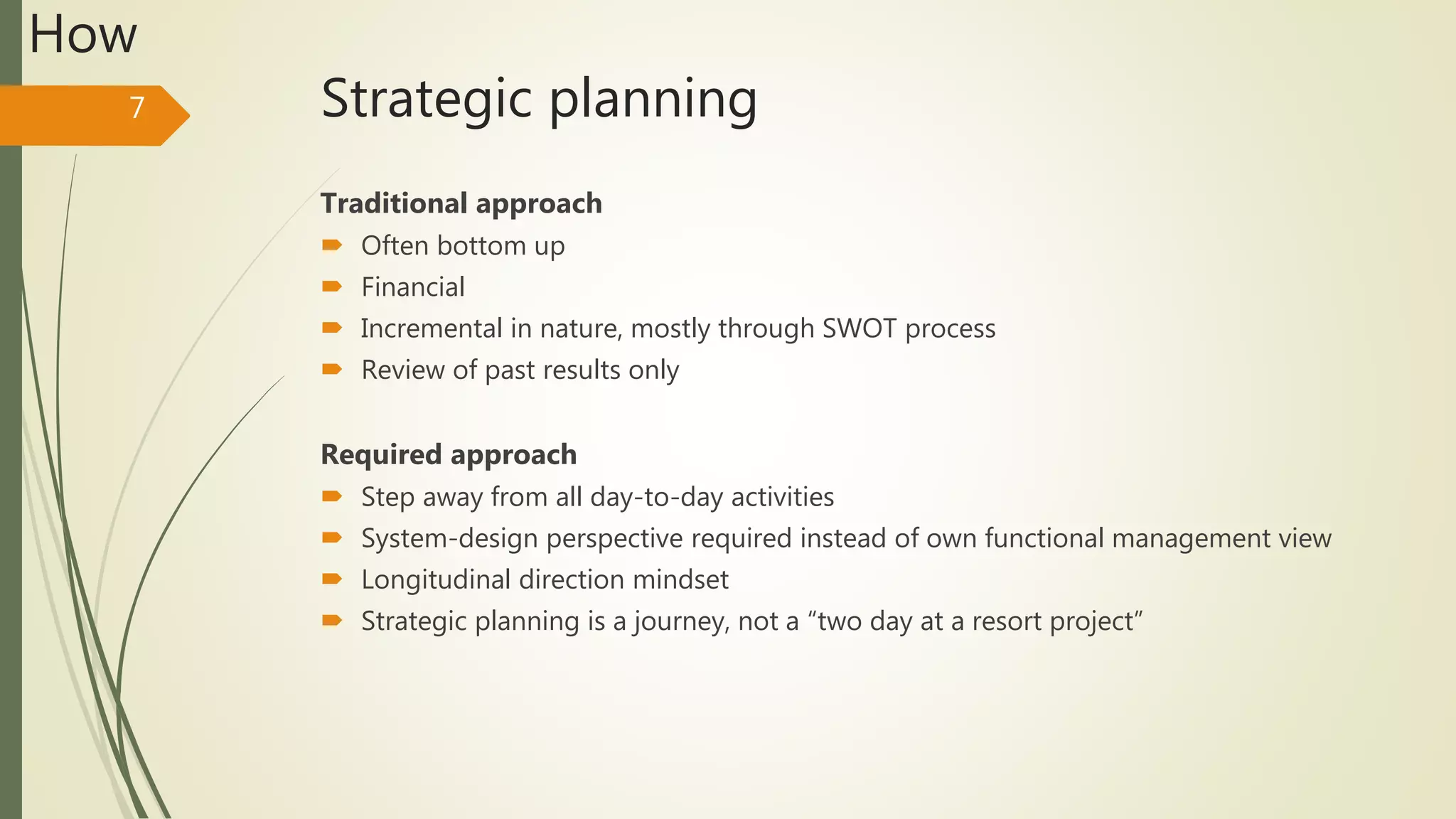
Strategic planning
Traditional approach
 Often bottom up
 Financial
 Incremental in nature, mostly through SWOT process
 Review of past results only
Required approach
 Step away from all day-to-day activities
 System-design perspective required instead of own functional management view
 Longitudinal direction mindset
 Strategic planning is a journey, not a “two day at a resort project”
7
How
Strategy – traditional approach
Option 1: SWOT analysis (+ confrontation matrix)
Advantages
- Relatively quick method
- Capitalises on opportunities
- Deter threats / take advantage of your strengths
- It concentrates on the most important business affecting factors
Disadvantages
- It is incremental in nature
- Is only one stage of a business planning process tool; it doesn't prioritise issues
and doesn't provide solutions or offer alternative decisions
- Different goals; often also used as relationship builder with other departments
8
How
Strategy – traditional approach
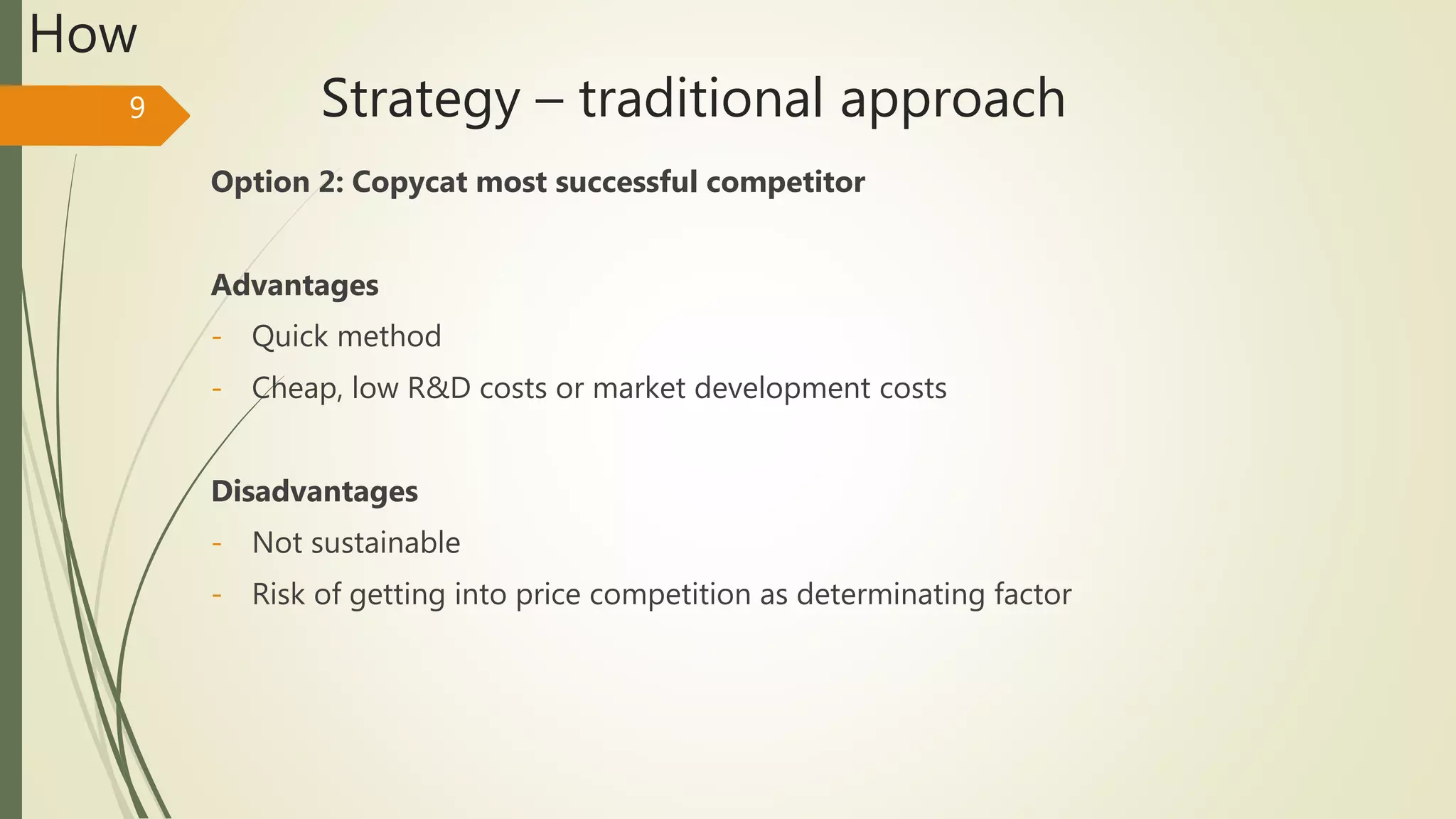
Option 2: Copycat most successful competitor
Advantages
- Quick method
- Cheap, low R&D costs or market development costs
Disadvantages
- Not sustainable
- Risk of getting into price competition as determinating factor
9
How
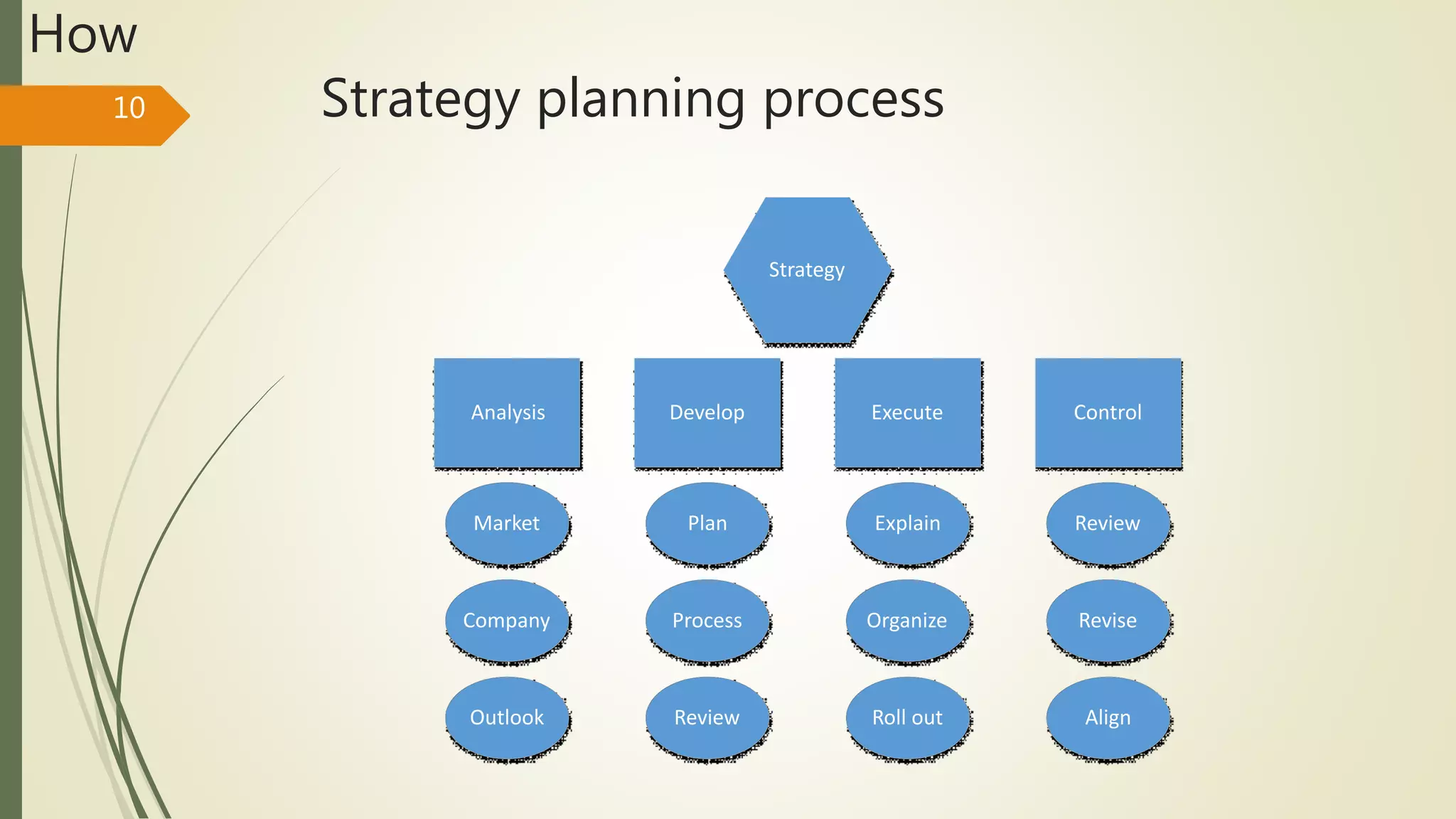
Strategy planning process10
How
Analysis Develop Execute Control
Market Plan
Process Organize
Explain Review
ReviseCompany
Outlook Review Roll out Align
Strategy
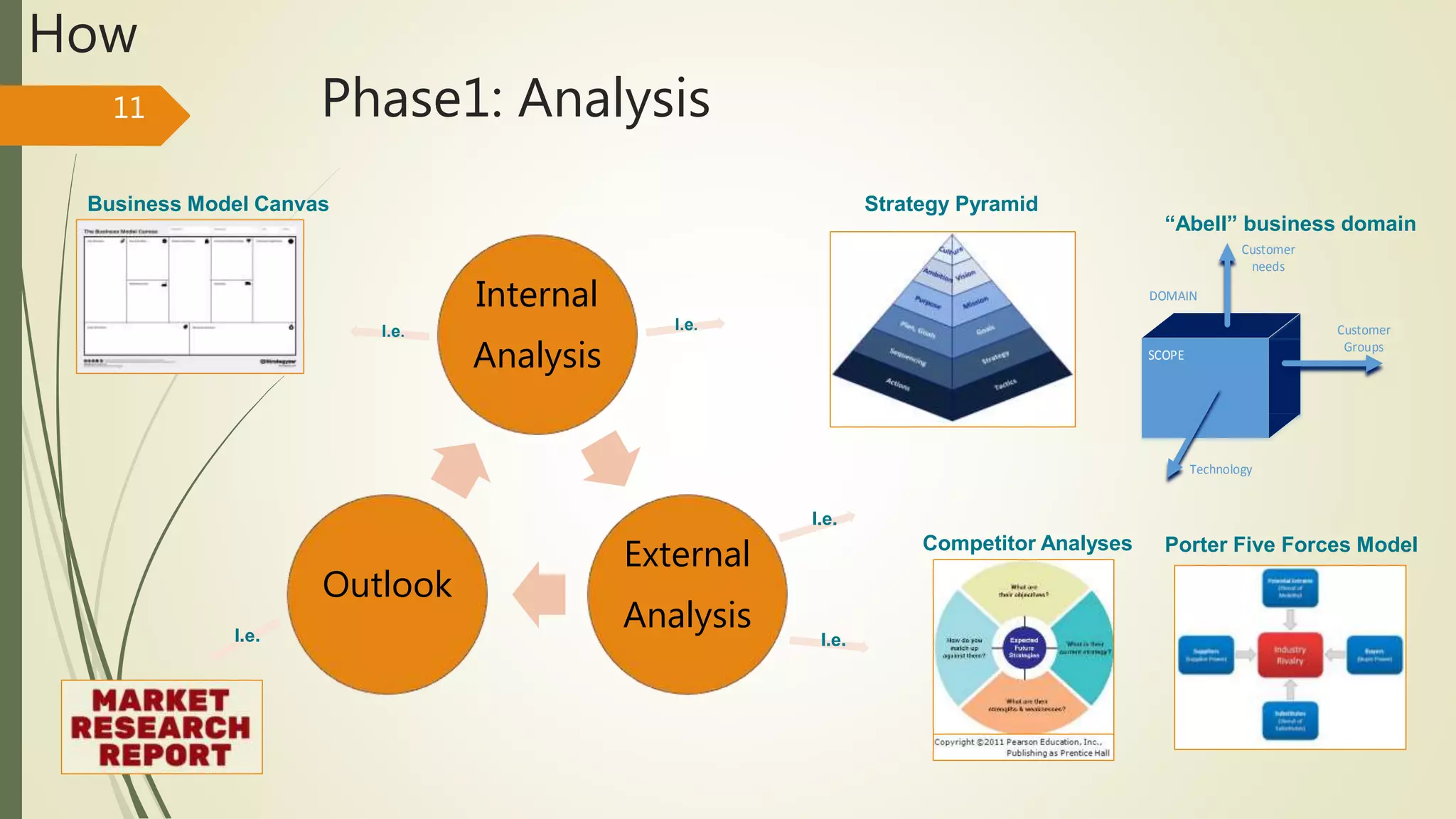
Phase1: Analysis11
How
Internal
Analysis
External
Analysis
Outlook
Strategy PyramidBusiness Model Canvas
Porter Five Forces ModelCompetitor Analyses
I.e. I.e.
I.e.
I.e.
Customer
Groups
Customer
needs
Technology
DOMAIN
SCOPE
“Abell” business domain
I.e.
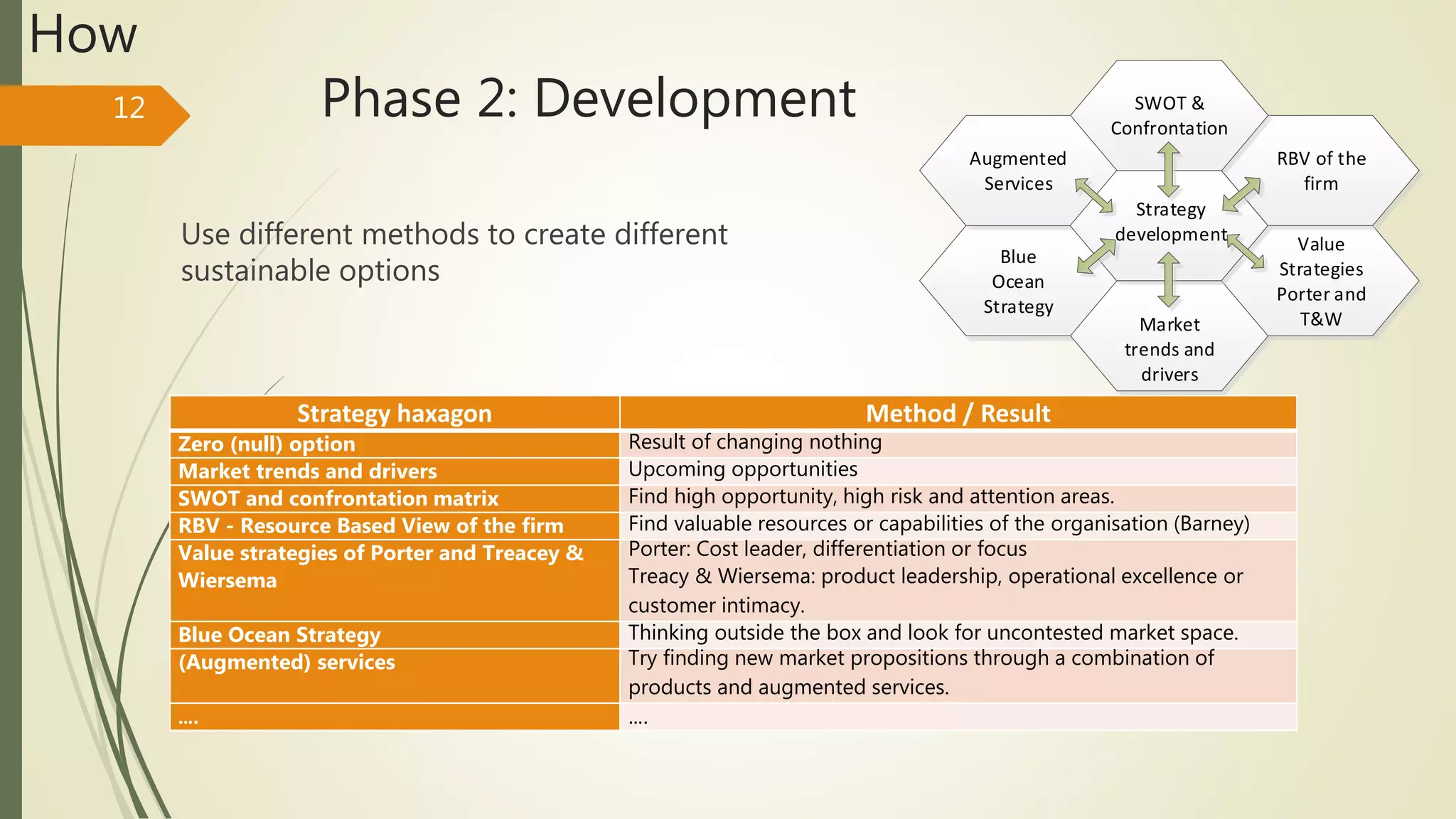
Phase 2: Development12
Strategy haxagon Method / Result
Zero (null) option Result of changing nothing
Market trends and drivers Upcoming opportunities
SWOT and confrontation matrix Find high opportunity, high risk and attention areas.
RBV - Resource Based View of the firm Find valuable resources or capabilities of the organisation (Barney)
Value strategies of Porter and Treacey &
Wiersema
Porter: Cost leader, differentiation or focus
Treacy & Wiersema: product leadership, operational excellence or
customer intimacy.
Blue Ocean Strategy Thinking outside the box and look for uncontested market space.
(Augmented) services Try finding new market propositions through a combination of
products and augmented services.
…. ….
Blue
Ocean
Strategy
Market
trends and
drivers
Value
Strategies
Porter and
T&W
RBV of the
firm
SWOT &
Confrontation
Strategy
development
Augmented
Services
How
Use different methods to create different
sustainable options
Strategy development should aim to develop sustainable competitive
advantage by analysing possibilities and alignment.
13
Each different strategy development method on
itself creates valuable options, but finding
coherent and mutually reinforcing opportunities
through different analyses will bring a highly
differentiating, innovative value proposition.
This creates sustainability and increased barriers
to imitation.
Blue
Ocean
Strategy
Market
trends and
drivers
Value
Strategies
Porter and
T&W
RBV of the
firm
SWOT &
Confrontation
Strategy
development
Augmented
Services
How
Phase 2: Development
Phase 3: Execution14
How
Strategy is useless, if it isn’t implemented correctly (Michael Porter).
 Commit to the chosen identity;
 Shared understanding of the value proposition
 Engage and enable the organization
 Create operational targets
 Plan everyday actionable goals
 Implementing and sustaining
 Focus on the barriers of execution
 Create quick wins
Phase 4: Control15
How
The “DMAIC” cycle
Define
Measure
Analyze
Improve
Control
KPI’s
Analysis Develop Execute Control
Market Plan
Process Organize
Explain Review
ReviseCompany
Outlook Review Roll out Align
Strategy
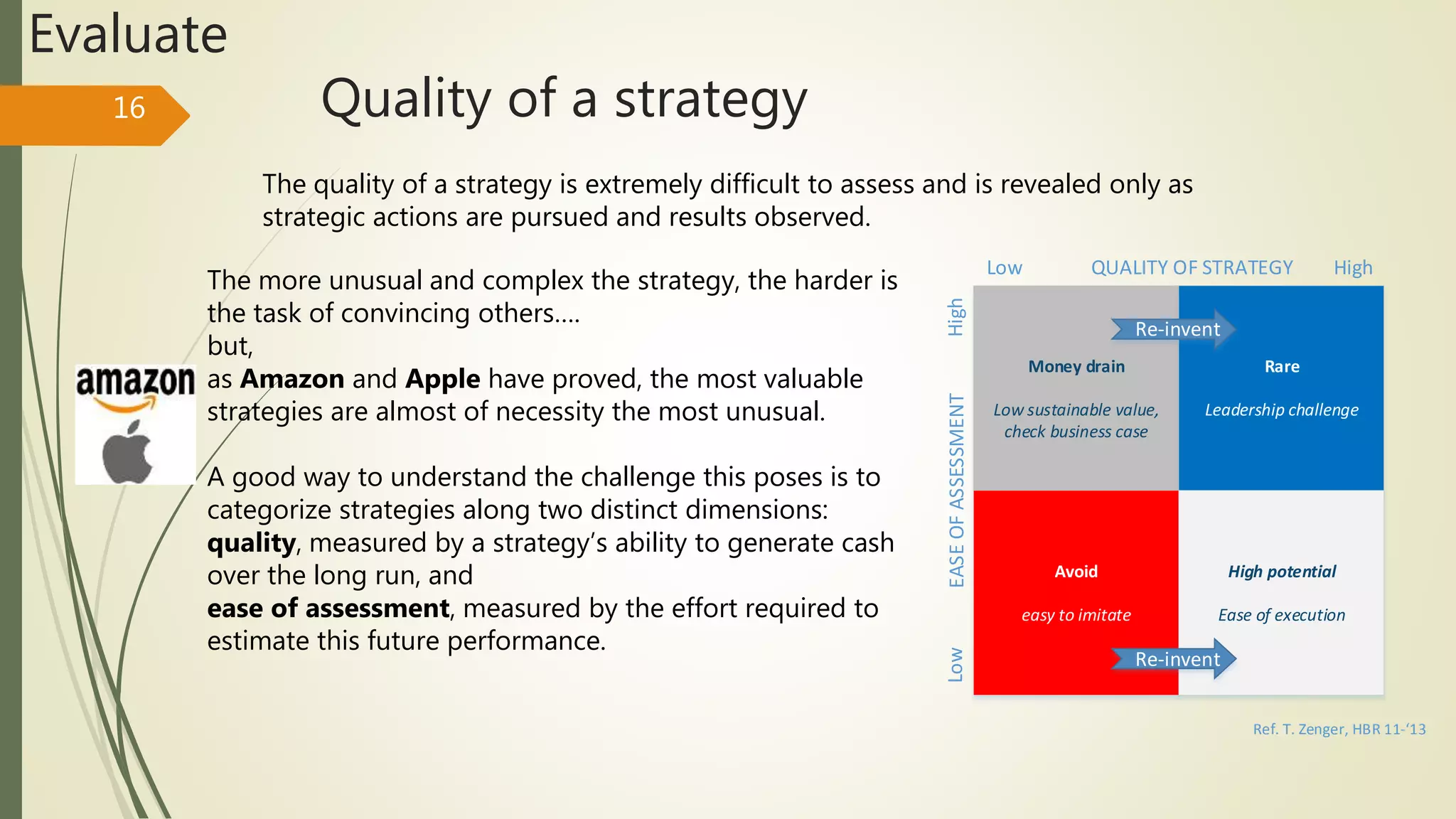
Quality of a strategy16
The more unusual and complex the strategy, the harder is
the task of convincing others….
but,
as Amazon and Apple have proved, the most valuable
strategies are almost of necessity the most unusual.
A good way to understand the challenge this poses is to
categorize strategies along two distinct dimensions:
quality, measured by a strategy’s ability to generate cash
over the long run, and
ease of assessment, measured by the effort required to
estimate this future performance.
Money drain
Low sustainable value,
check business case
Rare
Leadership challenge
Avoid
easy to imitate
High potential
Ease of execution
EASEOFASSESSMENT
QUALITY OF STRATEGY
LowHigh
HighLow
Re-invent
Re-invent
Ref. T. Zenger, HBR 11- 13
The quality of a strategy is extremely difficult to assess and is revealed only as
strategic actions are pursued and results observed.
Evaluate
17
“The essence
of strategy is
choosing
what not to
do”
Michael Porter
“A satisfied
customers is the
best business
strategy of all.”
Michael LeBoeuf
“Success is 20%
skills and 80%
strategy. You may
know how to read,
but what is your
plan to read?”
Jim Rohn
“Strategy is not
a lengthy action
plan. It is the
evolution of a
central idea
through
continually
changing
circumstances”
Jack Welch
“Without
strategy
execution is
aimless,
without
execution
strategy is
useless”
Morris Chang
“Thus what is of
supreme importance in
war is to attack the
enemy’s strategy”
Sun Tzu
“Strategy is
thinking about a
choice and choosing
to stick with your
thinking”
Jeroen de Flander
“Strategy is a
pattern in a
stream of
decisions”
Henri Mintzberg
“It’s not
enough to be
busy, so are
the ants.
The question
is what are
we busy
about?”
Henri David Thoreau
“Business
strategy is
the battleplan
for a better
future”
Patrick Dixon
“Manage the top
line: your strategy,
your people and
your products, and
the the bottom line
will follow”
Steve Jobs
Inspirational
18
The things that distinguishes today’s successfull
businesses is the ability to adapt to changes in
markets and customer expectations.
Inspirational
Where do you belong?
 Those who watch things happen,
 Those who wonder what happened, or
 Those who make things happen.

Creating a strategy is inspirational

  • 1.
    Creating a strategyis inspirational John van der Laan
  • 2.
    Slide master Contents Purpose Whybother Slides 3-5 Not Misconceptions Slide 6 How Strategy development Traditional approach Required approach Analysis Development Execution Control Slides 7-15 8-9 10 11 12-13 14 15 Evaluate Quality of a strategy Slide 16 Inspirational Strategy is inspirational Slides 17-18 2 Have fun reading and reviewing
  • 3.
    Challenge your (company)strategy3 Why - Can I state our strategy? - When was the last strategy update? - Have we successfully executed our strategy? - What are our capabilities that distinguish ourselves from competition (USP’s) Please read further if …
  • 4.
    What is aStrategy4 Purpose 1. A method or plan to realize a desired future, such as a goal or solution to a problem. 2. The art and science of planning and allocating resources for their most efficient and effective use. …. to deliver value to the organization’s stakeholders and meet the objectives of the organization. The positioning of your business against others Direction to sustainable competitive advantages How to create value delivered through the value proposition The manner in which a company strives to be unique Ref.: www.businessdictionary.com Purpose
  • 5.
    Why bother? Strategy isabout making choices, trade-offs; It’s about deliberately choosing to be different. You cannot be all things for all people. Key questions hereby;  What is our fundamental goal  What business are we in  What scope of business should we compete in  How will we be different 5 Purpose In current highly competitive, VUCA, environment, it is very hard to differentiate yourself from the competition and not competing on price only, especially on commodities!
  • 6.
    Misconceptions about strategy Strategy≠ objectives Strategy ≠ actions Objectives and actions are a result of successful strategy execution. 6 Not Realize budgets Increase revenues /margin Improve customer satisfaction Differentiate products Increase shareholder value Increase market share Reduce costs Launch a new product/s ervice Find more sales channels Implement a CRM system
  • 7.
    Strategic planning Traditional approach Often bottom up  Financial  Incremental in nature, mostly through SWOT process  Review of past results only Required approach  Step away from all day-to-day activities  System-design perspective required instead of own functional management view  Longitudinal direction mindset  Strategic planning is a journey, not a “two day at a resort project” 7 How
  • 8.
    Strategy – traditionalapproach Option 1: SWOT analysis (+ confrontation matrix) Advantages - Relatively quick method - Capitalises on opportunities - Deter threats / take advantage of your strengths - It concentrates on the most important business affecting factors Disadvantages - It is incremental in nature - Is only one stage of a business planning process tool; it doesn't prioritise issues and doesn't provide solutions or offer alternative decisions - Different goals; often also used as relationship builder with other departments 8 How
  • 9.
    Strategy – traditionalapproach Option 2: Copycat most successful competitor Advantages - Quick method - Cheap, low R&D costs or market development costs Disadvantages - Not sustainable - Risk of getting into price competition as determinating factor 9 How
  • 10.
    Strategy planning process10 How AnalysisDevelop Execute Control Market Plan Process Organize Explain Review ReviseCompany Outlook Review Roll out Align Strategy
  • 11.
    Phase1: Analysis11 How Internal Analysis External Analysis Outlook Strategy PyramidBusinessModel Canvas Porter Five Forces ModelCompetitor Analyses I.e. I.e. I.e. I.e. Customer Groups Customer needs Technology DOMAIN SCOPE “Abell” business domain I.e.
  • 12.
    Phase 2: Development12 Strategyhaxagon Method / Result Zero (null) option Result of changing nothing Market trends and drivers Upcoming opportunities SWOT and confrontation matrix Find high opportunity, high risk and attention areas. RBV - Resource Based View of the firm Find valuable resources or capabilities of the organisation (Barney) Value strategies of Porter and Treacey & Wiersema Porter: Cost leader, differentiation or focus Treacy & Wiersema: product leadership, operational excellence or customer intimacy. Blue Ocean Strategy Thinking outside the box and look for uncontested market space. (Augmented) services Try finding new market propositions through a combination of products and augmented services. …. …. Blue Ocean Strategy Market trends and drivers Value Strategies Porter and T&W RBV of the firm SWOT & Confrontation Strategy development Augmented Services How Use different methods to create different sustainable options
  • 13.
    Strategy development shouldaim to develop sustainable competitive advantage by analysing possibilities and alignment. 13 Each different strategy development method on itself creates valuable options, but finding coherent and mutually reinforcing opportunities through different analyses will bring a highly differentiating, innovative value proposition. This creates sustainability and increased barriers to imitation. Blue Ocean Strategy Market trends and drivers Value Strategies Porter and T&W RBV of the firm SWOT & Confrontation Strategy development Augmented Services How Phase 2: Development
  • 14.
    Phase 3: Execution14 How Strategyis useless, if it isn’t implemented correctly (Michael Porter).  Commit to the chosen identity;  Shared understanding of the value proposition  Engage and enable the organization  Create operational targets  Plan everyday actionable goals  Implementing and sustaining  Focus on the barriers of execution  Create quick wins
  • 15.
    Phase 4: Control15 How The“DMAIC” cycle Define Measure Analyze Improve Control KPI’s Analysis Develop Execute Control Market Plan Process Organize Explain Review ReviseCompany Outlook Review Roll out Align Strategy
  • 16.
    Quality of astrategy16 The more unusual and complex the strategy, the harder is the task of convincing others…. but, as Amazon and Apple have proved, the most valuable strategies are almost of necessity the most unusual. A good way to understand the challenge this poses is to categorize strategies along two distinct dimensions: quality, measured by a strategy’s ability to generate cash over the long run, and ease of assessment, measured by the effort required to estimate this future performance. Money drain Low sustainable value, check business case Rare Leadership challenge Avoid easy to imitate High potential Ease of execution EASEOFASSESSMENT QUALITY OF STRATEGY LowHigh HighLow Re-invent Re-invent Ref. T. Zenger, HBR 11- 13 The quality of a strategy is extremely difficult to assess and is revealed only as strategic actions are pursued and results observed. Evaluate
  • 17.
    17 “The essence of strategyis choosing what not to do” Michael Porter “A satisfied customers is the best business strategy of all.” Michael LeBoeuf “Success is 20% skills and 80% strategy. You may know how to read, but what is your plan to read?” Jim Rohn “Strategy is not a lengthy action plan. It is the evolution of a central idea through continually changing circumstances” Jack Welch “Without strategy execution is aimless, without execution strategy is useless” Morris Chang “Thus what is of supreme importance in war is to attack the enemy’s strategy” Sun Tzu “Strategy is thinking about a choice and choosing to stick with your thinking” Jeroen de Flander “Strategy is a pattern in a stream of decisions” Henri Mintzberg “It’s not enough to be busy, so are the ants. The question is what are we busy about?” Henri David Thoreau “Business strategy is the battleplan for a better future” Patrick Dixon “Manage the top line: your strategy, your people and your products, and the the bottom line will follow” Steve Jobs Inspirational
  • 18.
    18 The things thatdistinguishes today’s successfull businesses is the ability to adapt to changes in markets and customer expectations. Inspirational Where do you belong?  Those who watch things happen,  Those who wonder what happened, or  Those who make things happen.